Author name: Owen Drury

Newsletter

ICYMI: Construction’s Biggest Problems: Heat, UX, and Hidden Utilities

Want to get your message in front of {{active_subscriber_count}} highly engaged innovation leaders? Check out our sponsorship offers. This Week’s Quickfire BytesFuel your curiosity with this week’s contentW/C 21st July 2025 NEW EPISODESBuilding the Google Maps of Underground America – This Ex-Soldier Mapping What’s Beneath Our Feet IItzik Malka from 4M Analytics and we got to learn about turning military explosive detection expertise into construction tech, the tragic consequences when underground mapping fails, and how AI is revolutionizing subsurface data. Find out how military landmine detection skills translate to finding buried utilities, why 8% of every construction budget goes to unknown underground risks, and the business model that maps once but sells the same data forever. open.spotify.com/episode/5A61O2cYA3wjN46HTwYp2i $5B Heat Crisis, 89% Productivity Drop, Startup Reality Check, SuperSede Plastic Innovation, $10M Raise Success with Sean Petterson In this episode, we dive deep into the hidden forces reshaping the AEC industry, plus exclusive interviews with game-changing founders who are disrupting everything. We cover the $5 billion heat crisis destroying construction schedules (and why Martin thinks it’s just an excuse), why 70% of construction tech startups are failing at Series A funding round, and the brutal truth about why all construction software has terrible UX design. open.spotify.com/episode/0uRhJgP8HVqJveUpl8ZQC6 Young Marketers Cost More Money – Marketing Mistakes & Fixes from a Silicon Valley CMO Phil Carpenter, a fractional CMO, shares why most AEC startups fail at marketing, the hidden costs of inexperienced hires, and how to actually reach construction professionals. cwhy AEC customers are more skeptical than other industries and what they really want to see, the “crossing the chasm” strategy that determines startup success or failure, and why LinkedIn marketing doesn’t work for most construction professionals. open.spotify.com/episode/3D4CFpBDqykP0I15UWiQyz View All Podcasts BRICKS & BYTES PREMIUMEarly Release Episodes Augmenta’s Bold Bet: Automating the ‘Hardest Problem’ in Construction – Francesco Iorio – EARLY RELEASE Francesco Iorio left his Director role at Autodesk to solve construction’s most complex automation challenge. Hear why electrical design became his $350M obsession. Inside TestFit’s Rapid Expansion Playbook – Laura Paciano & Jack Joers – EARLY RELEASE TestFit’s pod strategy revealed: How they launch new markets in months, not years. How Amazon’s Ex-Robotics VP Is Building 500 Homes Per Year in a 50,000 sq ft Factory Vikas Enti breaks down how they’re solving the $350-450/sq ft cost crisis in infill construction by selling homes at $275/sq ft, why breaking the assembly line was crucial, and how they’re shipping homes from Massachusetts to wildfire-rebuilding efforts in California. 2 FAVORITE QUOTES: “”If you build shit companies and you raise your seed round on a shit promise and you can’t deliver on that shit promise, well, at series A and B, it’s easier to be made, right?” – Patric Hellermann on the funding gap between seed and Series A rounds “The currency in this industry is the trust, but how can you measure trust? Somebody told me by speed, which you used to get to make a decision.” – Itzik Malka on what really matters in construction relationships BRICKS & BYTES PREMIUM🚀 Ready to Break Through the $10M Ceiling? Here’s a quick recap of what you’ll receive as a premium subscriber: Premium in-depth articles delivered to your inbox Early access to podcast episodes before public release 33% discount on all future GTM guides we publish UPGRADE TO PREMIUM Want 33% off the guide?Sign Up for Our Monthly Subscription Monthly members ($10/mo) can purchase the guide for just $67 UPGRADE TO MONTHLY YOU MIGHT ALSO LIKE Premium Insights 10 Hard-Won Lessons from Founders Who Sold for Millions A Step-by-Step Guide to Clear Product Marketing for AEC Startups 12 Lessons About Hiring From AEC’s Top Leaders More Insights NSFW: Build a F*cking Business McKinsey’s Secrets to Scaling Construction Tech How Flux Burned Through $29M – Lessons for AEC Innovators Ex AutoDesk CEO’s 12 Lessons For Developing Products Could an Entrepreneur in Residence Save Your Construction Firm? Reports and Case Studies Innovating the Future: Robotics and the Revolution in Construction The Future of Design Software In AEC – Experts Insights Investing In AEC Tech The Future Of Construction Document Management The Construction Tech Revolution In India: Lessons From InfraMarket’s Success Innovation at Windover Construction Swinerton’s Innovation Strategy Most Popular Episodes How To Build A Unicorn In Construction Tech – Patric Hellermann Story Of A Modular Construction Startup That Burned Through £10M in 15 Months – Chris Spiceley McKinsey FINALLY updates their Productivity Curve, & The Future Of Construction – David Rockhill, Partner at McKinsey Procore’s AI Strategy & Implementation – AI’s Role in Modern Construction Disrupt Autodesk? This Ex-Autodesk CEO Has Some Advice – Amar Hanspal Super Series Super Series with Ediphi Super Series With Speckle Super Series With Monumental Super Series with Foundamental OUR SPONSORS BuildVision — streamlining the construction supply chain with a unified platform for contractors, manufacturers, and stakeholders. Powered by beehiiv


construction insurance startup go-to-market strategy
Go To Market

The Underwriter as Sales Lead: Shepherd’s Unique Go-to-Market Strategy

  When Justin Levine tells people that Shepherd has reached double-digit millions in revenue without any dedicated sales team members, the reaction is usually disbelief. In a world where construction technology companies often have armies of SDRs, account executives, and sales engineers, how does an insurance startup scale to eight figures using underwriters as their primary sales force? The answer reveals something fascinating about go-to-market strategy: sometimes the most counterintuitive approach creates the biggest competitive advantage. TL;DR: Breaking the Traditional Sales Playbook How Shepherd built a $10M+ insurance business without dedicated sales teams: Underwriters as Salespeople: Technical experts own the entire customer journey from initial outreach to policy binding Channel Partner Focus: 50%+ business comes through broker relationships, creating efficient one-to-many distribution Fast No Philosophy: 60% of opportunities get declined quickly, building trust through rapid, transparent responses Founder-Led Approach: Underwriters have deep stake in outcomes, similar to founder-led sales but at scale Territory-Based Organization: East/West teams with geographic assignments mirror traditional SaaS sales structure 24-Hour Response Times: Technology-enabled speed creates massive competitive advantage over traditional insurers   In this episode, Justin Levine shares how he’s revolutionizing construction insurance by rewarding tech adoption, scaling to double-digit millions in revenue, and why reality capture tools reduce claims by 40-50%.   The Anti-Sales Team Philosophy “We have no specific people within our team that are titled as sales members,” Levine explains. Instead, Shepherd has organized their underwriting team to function like an enterprise SaaS sales organization—but with a crucial difference. The people making the sales calls are the same people who will underwrite the risk and manage the account long-term. This isn’t just a quirky organizational choice. It’s a strategic decision that addresses one of the biggest problems in traditional insurance sales: the handoff between sales and underwriting often creates friction, miscommunication, and unrealistic expectations. At Shepherd, when an underwriter calls a potential customer, they’re not just trying to get a deal in the door. They’re evaluating whether this is actually a risk they want to take on, what the pricing should be, and how to structure the coverage appropriately. It’s what Levine calls “founder-led sales” mentality, but scaled across an entire team. The Power of Channel Distribution Perhaps the most crucial element of Shepherd’s go-to-market strategy is their focus on retail broker partnerships. Unlike most insurtech companies that work through wholesale channels, Shepherd goes directly to retail brokers—the agents who actually represent the construction companies buying insurance. “Every broker that we work with potentially represents a one to many type of relationship where they’re going to represent multiple customers,” Levine notes. “Our best broker partners have sent us dozens, if not 100 plus submissions across their portfolio.” This creates incredible efficiency. Instead of hunting individual customers one by one, Shepherd can land a strong broker relationship and access their entire portfolio of construction clients. It’s channel sales at its most effective—but it requires a completely different approach to relationship building. The Fast No Advantage Here’s where Shepherd’s strategy gets really interesting: they reject 60% of the opportunities they receive. That’s not a bug in their system—it’s a feature. “A fast no is incredibly more valuable than a long maybe,” Levine explains. “We’ve gotten really good at the fast no.” When Shepherd can’t write a piece of business, they tell the broker immediately, often within 24 hours. This creates trust and actually drives more business their way. Traditional insurance companies often string brokers along for weeks before declining an opportunity. Shepherd’s rapid, honest responses mean brokers know exactly where they stand and are more likely to bring future opportunities. It’s counterintuitive, but being helpful when you can’t do business often leads to more business you can do. Technology as the Sales Enabler The reason Shepherd can operate this way is technology. While traditional insurance companies use “anywhere from five to 10 different systems just to get from a submission to a price,” Shepherd has built an integrated platform that makes their underwriters dramatically more efficient. “We are just faster and more responsive and easier to work with than most of our competitors, simply because our team has better tools,” Levine says. This speed advantage—responding to most submissions within 24 hours versus competitors who take weeks—becomes a massive differentiator in a relationship-driven industry. The technology also enables Shepherd’s unique value proposition: using construction technology adoption data to offer better insurance rates. This isn’t just about efficiency; it’s about having capabilities that traditional competitors simply can’t match. Building Relationships at Scale One of the most impressive aspects of Shepherd’s approach is how they’ve systematized relationship building. Levine has written a monthly update to all broker partners for four years straight, sharing company progress, celebrating wins, and maintaining engagement. “I was expecting we would have a lot of people say, ‘Don’t need your update, please leave me alone.’ But I get a lot of people who come back and say, ‘Thanks for sharing, this is really interesting.’” They’ve also created partner advisory boards, leaderboards showing broker performance, and even brought broker partners into their office for hackathons. These aren’t traditional sales tactics—they’re community building at scale. The Underwriter Advantage Why does having underwriters handle sales work so well? It comes down to credibility and alignment. When a construction company talks to a Shepherd underwriter, they’re speaking with someone who actually understands insurance, not just someone trying to hit a quota. The underwriter can make real commitments about coverage and pricing because they’re the ones who will ultimately make those decisions. There’s no game of telephone between sales promises and underwriting reality. This alignment creates trust faster and reduces the friction that kills deals in traditional insurance sales. Moreover, because underwriters own the entire relationship, they’re incentivized to bring in good business, not just any business. They know they’ll be responsible for managing the account long-term, so they’re naturally selective about what they pursue. Scaling Through Structure Despite not having traditional sales roles, Shepherd has organized like a SaaS company. They have East and West teams

Newsletter

Augmenta CEO Automates Electrical Design – Francesco Iorio – EARLY RELEASE

This is an early release of our podcast, exclusive for premium subscribers. To get early access, upgrade here. EARLY RELEASEAugmenta CEO Automates Electrical Design Francesco Iorio, CEO and founder of Augmenta, shares his journey from Autodesk’s Director of Computational Design Research to building a groundbreaking AI-powered electrical design automation platform. With over six years of bootstrapping and scaling, Francesco offers rare insights into the intersection of generative design, AI implementation, and the future of construction technology. In this episode, you’ll: Discover how generative design is evolving beyond conceptual phases into constructible, fabrication-ready solutions Learn why electrical design automation could be the key to solving construction’s labor shortage crisis Understand the real challenges of building AI solutions for AEC (spoiler: it’s not what you think) Get an insider’s perspective on raising capital in today’s challenging funding environment Hear bold predictions about how AI will reshape industry contracts, insurance, and stakeholder relationships Uncover the counterintuitive truth about which demographics are actually adopting bleeding-edge construction tech Chapters 00:00 – Current state of generative design in AEC 01:01 – From video games to construction: Francesco’s unconventional path 05:39 – Why electrical design is the “hardest computational problem” in construction 09:16 – The startup leap: Trading corporate safety for unrestricted innovation 14:20 – How Augmenta identifies and solves real industry pain points 23:00 – Subcontractors vs. engineers: Understanding North American workflows 32:40 – The funding reality: Why AEC software costs hundreds of millions to build 42:37 – Integration strategies: Meeting the industry where it works 47:55 – Bold predictions: How AI will disrupt generative design 52:12 – Sales strategy: Solving problems, not selling technology 59:26 – The vision: From electrical to full building automation »»» Listen Now (Premium Subscribers Only) ««« Subscribe to our premium content to read the rest. This is a subscriber only post. Become a paying subscriber of our annual or monthly paid subscriptions to get inside takes on growth in construction tech. Upgrade Translation missing: en.app.shared.conjuction.or Sign In Powered by beehiiv

construction tech early sales tactics
Go To Market

From Zero to First Million ARR: Early Sales Tactics That Actually Work in Contech

  Most construction tech founders struggle with the same fundamental question: how do I get from zero to my first million ARR without burning through cash or making expensive hiring mistakes? Martin Roth has the answer, having lived through this exact journey at Levelset. When Martin joined Levelset (then Zlien) in January 2013, the company had just $15-20,000 in monthly transactional revenue helping contractors file liens online. Eight years later, they’d built a business that scaled to over $30 million in total revenue before being acquired by Procore. The journey from zero to that first crucial million offers a masterclass in construction tech early sales tactics that actually work. TL;DR: The First Million ARR Playbook The Challenge: Getting from zero to first million ARR without venture backing or sophisticated sales infrastructure Proven Early Sales Tactics: The Dream 100 approach – Target 100 companies and persistently pursue them until they say yes or no Founder-led selling is non-negotiable – Don’t hire sales leadership until you understand your own sales process Start with enterprise then focus down – Counter-intuitive but enterprise deals can accelerate early traction “Chunky mail” and persistence – Physical touchpoints still work in a digital world Help first, sell second – Lead with education and problem-solving, not product features Ask for the sale directly – Don’t dance around the buying conversation—ask them to pay Hire for character over experience – Look for grit, resourcefulness, enthusiasm, curiosity, and ambition   In this episode, Martin Roth shares his journey as Levelset’s go-to-market leader and the real-world tactics that helped scale the business to a successful exit.   The Foundation: Content Creates Opportunity Before diving into specific tactics, it’s crucial to understand that early sales success in construction tech rarely happens in a vacuum. Scott Wolfe, Levelset’s founder, had spent years building what Martin calls “a nice garden to grow plants in” through prolific content creation. “Scott had already generated demand,” Martin explains. “He’d written hundreds of articles and built a ton of resources around how to file liens and how to what is a lien waiver and how to send a preliminary notice.” This content foundation is critical because construction is fundamentally an educational sale. Most prospects don’t wake up thinking they need your specific solution—they wake up with problems they may not even realize have tech-enabled solutions. The Dream 100: Your First Sales Strategy Martin’s early sales training came from a single book: “The Ultimate Sales Machine” by Chet Holmes. The core concept that drove Levelset’s first million? The Dream 100. “Go pick 100 companies, the biggest companies you could ever sell to and go persistently go after them,” Martin recalls. “Touch them once a week forever until they tell you to go pound sand or until they give you an opportunity to buy.” Within 14 months, this approach had closed six or seven enterprise deals worth $100,000+ each. But here’s the counterintuitive part: Martin doesn’t necessarily recommend targeting the biggest companies you can sell to. “I don’t recommend you go after the biggest companies you can sell to, but I do recommend that founders do the selling. And I also recommend that you just need to pick 100 companies that you want to be customers and you need to go sell to them.” The Persistence Playbook: Beyond Cold Calls While the Dream 100 approach sounds simple, execution requires creativity and persistence. Martin and Scott used what he calls “chunky mail”—physical packages that recipients couldn’t ignore. “We would send physical bubble mailers, like we would put letter openers in a bubble mailer with a handwritten card,” Martin explains. “You send people mail, you know what they do with mail? They open it. They may not call you back, but they will [remember you].” The key insight here: in an increasingly digital world, physical touchpoints create memorable moments. Everyone gets emails; few people get thoughtful packages. The Founder-Led Sales Imperative One of Martin’s strongest recommendations flies in the face of many startup playbooks: founders must do the selling themselves, and they should do it longer than they think. “The wrong thing to do is to try to strategize and analyze this,” Martin emphasizes. “Sales is really simple. At least the first version of sales: put a hundred companies in a list, pick three contacts at each company that are your people that would be buyers, get their contact information and then call them. Pick up the phone and call them.” This founder-led approach serves multiple purposes: It forces product-market fit conversations It builds essential sales skills in leadership It creates the foundation for training future hires It ensures you understand your sales process before scaling it Martin and Scott would travel together extensively, often selling “vaporware”—promising features that didn’t exist yet but rushing back to build them based on customer commitments. While not recommended as a long-term strategy, this approach helped them understand market needs in real-time. The Art of Getting to “Yes” or “No” One of the biggest mistakes early-stage founders make is having “nice chats” instead of sales conversations. Martin’s approach cuts through this: “You have to have the conversation. Here’s your current set of challenges. I understand those challenges well. Here’s the desired outcome. Do you agree with this desired outcome? Okay, great. Here are the commercial terms and here’s why my product is the best solution to solve those problems you just said. Do you want to buy this?” This direct approach serves two purposes: it respects everyone’s time and it provides immediate market feedback about whether you have something people will actually pay for. Early Pricing: Start Competitive, Evolve to Value Levelset’s pricing evolution offers practical lessons for early-stage companies. Martin estimates they had “150 different pricing and packaging structures over the course of 10 years”—a number that might seem excessive but reflects the iterative nature of finding product-market fit. Their initial approach was competitive anchoring: “We just said, what are you paying them? Are you willing to share that? Okay, great. We’ll do that,

Newsletter

10 Hard-Won Lessons from Founders Who Sold for Millions

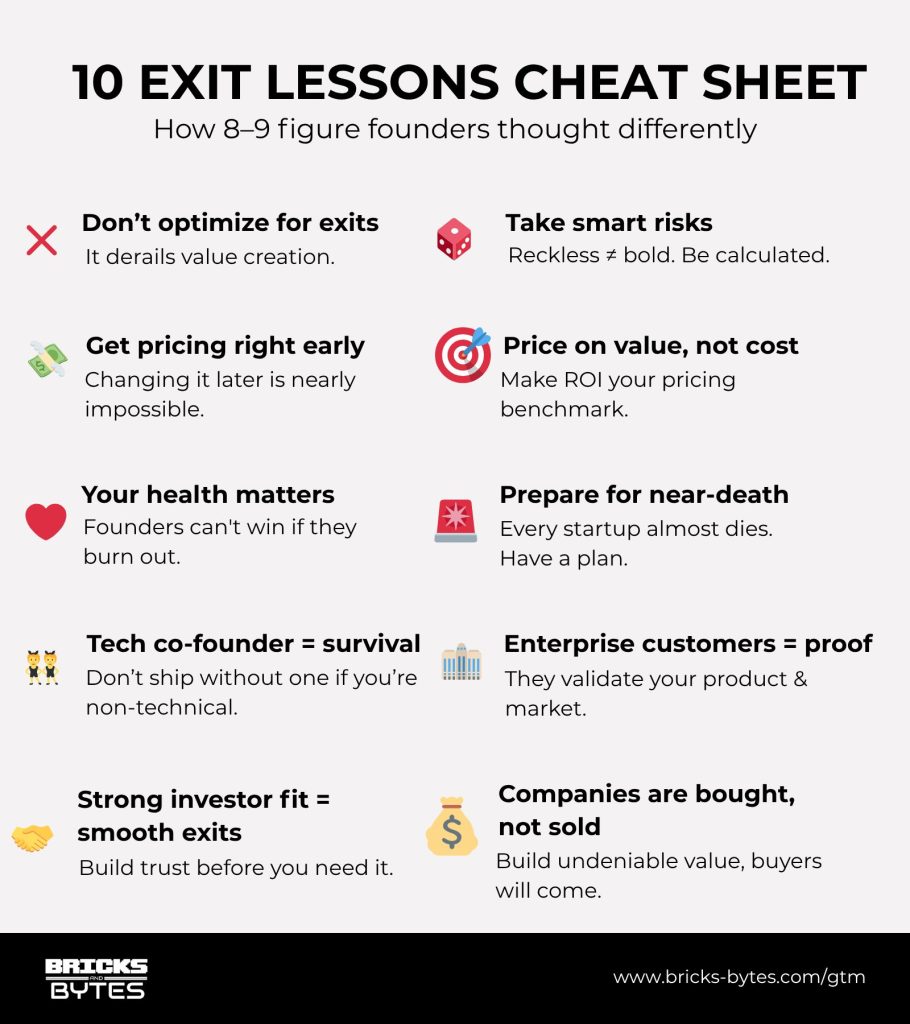
Want to get your message in front of {{active_subscriber_count}} highly engaged innovation leaders? Check out our sponsorship offers. INSIGHTS10 Hard-Won Lessons from Founders Who Sold for Millions After analyzing dozens of exit stories from founders who sold their companies for eight and nine-figure sums, ten critical patterns emerge. From PlanGrid’s acquisition by Autodesk to Enscape’s merger with Chaos Group, successful exits aren’t about luck. They’re about building fundamental value while avoiding common pitfalls that kill deals. TL;DR: Want a Big Payday? Here’s How Founders Sold for Millions After studying 10+ founder exit stories, we found the real patterns behind $100M+ acquisitions. Here are the 10 rules they lived by: Companies are bought, not sold. Build undeniable value. Price for value, not cost. Create ROI that’s hard to ignore. Non-tech founder? Find your tech partner ASAP. Enterprise customers = credibility. Take risks, but only calculated ones Nail pricing early. Changing it later is brutal. Survive near-death moments. Every startup faces them. Don’t build for exits. It backfires. Protect your health. Burnout kills billion-dollar dreams. Investor-founder fit is everything. It’ll make or break your exit. 📌 Final word: Don’t chase exits. Build something so good that acquirers chase you. Lesson 1: Companies Are Bought, Not Sold Every successful founder emphasized this golden rule. Yves Frinault from Fieldwire put it best: “Companies are bought, not sold. People repeat it, but even when they hear it, they don’t actually listen.” Stop pitching your company around hoping for acquisition interest. Instead, build something so valuable that acquirers come to you. Fieldwire received acquisition offers every time they raised funding rounds because they had built undeniable value in their market. Action Item: Focus 100% of your energy on building value for customers. The exit conversations will follow naturally. Lesson 2: Value-Based Pricing Is Your Secret Weapon Don’t compete on price… compete on value creation. Price based on the value you deliver, not your costs or competition. Chase Gilbert discovered this when his $50,000 annual fee was creating $2.5 million in incremental value for clients. His approach: “I need to deliver more value to you than I take in what I charge you. Otherwise, you should not work with me.” The framework Chase uses: Understand the value you’re creating Capture a fair slice of that value If you’re wrong about value delivery, make it right Be “long-term greedy”. Think beyond the initial product Action Item: Calculate the actual dollar value your product creates for customers. Price accordingly. Subscribe to our premium content to read the rest. This is a subscriber only post. Become a paying subscriber of our annual or monthly paid subscriptions to get inside takes on growth in construction tech. Upgrade Translation missing: en.app.shared.conjuction.or Sign In Powered by beehiiv

Newsletter

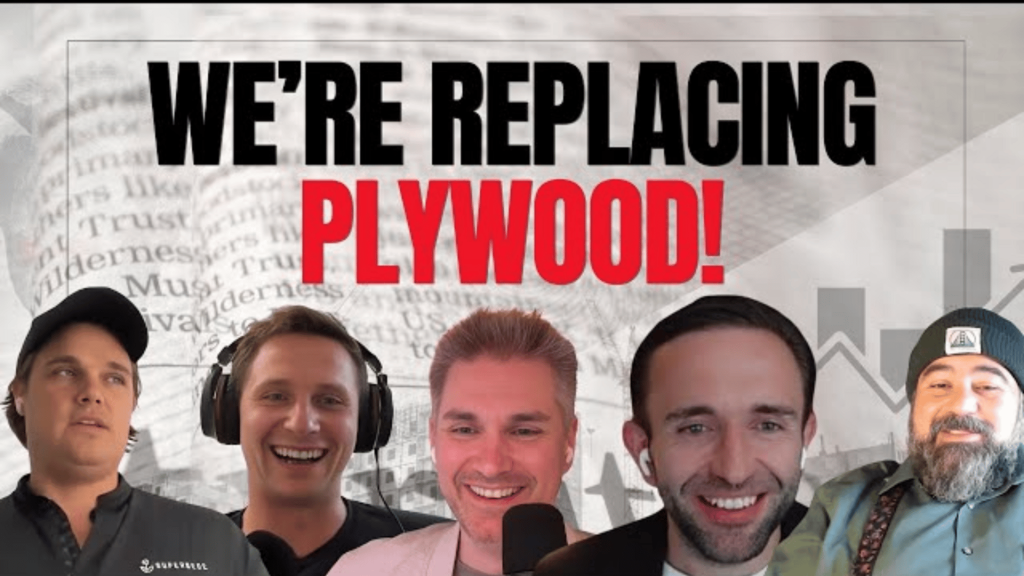
59% of Projects Delayed by Heat? Martin Calls BS

Europe’s cooking, construction’s sweating, and plywood just got disrupted. In this week’s Bricks, Bucks & Bytes episode: 🔥 59% of firms blame project delays on heat, but Martin calls BS. 🌡️ Europe’s overheating homes: bad regs or broken design? 🏗️ Q2 venture funding cools off… but construction tech holds its ground. And we’ve got guests: Sean Petterson, CEO of SuperSede, the startup turning recycled plastic into high-performance plywood alternatives. Mo Akbari returns with spicy takes on GTM and innovation stagnation. 🎧 Listen now for: Why buildings in the UK are overheating by design Whether “heat delay” is a legit excuse or just another bottleneck The real reason construction startups fail to raise Series A How SuperSede plans to crush plywood with recycled plastic Watch the Full Episode 🗣 Bonus: Some personal highlights Martin’s take: “Weather delays are a Western privilege” Patric drops green-roof gospel (and a love letter to German HVAC) Owen’s Greek island monologue sparks an AEC labor rabbit hole And yes… the FlexSeal meme finally makes it to the podcast You might also like: ChatGPT Makes Us Dumber, LIVE from House Factory, Vibe Designing Is Here Apple Kills Cold Calling, In Office Scares CEO’s, Insurance Proves Climate Change Fears New Steel Tariffs Hit, Is A 12hr Work-day Unreasonable? ChatGPT NoteTaker Kills Startups Builder AI $450M Bankruptcy – Beginning Of The End for AI Startups? Johnny Ive $6.5B Hire, TAM Check Why Data Centers Might Crash, Y Combinator Predatory Practices, with Softbank’s $100B Pledge How China Builds Nuclear Plants Cheaper, Construction’s $860bn Problem, & Trump 2.0 Germany Effects 90% Of AI Startups Are Worthless, US Economy CRASH, Is Autodesk Investable + $2bn Startup Meltdown Powered by beehiiv

Newsletter

ICYMI: Domain Expertise, Circus Stunts, and Beer Tests

Want to get your message in front of {{active_subscriber_count}} highly engaged innovation leaders? Check out our sponsorship offers. This Week’s Quickfire BytesFuel your curiosity with this week’s contentW/C 14th July 2025 NEW EPISODESYoung Marketers Cost More Money – Marketing Mistakes & Fixes from a Silicon Valley CMO Phil Carpenter, a fractional CMO, shares why most AEC startups fail at marketing, the hidden costs of inexperienced hires, and how to actually reach construction professionals. cwhy AEC customers are more skeptical than other industries and what they really want to see, the “crossing the chasm” strategy that determines startup success or failure, and why LinkedIn marketing doesn’t work for most construction professionals. open.spotify.com/episode/3D4CFpBDqykP0I15UWiQyz Most Founders Hire CROs Too Early – Revenue Leadership Mistakes & Smart Framework from Unicorn Builders Ricky Sevta from Deep Space shares why most founders hire the wrong sales leadership at the wrong time, how to scale from zero to unicorn status, and the brutal reality of go-to-market in construction tech. Find out why construction sales still requires picking up the phone in 2025, the exact revenue stage when you should hire a CRO (hint: it’s not when you think), and how to build repeatable sales processes that actually work in AEC. open.spotify.com/episode/6iDRy8j7zgrAyGy1dxZ9uy Construction Tech Marketing is Broken – Industry Skepticism Problem & Proven Go-to-Market from Ex-director of Marketing at 4M Analytics David Horesh shares why construction marketing is still a blue ocean, how to avoid the handshake trap, and why memes might be your secret weapon. Find out why understanding construction jargon is make-or-break for tech marketers, the leaky bucket problem killing your sales funnel, and how AI agents can replace entire marketing teams, open.spotify.com/episode/2G4JHexHeHdjt1xwO0fsxf View All Podcasts BRICKS & BYTES PREMIUMEarly Release Episodes Inside TestFit’s Rapid Expansion Playbook – Laura Paciano & Jack Joers – EARLY RELEASE TestFit’s pod strategy revealed: How they launch new markets in months, not years. How Amazon’s Ex-Robotics VP Is Building 500 Homes Per Year in a 50,000 sq ft Factory Vikas Enti breaks down how they’re solving the $350-450/sq ft cost crisis in infill construction by selling homes at $275/sq ft, why breaking the assembly line was crucial, and how they’re shipping homes from Massachusetts to wildfire-rebuilding efforts in California. 2 FAVORITE QUOTES: “Bringing in CRO too early is the death of any business… It’s almost like bringing in Lewis Hamilton and then saying, drive my Fiat, right? Like, and, and, and the school zone, right? And it’s, it’s just not going to work.” – Ricky Sevta on the common mistake of hiring senior executives before the business is ready “”And frankly, if everything you’re doing is working, I would submit you’re not doing enough things. You’re not trying enough things. Because you need to take some risks.” – Phil Carpenter on the importance of failure in marketing BRICKS & BYTES PREMIUM🚀 Ready to Break Through the $10M Ceiling? Here’s a quick recap of what you’ll receive as a premium subscriber: Premium in-depth articles delivered to your inbox Early access to podcast episodes before public release 33% discount on all future GTM guides we publish UPGRADE TO PREMIUM Want 33% off the guide?Sign Up for Our Monthly Subscription Monthly members ($10/mo) can purchase the guide for just $67 UPGRADE TO MONTHLY YOU MIGHT ALSO LIKE Premium Insights A Step-by-Step Guide to Clear Product Marketing for AEC Startups 12 Lessons About Hiring From AEC’s Top Leaders More Insights NSFW: Build a F*cking Business McKinsey’s Secrets to Scaling Construction Tech How Flux Burned Through $29M – Lessons for AEC Innovators Ex AutoDesk CEO’s 12 Lessons For Developing Products Could an Entrepreneur in Residence Save Your Construction Firm? Reports and Case Studies Innovating the Future: Robotics and the Revolution in Construction The Future of Design Software In AEC – Experts Insights Investing In AEC Tech The Future Of Construction Document Management The Construction Tech Revolution In India: Lessons From InfraMarket’s Success Innovation at Windover Construction Swinerton’s Innovation Strategy Most Popular Episodes How To Build A Unicorn In Construction Tech – Patric Hellermann Story Of A Modular Construction Startup That Burned Through £10M in 15 Months – Chris Spiceley McKinsey FINALLY updates their Productivity Curve, & The Future Of Construction – David Rockhill, Partner at McKinsey Procore’s AI Strategy & Implementation – AI’s Role in Modern Construction Disrupt Autodesk? This Ex-Autodesk CEO Has Some Advice – Amar Hanspal Super Series Super Series with Ediphi Super Series With Speckle Super Series With Monumental Super Series with Foundamental OUR SPONSORS BuildVision — streamlining the construction supply chain with a unified platform for contractors, manufacturers, and stakeholders. Powered by beehiiv

construction tech scaling past 10 million ARR
Go To Market

Cracking the Code: Scaling Contech Go-to-Market Past the $10M ARR Hurdle

  There’s a graveyard of construction tech companies that couldn’t crack the code. They had great products, solved real problems, even achieved initial traction. But somewhere between $5-10 million ARR, they hit a wall. Kevin Halter has seen it happen repeatedly, and more importantly, he’s cracked the code to get past it. As the leader who scaled PlanGrid from $5 million to over $100 million ARR in just four years, and now Chief Revenue Officer at OpenSpace, Kevin has witnessed both sides of this challenging transition. His insights reveal why most construction tech companies plateau—and what the successful ones do differently. TL;DR: Breaking Through the $10M ARR Barrier The Challenge: Most construction tech companies hit a wall around $5-10M ARR and struggle to scale beyond Key Breakthrough Strategies: Project-to-enterprise transition – Move from $5-20K project deals to $100-500K enterprise agreements Land and expand mastery – Focus on fewer accounts but go deeper, wider, and higher within them In-person, regional approach – Build trusted relationships through on-site presence in key markets Value-based selling – Connect project-level ROI to enterprise business initiatives Talent evolution – Hire “hungry, humble, smart” profiles and develop them through growth stages Retention focus – The best renewal is no renewal—close 3-year agreements from the start Market specialization – Target regional players who make faster decisions than national enterprises   In this episode,  Kevin Halter (CRO of OpenSpace) shares his journey from scaling PlanGrid from $5M to $100M+ ARR and building high-performing sales teams in construction tech.   The $10M ARR Death Valley “Most companies in construction tech struggle to get past the 10 million ARR mark,” Kevin observes. “That seems to be a kind of a common sticking point for a lot of companies.” The statistics back this up—you can count construction tech companies that have hit $100 million ARR on one hand. The problem isn’t usually product-market fit. By $5-10 million, companies have typically proven their solution works. The issue is go-to-market evolution. What got you to $5 million won’t get you to $50 million. “You can’t really get to a hundred million fast by closing five, 10K transactions,” Kevin explains. “It takes forever. You may have multiple projects, but you got to build the business case and turn it into an enterprise agreement.” The Project-to-Enterprise Evolution The fundamental shift required for construction tech scaling past 10 million ARR is moving from project-level sales to enterprise-wide implementations. This isn’t just about deal size—it’s about completely rethinking your approach to customers. Understanding Where the Money Lives “All the money to pay for technology is at the project level,” Kevin notes. “The project is where you make money or lose money. There’s very little budget typically at the headquarters level.” This creates a unique dynamic where you need to prove value at the project level but sell at the enterprise level. The key is connecting project ROI to enterprise business initiatives. “You have to understand the value, the ROI at the project level, build those business cases, and then connect the project ROI to the enterprise business initiatives and what kind of outcomes they’re looking for across their entire project portfolio.” The Discovery Revolution This transition requires becoming genuinely curious about your customers’ business challenges. Kevin’s approach is refreshingly simple: “I just ask questions. Be a learner. Have the humility that you don’t know everything.” The questions that matter go beyond surface-level pain points: What’s keeping you up at night? How do you quantify that value? How often does this happen? What’s the impact to your business? Kevin shares a powerful example: “Every project has a minimum of at least one change order, and we do 400 projects or more per year. An average change order for us can be upwards of $100,000.” When you start asking these questions, “the dollars that is at risk is always bigger than you believe.” The Land and Expand Imperative The companies that successfully scale past $10M ARR master what Kevin calls the “land and expand” motion, but not in the traditional sense. It’s not about selling small and gradually expanding—it’s about being strategic with account selection and going deep.   Quality Over Quantity Typically in sales, I need a ton of accounts. A rep cannot handle 200 accounts and provide world-class customer service. They can probably support five to 10 enterprise accounts as true customer service.” Kevin shares a telling story of one of his top reps who complained about not having enough accounts: “Let’s reduce your account list to these 20 that you’ve already built relationships with.” The result? “He doubled what he brought into the company in one year and continued on that path.” The Renewal Philosophy “The best renewal is no renewal,” Kevin emphasizes. “Closing a three-year agreement, expanding it in a realistic amount of fashion to get into an enterprise agreement.” This approach eliminates the constant risk of churn and creates predictable revenue growth. Building the Right Go-to-Market Engine Regional, In-Person Strategy Construction remains fundamentally relationship-driven. At PlanGrid, Kevin built a model with “over 75 people in the field, quota carrying reps” covering 26 major metros in North America. “These teams could be the face of PlanGrid in that market.” “It’s an in-person business,” he stresses. “They went to project sites to understand their needs, their challenges, how they could provide value, build that trust.” The Hiring Revolution Most construction tech companies hire the wrong sales profiles. “I see that happening time and time again. They hired the wrong VP of sales, the wrong hiring profile… they burn a ton of capital, but they waste time.” Kevin’s profile is specific: “Hungry, humble, smart with a fire in the belly.” He deliberately avoids hiring from tier-one tech companies: “Would I hire someone from a Salesforce? They have a brand in the space. When you have a startup, you have to build the brand.” Instead, he looks for people with something to prove: “Whether you came from a failed startup, which is a key thing… Do they have

construction technology owners market strategy
Startups

Why Owners are the New Contech Kingmakers: Lessons from OnSite IQ’s Success

  Let’s be honest: most construction tech companies are fighting over scraps in the contractor market while the real money sits untouched upstream. After diving deep into OnSiteIQ’s journey with founder Ardalan Khosrowpour, it’s crystal clear why targeting owners instead of contractors isn’t just smart—it’s the only sustainable path to building a construction tech monopoly. TL;DR: The Owner-First Strategy Revolution Why OnSiteIQ’s approach is changing construction tech forever: Network Effects Rule: Every project connects three paying customers (developer, private equity, lender) Higher LTV, Less Competition: 80% of deals have zero competition vs. crowded contractor market Misaligned Incentives: Contractors hide data that owners desperately need Scale Economics: $200M+ owners offer enterprise deals with sticky, multi-year relationships Strategic Capital: Investor-customers become your best sales channel   In this episode, Ardalan Khosrowpour, CEO of OnsiteIQ, shares why contractors intentionally hide project data from owners, how 95% of construction projects don’t even use their BIM models, and the brutal reality of 3% profit margins that force underbidding.   The Network Effect That Changes Everything Here’s what most contech founders miss: every construction project is structured as an LLC with three distinct parties who all need the same information, but currently get it through completely different channels. You’ve got the GP (developer), the LP (private equity firm), and the lender. When OnSiteIQ touches one asset, they instantly connect to three nodes in the network. “Every time we touch an asset, we get connected to three nodes,” Khosrowpour explains. “And as we’re growing in a market, the network effect is pulling us in as opposed to us pushing the product.” This isn’t theoretical—it’s happening right now. Private equity firms are telling their portfolio companies to use OnSite IQ. Lenders are recommending it to borrowers. Developers are bringing it to their JV partners. Compare that to the contractor market where you’re selling one-off point solutions with limited network effects. Why Contractors Will Never Give You the Data Owners Need The dirty secret of construction? Contractors are incentivized to hide information, not share it. Think about the economics: they’re working on razor-thin 3-5% margins, locked into GMAX contracts with penalty clauses, and facing potential lawsuits for up to 10 years after project completion. When OnSiteIQ initially tried selling to contractors, one progressive project executive pulled Khosrowpour aside after a failed pitch meeting and said: “We do not want this data to exist, because if the owner knows it exists, they’ll be all over us. Go sell to the owners—they’re gonna love it, because we intentionally don’t give it to them.” That’s your lightbulb moment right there. The misalignment of incentives isn’t a bug—it’s a feature you can exploit by positioning yourself as the transparency solution for capital allocators. The Competition Desert You Didn’t Know Existed While contractors get bombarded with “20 chatbots that analyze floor plans or specs,” the owner market is practically empty. OnSiteIQ competes maybe 15% of the time, and when they do, it’s usually against legacy photography companies that lack centralized operations and AI capabilities. “Either you’re up to something or you’re an absolute idiot,” Khosrowpour jokes about the lack of competition. “I hope it’s not the second one.” But here’s why that competition desert exists: owners aren’t traditional tech buyers. They need Microsoft Office, an ERP system, and some data for underwriting. That’s it. Breaking through requires a completely different sales approach than the contractor market.   The $200M Minimum and Why It Matters OnSiteIQ won’t work with developers who have less than $200 million in active construction. Why? Because construction has inherent churn—when projects end, revenue ends. But that minimum threshold creates something beautiful: enterprise customers with predictable pipelines and multi-year relationships. “Once we break through, your LTV is through the roof,” explains Khosrowpour. “They don’t want to change it. You just give them a good product, you build a good relationship, they don’t want to change.” The magic happens when you realize that selling a single project versus a million-dollar enterprise deal only adds 90-120 days to your sales cycle. Same effort, 10x the outcome. The Strategic Capital Hack Here’s OnSiteIQ’s genius move: they took strategic capital from RIT Ventures, a multifamily fund whose LPs include major developers like Greystar, ZOM, and Alcor. Suddenly, their investors became their customers and reference accounts. “They did give us a lot of the business that we needed. They tested, they gave us the opportunity to try, and they’re like, ‘huh, that’s pretty good. So how do we roll this out?’” This creates a flywheel effect where your cap table becomes your sales funnel. Strategic investors pilot your product, prove the ROI, then recommend it throughout their networks. Try doing that in the fragmented contractor market.   The Pricing Psychology That Actually Works Contractors think in terms of protecting their 3% margin on a $50 million project. Owners think in terms of generating 20% IRR over 10 years on a $150 million asset. Same project, completely different lenses. OnSiteIQ charges based on construction cost (presented as price per square foot to avoid sticker shock), but they’re really capturing basis points of deployed capital. While Procore takes 10-12 basis points in the contractor market, OnSiteIQ believes they can capture 30-40 basis points by replacing expensive owner rep and project management functions. “Your legacy project manager owner rep firms charge roughly 100 to 150 basis points,” notes Khosrowpour. “If you imagine, can I take 30% of that part of the market and just automate the whole thing?” The Information Asymmetry Goldmine Twenty years ago, real estate development was regional. Now you have $2 billion funds deploying capital across 50 states without the infrastructure to monitor it effectively. As scale goes up, performance typically goes down due to lack of visibility. This creates a massive opportunity for technology that gives institutional capital the same level of oversight they had when they were building locally. OnSiteIQ’s customers use their platform to identify the 4 out of 20 projects that need immediate attention, rather than trying to micromanage everything. The

Newsletter

Why Your Construction Marketing Looks Like Everyone Else’s (And How to Fix It)

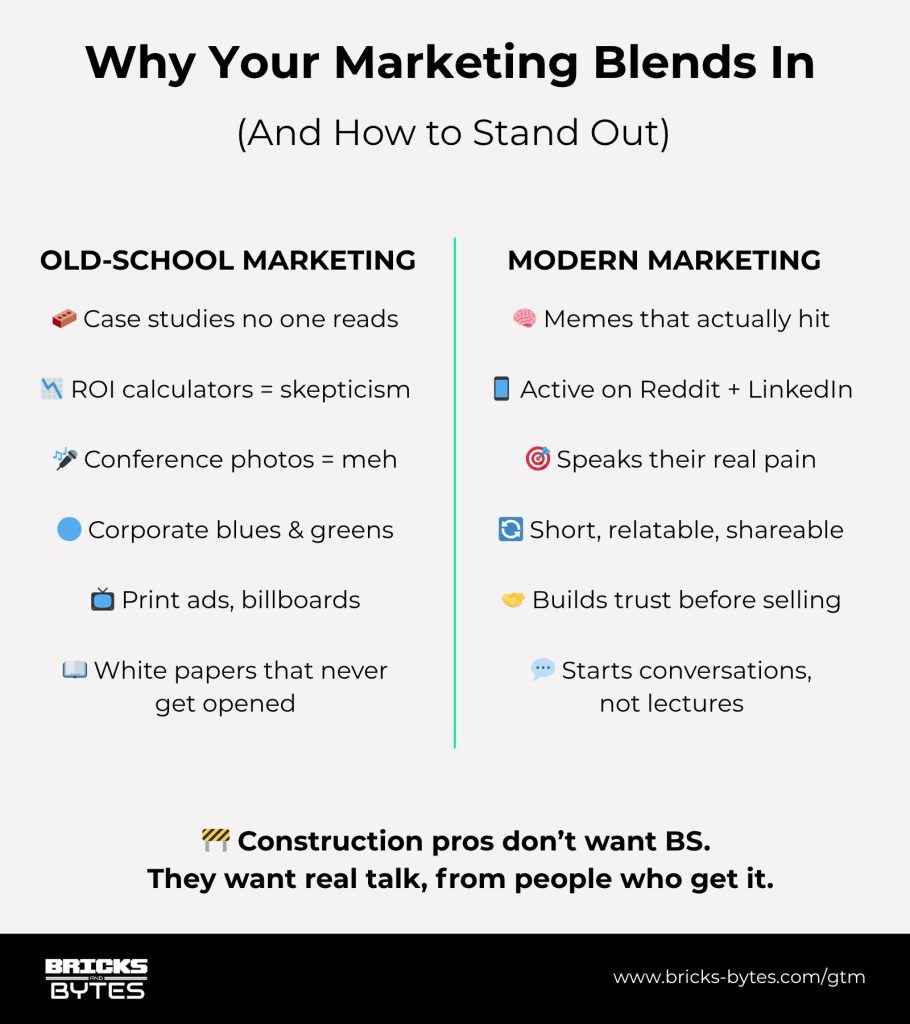
Want to get your message in front of {{active_subscriber_count}} highly engaged innovation leaders? Check out our sponsorship offers. BRICKS, BYTES & BEYOND Thank You for 200K Views! We hit 200k views. And we did not expect that! Thanks to everyone who watched. If you missed it, check the link and please support us by subscribing… Now onto the useful stuff 👇👇👇 INDUSTRY INSIGHTSWhy Your Construction Marketing Looks Like Everyone Else’s (And How to Fix It) We mentioned this in a previous newsletter: if you can’t clearly explain what your product does, neither can your customers. But even when AEC tech companies nail their messaging, they often stumble on the next challenge: making it actually resonate with their audience. David Horesh, an experienced construction tech CMO,  learned this the hard way during a sales call with a senior civil engineer. The engineer was confused by something on their website and asked, “David, I don’t understand what is this Al, Al, Al all over your website.” David realized the engineer was reading “AI” as a person’s name, not the tech buzzword plastered across their marketing materials. That moment sparked a complete overhaul of how they communicated with the construction industry. After building go-to-market strategies for multiple AEC tech companies and consulting with dozens more, David has identified why most of construction marketing looks identical, and more importantly, how to fix it. TL;DR: Why Your Marketing Isn’t Working (And How to Fix It) Tired of your construction tech marketing falling flat? Here’s the fix: Everyone sounds the same. Generic ROI stats, dull branding, and forgettable case studies Your buyers don’t speak “AI” (literally). One CMO learned this mid-sales call Your audience lives on Reddit, not trade magazines Memes > White papers. Yes, really The real funnel: Awareness → Trust → Demand Success = Customers. Not likes. Not leads. Fix it fast: Scrap copycat content Go where the audience actually is (Reddit, LinkedIn, memes) Make content that feels human, real, and actually useful The Problem: Everyone’s Playing It Safe Scroll through LinkedIn and you’ll see it everywhere. AEC tech companies posting the same content: Corporate case studies nobody reads ROI calculators that breed skepticism Conference photos showing executives on stage Dark blue, gray, and green branded materials that blend together The result?  A sea of forgettable content that fails to connect with the no-BS professionals who actually buy construction technology. “The industry marketers think they need to create BS content to market to no-BS type of people,” David explains. “It’s backwards thinking that’s killing engagement.” The Solution: Go Where Your Audience Actually Is While most AEC marketers stick to “traditional” channels like print ads and billboards, David discovered two overlooked goldmines where construction professionals actively engage: 1. Reddit Communities Are More Active Than You Think David was surprised to find thriving construction communities on Reddit, a platform he initially dismissed as “conspiracy theory territory.”  But digging deeper revealed active forums where project managers, engineers, and superintendents discuss real problems and get genuine answers. Admittedly, we have never heard of Reddit being an effective channel for AEC tech startups. BUT, if you spend some time exploring the platform, you will see people seeking solutions. We sense this channel will grow. The opportunity: These professionals are already seeking solutions and advice. Instead of interrupting them with ads, you can provide value where they’re already looking for it. 2. Memes Work Better Than White Papers Credit: Construction Yeti This might sound ridiculous, but David’s data proves it works. Construction professionals engaging with memes that highlight their daily pain points significantly outperform traditional content. “Picture this: a PM or superintendent on site at 7 AM with their first cup of coffee. Do you think they’re going to read a 10-page essay about maximizing ROI? They want a meme that’s going to start their day with a smile.” Why memes work: They show you understand real industry challenges They’re easy to consume during short breaks They get shared because they’re relatable They build trust through authenticity Look at what Matt and Joey are doing on LinkedIn. They’re “killing it” because they’re creating content nobody else is making while addressing genuine pain points. The Strategic Shift: From Awareness to Trust to Demand David’s approach follows a clear progression: Awareness: Get in front of your audience where they actually spend time (hint: it’s on their phones, not reading trade magazines) Trust: Create content that shows you understand their day-to-day challenges Demand: Once they trust you understand their problems, they’ll ask what you do “You want to first create content that shows you understand the pain points of your ICP. After that, they’ll see the content, engage with it, and eventually ask themselves: what’s this company that’s sharing this content actually do?” The Measurement That Actually Matters Forget vanity metrics. David uses one primary measure of marketing success: customers. Not LinkedIn views. Not lead generation numbers. Customers. “Any marketer that knows what they’re doing can bring in leads. The challenge is bringing in people who actually want to buy.” This means tracking the complete journey from awareness to closed deals, identifying where your “bucket is leaking,” and fixing conversion issues at each stage. Making the Shift: Three Immediate Actions Obvious but overlooked. 1. Audit your current content: Does it look like everyone else’s? If yes, scrap it. 2. Find your audience’s real hangouts: Research Reddit communities, LinkedIn groups, and other platforms where your buyers actually engage. 3. Create authentic content: Share real industry pain points in formats people actually consume (hint: shorter is better). The Bottom Line Construction professionals are tired of being talked at by companies that clearly don’t understand their daily reality. They want to buy from people who get it, who understand that change orders are a nightmare, that safety isn’t just a talking point, and that not every problem needs an app. The companies winning in AEC tech are the ones building genuine relationships with their audience through authentic, valuable content. Your competition is still stuck in

construction tech go-to-market scaling
Go To Market

Scaling Contech Go-to-Market: Breaking Through the £10M ARR Barrier

  Most construction tech companies can get to their first few million in ARR through founder-led sales, scrappy outreach, and pure determination. But somewhere around the £10 million mark, everything changes. The tactics that got you there won’t get you further. You need systems, processes, and a fundamentally different approach to go-to-market. Anton Marinovich knows this transition intimately. Having scaled sales teams at HoloBuilder and now leading go-to-market at Joist AI, he’s lived through the exact challenges that separate the companies that plateau from those that break through to significant scale. TL;DR: Scaling Construction Tech Beyond £10M ARR The Challenge: Moving from early-stage responsiveness to systematic, scalable go-to-market processes Key Scaling Strategies: Process over intuition – Build repeatable buyer journeys based on observed patterns, not assumptions Revenue operations first – Implement robust CRM and automation systems early, not later Team composition matters – Hire experienced “Swiss Army Knives” who understand multiple business functions Focus on workflow alignment – Match your product to existing customer workflows, don’t force adoption Land and expand mastery – Perfect expansion strategies as a team sport involving sales, CS, and product Simplicity in compensation – Keep sales incentives clear and easy to understand AI-powered efficiency – Leverage automation for top-of-funnel activities while maintaining human relationships In this episode,  Anton Marinovich from Joist AI shares his construction tech go-to-market journey from my father’s masonry business to leading sales at Contentful, HoloBuilder, and now Joist AI.   The Shift from Zero-to-One to Scale “What makes go-to-market successful in like a zero to one is responsiveness,” Anton explains. “Hey, I’m interested in this. I want to buy.” In the early days, success often comes down to simply not dropping the ball when opportunities arise. But as Anton has observed through his angel investments and advisory work, even this basic level is often missed: “I can’t tell you enough how I’ve seen situations where you might have a founder doing founder-led sales right now. And they’ve done a bunch of demos and then someone’s emailed in saying, ‘this is great. Can I have a proposal?’ And then they totally forgot about it.” Once you’ve mastered basic responsiveness and moved past the initial traction phase, the game changes completely. “After a million, this is where a lot of process stuff really comes into play. You have identified a repeatable process and now you’re building the structure around it so that you can just start managing that process.” The Revenue Operations Foundation One of Anton’s most contrarian pieces of advice for construction tech go-to-market scaling is to implement robust revenue operations early—much earlier than most companies think necessary. “A lot of companies look at rev ops as something a little bit later in the game. But learning lessons of the past was like, no, we are going to put a lot of emphasis on this on the front.” At Joist AI, despite being early-stage with 21 employees, they’re already implementing systems and processes that most companies don’t consider until much later. This includes: CRM automation that reduces manual data entry Automated stage progression based on email triggers and signals Clean reporting and dashboards from day one Systems designed to evolve as the business scales “By doing that, it actually gives you more bandwidth because you’re having easier visibility on everything that’s going on and people are not losing time on data input, which every salesperson hates.” Building the Right Team for Scale Anton’s approach to team building reflects the complexity of scaling in construction tech. Rather than hiring specialists, he’s building what he calls “Swiss Army Knives”—experienced professionals who can handle multiple functions. “We really see ourselves as we want to be Swiss Army Knives, and as being Swiss Army Knives, it means that we’re doing multiple other things too, like helping out with onboarding, participating in customer success, helping out in support.” This approach serves two purposes: it creates a foundational team with deep business understanding, and it acknowledges that construction tech sales requires understanding multiple aspects of the customer journey. His hiring philosophy is equally instructive: “Since I’m getting experienced people to come in, the one request that I’ve had is that I don’t want to hear about anything successful that you did in a previous company. I only want to hear about everything that went wrong or what you should have done better.” Understanding Your Buyer Journey Through Pattern Recognition One of the biggest mistakes companies make when scaling is assuming they know how customers want to buy, rather than observing and adapting to actual buyer behavior. Anton’s methodology is refreshingly simple: “I sat a ridiculous amount of time just listening to calls. And if it wasn’t just the calls, it was reading emails. I was just understanding how is the market wanting to buy.” The process involves taking your last 15-20 demos and mapping out the actual steps prospects took: “You start writing it all out and you’re like, ‘Oh my God, there’s a pattern here.’ You know, it’s like a two demo close. It’s a one demo close. It’s a two demo trial then close.” This pattern recognition becomes the foundation for building scalable processes. “I don’t want to force the way I think that they should buy. I would rather be running with the wind, but structuring it so I can facilitate it so we can run even faster. The Critical Role of Workflow Alignment Perhaps the most important insight for construction tech go-to-market scaling is understanding the unique importance of workflows in the AEC industry. “Having a product that matches a workflow. Workflows are so important in this space, whereas workflows aren’t as critical to other organizations and other sectors,” Anton observes. This has profound implications for how you position, sell, and expand your solution. Unlike other industries where you might be able to force new processes, construction companies need solutions that fit into existing workflows seamlessly. “Problem solution through workflow—I don’t even know if I just made this up or not, but I

Newsletter

ICYMI: Nuclear Reactors, Data Centers, and Why Your Marketing Still Sucks

Want to get your message in front of {{active_subscriber_count}} highly engaged innovation leaders? Check out our sponsorship offers. This Week’s Quickfire BytesFuel your curiosity with this week’s contentW/C 7th July 2025 NEW EPISODESConstruction Tech Marketing is Broken – Industry Skepticism Problem & Proven Go-to-Market from Ex-director of Marketing at 4M Analytics David Horesh shares why construction marketing is still a blue ocean, how to avoid the handshake trap, and why memes might be your secret weapon. Find out why understanding construction jargon is make-or-break for tech marketers, the leaky bucket problem killing your sales funnel, and how AI agents can replace entire marketing teams, Big Tech Rethinks Construction, Palantir $100M Nuclear Deal, Data Center Capacity Crisis & Nvidia AI Profits We dive deep into how tech giants are reshaping the construction industry – and who’s really profiting from the AI boom. We cover how big tech companies are forcing construction firms to completely rethink project delivery, why Palantir just signed a $100 million deal with a nuclear company (and what it means for the industry), and the shocking truth about where all the AI money actually goes. Pen & Paper STILL BEATS Tech In Construction – Overcoming Adoption Barriers & Driving Change In Construction Kalyn Lengieza, owner of Grindstone Consultants, shares why authenticity beats fancy tech features, how relationships still drive deals in our industry, and the real secrets behind successful construction tech marketing. Find out why deals still get done on golf courses and job site trailers, the time, talent, treasure framework for resource allocation, and how to use AI and tools like Gong to understand your customers better. open.spotify.com/episode/1CCYb7MmX8DVCMSVBMh2dE View All Podcasts BRICKS & BYTES PREMIUMEarly Release Episodes Inside TestFit’s Rapid Expansion Playbook – Laura Paciano & Jack Joers – EARLY RELEASE TestFit’s pod strategy revealed: How they launch new markets in months, not years. How Amazon’s Ex-Robotics VP Is Building 500 Homes Per Year in a 50,000 sq ft Factory Vikas Enti breaks down how they’re solving the $350-450/sq ft cost crisis in infill construction by selling homes at $275/sq ft, why breaking the assembly line was crucial, and how they’re shipping homes from Massachusetts to wildfire-rebuilding efforts in California. Why 90% of AEC Tech Startups Fail at Marketing (And How to Be the 10%) – Phil Carpenter – EARLY RELEASE 30-year marketing vet reveals what actually works in construction tech 2 FAVORITE QUOTES: “The worst marketing is sales and the best sales is marketing because you don’t want to always like every conversation that you have in the industry. You don’t want it to be transactional.” – David Horesh on the relationship between marketing and sales in building industry relationships “I can tell you these institutional investors are fucking clueless and they are fucking lazy. So there you need to give them a completely ready-made dish, everything perfectly prepared from soup to nuts in a data room.” – Patric Hellermann on why fundraising advisors might be valuable for late-stage rounds but not early-stage BRICKS & BYTES PREMIUM🚀 Ready to Break Through the $10M Ceiling? Here’s a quick recap of what you’ll receive as a premium subscriber: Premium in-depth articles delivered to your inbox Early access to podcast episodes before public release 33% discount on all future GTM guides we publish UPGRADE TO PREMIUM Want 33% off the guide?Sign Up for Our Monthly Subscription Monthly members ($10/mo) can purchase the guide for just $67 UPGRADE TO MONTHLY YOU MIGHT ALSO LIKE Premium Insights A Step-by-Step Guide to Clear Product Marketing for AEC Startups 12 Lessons About Hiring From AEC’s Top Leaders More Insights NSFW: Build a F*cking Business McKinsey’s Secrets to Scaling Construction Tech How Flux Burned Through $29M – Lessons for AEC Innovators Ex AutoDesk CEO’s 12 Lessons For Developing Products Could an Entrepreneur in Residence Save Your Construction Firm? Reports and Case Studies Innovating the Future: Robotics and the Revolution in Construction The Future of Design Software In AEC – Experts Insights Investing In AEC Tech The Future Of Construction Document Management The Construction Tech Revolution In India: Lessons From InfraMarket’s Success Innovation at Windover Construction Swinerton’s Innovation Strategy Most Popular Episodes How To Build A Unicorn In Construction Tech – Patric Hellermann Story Of A Modular Construction Startup That Burned Through £10M in 15 Months – Chris Spiceley McKinsey FINALLY updates their Productivity Curve, & The Future Of Construction – David Rockhill, Partner at McKinsey Procore’s AI Strategy & Implementation – AI’s Role in Modern Construction Disrupt Autodesk? This Ex-Autodesk CEO Has Some Advice – Amar Hanspal Super Series Super Series with Ediphi Super Series With Speckle Super Series With Monumental Super Series with Foundamental OUR SPONSORS BuildVision — streamlining the construction supply chain with a unified platform for contractors, manufacturers, and stakeholders. Powered by beehiiv
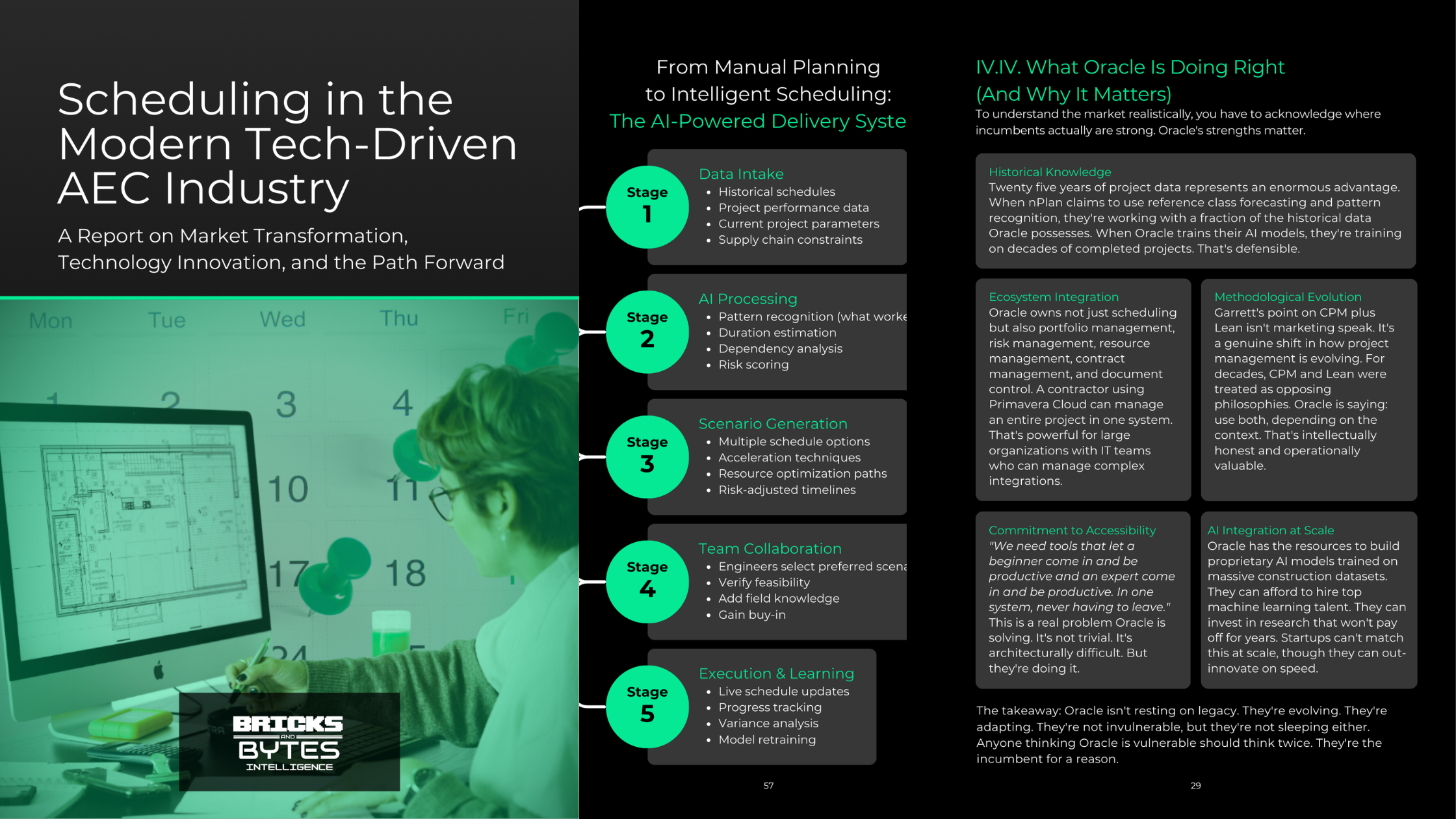
Get a FREE copy of our Scheduling in the Modern Tech-Driven AEC Industry: A Report on Market Transformation, Technology Innovation, and the Path Forward” (worth $150) and a FREE weekly email to stay up to date on construction tech. SIGN UP TODAY!

Scheduling in the Modern Tech-Driven AEC Industry

Sign up to the #1 Newsletter In AEC Tech. Join over 2,100 like-minded Founders, Investors and Techies disrupting the way we build. 

Scheduling in the Modern Tech-Driven AEC Industry