
There’s a graveyard of construction tech companies that couldn’t crack the code. They had great products, solved real problems, even achieved initial traction. But somewhere between $5-10 million ARR, they hit a wall. Kevin Halter has seen it happen repeatedly, and more importantly, he’s cracked the code to get past it.
As the leader who scaled PlanGrid from $5 million to over $100 million ARR in just four years, and now Chief Revenue Officer at OpenSpace, Kevin has witnessed both sides of this challenging transition. His insights reveal why most construction tech companies plateau—and what the successful ones do differently.
TL;DR: Breaking Through the $10M ARR Barrier
The Challenge: Most construction tech companies hit a wall around $5-10M ARR and struggle to scale beyond
Key Breakthrough Strategies:
- Project-to-enterprise transition – Move from $5-20K project deals to $100-500K enterprise agreements
- Land and expand mastery – Focus on fewer accounts but go deeper, wider, and higher within them
- In-person, regional approach – Build trusted relationships through on-site presence in key markets
- Value-based selling – Connect project-level ROI to enterprise business initiatives
- Talent evolution – Hire “hungry, humble, smart” profiles and develop them through growth stages
- Retention focus – The best renewal is no renewal—close 3-year agreements from the start
- Market specialization – Target regional players who make faster decisions than national enterprises
In this episode, Kevin Halter (CRO of OpenSpace) shares his journey from scaling PlanGrid from $5M to $100M+ ARR and building high-performing sales teams in construction tech.
The $10M ARR Death Valley
“Most companies in construction tech struggle to get past the 10 million ARR mark,” Kevin observes. “That seems to be a kind of a common sticking point for a lot of companies.” The statistics back this up—you can count construction tech companies that have hit $100 million ARR on one hand.
The problem isn’t usually product-market fit. By $5-10 million, companies have typically proven their solution works. The issue is go-to-market evolution. What got you to $5 million won’t get you to $50 million.
“You can’t really get to a hundred million fast by closing five, 10K transactions,” Kevin explains. “It takes forever. You may have multiple projects, but you got to build the business case and turn it into an enterprise agreement.”
The Project-to-Enterprise Evolution
The fundamental shift required for construction tech scaling past 10 million ARR is moving from project-level sales to enterprise-wide implementations. This isn’t just about deal size—it’s about completely rethinking your approach to customers.
Understanding Where the Money Lives
“All the money to pay for technology is at the project level,” Kevin notes. “The project is where you make money or lose money. There’s very little budget typically at the headquarters level.” This creates a unique dynamic where you need to prove value at the project level but sell at the enterprise level.
The key is connecting project ROI to enterprise business initiatives. “You have to understand the value, the ROI at the project level, build those business cases, and then connect the project ROI to the enterprise business initiatives and what kind of outcomes they’re looking for across their entire project portfolio.”
The Discovery Revolution
This transition requires becoming genuinely curious about your customers’ business challenges. Kevin’s approach is refreshingly simple: “I just ask questions. Be a learner. Have the humility that you don’t know everything.”
The questions that matter go beyond surface-level pain points:
- What’s keeping you up at night?
- How do you quantify that value?
- How often does this happen?
- What’s the impact to your business?
Kevin shares a powerful example: “Every project has a minimum of at least one change order, and we do 400 projects or more per year. An average change order for us can be upwards of $100,000.” When you start asking these questions, “the dollars that is at risk is always bigger than you believe.”
The Land and Expand Imperative
The companies that successfully scale past $10M ARR master what Kevin calls the “land and expand” motion, but not in the traditional sense. It’s not about selling small and gradually expanding—it’s about being strategic with account selection and going deep.

Quality Over Quantity
Typically in sales, I need a ton of accounts. A rep cannot handle 200 accounts and provide world-class customer service. They can probably support five to 10 enterprise accounts as true customer service.”
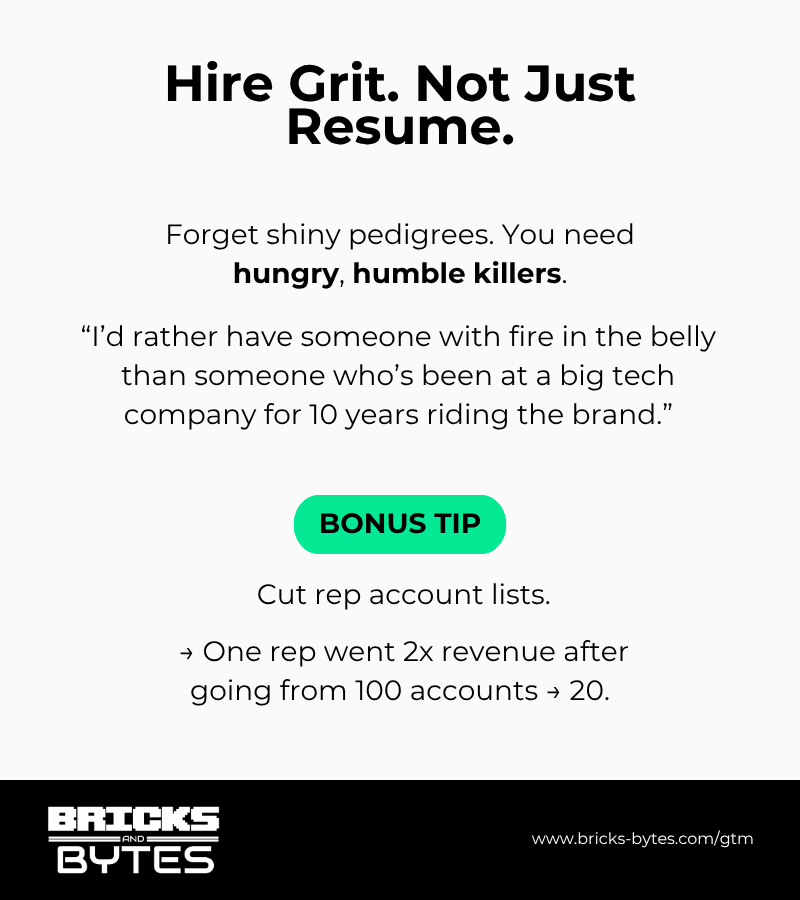
Kevin shares a telling story of one of his top reps who complained about not having enough accounts: “Let’s reduce your account list to these 20 that you’ve already built relationships with.” The result? “He doubled what he brought into the company in one year and continued on that path.”
The Renewal Philosophy
“The best renewal is no renewal,” Kevin emphasizes. “Closing a three-year agreement, expanding it in a realistic amount of fashion to get into an enterprise agreement.” This approach eliminates the constant risk of churn and creates predictable revenue growth.
Building the Right Go-to-Market Engine
Regional, In-Person Strategy
Construction remains fundamentally relationship-driven. At PlanGrid, Kevin built a model with “over 75 people in the field, quota carrying reps” covering 26 major metros in North America. “These teams could be the face of PlanGrid in that market.”
“It’s an in-person business,” he stresses. “They went to project sites to understand their needs, their challenges, how they could provide value, build that trust.”
The Hiring Revolution
Most construction tech companies hire the wrong sales profiles. “I see that happening time and time again. They hired the wrong VP of sales, the wrong hiring profile… they burn a ton of capital, but they waste time.”
Kevin’s profile is specific: “Hungry, humble, smart with a fire in the belly.” He deliberately avoids hiring from tier-one tech companies: “Would I hire someone from a Salesforce? They have a brand in the space. When you have a startup, you have to build the brand.”
Instead, he looks for people with something to prove: “Whether you came from a failed startup, which is a key thing… Do they have the hunger and grit? I want to make this company successful. I treated it like it was my own company.”
The Economic Model That Works
Understanding True Enterprise Value
The transition from project sales to enterprise agreements isn’t just about deal size—it’s about understanding how large companies actually buy technology. “Even just a portion of their business, a regional office, one division—a hundred million or a $500 million business—and then continue to expand.”
“You cannot get a contractor’s whole business in the first transaction. They’re not going to deploy a technology midstream. Projects are anywhere from 18 months to three years typically.”
The 3-5X Model
Kevin operates on a proven economic model: “Your quota, if you’re getting paid 200 grand a year, your quota needs to be 600K to a million dollars in new business. That pays for that individual, that pays for the extended team to support them, as well as builds a return for the business.”
Learning from the Graveyard
What separates the winners from the graveyard of failed construction tech companies? “You may have product market fit, but you need to learn how to sell the product and go to market. Build and sell. If you build the product, that’s the first step. But if you don’t learn how to sell the product and go to market, it’s never going to work.”
The companies that successfully navigate construction tech scaling past 10 million ARR understand that:
- Technology adoption in construction requires proving value quickly
- Relationships matter more than features
- Enterprise sales require enterprise-level business cases
- Regional presence beats remote selling
- The right people make all the difference
The Path Forward
Kevin’s blueprint for scaling past $10M ARR isn’t just theoretical—it’s been proven at multiple companies. At PlanGrid, this approach took them from $5M to $120M in four years. At OpenSpace, he’s applying the same playbook to drive even faster growth.
The secret isn’t revolutionary—it’s about execution. Understanding that construction tech scaling past 10 million ARR requires a fundamental shift from selling projects to transforming businesses. It’s about building trust through presence, proving value through results, and expanding through relationships.
“There’s very few companies that have hit a hundred million ARR. You can count them on one hand,” Kevin notes. But for those willing to evolve their go-to-market approach, the opportunity is enormous.