
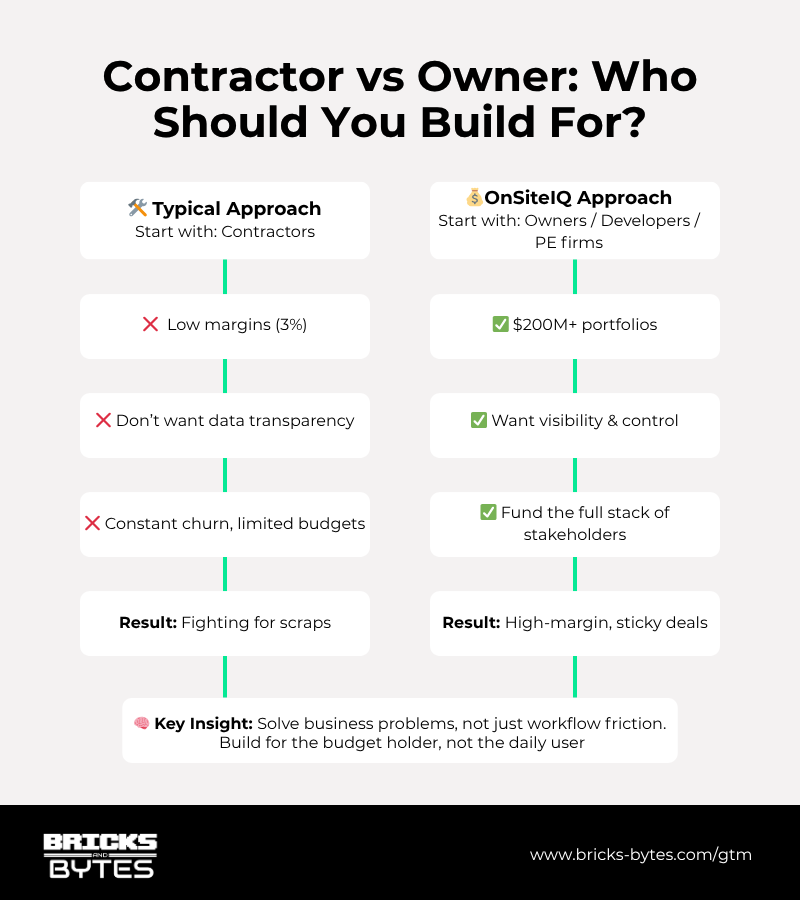
Let’s be honest: most construction tech companies are fighting over scraps in the contractor market while the real money sits untouched upstream. After diving deep into OnSiteIQ’s journey with founder Ardalan Khosrowpour, it’s crystal clear why targeting owners instead of contractors isn’t just smart—it’s the only sustainable path to building a construction tech monopoly.
TL;DR: The Owner-First Strategy Revolution
Why OnSiteIQ’s approach is changing construction tech forever:
- Network Effects Rule: Every project connects three paying customers (developer, private equity, lender)
- Higher LTV, Less Competition: 80% of deals have zero competition vs. crowded contractor market
- Misaligned Incentives: Contractors hide data that owners desperately need
- Scale Economics: $200M+ owners offer enterprise deals with sticky, multi-year relationships
- Strategic Capital: Investor-customers become your best sales channel
In this episode, Ardalan Khosrowpour, CEO of OnsiteIQ, shares why contractors intentionally hide project data from owners, how 95% of construction projects don’t even use their BIM models, and the brutal reality of 3% profit margins that force underbidding.
The Network Effect That Changes Everything
Here’s what most contech founders miss: every construction project is structured as an LLC with three distinct parties who all need the same information, but currently get it through completely different channels. You’ve got the GP (developer), the LP (private equity firm), and the lender. When OnSiteIQ touches one asset, they instantly connect to three nodes in the network.
“Every time we touch an asset, we get connected to three nodes,” Khosrowpour explains. “And as we’re growing in a market, the network effect is pulling us in as opposed to us pushing the product.”
This isn’t theoretical—it’s happening right now. Private equity firms are telling their portfolio companies to use OnSite IQ. Lenders are recommending it to borrowers. Developers are bringing it to their JV partners. Compare that to the contractor market where you’re selling one-off point solutions with limited network effects.
Why Contractors Will Never Give You the Data Owners Need
The dirty secret of construction? Contractors are incentivized to hide information, not share it. Think about the economics: they’re working on razor-thin 3-5% margins, locked into GMAX contracts with penalty clauses, and facing potential lawsuits for up to 10 years after project completion.
When OnSiteIQ initially tried selling to contractors, one progressive project executive pulled Khosrowpour aside after a failed pitch meeting and said: “We do not want this data to exist, because if the owner knows it exists, they’ll be all over us. Go sell to the owners—they’re gonna love it, because we intentionally don’t give it to them.”
That’s your lightbulb moment right there. The misalignment of incentives isn’t a bug—it’s a feature you can exploit by positioning yourself as the transparency solution for capital allocators.
The Competition Desert You Didn’t Know Existed
While contractors get bombarded with “20 chatbots that analyze floor plans or specs,” the owner market is practically empty. OnSiteIQ competes maybe 15% of the time, and when they do, it’s usually against legacy photography companies that lack centralized operations and AI capabilities.
“Either you’re up to something or you’re an absolute idiot,” Khosrowpour jokes about the lack of competition. “I hope it’s not the second one.”
But here’s why that competition desert exists: owners aren’t traditional tech buyers. They need Microsoft Office, an ERP system, and some data for underwriting. That’s it. Breaking through requires a completely different sales approach than the contractor market.
The $200M Minimum and Why It Matters
OnSiteIQ won’t work with developers who have less than $200 million in active construction. Why? Because construction has inherent churn—when projects end, revenue ends. But that minimum threshold creates something beautiful: enterprise customers with predictable pipelines and multi-year relationships.
“Once we break through, your LTV is through the roof,” explains Khosrowpour. “They don’t want to change it. You just give them a good product, you build a good relationship, they don’t want to change.”
The magic happens when you realize that selling a single project versus a million-dollar enterprise deal only adds 90-120 days to your sales cycle. Same effort, 10x the outcome.
The Strategic Capital Hack
Here’s OnSiteIQ’s genius move: they took strategic capital from RIT Ventures, a multifamily fund whose LPs include major developers like Greystar, ZOM, and Alcor. Suddenly, their investors became their customers and reference accounts.
“They did give us a lot of the business that we needed. They tested, they gave us the opportunity to try, and they’re like, ‘huh, that’s pretty good. So how do we roll this out?'”
This creates a flywheel effect where your cap table becomes your sales funnel. Strategic investors pilot your product, prove the ROI, then recommend it throughout their networks. Try doing that in the fragmented contractor market.

The Pricing Psychology That Actually Works
Contractors think in terms of protecting their 3% margin on a $50 million project. Owners think in terms of generating 20% IRR over 10 years on a $150 million asset. Same project, completely different lenses.
OnSiteIQ charges based on construction cost (presented as price per square foot to avoid sticker shock), but they’re really capturing basis points of deployed capital. While Procore takes 10-12 basis points in the contractor market, OnSiteIQ believes they can capture 30-40 basis points by replacing expensive owner rep and project management functions.
“Your legacy project manager owner rep firms charge roughly 100 to 150 basis points,” notes Khosrowpour. “If you imagine, can I take 30% of that part of the market and just automate the whole thing?”
The Information Asymmetry Goldmine
Twenty years ago, real estate development was regional. Now you have $2 billion funds deploying capital across 50 states without the infrastructure to monitor it effectively. As scale goes up, performance typically goes down due to lack of visibility.
This creates a massive opportunity for technology that gives institutional capital the same level of oversight they had when they were building locally. OnSiteIQ’s customers use their platform to identify the 4 out of 20 projects that need immediate attention, rather than trying to micromanage everything.
The Path Forward
The lesson here isn’t just about OnSiteIQ—it’s about rethinking who you’re building for in construction tech. While everyone else fights over contractors with limited budgets and misaligned incentives, there’s an entire ecosystem of capital allocators desperate for better visibility into their investments.
The network effects are stronger. The LTV is higher. The competition is nonexistent. And the customers actually want the transparency you’re trying to provide.
The question isn’t whether you should be targeting owners—it’s why you’re still wasting time anywhere else.