
Most construction tech companies can get to their first few million in ARR through founder-led sales, scrappy outreach, and pure determination. But somewhere around the £10 million mark, everything changes. The tactics that got you there won’t get you further. You need systems, processes, and a fundamentally different approach to go-to-market.
Anton Marinovich knows this transition intimately. Having scaled sales teams at HoloBuilder and now leading go-to-market at Joist AI, he’s lived through the exact challenges that separate the companies that plateau from those that break through to significant scale.
TL;DR: Scaling Construction Tech Beyond £10M ARR
The Challenge: Moving from early-stage responsiveness to systematic, scalable go-to-market processes
Key Scaling Strategies:
- Process over intuition – Build repeatable buyer journeys based on observed patterns, not assumptions
- Revenue operations first – Implement robust CRM and automation systems early, not later
- Team composition matters – Hire experienced “Swiss Army Knives” who understand multiple business functions
- Focus on workflow alignment – Match your product to existing customer workflows, don’t force adoption
- Land and expand mastery – Perfect expansion strategies as a team sport involving sales, CS, and product
- Simplicity in compensation – Keep sales incentives clear and easy to understand
- AI-powered efficiency – Leverage automation for top-of-funnel activities while maintaining human relationships
In this episode, Anton Marinovich from Joist AI shares his construction tech go-to-market journey from my father’s masonry business to leading sales at Contentful, HoloBuilder, and now Joist AI.
The Shift from Zero-to-One to Scale
“What makes go-to-market successful in like a zero to one is responsiveness,” Anton explains. “Hey, I’m interested in this. I want to buy.” In the early days, success often comes down to simply not dropping the ball when opportunities arise.
But as Anton has observed through his angel investments and advisory work, even this basic level is often missed: “I can’t tell you enough how I’ve seen situations where you might have a founder doing founder-led sales right now. And they’ve done a bunch of demos and then someone’s emailed in saying, ‘this is great. Can I have a proposal?’ And then they totally forgot about it.”
Once you’ve mastered basic responsiveness and moved past the initial traction phase, the game changes completely. “After a million, this is where a lot of process stuff really comes into play. You have identified a repeatable process and now you’re building the structure around it so that you can just start managing that process.”
The Revenue Operations Foundation
One of Anton’s most contrarian pieces of advice for construction tech go-to-market scaling is to implement robust revenue operations early—much earlier than most companies think necessary.
“A lot of companies look at rev ops as something a little bit later in the game. But learning lessons of the past was like, no, we are going to put a lot of emphasis on this on the front.”
At Joist AI, despite being early-stage with 21 employees, they’re already implementing systems and processes that most companies don’t consider until much later. This includes:
- CRM automation that reduces manual data entry
- Automated stage progression based on email triggers and signals
- Clean reporting and dashboards from day one
- Systems designed to evolve as the business scales
“By doing that, it actually gives you more bandwidth because you’re having easier visibility on everything that’s going on and people are not losing time on data input, which every salesperson hates.”
Building the Right Team for Scale
Anton’s approach to team building reflects the complexity of scaling in construction tech. Rather than hiring specialists, he’s building what he calls “Swiss Army Knives”—experienced professionals who can handle multiple functions.
“We really see ourselves as we want to be Swiss Army Knives, and as being Swiss Army Knives, it means that we’re doing multiple other things too, like helping out with onboarding, participating in customer success, helping out in support.”
This approach serves two purposes: it creates a foundational team with deep business understanding, and it acknowledges that construction tech sales requires understanding multiple aspects of the customer journey.
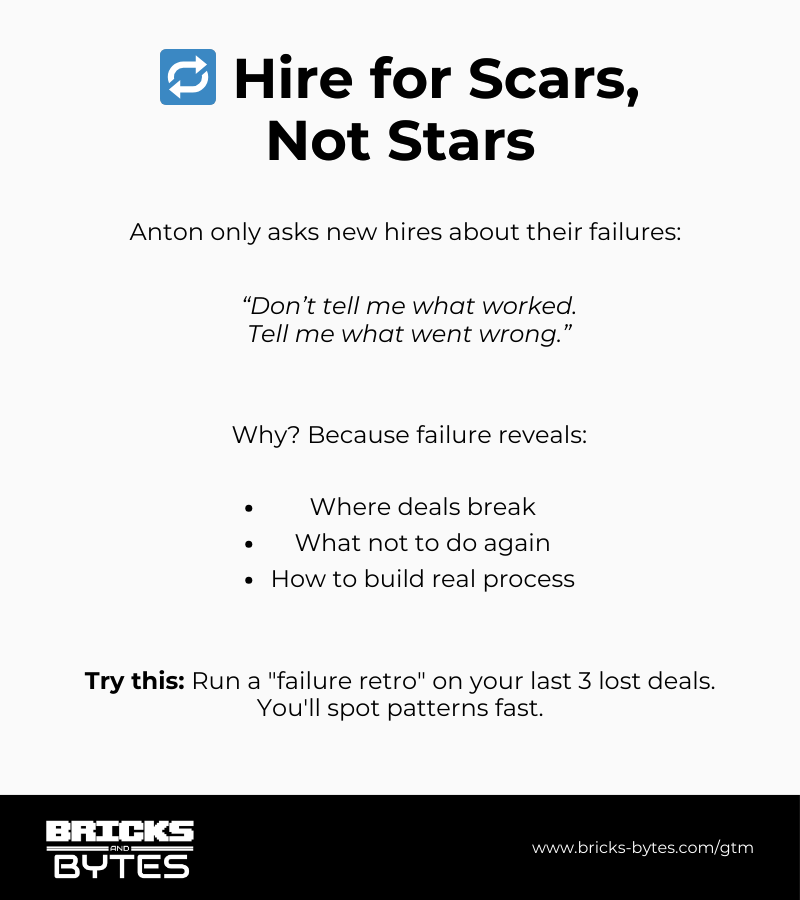
His hiring philosophy is equally instructive: “Since I’m getting experienced people to come in, the one request that I’ve had is that I don’t want to hear about anything successful that you did in a previous company. I only want to hear about everything that went wrong or what you should have done better.”
Understanding Your Buyer Journey Through Pattern Recognition
One of the biggest mistakes companies make when scaling is assuming they know how customers want to buy, rather than observing and adapting to actual buyer behavior.
Anton’s methodology is refreshingly simple: “I sat a ridiculous amount of time just listening to calls. And if it wasn’t just the calls, it was reading emails. I was just understanding how is the market wanting to buy.”
The process involves taking your last 15-20 demos and mapping out the actual steps prospects took: “You start writing it all out and you’re like, ‘Oh my God, there’s a pattern here.’ You know, it’s like a two demo close. It’s a one demo close. It’s a two demo trial then close.”
This pattern recognition becomes the foundation for building scalable processes. “I don’t want to force the way I think that they should buy. I would rather be running with the wind, but structuring it so I can facilitate it so we can run even faster.
The Critical Role of Workflow Alignment
Perhaps the most important insight for construction tech go-to-market scaling is understanding the unique importance of workflows in the AEC industry.
“Having a product that matches a workflow. Workflows are so important in this space, whereas workflows aren’t as critical to other organizations and other sectors,” Anton observes.
This has profound implications for how you position, sell, and expand your solution. Unlike other industries where you might be able to force new processes, construction companies need solutions that fit into existing workflows seamlessly.
“Problem solution through workflow—I don’t even know if I just made this up or not, but I think that that is important to retain that value.”

Mastering Land and Expand as a Team Sport
As companies scale, expansion revenue becomes increasingly critical. But Anton emphasizes that expansion isn’t just a sales function—it’s a coordinated effort across multiple teams.
“Expansion is a total team play. 100% team play, right? The new is very much a marketing sales kind of motion, whereas expansion is very much a combination of customer success, sales, marketing, but also product.”
The key questions become: “What am I upselling? Okay, user license that’s already there, but maybe I don’t have anything to upsell them to right now. What is that going to be? How are we going to put that together?”
Success in expansion requires customers to trust your roadmap, like what you’re building, and see ongoing value in the relationship.
The Technology Layer: AI and Automation
While maintaining that construction remains fundamentally relationship-driven, Anton sees significant opportunities for AI to improve construction tech go-to-market scaling, particularly in top-of-funnel activities.
“I think AI is going to have more influence over the top of the funnel than maybe the deals itself. Building out cadences and managing cadences with complex groups of young salespeople, like SDRs—it’s a lot of work and it’s a lot of effort. And I think that could be a lot more efficient and effective.”
However, he maintains that AI currently “still needs a lot of adult supervision” and sees it more as an efficiency multiplier than a replacement for human relationship-building.
Avoiding Common Scaling Pitfalls
Anton identifies several common mistakes that prevent construction tech companies from scaling effectively:
Over-optimism about product-market fit: “Everything just happens easy, or you know what? My product is the best. Like, you know, my baby’s not ugly.” Sometimes products simply aren’t ready for scale.
Inflexibility in approach: “We have a tendency to just try harder, try more, try harder. No, screw it. Like you tried it, it didn’t work. It’s fine. Learn from it and learn from those failures.”
Overcomplicating compensation: “The golden rule is simplicity. Someone has to clearly understand what they make from the deal. Can’t be any kind of weird, nuanced stuff.”
The Path Forward
Breaking through the £10M ARR barrier in construction tech requires a fundamental shift from scrappy startup tactics to systematic, scalable processes. But as Anton’s experience shows, this doesn’t mean losing the relationship-driven approach that makes construction tech sales successful.
“Sales is about relationship building. Sales is also caring. Caring about your clients and caring about your buyers.” The challenge—and opportunity—is building systems that enable this at scale.