
Author name: Owen Drury

construction tech event strategy
Go To Market

Navigating the Event Landscape: Strategies for Contech Companies to Maximise Value

  Suppose you’ve spent any time in the construction technology space. In that case, you’ve probably had this conversation: “Are you going to [insert major industry event here]?” followed immediately by eye-rolling and complaints about costs, quality, and the inevitable sales pitch masquerading as thought leadership. Yet here’s the paradox: everyone complains about construction tech events, but everyone still goes. Why? Because, despite their flaws, they remain one of the most effective ways to build relationships in an industry that’s fundamentally driven by trust and handshakes. TL;DR: Mastering Construction Tech Events The Challenge: Events are essential but expensive, time-consuming, and often frustrating for construction tech companies Key Strategies: Go with purpose – Define clear objectives before attending any event Focus on quality networking – Prioritize meaningful one-on-one conversations over stage presentations Host your own meetups – Leverage event attendance to organize exclusive customer gatherings Choose wisely – Not all events are created equal; some deliver better ROI than others Manage expectations – Understand that most talks are sales pitches disguised as education Budget strategically – Factor in booth costs, team travel, and opportunity cost of time away from business   In this episode, we discuss how industry events might be useful for startups but painful for everyone else.   The Love-Hate Relationship with Industry Events During a recent discussion among industry professionals, the sentiment was crystal clear. As one founder put it, events are “things that you as a founder have to be at. However, [they’re] not enjoyable experiences [and] can be very expensive and resource heavy.” This captures the essential tension perfectly. Construction tech events like Future Tech Week or Digital Construction Week are necessary evils—places where deals get made, partnerships form, and industry relationships solidify, but also venues where startup budgets get stretched thin and valuable time gets consumed by mediocre content. Why Events Still Matter for Construction Tech Companies Before we dive into strategies, let’s acknowledge why construction tech event strategy remains crucial: Relationship-Building in a Relationship-Driven Industry. Construction is fundamentally about trust. People buy from people they know and trust. Events provide the face-to-face interaction that Zoom calls simply can’t replicate. As one industry veteran noted, “Construction remains fundamentally relationship-driven. Despite all our talk about digital transformation, deals still happen because people trust each other.” Market Validation and Social Proof. Being present at major industry events signals legitimacy. For startups especially, having a booth at a recognized trade show tells potential customers that you’re serious, funded, and here to stay. Concentrated Access to Decision Makers. Where else can you access hundreds of potential customers, partners, and investors in a single location over just a few days? The efficiency of networking at events is unmatched. The Reality Check: What Actually Happens at Events Let’s be honest about what you’re really getting when you attend most construction tech events: The Content Problem: Most presentations are thinly veiled sales pitches. Event organizers need to fill 8+ hours of stage time over multiple days, and there are only so many genuinely insightful speakers available. The result? A lot of filler content that promises revolutionary insights but delivers product demos. The Overpromise-Underdeliver Cycle. Marketing teams craft compelling session titles that rarely match the actual content. You’ll see “The Future of AI in Construction” and get a basic overview of ChatGPT applications, or “Revolutionary Productivity Gains” that turns out to be a case study on switching from paper to tablets. The Cost Reality. Between booth fees, travel expenses, team time, and opportunity costs, attending major events can easily cost a startup $50,000-100,000. For early-stage companies, that’s often months of runway. Strategic Approaches to Event Success Despite these challenges, smart construction tech companies can extract significant value from events with the right construction tech event strategy: 1. Go with Clear, Specific Objectives Don’t just show up and hope for the best. Define exactly what success looks like: “Meet 20 qualified prospects in our target market segment” “Connect with 5 potential integration partners” “Schedule 10 follow-up demos” “Recruit 2 industry advisors” 2. Host Your Own Exclusive Gatherings Some of the most successful event strategies involve piggybacking on major events to host intimate customer meetups. One approach that works well: “Events where founders were organizing meetups in the evening or afternoon, and they were inviting customers. I think from the founders and startups point of view, it’s a great opportunity.” Rent a private dining room, invite your best customers and highest-value prospects, and create a forum for genuine discussion. You’ll get more meaningful conversations in 3 hours than in 3 days of booth duty. 3. Focus on the Networking, Skip the Presentations Unless you know the speaker personally or they’re sharing genuinely proprietary insights, skip most presentations. Your time is better spent in the hallways, at coffee stations, and in the exhibition area having one-on-one conversations. 4. Develop an Anti-Event Strategy One successful approach shared by an industry professional: limit yourself to just two events per year, but make them count. Instead of trying to be everywhere, choose the events where your exact target customers congregate and go deep rather than wide. 5. Leverage Events for Team Building Some companies use industry events as team retreat opportunities. Bring your key team members, stay an extra day or two, and use the change of environment to strengthen internal relationships and strategic planning.   Red Flags to Avoid VC Dinner Circuits. Be wary of generic networking events, especially “exclusive” VC dinners where you’ve been invited despite the organizer knowing nothing about your company. These often devolve into superficial conversations with no actionable outcomes. Vanity Metrics Over ROI. Don’t get caught up in booth size or speaking slot prominence. A small booth with the right traffic is infinitely more valuable than a massive installation that attracts tire-kickers. Overstaffing Events. Bringing your entire team to events rarely makes sense. Choose 1-2 people who are excellent at relationship building and let them focus on quality interactions rather than trying to cover every possible conversation. The Future of Construction Tech

construction skilled labor shortage solutions
Technology

Fewer Hands, More Homes: Cuby’s Approach to the Skilled Labor Shortage

  Let’s face it: the construction industry has a massive people problem. And it’s not getting better anytime soon. Walk past any construction site today, and you’ll notice something striking—lots of gray beards and not many young faces. The statistics are sobering: for every seven construction workers who retire, only one person enters the workforce to replace them. When Alex Gampel of Cuby asks people if they know someone in their immediate circle who “swings a hammer,” nine out of ten times the answer is no. This isn’t just an abstract workforce issue—it’s a crisis that’s directly driving up housing costs and limiting supply in markets that desperately need more homes. TL;DR: Revolutionizing Construction Through Labor Innovation How Cuby is solving the construction industry’s biggest challenge: The Crisis: For every 7 construction workers retiring, only 1 enters the workforce Traditional Problem: 60-70% of building costs in first-world countries come from expensive skilled labor Cuby’s Solution: Mobile micro-factories that enable unskilled workers to build quality homes The Numbers: 200 homes per year at $100-110/sq ft vs. industry standard $150-160/sq ft The Process: 4 unskilled workers guided by software can replace 22+ specialized subcontractors Timeline: 30-60 day construction vs. 6-14 months traditional building   In this episode, we sit down with Alex Gample, co-founder of Cuby, who’s tackling America’s housing shortage with a radical approach: containerized micro-factories that can be deployed anywhere to manufacture homes at $100-110 per square foot—significantly cheaper than traditional construction.   The Real Cost of Skilled Labor Dependence Here’s what most people don’t realize about construction costs: in first-world economies like the US and UK, skilled labor accounts for 60-70% of the total cost to build a home. That’s not materials, land, or permits—it’s purely the human expertise required to turn raw materials into livable spaces. “Places like China and India, the cost waits towards materials as much as labor because labor is very cheap,” Gampel explains. “Where we have the most value and what our target markets are, are really first world economies where blue collar is deprioritized and white collar jobs are prioritized.” The result? A vicious cycle where expensive skilled labor drives up housing costs, making homeownership less accessible, while the industry struggles to attract new workers who can earn similar wages sitting behind a desk instead of working in all weather conditions. Cuby’s Radical Rethink: Factories That Come to You Rather than accepting this reality, Cuby has fundamentally reimagined how homes get built. Their solution centers around mobile micro-factories—containerized manufacturing facilities that can be deployed within 150 miles of construction sites, bringing industrial efficiency directly to where homes are needed. These aren’t your typical prefab facilities. Each mobile micro-factory occupies about 30,000 square feet and can produce 200 homes annually—roughly 430,000 square feet of housing per year. But here’s the revolutionary part: the entire operation, including on-site assembly, requires only 260 people total, with just 35 working on the factory floor in two shifts. “We have about 35 folks in two shifts on the factory floor, about a dozen GNA roles, and then assuming the factory is building about 20 single family homes a month, on any of those 20 sites, you have four unskilled people in two shifts,” Gampel breaks down the math. Compare that to traditional homebuilding, which typically requires a general contractor coordinating 22+ specialized subcontractors, each bringing their own crews, tools, and expertise to individual job sites. The IKEA Approach to Homebuilding Cuby’s most innovative breakthrough isn’t just the factory—it’s how they’ve redesigned the construction process to work with unskilled labor. Think of it as applying IKEA’s approach to homebuilding, but with much more sophisticated guidance systems. Their software literally tells workers on their phones to “grab tool 26C, do stage 18A, and this is how you do it.” Each step is broken down so granularly that mistakes become nearly impossible before moving to the next phase. The four on-site workers check each other’s work, while a supervisor from the factory continuously inspects progress. “When I mean unskilled labor, I don’t mean we just pull random people off the street,” Gampel clarifies. “We can take a barista, they’ll spend 30 days with us, and they become skilled in our system because the software and hardware is enabling them.” This approach doesn’t just reduce labor costs—it actually improves quality. Traditional construction is notorious for inconsistency, where identical homes built side-by-side can turn out completely different. Cuby’s standardized process eliminates this variability.   Bricks, Bytes & Beyond is a documentary-style tech channel that goes deeper than anyone else into how humanity is solving its toughest real-world problems. From housing to hardware, robotics to reindustrialisation, we travel the globe to bring you inside the minds of the founders, engineers, and visionaries reshaping our physical world. Breaking Down the Economics The numbers tell a compelling story. While the National Association of Home Builders surveys show construction costs of $150-160 per square foot, Cuby believes they can consistently deliver at $100-110 per square foot. Even more impressive, that’s while producing higher quality homes and providing full vertical construction from foundation to finishes. This cost reduction comes primarily from eliminating skilled labor premiums and reducing total labor hours. In traditional construction, multiple specialized trades work sequentially, often waiting for others to complete their work. Cuby’s integrated approach eliminates much of this inefficiency. The factory model also solves supply chain challenges that plague traditional builders. By manufacturing components like windows in-house, Cuby eliminates multiple margin layers—the manufacturer, wholesaler, delivery, and installer—that typically add cost without adding value. The Scalability Challenge and Solution Critics might argue that this approach simply shifts the skilled labor requirement from job sites to factories. But Cuby has thought through this challenge carefully. Their business model recognizes that while some skilled oversight is necessary, the ratio of skilled to unskilled workers becomes far more favorable. More importantly, they’re building infrastructure to scale factory production itself. They’re establishing a “Papa factory” in China that will mass-produce the mobile micro-factories, targeting eventual production of

Newsletter

TestFit’s Go-to-Market Playbook: From Spreadsheets to $750K Wins

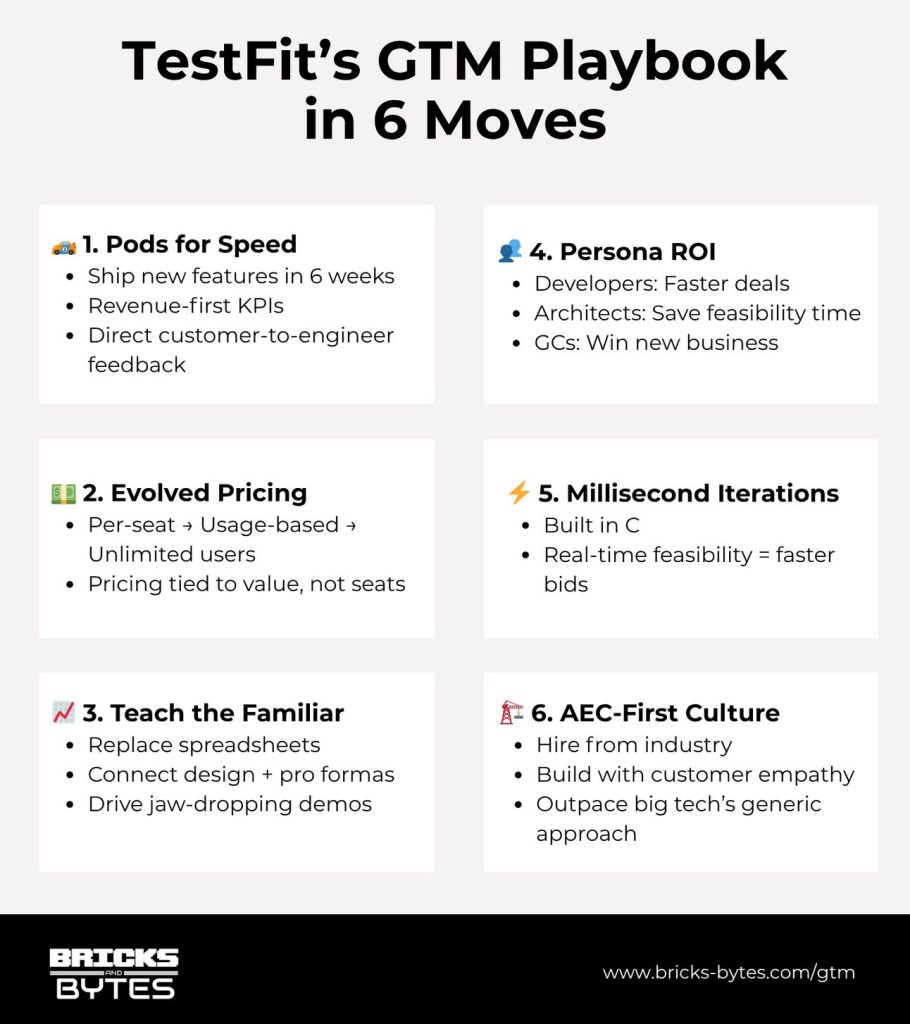
Want to get your message in front of {{active_subscriber_count}} highly engaged innovation leaders? Check out our sponsorship offers. INDUSTRY INSIGHTSTestFit’s Go-to-Market Playbook: From Spreadsheets to $750K Wins How TestFit is cracking the code on category creation, pricing evolution, and rapid product development in AEC tech The bottom line: TestFit transformed from a single-product startup into a multi-typology platform by building “pods” that can ship new features in 6 weeks, evolving from per-seat to usage-based pricing, and solving the hardest problem in AEC tech—getting conservative buyers to change their behavior. When Laura Paciano joined TestFit as employee number 30 after watching the product demo, her reaction was immediate: “They’ve got something here.”  Three years later, she’s orchestrating go-to-market for a platform that helps customers win deals worth hundreds of thousands more annually. But getting here wasn’t about finding product-market fit once. It was about finding it repeatedly, across multiple building typologies, pricing models, and customer personas. TL;DR: How TestFit Built a $750K GTM Engine in AEC Tech Pods > Departments: TestFit uses “pods” to launch new features in weeks, not years—tying each to revenue goals. Pricing Evolution: From per-seat to usage-based to unlimited users—pricing shifted to match value and drive adoption. Category Creation: They teach conservative buyers with relatable references (“like spreadsheets, but live”) to trigger behavior change. Persona Mastery: Tailored ROI stories for architects, developers, and GCs speed up sales cycles. Speed Wins: Millisecond-fast iterations enable instant feasibility—transforming workflows from weeks to hours. Culture Matters: Hiring AEC insiders and obsessing over customer pain creates unbeatable empathy. Big Tech Myth: Deep industry knowledge—not generic tech muscle—is what cracks AEC. The “Pod” Revolution: How TestFit Ships Features in Weeks, Not Years Most AEC tech companies treat new markets like major expeditions—months of planning, dedicated teams, massive resource allocation. TestFit flipped this model entirely. Their secret weapon? Internal “pods.” Each pod is a 3-6 month focused team combining go-to-market, product, and engineering. Jack, TestFit’s Director of New Markets, runs pods like revenue-generating experiments: Clear KPI: Usually a specific sales number by a specific date Tight timeline: Most pods run 1-6 months maximum Direct feedback loop: Go-to-market leaders talk to customers Monday, feed insights to engineers by Tuesday “I can go from a meeting with an engineer on Monday to a customer call Tuesday, get an answer, and be back to engineering an hour later,” Jack explains. The results speak volumes: TestFit launched their data center configurator when the market exploded from 30-megawatt buildings to 500-megawatt campuses. They caught the wave because they could ship fast. TestFit’s pod formula is deceptively simple: revenue-first KPIs (“We will close X deals in Y market by Z date”), customer-facing leadership (someone who talks to prospects daily), tight timelines (if it takes more than 6 months, break it down or kill it), and direct engineering access with no intermediaries between market feedback and product development. The Pricing Evolution: Why TestFit Ditched Per-Seat Licensing Laura jokes that “on Wednesdays we change pricing”—but behind the humor lies serious strategy. TestFit evolved through three distinct pricing phases: Phase 1: Per-Seat (The Old Way) Traditional software licensing that AEC was comfortable with but didn’t capture value. Phase 2: Usage-Based Testing Multiple experiments tying price to value creation—the number of sites tested, projects completed, iterations run. Phase 3: Collaborative Platform (Current) Unlimited users with pricing tied to usage, recognizing that real estate execution requires all stakeholders in the same system. “You can have an architect who’s really happy with the building, but if the developer can’t make it pencil, the project dies,” Laura explains. “The only way this works is if everyone’s in the platform.” The progression reveals an important truth about pricing in collaborative software: if your product requires multiple stakeholders, you need to identify what Laura calls the “collaboration tax”—what happens when key people aren’t in your system. Then price for the outcome, not seats filled. Most importantly, remove friction barriers. Sometimes unlimited users at higher per-project pricing wins over traditional licensing. Category Creation: Teaching Conservative Buyers to Want Something New AEC buyers don’t ask for innovation. As Jack puts it: “No one is asking to spend more time in feasibility. Everyone wants to build buildings.” TestFit’s approach to category creation focuses on behavior change through familiar reference points: The Sonos Playbook (Borrowed from Laura’s Previous Life) At Sonos, Laura learned to explain wireless multi-room audio before the iPhone existed. The key? Reference something customers knew. “As soon as there were iPod docking stations, we said ‘It’s like that, but you don’t have to dock anything,’” Laura recalls. TestFit uses the same strategy: “We’re replacing spreadsheets and connecting design to numbers.” The Three-Step Education Process Identify existing pain (even if they don’t know they have it) Reference familiar tools (spreadsheets, CAD workflows) Show the transformation (geometry connected to live pro formas) The magic moment: When prospects see their jaw drop during demos—TestFit tracks this using Gong to identify exactly when customers “see the magic.” For any company trying to create a new category in conservative markets, this approach scales: don’t ask what customers want—observe what they struggle with. Reference their current process explicitly, show transformation through live demonstration, and track that emotional moment when they understand the possibility. Henry Ford’s famous insight applies perfectly here—customers would have asked for a better horse, not a car. Multi-Persona Mastery: Serving Architects, Developers, and GCs Simultaneously TestFit serves radically different personas with opposing priorities: Architects: Want design freedom and technical capability Developers: Need speed and financial modeling General Contractors: Focus on constructability and business development The challenge? Each persona has different decision-making timelines, budgets, and success metrics. The Hidden ROI Problem Quantifying value varies dramatically by persona: Developers: Easy math—time savings = faster bidding = more deals won Architects: Harder math—opportunity cost of free feasibility studies GCs: Unexpected use case—using TestFit for business development to create their own deal flow “Our salespeople love when someone is paying someone else to do something and we can say ‘now you don’t have to,’” Laura explains.

Newsletter

Inside Palantir’s $100M Nuclear Gamble (And Construction’s Future)

Big tech’s building binge, nuclear’s next act, and the future of construction software. In this week’s Bricks, Bucks & Bytes episode: 🚀 Big tech is reshaping construction — with data center demand forcing GCs to rethink capacity, speed, and standardization. ⚡ Palantir dives into nuclear — $100M partnership to streamline reactor builds with AI-driven ops. 🏗️ Is software really the answer… or is construction’s real bottleneck still capacity? But that’s not all: Patric drops a mind-bending stat: 22-28% of mature economy GDP comes from projects. In emerging markets? Closer to 40%. The crew roasts “fundraising consultants” scamming desperate founders. We tear apart the World Economic Forum’s “Top 10 Emerging Tech” list. Spoiler: hydrogen didn’t make the cut. 🎧 Listen now for: Why vertical integration (think Goldbeck) might be the future of GCs What Palantir’s nuclear play really signals for construction tech The hidden risks of consumption-based pricing models (and what Chamath gets right) Watch the Full Episode 🗣 Bonus: Some personal highlights Owen’s battling a London heatwave (finally got AC) Martin’s dreaming of a Central European construction boom Patric’s out here dropping $320B market cap flexes You might also like: ChatGPT Makes Us Dumber, LIVE from House Factory, Vibe Designing Is Here Apple Kills Cold Calling, In Office Scares CEO’s, Insurance Proves Climate Change Fears New Steel Tariffs Hit, Is A 12hr Work-day Unreasonable? ChatGPT NoteTaker Kills Startups Builder AI $450M Bankruptcy – Beginning Of The End for AI Startups? Johnny Ive $6.5B Hire, TAM Check Why Data Centers Might Crash, Y Combinator Predatory Practices, with Softbank’s $100B Pledge How China Builds Nuclear Plants Cheaper, Construction’s $860bn Problem, & Trump 2.0 Germany Effects 90% Of AI Startups Are Worthless, US Economy CRASH, Is Autodesk Investable + $2bn Startup Meltdown Powered by beehiiv

construction tech go-to-market strategy
Go To Market

Decoding the Contech Go-to-Market: Why Solving Real Pain Points is Paramount

  When Tom Feliz from DataGrid talks about his journey from building the Apple campus to closing billion-dollar valuations at OpenSpace, one theme echoes throughout: successful construction tech go-to-market strategy starts with genuine pain points. “Your product has to solve a real industry pain point,” Feliz emphasizes. “That’s why OpenSpace caught fire. We had a really good product that worked and solved a real problem, and it didn’t need training.” Think about it. Construction is an industry where a superintendent might manage 40+ different companies on a single project. Everyone’s using different tools, processes, and systems. The complexity is mind-boggling, yet we keep throwing more technology at an industry that’s notoriously resistant to change. The magic happens when you solve problems so clearly that adoption feels inevitable, not forced.   In this episode, Tom Feliz talks about his journey from construction sites to tech leadership at Data Grid. He unpacks the secrets behind effective Go-To-Market strategies in construction tech, drawing from his experiences at OpenSpace, Autodesk, and more.     Speed to Value: The Make-or-Break Metric In construction, time is literally money. Every minute a trade worker stands around waiting for information costs real dollars. That’s why speed to value isn’t just nice to have—it’s everything. Feliz shares a perfect example: “I had a customer do a $49 credit card swipe back in October, November. Just last week I signed them up on an enterprise deal almost the same enterprise value as Procore that they use every single day.” The lesson? Let people experience value immediately. Whether it’s through freemium models, limited free trials, or proof-of-value projects, getting the product into users’ hands quickly separates the scalable solutions from the science projects. Understanding the Complex Web of Construction Personas Here’s where most construction tech companies stumble: they think of construction as a monolith. But the reality is far more nuanced. You’ve got owners who care about IRR and cap rates. Owner representatives managing fiduciary responsibilities. General contractors focused on schedule, cost, quality, and safety. Project executives worried about client satisfaction. Young project engineers who want the best tech to get home by 5 PM instead of staying in trailers until 7. Each persona has different motivations, different pain points, and different definitions of success. A COO cares about bottom-line efficiency. A 22-year-old project engineer cares about having tools that don’t make them look outdated compared to their software developer friends. “You have to understand from a persona perspective what are each of those people’s goals and objectives, and how do you align to the problem that you’re solving for each of those personas,” Feliz notes. The Relationship Game in a Digital World Construction remains fundamentally relationship-driven. Despite all our talk about digital transformation, deals still happen because people trust each other. They want to look you in the eye, shake your hand, and know you understand their world. This creates an interesting tension for construction tech go-to-market strategy. You need digital efficiency, but you can’t lose the human element. The companies that win combine both: they use technology to scale relationships, not replace them. Trade shows remain the number one lead generation source in construction—not because the industry is backward, but because relationships matter. The key is augmenting traditional relationship-building with smart technology, not replacing it entirely.   Product-Led Growth in Construction: Yes, It’s Possible While construction might seem like an unlikely candidate for product-led growth, the most successful companies are proving otherwise. OpenSpace, ClearStory, and DataGrid all use freemium models that let users experience value before committing budgets. The pattern works like this: Offer core functionality for free Create obvious upgrade paths to premium features Build virality into the product (like ClearStory requiring subs to use the platform to get paid) Convert organic users into enterprise deals “It’s true product-led growth,” Feliz explains. “Companies that if you look at any unicorn company outside of tech, you look at their secret to success—it’s a lot of product led growth and a lot of word of mouth.” Enterprise vs. Mid-Market: Choose Your Battle Wisely Here’s a strategic decision every construction tech startup faces: chase the prestigious Enterprise names or dominate the mid-market? The enterprise route offers social proof. When DPR or Suffolk uses your tool, others take notice. But enterprise sales cycles can stretch 12-24 months, requiring extensive proof-of-value across multiple business units. The mid-market approach—targeting regional contractors doing $100-500 million annually—offers faster closes and quicker ARR growth. These companies can make decisions in 1-2 months versus 1-2 years. “90% of the annual construction volume in the United States is not done by the top 50 ENR,” Feliz points out. “The majority is done by the mid-market—regional firms that power most of the growth.” The Pricing Model Problem Let’s address the elephant in the room: construction volume-based pricing. While companies like Procore have built empires on this model, it’s fundamentally flawed for the industry’s future. Charging based on construction volume penalizes companies for growing. It’s like saying, “Congratulations on doubling your business! Now pay us twice as much for the same software.” The future belongs to consumption-based, seat-based, or flat-fee models that align with value delivered rather than project size. It’s about partnering with companies to grow, not extracting tolls on their success. Founder-Led Sales: Stay Close to the Customer Finally, here’s contrarian advice for construction tech founders: don’t outsource sales too early. The temptation after raising money is to hire a VP of Sales and focus on “CEO stuff.” But that’s often a mistake. “Founders should lead sales for as long as possible,” Feliz argues. “If you just outsource your sales and lose contact with the customer and their problems and their needs, you miss the iteration opportunities that make products truly valuable.” The Bottom Line Construction tech go-to-market success isn’t about having the flashiest technology or the biggest trade show booth. It’s about understanding real problems, solving them simply, and building relationships that scale. The companies winning today started with genuine pain points, delivered immediate value, understood their

Newsletter

ICYMI: Mobile Money, Muscle Atrophy, and Marketing Fails

Want to get your message in front of {{active_subscriber_count}} highly engaged innovation leaders? Check out our sponsorship offers. This Week’s Quickfire BytesFuel your curiosity with this week’s contentW/C 30th June 2025 NEW EPISODESNobody Knows What You’re Building – Bad Messaging & How to Fix It from Kevin Ferguson, a Product Marketing Expert in AEC Kevin Ferguson shares why most AEC startups fail at basic messaging, the real difference between hype and reality in construction tech, and how to effectively position products that sell. Find out why 2,000+ AEC tech companies can’t explain what they do, the one thing that kills more startups than bad products, and how to break through the noise in a relationship-driven industry. open.spotify.com/episode/2KAm5Z0aa5jEvRl6koTEus ChatGPT Makes Us Dumber, LIVE from House Factory, Vibe Designing Is Here We dive deep into the controversial world of AI and its impact on our brains, plus exclusive behind-the-scenes access to Cuby’s revolutionary construction process. Key topics discussed: MIT study proves ChatGPT users show “lowest brain engagement” and get lazier over time, DocuSign’s $15 billion empire threatened by AI-built copycat app, and exclusive live tour of Cuby’s construction site where entire house interiors are built in just 16 hours. open.spotify.com/episode/50aS9Bk561Y2OJnacoDb9Z Building A Construction Marketplace in Africa With Kagure Wamunyu Kagure Wamunyu from Jumba shares how African tech companies must build entire ecosystems from scratch, why 60% of Kenya’s GDP runs on mobile money, and how construction distribution works in emerging markets. Find out how Uber Kenya became the first 100% cash market using manual Excel reconciliation, why Kenyans build homes instead of buying them due to 15% mortgage rates, and the reality of building construction tech in Africa where you become multiple businesses. open.spotify.com/episode/6DcpuJYyV1GAL1a3e6JBks View All Podcasts BRICKS & BYTES PREMIUMEarly Release Episodes How Amazon’s Ex-Robotics VP Is Building 500 Homes Per Year in a 50,000 sq ft Factory Vikas Enti breaks down how they’re solving the $350-450/sq ft cost crisis in infill construction by selling homes at $275/sq ft, why breaking the assembly line was crucial, and how they’re shipping homes from Massachusetts to wildfire-rebuilding efforts in California. Why 90% of AEC Tech Startups Fail at Marketing (And How to Be the 10%) – Phil Carpenter – EARLY RELEASE 30-year marketing vet reveals what actually works in construction tech Stop Marketing Like It’s 2010 – David Horesh – EARLY RELEASE Construction pros hate corporate fluff. Here’s what they actually engage with. 2 FAVORITE QUOTES: “Now, if I don’t know what they do, then there’s a huge chance that their customers also have no idea what they do.” – Kevin Ferguson on bad messaging being pervasive Here you have great tech, great tech that has worked… But it was struggling here because of that whole market fit. And the reason here was mobile money.” – Kagure Wamunyu describing how Uber’s credit card model failed in Kenya until they adapted to local mobile money BRICKS & BYTES PREMIUM🚀 Ready to Break Through the $10M Ceiling? Here’s a quick recap of what you’ll receive as a premium subscriber: Premium in-depth articles delivered to your inbox Early access to podcast episodes before public release 33% discount on all future GTM guides we publish UPGRADE TO PREMIUM Want 33% off the guide?Sign Up for Our Monthly Subscription Monthly members ($10/mo) can purchase the guide for just $67 UPGRADE TO MONTHLY YOU MIGHT ALSO LIKE Premium Insights A Step-by-Step Guide to Clear Product Marketing for AEC Startups 12 Lessons About Hiring From AEC’s Top Leaders More Insights NSFW: Build a F*cking Business McKinsey’s Secrets to Scaling Construction Tech How Flux Burned Through $29M – Lessons for AEC Innovators Ex AutoDesk CEO’s 12 Lessons For Developing Products Could an Entrepreneur in Residence Save Your Construction Firm? Reports and Case Studies Innovating the Future: Robotics and the Revolution in Construction The Future of Design Software In AEC – Experts Insights Investing In AEC Tech The Future Of Construction Document Management The Construction Tech Revolution In India: Lessons From InfraMarket’s Success Innovation at Windover Construction Swinerton’s Innovation Strategy Most Popular Episodes How To Build A Unicorn In Construction Tech – Patric Hellermann Story Of A Modular Construction Startup That Burned Through £10M in 15 Months – Chris Spiceley McKinsey FINALLY updates their Productivity Curve, & The Future Of Construction – David Rockhill, Partner at McKinsey Procore’s AI Strategy & Implementation – AI’s Role in Modern Construction Disrupt Autodesk? This Ex-Autodesk CEO Has Some Advice – Amar Hanspal Super Series Super Series with Ediphi Super Series With Speckle Super Series With Monumental Super Series with Foundamental OUR SPONSORS BuildVision — streamlining the construction supply chain with a unified platform for contractors, manufacturers, and stakeholders. Powered by beehiiv

Newsletter

Inside TestFit’s Rapid Expansion Playbook – Laura Paciano & Jack Joers – EARLY RELEASE

This is an early release of our podcast, exclusive for premium subscribers. To get early access, upgrade here. EARLY RELEASEInside TestFit’s Rapid Expansion Playbook An insider’s look at one of AEC tech’s most innovative companies as we sit down with Laura Paciano (SVP of Growth) and Jack Joers (Director of New Markets) from TestFit. Laura and Jack share hard-won insights on everything from their “pod” organizational structure that enables rapid market expansion to why traditional BIM approaches are fundamentally flawed. In this episode, you’ll: Discover how TestFit’s “pod” structure enables rapid market expansion and product iteration in just 3-6 months Learn the counterintuitive pricing strategy that’s driving adoption across architects, developers, and GCs Understand why category creation in AEC requires fundamentally different go-to-market approaches than traditional tech Hear real customer stories of winning $750K+ in additional business and beating competitors to deals Get exclusive insights into TestFit’s upcoming web-based editing capabilities and AI integration strategy Learn why Big Tech giants like Google have failed in AEC—and what it really takes to succeed in this relationship-driven industry Chapters 00:00 – Introductions and backgrounds: From Sonos to AEC tech 07:00 – What TestFit does today: Beyond multifamily to data centers and industrial 12:00 – Category creation challenges: Educating the market on generative design 20:00 – The “Rex Model”: Connecting design geometry to financial outcomes 26:00 – Unconventional pricing strategies: Why per-seat licensing doesn’t work 32:00 – The “Pod” strategy: How TestFit ships new markets in months, not years 40:00 – Hidden ROI and go-to-market surprises that even experienced operators didn’t see coming 47:00 – Municipality partnerships and the future of permitting 54:00 – Industry fragmentation vs. consolidation: Two different visions of the future 58:00 – The BIM controversy: Why TestFit thinks differently about building information 61:00 – The biggest myths about selling tech to the real estate industry »»» Listen Now (Premium Subscribers Only) ««« Subscribe to our premium content to read the rest. This is a subscriber only post. Become a paying subscriber of our annual or monthly paid subscriptions to get inside takes on growth in construction tech. Upgrade Translation missing: en.app.shared.conjuction.or Sign In Powered by beehiiv

Newsletter

Why This Construction Tech Founder Started With Cement (Not Software)

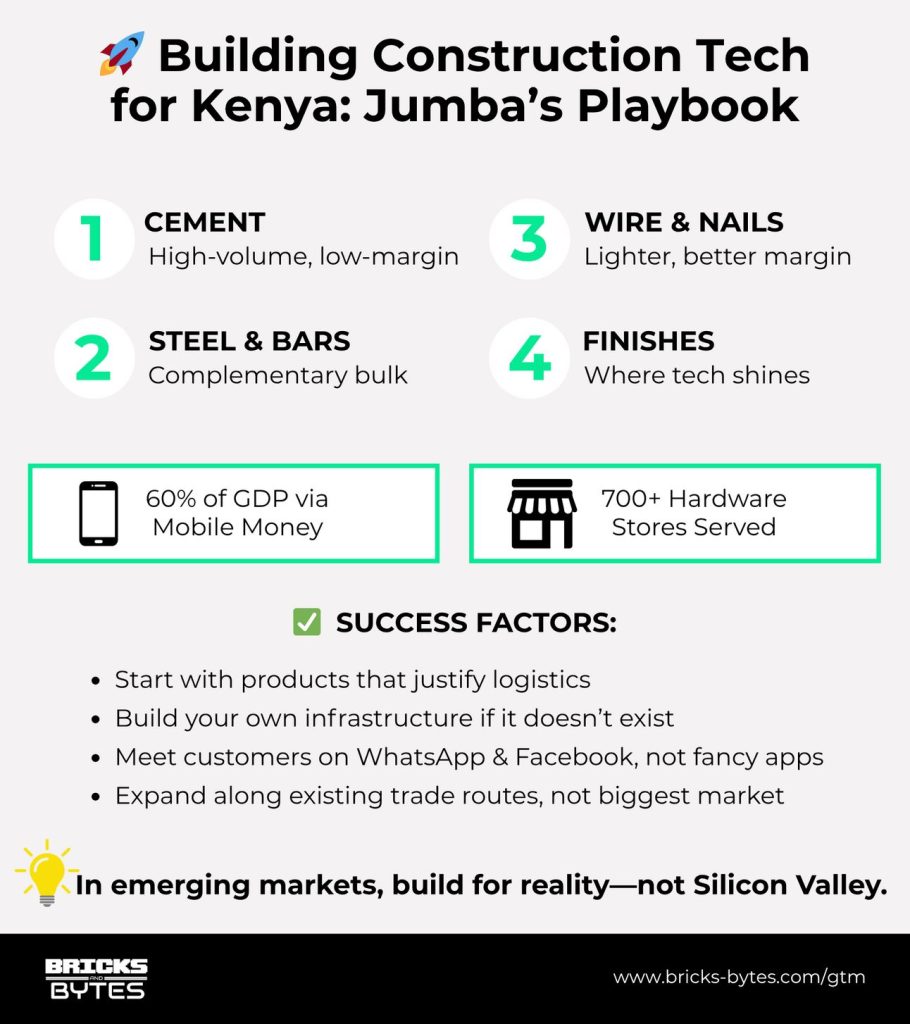
Want to get your message in front of {{active_subscriber_count}} highly engaged innovation leaders? Check out our sponsorship offers. INDUSTRY INSIGHTSWhy This Construction Tech Founder Started With Cement (Not Software) How Jumba built a 700+ hardware store network using WhatsApp, mobile money, and high-volume logistics I recently posted a post on LinkedIn with a link to our episode with Kagure Wamunyu. This episode took us around 8 months to finally get on the calendar and boy am I glad we did! We have never spoke to an African tech company before. And I’m glad Jumba was our first. What struck me were the major cultural differences one must consider when thinking about other continents.  For example, Kagure was the country manager for Uber when it arrived in Kenya.  As Uber’s Kenya operations lead, she was watching a world-class product fail spectacularly. The ride-hailing giant had launched across Sub-Saharan Africa as a credit card-only product.  In Kenya, it was dying a slow death. The problem? Credit cards barely existed.  In a country where over 60% of GDP flows through mobile money wallets tied to phone numbers, Uber was demanding plastic that locals didn’t have or want. “HQ in San Francisco was like, ‘You guys are insisting on this mobile money thing, but you can go ahead, we will not fully build for you,’” Kagure recalls. So she did something that would horrify any Silicon Valley product manager: She ran Uber on Excel spreadsheets. :O :O Here’s how it worked: Drivers would complete trips. Kagure’s team would run scripts trying to reconcile payments on Excel. Then drivers would line up, one by one, to settle their mobile money accounts manually. It was messy. It was manual. It was completely contrary to Uber’s tech-first DNA. It also made Kenya the first city in the world to roll out 100% cash payments on the Uber platform. “Back then, we ran Uber on Excel sheets,” she says, almost proudly. “As tough as it was and manual as it was, it really unlocked Nairobi.” That experience taught Kagure two lessons that would shape her entire approach to building construction tech in Africa: Great tech that works elsewhere can fail spectacularly if it doesn’t fit the market Don’t be afraid to run things manually while you prove the model Today, Kagure is the founder of Jumba, a construction tech platform serving 700+ hardware stores across Kenya. But her success didn’t come from following Silicon Valley playbooks—it came from breaking them. TL;DR: Why Jumba Built a Cement Empire on WhatsApp Silicon Valley playbooks failed Kagure Wamunyu, so she built her own. Running Uber on Excel taught her to meet markets where they are—like Kenya’s WhatsApp-driven, mobile money-fueled economy. Starting with cement justified building Kenya-wide logistics, letting Jumba serve 700+ hardware stores. The lesson? In emerging markets, success means starting with volume, layering on tech later, and expanding along trade routes—not tech hubs. The Market Reality That Changes Everything When Kagure decided to become a real estate developer in Kenya (her “side hustle” while working in tech), she discovered something that would reshape her entire career: In Kenya, people build homes rather than buy them. Why? Mortgages cost 15% annually. So Kenyans get money, build a stage, stop, then continue when they get more money.  This creates a massive network of hardware stores serving individual home builders and small developers—stores doing anywhere from $50,000 to millions in monthly revenue. And here’s the kicker: Manufacturing is centralized in major cities while development happens everywhere. The further you are from Nairobi, the harder it is to access construction materials affordably. This isn’t just a Kenya problem, it’s the reality across emerging markets where traditional distribution models break down outside major metropolitan areas. The High-Volume, Low-Margin Strategy That Built Jumba Most construction tech companies start with high-margin, low-volume products. Kagure did the opposite, and there’s brilliant logic behind it. Jumba started with cement. 50kg bags, commoditized, high-volume, low-margin. Why? “You’ve got to have the ability to move trucks into multiple areas of the country,” Kagure explains. “The bulk products allow you to be able to move the truck because the transport component can pay for the load.” The strategy evolved methodically: Phase 1: Cement (the foundation product everyone needs) Phase 2: Steel and deformed bars (complementary, still bulk) Phase 3: Wire products and nails (lighter, higher margin) Phase 4: Finishes (where tech value proposition really shines) Each phase builds on the logistics infrastructure of the previous one. By the time you get to tiles and finishes (where customers care about seeing options, comparing colors, and making aesthetic choices) you have the distribution network and customer relationships to make the tech play work. The lesson for emerging markets: Start with what justifies the infrastructure, then layer on the high-value, tech-enabled products. Building When Supporting Infrastructure Doesn’t Exist Here’s what blew my mind: In developed markets, you’d use separate companies for logistics, warehousing, payment processing, and order management. In Kenya, Kagure had to build all of this herself. “When you’re building in Africa, you have to build for your own ecosystem,” she says. “You’re building multiple products. What would be different businesses in other markets, here you become it.” Jumba’s “simple” B2B marketplace actually includes: Order management system: customers send WhatsApp photos of handwritten quotes AI quote reader: converts those photos to structured data Logistics management: tracking trucks across the country Mobile money integration: because 60% of Kenya’s GDP runs on mobile wallets Multi-manufacturer bundling: combining cement, steel, and nails in one delivery What started as internal tools became their SaaS product, now being deployed to manufacturers who currently run everything on WhatsApp after their basic ERP systems. The WhatsApp Economy (And What It Means for Sales) Forget LinkedIn.  In Kenya’s B2B world, everything runs on WhatsApp and Facebook. “If you ask me the best tech that ever happened in Africa, it’s WhatsApp,” Kagure says. Orders get posted in WhatsApp groups with directors, forwarded to finance teams, and payment confirmations shared in group chats.

Newsletter

MIT: ChatGPT Is Making You Dumb — We Break It Down

AI atrophy, prefab revolutions, and why VCs are missing the biggest prize in history. In this week’s Bricks, Bucks & Bytes episode: 🚨 MIT says ChatGPT makes you dumber. We break down what it really means for the next generation of builders. 📈 Why 90% of Decacorns aren’t what you think. Patric drops the Six Sigma math on outliers and why VCs are chasing the wrong unicorns ⚖️ We argue whether AI-driven app clones like Springtime vs. DocuSign will redefine who owns what. But that’s not all: Patric shares a mind-bending “Black Mirror” thought experiment on AI as a cognitive drug. Aleks Gampel gives us a live tour from a Cuby site where software turns rookies into builders overnight. Danny (Cuby’s new Chief of Staff) reveals how unskilled labor can assemble homes like Lego. 🎧 Listen now for: Why construction might be the last frontier for venture outliers. The real reason investors ignore trillion-dollar opportunities in AEC. How Cuby is quietly building a model for 21st-century housing. Watch the Full Episode 🗣 Bonus: Some personal highlights Patric’s new mustache is inspired by Top Gun (seriously). Owen’s take on whether AI will ruin his kids’ ability to do homework. Martin’s backdrop is different every week (he’s basically a digital nomad). You might also like: Apple Kills Cold Calling, In Office Scares CEO’s, Insurance Proves Climate Change Fears New Steel Tariffs Hit, Is A 12hr Work-day Unreasonable? ChatGPT NoteTaker Kills Startups Builder AI $450M Bankruptcy – Beginning Of The End for AI Startups? Johnny Ive $6.5B Hire, TAM Check Why Data Centers Might Crash, Y Combinator Predatory Practices, with Softbank’s $100B Pledge How China Builds Nuclear Plants Cheaper, Construction’s $860bn Problem, & Trump 2.0 Germany Effects 90% Of AI Startups Are Worthless, US Economy CRASH, Is Autodesk Investable + $2bn Startup Meltdown Powered by beehiiv

Newsletter

ICYMI: FIRST LOOK: Inside the Secret Factory + RFIs Are Weapons

Want to get your message in front of {{active_subscriber_count}} highly engaged innovation leaders? Check out our sponsorship offers. This Week’s Quickfire BytesFuel your curiosity with this week’s contentW/C 23rd June 2025 BRICKS, BYTES & BEYOND PREMIERE: Inside the Secret Factory Building Homes to End the Housing Crisis The housing crisis is worse than you think. But these factories might just fix it. America is 6.5 million homes short. Construction is slower, costlier, and more broken than ever. Skilled labor is vanishing. But what if the solution isn’t more workers… it’s factories that build homes? In this exclusive Bricks, Bytes & Beyond documentary, we take you inside Cuby’s revolutionary mobile micro factories – compact, tech-driven units that can be deployed globally to produce affordable, high-quality homes at scale. Watch it Now Bricks, Bytes & Beyond is a documentary-style tech channel that goes deeper than anyone else into how humanity is solving its toughest real-world problems. From housing to hardware, robotics to reindustrialisation, we travel the globe to bring you inside the minds of the founders, engineers, and visionaries reshaping our physical world. NEW EPISODESWe’re Already Too Late – Real Talk on Labor Crisis Solutions from Construction Brothers and Bricks & Bytes Tyler Campbell, host of Construction Brothers Podcast, shares why construction tech keeps failing, the reality behind the $13 trillion industry myth, and how major projects still run on Excel spreadsheets. Find out why RFIs have become weapons for project delays, the real reason construction apps fail to get field adoption, and how a £100 million project runs entirely on Excel. open.spotify.com/episode/1PkXcx90wuUCiTQ35SG4LO Homes Built In 35 Days for $100/sqft – Why This Physicist Is Building Factories for Construction Sites We sit down with Oleg, co-founder of Cuby, who’s cracked the code on industrial-scale homebuilding with mobile micro-factories that can pump out a 2,000 sq ft house every single day. Key topics discussed: why construction is still stuck in the stone age (and how Cuby is dragging it into the future), the mobile micro-factory concept: bringing manufacturing directly to construction sites, and how they’re producing homes at $100/sq ft with just 4-person assembly teams. open.spotify.com/episode/0erqyvbIJkT5HvLANAB2uN Why Construction Scheduling is Still Stuck in 1995 (And How to Fix It) Nitin Bhandari talks about his journey from wireless networks to construction tech, the critical mistakes first-time founders make, and why scheduling software has stayed stuck in the stone age while every other industry moved forward. Find out why he spent 9 months just learning construction before building anything, how he landed customers who wanted to invest their own money in his company, and the real reason construction scheduling is broken (it’s not what you think). open.spotify.com/episode/3d1YTolU0rH8RE9UqjSj4N View All Podcasts BRICKS & BYTES PREMIUMEarly Release Episodes How Amazon’s Ex-Robotics VP Is Building 500 Homes Per Year in a 50,000 sq ft Factory Vikas Enti breaks down how they’re solving the $350-450/sq ft cost crisis in infill construction by selling homes at $275/sq ft, why breaking the assembly line was crucial, and how they’re shipping homes from Massachusetts to wildfire-rebuilding efforts in California. Why 90% of AEC Tech Startups Fail at Marketing (And How to Be the 10%) – Phil Carpenter – EARLY RELEASE 30-year marketing vet reveals what actually works in construction tech Stop Marketing Like It’s 2010 – David Horesh – EARLY RELEASE Construction pros hate corporate fluff. Here’s what they actually engage with. The $13 Trillion Messaging Mistake Killing AEC Startups – Kevin Ferguson – EARLY RELEASE Product marketing expert Kevin Ferguson reveals why he can’t figure out what most AEC tech companies do—and why that’s costing them enterprise deals. 2 FAVORITE QUOTES: “Don’t get too competitive. It’s not worth it.” – Tyler Campbell’s advice to Owen about podcast competition “Do you know that there is a joke that if Jesus will come back on our earth, only one profession that he can recognize, will be the construction worker. Because do you know he was a carpenter? Nothing changed in 2000 years.” – Oleg Kondrashov on the lack of innovation in construction BRICKS & BYTES PREMIUM🚀 Ready to Break Through the $10M Ceiling? Here’s a quick recap of what you’ll receive as a premium subscriber: Premium in-depth articles delivered to your inbox Early access to podcast episodes before public release 33% discount on all future GTM guides we publish UPGRADE TO PREMIUM Want 33% off the guide?Sign Up for Our Monthly Subscription Monthly members ($10/mo) can purchase the guide for just $67 UPGRADE TO MONTHLY YOU MIGHT ALSO LIKE Premium Insights 12 Lessons About Hiring From AEC’s Top Leaders More Insights NSFW: Build a F*cking Business McKinsey’s Secrets to Scaling Construction Tech How Flux Burned Through $29M – Lessons for AEC Innovators Ex AutoDesk CEO’s 12 Lessons For Developing Products Could an Entrepreneur in Residence Save Your Construction Firm? Reports and Case Studies Innovating the Future: Robotics and the Revolution in Construction The Future of Design Software In AEC – Experts Insights Investing In AEC Tech The Future Of Construction Document Management The Construction Tech Revolution In India: Lessons From InfraMarket’s Success Innovation at Windover Construction Swinerton’s Innovation Strategy Most Popular Episodes How To Build A Unicorn In Construction Tech – Patric Hellermann Story Of A Modular Construction Startup That Burned Through £10M in 15 Months – Chris Spiceley McKinsey FINALLY updates their Productivity Curve, & The Future Of Construction – David Rockhill, Partner at McKinsey Procore’s AI Strategy & Implementation – AI’s Role in Modern Construction Disrupt Autodesk? This Ex-Autodesk CEO Has Some Advice – Amar Hanspal Super Series Super Series with Ediphi Super Series With Speckle Super Series With Monumental Super Series with Foundamental OUR SPONSORS BuildVision — streamlining the construction supply chain with a unified platform for contractors, manufacturers, and stakeholders. Powered by beehiiv

consulting firm innovation strategy framework
Go To Market

A Consulting Firm’s Playbook: Strategic Innovation Through Investment, R&D, and Ideation

  Most consulting firms talk about innovation. Some even have innovation departments. But very few have cracked the code on systematically driving transformation while maintaining their core business. Syska Hennessy, a 700-person MEP (mechanical, electrical, plumbing) consulting firm approaching $200 million in revenue, has built something different – a three-pronged innovation engine that’s reshaping how they compete and serve clients. Robert Ioanna, the firm’s CTO and head of operations, didn’t set out to reinvent innovation. His journey began in 2019 with a simple request from Building Ventures Group to evaluate a startup called Envered, which scrubs carbon dioxide from the air. That single evaluation opened his eyes to an entire ecosystem of companies working to solve problems his industry faced daily. “I went to the board and I said, hey, we need to be part of building ventures, platform, et cetera,” Ioanna recalls. What emerged from that conversation became a comprehensive innovation framework that every consulting firm can learn from.   In this episode, Robert Ioanna, Executive Principal of Syska Hennessy Group, shares his innovative approach to construction tech investment and internal R&D.     The Three-Pronged Approach After years of development and iteration, Syska Hennessy settled on what Ioanna calls their “three-pronged approach” to innovation: 1. External Investments: Strategic partnerships and investments in early-stage companies 2. Internal R&D: Developing proprietary solutions and tools 3. Corporate Ideation: Systematic processes for generating and developing ideas from within This wasn’t a theoretical framework imposed from above. It evolved organically as the firm discovered the unique advantages each approach offered and how they could work together synergistically. External Investments: Learning from the Ecosystem The external investment arm operates through Syska Innovations, a separate subsidiary formed in 2021. Unlike traditional corporate venture capital arms that lead deals, Syska Hennessy positions itself as a strategic add-on investor, focusing on alignment with their vision rather than pure financial returns. “We do it more because it aligns with our vision,” Ioanna explains. “When we’re talking to our clients, we have to be telling them that we’re analyzing the latest and the greatest products that are out there.” This approach serves multiple purposes beyond potential ROI. It keeps the firm connected to emerging technologies, provides their team exposure to cutting-edge solutions, and helps them understand where the industry is heading. Perhaps most importantly, it positions them to “drive the disruption of this industry that we’re in from within as opposed to somebody coming in from external the space and disrupting it on us.” The firm focuses on seven specific innovation buckets: smart buildings, digitization, products and methods, eco innovation, industrialization of design, project design, and project management. This framework ensures investments align with their core business while pushing boundaries in areas that matter most to their clients. Internal R&D: Building What Doesn’t Exist The internal R&D program operates differently than many consulting firms’ innovation efforts. Rather than having a small team working in isolation, Syska Hennessy treats R&D assignments like project assignments, involving 30-40 team members across the firm. “We assign the assignments who are R&D just like you would get a project assignment,” Ioanna notes. This distributed approach ensures R&D stays connected to real client needs while leveraging the firm’s collective expertise. The program includes both full-time dedicated resources and part-time contributors, allowing them to tackle complex challenges without massive overhead. They’ve already released DigiDux, a mechanical design tool they developed and offer for free to clients – a concrete example of how internal R&D can create value beyond traditional consulting services.   Corporate Ideation: Systematic Creativity Perhaps the most innovative aspect of Syska Hennessy’s approach is their systematic corporate ideation program. Inspired by a presentation from Leo Chan, who worked at Chick-fil-A, Ioanna built a framework that democratizes innovation across the firm. The program centers on a “coaches network” – approximately 40 people trained in specific innovation techniques and facilitation methods. These coaches run monthly workshops using structured exercises designed to drive creativity and uncover pain points. One particularly effective technique is “photo serendipity,” where teams discuss client pain points, then use randomly generated photos to spark new thinking. “Just by sort of taking your mind completely away from the project you’re trying to solution and looking through a different lens, we’ve gotten some pretty amazing solutions,” Ioanna explains. The program includes a gamification element called “inner points,” where employees earn points for innovative activities – recommending ideas, specifying invested products, writing blog posts, or making presentations. With about 20% of the firm participating, this creates sustained engagement and keeps innovation top-of-mind. The Chick-fil-A Connection The fact that Syska Hennessy modeled their innovation framework after a fast-food restaurant might seem odd, but it reveals an important insight. Chan’s philosophy was that “you need innovation to drive innovation in a firm – it needs to be decentralized and it needs to touch as many people in the firm as you possibly can.” This decentralized approach contrasts sharply with the traditional model of having “five guys off in the corner doing some pretty awesome stuff.” By involving hundreds of employees in innovation activities, Syskaa Hennessy creates a culture where innovation becomes everyone’s responsibility, not just the innovation team’s. Measuring Success Syska Hennessy sets concrete goals for their innovation program: reduce FTE productivity requirements by 10 people annually and generate enough revenue to cover the costs of labor and investments. This dual focus on efficiency and revenue generation ensures the program creates measurable business value. The revenue component comes from both returns on investments and additional work generated through exposure to new technologies. For example, their involvement with liquid cooling technologies for data centers has led to new client opportunities and revenue streams. Implementation Lessons Rolling out this comprehensive innovation framework required careful staging and buy-in building. As a consulting firm where “our asset is people” and “we sell time,” justifying significant innovation investment requires demonstrating value early and often. Ioanna started with workshops and proof-of-concept successes before asking for full-time headcount. The hiring of David Victor as

Newsletter

Why Targeting Contractors Is The Wrong Approach: OnSiteIQ’s Upstream Strategy

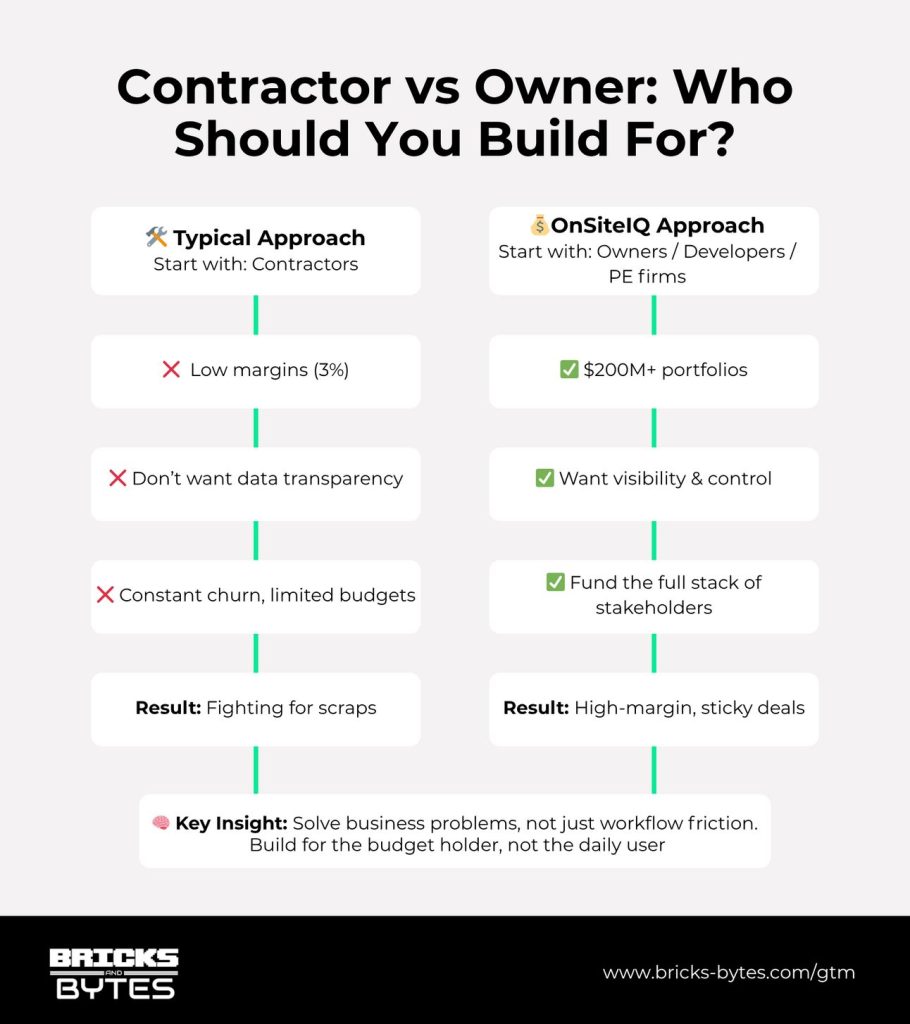
Want to get your message in front of {{active_subscriber_count}} highly engaged innovation leaders? Check out our sponsorship offers. BRICKS, BYTES & BEYOND Inside The Factories That Build Houses – Official Trailer Coming 27th June 2025 A documentary by Bricks & Bytes, focusing on Cuby. From New York to Belarus, to London this was a truly global effort by the team to create our most impressive piece of content to date. Keep up to date 👇👇👇 Subscribe INDUSTRY INSIGHTSWhy Targeting Contractors Is The Wrong Approach: OnSiteIQ’s Upstream Strategy “Construction companies aren’t innovators – they’re implementers,” Ardalan Khosrowpour. As the founder and CEO of OnSite IQ, he’s built a construction intelligence platform that most of us would assume targets contractors. He doesn’t. In fact, Ardalan walked away from what could have been a healthy amount in contractor revenue to focus exclusively on owners, developers, and private equity firms.  The reason? A single conversation that changed everything. TL;DR: Why Selling to Contractors Might Be Killing Your Startup OnSiteIQ’s CEO Ardalan Khosrowpour is flipping the script on construction tech go-to-market: Contractors = users, not buyers. They’re margin-strapped and incentivized to hide data. Owners & PE = the real customer. They have the money, the pain, and the power. Construction’s biggest flaw? Information asymmetry between builder and buyer. OnSiteIQ’s strategy: Target $200M+ portfolios, not one-off jobs Sell to owners, activate contractors downstream Build sticky network effects across all stakeholders GTW tip: Cold calls > cold emails. Old school wins. The result? Higher margins, less competition, and monopoly potential. The $12,000 Wake-Up Call Picture this: You’ve just spent months walking a 100-million-dollar construction project in New York. You’ve captured every corner, tracked every trade, documented everything. You approach the contractor and ask for $12,000 total for two years of service. The room full of project executives and VPs says no. After the meeting, Ardalan’s champion pulled him aside: “We do not want this data to exist, because if the owner knows it exists, it’ll be all over us. But here’s something interesting – go sell to the owners. They’re gonna love it, because we intentionally don’t give it to them.” That was OnSite IQ’s origin story. And it reveals the fundamental flaw in how most construction tech companies think about their market. To us, this story almost seems unbelievable. But anyone operating in the construction industry will know why it is that way. The Information Asymmetry Problem Here’s what Ardalan realized: The construction industry has a massive information asymmetry problem that’s only getting worse. Twenty years ago, real estate development was regional. You built in New York if you were based in New York. But today? Private equity firms are deploying $2 billion across 30 states with no infrastructure to oversee that capital. “As I’m deploying more money, I need to hire more people, fly them around, hire more consultants,” Ardalan explains. “And as you’re growing, over time, your performance just goes down because you have less information, less visibility.” Meanwhile, contractors are boxed into 3% margins with GMP (Guaranteed Maxium Price) contracts. They’re incentivized to hide problems, not share data.  The result?  A systematic misalignment that creates opportunity for anyone smart enough to target the money, not the user. Target the Money, Not the User This is where most construction tech companies get it wrong.  They see contractors using the tools daily and assume that’s their customer. But contractors “don’t have much money to spend, to be very frank,” Ardalan says. “Number two, they’re bombed with so many shitty products every day – 20 chatbots that analyze floor plans.” Owners think differently. A contractor sees a $50 million project and worries about protecting their $1.5 million margin. An owner sees that same project as a $150 million machine generating 20% IRR for the next decade. “Upfront little cost is nothing compared to the 10 years that this asset has to be successful,” Ardalan explains. OnSite IQ’s minimum customer threshold? $200 million in active construction. Why? Because construction has inherent churn. Projects end, revenue ends. You need customers with staying power. The Network Effect Strategy Here is where IQ’s strategy gets quite interesting…  Every project is an LLC with three parties: a GP, LP, and lender. All three become OnSite IQ’s customers. “Every time we touch an asset, we get connected to three nodes,” Ardalan says. “As we’re growing in a market, the network effect is pulling us in as opposed to us pushing the product.” They start with the developer, give access to everyone downstream (contractors, architects, subcontractors), then work their way up to private equity firms and lenders. The stickiness is incredible – their Net Promoter Score is 77 compared to the median SaaS score of 40. “Once we sign an enterprise deal with these owners, it is so sticky, I’m going to make a claim it’s almost irreplaceable,” Ardalan says.  Why? Because now architects, contractors, private equity firms, and owner reps are all relying on the same data source. Old School Tactics That Work OnSite IQ’s go-to-market approach is refreshingly analog in a digital world: Phone calls over emails. “Phone works better than emails or anything,” Ardalan says. Good old-fashioned cold calling. Strategic capital. They took investment from RIT Ventures, a multifamily fund whose LPs include major developers. This gave them credibility and pilot opportunities. Intimate dinners over trade show booths. They bring customers who invite their peers from other companies. No razzle-dazzle, just relationship building. Partner leverage. They work with owner reps and architects, offering free monthly walks in exchange for introductions to new accounts. The Contrarian Bet Is Paying Off While 80% of construction tech companies fight over contractor dollars, OnSite IQ operates with minimal competition. Their take rate? Double-digit basis points compared to Procore’s 10-12 basis points. And they’re targeting 30 basis points long-term. “If you fully activate this network effect, I think you can build a very, very solid monopoly in this industry,” Ardalan says. “We can do what Carta did, but just the only difference is in

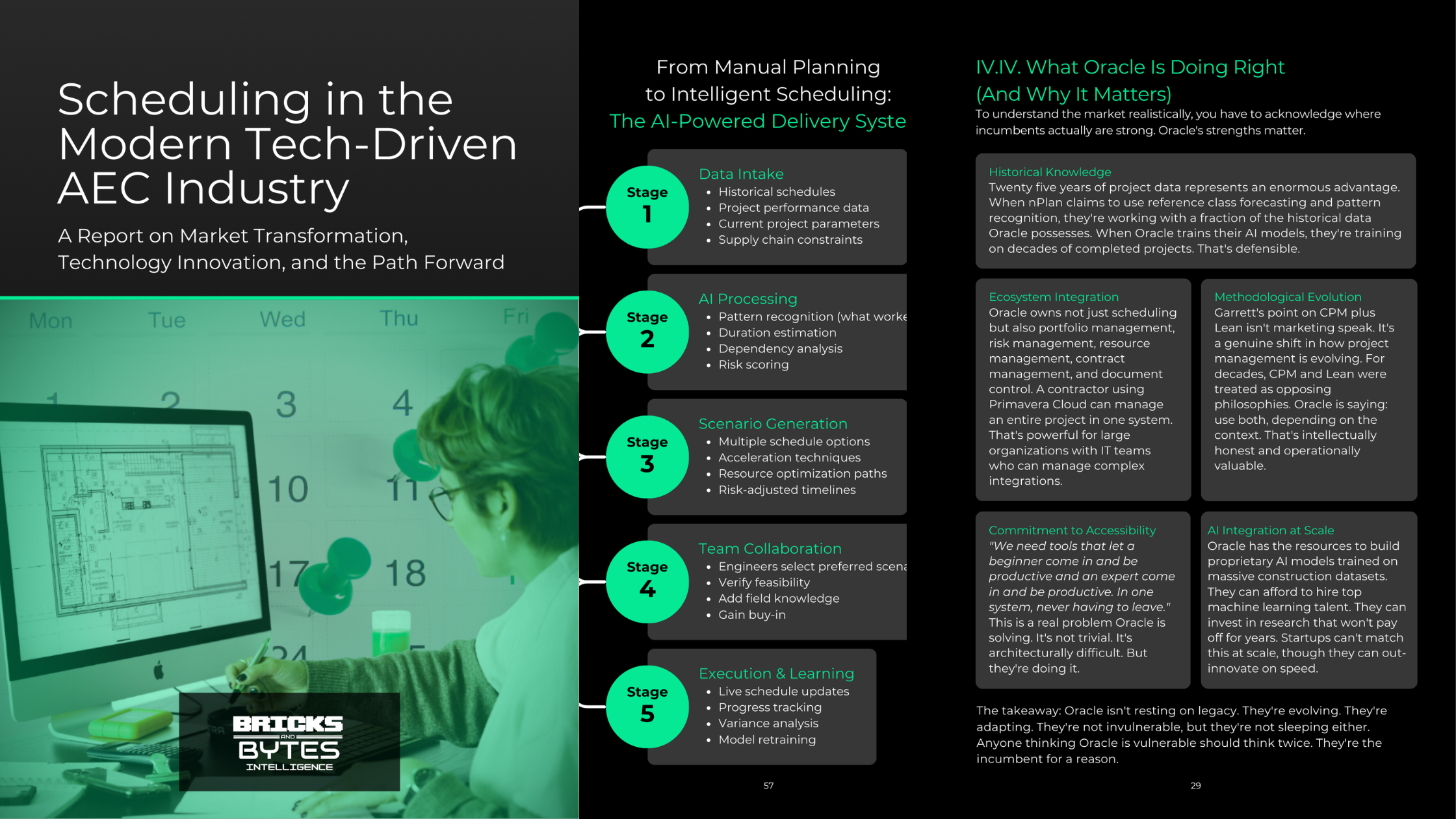
Get a FREE copy of our Scheduling in the Modern Tech-Driven AEC Industry: A Report on Market Transformation, Technology Innovation, and the Path Forward” (worth $150) and a FREE weekly email to stay up to date on construction tech. SIGN UP TODAY!

Scheduling in the Modern Tech-Driven AEC Industry

Sign up to the #1 Newsletter In AEC Tech. Join over 2,100 like-minded Founders, Investors and Techies disrupting the way we build. 

Scheduling in the Modern Tech-Driven AEC Industry