Author name: Owen Drury

Newsletter

NEW – Inside Bricks & Bytes + ICYMI: Great Debate, New Unicorn + more

Reach a highly engaged audience of AEC innovation leaders, executive teams, and industry titans. Check out our media kit. This Week’s Quickfire BytesFuel your curiosity with this week’s contentW/C 2nd February 2026 THE MONTHLY MEGABYTE Dear friends, followers and fans, For the first time in forever, we are peeling back the curtain and giving you an inside look into Bricks & Bytes. From today and this month forward, each month, we will be taking you inside our world with “The Monthly Byte”. Don’t worry… It’s not another newsletter! Just an extension of our weekly ICYMI. This will almost be our external-facing diary of how two construction dudes started a podcast and are turning it into a global media business. Expect: Product & content launches and announcements Community updates A behind the curtain look on how we’re building our media brand Our take on the month in AEC Thanks for being a subscriber, we appreciate your support and we look forward to you joining this journey with us. January In 2026 Ok so January was an extremely busy month. There is nothing like hitting the ground running at the start of the year. Firstly, we welcomed 3 new team members: Aren Deu – Our new Head of Content, Aren will be responsible for pushing B&B’s content to the next level. Since we started B&B back in 2022 (two strange guys from construction with little/no content expertise) we threw content out there without much thought, and the priority was always to just “get it done”. Well we are now delighted to welcome Aren to our team, the brains behind what content we produce, why we produce it and how we get it in front of those who need to hear it. Aren’s background includes various forms of as business, in particular within property and investing, as well as growing his own YouTube and social media channels to tens of thousands of subscribers and millions of views. Amir Zarandouz aka Zed – Marketer – Amir joins us as a general marketer with a twist. Amir is an expert in website design, SEO, growth marketing and AI workflow automations. First job is to convert our myspace 2010 website into a modern content hub. From there, it will be helping us put the rocket-fuel on our content and getting it in front of the masses. Note: We named him Zed as there are too many people with names starting with the letter A in Bricks & Bytes and poor Martin can’t handle it. Jainish Rathod – Jainish joins us part time to help us drive bbradar.com. If you are involved in construction tech, you probably already know Jainish who is a very valuable member of the community. More on bbradar later in the newsletter. 2026 Media Kit Launch We have officially launched our 2026 media kit. Details here. Some great opportunities for folks to get their brand in front of a highly engaged and concentrated AEC audience of founders/operators/execs/buyers/industry enthusiasts. Official Media Sponsorship With Contech-Connect Event A new event arises in Europe. And a Bricks & Bytes first, we are an official media sponsor of Contech Connect. True story – I had to look up what a media partner was before pitching the idea to Jerome. Here, we will be hosting the opening fireside chat with our fellow Buck, Patric – quite a big deal, especially as Patric is not an event kind-of-guy. Contech Connect will be held in Paris on 28th May 2026. You can buy tickets here: https://contech-connect.com/, and we will shortly be releasing a discount code for you all. AEC Fight Night 002 In December Mike Powers & Luigi approached me (Owen) with an idea. They wanted to debate eachother on B&B. Fine. I told Patric Hellermann I wanted him to moderate it and with some minor convincing, he agreed. What resulted was a new, provocative format, hosting the conversations that as an industry we should be having. For a number of years, people had told us that a debate format is needed in AEC. So here we are. Soon after, Dustin & KP agreed to partake. What followed was a fiery debate, contemplating the “death of software or the system of record”. Watch here: https://www.youtube.com/watch?v=If0jJnX7tZY We will continue to build this format out over 2026, with more participants and more events. Watch this space. PS shoutout to our sponsors for the latest edition: Track3D, HVAKR, Provision, ALICE, Datagrid, and BuildVision. BB Radar I was in two minds as to whether to include this in this month’s edition. But as it is starting to appear and gain traction, here is an insider/soft/silent launch of www.bbradar.com. Long story short: Tech buyers hated being sold tech. We make it easier for them. Official announcement coming soon. If you are building a product in AEC and want to be featured in the platform, we have some launch offers through Q1 2026. Just hit me up. Prediction Market Results In December, we held a closed Beta for the AEC prediction market. Shout-out to Tom Feliz for claiming the #1 spot. Keep your eyes peeled to see how our prediction market develops over the year. That’s about it for January. Plenty more in the pipeline for February :). Behind The Scenes We’ve been working up some awesome claude code apps to help us with all sorts, from financial analysis through to analysis on which of our content performs best. Every member in our team is required to teach themself how to claude code and build automations to help them do their job quicker and with more insight. Check out the screenshot of our newsletter analysis below: Are you building any Claude code apps for your business? Reply and we’ll cover you in an upcoming article or episode. January AEC Industry Highlights Well, January hit with a bang. Here’s some of the tech highlights: Tigereye selling up to Lennar – an interesting and unexpected acquisition that sees a major housing developer buy an AI company – AECOM


Newsletter

The $1B Startup’s Marketing Playbook – Colin Piper – EARLY RELEASE

This is an early release of our podcast, exclusive for premium subscribers. To get early access, upgrade here. EARLY RELEASEThe $1B Startup’s Marketing Playbook Colin Piper spent a decade scaling Autodesk Construction Cloud’s marketing operation to over 100 people. Now, as CMO of unicorn startup BuildOps ($127M raised, $1B+ valuation), he’s applying enterprise playbooks to one of construction’s most underserved segments: trade contractors. In this conversation, Colin breaks down the marketing engine behind one of construction tech’s fastest-growing companies, from brand-to-demand funnels and account-based strategies to the surprising AI adoption data from BuildOps’ latest industry report. Whether you’re building a marketing function from scratch or optimizing a mature team, Colin’s frameworks translate directly to the bottom line. In this episode, you’ll: Learn how to structure a marketing team from your first hire through 100+ people, and which role should always come first Discover the “incrementality testing” method BuildOps uses to prove ROI on brand campaigns that most companies can’t measure Understand why 78% of trade contractors have already adopted AI workflows (and what’s actually stopping the other 22%) Get the account-based marketing playbook for landing enterprise deals—including the physical “swag box” strategy that still works Hear why Colin believes the labor shortage and burnout crisis are accelerating technology adoption faster than anyone expected Chapters: 00:00 – Introduction: BuildOps’ Unicorn Journey 03:13 – Colin’s Path from Autodesk to Startup CMO 05:46 – What Marketing Actually Means at Scale 08:43 – Demand Generation Explained: The Three Legs 11:20 – Account-Based Marketing Tactics That Close Enterprise Deals 19:45 – BuildOps vs. Autodesk: Reaching Trade Contractors 22:59 – Building Top-of-Funnel Awareness for a Growing Brand 28:00 – Channels That Work: Where Trade Contractors Actually Are 33:34 – Why Long-Form Research Reports Outperform Everything Else 35:52 – Testing Marketing Campaigns: When to Invest, When to Kill 41:27 – Offline Marketing: Events, Direct Mail, and Out-of-Home 43:27 – How to Structure a Marketing Team from Day One 46:05 – The Marketing Tech Stack Every Team Needs 47:35 – AI in Marketing: Why Every Marketer Must Be AI-Enabled 50:35 – The BuildOps AI Report: 78% Adoption and What It Means 52:26 – Labor Shortage, Burnout, and the Case for Automation 55:14 – How Trade Contractors Should Market Themselves 57:52 – Gen Z and the Future of AI Adoption in Construction 01:02:16 – Closing Thoughts and Where to Find BuildOps »»» Listen Now (Premium Subscribers Only) ««« Subscribe to our premium content to read the rest. This is a subscriber only post. Become a paying subscriber of our annual or monthly paid subscriptions to get inside takes on growth in construction tech. Upgrade Translation missing: en.app.shared.conjuction.or Sign In Powered by beehiiv

Newsletter

3D Printing is Back: $62M Contracts, Growth, and the Real Opportunity

INDUSTRY INSIGHTS3D Printing is Back: $62M Contracts, Growth, and the Real Opportunity Standards-based validation has unlocked a new phase. Here’s what happens now. Two years ago, Icon laid off staff. Mighty Buildings went into administration. The narrative was simple: 3D printing in construction was failing.  Today, the military is writing $62M contracts for barracks. Multi-story residential projects are under construction. Specialized infrastructure is being deployed. The narrative has shifted entirely.  What actually changed between 2024 and 2026? According to Stephan Mansour, a construction veteran with 20 years in major projects and now focused on standards development in the sector, the answer isn’t what most people think.  It wasn’t the technology. The machines work roughly as they did two years ago. No sudden breakthrough in materials or capabilities.  The shift was structural. The construction industry finally built the validation framework that had been missing all along. Insurance companies can now underwrite projects. Regulators can approve structures. Government agencies are confident enough to contract for deployment.  That’s why Fort Bliss matters more than Icon’s layoffs. One signals a technology. The other signals market structure. And market structure is what actually drives adoption.  Stephan Mansour, Director of Operations at Printerra Inc. TL;DR: Additive Construction Is Real Now The 2024 “collapse” wasn’t a tech failure. It was a lack of standards, insurance, and regulation. Those standards now exist, unlocking insurance, permits, and $62M government contracts. That’s why Fort Bliss matters more than startup layoffs: market structure drives adoption. The industry has matured from “3D printing” to “additive construction.” Language matters. It doesn’t replace labor; it shifts workers to safer, higher-value tasks. Use cases are now clear: military, housing, infrastructure, and custom components. Economics are application-specific, not universal. The real question in 2026 isn’t “does it work?” but “does this solve my problem?” Bottom line: Additive construction is validated, boring, and practical — which is exactly why it’s finally happening. Why The 2024 Crash Made Sense When Icon faced headwinds in 2024, the narrative seemed clear: 3D printing wasn’t ready. But that missed the real issue.  These companies faced a market structure problem, not a technology problem.  According to those working in the space, the problem was structural. As Stephan puts it, “The construction industry requires assurance of better results before it adopts innovation.” You can’t build that assurance with technology alone. You need standards, regulatory frameworks, and insurance underwriting.  Construction doesn’t adopt tools it doesn’t understand. It doesn’t finance unproven methods. Insurance won’t underwrite unvalidated approaches. Regulators won’t approve structures without frameworks.  By 2024, 3D printing companies had technology but lacked the scaffolding that enables adoption.  The Standards Breakthrough The conversation shifted in late 2024. Instead of debating whether 3D printing could work, the industry focused on standards.  A framework was published in December 2023 after 2.5 years of work. It specified material behavior, extrusion tolerances, structural performance, and safety protocols.  Standards unlocked three things:  Insurance underwriting: Companies can evaluate and insure 3D-printed structures  Regulatory approval: Clear frameworks for permits and structure approval  Capital deployment: Investors and GCs move forward with defined paths  Army opens DOD’s first 3D-printed barrack. Credit: U.S. Army Government adoption proves the point. The $62M Fort Bliss award (10 barracks) only became possible after standards validation. When the Department of Defense contracts for 3D-printed structures, regulators have officially validated the approach.  That confidence cascades to private capital.  What “Additive Construction” Is Industry moved away from “3D printing” terminology. The term now is “additive construction.”  Stephan Mansour, involved in the 2.5-year standards development process published in December 2023, explains the distinction: “Additive construction means building one layer at a time. We created this term for construction specifically because additive manufacturing already exists in aerospace and other industries. We wanted our own framework, our own standards.”  Why does this matter? Language shapes perception. “3D printing” evokes novelty. “Additive construction” signals this isn’t borrowed technology. Construction has its own standards, safety requirements, and regulatory framework.  When an industry invests in terminology precision, it signals maturation.  How It Works Additive construction builds layer by layer using robotic systems. Gantries or arms mounted on platforms move vertically as the structure rises. Mixing pump systems deliver material to the robotic applicator. One or two operators manage systems while the crew does other work.  The labor shift is significant. Instead of multiple workers pouring concrete, humans move to higher-value tasks: coordinating placement, inspecting quality, installing other systems. Physical strain decreases. Site safety improves.  Where It’s Being Deployed Additive construction solves different problems for different applications.  Windsor, Canada, has a 3-story, 14,000-square-foot student housing project (net-zero) under construction. Saudi Arabia had a Ministry of Housing pilot in 2018. These address housing shortages where speed and material efficiency matter.  Credit: University of Windsor The $62M Fort Bliss contract represents different value. The military valued mobility, use of local materials, and rapid deployment. These benefits matter in military applications, disaster relief, and infrastructure repair.  Specialized applications include coral reefs, sea walls, and custom architectural elements. Specialist contractors avoid expensive molds and casting setups by changing design parameters.  Economic logic shifts by application. Residential economics differ from military to custom components. Some applications become attractive immediately. Others need volume and process refinement. This specificity is healthy.  The Labor Reality The labor shortage in construction is real. What role does additive construction play?  Additive construction doesn’t eliminate the workforce. This is important to clarify. The goal, as Stephan notes, is “to make the construction site more safe and enable the workforce to do more important duties, not deal with menial and tedious tasks on the site.”  It requires operators, maintenance, and integration with traditional workflows.  What It Actually Does It shifts labor from repetitive, menial tasks to higher-value work. Instead of multiple workers pouring concrete, you have operators managing systems and crews handling placement, inspection, coordination.  Physical demands decrease. Site safety improves. Material usage becomes optimized. Design flexibility increases. A contractor creates custom elements and structural variations without new molds.  These aren’t revolutionary benefits individually. Combined, they create operational efficiency.  Why

Newsletter

Are We Building Tools or Crutches?

AI is running Tinder accounts, EquipmentShare just IPO’d, and construction is asking the wrong questions. In this week’s Bricks, Bucks & Bytes episode: 🤖 AI agents are getting weird, from running 24/7 on Mac Minis to accidentally ordering physical robots. 📈 EquipmentShare breaks the IPO drought with a ~$6B debut and exposes how hard asset-heavy tech really scales. 🧠 The real AI debate emerges: Are we building tools… or outsourcing our brains? But that’s not all: Clawdbot → Moltbot hype hits peak saturation, and we unpack what agentic AI is actually good for. Patric dismantles “AI will manage your life” culture (and doesn’t hold back). Martin explains why agents will win in industry-specific workflows, not generic life admin. We debate whether systems of record still matter or if vibe-coding kills them from the edges. 🎧 Listen now for: Why EquipmentShare’s financial engineering matters more than the headline valuation The difference between AI that helps you think vs AI that replaces thinking Where robotics is quietly winning (and where it’s still stuck) Why most “time-saving AI” just creates more time to scroll Watch the Full Episode You might also like: DataGrid Acquired by Procore, 1,300 Jobs Gone at Autodesk, & Why BuildVision Dropped AI Branding Carbon Accounting’s Collapse, Apple Chooses Gemini, First 2026 IPO Is Here 2026 Construction Industry, $3 Billion Construction Tech Exits & LinkedIn Content Crisis $100K Christmas Party, AEC UFC Arrives, EquipmentShare Files Public, Three?? AEC Tech IPOs Coming Bobyard’s $35M AI Claims, Oracle’s $523B Backlog, Larry Ellison’s Debt Mastery AEC’s Craziest Acquisition Ever? Landing Page 101, UK Construction Doomed, Robotics to win 2026 $875m Founders Return to Construction, $9.2M Nextlight Raise, AI Go-To-Market Race OpenAI Turner Mega Deal, OpenSpace Buys Disperse, Government Shutdown Impact on Construction nPlan Raises £11.9M Series B, AI Agents Lack Evals Crisis, WhatsApp Dominates 90% Site Communication Procore’s AI Bomb, Should VCs Pick Ideas, Revolutionary Site Layout Tool Buildots Acquisition, Procore Groundbreak’s Awkward Week, Pre-Con Is On Fire Powered by beehiiv

Newsletter

ICYMI: AEC Fight Night 002, ICON Lands $62M Army Deal, & 3D Printing Enters US Building Code

This Week’s Quickfire BytesFuel your curiosity with this week’s contentW/C 26th January 2026 NEW EPISODES “Stop Treating It Like Alien Technology” — 3D Printing Is Just Another Construction Equipment Why 2025 might be the tipping point for 3D printing in construction, how a full concrete structure can harden in just 30 minutes, and what’s really holding the industry back from mass adoption. DataGrid Acquired by Procore, 1,300 Jobs Gone at Autodesk, Tim Draper Backs Robots & Why BuildVision Dropped AI Branding We sit down with Mike Powers, Kevin Halter, and Anton Glance to dissect the most chaotic week in construction tech. “AI Today = 1999 Internet” – How Bluebeam Became Construction’s Most Legendary Product Don Jacob, Co-founder of Bluebeam, talks about the wild 24-year journey from NASA’s Jet Propulsion Lab to building one of the most iconic products in construction tech. View All Podcasts BRICKS & BYTES DEBATEAEC Fight Night 002 – KP Reddy Vs Dustin DeVan AI will kill the System of Record. Or will it? On February 03rd 2026, we’re bringing together two of the most outspoken voices in AEC to stop the politeness and start the debate. The Heavyweights: Dustin DeVan: The superstar founder who says if your data isn’t structured in the cloud, your AI strategy is a fantasy. KP Reddy: The VC and Futurist who claims “Corporate Software is for Corporate Overlords” and that the future is unstructured, local, and personalized. This is the ultimate clash of philosophies on how we actually build in the age of AI. Register Here Powered by the innovators bridging the gap: BRICKS & BYTES PREMIUMEarly Release Episodes The Acquisition That Was Obvious in 7 Seconds – Buildots & Genda – EARLY RELEASE When Buildots CPO Aviv Leibovici first explored acquiring Genda, he and CEO Roy Danon needed just seven seconds to know it was the right call. 2 FAVORITE QUOTES: “Don’t look at 3D printing as a solution from Mars. It is just like any other piece of equipment that comes into your workshop or into your construction site.” – Stephan Mansour’s advice to home builders, cutting through the hype with practical framing. “The best salespeople are the laziest. Sorry, if you’ve never learned that—it’s absolutely true.” – Patric’s on why top performers resist change. They’ve optimized for efficiency on existing products. YOU MIGHT ALSO LIKE Premium Insights 10 Hard-Won Lessons from Founders Who Sold for Millions A Step-by-Step Guide to Clear Product Marketing for AEC Startups 12 Lessons About Hiring From AEC’s Top Leaders More Insights NSFW: Build a F*cking Business McKinsey’s Secrets to Scaling Construction Tech How Flux Burned Through $29M – Lessons for AEC Innovators Ex AutoDesk CEO’s 12 Lessons For Developing Products Could an Entrepreneur in Residence Save Your Construction Firm? Most Popular Episodes How To Build A Unicorn In Construction Tech – Patric Hellermann Story Of A Modular Construction Startup That Burned Through £10M in 15 Months – Chris Spiceley McKinsey FINALLY updates their Productivity Curve, & The Future Of Construction – David Rockhill, Partner at McKinsey Procore’s AI Strategy & Implementation – AI’s Role in Modern Construction Disrupt Autodesk? This Ex-Autodesk CEO Has Some Advice – Amar Hanspal Super Series Super Series with Ediphi Super Series With Speckle Super Series With Monumental Super Series with Foundamental OUR SPONSORS Aphex – The multiplayer planning platform where construction teams plan together, stay aligned, and deliver projects faster. Archdesk – The #1 construction management software for growing companies. Manage your projects from Tender to Handover. BuildVision – Streamlining the construction supply chain with a unified platform for contractors, manufacturers, and stakeholders. Powered by beehiiv

Newsletter

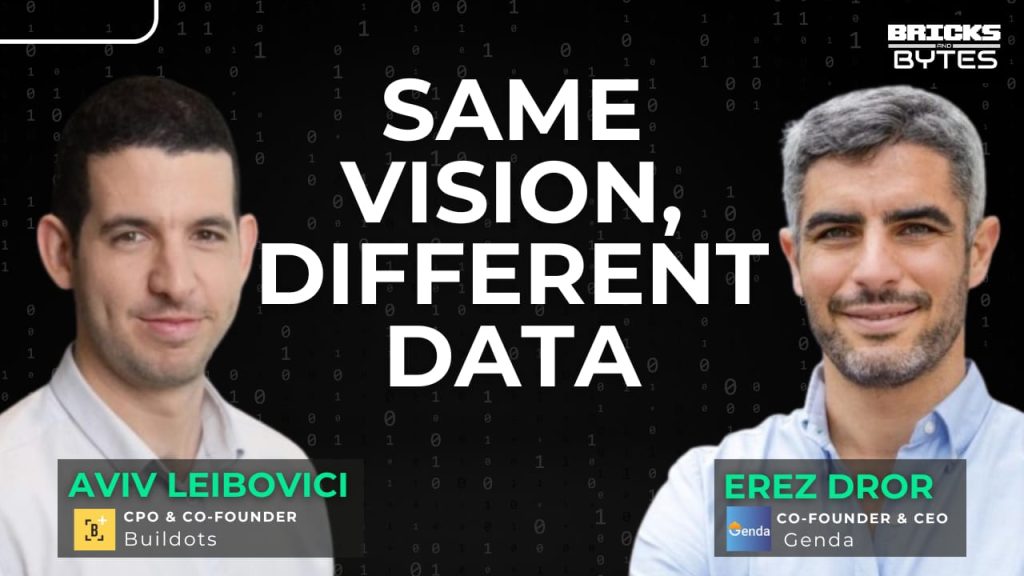
The Acquisition That Was Obvious in 7 Seconds – Buildots & Genda – EARLY RELEASE

This is an early release of our podcast, exclusive for premium subscribers. To get early access, upgrade here. EARLY RELEASEThe Acquisition That Was Obvious in 7 Seconds When Aviv Leibovici (Buildots) and Erez Dror (Genda) sat down to explore a potential acquisition, it took just seven seconds to know it was the right move. The strategic fit was that obvious. In this conversation, you’ll get an insider’s look at how two Israeli construction tech companies, born from the same vision but attacking different sides of the same problem, merged to create something the market hasn’t seen before: true productivity intelligence. Aviv explains why knowing what got built is only half the equation, while Erez reveals how Genda cracked the code on getting workers to willingly adopt tracking technology (a feat many thought impossible). In this episode, you’ll: Discover why Buildots believes “reality capture” fundamentally misses the point, and what productivity intelligence actually means for your operations Learn the acquisition logic that made this deal obvious in seven seconds (and what that reveals about strategic fit) Understand how Genda solved construction’s adoption problem by getting tens of thousands of workers to voluntarily use location-tracking technology Hear Aviv’s contrarian take on why interviewing customers for pain points leads founders astray and what to do instead Get a preview of where this combined platform is heading: automated insights that turn into field-level tasks without human bottlenecks Chapters: 00:00 – Meet the minds behind Buildots and Genda 01:14 – Why Aviv hates the term “reality capture” 03:35 – Erez’s journey from carpenter to construction tech CEO 06:42 – The acquisition explained: Why BuildOts bought Genda 10:28 – The other side: Why Genda wanted to be acquired 25:06 – How BuildOts turns progress data into risk insights 26:21 – Genda’s breakthrough: Workforce tracking without wearables 34:36 – The integration roadmap and early joint wins 39:43 – Why reality capture attracts massive funding 47:46 – Productivity intelligence vs. the competition 51:02 – Building great products: Study your customers, don’t just listen 57:27 – How AI is changing the speed of product iteration 01:01:33 – BuildOts is hiring (and their bar is high) »»» Listen Now (Premium Subscribers Only) ««« Subscribe to our premium content to read the rest. This is a subscriber only post. Become a paying subscriber of our annual or monthly paid subscriptions to get inside takes on growth in construction tech. Upgrade Translation missing: en.app.shared.conjuction.or Sign In Powered by beehiiv

Newsletter

Autodesk Calls It a Crisis: Why CIOs Rank Digital Skills Gap #1

BRICKS & BYTES DEBATEAEC Fight Night 002 – KP Reddy Vs Dustin DeVan AI will kill the System of Record. Or will it? On February 03rd 2026, we’re bringing together two of the most outspoken voices in AEC to stop the politeness and start the debate. The Heavyweights: Dustin DeVan: The superstar founder who says if your data isn’t structured in the cloud, your AI strategy is a fantasy. KP Reddy: The VC and Futurist who claims “Corporate Software is for Corporate Overlords” and that the future is unstructured, local, and personalized. This is the ultimate clash of philosophies on how we actually build in the age of AI. Register Here INDUSTRY INSIGHTSAutodesk Calls It a Crisis: Why CIOs Rank Digital Skills Gap #1 The pace of tech change has outstripped human capability, turning your best people into liabilities. Here’s what construction leaders need to understand. Autodesk’s 2025 State of Design and Make report coined a term that should worry every construction executive: the “digital skills gap crisis.” According to Susan Brattberg, co-founder and Chief Customer Officer at Global e-Training, this is the number one priority for CIOs across all industries globally right now. And construction is feeling it acutely. “It’s compounding and becoming more of a crisis,” Susan explains. “Technology is changing at as fast a pace as it’s ever changed.” TL;DR: Autodesk calls the digital skills gap a crisis. CIOs rank it the #1 issue globally. Tech is accelerating faster than people can keep up. The gap widens every year. Construction is hit hardest: project-based work, talent shortages, and bloated tech stacks. The cost is real: slower projects, more rework, lost bids, weaker retention. Old training is broken: annual, generic, classroom-based learning no longer works. What leaders do instead: project-specific, on-demand, AI-personalized training (tracked like a KPI). Key takeaway: You can’t slow tech change. You can increase human capability. Bottom line: The gap already exists. If you’re not measuring it, it’s costing you. Technology in construction is moving faster than people can adapt. Credit: DT Research The Widening Gap At a recent Autodesk University presentation, Susan shared a simple visual that captures the problem: two lines on a graph. One line represents the rate of technological change. It’s accelerating exponentially. The other represents human capability. It’s growing linearly. The gap between them is widening every year. For years, sending people to a classroom for a week once a year was a reasonable way to keep pace. According to Susan, those days are over. The technology changes too quickly. The workflows shift too often. Every project brings different tools and different requirements. “Those days are gone,” she says. “Now there’s no option. That will not work in today’s age.” Why This Hits Construction Harder Three compounding factors make this crisis particularly acute in AEC. Project-Based Work Every new project brings different tech stacks, different workflows, different client requirements. Teams can’t learn something once and coast. Susan describes the cycle: you finish one project, move to the next, and suddenly need different tools and different workflows. “It’s a brand new way of working,” she notes, “and training and change management comes into that.” The skills that made someone effective on the last project may be insufficient for the next one. Talent Shortage The industry is already struggling to find people. Now those people need to be digitally fluent too. Susan points to this double bind: there’s a digital skills gap crisis layered on top of a talent shortage. Companies aren’t just competing for bodies; they’re competing for digitally capable talent in a shrinking pool. And when they find that talent, they risk losing it to competitors who invest more in development. The retention data reinforces this. When compensation is equal, training is the number one factor in job satisfaction. Employees will choose the company that invests in their growth. Tech Proliferation ACC, Procore, Revit, plus dozens of point solutions. The average tech stack has exploded. Susan notes that Revit was the most popular training course for a decade as the industry shifted from CAD to BIM. Now, companies are layering on ACC, Procore, Microsoft tools, and project management platforms on top of that foundation. Multiple platforms. Different workflows. Every project. Credit: Autodesk Some firms are still getting on board with BIM basics while others have moved to advanced workflows. The gap between leaders and laggards is widening. Teams need fluency across multiple platforms, often switching between them project to project. Each tool has its own logic, its own interface, its own quirks. Proficiency in one doesn’t guarantee competence in another. The Late Majority Is Catching Up Susan describes where the industry sits on the technology adoption curve: the leading edge has adopted BIM and moved on. But there’s a large cohort of companies in the late majority who are now being forced to close skills gaps under project pressure. She knows who they are: “They win a project and they’re like, ‘Oh my God, we won a project and we have to figure out how to do it.’” The Real Cost of the Gap What happens when companies fail to close this gap? Susan hears the same patterns from customers: Projects run less smoothly. When people don’t know the tools, coordination breaks down. Simple tasks take longer. Mistakes compound. More rework. Errors that could have been caught digitally slip through. The cost shows up later in the project. Less competitive on bids. Companies that can demonstrate digital fluency and efficient workflows win work. Those that can’t lose out. Harder to attract and retain talent. Skilled professionals want to work somewhere that invests in their development. They’ll leave for companies that do. According to Susan, customers who close these gaps report ROI figures as high as 10,000 percent. The math works because the baseline cost of the gap is so high: inefficiency, rework, lost bids, and turnover all compound. Training also affects retention directly. Susan points to survey data showing that when compensation is equal, training is the number one

Newsletter

Procore Buys. Autodesk Cuts. AI Grows Up.

Procore goes shopping. Autodesk cuts deep. AI agents are no longer a side quest. In this week’s Bricks, Bucks & Bytes episode: 🚨 Procore acquires DataGrid, arguably the most consequential AI deal in construction so far. ✂️ Autodesk lays off ~1,300 people, sales orgs tighten as margins get squeezed. 🤖 AI agents move from hype to execution, but only if they’re tied to real workflows. But that’s not all: Why Procore buying DataGrid changes the AI endgame, and who just lost their exit path The real reason Autodesk keeps oscillating between build vs buy (and why sales orgs kill most synergies) Why most “AI wrappers” in construction are now officially on borrowed time What founders should do right now if they’re burning cash and betting on agents Why playing nice in construction ecosystems matters more than ever (and who proved it) ➡️ Watch now for: Where the next construction tech exits won’t come from How Procore might unlock a whole new revenue engine Why layoffs aren’t about AI magic; they’re about margin pressure What serious founders are quietly changing in their GTM right now Watch the Full Episode You might also like: Carbon Accounting’s Collapse, Apple Chooses Gemini, First 2026 IPO Is Here 2026 Construction Industry, $3 Billion Construction Tech Exits & LinkedIn Content Crisis $100K Christmas Party, AEC UFC Arrives, EquipmentShare Files Public, Three?? AEC Tech IPOs Coming Bobyard’s $35M AI Claims, Oracle’s $523B Backlog, Larry Ellison’s Debt Mastery AEC’s Craziest Acquisition Ever? Landing Page 101, UK Construction Doomed, Robotics to win 2026 $875m Founders Return to Construction, $9.2M Nextlight Raise, AI Go-To-Market Race OpenAI Turner Mega Deal, OpenSpace Buys Disperse, Government Shutdown Impact on Construction nPlan Raises £11.9M Series B, AI Agents Lack Evals Crisis, WhatsApp Dominates 90% Site Communication Procore’s AI Bomb, Should VCs Pick Ideas, Revolutionary Site Layout Tool Buildots Acquisition, Procore Groundbreak’s Awkward Week, Pre-Con Is On Fire NEOM Cancelled, SoftBank’s $5.4B Bet, Track3D Raises $10 Powered by beehiiv

Newsletter

EXCLUSIVE: Interview with Datagrid CEO + Bluebeam Founder Journey & $6B IPO Breakdown

This Week’s Quickfire BytesFuel your curiosity with this week’s contentW/C 19th January 2026 BREAKINGWhat Procore’s Acquisition of DataGrid Means for the Future of AEC The construction technology industry is no stranger to major acquisitions, but every so often, a deal comes along that feels like a foundational shift. On October 15, 2025, Procore announced significant enhancements to Procore Assist and the launch of the Procore Agent Builder. Shortly after, the industry was hit with an announcement: Procore had officially acquired DataGrid. In the first interview since the acquisition, DataGrid founder Thiago Da Costa sat down with Owen Drury to pull back the curtain on the deal. The conversation was a masterclass in growth, the reality of “agentic” AI, and a blunt warning for anyone building in the space today. Read More NEW EPISODES “AI Today = 1999 Internet” – How Bluebeam Became Construction’s Most Legendary Product Don Jacob, Co-founder of Bluebeam, talks about the wild 24-year journey from NASA’s Jet Propulsion Lab to building one of the most iconic products in construction tech… and the future of AI-powered collaboration that’s coming next. Carbon Accounting’s Collapse, Apple Chooses Gemini, First 2026 IPO Is Here We dive into the rise and fall of carbon accounting in construction, why Autodesk’s big bet didn’t pan out, and what it reveals about the gap between tech hype and real-world adoption. “I Liquidated My Entire Savings to Make Payroll” – Startup Survival Stories – Thiago & Clifton Thiago Da Costa from DataGrid and Clifton Harness from TestFit talk about the raw truth of building construction tech startups – from pivoting at $1M ARR to nearly missing payroll. View All Podcasts BRICKS & BYTES PREMIUMEarly Release Episodes The 3D Printing Skeptics Were Wrong – Stephan Mansour – EARLY RELEASE Listen Now: Stephan breaks down the real economics, the standards unlock, and why the skeptics got this one wrong. 2 FAVORITE QUOTES: “The amount of labor to make carbon accounting extremely accurate would make it completely unjustifiable. The marginal level of confidence is just not worth it.” – Dustin on why forensic carbon accounting for individual construction projects doesn’t make economic sense. “I left the premier space agency in the world to go sell dog food online.” – Don Jacob on leaving NASA JPL in 1999 to join the dot-com boom before eventually co-founding Bluebeam YOU MIGHT ALSO LIKE Premium Insights 10 Hard-Won Lessons from Founders Who Sold for Millions A Step-by-Step Guide to Clear Product Marketing for AEC Startups 12 Lessons About Hiring From AEC’s Top Leaders More Insights NSFW: Build a F*cking Business McKinsey’s Secrets to Scaling Construction Tech How Flux Burned Through $29M – Lessons for AEC Innovators Ex AutoDesk CEO’s 12 Lessons For Developing Products Could an Entrepreneur in Residence Save Your Construction Firm? Most Popular Episodes How To Build A Unicorn In Construction Tech – Patric Hellermann Story Of A Modular Construction Startup That Burned Through £10M in 15 Months – Chris Spiceley McKinsey FINALLY updates their Productivity Curve, & The Future Of Construction – David Rockhill, Partner at McKinsey Procore’s AI Strategy & Implementation – AI’s Role in Modern Construction Disrupt Autodesk? This Ex-Autodesk CEO Has Some Advice – Amar Hanspal Super Series Super Series with Ediphi Super Series With Speckle Super Series With Monumental Super Series with Foundamental OUR SPONSORS Aphex – The multiplayer planning platform where construction teams plan together, stay aligned, and deliver projects faster. Archdesk – The #1 construction management software for growing companies. Manage your projects from Tender to Handover. BuildVision – Streamlining the construction supply chain with a unified platform for contractors, manufacturers, and stakeholders. Powered by beehiiv

DataGrid CEO on Procore Acquisition
Startups, Founders & Operators, Technology

What Procore’s Acquisition of DataGrid Means for the Future of AEC

  The construction technology industry is no stranger to major acquisitions, but every so often, a deal comes along that feels like a foundational shift. On October 15, 2025, Procore announced significant enhancements to Procore Assist and the launch of the Procore Agent Builder. Shortly after, the industry was hit with an announcement: Procore had officially acquired DataGrid. In the first interview since the acquisition, DataGrid founder Thiago Da Costa sat down with Owen Drury to pull back the curtain on the deal. The conversation was a masterclass in growth, the reality of “agentic” AI, and a blunt warning for anyone building in the space today.     The “Why” Behind the Deal For many, the acquisition felt like a sudden pivot. Only a year prior, Procore was discussing its internal plans to build out an AI stack and agent platform. So, why buy now? Thiago suggests the answer lies in the relentless velocity of AI. In the current landscape, companies no longer have the luxury of a three-to-four-year development cycle. “You have to be building and you have to be building really fast,” Thiago noted. For Procore, DataGrid represented an immediate acceleration of their vision. In the year leading up to the acquisition, the company saw a staggering $600% growth rate. This explosive demand from the Procore customer base made the partnership a “win-win-win” for the customers, the company, and the acquirer. The Reality of AI “Wrappers” Thiago’s advice to other founders building in the AEC space. He was clear: the era of simply “wrapping” existing data or models with a simple interface is over. “There is too much of that. Let’s figure out how do you really use AI to do something really important”. He urged founders to move beyond basic ChatGPT wrappers and focus on true value creation -solving specific, difficult workflows that provide unique technology shifts. He pointed to examples like Novorender, which succeeded not just by being a “product,” but by building the fastest, most scalable BIM loader technology in the market. A New Model for Intelligence For the operators and construction professionals wondering how this affects their day-to-day, the change is as much about economics as it is about technology. Unlike traditional SaaS, which is often sold by “seats,” AI consumes resources through GPU usage and tokens. DataGrid has successfully implemented a credit-based model that prioritizes transparency. This allows customers to pay for the “work” the AI completes rather than just access to the software. As DataGrid’s agentic capabilities are integrated into the core Procore platform, this usage-based approach will likely become the standard for how the industry consumes intelligence. Is the Ecosystem Closing? One of the biggest fears in any major acquisition is the “shadow” risk, the idea that a nimble, innovative startup will disappear into a corporate giant and stop playing well with others. Thiago was quick to dismiss these concerns. DataGrid intends to remain a multi-platform system. The goal is to continue building an open ecosystem that connects deeply with other industry giants like Trimble, Autodesk, and Bentley. “We don’t do any good for the customers for closing ecosystems,” Thiago stated, emphasizing that customer mobility and data privacy remain top priorities. The Road Ahead The decision to sell wasn’t an easy one. Thiago admitted that they initially “rejected the idea entirely” before seeing the potential for scale that Procore provided. Ultimately, the move was about people and intent – finding a group that wanted to move fast and invest heavily in the future of agentic AI. For the construction industry, this acquisition signals that AI has moved past the “hype” phase and into the “execution” phase. As Thiago puts it, “It takes an army to build this type of solution”. With this deal, that army just got a lot bigger.

Newsletter

The 3D Printing Skeptics Were Wrong – Stephan Mansour – EARLY RELEASE

This is an early release of our podcast, exclusive for premium subscribers. To get early access, upgrade here. EARLY RELEASEThe 3D Printing Skeptics Were Wrong Stephan Mansour isn’t a tech evangelist who wandered into construction. He’s a 20-year construction veteran who led a pilot project for Saudi Arabia’s Ministry of Housing, then spent two and a half years building the international standards that are now opening insurance markets, unlocking financing, and forcing regulators to take additive construction seriously. In this conversation, Stephan breaks down why the “perfect storm” of labor shortages, supply chain chaos, and climate disasters is making 3D printing impossible to ignore, and what separates the companies gaining real traction from the ones generating YouTube hype before disappearing. In this episode, you’ll: Learn why buying a printer based on Instagram popularity is the most expensive mistake you can make and the step-by-step path from pilot project to profitable scale Understand the standards framework (ISO, ASTM, ICCS) that’s quietly unlocking insurance, mortgages, and building code approval by 2027 Discover how insurance companies in Texas are now advocating for 3D printing after realizing they can’t keep underwriting homes that burn down every fire season Hear the real cost breakdown: why your first house takes three weeks, but subsequent builds get dramatically faster and cheaper Get the insider view on which project types, military, disaster recovery, and multi-story residential, are driving adoption right now Chapters: 00:00 – Why the most connected person in advanced construction recommended Stephan 02:29 – What you’d actually see on a 3D printing construction site today 04:40 – The “perfect storm” making 2026 a potential inflection point 06:00 – From Dubai mega-projects to Canadian standards: Stephan’s unlikely path 08:34 – Why standards aren’t blocking innovation—they’re enabling it 11:41 – The real reason construction appears resistant to new technology 13:16 – How 3D printing actually works: layer by layer, no magic 21:05 – Climate resilience: the insurance argument no one’s talking about 24:20 – Why Texas dominates US adoption (and what’s different there) 26:05 – Dubai’s 25% mandate: realistic target or forcing function? 30:58 – The $2M mistake: why buying a printer first is backwards 33:06 – The smarter path: subcontractor first, investment later 36:21 – Real cost economics: pilot projects vs. scale 47:07 – Material science challenges still being solved 49:34 – Key players to watch: Printerra, Icon, Peri, 14Trees 54:28 – 2030 predictions: when the dam breaks 55:35 – Why the US Army is betting big on additive construction 59:05 – Straight talk for homebuilders, GCs, and specialty contractors »»» Listen Now (Premium Subscribers Only) ««« Subscribe to our premium content to read the rest. This is a subscriber only post. Become a paying subscriber of our annual or monthly paid subscriptions to get inside takes on growth in construction tech. Upgrade Translation missing: en.app.shared.conjuction.or Sign In Powered by beehiiv

Newsletter

A Venture Capitalist’s Hot Takes On Construction Tech

INDUSTRY INSIGHTSA Venture Capitalist’s Hot Takes On Construction Tech How capital consolidation reshapes the funding strategy for AEC founders KP Reddy has built, funded, and exited multiple construction tech companies. He authored “BIM for Building Owners and Developers,” a guide that shaped how the industry adopts digital construction tools. Today, as founder and general partner of Shadow Ventures, he invests in seed-stage startups disrupting the built environment. When he talks about venture capital dynamics in AEC tech, people listen. Three years ago, Reddy observed a pattern in venture capital that shifted his strategy. Capital was consolidating back to the Bay Area. Not gradually. Rapidly. The conventional narrative suggested startup geography had become irrelevant. Build anywhere. The pandemic had validated remote work. Yet geography continues to matter significantly. AI companies, robotics startups, and serious founders are gravitating toward concentrated locations. The capital-light movement created opportunities for builders, yet it demanded the urgency to actually compete at scale. “If I was going to stay in venture capital,” he told us, “we needed to move full stop.” So he moved to San Francisco. It’s a decision that reveals something important about AEC tech right now. The rules have been clarified. And that clarity creates real opportunity for founders who understand what game they’re actually playing. KP Reddy is the founder and managing partner of Shadow Ventures, a seed-stage venture firm focused on revolutionizing the built environment. TL;DR: Capital has re-centralized. Geography matters again. Serious AEC tech capital, AI talent, and momentum are back in the Bay Area. Series A bar moved. ~$5M ARR is now the baseline. If you can’t hit it fast, you’re competing at a disadvantage. Construction vs VC mismatch. Slow pilots and risk-averse buyers clash with venture’s hypergrowth expectations. Most founders shouldn’t raise VC. A $2M ARR, bootstrapped business can mean full ownership, strong income, and no exit pressure. New model emerging. PE-style rollups + AI/robotics to boost margins in real construction businesses. One decision matters. Pick your path deliberately: venture scale, seed-scale profit, or operational efficiency. The real question: Are you building for venture scale, sustainable profit, or operational efficiency? Most founders drift into a path by accident. The winners choose on purpose. Capital Consolidation is Back Venture capital has always been geography-dependent. The last few years have hardened this into something inescapable. The Bay Area concentrates where capital lives and where capital flows. Why this matters for construction tech You can’t hire a top machine learning engineer to work on your roofing software from Austin. You can’t build computer vision for job site automation without access to the world-class talent concentrated in one place. Geography determines access to talent, networks, and capital velocity. Location influences whether you’re part of the conversation or observing from the periphery. This has implications for founders deciding where to base their operations. The post-pandemic era created a widespread belief that capital distribution had spread across regions. Founders thought they could operate from anywhere. The mechanics of capital-light startups created this sense of decentralization. Yet Reddy observed something different: serious venture money, serious founders, and serious technical talent consolidated back to where network effects operate most effectively. Capital-light startups created the appearance of decentralization while concentration deepened at the core. What this means for your strategy For construction tech founders building outside the Bay Area, geography shapes competitive positioning. Founders can accept the structural disadvantages of remote location. Founders can relocate and join the concentration. The choice depends on your specific situation and strategy. There’s also a second dynamic. In content-heavy industries like AEC tech, being close to decision-makers, other builders, and the broader tech conversation creates a competitive advantage. Proximity matters for access, for relationships, for being part of where the conversation is happening. Clarity about geography means clarity about strategy. You can make an intentional choice informed by this reality and adjust your operations accordingly. Capital didn’t decentralize. It snapped back. Credit: Reuters The Series A Goalpost Moved Getting from seed to Series A required certain milestones. Proof of concept. Initial customers. Some revenue. The threshold for Series A funding has shifted considerably over the past few years. The new threshold The new reality is $5 million in annual recurring revenue. “If you’re going to go from seed to Series A on the basis of revenue,” KP explained, “you need to be about 5 million in recurring right now. Otherwise, you have to invent some magic. You have to be Anthropic.” The “invent some magic” part is key. Most founders aren’t Anthropic. Most construction tech companies lack the exceptional qualities required to raise Series A without substantial revenue. The math has tightened considerably. The real competitive landscape According to KP Reddy, construction tech founders operate within a specific competitive set. They compete with Lovable, Replit, Cursor, and every other AI-enabled, hyper-scaling software company consuming venture capital at an unprecedented pace. They’re competing for the same pool of money, increasingly concentrated on companies that can hit $5 million ARR in 18 months. Construction tech founders often focus on contractors, designers, and property managers as their competitive reference points. Reddy points out that the actual venture capital competition extends far beyond construction-specific tools. This distinction shapes funding timelines and growth expectations. “If you can’t get to five million in recurring in 18 months, or maybe six months, you maybe aren’t venture fundable right now,” Reddy said. For most construction tech companies, multiple velocities operate simultaneously. The construction industry moves at a measured pace. Customers typically want a three-month pilot before committing. Investors want hypergrowth trajectories. These velocities create tension that shapes funding and operational strategy. Reddy contends that understanding these dynamics upfront means founders can make decisions about which path to pursue with full awareness of the constraints. Every founder is pitching into the same funnel. Credit: Foundersuite What Construction Tech Founders Won’t Admit There’s a selection bias in who builds construction tech, Reddy identifies. People go into construction because it’s safe. You get an engineering degree because there are always engineering jobs.

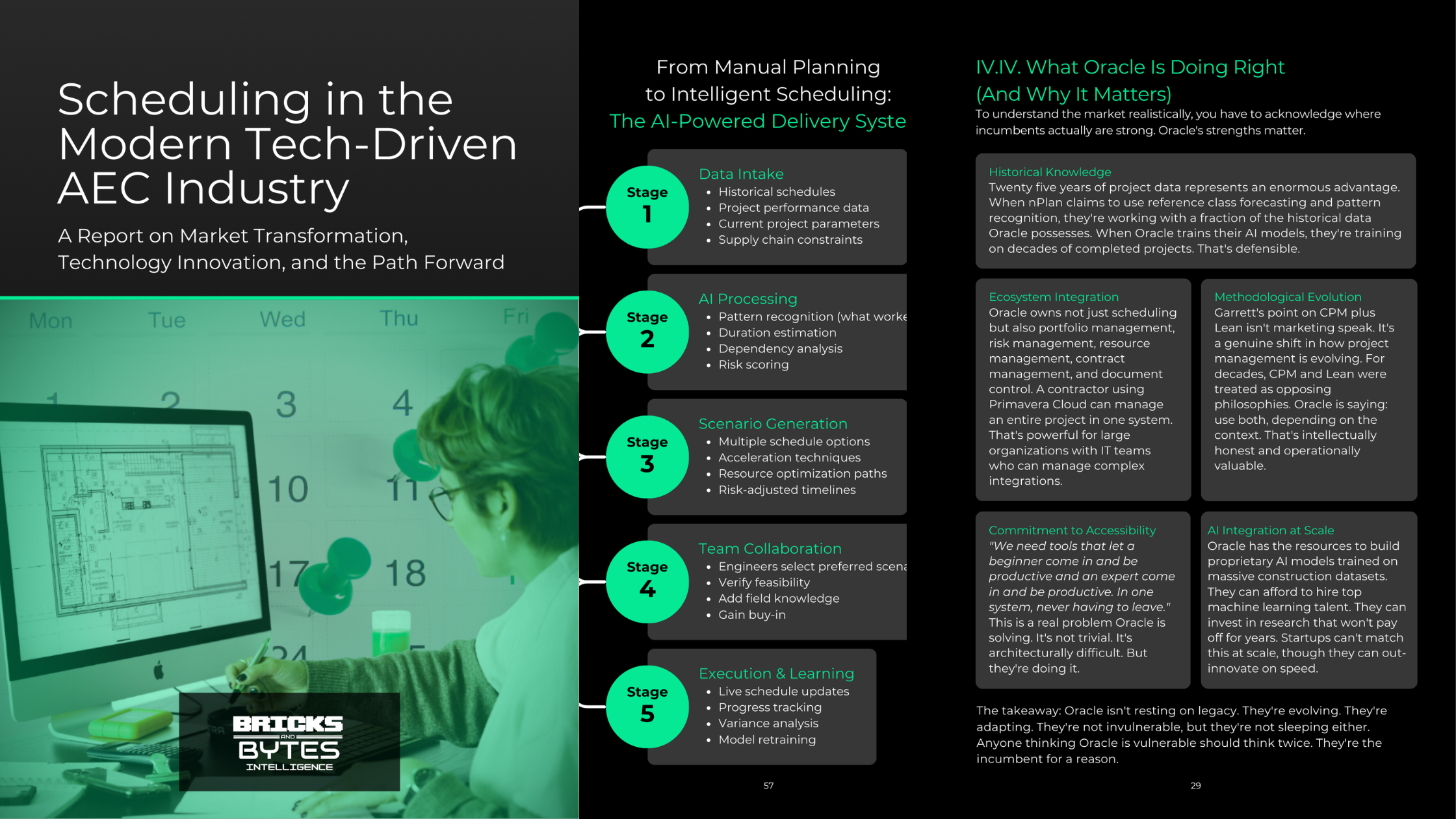
Get a FREE copy of our Scheduling in the Modern Tech-Driven AEC Industry: A Report on Market Transformation, Technology Innovation, and the Path Forward” (worth $150) and a FREE weekly email to stay up to date on construction tech. SIGN UP TODAY!

Scheduling in the Modern Tech-Driven AEC Industry

Sign up to the #1 Newsletter In AEC Tech. Join over 2,100 like-minded Founders, Investors and Techies disrupting the way we build. 

Scheduling in the Modern Tech-Driven AEC Industry