Author name: Owen Drury

bricks and bytes podcast thumbnail
Videos

What is Next for Bricks and Bytes Podcast

  Construction technology is constantly evolving, and we’re thrilled to announce some exciting updates to our podcast lineup. We’re currently preparing a series of episodes focused on document management, offering valuable insights into the future of this crucial aspect of the industry.   Our podcast landscape has undergone some changes to better serve our listeners. The Bricks and Bytes podcast channel, which previously released three episodes per week, has now been split into two distinct streams: Bricks, Buck and Bytes: Released every Friday in collaboration with Patrick from Fundamental, this podcast delves into specific construction tech topics. Bricks and Bytes: Our flagship podcast continues to cover a broad range of construction technology subjects in an open format. We invite you to visit our website to explore our diverse range of episodes and topics. Whether you’re interested in document management, cutting-edge construction technologies, or industry trends, our podcasts offer something for everyone in the construction tech space. Stay tuned for more updates and informative content as we continue to bring you the latest in construction technology

Newsletter

ICYMI: HoloBuilder’s $34M Secret, AI, Digital Drawings, and the Future

This Week’s Quickfire BytesFuel your curiosity with this week’s contentW/C 29th July 2024 NEW EPISODES: What Happens When AI Meets the Jobsite: July’s Construction Tech Monthly Roundup What if the next construction tech unicorn is bootstrapped and uses AI to revolutionise how we design buildings?  Rohan from Joist, a bootstrapped AI company, shows it’s possible in the construction proposal space. In our latest Bricks and Bytes monthly recap, Owen and Martin break down July’s most fascinating developments in construction technology, featuring conversations with industry leaders. open.spotify.com/episode/2Ak2GhIeksEGsfjHdbXr96 GUEST: HoloBuilder’s Path To $34m Exit, Mo Akbari’s Journey Building The Pioneering Reality Capture Tool Ever wonder how a startup goes from $8M to a big exit in construction tech? In this episode, we learned about HoloBuilder’s journey from raising $8M to being acquired by Faro. We also found out that despite big investments, the reality capture market still has room to grow. Companies like Cupix and Faro are leading, but there’s space for new ideas in robotics and AI. Plus, we got insights on how some VCs are betting on AI startups, hoping to find the next big winner. open.spotify.com/episode/3UbWiZmZIuAyMglUBn7Ng8 Why Robotics Might Solve Construction’s Labour Shortage & How AI and Digital Drawings Are Reshaping Construction Sites “AI will transform AEC so much, we won’t have the same industry in 5-10 years.” In this episode, we had Britton Langdon (SnapTrude) and Clifton Harness (TestFit) share their views on construction tech’s future. We explored AI’s impact, robotics in construction, and new ways to assess land deals. Britton, with his background in founding and selling M Suite, shared insights on AI’s practical applications in construction. Meanwhile, Clifton, driven by his developer father’s challenges, explained how TestFit is revolutionsing land deal assessments. open.spotify.com/episode/7dUHRlAIoXtBA7jCVkVsz1 View All Podcasts BRICKS & BYTES BULLETIN From Per-Seat to Pay What You Want: The Wild World of Pricing Models Pricing Models. Almost a taboo subject in construction tech. And one that definitely results in sleepless nights for the poor founders trying to navigate it. The truth is, there is no right (or wrong) model. In fact, I remember listening to a podcast with Toeey (Founder/CEO of Procore), who described their method of volume-based pricing as “contrarian” and one their customers don’t love. “It was so wildly unpopular with our customers even till this day some of our customers don’t love it but it is it is a it’s it’s the ultimate yard stick and we really believe in it” – Tooey Courtemanche on 20VC. If the true pioneer of construction tech says it. What hope do the rest of us have?  With that, let’s explore some some of our guests and industry thinker’s views on Pricing models in construction tech. (PS – if you just want the recommendations, scroll to the conclusion) Read Full Article 2 FAVORITE QUOTES: “I think just the expectation of some people is really to raise pre-seed with crazy evaluation numbers, which is not possible. I did the same thing. When I first came to Silicon Valley, I saw people are throwing cash at staff for nothing, which was not true.” – Mo Akbari Hochberg on the unrealistic expectations some founders have about fundraising “We’re doing as dumb things as in 2021 as an industry.“ – Patric Hellermann on how venture capital is repeating some of the mistakes made during the 2021 investment boom, particularly in relation to AI startups LATEST STORIES: From Computer Science to Construction: The HoloBuilder Story In the world of construction technology, few stories are as compelling as that of Mo Akbari Hochberg and HoloBuilder. It’s a tale of innovation, perseverance, and the power of seeing opportunity where others don’t. HammerTech Secures $70 Million Investment to Drive International Expansion Melbourne-based construction safety software company, HammerTech, has secured a significant US$70 million (AUD$105 million) growth investment from Riverwood Capital, a Californian private equity firm renowned for its focus on technology growth and scalability. The Role of AI in Construction: Will Incumbents or Startups Reap the Benefits? Artificial Intelligence is reshaping the construction industry. From project planning to risk assessment, AI is making its mark. But who will benefit most from this revolution? View All Articles BONUS CONTENTWhat Are Investors Betting On? OUR SPONSORS Shft — helping contractors like you leverage BIM to secure a leading position in the race towards construction’s digital future.  BuildVision — streamlining the construction supply chain with a unified platform for contractors, manufacturers, and stakeholders. Powered by beehiiv

tiger global management construction tech venture capitalist
Venture Capitalists, Venture

Tiger Global Management – Construction Tech Venture Capitalist

Introduction Tiger Global Management, founded in 2001, is a globally recognized investment firm focusing on both public and private equity markets. Known for its long-term investment approach, the firm targets high-quality companies leveraging technological innovations. Its mission is to generate world-class returns for investors while fostering pride among employees, partners, and portfolio companies. With over 20 years of experience, Tiger Global has invested in hundreds of businesses across more than 30 countries, contributing to over 90 IPOs. The firm is committed to identifying and supporting industry-leading innovators globally. Key Staff Members – Investors Chase Coleman III – Founder and Managing Partner John Curtius – Partner, Technology Scott Shleifer – Partner, Head of Private Equity Lee Fixel – Former Partner Scott Frantz – Partner, Head of Public Equity Alex Cook – Partner, Public Equity Key (AEC) Tech Investments Facebook An early investor in Facebook, Tiger Global capitalized on the social media giant’s explosive growth. Facebook’s subsequent IPO and continued dominance in the social media landscape exemplify a successful exit and substantial returns for the firm. JD.com Tiger Global’s investment in JD.com, one of China’s largest e-commerce platforms, highlights its strategic focus on global opportunities. JD.com’s rise to become a major player in China’s online retail market, supported by innovative logistics and technology, underscores the firm’s ability to identify and support scalable businesses. Spotify Investing in Spotify during its growth phase allowed Tiger Global to partake in the transformation of the music industry. Spotify’s expansion and eventual public listing through a direct listing provided significant returns, validating the firm’s investment strategy in disruptive technologies. LinkedIn Tiger Global’s investment in LinkedIn before its IPO was a strategic move into the professional networking space. LinkedIn’s acquisition by Microsoft for $26.2 billion in 2016 marked a significant success for the firm, demonstrating its knack for picking industry leaders early on. Stripe Investing in Stripe, a leading fintech company, highlights Tiger Global’s interest in financial technology innovations. Stripe’s growth into a major payment processing platform, valued at billions of dollars, showcases the firm’s foresight in backing companies that revolutionize traditional industries. Focus Area In Construction Tech Tiger Global Management focuses primarily on technology-driven sectors, seeking out companies that are at the forefront of innovation and industry transformation. Key areas of interest include: E-commerce Tiger Global targets companies that are reshaping the retail landscape through online platforms, emphasizing scalability and market reach. Fintech The firm invests heavily in financial technology startups that disrupt traditional banking and financial services, aiming to capitalize on the digital transformation of financial transactions and services. Software Enterprise and consumer software companies are a significant focus, particularly those offering SaaS solutions that enhance productivity and operational efficiency. Healthcare Technology Tiger Global is interested in companies that leverage technology to improve healthcare delivery, diagnostics, and patient management, aligning with the broader trend towards digital health. Consumer Internet Investments in social media, digital entertainment, and online marketplaces are critical, reflecting the shift towards digital consumption and interaction. Investment Strategy Tiger Global Management is a long-term investor focused on high-growth companies leveraging technology. They employ a hybrid approach, investing in both public and private markets globally to capitalize on growth opportunities. By prioritising rigorous analysis, active partnership, and a diversified portfolio across sectors like e-commerce, fintech, and healthcare technology, Tiger Global aims to identify and support companies with sustainable growth trajectories, ultimately driving significant returns and solidifying its position as a leading global investment firm. Investment Metrics Correct as of August 2024. AEC-Tech Activity Number of early AEC-Tech Unicorns: 0AEC-Tech Rank: 1 Deal Activity Number of deals in last 12 months (incl. follow-ons): 24Number of deals per year in last 3 years (average, incl. follow-ons): 166 Other Resources

tenderd construction tech startup logo
Startups

Tenderd: Innovative Equipment and Technology Solutions

  In the ever-evolving world of construction technology, one company stands out in the Middle East and beyond. Meet Tenderd, a pioneering force that’s reshaping how the construction industry operates. Founded in 2017 by industry veterans Arjun Mohan and Hamish Brewer, Tenderd has quickly become a trusted partner for construction projects across the region. But what sets this company apart?   A Vision for the Future of Construction Tenderd’s mission is clear: to revolutionise the construction industry through innovative solutions that boost efficiency, productivity, and sustainability. They’re not just dreaming of a better future – they’re building it. Comprehensive Services for Modern Construction Tenderd offers a wide range of services designed to meet the diverse needs of today’s construction projects: Heavy Equipment Rental: From excavators to cranes, Tenderd maintains a fleet of cutting-edge machinery available for short or long-term rental. Construction Technology: Their advanced solutions, including fleet management software and telematics systems, help companies optimise operations and cut costs. Project Management: Experienced project managers provide support from planning to quality control, ensuring projects run smoothly To describe Tenderd’s evolution, their initial approach when emerging from Y Combinator in 2018-2019 was similar to Equipment Share’s strategy in the US, but adapted for the Middle East market. They started as a rental marketplace for construction machinery. However, as they gained traction and scale, Tenderd was able to leverage their market position to identify and develop additional services that could potentially be even more effective or equally valuable for their customers Rapid Growth and Recognition Since its inception, Tenderd has experienced explosive growth. Key milestones include: 2017: Company founded 2019: Launch of construction technology division 2020: Awarded the Construction Week Innovation Award June 2024: Secured $30 million in Series A funding This latest funding round, led by A.P. Moller Holding, marks a significant milestone for Tenderd. The substantial investment will fuel the company’s expansion plans and drive the development of cutting-edge solutions for the construction industry. On a recent Bricks, Bucks, & Bytes episode, Patric noted:  “Tenderd is very successful. It’s probably the category leader in the Middle East. It used to start in the Emirates. Saudi Arabia is the big construction market that right now a lot of companies want to be in and that’s where Tendert seems to be the preferred supplier not just for Neon but perhaps also for other projects in the booming Saudi construction market.” The impressive Series A round underscores investor confidence in Tenderd’s vision and potential. With backers like A.P. Moller Holding, Y Combinator, Peter Thiel, and Stripe, Tenderd is well-positioned to accelerate its growth and innovation in the construction technology sector.   Commitment to Sustainability Tenderd isn’t just about efficiency – they’re also committed to promoting sustainable practices in construction. Their initiatives include: Fuel-Efficient and Low-Emission Equipment: Tenderd is continuously investing in state-of-the-art machinery that minimizes fuel consumption and reduces emissions. Renewable Energy Promotion: The company actively encourages the use of renewable energy sources on construction sites. Waste Reduction and Recycling Initiatives: Tenderd has implemented comprehensive waste management strategies, including: on-site waste sorting and recycling programs, training programs for clients on effective waste reduction techniques, and partnerships with local recycling facilities.   The Tenderd Advantage What sets Tenderd apart in the competitive construction tech landscape? First-mover advantage in the MENA region Deep understanding of local market needs Comprehensive suite of services, from equipment rental to advanced tech solutions Strong backing from strategic investors By leveraging these advantages, Tenderd has positioned itself not just as a service provider, but as a strategic partner in the construction industry’s digital transformation. Their unique combination of local expertise, technological innovation, and comprehensive services makes them a formidable player in the construction technology landscape, both in the MENA region and beyond.   Looking to the Future As Tenderd continues to grow, they’re well-positioned to expand their services and reach. Potential avenues include: Branching into new sectors like mining and agriculture Developing additional tech-driven services Expanding beyond the MENA region Reflecting on their potential, Tenderd has undergone a significant strategic shift. The company has transitioned from its initial focus to now providing comprehensive solutions for machinery management. This includes offering the equipment itself, along with advanced analytics tools. These tools monitor various crucial aspects such as productivity, safety measures, emission levels, and fuel consumption for both individual machines and entire fleets. This evolution has positioned Tenderd to offer more value-added services to their clients in the construction industry. While the road ahead presents challenges, such as market fluctuations and expansion complexities, Tenderd’s innovative approach and strong foundation make it a company to watch.        

Hammertech co-founders James Harris (left) and Ben Leach (right). Photo: Aaron Francis Photography
News, Founders & Operators, Venture

HammerTech Secures $70 Million Investment to Drive International Expansion

  Melbourne-based construction safety software company, HammerTech, has secured a significant US$70 million (AUD$105 million) growth investment from Riverwood Capital, a Californian private equity firm renowned for its focus on technology growth and scalability. This substantial financial injection is set to fuel HammerTech’s ambitious plans for global expansion and further product innovation. Company Background and Mission Founded in 2013, HammerTech has quickly emerged as a leader in the construction technology sector. The company offers a comprehensive safety management platform designed to streamline safety processes on construction sites. By integrating safety inspections, incident reporting, compliance management, and more, HammerTech’s platform enhances operational efficiency and promotes a safer working environment. Details of the Investment Riverwood Capital’s $70 million investment will significantly bolster HammerTech’s capabilities. This funding is earmarked for expanding the company’s presence in key international markets, including North America and Europe. CEO and Co-Founder Ben Leach emphasised that the investment marks a pivotal moment for the company, allowing it to scale its operations and continue its mission to improve safety in the construction industry. Leach stated, “This is a transformative investment that will enable us to enhance our platform with advanced technologies such as artificial intelligence, thereby providing even greater value to our clients and ensuring safer construction sites worldwide.” Strategic Goals and Market Opportunities HammerTech plans to leverage the new capital to intensify its research and development efforts. The focus will be on integrating cutting-edge technologies into their platform, which is already utilised by over 500 clients globally, including major contractors such as Shawmut Design and Construction, DPR Construction, and Hutchinson. The company aims to address the critical need for improved safety measures in the construction industry, which remains one of the most hazardous sectors. By enhancing its platform with AI and other advanced technologies, HammerTech seeks to simplify safety management processes and make them more effective. Industry Impact and Future Outlook Jeff Parks, Co-Founder and Managing Partner at Riverwood Capital, expressed his enthusiasm for the partnership, highlighting HammerTech’s vision and its potential to revolutionise construction safety. Parks noted, “HammerTech powers the safety programs for the most sophisticated construction firms in the world. We are excited to support their growth and help bring their innovative safety solutions to new markets.” Riverwood Capital’s involvement will also bring strategic guidance to HammerTech, as the private equity firm gains board representation. This partnership is expected to drive HammerTech’s expansion plans and solidify its position as a leader in the construction safety technology sector. In conclusion, HammerTech’s recent $70 million investment is a significant milestone in the company’s evolution. With a strong focus on innovation and a commitment to enhancing safety in the construction industry, HammerTech is well-positioned to capitalise on the growing demand for advanced safety solutions. This strategic investment will undoubtedly accelerate the company’s growth and ensure its continued success in making construction sites safer and more efficient.      

The HoloBuilder Team at the offsite week in Spain in 2019
Founders & Operators

From Computer Science to Construction: The HoloBuilder Story

  In the world of construction technology, few stories are as compelling as that of Mo Akbari Hochberg and HoloBuilder. It’s a tale of innovation, perseverance, and the power of seeing opportunity where others don’t. Mo’s journey began far from the dusty construction sites where his technology would eventually make its mark. With a background in computer science and a passion for basketball coaching, he was an unlikely candidate to revolutionise the construction industry. But sometimes, the most transformative ideas come from outsiders who bring fresh perspectives to age-old problems. “I have this big passion for computer science, for sports, and I see everything going on in Silicon Valley, being in Europe,” Mo recalls. “And I thought, ‘Okay, why can’t I combine this, take some computer scientists, create a team, and bring them to the first league, which is Silicon Valley?’” This ambitious vision led Mo to gather a team of talented computer scientists and make the leap across the Atlantic. However, their initial focus wasn’t on construction at all. The team was exploring various applications of augmented reality and machine vision, with no clear industry focus. It was a classic startup story of searching for product-market fit. The pivotal moment came almost by accident. “We found out when we put a platform out there for free, everybody was using one feature, which was 360 images on our platform,” Mo explains. This unexpected discovery would set the course for HoloBuilder’s future.   As they dug deeper, they realised that the construction industry was hungry for visual documentation solutions. In 2015, there was no easy-to-use platform for creating and managing 360-degree content in the construction space. HoloBuilder had stumbled upon an untapped market. The team quickly pivoted, focusing all their efforts on developing a solution tailored to the construction industry’s needs. Their timing couldn’t have been better. As Mo puts it, “Everybody wanted to pay for a free solution.” The demand was clear, and HoloBuilder was positioned to meet it. But the road ahead wasn’t smooth. Despite the clear market need, HoloBuilder faced significant challenges. They were operating in a capital-intensive industry with well-funded competitors emerging. Companies like OpenSpace were raising massive amounts of venture capital, while HoloBuilder took a more bootstrapped approach. In total, HoloBuilder raised only about $8 million across two funding rounds. This capital efficiency was both a blessing and a curse. On one hand, it allowed the company to maintain control and focus on building a product that truly met customer needs. On the other, it meant they had to be extremely strategic with their resources, often competing against rivals with much deeper pockets. Mo and his team had to navigate the delicate balance between achieving product-market fit and meeting investor expectations. The pressure to grow quickly and capture market share was immense, but they remained committed to building a sustainable business. Their persistence paid off. HoloBuilder gained traction with major customers, including airports and large construction firms. The company’s focus on user-friendly solutions and high-quality data management set them apart in a crowded field. In this episode of Bricks, Bucks and Bytes, we learned about HoloBuilder’s journey from raising $8M to being acquired by Faro. We also found out that despite big investments, the reality capture market still has room to grow.  As HoloBuilder’s reputation grew, it caught the attention of Faro, a leading provider of 3D measurement, imaging, and realisation technologies. The acquisition offer came at a crucial juncture for Mo and his team. They had a term sheet for another funding round in hand, but Faro’s offer presented an opportunity for a different kind of growth. The decision to sell wasn’t easy. Mo reflects on the process: “Two or three customers went in the same week to Faro and said, ‘Hey, it’s nice what you have, but actually we want this HoloBuilder thing.’ This customer demand was a key factor in Faro’s interest and ultimately in Mo’s decision to sell. After careful consideration of the opportunities and challenges ahead, Mo concluded, “We came to the conclusion that it was good timing for everybody to move out at that point.” The exit was a validation of HoloBuilder’s vision and the hard work of the entire team. Looking back on his journey, Mo offers valuable insights for other entrepreneurs in the construction tech space. First and foremost, he emphasizes the importance of focus. “Build your go-to-market as niche as possible,” he advises. In a complex industry like construction, trying to be all things to all people is a recipe for failure.     Equally important is the concept of adoption. “Adoption, adoption, adoption. That’s something people are really missing,” Mo stresses. It’s not enough to sell a product to construction firms; the real measure of success is whether people on job sites actually use and benefit from the technology. This focus on user adoption ties into Mo’s philosophy of creating products that people genuinely love to use. He draws an unexpected but apt comparison: “It should be like cake or burritos here on a job site, so everybody loves to use it or eat it. If you do free burritos or there’s a burrito truck a company paid for, everybody would line up and eat. That’s how it goes. And your product should be the same.” This “burrito truck philosophy” encapsulates Mo’s approach to product development and customer engagement. It’s about creating solutions that are not just useful, but that people actively want to engage with. In an industry often resistant to change, this user-centric approach can make all the difference.     Looking to the future, Mo sees both challenges and opportunities in the reality capture space. On one hand, he acknowledges that capture technology itself is becoming commoditized. The barriers to entry for creating 360-degree imagery or 3D scans are lower than ever. However, he also sees vast untapped potential. “Most construction sites do not have a reality capture solution,” Mo points out. Despite the progress made by HoloBuilder and others, there’s still

Go To Market, Newsletter, Startups

The Wild World of Pricing Models

INDUSTRY INSIGHTSFrom Per-Seat to Pay What You Want: The Wild World of Pricing Models Pricing Models. Almost a taboo subject in construction tech. And one that definitely results in sleepless nights for the poor founders trying to navigate it. The truth is, there is no right (or wrong) model. In fact, I remember listening to a podcast with Toeey (Founder/CEO of Procore), who described their method of volume-based pricing as “contrarian” and one their customers don’t love. “It was so wildly unpopular with our customers even till this day some of our customers don’t love it but it is it is a it’s it’s the ultimate yard stick and we really believe in it” Tooey Courtemanche on 20VC. If the true pioneer of construction tech says it. What hope do the rest of us have?  With that, let’s explore some some of our guests and industry thinker’s views on Pricing models in construction tech. (PS – if you just want the recommendations, scroll to the conclusion) Common Pricing Models Available To Construction Tech Companies Volume based pricingCharges a percentage of the total construction cost. This model scales with project size and can align with the value provided on larger projects. Per seat pricingA typical SaaS model where customers pay for each user (e.g., £500 per seat). This is straightforward but can limit adoption within organizations. Per project pricing Fees are based on the size or complexity of individual projects. This can be more intuitive for construction clients used to project-based budgeting. Value based pricing Charges based on the quantifiable value provided (e.g., “We save you £X, so we charge £Y”). This directly ties pricing to ROI but can be complex to implement. Processing based/Resource basedPricing is determined by the amount of computing resources or processing power used. This can be fair but may be difficult for clients to predict costs. Token based pricingCustomers purchase and expend ‘tokens’ to use various features. This allows for flexible usage but may require education for customers unfamiliar with the model. Pay What You Want Allows customers to determine the price they pay. While unconventional, it can build goodwill and potentially lead to higher average prices in some scenarios. Each of these models has its own strengths and challenges in the context of construction technology.  The choice depends on factors like the specific product, target market, and company goals.  In the following sections, we’ll explore insights from industry leaders on how they approach pricing in this unique sector. Tooey Courtemanche – CEO, Procore (for the record, Tooey hasn’t been a guest on Bricks & Bytes… yet. PPS Procore employees that read this, feel free to put in a good word ;))! Procore uses volume-based pricing rather than typical per-seat models used by most SaaS companies Volume-based pricing is wildly unpopular with customers However, they believe it is the ultimate yardstick and gives customers flexibility to scale Procore usage up and down It allows everyone to be connected; only the main customer pays and all other team members and collaborators get a seat Fun Fact: Tooey still gets on calls occasionally with customers who wish they had a different pricing model, indicating it remains somewhat controversial. Dev Amratia – Co Founder, CEO nPlan (episode coming soon) nPlan’s approach to pricing is both structured and flexible. They offer two main product tiers: a core version priced at around $500 per month, and  a pro version that reaches into six figures. The core version provides basic functionality, such as probabilistic project schedule visualidation, while the pro version offers advanced features including a recommendation engine, deep insights, management plans, and comprehensive reporting systems. Dev emphasises that their pricing strategy was developed through an iterative process, constantly seeking customer input on what they’d be willing to pay. For their premium offering, they initially used consultant fees as a benchmark, aiming to provide a more cost-effective and efficient solution than traditional consulting. When it comes to advice for other entrepreneurs in the construction SaaS space, Dev offers several key points: Expect your initial pricing to be incorrect Iterate rapidly with customer feedback Actively seek opinions on fair pricing Ensure your pricing isn’t too low by making sure some potential customers decline nPlan views their model as a hybrid between SaaS and outcome-based service, particularly for their high-end pro version. Dev notes that they’re still in the experimental phase with their SaaS model for the lower-cost offering, emphasizing the importance of finding the right market fit and being open to trying different approaches. Ultimately, Dev stresses that pricing is an ongoing process of refinement and adjustment. He believes that you never truly perfect your pricing strategy, but rather continuously evolve it to meet market demands and reflect the value you provide. Patric Hellermann – General Partner, Foundamental From this episode and this episode. A take on subscription-based pricing. In these episodes, Patric notes that most VCs prefer recurring subscription revenue, with a preference for annual subscriptions due to their reliability. However, some VCs favor monthly subscriptions as they allow for better churn control. Patric also discusses alternative pricing models, such as token-based systems where customers purchase tokens to access software or specific features. He highlights the growing popularity of hybrid models, which typically combine a base subscription or freemium model for basic features with a pay-as-you-go option for additional functionalities. When it comes to subscription pricing, Patric outlines three main approaches: Feature-based pricing Usage-based pricing Seat-based pricing While presenting these common approaches, Patric emphasises that this is a general overview rather than a specific recommendation. He acknowledges that variations and different approaches may be necessary depending on the specific product and market.  The key takeaway is that pricing strategies should be tailored to the unique characteristics of each construction tech solution and its target market. Rohan Jawali – Founder, Joist AI Joist uses headcount as a proxy for company revenue, which informs their pricing structure.  Interestingly, Rohan candidly admits that their current model was chosen as “the laziest approach,” indicating that they’re

Newsletter

ICYMI: €5.7M Investment, AI, Robotics, and Industry Insights

This Week’s Quickfire BytesFuel your curiosity with this week’s contentW/C 22nd July 2024 NEW EPISODES: Why Robotics Might Solve Construction’s Labour Shortage & How AI and Digital Drawings Are Reshaping Construction Sites “AI will transform AEC so much, we won’t have the same industry in 5-10 years.” In this episode, we had Britton Langdon (SnapTrude) and Clifton Harness (TestFit) share their views on construction tech’s future. We explored AI’s impact, robotics in construction, and new ways to assess land deals. Britton, with his background in founding and selling M Suite, shared insights on AI’s practical applications in construction. Meanwhile, Clifton, driven by his developer father’s challenges, explained how TestFit is revolutionsing land deal assessments. open.spotify.com/episode/7dUHRlAIoXtBA7jCVkVsz1 €5.7M VC Bet To Retrofit Europe’s Housing Stock, “Pay What You Want” models and Nemetschek to India Could a “Cloud Installer” approach help insulate 30 million European homes faster? In this episode of Bricks, Bucks and Bytes, we learned about Varm’s €5.7M seed round for their innovative insulation business. They’re using a “Cloud Installer” approach to scale across Europe. We also discussed Nemetschek Group entering India’s construction software market, starting with university partnerships. Plus, Patric Hellermann shared why he’s excited about Varm and his thoughts on “pay what you want” pricing for software. open.spotify.com/episode/6lvX3xrJKt3wHzLXb1I1Mc Will AI Replace Construction Managers? – Amir Berman, Go-To-Market Strategist At Buildots In this episode, Amir Berman of Builddots challenges the status quo in construction technology. We explore how AI and data are silently revolutionizing the industry, despite widespread skepticism. Amir shares lessons from his failed startup, proposing controversial new models for ROI and product management in construction tech. We delve into the clash between digital solutions and physical realities and uncover strategies to bridge this divide. open.spotify.com/episode/6AuYlB1xdgDsv4OaQjVUf View All Podcasts BRICKS & BYTES BULLETIN $121m Buildot’s 5 Key Strategies for Successful Product Management On last week’s episode of Bricks & Bytes, we were joined by Buildots’ Director of Strategy and Go-to-Market, Amir Berman. Amir took us on a journey of the complex field of product management and development in construction tech. In this week’s bulletin, we explore Buildots’ approach. One that’s led them to over $121m in funding since 2019, as they march toward progress tracking dominance. “Think about a different digital product that you might have been building on a different life. Let’s say that you were the product manager for Gmail,” Berman explains. “Now take it back, for example, for construction. You’re building usually online products 90% of the time for clients that will interact with it and their product is completely offline.” This fundamental disconnect between digital solutions and physical construction projects is at the heart of the challenge. Read Full Article 2 FAVORITE QUOTES: “You can either have a leaky bucket and kind of stir the water in that leaky bucket… or you can just basically fix the leaky bucket and put more water in. And the latter is what VARM does.” – Patric Hellerman on VARM’s approach to addressing labour shortages in the trades “I think what will happen is we’re going to have a lot more architects and fewer massive companies.“ – Clifton Harness forecasting a shift in the industry structure due to AI advancements. LATEST STORIES: The Story Of Tom Deane – Founder & CEO, ProjectMark Tom Deane’s story is one of entrepreneurial spirit, international ambition, and a deep understanding of the construction industry. As the co-founder of ProjectMark, a cutting-edge CRM software tailored for the construction sector, Deane’s journey from Ireland to Silicon Valley exemplifies the global nature of today’s startup ecosystem. The Rise of Supply Chain Visibility Tools in Construction: Lessons from Matrak and Infra.Market In today’s complex construction landscape, supply chain visibility is no longer a luxury—it’s a necessity. As projects grow in scale and complexity, the need for real-time tracking and efficient material management has never been more critical. The OPTIMA Framework: Tools, Measurement, and Putting It All Together (Part 3) Welcome to the final installment of our OPTIMA framework series. We’ve explored Objectives, People, Targeted outcomes, and Integrated processes. Now, let’s dive into the last two elements: Modern tools and Accurate measurement. View All Articles BONUS CONTENTWhat Are Investors Betting On? OUR SPONSORS Shft — helping contractors like you leverage BIM to secure a leading position in the race towards construction’s digital future.  BuildVision — streamlining the construction supply chain with a unified platform for contractors, manufacturers, and stakeholders. Powered by beehiiv

ai in construction
Technology

The Role of AI in Construction: Will Incumbents or Startups Reap the Benefits?

  Artificial Intelligence is reshaping the construction industry. From project planning to risk assessment, AI is making its mark. But who will benefit most from this revolution? Will it be the established giants or nimble startups? Let’s dive in and explore this burning question.   The AI Revolution in Construction AI isn’t just a buzzword in construction anymore. It’s a reality. Today, AI helps predict project delays, optimises resource allocation, and even controls autonomous equipment. According to a recent McKinsey report, AI could boost the construction industry’s profits by 71% by 2035.   The Incumbent Advantage: Giants Ready to Flex Established players like Autodesk and Procore aren’t sitting idle. They have three aces up their sleeves: Data Goldmine: Years of project data to feed AI algorithms. Deep Pockets: Resources to invest in cutting-edge AI research. Loyal Customer Base: A ready market for new AI-powered features. As Peter Drucker, a renowned management consultant, educator, and author, notes, “The big players have the data and the distribution channels. That’s hard to beat.”   The Startup Edge: David vs. Goliath But don’t count out the startups just yet. They bring their own strengths to the table: Agility: Quick to adapt to new technologies and market needs. Focus: Specialised solutions for niche problems. Innovation: Fresh approaches unencumbered by legacy systems Remember, every incumbent was once a startup. Could the next Autodesk be born from the AI revolution?     Key Battlegrounds: Where AI Meets Brick and Mortar So, where exactly is AI making waves in construction? Let’s look at three key areas: Project Planning: AI-powered tools optimising schedules and resource allocation (Kwant, Versatile, Zepth) Safety: Predictive algorithms identifying potential hazards before they occur (Smartvid.io, Pillar Technologies, Doxel) Design: Generative AI creating optimised building designs (Augmenta, Spacemaker) In each of these areas, we see both incumbents and startups making moves. But who’s gaining the upper hand? Kwant, is a construction workforce management software that uses AI-driven insights and wearables to increase safety, productivity and compliance.   Data: The New Concrete in Construction In the world of AI, data is king. And in construction, project data is gold dust. Incumbents have mountains of it. Startups? Not so much. But here’s the twist: it’s not just about quantity. It’s about quality and how you use it. As Camille Maréchal boldly puts it, “We may have less data, but we’re better at making it talk.”   Distribution Channels: The Hidden Battleground Here’s something you might not have considered: distribution channels. As Patric Hellerman points out in a Bricks, Bucks & Bytes episode : “Whoever builds insanely efficient distribution and a distribution that is relevant through touch points within construction will reap the benefits of AI.” Incumbents have established networks. But startups? They’re building new, AI-native channels that could leapfrog traditional methods. In this episode, Patric Hellermann of Foundamental, explored the complex world of construction tech, energy infrastructure, and global market trends.   Case Studies: AI in Action Let’s look at two examples: Incumbent Success: Autodesk’s AI-powered tool, Construction IQ, is making waves in the industry. One of its early adopters, BAM Ireland, a major player in general contracting and civil engineering, has seen impressive results. By leveraging machine learning to break down traditional data silos, the firm achieved a significant 20% decrease in quality and safety issues across their projects. Startup Sensation: In a case study shared by Doxel, their autonomous robot scanning helped supervise construction on a multi floor medical office building in San Diego, California. The robot could scan the entire site in 4.5 hours every day. This resulted in a 38% increase in labour productivity over the original project budget estimate, allowing the project to come in 11% under budget Both are impressive, but taking very different approaches.   Challenges: It’s Not All Smooth Sailing Implementing AI isn’t a walk in the park. Both incumbents and startups face hurdles: Integration with existing systems Workforce adaptation and training Data privacy and security concerns     The Future of AI in Construction Let’s be clear: AI isn’t about to replace construction workers. It’s about augmenting human expertise. So, what does the future hold? Here are our predictions: Collaboration, Not Just Competition: We’ll likely see incumbents acquiring or partnering with AI startups. Specialisation: AI solutions will become more tailored to specific construction niches. Democratisation: AI tools will become more accessible to smaller construction firms.   The Verdict: It’s Not Winner-Takes-All In the AI race, there’s room for both incumbents and startups to thrive. Incumbents have the resources and data, but startups bring innovation and specialisation. The real winners? Construction firms that can effectively leverage AI, regardless of its source. Key Takeaways: AI is transforming construction, from planning to execution. Incumbents have data and resources; startups offer innovation and agility. Success in AI isn’t just about technology, but also about distribution and industry understanding. The future likely involves collaboration between incumbents and startups.        

Go To Market, Newsletter, Startups

$121m Buildot’s 5 Key Strategies for Successful Product Management

INDUSTRY INSIGHTS $121m Buildot’s 5 Key Strategies for Successful Product Management On last week’s episode of Bricks & Bytes, we were joined by Buildots’ Director of Strategy and Go-to-Market, Amir Berman. Amir took us on a journey of the complex field of product management and development in construction tech. In this week’s bulletin, we explore Buildots’ approach. One that’s led them to over $121m in funding since 2019, as they march toward progress tracking dominance “Think about a different digital product that you might have been building on a different life. Let’s say that you were the product manager for Gmail,” Berman explains. “Now take it back, for example, for construction. You’re building usually online products 90% of the time for clients that will interact with it and their product is completely offline.” This fundamental disconnect between digital solutions and physical construction projects is at the heart of the challenge. Here are five key strategies for successful product management in construction tech: 1. Bridge the Digital-Physical Divide The most successful construction tech products seamlessly connect digital plans with on-site realities. This requires a deep understanding of both the tech and construction worlds. Berman emphasises, “The biggest challenge is that you need to constantly take your users back and forth between their offline perception of life and the online perception of life.” To address this: Spend time on construction sites to understand the physical realities Involve construction professionals in your product development process Design interfaces that mirror physical construction workflows 2. Ensure Product Resilience Construction projects are dynamic, with frequent changes and unexpected challenges. Your product needs to be flexible enough to handle these discrepancies. “No schedule and no 3D model is 100% to the point exactly as it is in reality,” Berman notes. “And even the schedule and the models themselves as an intent, they have their own flaws.” To build resilience into your product: Anticipate and plan for common discrepancies Build in flexibility to handle changes Regularly test your product against real-world scenarios 3. Iterate Quickly and Efficiently While construction projects move slowly, tech products need to evolve rapidly. Balancing these different paces is crucial. Berman advises, “The whole idea is to try to be very, very lean and very, very fast and to test ideas and concepts in the market with whatever you can and invest as little as much from an energy standpoint and financial obligation from the other aspect.” To iterate effectively: Set up quick feedback loops with users Use prototypes and MVPs to test ideas rapidly Balance quick wins with longer-term development goals 4. Focus on Clear, Measurable ROI In an industry with tight margins, demonstrating clear ROI is crucial for product adoption. “The biggest challenge was creating a very, very clear ROI formula for our clients,” Berman states. “And we were very strict with that ROI formula.” To develop and communicate ROI: Work with clients to identify key performance indicators Develop case studies that showcase tangible benefits Align your pricing model with value creation (BuildDots, for instance, prices based on construction volume rather than per user) 5. Align Product Development with Industry Needs Successful products in construction tech solve real, pressing problems in the industry. Berman reflects on his previous startup: “We had a very, very good idea, but we just took like too big of a challenge from our standpoint.” To stay aligned with industry needs: Regularly engage with construction professionals at all levels Stay updated on industry trends and challenges Balance innovation with practical, immediate needs Implementing These Strategies Starting with these strategies requires a shift in mindset. “You need to be able to move really fast into execution,” Berman advises. “So if you’re picking up something too big, too vast for you to chew, means that you will choke along the way like we did.” Common pitfalls to avoid include: Assuming digital solutions will seamlessly translate to physical environments Overlooking the importance of change management in construction organizations Prioritizing features over solving real industry problems The long-term benefits of these strategies are significant. As Berman notes, “I’m on a mission to kind of help this industry transform itself to make better decisions based on data.” By bridging the digital-physical divide, ensuring product resilience, iterating quickly, focusing on ROI, and aligning with industry needs, product managers in construction tech can create solutions that truly transform the industry. The future of product management in construction tech is bright, but challenging. As the industry continues to digitise, the need for innovative, practical solutions will only grow. By following these strategies, product managers can position themselves at the forefront of this transformation, creating products that not only meet the needs of today’s construction industry but help shape its future. As Berman concludes, “Now you can define what’s the end, but for me the end, it goes through increase of business volume… Eventually that’s it. So my growth personally moved from being product manager, leading product group into like, let’s try to work together in this industry to transform it to a better situation like in a decade.” Interested in learning more? Check out the full episode with Amir Berman 👇 Listen Now WEEKLY MUSINGSBig Bets on Tomorrow’s Tech A record half-year Patric Hellermann on LinkedIn: #aec #construction #contech #vc #funding | 18 comments H1-2024 is in the rearview mirror. Super proud what the Foundamental family achieved in the last 6 months, counter-cyclically to a continued challenging… | 18 comments on LinkedIn Firing up the 1M home insulation goal noa (formerly A/O) on LinkedIn: #climatetech #retrofit #startups #fundraisingnews #investment We’re excited to continue supporting VARM in their €5.7 million Seed round after co-leading their previous round last year, together with our friends at… $15M for smarter construction Aviv Leibovici on LinkedIn: I’m thrilled to announce that Buildots has secured $15M in funding led by… I’m thrilled to announce that Buildots has secured $15M in funding led by Intel Capital, with participation from OG Venture Partners and previous investors. We… RESEARCH Data-driven Collaboration for Construction Projects Speckle

Foundamental Logo
Venture Capitalists, Venture

Foundamental – Construction Tech Venture Capitalist

Introduction One of the leading construction tech venture capitalists, Foundamental is a leading venture capital firm focused on investing in technology and innovation in the Architecture, Engineering, and Construction (AEC) sectors. Committed to transforming the real world, Foundamental partners with exceptional founders to support groundbreaking ventures globally. The firm’s investment strategy spans from early-stage to growth rounds, fostering startups that innovate in construction, renovation, blue-collar workforce, logistics, and robotics. Foundamental’s portfolio boasts numerous success stories, highlighting its impact on the AEC industry and as a construction tech venture capitalist. Key Staff Members – Investors General Partners Patric Hellermann – General Partner Shub Bhattacharya – General Partner Adam Zobler – General Partner Key AEC Tech Investments Infra.Market (Core AEC, 2020) Infra.Market, often dubbed the ‘Amazon of Construction,’ has grown into a $2.5 billion enterprise. This platform streamlines the procurement of construction materials, making it easier for businesses to access high-quality supplies efficiently. Infra.Market’s innovative approach has attracted substantial follow-on funding, showcasing its disruptive potential in the construction industry. TazaPay (Supply Chain & Logistics, 2021) Tazapay is revolutionizing cross-border payments in the Asia-Pacific region. By offering secure and seamless payment solutions, Tazapay empowers global trade, ensuring smooth financial transactions across different geographies. Its robust technology has garnered support from major investors like Sequoia Capital Southeast Asia. Enter Enter focuses on energy-efficient renovation solutions in Europe. Utilizing data-driven insights, Enter designs and implements systems that significantly reduce energy consumption. The company has successfully raised a €19.4 million Series A round to expand its operations, reflecting its growing influence in the green tech space. Speckle Speckle is at the forefront of 3D design technology, providing an open-source platform for managing 3D drawings. This innovation facilitates collaboration and efficiency in architectural design, making it a crucial tool for modern construction projects. Speckle’s seed funding of $5.5 million underscores its potential to reshape the industry. Welcome Welcome Homes simplifies the home-building process with a user-friendly platform that allows users to design and build homes online. This North American startup has raised $29 million, demonstrating its appeal and the market’s demand for streamlined residential construction solutions. Snaptrude Snaptrude is enhancing building design with collaborative tools that enable real-time model and blueprint creation. Its innovative approach has attracted significant investment, positioning it as a strong contender against traditional design platforms. Auba Auba leverages AI to mitigate disruptions in global supply chains, providing comprehensive data overviews for companies. This North American startup’s technology addresses critical pain points in logistics, ensuring smoother operations and increased resilience against unforeseen challenges. Focus Area In Construction Tech Foundamental’s investment focus covers five key verticals that drive real-world transformation: 3D and Design Investing in technologies that revolutionize architectural design and modeling, enabling better collaboration and efficiency. Construction Supporting innovations in building processes, materials, and methods to enhance construction efficiency and sustainability. Renovation Focusing on energy-efficient and cost-effective renovation solutions to meet the growing demand for sustainable living spaces. Blue-Collar Workforce and Robotics Empowering the workforce with advanced tools and robotics to improve productivity and safety in construction and related fields. Supply Chains and Logistics Streamlining logistics and supply chain management with cutting-edge technologies to ensure seamless operations in the construction industry. Investment Metrics Correct as of August 2024. AEC-Tech Activity Number of early AEC-Tech Unicorns: 4AEC-Tech Rank: 3 Deal Activity Number of deals in last 12 months (incl. follow-ons): 22Number of deals per year in last 3 years (average, incl. follow-ons): 31 Investment Strategy Foundamental’s investment philosophy is centered around partnering with visionary founders who are dedicated to reimagining the AEC sector. The firm believes in the potential of early-stage investments, providing substantial support from day zero to help startups navigate their initial challenges. Foundamental’s approach involves deep market embedding and global collaboration, leveraging cross-border knowledge transfer to maximize the impact of their investments. This strategy not only nurtures individual startups but also contributes to the broader advancement of the construction technology ecosystem. By focusing on high-impact areas and maintaining a global perspective, Foundamental positions itself as a catalyst for innovation in the AEC industry. Other Resources

construction supply chain management
Technology, Startups

The Rise of Supply Chain Visibility Tools in Construction: Lessons from Matrak and Infra.Market

  In today’s complex construction landscape, supply chain visibility is no longer a luxury—it’s a necessity. As projects grow in scale and complexity, the need for real-time tracking and efficient material management has never been more critical. Enter supply chain visibility tools, the game-changers revolutionising how we manage construction projects. Let’s explore this trend through the lens of two industry leaders: Matrak and InfraMarket.   The Supply Chain Challenge Before diving into solutions, let’s set the scene. Construction projects often face delays and cost overruns due to supply chain issues. Late deliveries, misplaced materials, and poor inventory management can throw even the most well-planned project into chaos. This is where visibility tools come in, offering a lifeline to project managers drowning in logistics nightmares.   In this episode, Owen, Martin, and Shub discuss the Australian company Matrak, which focuses on supply chain management in the construction industry.   Meet Some of the Pioneers: Matrak and InfraMarket Matrak, an Australian startup, and InfraMarket, an Indian powerhouse, are at the forefront of this revolution. While they operate in different markets, both share a common goal: bringing clarity to construction supply chains. Matrak: The Real-Time Tracker Founded in 2017, Matrak offers end-to-end visibility of construction materials. Their platform integrates with design drawings, linking every component to its real-time location in the supply chain. This means project managers can zoom in on a 3D model and instantly see if a specific window frame is in production, transit, or ready for installation. InfraMarket: The Marketplace Maestro InfraMarket, on the other hand, takes a marketplace approach. Since 2016, they’ve been connecting suppliers with contractors, streamlining the procurement process. Their platform doesn’t just track materials—it helps source them too, addressing supply chain issues before they even begin.   Key Features Face-Off While both Matrak and InfraMarket aim to improve construction supply chains, they offer unique approaches and features: Matrak: End-to-End Visibility: Matrak provides real-time tracking from design to installation. 3D Model Integration: Users can zoom in on specific components in a 3D model to check their status. QR Code and IoT Tracking: Utilizes advanced tracking technologies for precise location data. Design-Supply Chain Link: Connects design drawings directly to the supply chain status. Schedule Integration: Links material status to project schedules for better planning. Matrak’s platform can be viewed as a fusion of project management tools with supply chain tracking. It aims to consolidate various construction workflows into a single, centralised system. This approach seeks to streamline processes by bringing together different aspects of project management and material tracking in one cohesive platform. Matrak connects construction teams for instant updates InfraMarket: B2B Marketplace: Connects suppliers directly with contractors, streamlining procurement. Wide Product Range: Offers dozens of categories including structural materials, interior finishes, and machinery. Working Capital Optimisation: Provides flexibility in receivables and payables management. Export Capabilities: Facilitates international trade of construction materials. B2C Expansion: Developing a retail arm to serve smaller contractors and individual buyers. Highlighting InfraMarket’s success, Patric notes, “InfraMarket currently has multiple billion dollars of annual revenue, and they are net profitable. And they are actually not net profitable once or randomly. They have been net profitable for almost the entire lifetime of the company.”   Infra.Market’s tile manufacturing process from warehouse to delivery Both platforms excel in different areas, with Matrak focusing more on granular tracking and visualisation, while InfraMarket emphasises the procurement and marketplace aspects of the supply chain.   Stakeholder Benefits These tools aren’t just fancy tech—they’re solving real problems: For Contractors: Reduced delays Better cost control Improved project planning For Suppliers: Streamlined order management Improved cash flow Better demand forecasting For Project Managers: Real-time visibility Proactive issue resolution Enhanced team coordination   Overcoming Implementation Hurdles Adopting new technology isn’t always smooth sailing. Common challenges include: Resistance to change Integration with existing systems Training and onboarding Both Matrak and InfraMarket address these issues through user-friendly interfaces, robust support systems, and gradual implementation strategies. Key Takeaways Visibility is crucial: Real-time tracking is no longer optional in modern construction. Integration is key: Look for tools that work seamlessly with your existing systems. Think beyond tracking: The best platforms offer additional value, like procurement optimization. Prepare for AI: The next wave of innovations will leverage artificial intelligence for even greater insights.   The Future is Bright (and Visible) As AI and machine learning evolve, so too will these platforms. Imagine predictive analytics foreseeing supply chain disruptions before they happen, or autonomous procurement systems optimising orders in real-time. The possibilities are endless. Supply chain visibility tools are revolutionising the construction industry, going beyond mere efficiency improvements. These technologies are reshaping the entire approach to project management in construction. Companies that are quick to adopt and integrate these tools into their operations are likely to emerge as the frontrunners in the industry’s future landscape.        

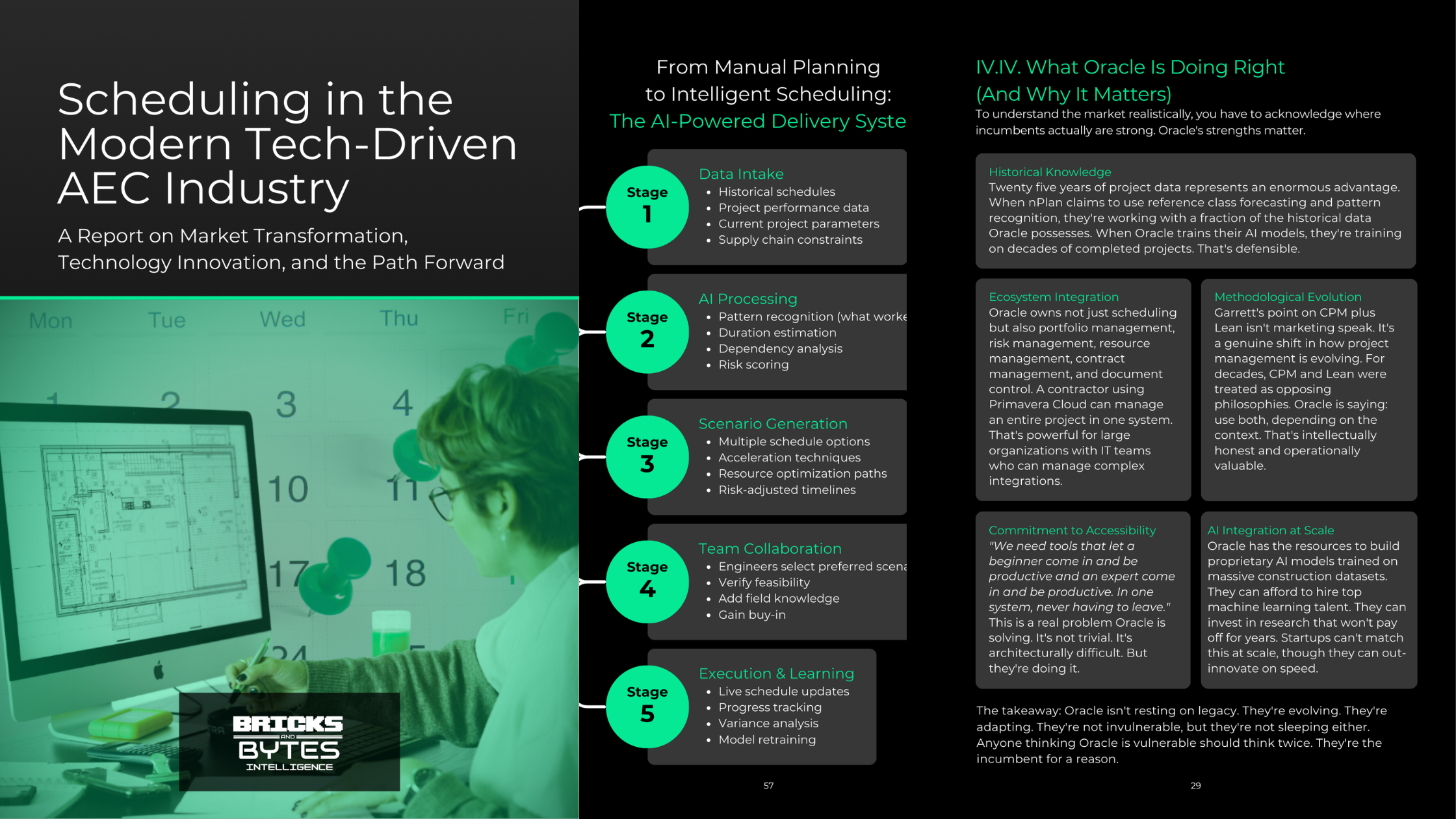
Get a FREE copy of our Scheduling in the Modern Tech-Driven AEC Industry: A Report on Market Transformation, Technology Innovation, and the Path Forward” (worth $150) and a FREE weekly email to stay up to date on construction tech. SIGN UP TODAY!

Scheduling in the Modern Tech-Driven AEC Industry

Sign up to the #1 Newsletter In AEC Tech. Join over 2,100 like-minded Founders, Investors and Techies disrupting the way we build. 

Scheduling in the Modern Tech-Driven AEC Industry