
Author name: Owen Drury

8vc construction tech venture capitalist
Venture Capitalists, Venture

8VC – Construction Tech Venture Capitalist

Introduction 8VC is a venture capital firm focused on investing in and building transformative technology and life sciences companies. Founded with a vision to solve the world’s most pressing problems, 8VC partners with leading entrepreneurs and innovators to create impactful solutions across various industries. With a strong emphasis on long-term value creation, 8VC aims to leverage technology to drive significant economic and societal advancements. The firm’s approach combines deep industry expertise with a commitment to supporting its portfolio companies through their growth journeys, from early-stage investments to market leadership. Key Staff Members – Investors Joe Lonsdale – Managing Partner Kimmy Scotti- Founding Partner Drew Oetting – Managing Partner David Moskowitz – Partner Jake Medwell – Founding Partner Key (AEC) Tech Investments 8VC has made significant investments in the AEC (Architecture, Engineering, and Construction) technology space, particularly focusing on companies that are revolutionising how infrastructure is built and managed. The Boring Company Founded by Elon Musk, The Boring Company is working on advanced tunneling and infrastructure projects, aiming to reduce traffic congestion through underground transportation systems. 8VC’s investment supports the company’s innovative approach to solving urban transportation challenges. Kojo (formerly Agora) Kojo is a construction technology platform that streamlines procurement for contractors. By digitizing the materials management process, Kojo helps reduce costs, minimize delays, and increase efficiency in construction projects. This investment aligns with 8VC’s focus on improving operational efficiency in the construction industry. Petra Petra is a company that develops advanced tunneling technologies to cut through hard rock. Its innovative approach aims to make tunneling faster, safer, and more cost-effective. 8VC’s backing of Petra underscores its commitment to investing in technologies that can significantly enhance infrastructure development. Focus Area In Construction Tech 8VC invests across a diverse range of industries, focusing on sectors where technology can drive substantial improvements and create lasting value. Key areas of interest include: Healthcare and Life Sciences Investing in companies that are transforming healthcare delivery, medical technology, and life sciences, aiming to improve patient outcomes and accessibility to care. Enterprise and IT Infrastructure Supporting businesses that are innovating in cloud computing, cybersecurity, and enterprise software, enabling organizations to operate more efficiently and securely. Logistics and Manufacturing Backing companies that are revolutionizing supply chain management, logistics, and manufacturing processes through automation and advanced technologies. Financial Services Investing in fintech companies that are reshaping financial services, providing more inclusive and efficient solutions for consumers and businesses. Government and Defense Focusing on technologies that enhance national security, defense capabilities, and government operations, ensuring safer and more effective public services. Investment Strategy 8VC’s investment strategy is centered on identifying and partnering with visionary entrepreneurs who are developing solutions to complex, large-scale problems. The firm employs a hands-on approach, providing not only capital but also strategic guidance, operational support, and access to an extensive network of industry experts and resources. Key elements of 8VC’s investment philosophy include: Long-term Commitment: 8VC is dedicated to supporting its portfolio companies through their entire growth journey, from seed stage to IPO and beyond, ensuring they have the resources and guidance needed to succeed. Collaborative Partnerships: The firm fosters a collaborative environment, working closely with founders to refine their business models, scale operations, and navigate challenges. Innovation-Driven: 8VC prioritizes investments in cutting-edge technologies and disruptive business models that have the potential to create significant economic and societal value. Impact Focused: The firm seeks investments that align with its mission of solving critical global challenges, ensuring that its portfolio companies contribute positively to society. By combining these principles, 8VC aims to build a portfolio of high-impact companies that drive innovation and create lasting value across various industries. Investment Metrics Correct as of August 2024. AEC-Tech Activity Number of early AEC-Tech Unicorns: 0AEC-Tech Rank: 6 Deal Activity Number of deals in last 12 months (incl. follow-ons): 38Number of deals per year in last 3 years (average, incl. follow-ons): 53 Other Resources


AECS and ConTech Funding Statistics for Q2 2024
Venture

Analysis of AECS and ConTech Funding Statistics for Q2 2024: A Sector on the Rise

  The Architecture, Engineering, Construction, and Supply Chains (AECS) sector, along with ConTech, has been making waves in the venture capital world. As we dive into the Q2 2024 funding statistics, we’re seeing a landscape that’s not just growing but thriving. This analysis is based on highlights from Foundamental’s “The State of AECS-Tech and Constru-Tech in Q2 2024 ⎟VC Funding Statistics” report, offering valuable insights for industry stakeholders, investors, and entrepreneurs alike.   Q2 2024 Funding Overview: Breaking New Ground The AECS-Tech sector has hit a remarkable milestone, surpassing $34 billion in total cumulative venture capital funding. This represents a significant leap from the $30 billion recorded in Q4 2023, underscoring the sector’s robust growth trajectory. Patric Hellermann puts this growth into perspective: “With the 34 billion that we crossed, we’re exactly on track to the pattern that we as fundamental predicted five years ago, which is it will take us six to eight years to get to 50 billion.”   Market Share Analysis: A Rising Star in the VC World One of the most striking statistics from the Q2 2024 report is the sector’s market share. AECS-Tech now represents 0.53% of total venture capital, doubling its previous percentage. This growth is particularly noteworthy given the competitive nature of the VC landscape. As Patric notes, “We never had these peaks a few years ago. And so that to me is a very important indicator that tells me that, actually capital allocators are spending more and more money into our sector. Funding Trends: Consistent Growth in a Fluctuating Market Since 2021, the AECS-Tech sector has consistently achieved quarterly funding levels above $3 billion. This steady growth stands in stark contrast to the fluctuations seen in other sectors, highlighting the industry’s resilience and attractiveness to investors. The report also reveals that seed funding rounds in AECS-Tech are now nearly three times larger than they were a decade ago. This increase in early-stage funding suggests growing confidence in the sector’s potential for innovation and returns. Notable Funding Rounds: A Diverse Playing Field One of the most encouraging aspects of the Q2 2024 funding landscape is the healthy distribution of investments. The top 10 funding deals accounted for only 34% of the total funding, indicating that a diverse range of companies are successfully attracting investor interest. This diversification is crucial for the long-term health of the sector, as it fosters competition and innovation across various sub-sectors and company stages. Sector-Specific Analysis: Where the Money is Flowing While the report doesn’t provide a detailed breakdown by sub-sector, the overall trends suggest that investors are interested in a wide range of AECS and ConstructTech solutions. From AI-driven project management tools to sustainable construction technologies, the sector is seeing innovation across the board.   In this episode, we got insights on the surprising growth in construction tech funding, reaching 0.53% of total venture capital. Investor Sentiment: Bullish on AECS-Tech The consistent growth in funding and the increasing market share of AECS-Tech in the overall VC landscape point to strong investor confidence. Venture capital firms, private equity players, and even corporate venture arms are taking notice of the sector’s potential. Patric’s optimism is palpable when he states, “After 50 billion sectors truly go boom. So from there, you typically go to 150 to 500.” This suggests that we may be on the cusp of even more dramatic growth in the coming years. Regional Analysis: A Global Phenomenon While the report doesn’t provide specific regional breakdowns, the global nature of the construction and engineering industries suggests that this growth is not limited to any one geographic area. Emerging markets, in particular, may present significant opportunities for AECS-Tech solutions that can address local challenges and inefficiencies. Impact of Economic Factors: Resilience in Uncertain Times The steady growth of AECS-Tech funding, even amidst broader economic uncertainties, speaks to the sector’s resilience. Construction and infrastructure development are often seen as economic drivers, which may contribute to the sector’s ability to attract investment even in challenging times. Future Projections: A Bright Horizon Based on the current trajectory, the future looks bright for AECS-Tech. If the sector maintains its current growth rate, it could reach the $50 billion cumulative funding mark within the next few years, as predicted by Hellermann and his team. Moreover, as the sector matures, we may see increased M&A activity, larger funding rounds, and potentially even more unicorns emerging from the AECS-Tech space. Conclusion: A Sector to Watch The Q2 2024 funding statistics for AECS-Tech paint a picture of a sector on the rise. With consistent growth, increasing market share, and diverse investment opportunities, AECS-Tech is positioning itself as a major player in the venture capital world. For startups in the space, this data suggests a favourable funding environment with opportunities to secure larger rounds at various stages. For investors, the sector offers a mix of established players and innovative newcomers, providing options for different risk appetites and investment strategies.      

the rise of construction tech unicorns
Startups, Venture

Construction Tech Unicorns: A 2024 Market Overview and Future Prospects

  In the fast-paced world of startups, achieving “unicorn” status – a valuation of over $1 billion – is often seen as the holy grail. As we look at the construction tech landscape in 2024, we’re witnessing a sector that’s not just growing but thriving, with unicorns playing a pivotal role in shaping the industry’s future. Current Landscape of Construction Tech Unicorns As of 2024, the construction tech industry boasts several unicorns, each bringing innovative solutions to longstanding industry challenges. While the exact number fluctuates, industry expert Patric Hellermann notes in the latest episode of Bricks, Bucks and Bytes, “In the middle of the chart, we have the alive and private ones. And so here, for example, Hous, Kujala, Tobato, they are technically still unicorns as per public knowledge.” One standout example is Infra.Market, a leading online marketplace for construction materials and services. However, the unicorn landscape isn’t without its challenges. Patric adds, “Up until July, those were Katera and Veve as previous unicorns. Now I have to update the chart in July again because Nexie actually also is a prior unicorn that is now dead in the water.” This dynamic illustrates the volatile nature of the construction tech unicorn club, where rapid growth can be followed by equally rapid downturns. Factors Contributing to Unicorn Status What sets these unicorns apart? It’s a combination of innovative solutions addressing major industry pain points, strong growth metrics, and the ability to attract significant funding. The global construction tech software market, valued at $12 billion annually in 2024, is projected to grow at a CAGR of 14%, reaching $20 billion. This growth potential is attracting investors and fueling the rise of new unicorns.   Challenges Facing Construction Tech Unicorns Despite the sector’s growth, construction tech unicorns face unique challenges. Market volatility, economic uncertainties, and competition from both startups and established players keep these companies on their toes. Moreover, scaling in the construction industry presents its own set of hurdles, given the sector’s traditional nature and resistance to change Emerging Trends Among Construction Tech Unicorns As the industry evolves, we’re seeing unicorns focus on AI and machine learning integration, expansion into adjacent markets, and an increased emphasis on sustainability. These trends are not just driving innovation but also opening up new revenue streams and market opportunities. While it’s challenging to predict the next unicorn, several promising startups are showing strong growth potential. Sectors likely to produce the next wave of unicorns include robotics, advanced materials, and integrated project management platforms. Impact on the Broader Ecosystem The rise of construction tech unicorns is having a profound impact on the broader ecosystem. The sector is experiencing unprecedented growth, with cumulative venture capital funding reaching a staggering $34 billion. This milestone isn’t just impressive; it’s a testament to the industry’s potential. As Patric astutely observes, this figure aligns perfectly with predictions made five years ago, suggesting that within the next few years, we could see a total investment surge to $50 billion. This trajectory underscores not only the sector’s current strength but also investors’ unwavering confidence in its future prospects. This surge in funding is influencing overall investment trends and driving innovation across the sector. The construction tech industry has seen a significant increase in venture capital funding, reaching $34 billion in total cumulative VC funding as of Q2 2024, up from $30 billion in Q4 2023.   In this episode, we discussed why unicorns in the sector are both rising and falling Looking Ahead: Predictions for the Next 5 Years As we look to the future, several trends are likely to shape the construction tech unicorn landscape: Emergence of New Unicorns: With the sector now accounting for 0.53% of total venture capital, double the previous percentage, we can expect to see more unicorns emerge. Consolidation: As the market matures, we may see increased M&A activity among existing unicorns and larger tech players. Global Expansion: Many unicorns will likely look to international markets for growth opportunities. Increased Focus on Sustainability: Green technologies and sustainable construction solutions could be the next big unicorn-makers. The construction tech unicorn landscape in 2024 is vibrant and full of potential. While challenges exist, the sector’s strong growth, increasing investment, and focus on innovation suggest a bright future. As these unicorns continue to drive industry transformation, they’re not just changing how we build – they’re redefining what’s possible in construction.      

Newsletter

McKinsey’s Secrets to Scaling Construction Tech

INDUSTRY INSIGHTSAn Hour (and a half) With McKinsey If you follow us, it will not be news to you that last week we were joined by David Rockhill, Partner at McKinsey.  David is responsible for the construction, real estate and infrastructure division and is the author of a number of notable articles and thought leadership publications such as this one. Fun story – I cold reached out to David on 18th January, after I had read this article and voila… the rest is history! The End Of The Productivity Curve? I couldn’t help but start our conversation by asking about the state of the McKinsey productivity curve.  This curve is responsible for nearly every conclusion on why construction NEEDS technology.  But as someone who has immersed themselves in construction technology for the last few years, the subject gets boring. Even David admitted that not a month goes by without someone phoning him to tell him that the measures used within the curve are not quite right. The good news? It’s being revamped. And at the time of writing, here is the updated article and version. Anyway, in this article, we won’t dive into this. Instead, we’ll pick apart David’s thoughts on how large enterprises view, choose and implement new technologies. These are small snippets of the key points raised within the episode. As always, we recommend listening to the full podcast for more in depth discussion points. A Strategic Approach To Navigating Construction Tech For Large Enterprises Successfully implementing new technologies across large organizations can be challenging.  In this newsletter, we’ll explore key strategies for effectively adopting and scaling construction technology, based on insights from our podcast with David. Align Technology with Business Strategy The first step in successful technology implementation is ensuring it aligns with core business objectives. As Davidl explains: “You need to link it back to business value. So looking at your business, and forget about digital for a minute, just look at your business and figure out where it creates value, right? And so, or how it creates value. So look at the revenues, look at the costs, and figure out where you can make the biggest change using technologies.” Rather than starting with a specific tool, begin by identifying key business processes or workflows where technology could drive meaningful improvements in productivity, quality, or cost reduction. Set clear targets for the impact you want to achieve, then work backwards to determine what technology solutions could help meet those goals. Secure Executive Sponsorship For technology initiatives to succeed, they need strong backing from leadership. “The first is around having very clear sponsorship and having digital written into the strategy. And that means having, typically the CEO, saying this is a business priority and we’re gonna put resource behind it.” Without this high-level support, technology projects risk being seen as side initiatives rather than core to the business. Ensure digital transformation is a key pillar of company strategy and has vocal champions in the C-suite. Build the Right Tech Stack Implementing technology effectively requires having the right foundational systems and tools in place. This can be challenging in construction, where decentralized project teams often use different software. “Each project or each business unit can make decisions about what tech they do or don’t use. And so you end up with this very fragmented tech stack often, particularly in construction companies where different BUs or even different projects have got different preferences for different software.” To address this, companies should aim to standardize core systems across the organization while still allowing flexibility to use specialized tools where needed. Focus on interoperability and data integration to enable information to flow between systems. Take a Pragmatic Approach to Data Many companies get stuck trying to perfect their data before implementing new technology. Rockhill advises a more practical approach: “What we really encourage our clients to do is kind of just to start. So don’t kind of clean up the data and then define the use case or define the change. Actually do the change and use what data you can and then use that to drive the improvement in the data.” Begin with the data you have, even if imperfect. As you implement new technology and processes, you can iteratively improve data quality over time. Develop Digital Talent Successfully leveraging technology requires having the right skills within the organization. “Making sure there are the same kind of career pathways for your digital talent as there is for your engineering talent. And it’s as core to your business as engineering talent is.” This may mean creating new roles and career tracks for technology specialists. It also requires upskilling existing staff, like teaching engineers computational design skills. Integrate Technology into Core Workflows Rather than treating technology as a separate function, it should be embedded into day-to-day operations. Rockhill suggests: “It’s about actually developing this stuff together. So building your, a bit like I was saying with the engineers who were learning computational workflows, it’s about embedding your digital talent with your engineering talent and developing new ways of working together.” Cross-functional teams combining domain experts and technologists can help ensure solutions meet real business needs. Drive Adoption and Scaling Implementing technology successfully requires driving widespread adoption across the organization. Rockhill recommends: “You need to get smart about how you’re building capabilities in your business and also how you’re incentivizing your business, people within your business. So what are the incentives within their personal development plans, maybe within their salary structure?” Consider how performance metrics, training programs, and compensation structures can encourage employees to embrace new technologies and ways of working. Focus on Key Business Challenges When evaluating technology investments, concentrate on solutions that address core industry pain points. For contractors, Rockhill sees two key focus areas: “One, how can I address the labor shortage? So how do I use technology to get more out of my existing workforce or re-skill my workforce faster? And the second is everything around regulation and

accel construction tech venture capitalist
Venture Capitalists, Venture

Accel – Construction Tech Venture Capitalist

Introduction Accel is a premier global venture capital firm that partners with exceptional entrepreneurs to build iconic companies. Established in 1983, Accel has a legacy of fostering innovation and driving growth in early-stage startups across a variety of sectors. With a presence in major innovation hubs including the United States, Europe, and India, Accel has been instrumental in the success of numerous high-profile companies by providing capital, strategic guidance, and operational support. Key Staff Members – Investors Accel’s team comprises several accomplished professionals. Some of the key partners include: Andrew Braccia – Cloud/SaaS, Consumer, and Media Ping Li – Cloud/SaaS, Enterprise IT, and Security Sameer Gandhi – Consumer, Cloud/SaaS, and Media Ryan Sweeney – Cloud/SaaS, Consumer, and Fintech Rich Wong – Cloud/SaaS, Consumer, and Media Key (AEC) Tech Investments CrowdStrike Founded in 2010, CrowdStrike is a leader in cybersecurity. Accel’s investment journey with CrowdStrike began with a Series B round in 2013. CrowdStrike’s Falcon platform, known for real-time detection of hacker behavior, has been widely adopted across various industries. The company went public in 2019, marking a significant milestone in its growth trajectory. Sunrun Sunrun, founded in 2007, revolutionized the home solar energy market with its innovative service plans and home battery solutions. Accel invested in Sunrun’s Series B round in 2009 and continued supporting the company through subsequent funding rounds. Sunrun went public in 2015, solidifying its position as a leader in residential solar energy. UiPath UiPath, a pioneer in robotic process automation (RPA), is another notable Accel investment. Founded in Romania, UiPath became a decacorn in 2020. The company’s platform automates repetitive digital tasks, significantly enhancing productivity across various industries. UiPath’s success underscores Accel’s ability to identify and nurture high-potential startups from diverse geographies. Focus Area In Construction Tech Fifth Wall invests primarily at the intersection of real estate and technology. Their focus areas include: Cloud/SaaS Accel has a strong track record of investing in software-as-a-service companies that transform business operations through cloud technology. Consumer From e-commerce to media and social platforms, Accel backs companies that redefine consumer experiences. AI and Machine Learning With investments in companies like UiPath and Synthesia, Accel is at the forefront of advancements in artificial intelligence. Fintech Accel supports fintech innovations that simplify financial transactions and enhance economic inclusivity. Cybersecurity Investments in firms like CrowdStrike highlight Accel’s commitment to protecting digital infrastructures. Investment Strategy Accel’s investment strategy centers on partnering early with visionary founders and supporting them through the growth phases of their companies. The firm leverages its extensive network, sector expertise, and a hands-on approach to help startups navigate challenges and scale effectively. Accel’s strategy involves: Early-Stage Focus: Investing primarily at the Series A stage, allowing Accel to shape the strategic direction of its portfolio companies from an early stag Global Reach: With a presence in major tech hubs, Accel taps into diverse talent pools and emerging markets, facilitating global expansion for its portfolio companies. Sector Expertise: Deep knowledge in specific sectors enables Accel to provide targeted support and insights, driving innovation and growth. Long-Term Partnership: Accel builds enduring relationships with founders, providing continuous support through multiple funding rounds and beyond. Accel’s approach is characterized by its commitment to building enduring companies that lead their respective industries, supported by a robust framework of strategic guidance and operational excellence. Investment Metrics Correct as of August 2024. AEC-Tech Activity Number of early AEC-Tech Unicorns: 0AEC-Tech Rank: 5 Deal Activity Number of deals in last 12 months (incl. follow-ons): 74Number of deals per year in last 3 years (average, incl. follow-ons): 138 Other Resources

Coast, a fintech startup,
Startups, Technology

Coast: More Than Just Another Fintech Startup

  Founded in late 2020 by Daniel Simon, Coast, a fintech startup, has quickly established itself as a modern financial services platform, providing smart Visa fleet and fuel cards alongside a comprehensive expense management solution tailored for businesses with vehicle fleets. Recently, Coast raised an impressive $40 million in Series B funding, led by ICONIQ Growth, with participation from existing investors such as Accel, Insight Partners, Vesey Ventures, and Avid Ventures, as well as new investor Thomvest. This latest round, which took place on July 18, 2024, comes just four months after the company announced a $92 million round in equity and debt capital, bringing its total equity investment to nearly $100 million. But what exactly is Coast, and why is it garnering such attention from investors? Coast describes itself as a “financial services platform for the future of transportation.” While this might sound like just another fintech buzzword, the company’s focus on fleet operators in industries such as trucking, plumbing, and HVAC services sets it apart from generic expense management companies. Patrick Hellermann explains its unique positioning: “Coast actually goes both vertical as well as super specific on the logistics use cases. They start with fuel cards, which is something that, for example, A2V has also done in the US, but for the trucker vertical.”   Core Offerings: Smart Fleet Cards and Comprehensive Expense Management At the heart of Coast’s offering are its smart Visa fleet and fuel cards. These aren’t your average corporate credit cards. Coast’s cards come with flexible spending controls that allow setting rules for each vehicle and employee, providing businesses with unprecedented control over their fleet expenses. But Coast goes beyond just fuel cards. Its comprehensive expense management platform offers detailed visibility into employee spending at the line-item level, integrating accounting tools with vehicle telematics and fleet management software to provide real-time data on vehicle status and location.   Key features of Coast’s platform include: SMS-based mobile sign-in and data collection for enhanced security and convenience Pre-built integrations with various GPS, telematics, fleet management, and accounting platforms Ability to manage expenses beyond fuel, such as maintenance, roadside assistance, parking fees, and EV charging   A Model Built for Growth Coast’s business model is built on the tried-and-true credit card model, but with a twist. By partnering with gas stations and suppliers, Coast can offer its users significant discounts while still turning a profit on each transaction. This model seems to be working as Coast has seen a 10x growth in both annualised revenue and payment volume in the last 18 months. This impressive growth caught the attention of investors, leading to the recent funding rounds.   The Market Opportunity Coast isn’t just solving a small problem; it’s addressing significant pain points in the logistics and supply chain needs of fleet operators. The company is targeting a market that includes approximately 1 million businesses managing around 40 million commercial vehicles in the U.S. alone. And there’s room for expansion. As Patric speculates, “The next one is going to be the maintenance of the fleet. The next one is going to be the spare parts. The next one is going to be insurance. The next one is going to be tolling.”   Looking Ahead With its recent funding and impressive growth, Coast is well-positioned to continue its expansion in the fleet management sector. The funds will be utilised to expand Coast’s team, develop its product offerings, and strengthen partnerships, particularly in the fleet management sector. Daniel Simon, the founder and CEO of Coast, expressed enthusiasm about the partnership with ICONIQ Growth, highlighting their expertise in fintech and the potential for accelerated growth in the fleet payment market. In conclusion, Coast represents a new breed of financial technology companies – one that’s not just digitising existing processes, but fundamentally rethinking how financial services can be tailored to specific industries. As the construction and transportation sectors continue to evolve, companies like Coast will likely play an increasingly important role in shaping the future of fleet management and financial operations.      

fifth wall
Venture Capitalists, Venture

Fifth Wall – Construction Tech Venture Capitalist

Introduction Fifth Wall is the largest venture capital firm focused on technology solutions for the global real estate industry. Founded in 2016, the firm leverages its strategic partnerships with more than 100 of the world’s leading real estate owners and operators to identify and invest in innovative technologies that address critical industry challenges. Fifth Wall’s mission is to create impact at scale by technologizing spaces to enhance sustainability, efficiency, and safety. With over $3 billion in commitments and capital under management, Fifth Wall invests in companies that are committed to future-proofing the built environment. Key Staff Members – Investors Brendan Wallace – Co-Founder & Managing Partner Fethi Kirdar – Managing Director, Capital Formation Greg Smithies – Partner, Climate Technology Brad Greiwe – Co-Founder & Managing Partner Francesca Whitehead – Vice President, Climate Tech Heather McGeory – Head of Sustainability Eric Lee – Partner & Chief Financial Officer G. M. Nicholas Vik – Co-President & Chief Operating Officer Jennifer Place – Principal, Climate Technology Key (AEC) Tech Investments ICON Known for its groundbreaking 3D printing technology, ICON is revolutionizing homebuilding. Using proprietary robotics, software, and advanced materials, ICON constructs homes more quickly and sustainably than traditional methods. The company aims to tackle housing shortages and has even explored building habitats on Mars. Industrious Industrious is a premium flexible workspace provider has redefined coworking with its hospitality-driven services and thoughtfully designed spaces. Industrious operates in over 75 locations across more than 40 U.S. cities, helping businesses scale efficiently while maintaining high satisfaction scores. Lessen Lessen‘s platform connects property owners with service professionals, streamlining the property services lifecycle. This marketplace platform automates job workflows for renovations, maintenance, and more, making property services more efficient and cost-effective. Loft Operating in Brazil, Loft transforms the real estate buying and selling process through technology and data. By simplifying complex transactions, Loft provides instant offers for sellers and curated move-in-ready homes for buyers, significantly enhancing customer experience. Opendoor Opendoor offers a seamless, hassle-free way to buy and sell homes. Operating in 20 U.S. markets, Opendoor simplifies the real estate transaction process, empowering people with the freedom to move without the tradoitional complexities of buying or selling property. Focus Area In Construction Tech Fifth Wall invests primarily at the intersection of real estate and technology. Their focus areas include: Climate Technology Addressing the real estate industry’s significant contribution to global emissions by investing in technologies that reduce energy consumption and carbon footprint. Construction Tech Innovating in building processes to create more efficient, cost-effective, and sustainable construction methods. Fintech for Real Estate Enhancing financial services within the real estate sector through digital platforms that improve transaction processes and accessibility. Flexible Workspaces Investing in companies that provide adaptive and flexible working environments to meet the evolving needs of businesses and employees. Investment Strategy Strategic Partnerships: By partnering with leading real estate companies, Fifth Wall provides its portfolio companies with direct access to decision-makers and large-scale distribution opportunities, accelerating their growth. Sector Expertise: Fifth Wall’s deep understanding of the real estate industry allows it to identify and invest in technologies that address specific industry pain points, ensuring targeted and impactful investments. Sustainability Focus: Recognizing the urgent need for climate action, Fifth Wall prioritizes investments in technologies that promote sustainability and reduce environmental impact within the built environment. Global Reach: With a diverse mix of limited partners from over 15 countries, Fifth Wall can support its portfolio companies in scaling their operations globally, facilitating cross-border innovation and market expansion. Fifth Wall’s unique model of connecting real estate corporations with innovative tech companies not only drives financial returns but also fosters transformative industry changes, positioning it as a leader in real estate technology investment. Investment Metrics Correct as of August 2024. AEC-Tech Activity Number of early AEC-Tech Unicorns: 0AEC-Tech Rank: 4 Deal Activity Number of deals in last 12 months (incl. follow-ons): 8Number of deals per year in last 3 years (average, incl. follow-ons): 27 Other Resources

construction tech news: Cloverleaf Infrastructure Secures $300M
News, Founders & Operators, Venture

Cloverleaf Infrastructure Secures $300M to Drive Low-Carbon Data Center Development in the U.S.

  Cloverleaf Infrastructure, a leading firm dedicated to sustainable infrastructure development, has successfully raised over $300 million in a significant funding round. This financial milestone will propel the development of clean energy-powered data centre campuses across the United States, signalling a substantial leap forward in the company’s mission to reduce carbon emissions in the tech industry. A Strategic Focus on Sustainability The funding round was led by a consortium of prominent investors, including institutional investors, private equity firms, and organisations focused on environmental, social, and governance (ESG) principles. These investors were particularly drawn to Cloverleaf Infrastructure’s innovative approach to marrying cutting-edge digital infrastructure with sustainable energy solutions. The capital raised will be deployed to establish and expand data centres that prioritise low-carbon energy sources, integrating renewable energy solutions to power these high-demand facilities. This aligns with Cloverleaf Infrastructure’s broader strategy to support the tech industry’s transition towards more sustainable operations. Cloverleaf’s approach is built on the foundation of combining advanced infrastructure with eco-friendly energy solutions. By targeting data centres—a sector notorious for its high energy consumption—the company aims to set a new standard in how digital infrastructure can coexist with environmental stewardship. The new campuses will be designed with state-of-the-art technology to ensure energy efficiency, reduced carbon footprint, and long-term sustainability.   Addressing the Growing Demand for Data Data centres are the backbone of the digital age, supporting everything from cloud computing to artificial intelligence. However, their energy-intensive operations have come under scrutiny as the world grapples with climate change. By focusing on the development of low-carbon data centre campuses, Cloverleaf Infrastructure is not only addressing the increasing demand for data processing and storage but also contributing to the global effort to combat climate change. The $300 million funding will enable Cloverleaf to accelerate its plans, bringing several projects from the conceptual stage to reality. These data centres will utilise clean energy sources such as solar, wind, and hydroelectric power, reducing reliance on fossil fuels and minimising environmental impact.     Meeting ESG Goals and Market Needs The move towards sustainable data centres is not only environmentally responsible but also meets the growing market demand for ESG-compliant infrastructure. Investors and companies alike are increasingly prioritising investments that align with ESG goals, recognizing the importance of sustainable practices in long-term business success. Cloverleaf Infrastructure’s projects are expected to create new benchmarks in the industry, demonstrating that large-scale data operations can be both technologically advanced and environmentally friendly. The company’s commitment to low-carbon solutions will likely attract further investment from those who are looking to support green initiatives in the tech infrastructure space.   A Vision for the Future The initiative undertaken by Cloverleaf Infrastructure marks a significant step in the evolution of data centre design and construction. As digitalization continues to expand globally, the need for data centres will only grow. Cloverleaf is positioning itself at the forefront of this expansion by ensuring that its developments contribute positively to the environment rather than detract from it. In conclusion, the $300 million raised by Cloverleaf Infrastructure is a strong indicator of the growing importance of sustainability in the tech industry. The funding round not only underscores the confidence investors have in Cloverleaf’s vision but also highlights the increasing demand for ESG-aligned infrastructure projects. As these projects come to fruition, Cloverleaf is set to become a key player in the sustainable infrastructure sector, paving the way for a greener future in data management.      

Newsletter

ICYMI: McKinsey, Mega-Deals, A New Series, and AI on the Jobsite

This Week’s Quickfire BytesFuel your curiosity with this week’s contentW/C 5th August 2024 NEW EPISODESMcKinsey FINALLY updates their Productivity Curve, & The Future Of Construction – David Rockhill, Partner at McKinsey Construction tech is booming, but adopting it remains a challenge. Why? David Rockhill from McKinsey shared some eye-opening insights on our latest episode. He explained how the industry has changed in the last 6-7 years, with tech now tackling on-site issues – the biggest value pool in construction. He also revealed how AR and VR are transforming construction worker training, making it faster and more effective than ever before. open.spotify.com/episode/66p8b0iKXj6nhAXnHaL5Wu Unicorns, Coast’s $40M Raise, and $34 Billion in Construction Tech Funding – Why Headcount Growth Might Be Misleading Construction tech funding is booming, but is it all hype? In this episode, we learned about Coast’s impressive $40 million Series B raise for their financial services platform in transportation. We also got insights on the surprising growth in construction tech funding, reaching 0.53% of total venture capital. Plus, we heard a critical take on using headcount growth as a measure of startup success. open.spotify.com/episode/4hDJkNcL8MbExrLNagnlTP What Happens When AI Meets the Jobsite: July’s Construction Tech Monthly Roundup What if the next construction tech unicorn is bootstrapped and uses AI to revolutionise how we design buildings?  Rohan from Joist, a bootstrapped AI company, shows it’s possible in the construction proposal space. In our latest Bricks and Bytes monthly recap, Owen and Martin break down July’s most fascinating developments in construction technology, featuring conversations with industry leaders. open.spotify.com/episode/2Ak2GhIeksEGsfjHdbXr96 View All Podcasts UPCOMING SERIESAnnouncing BitBuilders – The Construction Robotics Podcast Launching Wednesday 21st August 2024. Check out the trailer to get a sneak peek of what we’ve got coming up 👇👇👇 Watch the Trailer BRICKS & BYTES BULLETINUnderstanding Reality Capture from Pioneer Mo Akbari Hochberg – Holobuilder On 26th July, we released an episode with Mo-Akbari Hochberg. Founder of the pioneering reality capture platform, Holobuilder.  Founded in 2016 and then sold to FARO in 2021 for $34m, Mo decided to spend his small fortune on Nike Dunks, Air Max, Jordan and just about every other Nike shoe you can imagine… Mo also bought his son a BitCoin which he will give to him on his 18th Birthday. “I bought a Bitcoin for my newborn son, which he gets maybe when he gets 18. So let’s see… Yeah, that’s what I hope for him so he doesn’t need to work when he gets 18.” But jokes aside.  Amongst the controversial statements on fundraising and competition, Mo had some truly insightful takes following his journey and looking forward to the current and future state of Reality Capture. In this week’s newsletter, we break this down. Read Full Article 2 FAVORITE QUOTES: “It’s funny because we get a lot of flack for that report. And I think there’s often probably not a month goes by that someone phones me up to explain why the measure of productivity isn’t quite right.” – David Rockhill candidly acknowledges the frequent criticism McKinsey receives for their productivity report “I always find it funny when people discuss the multiple on a highly unprofitable business.” – Patric critiques the focus on valuation multiples for unprofitable businesses BB BTSHat Tip to Clifton for This Virtual Deep Dive On Wednesday we took a trip to the (Virtual) deep South where Clifton (CEO, Testfit) taught us about cowboy hats, the future of architecture and real estate feasibility. LATEST STORIES: Physical Substance Data: The Key to Unlocking Effective Energy Retrofits Imagine trying to renovate a house blindfolded. Sounds impossible, right? Yet, that’s essentially what we’re doing when retrofitting buildings without physical substance data. What is Next for Bricks and Bytes Podcast Construction technology is constantly evolving, and we’re thrilled to announce some exciting updates to our podcast lineup. We’re currently preparing a series of episodes focused on document management, offering valuable insights into the future of this crucial aspect of the industry. Enter: Revolutionising Home Energy Retrofits in Europe In the heart of Europe’s green revolution, a German startup is making waves in the home energy efficiency market. Enter, formerly known as Baupal, is not just another player in the retrofitting game – it’s changing the rules entirely. View All Articles BONUS CONTENTWhat Are Investors Betting On? OUR SPONSORS Shft — helping contractors like you leverage BIM to secure a leading position in the race towards construction’s digital future.  BuildVision — streamlining the construction supply chain with a unified platform for contractors, manufacturers, and stakeholders. Powered by beehiiv

insight partners - construction tech venture capitalist
Venture Capitalists, Venture

Insight Partners – Construction Tech Venture Capitalist

Introduction Insight Partners is a leading global venture capital and private equity firm that has been investing in growth-stage software, internet, and data services companies since 1995. With a focus on scaling and transforming companies, Insight Partners offers a combination of deep expertise, operational support, and flexible capital solutions tailored to the needs of each portfolio company. The firm’s unique approach helps companies navigate the complexities of growth, from product-market fit to international expansion. Insight Partners has invested in over 600 companies worldwide, supporting their journeys to IPO, acquisition, and beyond. Key Staff Members – Investors Jeff Horing – Co-Founder & Managing Director Ryan Hinkle – Managing Director Lonne Jaffe – Managing Director Richard Wells – Managing Director Deven Parekh – Managing Director Nikhil Sachdev – Managing Director Emmet Keeffe – Managing Director Peter Segall – Managing Director Jeff Lieberman – Managing Director Hilary Gosher – Managing Director Ross Devor – Managing Director Key (AEC) Tech Investments monday.com Insight Partners invested in monday.com from Series B through IPO. The company, which offers a Work OS platform to manage workflows, scaled rapidly, becoming a key player in the market. Insight’s support included strategic advice on product development, sales expansion, and international growth. SentinelOne SentinelOne is a leader in autonomous cybersecurity solutions. Insight Partners supported the company through several funding rounds leading to its successful IPO. The partnership focused on enhancing SentinelOne’s product offerings, expanding its customer base, and scaling its operations [oai_citation:5,Portfolio Companies | Insight Partners](https://www.insightpartners.com/portfolio/). Qualtrics Insight Partners led Qualtrics‘ $150M Series B round and co-led its $180M Series C round. The firm provided strategic guidance as Qualtrics pivoted from a survey tool to a comprehensive customer experience platform, culminating in its $8B acquisition by SAP. nCino nCino, a cloud banking company, benefited from Insight Partners’ investment and expertise, which helped the company grow from Series B to a successful IPO. Insight’s support was crucial in scaling nCino’s operations and expanding its market reach. Focus Area In Construction Tech Insight Partners focuses on sectors that demonstrate significant growth potential and innovation, including: Software & SaaS Investments in software companies that provide scalable solutions across various industries. Internet Supporting companies that leverage the internet to deliver innovative products and services. Data Services Investing in companies that utilize data to drive insights and business decisions. Cybersecurityare Technology Companies that provide advanced security solutions to protect data and infrastructure. Fintech Firms that are revolutionizing financial services through technology. HealthTech Companies at the intersection of healthcare and technology, improving patient outcomes and operational efficiencies. Investment Strategy Insight Partners is a hands-on investor that provides more than just capital; they offer comprehensive support to drive company growth. Their strategy includes flexible funding options tailored to companies at every stage of development, coupled with operational expertise provided by their Onsite team. This team works closely with portfolio companies to enhance marketing, sales, product development, and talent acquisition. Furthermore, Insight Partners assists companies in strategic initiatives such as international expansion and mergers and acquisitions. Their data-driven approach ensures that investment decisions and operational improvements are aligned with achieving growth objectives. This combination of financial backing, operational guidance, and strategic support positions Insight Partners as a valuable partner for companies seeking to achieve transformative growth and long-term success. Investment Metrics Correct as of August 2024. AEC-Tech Activity Number of early AEC-Tech Unicorns: 0AEC-Tech Rank: 2 Deal Activity Number of deals in last 12 months (incl. follow-ons): 70Number of deals per year in last 3 years (average, incl. follow-ons): 141 Other Resources

announcing bitbuilders construction robotics podcast
Videos, Robotics

Announcing BitBuilders – The Construction Robotics Podcast

  Get ready for an exciting new journey into the world of construction robotics! Bricks and Bytes podcast is launching its latest series, BitBuilders, set to premiere on August 21st. This cutting-edge Construction Robotics Podcast promises to be a game-changer for industry professionals and tech enthusiasts. Hosted by the dynamic Gabriele Tinelli, a prominent investor in the construction tech space, BitBuilders will explore the revolutionary advancements reshaping our built environment. Tinelli, an aerospace engineer and self-proclaimed hardware nerd, brings his expertise and passion to the forefront as the future full-time voice of the robotics industry. The series offers a tantalizing glimpse into the world of construction innovation. From 3D-printed buildings to drone-based project management, BitBuilders will dive deep into the technologies transforming the way we build. The podcast promises to unpack the challenges and opportunities in modernising the construction sector by featuring insights from industry leaders like Alexey Dubov of Mighty Buildings and experts from companies like DroneDeploy. Don’t miss the premiere on August 21st. Tune in to BitBuilders and be part of the conversation shaping the future of construction!

Newsletter

Understanding Reality Capture from Pioneer Mo Akbari Hochberg – Holobuilder

UPCOMING SERIES Announcing BitBuilders – The Construction Robotics Podcast Launching Wednesday 21st August 2024. Check out the trailer to get a sneak peek of what we’ve got coming up 👇👇👇 Watch the Trailer INDUSTRY INSIGHTSUnderstanding Reality Capture On 26th July, we released an episode with Mo-Akbari Hochberg. Founder of the pioneering reality capture platform, Holobuilder.  Founded in 2016 and then sold to FARO in 2021 for $34m, Mo decided to spend his small fortune on Nike Dunks, Air Max, Jordan and just about every other Nike shoe you can imagine… Mo also bought his son a BitCoin which he will give to him on his 18th Birthday. “I bought a Bitcoin for my newborn son, which he gets maybe when he gets 18. So let’s see… Yeah, that’s what I hope for him so he doesn’t need to work when he gets 18.” But jokes aside.  Amongst the controversial statements on fundraising and competition, Mo had some truly insightful takes following his journey and looking forward to the current and future state of Reality Capture. In this week’s newsletter, we break this down. Reality Capture in Construction Reality capture has transformed the construction industry, offering unparalleled documentation, monitoring, and analysis capabilities. But what exactly is it?  Simply put, it’s the process of digitally documenting physical spaces and objects using tech like 360-degree cameras, laser scanners, and other fancy gadgets. It can be broken down into three key components: Capture Technology 360-degree camera Laser scanners Mobile devices with LiDAR capabilities Data Management Viewing and interacting with captured content Data storage and accessibility Privacy and security considerations Analytics and AI Image recognition and processing Progress tracking Scan-to-BIM capabilities Evolution of Reality Capture Technology The field has seen rapid advancement since its inception in the mid-2010s. Early solutions focused primarily on capturing and viewing 360-degree images. As the technology matured, more sophisticated tools emerged, integrating multiple capture methods and advanced analytics. Mo, founder of HoloBuilder, recalls the early days: “In 2015, there was no other platform between China and Silicon Valley who would have an easy drag and drop platform for creating 360 content.” This observation highlights how nascent the field was just a few years ago. Challenges in Reality Capture Despite its game-changing potential, reality capture faces some hurdles: A. Data Quality and Accuracy. Ensuring consistent, high-quality captures across large, complex construction sites remains a challenge. Factors like lighting conditions, obstructions, and human error can impact data quality. B. Integration with Existing Workflows. Adopting reality capture often requires changes to established processes. As Mo Akbari Hochberg, founder of HoloBuilder, notes, “There was nearly no workflow or maybe not taking pictures with a camera or a phone or making notes to go into 360 cameras and doing capturing. That disrupted the whole workflow.” C. User Adoption. Getting construction teams to consistently use reality capture tools can be difficult. Solutions need to be user-friendly and demonstrate clear value to gain widespread adoption. D. Data Processing and Analysis. Converting raw capture data into actionable insights remains a significant challenge, especially for large-scale projects. E. Offering practical solutions rather than just technology. No more words needed. User adoption remains a significant challenge in the industry. As Mo notes, “Are people using it or not? What do you build? I mean, a lot of people sell stuff also, but then it’s not used.” This insight underscores the importance of creating solutions that users will actually implement in their daily workflows. Opportunities and Future Trends Artificial Intelligence and Machine Learning AI is increasingly being applied to analyze captured data, automating tasks like progress tracking and issue detection. However, as industry experts note, fully automated analysis remains a challenge. Robotics and Autonomous Capture The future may see increased use of robots or drones for autonomous site capture, especially in large or hazardous environments. As Akbari Hochberg suggests, “If something autonomous can do the capturing, that’s a big thing.” Integration with Other Construction Technologies Reality capture is increasingly being integrated with other construction tech, such as Building Information Modeling (BIM), project management software, and augmented reality tools. The Business of Reality Capture The reality capture market has seen its fair share of big investments and fierce competition. Some companies have raised eye-watering amounts of capital, while others (like HoloBuilder) took a more capital-efficient approach. As the market matures, we’re seeing consolidation as bigger fish gobble up innovative startups. Mo shared a funny story with us on this point, to do with a competitor of his at the time. Doxel. In short, Doxel raised around 7-8x more money than Holobuilder, tried to do something revolutionary, but ended up, with the same product as Holobuilder (only it took 10 years longer)… On Doxel’s initial pitch and fundraising: “And I really remember the early days we were applying for StartX, the Stanford accelerator. And I met the founders in the hallway. We were talking, what do you do? And they said, hey, we’re doing this cool thing. We want to fly a drone in construction sites to do capturing of job sites.” On his initial skepticism: “I said, oh, yeah, that’s great. We’re doing something similar. I mean, we’re not very focused on construction. I said, But I said, the drone thing will not work in the next 10 years. The Slam algorithms are not there, the battery life, that thing will not work.” On Doxel’s fundraising success despite his doubts: “They went in, they pitched, they got much more money than we got from the same VCs we pitched. And that’s where I learned, okay, having less knowledge about the tech helps. Then you’re not that realistic.” On Doxel’s eventual pivot to a similar solution: “Ten years later and I know 60 million raised, they switched to 360 cameras. Yeah. They now have 360 cameras and a video where people go around jobsites with 360 cameras during capturing.” On the irony of the situation: “So that’s like 10 years later, so they start to say, okay, we do a drone that

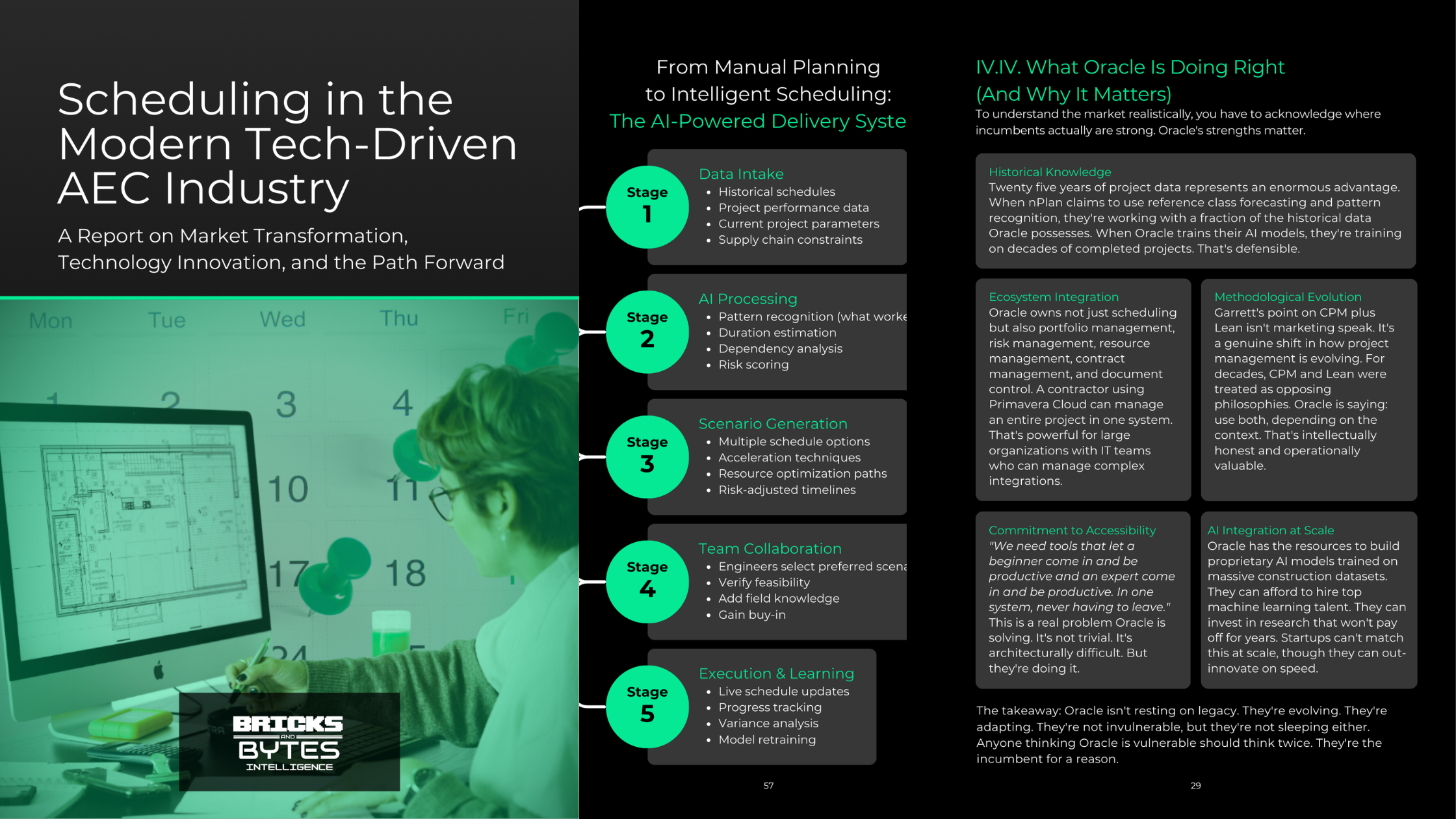
Get a FREE copy of our Scheduling in the Modern Tech-Driven AEC Industry: A Report on Market Transformation, Technology Innovation, and the Path Forward” (worth $150) and a FREE weekly email to stay up to date on construction tech. SIGN UP TODAY!

Scheduling in the Modern Tech-Driven AEC Industry

Sign up to the #1 Newsletter In AEC Tech. Join over 2,100 like-minded Founders, Investors and Techies disrupting the way we build. 

Scheduling in the Modern Tech-Driven AEC Industry