
Artificial Intelligence is reshaping the construction industry. From project planning to risk assessment, AI is making its mark. But who will benefit most from this revolution? Will it be the established giants or nimble startups? Let’s dive in and explore this burning question.
The AI Revolution in Construction
AI isn’t just a buzzword in construction anymore. It’s a reality. Today, AI helps predict project delays, optimises resource allocation, and even controls autonomous equipment. According to a recent McKinsey report, AI could boost the construction industry’s profits by 71% by 2035.
The Incumbent Advantage: Giants Ready to Flex
Established players like Autodesk and Procore aren’t sitting idle. They have three aces up their sleeves:

- Data Goldmine: Years of project data to feed AI algorithms.
- Deep Pockets: Resources to invest in cutting-edge AI research.
- Loyal Customer Base: A ready market for new AI-powered features.
As Peter Drucker, a renowned management consultant, educator, and author, notes, “The big players have the data and the distribution channels. That’s hard to beat.”
The Startup Edge: David vs. Goliath
But don’t count out the startups just yet. They bring their own strengths to the table:
- Agility: Quick to adapt to new technologies and market needs.
- Focus: Specialised solutions for niche problems.
- Innovation: Fresh approaches unencumbered by legacy systems
Remember, every incumbent was once a startup. Could the next Autodesk be born from the AI revolution?
Key Battlegrounds: Where AI Meets Brick and Mortar
So, where exactly is AI making waves in construction? Let’s look at three key areas:
- Project Planning: AI-powered tools optimising schedules and resource allocation (Kwant, Versatile, Zepth)
- Safety: Predictive algorithms identifying potential hazards before they occur (Smartvid.io, Pillar Technologies, Doxel)
- Design: Generative AI creating optimised building designs (Augmenta, Spacemaker)
In each of these areas, we see both incumbents and startups making moves. But who’s gaining the upper hand?
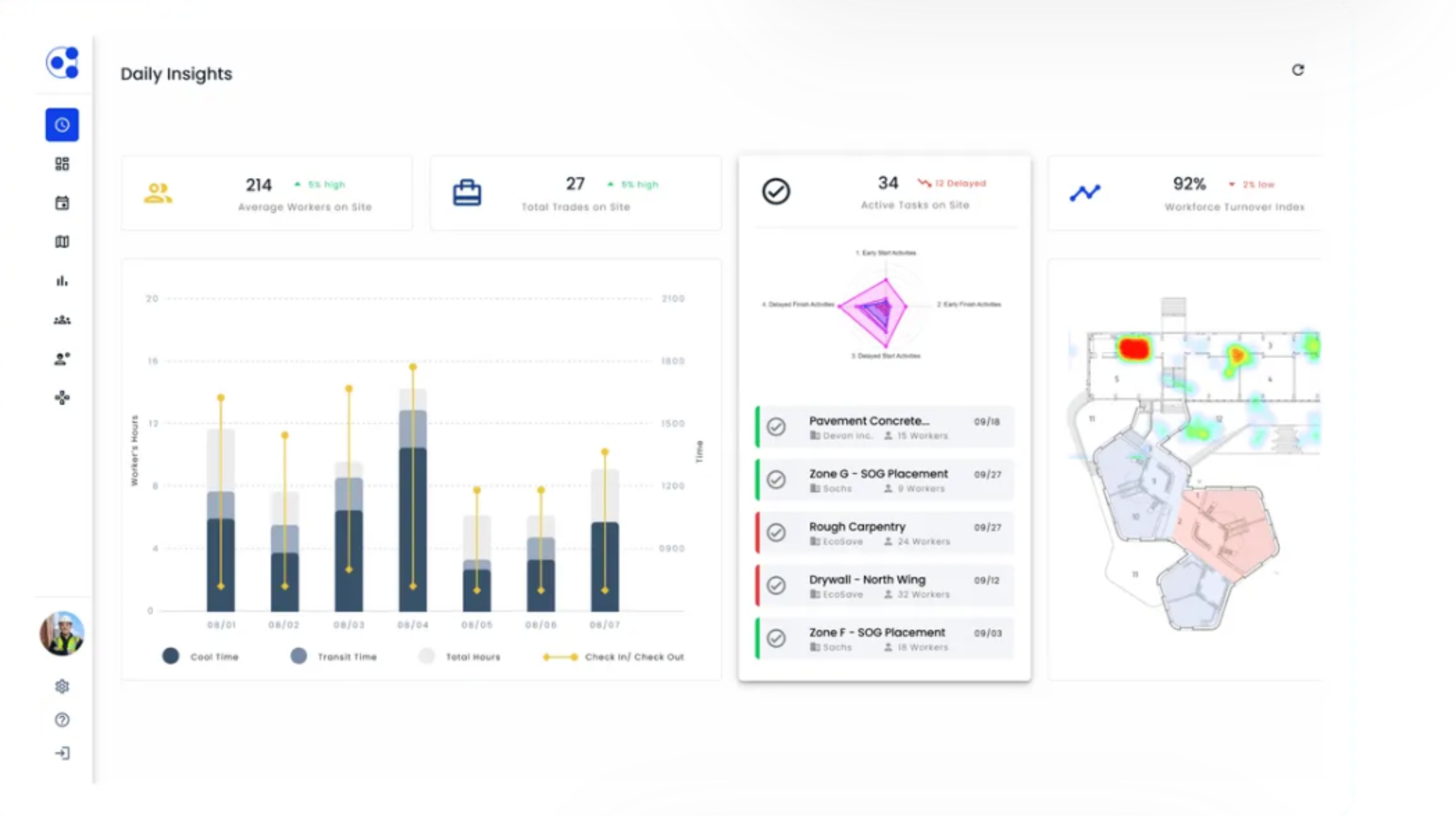
Kwant, is a construction workforce management software that uses AI-driven insights and wearables to increase safety, productivity and compliance.
Data: The New Concrete in Construction
In the world of AI, data is king. And in construction, project data is gold dust. Incumbents have mountains of it. Startups? Not so much.
But here’s the twist: it’s not just about quantity. It’s about quality and how you use it. As Camille Maréchal boldly puts it, “We may have less data, but we’re better at making it talk.”
Distribution Channels: The Hidden Battleground
Here’s something you might not have considered: distribution channels. As Patric Hellerman points out in a Bricks, Bucks & Bytes episode :
“Whoever builds insanely efficient distribution and a distribution that is relevant through touch points within construction will reap the benefits of AI.”
Incumbents have established networks. But startups? They’re building new, AI-native channels that could leapfrog traditional methods.
In this episode, Patric Hellermann of Foundamental, explored the complex world of construction tech, energy infrastructure, and global market trends.
Case Studies: AI in Action
Let’s look at two examples:
- Incumbent Success: Autodesk’s AI-powered tool, Construction IQ, is making waves in the industry. One of its early adopters, BAM Ireland, a major player in general contracting and civil engineering, has seen impressive results. By leveraging machine learning to break down traditional data silos, the firm achieved a significant 20% decrease in quality and safety issues across their projects.
- Startup Sensation: In a case study shared by Doxel, their autonomous robot scanning helped supervise construction on a multi floor medical office building in San Diego, California. The robot could scan the entire site in 4.5 hours every day. This resulted in a 38% increase in labour productivity over the original project budget estimate, allowing the project to come in 11% under budget
Both are impressive, but taking very different approaches.
Challenges: It’s Not All Smooth Sailing
Implementing AI isn’t a walk in the park. Both incumbents and startups face hurdles:
- Integration with existing systems
- Workforce adaptation and training
- Data privacy and security concerns
The Future of AI in Construction
Let’s be clear: AI isn’t about to replace construction workers. It’s about augmenting human expertise.
So, what does the future hold? Here are our predictions:
- Collaboration, Not Just Competition: We’ll likely see incumbents acquiring or partnering with AI startups.
- Specialisation: AI solutions will become more tailored to specific construction niches.
- Democratisation: AI tools will become more accessible to smaller construction firms.
The Verdict: It’s Not Winner-Takes-All
In the AI race, there’s room for both incumbents and startups to thrive. Incumbents have the resources and data, but startups bring innovation and specialisation. The real winners? Construction firms that can effectively leverage AI, regardless of its source.
Key Takeaways:
- AI is transforming construction, from planning to execution.
- Incumbents have data and resources; startups offer innovation and agility.
- Success in AI isn’t just about technology, but also about distribution and industry understanding.
- The future likely involves collaboration between incumbents and startups.