
Author name: Owen Drury

construction tech acquisition
Startups, Founders & Operators

From Acquisition to Integration: Lessons from a Contech Success Story

  The path from startup to successful acquisition isn’t always straightforward, but when it works, it can create tremendous value for both companies involved. The story of Rocos’ acquisition by DroneDeploy offers valuable insights into what makes a successful merger in the construction technology space. The Genesis of the Deal David Inggs and his team at Rocos had built a sophisticated cloud infrastructure platform for robotics companies when they first connected with DroneDeploy. What started as a casual introduction through venture capitalists evolved into a strategic partnership and eventually led to acquisition. As Inggs recalls: “We were literally doing a capital raise at that moment. So for us, in some ways it was convenient because we could literally say, look, if we’re going to do this, let’s not talk for the next 12 months. It’s like, look, we’ve got weeks to make this decision, not months to make this decision.” This timing created a natural urgency that helped focus the discussions and decision-making process. But what made this particular acquisition successful went far beyond timing. In this episode of BitBuilders, David Inggs, Head of Robotics at DroneDeploy, shares invaluable insights on the challenges and opportunities in construction robotics.   Cultural Alignment: The Foundation of Success One of the most striking aspects of this story is how the acquisition succeeded despite being negotiated entirely during COVID, with most team members never meeting in person. The secret? A strong alignment of company values and culture on both sides. “We were, I think, lucky that two sets of values of the company had built up in the culture of the humans, the type of humans we attract, and what we encourage was very much aligned,” Inggs explains. This cultural fit proved crucial for the post-acquisition integration, with both teams working together seamlessly three years later. The Strategic Fit The acquisition made sense because it wasn’t just about buying technology – it was about expanding capabilities in a way that aligned with DroneDeploy’s broader vision. DroneDeploy’s strategy rested on three key pillars: Unify: Bringing together aerial and ground-based reality capture Automation: Making continuous site digitization possible AI: Adding intelligence to transform raw data into actionable insights   Rocos’ robotics infrastructure technology fit perfectly into this vision, particularly in advancing the automation pillar. This strategic alignment meant the acquired team could continue their mission with greater resources and an established customer base. Making the Decision For startup founders, the decision to sell can be emotionally challenging. Inggs’s team approached it pragmatically, weighing several factors: Market timing and risk: While Rocos could potentially become a billion-dollar company independently, the robotics market still carried significant uncertainties Resources and scale: DroneDeploy offered immediate access to enterprise customers and established sales channels Value creation potential: The combined technologies could create more value together than separately Risk mitigation: Joining an established player reduced execution risk while maintaining upside potential   As Inggs puts it: “If you look at it realistically, you’re going to create a very valuable company with the combined technology. There’s a long way for DroneDeploy still to grow, especially with our technology and the stuff they have in their roadmap and the downside, you’re just eliminating a whole bunch of downside risk.” Keys to Success Several factors contributed to making this acquisition successful: Clear strategic alignment: Both companies shared a vision for the future of construction technology and automation Cultural compatibility: Similar values and working styles made integration smoother Autonomy with support: The Rocos team could continue their mission while leveraging DroneDeploy’s resources Complementary capabilities: The technologies enhanced each other rather than overlapping Timing: The market was mature enough to validate the concept but early enough to capture significant growth Lessons for Other Founders For construction technology founders considering acquisition offers, this story offers several valuable takeaways: Talk to VCs even if you’re not raising money: They can provide valuable introductions and industry insights Focus on culture: Strong cultural alignment can overcome physical distance and other integration challenges Think strategically: Consider how combining forces might create more value than staying independent Stay mission-focused: The right acquisition should accelerate your mission, not derail it Be realistic about market timing: Sometimes being acquired by a more established player can help you reach your goals faster The Future Outlook Three years post-acquisition, the integration continues to bear fruit. The combined company is well-positioned to lead in construction technology, particularly as the industry increasingly embraces automation and digital transformation. For the construction technology ecosystem, this success story demonstrates that strategic acquisitions can work well when there’s genuine alignment of vision, culture, and capabilities. As the industry continues to evolve and mature, we’re likely to see more such combinations as companies seek to build comprehensive solutions for their customers. Remember, while not every acquisition story ends this successfully, understanding what works can help founders make better decisions about their own companies’ futures. The key is finding the right partner at the right time, with the right cultural fit and strategic alignment to take your vision forward.      

Newsletter

ICYMI: From $250K Labor Savings to €130M Exits + November Roundup

Want to go deeper? Join our Patreon community for exclusive, not publicly available content and support the future of architecture, engineering, and construction. This Week’s Quickfire BytesFuel your curiosity with this week’s contentW/C 9th December 2024 NEW EPISODESWhat We Learned After a Year of Talking to Construction Tech’s Biggest Names – November Monthly Review For our November monthly review, we reflected on an action-packed month of content creation and exciting future plans. We talked about our successful launch of the AI in Construction Report and first steps into monetisation, highlights from our Boston trip interviewing startups at Suffolk’s boost cohort and plans for New York and San Francisco tour in 2025, plus a potential India expansion. open.spotify.com/episode/4sPhT4TsXnDh7kYRwfeyaP Retrofitting Yellow Machines: The $250,000 Labor Cost Savings in Construction We discussed Teleo, a startup retrofitting heavy machinery for remote operation and semi-autonomous functionality. We also explored the intriguing case of ServiceTitan’s IPO plans, shedding light on the complex dynamics of venture capital and founder equity. Additionally, we delved into the challenges and opportunities in automating construction equipment across various environments. open.spotify.com/episode/4zRBenZZG5o35EVcI1s6PZ From First Employee to €130M Exit: Nici’s Journey To Creating Alrik Nici Sundén-Cullberg, former CEO of Lendify and co-founder of Alrik, talks about his transition from investment banking to fintech, the challenges of scaling a lending platform, and his latest venture in construction tech. Find out how Alrik is solving logistics nightmares for construction material distributors, the journey of growing Lendify to a €130 million exit and why Nici turned down a climate tech opportunity to start Alrik. open.spotify.com/episode/0Y3R8YqWTJJF7eFhpXSF0S View All Podcasts BRICKS & BYTES BULLETINNo Innovation Department? How Mid-Size Contractors Navigate Tech Adoption When it comes to understanding how mid-sized construction companies adopt technology, few people have the depth of insight that Ryan Rademann brings to the table. As a partner at Wipfli, a CPA and consulting firm, he has spent his career working with construction firms across the United States and beyond, focusing particularly on companies with revenues between $100 million and $500 million. What makes Ryan’s perspective particularly valuable is his position at the intersection of finance, technology, and construction operations.  He regularly works with CFOs and financial technology teams, but he’s equally comfortable on job sites, thinking about how emerging technologies like robotics and AI might transform construction work. This dual perspective allows him to bridge the gap between the financial imperatives that drive technology decisions and the operational realities of implementing new systems. Today we unpack Ryan’s extensive experience from working with a large number of mid-sized companies. Read Full Article 2 FAVORITE QUOTES: “You would have to smoke some really hard shit to think that that is a positive thing.” – Patric’s candid assessment of European Central Bank’s GDP growth projections “It’s lonely at the top. Especially when you’re not an owner, you’re not included in those things.” – Nici on the challenges of being a CEO without founder status LATEST STORIES Scaling for Success: Strategic Considerations for Contech Growth Learn key strategies for scaling construction technology companies from industry leaders. Real insights on hardware, manufacturing, and market expansion. The Evolution of Robotics Business Models: Why Subscription Makes Sense Discover how subscription-based robotics models are transforming industry, lowering barriers to adoption while maximising value through innovative software platforms. Conquering Construction’s Biggest Challenge: Risk Management with AI Discover how AI construction risk management is transforming project planning. Real insights from nPlan’s CEO on predicting and preventing costly delays. View More Articles BONUS CONTENTWhat Are Investors Betting On? OUR SPONSORS BuildVision — streamlining the construction supply chain with a unified platform for contractors, manufacturers, and stakeholders. Powered by beehiiv

AI construction risk management
Technology

Conquering Construction’s Biggest Challenge: Risk Management with AI

  When Dev Amratia was working on a project off the coast of Russia’s Sakhalin Island, a bridge collapsed 200 kilometers from the site. “I promise you that event felt worse than the COVID pandemic,” he recalls. “We were just like, we don’t even know how we’re going to get food on here.” Later, someone arrived on site and casually mentioned experiencing a similar situation elsewhere. Amratia’s frustration was palpable: “Where were you when we were planning this project?” Dev, now co-founder and CEO of nPlan, in an episode of the Groundbreakers podcast shares how artificial intelligence is transforming this landscape by doing what humans simply cannot – learning from hundreds of thousands of projects simultaneously to predict and prevent delays before they happen. The Experience Gap One of the fundamental challenges in construction project management is the limitation of human experience. As Amratia explains: “We don’t have enough experience to really be able to foresee what might happen to our project, no matter what… That means no matter how much money you have, no matter how good you think your team is, they never have enough experience.” This insight emerged from hundreds of interviews with project managers and reveals a sobering truth: traditional career development and training in construction can’t keep pace with the complexity of modern projects. No individual or team can accumulate enough experience to anticipate every potential risk. In this episode of BitBuilders, Dev shares nPlan’s journey in revolutionising construction risk management, the power of AI in forecasting project timelines, and the importance of company culture in building a successful startup.   The Power of Machine Learning nPlan’s solution leverages AI to analyse over 760,000 construction projects representing $1.8 trillion in capital deployment. As Amratia notes: “The difference between what you plan to do and what you actually do is what you learn… And machines or our algorithms work in the same way. They go see what was planned and what actually happened.” This massive dataset allows the AI to identify patterns and potential risks that might be invisible to even the most experienced project managers. By analyzing historical schedule data, actual outcomes, and the variations between them, the system can predict likely challenges and suggest mitigation strategies. Beyond Human Limitations One particularly interesting aspect of AI-powered risk management is its ability to overcome human cognitive biases. Amratia identifies three key biases that plague traditional project management: Availability Bias – We only know what we know Optimism Bias – Every team thinks they’ll be the best Salience Bias – We tend to focus on physical construction while overlooking administrative challenges   “Over 750,000 projects nPlan has now analyzed, we can see overwhelmingly the largest contributors of project delay is non-physical construction, also known as administration,” Amratia reveals. This insight challenges conventional wisdom about what causes delays and highlights the value of AI’s unbiased analysis.   The Future of Project Management The implementation of AI in construction risk management isn’t about replacing human judgment – it’s about augmenting it. The goal is to elevate the role of project teams, allowing them to focus on decision-making rather than administrative tasks. As Amratia envisions it, machines will handle the complex analytical work while humans focus on what they do best: negotiating, arbitrating, and making strategic decisions. Key Benefits of AI-Powered Risk Management: Comprehensive Risk Assessment Analyzes thousands of potential scenarios Identifies patterns across similar projects Considers both obvious and subtle risk factors Improved Decision Making Provides data-driven insights Reduces impact of cognitive biases Enables proactive risk mitigation Enhanced Efficiency Automates administrative tasks Streamlines reporting processes Allows teams to focus on strategic work Implementation Challenges While the potential of AI in construction risk management is enormous, implementation isn’t without challenges. Teams need to ensure they’re providing quality input data – the more detailed and considered the project plans, the better the AI’s forecasting will be. Additionally, organizations need to overcome potential skepticism and resistance to new technologies. Looking Ahead The future of construction risk management lies in the combination of human expertise and artificial intelligence. As systems become more sophisticated, we’ll likely see even greater integration of various data sources, including project drawings, specifications, and real-time site data For construction professionals looking to stay ahead of the curve, understanding and embracing AI-powered risk management tools isn’t just an option – it’s becoming a necessity. As projects become increasingly complex and stakeholders demand greater certainty in outcomes, the ability to leverage AI for risk management could become a key differentiator between successful and struggling organizations.      

scaling construction technology companies
Go To Market, Robotics

Scaling for Success: Strategic Considerations for Contech Growth

  The contech space is experiencing rapid growth, but scaling hardware companies in traditional industries presents unique challenges. Through our conversation with Troy Demmer, co-founder of Gecko Robotics, I gained valuable insights into successfully scaling a contech company from initial prototype to market leadership. Finding the Right First Customer One of the most crucial early decisions is identifying the right first customer. As Troy emphasised, you need a co-development partner who understands they’re getting involved with emerging technology. This partner should be forward-thinking enough to weather the inevitable early failures and iterations while maintaining trust in the long-term vision. In Gecko’s case, they found this partner in a power plant manager who gave them unprecedented access to test and refine their robotics solution. This relationship provided the essential feedback loop needed to develop a truly useful product. However, Troy noted that they always ensured customers had “skin in the game” – there were no free demos. This approach helped set proper expectations and established the professional standards necessary when working with critical infrastructure. In this episode of BitBuilders, Troy Demmer, co-founder of Gecko Robotics, shares his journey from healthcare to robotics, the challenges of building hardware startups, and how Gecko is transforming infrastructure maintenance for both the private and public sector.   The Service-First Approach A fascinating strategic choice Gecko made was leading with services rather than product sales. While this meant long days in challenging environments wearing protective gear and steel-toed boots, it allowed them to deeply understand their customers’ problems and rapidly iterate their solution. This “painful” approach, as Troy described it, enabled them to improve their robotics platform through about ten iterations in their first six to seven years. This service-first model contrasts with companies that try to sell hardware products directly to end customers or service providers. The latter approach often struggles with technology adoption because it lacks the tight feedback loop between product development and real-world use. Manufacturing and Fleet Management One surprising insight is that successful contech companies don’t necessarily need massive manufacturing scale. Gecko maintains a relatively small fleet of 50-100 robots across two to three SKUs. This is possible because they sell outcomes rather than units – their robots are tools to capture data and create workflows that give customers decision-making advantages. This outcome-based model provides valuable flexibility in managing manufacturing and deployment. Companies can fine-tune their fleet size based on demand and even strategically manage their backlog rather than rushing to scale production capacity. However, Troy emphasised a critical lesson about manufacturing: supply chain resilience is essential. With thousands of components sourced globally, having redundancy and avoiding single points of failure is crucial. This became particularly evident during COVID-19 when chip shortages affected their operations. Public Sector Opportunities and Challenges An often-overlooked growth avenue for contech companies is the public sector. Gecko’s experience with the U.S. military, particularly the Air Force and Navy, offers valuable lessons. They began this journey through innovative acquisition programs like AFWERX’s Open Topic, which allowed them to propose solutions rather than respond to rigid requirements lists. However, working with the public sector requires significant adaptation. Troy highlighted the importance of understanding the three-legged stool of government contracting: the user, the buyer, and the beneficiary are often different entities with distinct needs and priorities. Moreover, success often requires working with Congress years in advance to ensure appropriate funding. Key Considerations for Scaling Based on Troy’s experiences, here are several critical considerations for contech companies looking to scale: 1. Customer Selection: Choose early customers who can tolerate iteration and failure while maintaining a commitment to the long-term vision. 2. Business Model: Consider a service-first approach to accelerate learning and product development, even if it seems less scalable initially. 3. Team Building: Find “maniacs” – deeply committed individuals who can lead complex deployments and manage multi-stakeholder relationships. 4. Manufacturing Strategy: Focus on outcomes rather than unit sales, and build supply chain resilience from the start. 5. Market Expansion: Consider public sector opportunities, but be prepared for longer sales cycles and more complex stakeholder management. The Final Word Troy’s most important advice for founders in the built world? “Compress that feedback cycle, figure out who your customers are, and be totally radically prioritized to solving their problem. Sometimes you have to do things that don’t feel like they’re going to scale in hardware. Lean into that. Embrace that.” This wisdom encapsulates the core challenge and opportunity in contech: success often requires choosing the harder, seemingly less scalable path initially to build something truly valuable for customers. By focusing intensely on solving real problems and maintaining close customer relationships, contech companies can build the foundation for sustainable growth, even in the face of challenging market conditions and complex stakeholder environments.      

Videos, Robotics

The Evolution of Robotics Business Models: Why Subscription Makes Sense

  The traditional approach to industrial robotics often focused on hefty upfront investments in hardware. However, forward-thinking companies are revolutionizing this model by prioritizing software platforms and subscription-based services that deliver ongoing value to customers. In a recent episode of BitBuilders, Andrei Danescu, co-founder and CEO of Dexory, highlighted how robots, while technologically sophisticated, should become “invisible” in day-to-day operations. The real value lies in the software platform and digital twin technology that processes and analyzes the data these robots collect. This shift in focus has led to the emergence of subscription-based business models in robotics. This subscription approach offers several key advantages. For customers, it lowers the barrier to entry and simplifies decision-making, enabling faster technology adoption. For providers, it creates a sustainable revenue stream while establishing a framework for continuous innovation and value delivery. As the technology evolves, providers can offer upgrades, new modules, and enhanced capabilities to existing customers. Perhaps most importantly, this model future-proofs both the provider and customer relationship. While robots collect data today, the ability to implement new AI algorithms, advanced interfaces, and improved data analysis methods tomorrow ensures that the platform grows and adapts with emerging technologies and customer needs. Check out the full episode with Andrei Danescu HERE.       

Newsletter

No Innovation Department? How Mid-Size Contractors Navigate Tech Adoption

Want to go deeper? Join our Patreon community for exclusive, not publicly available content and support the future of architecture, engineering, and construction. INDUSTRY INSIGHTSNo Innovation Department? How Mid-Size Contractors Navigate Tech Adoption When it comes to understanding how mid-sized construction companies adopt technology, few people have the depth of insight that Ryan Rademann brings to the table. As a partner at Wipfli, a CPA and consulting firm, he has spent his career working with construction firms across the United States and beyond, focusing particularly on companies with revenues between $100 million and $500 million. What makes Ryan’s perspective particularly valuable is his position at the intersection of finance, technology, and construction operations.  He regularly works with CFOs and financial technology teams, but he’s equally comfortable on job sites, thinking about how emerging technologies like robotics and AI might transform construction work. This dual perspective allows him to bridge the gap between the financial imperatives that drive technology decisions and the operational realities of implementing new systems. Today we unpack Ryan’s extensive experience from working with a large number of mid-sized companies. Rounding out his 10th year with Wipfli, Ryan is a regional leader for the firm’s Construction and Real Estate practice overseeing the Lower Great Lakes. David Vs Goliath – Technology In Mid-Size Versus Large Contractor’s The construction industry stands at a technological crossroads. While industry giants invest millions in dedicated innovation departments, mid-sized contractors – those with annual revenues between $100-500 million – face a different reality. These companies must navigate the complex landscape of technology adoption without specialized innovation teams, yet their success in doing so may determine their future competitiveness. This personal experience sparked what would eventually become EarlyTrade, though the path wasn’t as straightforward as it might seem. Current State: A Complex Web of Legacy and Modern Systems The technology landscape in mid-sized construction firms reveals a fascinating contradiction. These companies often manage projects worth tens of millions of dollars, yet their internal systems can range from cutting-edge to surprisingly antiquated. In many cases, you’ll find cloud-based project management software sitting alongside paper-based purchase order systems, creating an operational environment that spans decades of technological progress. What makes this situation particularly complex is the organizational structure. Unlike larger firms with dedicated technology leaders, technology decisions in mid-sized contractors typically fall under the CFO’s purview. This arrangement made sense when technology primarily served financial functions, but today’s construction technology extends far beyond accounting software. The result is often a disconnected technology ecosystem. Field operations teams might adopt specialized tools for project management, safety monitoring, and quality control, while back-office systems remain largely unchanged. This creates what Ryan Rademann calls “shadow IT” – where frustrated employees implement their own solutions outside the company’s official systems. ¶Risks associated with shadow IT. Source: SecurityTrails The Democratic Path: A New Approach to Technology Adoption Successful technology adoption in mid-sized construction firms requires a fundamentally different approach from the top-down implementations common in larger organizations. The key lies in creating what Ryan calls “democratic technology adoption.” This process begins with understanding that resistance to change often stems from lack of involvement rather than opposition to technology itself. When employees feel they’ve been consulted and their needs considered, they’re more likely to embrace new systems. This means creating weighted scorecards for evaluating options, conducting thorough RFPs, and ensuring all stakeholders – from field superintendents to office administrators – have a voice in the decision-making process. More importantly, this democratic approach helps identify the real pain points that technology needs to address. Often, what leadership perceives as the primary problem differs significantly from what front-line workers experience daily. By involving all levels of the organization, companies can better target their technology investments to solve actual rather than perceived problems. Data Strategy: The Foundation of Modern Construction Technology Perhaps the most crucial insight for construction firms looking toward technologies like AI and robotics is this: without a solid data strategy, no advanced technology initiative can succeed. This means ensuring your company’s data is not just stored, but accessible, accurate, and properly structured. The journey typically begins with moving from on-premise servers to cloud solutions, but this is just the first step. The real challenge lies in creating a connected environment where data flows seamlessly between systems. This might mean implementing integration platforms that allow your estimating software to communicate with your project management system, which in turn connects to your financial software. Moreover, companies need to think beyond structured data (like costs and schedules) to include unstructured data – emails, photos, daily reports, and safety observations. This comprehensive data approach creates the foundation for future AI and analytics capabilities. The AI Horizon: From Back Office to Job Site Whilst the construction industry’s attention often focuses on dramatic innovations like robots and autonomous equipment, the real AI revolution is already happening in the back office. Mid-sized contractors are increasingly using language models to analyze project documentation, automate routine communications, and extract insights from historical project data. What’s particularly exciting is the emergence of Retrieval Augmented Generation (RAG) systems. These allow companies to combine the power of AI with their private company data, creating tools that understand not just construction in general, but your company’s specific experience, relationships, and past projects. This means AI can help with everything from bid preparation to risk assessment, drawing on your company’s unique history and expertise. Introduction to RAG. Source: Prompt Engineering Guide The Technology-Talent Connection One often overlooked aspect of technology adoption is its impact on talent retention. Today’s construction professionals, especially project managers and engineers, expect modern tools that allow them to work effectively. Having to deal with outdated systems or manual processes isn’t just inefficient – it can be a significant factor in employee turnover. This creates a compelling argument for technology investment beyond pure efficiency gains. When evaluating technology investments, companies need to consider not just the direct ROI in terms of time and money saved, but also the indirect benefits of improved employee satisfaction

Newsletter

ICYMI: India’s 156 Tech Stars, CAT’s Fuel Solution & Microsoft’s AI Vision

Want to go deeper? Join our Patreon community for exclusive, not publicly available content and support the future of architecture, engineering, and construction. This Week’s Quickfire BytesFuel your curiosity with this week’s contentW/C 2nd December 2024 NEW EPISODESFrom CAT to Robotics: How 33 Years at Caterpillar Shaped a Solution to Save 20% on Excavator Fuel Costs Ken Gray, co-founder of DIG Robotics, talks about the fascinating world of excavation machines and his 33-year journey at Caterpillar, from designing components to running billion-dollar businesses. Find out how CAT maintained its dominant position for decades, the staggering environmental impact of excavation machines and the surprising variability in operator performance and its impact on productivity open.spotify.com/episode/7JDdIw1ZsD0T65u7TMoksw Microsoft’s Vision For Construction Tech – Ajoy Bhattacharya Ajoy Bhattacharya from Microsoft talks about the tech giant’s unexpected approach to innovation in construction, the power of digital identity on job sites, and why AI isn’t just about generating content. Find out why Microsoft hired a construction industry veteran, Microsoft’s vision for AI in the AEC industry and how a simple login solution boosted efficiency on job sites. open.spotify.com/episode/3LC6bWjEQz7qXuBUJPySqQ 156 Indian Companies Grew 20% Annually for 20 Years: What It Means for Construction Tech Did you know that India has 156 publicly listed companies that have grown their revenue by over 20% annually for the past 20 years? That’s more than the US, China, Japan, and Germany combined. In this episode, we talk about the upcoming IPOs of Swiggy and BlackBuck in India, signaling a vibrant economy and thriving tech sector. open.spotify.com/episode/31JmFUjCEDi02BO16mmfeQ Why 50% of Mid-Size Contractors Still Struggle with Tech Integration in 2024 – Insights from Ryan Rademann, Partner at WipFli Ryan Rademann, partner at WipFli, talks about the challenges mid-sized construction firms face with outdated technology, the impact on talent retention, and the importance of data culture in driving efficiency. Find out why outdated tech is driving away top talent in construction, the role of data culture in adopting AI and robotics and the hidden costs of project delays and how better tech can mitigate them. open.spotify.com/episode/6lauqcrIQuZSjia3wlZMCh View All Podcasts BRICKS & BYTES BULLETINConstruction’s Cash Flow Crisis SOLVED – Are 24 Hour Payment Terms Truly Achieveable? We rarely explore the area of finances in AEC. But we hear time and time again of how crippling payment terms can be for contractors and suppliers across the supply chain. I make a joke that as a contractor “you are always one bad client away from going bust”. The reality is, this is no joke. It’s the truth. And it is a big problem within the industry. Read Full Article 2 FAVORITE QUOTES: “Wow. I mean, so the takeaway is VC sucks. We all suck. Whoever’s listening to this also sucks.” – Shubhankar ‘s humorous but candid observation about the VC industry “The price of dirt hasn’t changed in 100 years… the price of moving a yard or a cubic meter of dirt has not kept up with inflation” – Ken Gray on the fundamental economic challenge in excavation SUPER SERIES COLLECTION Super Series with Foundamental In this 8 part series, we sit down with General Partners of Foundamental: Patric Hellermann, Shubhankar Bhattacharya and Adam Zobler to dive deep into their world. Super Series With Monumental Explore the cutting-edge world of construction robotics in this exclusive five-part Super Series featuring Monumental, a pioneering startup revolutionising the building industry. Super Series With Speckle Follow one of construction tech’s most innovative startups as they transform how the industry handles data, from an open-source project to a venture-backed company View All Collections BONUS CONTENTWhat Are Investors Betting On? OUR SPONSORS BuildVision — streamlining the construction supply chain with a unified platform for contractors, manufacturers, and stakeholders. Powered by beehiiv

Newsletter

Construction’s Cash Flow Crisis SOLVED – Are 24 Hour Payment Terms Truly Achieveable?

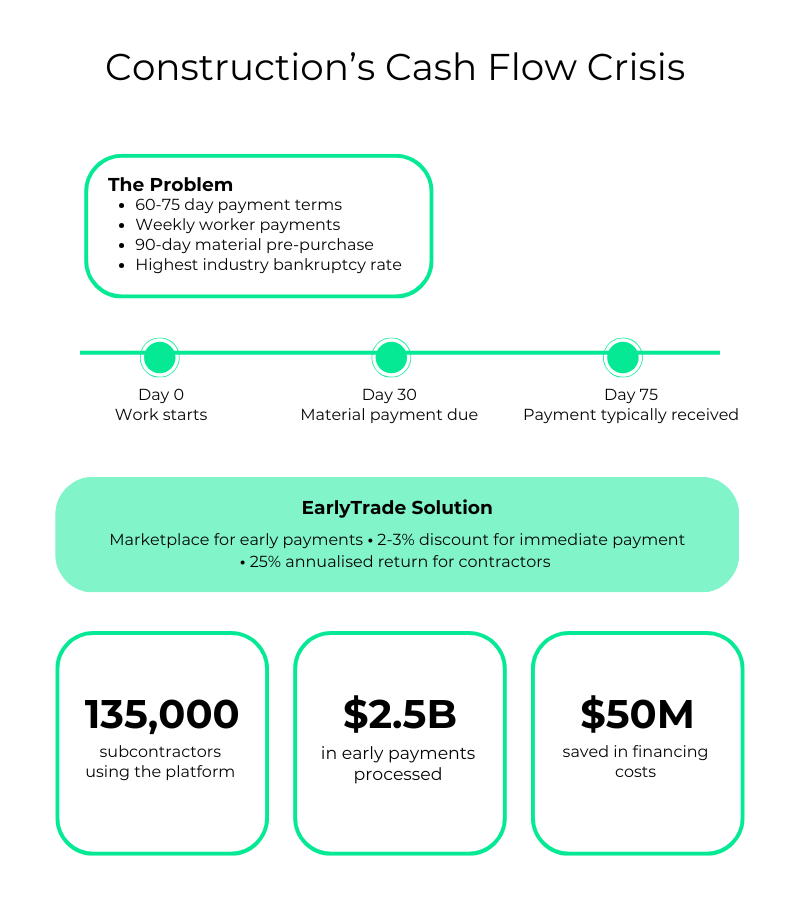
Want to go deeper? Join our Patreon community for exclusive, not publicly available content and support the future of architecture, engineering, and construction. INDUSTRY INSIGHTSConstruction’s Cash Flow Crisis SOLVED – Are 24 Hour Payment Terms Truly Achieveable? We rarely explore the area of finances in AEC. But we hear time and time again of how crippling payment terms can be for contractors and suppliers across the supply chain. I make a joke that as a contractor “you are always one bad client away from going bust”. The reality is, this is no joke. It’s the truth. And it is a big problem within the industry. The company we explore today doesn’t directly deal with preventing insolvencies. But it can certainly help reduce the risk of the eventuality. By enabling faster payment terms, EarlyTrade helps contractor’s improve cashflow and improve their financial position, which ultimately means they’re less likely to file for bankruptcy. In today’s bulletin, we explore EarlyTrade’s journey and how they plan to revolutionise construction payments. Learn how 135,000 contractors have accessed $2.5bn in early payments, as well as the shared benefits across the entire eco-system utilising early-payments. The EarlyTrade Story In the construction industry, cash flow isn’t just a financial metric—it’s the lifeblood that keeps projects moving forward. Traditional payment terms, often stretching 60 to 75 days in the United States, have long been a source of strain for subcontractors who must manage labor costs, purchase materials, and maintain operations while waiting for payment. Enter Guy, a former KPMG accountant whose journey to revolutionising construction payments began not in hard hats and steel-toed boots, but in the sleek offices of London’s tech scene. After experiencing firsthand the frustration of late payments causing missed bonuses and canceled holidays at a growing tech company, Guy began exploring solutions to the age-old problem of payment delays. “I lost a couple of high-performing people and had to cancel a European holiday,” Guy recalls. “That was just unacceptable.” This personal experience sparked what would eventually become EarlyTrade, though the path wasn’t as straightforward as it might seem. Initially launching in 2018 as a broad-market solution for late payments across all industries, EarlyTrade found its true calling during the COVID-19 pandemic. When Australian states shut down construction operations, the company began helping commercial builders support their subcontractors through the crisis. What started as a goodwill gesture revealed an unexpected truth: the construction industry’s demand for early payment solutions was astronomical compared to other sectors. Understanding the Construction Cash Crunch The reason became clear: construction’s unique payment challenges. Subcontractors typically operate on thin margins, paying workers every 7-14 days and purchasing materials up to 90 days in advance. Yet they often wait two to three months for payment after completing work. This misalignment creates a perfect storm for cash flow problems, contributing to construction having the highest bankruptcy rate of any sector in major markets like the UK, US, and Australia. Consider this real-world scenario: A mechanical subcontractor needs to purchase $100,000 in HVAC equipment for a commercial project. They must pay their supplier within 30 days, pay their installation crew weekly, yet won’t receive payment for the completed work for 75 days. This gap forces many subcontractors to either take on expensive debt or juggle payments between projects—a risky practice that can lead to business failure. A Market-Based Solution EarlyTrade’s solution is elegantly simple: they’ve created a marketplace where subcontractors can offer small discounts on their approved invoices in exchange for immediate payment. Unlike traditional financing options like invoice factoring, there’s no lending involved. Instead, general contractors use their own strong balance sheets to pay early, earning a return on their capital while helping their supply chain stay healthy. The system operates like a financial market, with discount rates fluctuating based on supply and demand. Subcontractors might offer a 2-3% discount on their invoices to receive payment immediately instead of waiting 60 days. For general contractors, this translates to an impressive 25% annualised return on their capital—far better than traditional investment vehicles. Money Market/Cash versus Early Payment Program – expected returns over twelve months ($1m). Source: Earlytrade. Making the Numbers Work To put this in perspective, let’s break down the economics: A subcontractor with a $100,000 invoice might offer a 2% discount ($2,000) to receive payment 60 days early. While $2,000 might seem significant, compared to traditional financing options like credit cards (20%+ APR) or invoice factoring (often 5-8% per invoice), it’s actually a cost-effective solution. Moreover, the ability to maintain steady cash flow often allows subcontractors to take on more projects and negotiate better terms with their own suppliers. Impact and Future Implications The platform’s success speaks for itself: 135,000 subcontractors now use EarlyTrade monthly, with $2.5 billion in early payments processed last year alone, saving subcontractors $50 million in financing costs. But perhaps more importantly, it’s creating a more sustainable construction ecosystem where subcontractors can focus on their work instead of worrying about their next payroll. “Construction people just want to get things done,” Guy observes. “They’re building the society we live in—the roads, the buildings, the bridges, the stadiums, the hospitals, everything.” By solving the payment terms puzzle, EarlyTrade is helping ensure they can keep doing exactly that.  Looking Ahead: Industry Evolution As interest rates fluctuate and construction projects become more complex, the importance of efficient payment systems grows. CFOs at major construction companies are increasingly looking at early payment programs not just as a way to support their supply chain, but as a strategic tool to improve their own returns. With traditional investments yielding less in a declining interest rate environment, the ability to earn substantial returns by simply paying vendors early is becoming an attractive proposition. Key Takeaways for Industry Professionals For General Contractors:Early payment programs can provide returns significantly higher than traditional investments while strengthening your supply chain and improving subcontractor relationships. For Subcontractors:Consider the true cost of waiting for payment versus taking a small discount. The ability to maintain consistent cash flow and potentially take on

Newsletter

ICYMI: 24 Hour Payment Terms and AI Speed & Scale

Want to go deeper? Join our Patreon community for exclusive, not publicly available content and support the future of architecture, engineering, and construction. This Week’s Quickfire BytesFuel your curiosity with this week’s contentW/C 25th November 2024 NEW EPISODESAutomating 90% of Contract Reviews: Building AI to Solve a $13 Trillion Industry’s Contract Challenges Josh Levy & Trent Miskelly from Document Crunch share their journey in building a document intelligence platform for the construction industry, the five best practices for contract compliance, and how they’re automating critical processes to reduce risk on construction projects. Find out how Document Crunch is solving the $13 trillion industry’s contract compliance challenges, why understanding contracts is crucial for preventing claims and project overruns and how Document Crunch is pricing their services based on “jobs to be done”. open.spotify.com/episode/6cWyb2v46h5k9M6mDCO0YZ Cintoo’s $37M Series B, Reality Capture Market Growth, Partech’s Investment Strategy In this episode, we talk about Cintoo’s $37 million Series B funding round led by Partech, signaling a growing interest in reality capture and data compression for construction sites. We also explored the potential for a surge in tech IPOs in 2025, as evidenced by Thrive Capital’s rumored $1 billion investment in Databricks at a $55 billion valuation. open.spotify.com/episode/2qpsrHJtep7h2oFMoGgwS7 Paid in 24-hours: The Construction Payment Platform That’s Eliminating the 90-Day Cycle Guy Saxelby, CEO and Co-founder of Earlytrade, talks about innovative solutions for construction payment challenges, the power of dynamic discounting, and how technology is reshaping financial transactions in the industry. Find out how Earlytrade’s platform works without lending money, why the US market is ripe for construction fintech solutions and the challenges of enterprise software sales in construction. open.spotify.com/episode/0BJmdWXz5vvKljdxglDjH View All Podcasts BRICKS & BYTES BULLETINThe 9 Tech Tools Running This $500M Construction Company We recently spoke with John Andres, Director of Technology at ANDRES Construction, to understand how a $500 million revenue construction company approaches innovation and technology.  What we discovered was a refreshingly honest perspective that challenges the conventional wisdom about innovation in construction. What we found particularly interesting was that unlike some of the other corporates we speak to, Andres does not have an innovation ‘department’. One man, John Andres leads their innovation team and is responsible for their technology strategy. Kudos, John! Read Full Article 2 FAVORITE QUOTES: “I lost a couple of high performing people and I canceled a European holiday and that was just unacceptable.” – Guy Saxelby on his personal frustration with late payments at a previous job, which sparked the idea for Earlytrade “I told Josh, I was like, well, I think a volcano just erupted by our heads” – Trent describing when ChatGPT emerged and its impact on their business LATEST STORIES The Secret to Talent Retention in the AI Era: It’s Not Rocket Science Discover why mission alignment, not just technical skills, is crucial for retaining top tech talent in the AI era. Learn sustainable recruitment strategies. Creating Our AI in Construction Report Inside look at AI’s impact on construction documentation. This report features interviews with pioneering construction tech companies. View All Articles BONUS CONTENTWhat Are Investors Betting On? OUR SPONSORS BuildVision — streamlining the construction supply chain with a unified platform for contractors, manufacturers, and stakeholders. Powered by beehiiv

AI in construction documentation management
Videos, Technology

Creating Our AI in Construction Report

  After months of work, I’m excited to share insights from our deep dive into AI’s impact on construction documentation management. When we started this project, we wanted to go beyond the surface-level conversations about AI in construction tech. We reached out to five leading startups in the space – each with solid industry reputations – and conducted structured interviews to understand their business models and AI implementation. But what really caught my attention was our conversation with Microsoft. Ajoy Bhattacharya, who previously served as a technology director at Suffolk Construction before joining Microsoft, offered a fascinating perspective. There’s been this ongoing concern in our industry that Microsoft would eventually build competing solutions to what construction tech startups are developing. However, Ajoy’s insight turned this assumption on its head – Microsoft is actually looking for partners rather than trying to compete. Special thanks to Bhragan from Last Week in ConTech for helping us shape these findings into a comprehensive report. The full document, featuring detailed insights from all participating companies, is now available for those wanting to understand where AI in construction is really headed. Get the full report HERE.       

retaining top tech talent in the AI era
Videos, Startups

The Secret to Talent Retention in the AI Era: It’s Not Rocket Science

  In today’s hyper-competitive tech landscape, particularly amid the AI boom, the battle for top talent has reached unprecedented levels. Yet, the fundamental principles of attracting and retaining exceptional team members remain surprisingly straightforward. The key? It’s about creating meaningful work and ensuring your team feels deeply connected to it. As Jeevan point out, this approach acts as a crucial “double filter” in the hiring process. While technical skills are essential, they’re only part of the equation. The real differentiator is finding individuals who genuinely resonate with your company’s mission. Why is this mission alignment so critical? Because every company, especially in tech, faces inevitable challenges. Looking back through Silicon Valley’s history, even the most successful companies have faced downturns – with eBay standing as a rare exception of consistent early-stage growth. When obstacles arise, team members who are purely motivated by skills or compensation are more likely to seek new opportunities. The most resilient teams are built on a foundation of shared purpose, where individuals are willing to persevere through setbacks because they believe in the bigger picture. In the end, sustainable talent retention isn’t about perks or prestige – it’s about purpose. Check out the full episode with Jeevan Kalanithi HERE.       

Newsletter

The 9 Tech Tools Running This $500M Construction Company

Want to go deeper? Join our Patreon community for exclusive, not publicly available content and support the future of architecture, engineering, and construction. INDUSTRY INSIGHTSThe 9 Tech Tools Running This $500M Construction Company We recently spoke with John Andres, Director of Technology at ANDRES Construction, to understand how a $500 million revenue construction company approaches innovation and technology.  What we discovered was a refreshingly honest perspective that challenges the conventional wisdom about innovation in construction. What we found particularly interesting was that unlike some of the other corporates we speak to, Andres does not have an innovation ‘department’. One man, John Andres leads their innovation team and is responsible for their technology strategy. Kudos, John! The Implementation Mindset Let’s start with a controversial statement: “construction companies aren’t innovators – we’re implementers”. At least, that’s how John Andres sees it. And he should know. As both the technology director of a major construction firm and the founder of a construction tech startup, he has a unique perspective on both sides of the equation “We’re not truly innovative,” John tells us. “We’re great at being implementers.” This might sound like a limitation, but it’s actually a strength. By focusing on being excellent implementers rather than trying to be innovators, ANDRES Construction has built a remarkably effective technology strategy. Early Adoption as Strategy This implementation-first mindset doesn’t mean being passive. ANDRES Construction has a history of being first movers. In 2009, they were among the earliest adopters of Procore. When the first iPad was released, John immediately saw its potential for construction. The day after showing his father how drawings could be viewed on the device, he walked out of an Apple store with 47 iPads for the company. The Selection Process When we asked about how they choose new technology, John’s answer was surprisingly straightforward: it starts with the people. “When it comes down to a tiebreaker between two things that work, it’s going to always come down to the people,” he explains. The process begins with identifying real needs. John spends time in job trailers, watching how people work. He looks for spreadsheets – they’re often a sign of a process that could be automated or improved. When they find a problem, they search for solutions through their network, including construction tech funds like Zacua where they’re a limited partner. The Enterprise Approach One of the most interesting aspects of ANDRES Construction’s strategy is their commitment to enterprise-wide implementation. They don’t do one-off software purchases or project-by-project technology decisions. If they’re going to use a tool, everyone gets access to it. “We want our employees to know that they’re going to have those tools on every project,” John explains. This ensures that when people move between projects, they always have access to the same toolset and know exactly what’s expected of them. Current Technology Stack Transparency is another key part of their strategy. ANDRES Construction publishes their entire technology stack on their website. This includes: Procore for project management CM Builder for 4D logistics scheduling Genda for worker tracking and safety Document Crunch for contract review Several other specialized tools for specific functions – view the full list here This openness helps set expectations with clients and subcontractors while also contributing to industry knowledge sharing. The Next Frontier: Data Looking ahead, John sees data as the next major challenge. But not just collecting data – making sense of it in a construction context. The challenge is that every project is unique, with different fee structures, different savings splits, and different contingency arrangements. Finding ways to analyze and compare this data meaningfully is the next big hurdle. Lessons for Other Contractors What can other construction companies learn from ANDRES Construction’s approach? We’d suggest these key takeaways: Focus on being an excellent implementer rather than trying to be an innovator Make enterprise-wide commitments to technology Look for systematic processes that can be replicated across projects Stay close to the field to identify real problems Consider the people behind the technology, not just the features The Future of Construction Tech John’s perspective on the future is pragmatic but optimistic. He sees a need for new pricing models that better align with construction business models. He envisions marketplaces that could make construction software more accessible and easier to implement. But most importantly, he emphasizes the need for construction companies to work together and share knowledge about what works and what doesn’t. “Unless everyone in construction is talking together,” he says, “it’s going to be very difficult to move forward with all this tech.” We couldn’t agree more. The future of construction technology isn’t about individual companies trying to out-innovate each other. It’s about the industry as a whole getting better at implementing and using technology effectively. And companies like ANDRES Construction are showing us how to do exactly that. Check out the full episode with John Andres👇👇👇 Watch Episode WEEKLY MUSINGSTrue Commitment, Free Resource, Unexpected Passions Tough times test true believers Jarett Gross on LinkedIn | 31 comments Searches are down, VC investment is down, Interest rates are up, Prices are up, Times like this separate the strong from the weak. For 3DCP companies, the… | 31 comments on LinkedIn Navigating AI in construction Trent Miskelly on LinkedIn: #contech #construction #ai Excited to share this free resource we created with Engineering News-Record! In the AI chapter, we dive into the considerations for construction teams… Who knew these two had so much in common? Mostafa Akbari Hochberg on LinkedIn: #jordan #jordan3 #blackcement #construction #sneakerhead Two awesome topics mixed together. Construction 🏗️ and Sneakers 👟 The Jordan 3 black cement are coming. This is an outstanding concrete mixer. :D… OUR SPONSORS BuildVision — streamlining the construction supply chain with a unified platform for contractors, manufacturers, and stakeholders. Powered by beehiiv

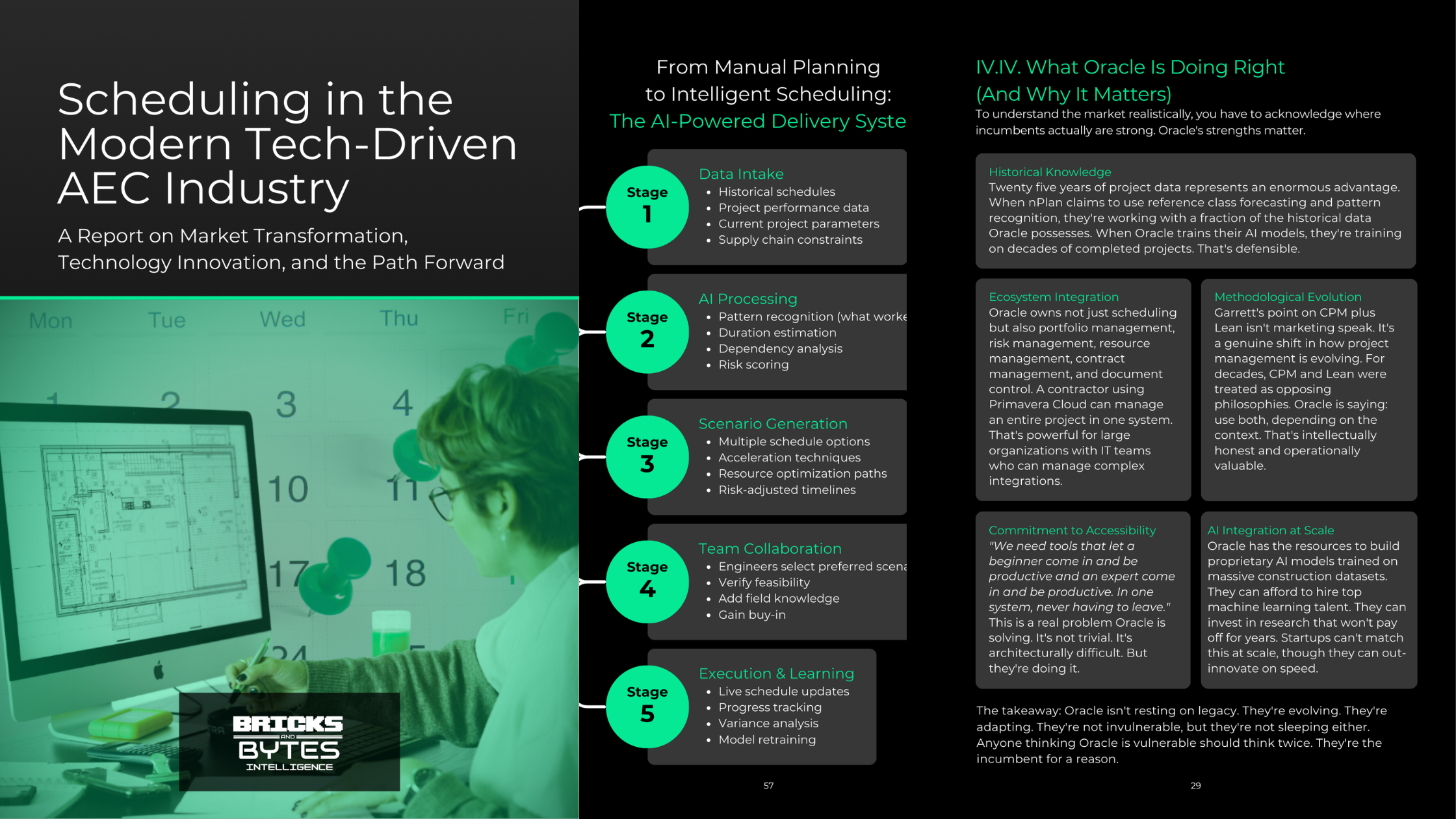
Get a FREE copy of our Scheduling in the Modern Tech-Driven AEC Industry: A Report on Market Transformation, Technology Innovation, and the Path Forward” (worth $150) and a FREE weekly email to stay up to date on construction tech. SIGN UP TODAY!

Scheduling in the Modern Tech-Driven AEC Industry

Sign up to the #1 Newsletter In AEC Tech. Join over 2,100 like-minded Founders, Investors and Techies disrupting the way we build. 

Scheduling in the Modern Tech-Driven AEC Industry