
Author name: Owen Drury

Newsletter

ICYMI: World’s Tallest Robots, Micro Nuclear Power + AI Risk Management

Want to go deeper? Join our Patreon community for exclusive, not publicly available content and support the future of architecture, engineering, and construction. This Week’s Quickfire BytesFuel your curiosity with this week’s contentW/C 18th November 2024 NEW EPISODESZero Infrastructure Changes, 24/7 Warehouse Scanning: Building Next-Gen Robotics for Global Supply Chains Andrei Danescu, co-founder and CEO of Dexory, shares insights on building a global visibility platform for logistics. We explored the journey from Formula One engineering to revolutionising warehouse operations with autonomous robots. Find out how F1 experience inspired a logistics innovation, the challenges of creating a full-stack robotics company and the power of digital twins in optimizing logistics operations. open.spotify.com/episode/0rvuG8WP1Tm7FzhSrQXuGE Reshaping Construction Risk Management With AI – Provision Luigi and Brendan from Provision AI share their journey in creating a risk identification tool for construction projects, their challenges and how they’re revolutionising project risk management. Find out how Provision AI helps contractors identify and manage project risks, their approach to achieving product-market fit in different segments and the importance of partnerships in growing awareness and improving their product. open.spotify.com/episode/76nkWdCSWspxwJ3FlCP5FG 12,000 Employees, 5 Regions, 1 Innovation Strategy: How DPR’s Drywall Division Rivals America’s Largest Contractors Kaushal Diwan from DPR Construction provided insights into WND Ventures, their investment strategy in construction tech startups, and how they support these innovative companies. Find out how WND Ventures balances strategic value and financial returns, DPR’s bottom-up approach to identifying innovation needs and a case study on Dusty Robotics and how DPR is leveraging their technology. open.spotify.com/episode/27hHRybtcpvvuzIn3GNr16 Micro Nuclear Power Plants – The $100 Million Power Plant Revolution for Industrial Decarbonisation Michelle Brechtelsbauer, VP of Strategy at Last Energy, shares insights on micromodular nuclear power plants and their potential impact on clean energy. Find out why nuclear power is crucial for baseload energy and decarbonisation, the importance of modular design and standardization in nuclear projects and why Europe is a prime market for small nuclear reactors. open.spotify.com/episode/5kirMWEBJwrAbXsGpmSUXp View All Podcasts BRICKS & BYTES BULLETINInside The Team Disrupting The AEC Design Stack Today we release our Deep Dive Documentary With Speckle. Here are 10 things we learnt. bricks-bytes.beehiiv.com/p/inside-the-team-disrupting-the-aec-design-stack Read Full Article 2 FAVORITE QUOTES: “Very quickly amongst our network, peer network, we know if something’s working or not, right? And when something works, it spreads very quickly.” – Kaushal on the collaborative nature of innovation in construction, even amongst competitors “If you look at a subcontractor, you’ll see a material portion of the market that says, hey, this is useful, but I don’t have any negotiating power, so I can’t do anything about it.” – Luigi on the key market challenge they’ve identified LATEST STORIES The Reluctant Entrepreneur: Dev Amratia’s Journey with nPlan Discover how nPlan revolutionises construction project forecasting with AI. Learn how Dev Amratia’s vision transforms risk management and project outcomes. Enterprise SaaS Pricing: Simplicity Meets Scalability Explore how modern SaaS companies are revolutionising enterprise pricing through headcount-based tiers and hybrid models combining base fees with token pricing. View All Articles BONUS CONTENTWhat Are Investors Betting On? OUR SPONSORS BuildVision — streamlining the construction supply chain with a unified platform for contractors, manufacturers, and stakeholders. Powered by beehiiv


dev amratia
Founders & Operators

The Reluctant Entrepreneur: Dev Amratia’s Journey with nPlan

  In the high-stakes world of construction and project management, where billion-dollar decisions hinge on the ability to predict the unpredictable, one might expect to find a seasoned entrepreneur at the helm of a cutting-edge AI company. Instead, we find Dev Amratia, a self-described “reluctant entrepreneur” who stumbled into his role as co-founder and CEO of nPlan almost by accident. “I don’t think I knew I wanted to be an entrepreneur until I was one,” Amratia admits with a wry smile. His journey to the forefront of construction tech was anything but conventional, driven not by a lifelong dream of entrepreneurship, but by an insatiable desire to make a meaningful impact on the world. From Oil Fields to AI: The Genesis of nPlan Dev’s path to nPlan began in the unlikeliest of places – the oil fields of Shell, where he spent a decade grappling with the complexities of large-scale project management. It was here, in some of the world’s most challenging environments, that he witnessed firsthand the persistent struggles of delivering projects on time and within budget. “I saw the problem firsthand,” Dev recalls. “I was on the receiving end of the grief when you didn’t deliver to time and budget. And I was like, man, it’s not like we’re not trying. We’re all, I think, relatively clever people working really, really hard. And at the end of the day, we still can’t get it right. Why is that?” This question would become the catalyst for nPlan, but not before a pivotal detour through the corridors of power. In 2016, Amratia found himself advising then-Prime Minister Theresa May on the UK’s emerging technology strategy, with a particular focus on artificial intelligence. This experience opened his eyes to the transformative potential of AI and set the stage for what was to come. In this episode of BitBuilders, Dev Amratia shares nPlan’s journey in revolutionising construction risk management, the power of AI in forecasting project timelines, and the importance of company culture in building a successful startup.   Building the Impossible: nPlan’s Early Days Today, nPlan’s AI engine is powered by an astounding dataset: over 760,000 projects, representing $1.8 trillion in deployed capital. This treasure trove of information forms the backbone of nPlan’s predictive capabilities, allowing it to learn from the collective experiences of countless projects. “The difference between what you plan to do and what you actually do is what you learn,” Dev explains, encapsulating the fundamental principle behind nPlan’s machine learning approach. By analysing the disparities between planned and actual project outcomes across an enormous range of projects, nPlan’s AI can identify patterns and risks that would be impossible for any human to discern. Revolutionising Project Management With this powerful tool at their disposal, Dev and nPlan are on a mission to revolutionise project management. Their vision is nothing short of transformative: “Imagine the project that doesn’t have reports because reporting is done algorithmically and automatically,”  he muses. This isn’t just about eliminating paperwork; it’s about fundamentally changing the role of project teams. By offloading the tedious, administrative work to AI, nPlan aims to elevate project professionals, allowing them to focus on high-value decision-making and problem-solving.   The nPlan Approach: Adding the Egg Central to nPlan’s philosophy is what Dev calls “adding the egg” – a concept borrowed from the world of cake mixes. Just as adding an egg to a pre-made mix gives bakers a sense of ownership over their creation, nPlan strives to involve project teams in the AI forecasting process. “How do you get the project team to add an egg into the super forecasting that we’re doing, such that they feel like it’s their project’s forecast?” he asks. This approach ensures that teams don’t feel replaced by AI, but rather empowered by it. Leadership and Culture: The nPlan Way As nPlan has grown, Dev has had to evolve from a reluctant entrepreneur into a visionary leader. His leadership philosophy centres on the concept of the servant leader. “My role is servant to them,” he says of his team. This philosophy extends to nPlan’s company culture, which he views as critical to their success. “Don’t just talk about culture, but practise it. Believe it,” he insists. This commitment to culture is so strong that nPlan has even asked employees to leave when they didn’t align with the company’s values, despite strong performance. Looking to the Future As nPlan continues to push the boundaries of AI in construction, Dev Amratia faces new challenges. Educating the market about the possibilities of AI in project management remains an ongoing task. Meanwhile, the rapid pace of AI development means that what seemed impossible just a year ago might now be within reach. Through it all, Dev maintains an unwavering commitment to learning and growth. “If you ever think that you’ve learned enough or you know it all now, you’re out. Forget it,” he states emphatically. As nPlan charts its course into the future, one thing is clear: the reluctant entrepreneur has found his calling. In the intersection of AI and construction, Dev Amratia and nPlan are not just predicting the future – they’re actively shaping it.      

Videos, Startups

Enterprise SaaS Pricing: Simplicity Meets Scalability

  When it comes to SaaS pricing strategies, sometimes the simplest approach proves most effective. Taking inspiration from industry leaders like Procore, successful companies embrace straightforward scalability based on company headcount – a metric that reliably indicates revenue potential across different sectors. Organisations are finding success with tiered structures that segment customers into small, medium, and large categories, with specialised considerations for general contractors, architects, and engineers. This approach streamlines the sales process while ensuring fair pricing alignment with organizational size and value derived. “We’re experimenting and moving fast,” Joist founder Rohan Jawali shares. “Pricing is something companies will continue to refine over the next two years.” This agile mindset reflects the dynamic nature of the SaaS landscape, where pricing models must evolve alongside customer needs and market demands. Forward-thinking companies are developing hybrid pricing models that combine base platform fees with token-based usage pricing. This innovative approach offers customers greater flexibility to scale their usage based on specific needs while maintaining the predictability of a base subscription. In the rapidly evolving SaaS space, the key is finding the sweet spot between simplicity and sophistication – a balance that serves both providers and customers alike. Check out the full episode with Rohan Jawali HERE.       

Newsletter

Inside The Team Disrupting The AEC Design Stack

Want to go deeper? Join our Patreon community for exclusive, not publicly available content and support the future of architecture, engineering, and construction. INDUSTRY INSIGHTSInside The Team Disrupting The AEC Design Stack Today we release our Deep Dive Documentary With Speckle. Here are 10 things we learnt: 1. The Future of AEC Design: Breaking Free from Outdated Workflows Data-driven design workflows are becoming dominant Poor data exchange costs major time and money in large projects Design data needs to be accessible to non-specialists (clients, executives) File-based workflows are becoming obsolete; API-first approaches are the future In-house tech development often fails without long-term support structures 2. Technology Strategy for Construction: Focus on What Matters Focus on core competencies rather than building all tech in-house Consider data ownership and vendor lock-in when choosing solutions Build on existing platforms rather than recreating infrastructure Have a clear data strategy for the next 5-10 years Evaluate ROI based on time saved and error reduction, not just features 3. Transforming the AEC Industry with Seamless Collaboration Better data exchange can prevent costly mistakes (wrong structural plans, rework) Design data should flow seamlessly between different disciplines Automation can reduce manual checking and compliance verification Consider how AI will augment rather than replace existing workflows Focus on solving fundamental communication problems between teams 4. Building Products That Solve Real Problems in AEC Start with solving real user problems rather than theoretical solutions Focus on communication and connectivity rather than perfect interoperability Build infrastructure that others can build upon Maintain focus despite wide surface area of potential features 5. Meeting the Needs of Enterprise Clients in Construction Tech Security, compliance, and SSO are key enterprise requirements Data residency and hosting location matter for large projects Change management and user adoption need careful consideration Integration with existing tools and workflows is crucial 6. Building Teams That Thrive in the Fast-Paced AEC Space Hire people who enrich company culture In remote teams, invest in real-life moments and team building Define and communicate clear company values Balance technical and non-technical roles as the company grows The Speckle Team 7. Implementation Strategies That Drive Success Start with technical early adopters within the organization Let users drive adoption through successful use cases Focus on specific workflows before expanding Build relationships with technology partners 8. Scaling Growth with Purpose and Precision Leverage internal champions and success stories Focus on solving specific pain points first Build partnerships with complementary solutions Expand gradually into adjacent workflows 9. Managing Risk in the Digital Transformation Journey Consider data security and compliance requirements early Evaluate vendor stability and long-term viability Plan for knowledge transfer and documentation Ensure solutions can scale with project size 10. Preparing for the Future of AEC Design and Collaboration Plan for increased automation and AI integration Consider how data will be used for analytics and insights Prepare for more collaborative and distributed workflows Build foundations for long-term digital transformation Want to watch the full series? Learn how Speckle is shaking up the design space here👇👇👇 Super Series with Speckle WEEKLY MUSINGSGlobal Growth Gains, Latest Tools, Skills Hack A prime target for global tech startups Global Growth Gains ⎟ Why Building For The US From Outside Creates Value This week on Practical Nerds – tl;dr: The US market is uniquely accessible to foreign companies due to cultural influence and dollar dominance Cost advantages can be 3-4x when building from markets like Europe or India Outcome-focused business models are particularly well-suited for cross-border expansion. Tech you should know Erin Khan on LinkedIn: #constructiontechnology #contech #innovation #techyoushouldknow #ekc… | 31 comments 🚀Did you know that construction tech funding skyrocketed from $1M in 2010 to over $5B by 2022? 📈 This means there are literally hundreds of thousands of… | 31 comments on LinkedIn Master any skill faster Book Summary: “The Science of Rapid Skill Acquisition” — MindBranches (@MindBranches) 4:49 PM • Nov 16, 2024 OUR SPONSORS BuildVision — streamlining the construction supply chain with a unified platform for contractors, manufacturers, and stakeholders. Powered by beehiiv
Newsletter

ICYMI: Carpenter to Stanford to $20M + More Tech Builders

Want to go deeper? Join our Patreon community for exclusive, not publicly available content and support the future of architecture, engineering, and construction. This Week’s Quickfire BytesFuel your curiosity with this week’s contentW/C 11th November 2024 NEW EPISODESFrom Carpenter at 12 to Stanford & Silicon Valley – How Sarah Built an AI to Process Construction Documents & Raised $20M in just 10 Days Sarah Buchner, founder of Trunk Tools, shares her journey from carpenter to tech entrepreneur, the challenges of unstructured data in construction, and how AI is revolutionizing the industry. Find out how Trunk Tools is building the “brain behind construction”, the staggering amount of documentation in a typical construction project and how AI agents are automating bureaucratic tasks in construction. open.spotify.com/episode/04YlxfuaQfRMuGGCHrxCc3 Enscape’s Journey From Idea To Exit – Moritz Luck, Co-Founder & CEO Note: This is a re-release of an episode originally released on Bricks, Bucks & Bytes. Moritz Luck, co-founder of Enscape, shares his journey from a university project to a game-ZZZ 3D rendering software. Find out how Enscape evolved from a VR treadmill idea to revolutionizing architectural visualization and why focusing on customer happiness trumps optimizing for investor metrics. open.spotify.com/episode/3QoV7C5aHHyVlPCZJkzugD Building a $902M Construction Tech Giant: Inside OpenSpace’s Growth Story Jeevan Kalanithi, CEO of OpenSpace, shares how to build a successful construction tech startup, the importance of product simplicity, and how to scale effectively in a complex industry. Find out why focusing on mid-market clients can be more valuable than chasing big names, the power of a simple, user-friendly product in driving adoption and how OpenSpace’s technology is reducing insurance claims in construction, open.spotify.com/episode/6ZY7Uo1b297GivJk8D5kdu Human Touch in Construction Sales, False Tech Solutions, and Large Company Lawsuits We dive into the world of B2B marketplaces in construction. We explore why human touchpoints are crucial for success, especially in an industry built on trust and relationships. We also discuss the recent lawsuit between Oracle and Procore, where Oracle accuses a former employee of stealing trade secrets related to payment management software. open.spotify.com/episode/4emfzI92iPeC8ENUQSRfzH View All Podcasts BRICKS & BYTES BULLETINMicrosoft’s Vision for Construction Technology We recently sat down with Ajoy Bhattacharya, Suffolk Construction’s former senior director of innovation and now director and technology strategist at Microsoft. Moving from Suffolk to Microsoft seems a little unconventional. Why is Microsoft so interested in the AEC Space? And what is the role of a Technology Strategist focused on AEC?  Let’s find out. Read Full Article 2 FAVORITE QUOTES: “6.5% of every construction site is spent in rework because of data discrepancies.” – Sarah on the massive inefficiency in construction that Trunk Tools aims to solve, representing billions in potential savings. “How do you tell a person to forget everything they learned in 20 years? And find a job elsewhere that does something completely differently… Like to me, this sounds ridiculous just as a concept.” – Patric on the concept of non-compete agreements, highlighting the impracticality of preventing people from using their accumulated expertise LATEST STORIES Building Hardware Startups: The Value of Patience and Customer Validation Discover essential advice for hardware startup founders: Learn why patience and early customer validation are crucial for success in physical product development. Selling Outcomes-as-a-Service in Construction Tech: A Gecko Robotics Case Study Outcomes-as-a-Service in Construction Technology: A case study that shows how this model delivers measurable results, improves project outcomes & transforms infrastructure inspection and maintenance. View All Articles BONUS CONTENTWhat Are Investors Betting On? OUR SPONSORS BuildVision — streamlining the construction supply chain with a unified platform for contractors, manufacturers, and stakeholders. Powered by beehiiv
hv capital logo
Venture Capitalists, Venture

HV Capital – Construction Tech Venture Capitalist

Introduction HV Capital, founded in 2000, is a leading venture capital firm in Europe, renowned for backing exceptional founders and market-leading digital companies. With over €2.8 billion in assets under management and investments in approximately 225 companies, HV Capital supports entrepreneurs from the earliest stages through all phases of growth. The firm has a history of identifying and nurturing high-potential startups, helping them to scale and succeed in competitive markets. HV Capital’s portfolio includes some of Europe’s most successful tech companies, reflecting its deep expertise and long-term commitment to its investments. Key Staff Members – Investors Lars Langusch – Founding Partner Christoph Jung – General Partner Martin Weber – General Partner Sven Achter – Founding Partner Alexander Joel-Carbonell – Partner Jan Miczaika – Partner David Kuczek – Partner Key (AEC) Tech Investments Enpal Enpal is at the forefront of the sustainable energy revolution, providing solar energy solutions primarily for residential properties. By simplifying the adoption of solar energy through an innovative subscription model, Enpal is transforming the way homes are powered, contributing to the decarbonization of the built environment. HV Capital’s investment in Enpal underscores its commitment to supporting technologies that not only advance the AEC sector but also promote sustainability. Enpal has become one of the fastest-growing green tech companies in Europe, reflecting the success of this strategic investment. Focus Area In Construction Tech HV Capital focuses on a broad range of industries with a keen interest in digital companies that have the potential to disrupt traditional markets. Their investment areas include: Consumer Internet Companies that provide innovative online services and products, like Zalando and HelloFresh. Fintech Financial technology companies like SumUp and Upvest that offer groundbreaking solutions for financial services. Healthcare Investing in companies that provide advanced healthcare technologies and services. Enterprise Software B2B SaaS companies that enhance business operations and efficiencies. Climate Tech Supporting companies like Enpal that are driving the transition to sustainable energy sources. Mobility Firms like FlixBus that are innovating in the transportation sector. Investment Strategy HV Capital’s investment strategy is centered around long-term partnerships with visionary founders. They lead early-stage funding rounds with investments ranging from €0.5 to €10 million, and support growth-stage investments up to €60 million. Their approach is characterized by a willingness to invest substantial follow-on capital, up to €100 million per company, ensuring continuous support through various growth phases. The firm’s strategy also emphasizes the creation of a supportive ecosystem for their portfolio companies. By leveraging their extensive network of business angels, co-investors, and industry experts, HV Capital fosters collaboration and growth within their portfolio. Additionally, their introduction of a continuation fund in 2022 highlights their commitment to providing long-term support beyond the typical investment horizon, ensuring that companies can achieve their full potential. Investment Metrics Correct as of August 2024. AEC-Tech Activity Number of early AEC-Tech Unicorns: 0AEC-Tech Rank: 19 Deal Activity Number of deals in last 12 months (incl. follow-ons): 26Number of deals per year in last 3 years (average, incl. follow-ons): 30 Other Resources

Newsletter

Microsoft’s Vision for Construction Technology

Want to go deeper? Join our Patreon community for exclusive, not publicly available content and support the future of architecture, engineering, and construction. INDUSTRY INSIGHTSMicrosoft’s Vision for Construction Technology We recently sat down with Ajoy Bhattacharya, Suffolk Construction’s former senior director of innovation and now director and technology strategist at Microsoft. Moving from Suffolk to Microsoft seems a little unconventional.  Why is Microsoft so interested in the AEC Space? And what is the role of a Technology Strategist focused on AEC?  Let’s find out. Ajoy Bhattacharya is a seasoned IT leader driving innovation and efficiency What We Learned About Microsoft’s Plans for Construction Tech After spending 9 years running tech at Suffolk Construction, Ajoy now helps guide Microsoft’s strategy in the construction industry. In his role at Microsoft, he primarily works with C-Level executives of general contractors to help with their technology strategy. An example of this would include understanding the C-Suite’s problems and advising on tools (from Microsoft) that they can use to help solve their issues. In addition, Ajoy is responsible for Microsoft’s AEC strategy, which includes identifying partners, providing insight on construction-specific language models, advising on practical applications of the Microsoft suite of tools, and ensuring Microsoft understands the landscape of AEC technology. Let’s dive in. From Best-of-Breed to Ecosystem Thinking One of the most significant challenges facing construction companies today is the proliferation of point solutions. While the “best-of-breed” approach works well for smaller organizations, it becomes increasingly problematic as companies scale. Each new application adds complexity in terms of: Data integration requirements Security management User adoption challenges Administrative overhead Instead, Ajoy advocates for an ecosystem approach, using platforms that can serve as connective tissue between different digital assets. This strategy allows companies to maintain core systems while gradually reducing peripheral applications that could be rebuilt within the platform ecosystem. The Real Innovation Challenge While many associate innovation with cutting-edge technologies, Microsoft view that true innovation in construction often lies in solving fundamental operational challenges. For example, one of Microsoft’s most impactful solutions at Suffolk Construction wasn’t a sophisticated AI system but rather a streamlined authentication system that eliminated password-related delays on job sites. Microsoft’s Three-Pillar Approach to Construction Platform Development Focus on creating foundational technologies that can be customized for construction Emphasis on security and data integration capabilities Development of tools like Microsoft Fabric for comprehensive data management Partner Ecosystem Recognition that Microsoft won’t develop industry-specific solutions Strategic partnerships with construction technology providers Clear “swim lanes” between Microsoft, Procore, and Autodesk AI Integration Implementation of AI capabilities across the Microsoft suite Development of construction-specific language models Focus on practical applications rather than theoretical possibilities The Future of AI in Construction Several key trends are emerging: Inter-Company AI CommunicationOne of the most promising developments is the concept of “Copilot-to-Copilot” communication, where AI assistants from different organizations (general contractors, subcontractors, insurance companies) could automatically handle routine interactions and workflow automation. Voice-Enabled Construction SitesEnhanced voice command capabilities could allow workers to access information and complete documentation hands-free, improving both efficiency and safety on job sites. Automated DocumentationAI-powered systems that can automatically generate and process construction documentation, from daily reports to insurance claims. Strategic Considerations for Construction Executives Resource Optimization: Start With What You Have Before rushing to invest in new technologies, construction companies need to take a hard look at their existing systems. Begin with a comprehensive audit of your current technology stack – understanding what you have is the first step to optimization. This isn’t just about listing software; it’s about understanding how each piece fits into your operational puzzle. Once you have this visibility, look for areas where systems overlap or where multiple tools serve similar purposes. These represent prime opportunities for consolidation. For instance, you might find three different systems handling various aspects of document management that could be consolidated into one platform. Custom solutions often seem attractive but can be expensive to maintain. Take time to evaluate whether these could be rebuilt within your existing platforms. Many companies are surprised to find that modern platforms like Microsoft’s Power Apps can recreate much of their custom functionality at a fraction of the cost. Remember to consider the total cost of ownership. The price tag of new software is just the beginning – factor in ongoing support, training requirements, and the hidden costs of maintaining multiple systems. Sometimes, the cheapest option up front becomes the most expensive in the long run. Security and Data Protection: The New Foundation With the rise of AI and cloud solutions, security can no longer be an afterthought. Data sovereignty – knowing exactly where your data resides and who has access to it – has become crucial. Construction companies handle sensitive information about buildings, infrastructure, and client details, making this particularly important. When implementing AI solutions, secure implementation should be your top priority. This means understanding how your AI tools process data, where that data is stored, and what security measures protect it. Microsoft’s approach, for instance, ensures that your company’s data remains your property and isn’t used to train their main AI models. Information sharing between parties needs careful consideration. While collaboration is essential in construction, protecting sensitive data is equally important. Implement systems that allow for controlled sharing of information, ensuring partners only see what they need to see. Adoption Strategy: Making Technology Work in the Real World Technology adoption in construction faces unique challenges. Your workforce ranges from tech-savvy project managers to skilled trades who may be less comfortable with digital tools. Success requires a strategy that acknowledges these realities. Start by focusing on solutions that require minimal training. The best technology often feels intuitive from the start. If workers need extensive training to use a tool, they’re less likely to embrace it, especially in the fast-paced construction environment. Mobile-first applications should be your priority. Construction happens in the field, not behind a desk. Any new technology needs to work seamlessly on mobile devices, with interfaces designed for use on job sites – think large buttons, clear

advice for hardware startup founders
Videos, Startups

Building Hardware Startups: The Value of Patience and Customer Validation

  Building a hardware startup isn’t just challenging—it’s a test of resilience that demands both strategic thinking and emotional fortitude. In our latest episode, two seasoned founders shared invaluable insights for entrepreneurs venturing into the complex world of physical product development. The first key takeaway? Embrace the long game. When you’re developing hardware—whether it’s spacecraft, Mars rovers, or racing vehicles—timelines will stretch beyond your initial expectations. Rather than fighting this reality, successful founders learn to be patient with the process. It’s not about the good days; it’s about persevering through the challenging ones, getting up each morning, and continuing to push forward. Equally crucial is the emphasis on early customer engagement. Before investing significant capital into product development, founders must validate their market fit. The trap many fall into is developing technology first and then trying to force-fit it into applications. Instead, successful hardware startups engage in meaningful customer conversations from day one. Remember: customers are typically forthcoming with feedback—the key is being willing to listen. By combining patience with proactive customer validation, hardware founders can build more resilient businesses and avoid costly missteps in their entrepreneurial journey. Check out the full episode with Gary and Conley from Raise Robotics HERE.       

case study Outcomes-as-a-Service in Construction Technology
Robotics, Go To Market

Selling Outcomes-as-a-Service in Construction Tech: A Gecko Robotics Case Study

  Outcomes-as-a-Service (OaaS) is a business model where companies focus on delivering measurable results rather than simply selling products or services. This model has gained significant traction in various industries, including construction technology, where stakeholders are increasingly seeking solutions to concrete challenges and measurable improvements in project outcomes.  Gecko Robotics, a company specialising in robotic infrastructure inspection and maintenance, offers a compelling case study of the successful implementation of OaaS in the construction tech sector. From Robots to Results: Gecko’s Journey to OaaS Gecko Robotics, founded by Troy Demmer and Jake Loosararian, emerged from a recognition of the critical need for safer, more efficient, and data-driven infrastructure inspections. The company develops and deploys robotic platforms equipped with advanced sensors and AI-powered data analysis capabilities to inspect assets such as power boilers, tanks, pipelines, and ships. From the outset, Gecko Robotics chose to offer a service rather than simply selling their robots. As Demmer explains in an interview, “We were selling data. People thought the robot was cool, of course… but for the most part, it was, they only really cared about what was that health map that we created at the end of the day.”  This “health map,” generated from the robots’ comprehensive data collection, provided customers with a clear understanding of the condition of their assets. This service-oriented approach was a natural stepping stone towards an OaaS model. Gecko Robotics shifted its focus from simply providing data to delivering actionable insights and empowering customers to make informed decisions regarding their infrastructure assets. Addressing Real-World Challenges: Gecko’s Value Proposition Gecko Robotics’ OaaS model specifically targets asset owners, facility managers, and maintenance teams across industries like power generation, oil and gas, and manufacturing. These customers face various challenges related to infrastructure inspection and maintenance, including safety risks associated with manual inspections in hazardous environments, the high costs of downtime, and the limitations of traditional inspection methods. Gecko Robotics tackles these challenges head-on by delivering tangible outcomes. The company’s robotic solutions eliminate the need for human inspectors in dangerous locations, thereby significantly improving safety. Additionally, because the robots can operate while assets are online, inspections can be conducted without disrupting operations, minimising costly downtime. Perhaps most importantly, Gecko Robotics provides customers with granular, comprehensive data, far surpassing the limited insights gleaned from traditional single-point measurements. This data, powered by AI and machine learning algorithms, enables customers to make data-driven decisions about maintenance, repairs, and asset life cycle management. Demmer highlights the value of this data-driven approach, stating, “The act two of the business is really the thing that’s most critical, which is how do you take that information, how do you take that you know static view of the health map of that asset, and start to… start to translate that in in different dimensions, right? So there’s sort of the longitudinal dimension, so what does this look like over time” Gecko’s OaaS model in action is exemplified through their work with the US Navy. By helping to expedite the process of getting ships out of dry dock, Gecko Robotics contributes to enhancing the Navy’s operational readiness. Similarly, their involvement in streamlining new ship construction for suppliers showcases their ability to improve throughput and ensure high quality standards. In this episode of BitBuilders, we learned about Troy’s journey from healthcare to robotics, the challenges of building hardware startups, and how Gecko is transforming infrastructure maintenance for both private and public sectors. A Win-Win: Benefits for Gecko and Its Customers The OaaS model offers significant advantages for both Gecko Robotics and its customers. For Gecko, the model fosters deeper customer relationships by positioning the company as a strategic partner invested in their success. The continuous feedback loop inherent in OaaS drives ongoing innovation, allowing Gecko to refine its technology and services based on real-world customer needs. Finally, the OaaS model sets Gecko apart from competitors by focusing on delivering measurable results rather than simply offering products or services. Customers also reap substantial benefits from Gecko’s OaaS model. By gaining access to comprehensive, data-driven insights, they can shift from a reactive to a proactive maintenance approach, anticipating and addressing potential issues before they escalate into costly failures. This proactive approach, coupled with a deep understanding of their assets’ condition, enables customers to optimise asset life cycle management, making informed decisions regarding maintenance investments and replacement schedules. Ultimately, Gecko’s OaaS offering can lead to cost savings, increased productivity, and reduced risk for their customers. Navigating the Complexities of OaaS Implementation While the OaaS model holds immense potential, successful implementation requires careful consideration of several key factors. First and foremost, measurable outcomes must be clearly defined. These outcomes should align with customer priorities and be quantifiable to track progress effectively. Establishing strong customer partnerships is crucial. This involves close collaboration, clear communication, and ensuring that both parties are aligned on expectations and success metrics. As Demmer points out, finding the right customers, those willing to partner through the initial “clunkiness” of early technology iterations, is critical to success. Robust data analytics capabilities form the backbone of the OaaS model. Gecko Robotics leverages AI and machine learning to extract actionable insights from the vast amounts of data collected by its robots, allowing for informed decision-making. Scalability and operational efficiency are also paramount. Building and maintaining a fleet of robots requires careful management of resources and a focus on streamlining operations. Gecko’s strategic decision to maintain a relatively small but highly effective fleet allows them to optimize resource allocation while meeting demand. Regulatory Compliance and Safety Finally, regulatory compliance and safety are paramount concerns, especially for robots operating in environments with human interaction. Adhering to stringent safety standards is not only ethical but also essential for building trust with customers and regulators. Navigating complex regulatory landscapes and obtaining necessary certifications can be time-consuming and costly, requiring careful planning and resource allocation. Beyond Robots: A Vision for the Future of Construction The Gecko Robotics case study provides a compelling example of how the OaaS model can transform the

Newsletter

ICYMI: Inside a $500M Builder’s Core Tech Stack + The Latest AI Tools Reshaping Construction

Want to go deeper? Join our Patreon community for exclusive, not publicly available content and support the future of architecture, engineering, and construction. This Week’s Quickfire BytesFuel your curiosity with this week’s contentW/C 04th November 2024 NEW EPISODESThe Story Behind Joist: Building AI Tools for Construction Proposals In this episode, Rohan Jawali, founder of Joist, shares insights on building a profitable construction tech startup without external funding. Find out how Joist is solving the universal problem of document management in construction, why Joist chose profitability over rapid growth through venture capital and the power of AI in streamlining proposal creation for mid-market AEC firms. open.spotify.com/episode/4ZrbAyi3p8g7qr3tXApXyt Suffolk Boost Program, Super Series with Ediphi, AI Report & Construction Tech Funding – October’s Monthly Roundup In this month’s roundup episode, we discussed our newly released AI report and upcoming plans, including a trip to Boston to record episodes with Suffolk’s Boost program startups. We also reflected on some notable episodes from October, including conversations with industry veterans like Amar from Autodesk and a discussion on why construction tech companies fail, using Flux as a case study. open.spotify.com/episode/4sf7VcgllFkQQq0L9w3Kk0 5 Things Founders Control During Fundraising That Most Don’t Know About In this episode, we learnt about Speckle’s recent Series A raise, showcasing the renewed liquidity in early-stage funding for 2024. Plus, we gained invaluable insights from Patric Hellermann on what really makes VCs tick when it comes to investing in startups. open.spotify.com/episode/1OYkrAJhFX1MXjjdAZjqGy 9 Core Tech Tools Running a $500M Construction Company – John Andres, Andres Construction John Andres, Director of Technology at Andres Construction, shares his unique perspective as a tech user, builder, and investor in construction. Find out how iPads revolutionized construction project management, the challenges of implementing new tech in construction companies and why construction firms are “implementers” rather than true innovators. open.spotify.com/episode/5onLwf4VYzUGZS2ZAdZ92r View All Podcasts BRICKS & BYTES BULLETINREPORT – The Future Of Construction Document Management – How AI Is Disrupting Document Workflows, Management & Analysis New Research Reveals What’s Actually Working in Document Management Let’s cut through the AI hype. After an intensive period of exploring AI in construction documentation management, consisting of numerous interviews with founders, investors and incumbents, we’ve just released our comprehensive report on AI in construction document management. What we found might surprise you. Read Full Article 2 FAVORITE QUOTES: “We’re not building this company because AI exists, but AI happened to be at the same time.” – Rohan’s pragmatic approach to AI, viewing it as an enabler rather than the core reason for the business’s existence “When it comes to a cloud-based SaaS deal, I don’t want to ever buy something that is per user.” – John on the challenges of current software pricing models in construction and their unintended consequences LATEST STORIES Navigating the Robotics Revolution: Scaling Businesses in a Complex Landscape Scaling robotics businesses presents unique challenges. Learn from industry leaders about navigating software complexity, hardware durability, funding, and more. When to Accept Corporate VC Investment: A Contrarian Framework Learn a proven 3-step framework for evaluating when to accept corporate VC investment. Avoid common startup funding mistakes and make smarter investor decisions. A Strategic Guide to Construction Technology Adoption for Large Enterprises Unlock the potential of construction technology adoption. Learn strategic approaches for large enterprises to navigate the digital frontier and boost productivity. View All Articles BONUS CONTENTWhat Are Investors Betting On? OUR SPONSORS BuildVision — streamlining the construction supply chain with a unified platform for contractors, manufacturers, and stakeholders. Powered by beehiiv

dynamo ventures logo
Venture Capitalists, Venture

Dynamo Ventures – Construction Tech Venture Capitalist

Introduction Dynamo Ventures is a venture capital firm specializing in early-stage investments within the supply chain and logistics industry. Founded with a vision to support the transformation of the global supply chain, Dynamo has positioned itself as a key player in fostering innovation and growth in this critical sector. The firm leverages its deep industry expertise and extensive network to partner with visionary entrepreneurs, providing not just capital but also strategic guidance and operational support. Dynamo’s portfolio companies benefit from a robust ecosystem designed to accelerate their growth and drive impactful change in the supply chain landscape Key Staff Members – Investors Jon Bradford – Partner Santosh Sankar – Partner Ted Alling – Partner Barry Large – Partner Key (AEC) Tech Investments Tenderd Tenderd is a UAE-based company that has developed a platform for managing heavy equipment rental in the construction industry. The platform uses AI and IoT to track equipment usage, optimize operations, and reduce downtime, helping construction companies improve their efficiency and reduce costs. Tenderd’s technology enables better resource allocation and offers real-time insights into equipment performance, leading to more efficient project management. Dynamo’s investment in Tenderd underscores their focus on supporting technologies that enhance productivity and sustainability in the construction industry. Focus Area In Construction Tech Dynamo Ventures focuses primarily on the supply chain and logistics industry, aiming to transform this essential sector through innovation and technology. Their investment areas include autonomous vehicles, AI-driven supply chain optimization, industrial robotics, and cloud-based logistics platforms. Dynamo seeks out startups that address critical challenges in transportation, warehousing, procurement, and overall supply chain management. By concentrating on these areas, Dynamo aims to foster advancements that lead to more efficient, cost-effective, and resilient supply chains. Their emphasis is on scalable solutions that can adapt to the dynamic needs of the global market, driving sustainable growth and operational excellence. Investment Strategy Dynamo Ventures adopts a hands-on investment strategy, providing not just capital but also strategic and operational support to its portfolio companies. Their approach involves partnering with founders who have a deep understanding of the supply chain and logistics industry and a vision for its future. Dynamo leverages its extensive network and industry expertise to offer mentorship, market insights, and business development opportunities. They focus on early-stage companies with innovative technologies and scalable business models. Dynamo’s investment philosophy centers on long-term growth and impact, aiming to build companies that can lead the transformation of the global supply chain. By fostering close collaborations with entrepreneurs, Dynamo helps drive the success of their portfolio companies and advances their mission of reshaping the supply chain and logistics landscape. Investment Metrics Correct as of August 2024. AEC-Tech Activity Number of early AEC-Tech Unicorns: 0AEC-Tech Rank: 18 Deal Activity Number of deals in last 12 months (incl. follow-ons): 5Number of deals per year in last 3 years (average, incl. follow-ons): 8 Other Resources

Scaling robotics businesses
Robotics, Go To Market

Navigating the Robotics Revolution: Scaling Businesses in a Complex Landscape

  The robotics industry is experiencing a surge in innovation, with robots poised to transform industries from construction and agriculture to healthcare and logistics. However, scaling a robotics business presents unique challenges, particularly when operating in dynamic and often hazardous real-world environments. This article explores these challenges and outlines key strategies for successfully navigating the robotics revolution. Lengthy Sales Cycles and Customer Acquisition One of the first hurdles robotics businesses face is the lengthy sales cycle. Robotics solutions often require substantial upfront investment and complex integration, making them a significant financial commitment for potential customers. This lengthens the sales process as companies carefully evaluate the return on investment (ROI) before committing. Attracting early adopters willing to embrace new technology becomes crucial. Building trust with these early customers, demonstrating a clear ROI, and managing their expectations through transparent communication are vital steps in navigating this initial phase. Offering a service-based model, where customers pay for outcomes rather than upfront hardware costs, can also help mitigate customer risk and facilitate iterative product development. Software Complexity and Reliability As David Inggs, Head of Robotics at DroneDeploy, emphasises, “What’s not fine is really the software side of the actual robot”. While the mechanical aspects of robotics are advancing rapidly, the software that governs robot behaviour, navigation, and data processing often lags behind. Developing robust and reliable software is essential, especially in dynamic environments like construction sites, where robots must navigate around obstacles, adapt to changing conditions, and interact safely with humans. In addition to functionality, software security must be a top priority. As robots become more connected and integrated into critical infrastructure, the potential for cyberattacks increases. Securing robot systems against unauthorised access is vital to prevent data breaches, operational disruptions, and potential safety hazards. In this episode of BitBuilders, David Inggs, Head of Robotics at DroneDeploy, shares invaluable insights on the challenges and opportunities in construction robotics. Hardware Durability and Maintenance The physical robustness of robots is another crucial consideration, particularly in challenging environments. Troy Demmer, CEO of Gecko Robotics, underscores the importance of hardware durability and maintenance: “The environment was sort of you know challenging to operate within so you know ruggedize our robots”.  Robots deployed in extreme temperatures, confined spaces, or hazardous areas require robust hardware capable of withstanding harsh conditions. Developing efficient maintenance procedures and ensuring access to spare parts is essential for minimising downtime and maximising robot uptime. Supply Chain Resilience This is a significant factor impacting scalability, particularly in light of recent global disruptions. Robotics companies rely on intricate networks of suppliers for components and materials, making them vulnerable to shortages and price fluctuations. Gecko Robotics learned this lesson the hard way when component shortages disrupted their production. Building strong relationships with suppliers, diversifying sourcing strategies, and implementing robust inventory management practices are critical for mitigating these risks. Regulatory Compliance and Safety Finally, regulatory compliance and safety are paramount concerns, especially for robots operating in environments with human interaction. Adhering to stringent safety standards is not only ethical but also essential for building trust with customers and regulators. Navigating complex regulatory landscapes and obtaining necessary certifications can be time-consuming and costly, requiring careful planning and resource allocation.     Despite these challenges, robotics businesses can implement various strategies to achieve sustainable growth: 1. Customer-Centric Approach A customer-centric approach is fundamental, emphasising deep understanding of customer needs and development of solutions that address specific pain points. Engaging potential customers early on in the development process fosters collaborative partnerships, facilitates product-market fit validation, and ensures the final product meets customer expectations. 2. Agile Development and Iteration These are crucial for adapting to evolving market demands and incorporating customer feedback. Embracing iterative design and testing cycles allows companies to refine their products, improve functionality, and address unforeseen challenges that arise in real-world deployments. This requires a culture of continuous improvement and a willingness to embrace feedback, even if it necessitates significant changes to the product or business model. 3. Vertical Integration and Strategic Partnerships These can enhance capabilities and expedite market penetration. Vertical integration, where a company controls multiple stages of the value chain, from component manufacturing to service delivery, can streamline operations and reduce reliance on external suppliers. Strategic partnerships with key suppliers, technology providers, and industry experts can provide access to specialised knowledge, resources, and distribution channels. 4. Focus on Recurring Revenue Models Focusing on recurring revenue models, such as subscription-based services or outcome-based contracts, is essential for achieving sustainable growth. These models provide predictable revenue streams, which are attractive to investors and support long-term business viability. As David  points out, “It was all about annual recurring revenue, it was not about one-off licences and things like that”. This shift from traditional hardware sales to service-based models represents a significant trend in the robotics industry, reflecting the evolving customer expectations and the desire for flexible, scalable solutions. 5. Leverage Data and AI This presents a significant opportunity for robotics companies to differentiate themselves and create additional value for customers. Data collected by robots can be analysed to generate insights that optimise robot performance, inform predictive maintenance, and enable data-driven decision-making. AI-powered analytics can identify patterns, predict potential issues, and personalise robot behaviour to specific customer needs, enhancing efficiency and safety.   6. Build a Strong Team and Culture Finally, building a strong team and culture is crucial for attracting and retaining top talent and fostering a thriving work environment. This involves assembling a team with diverse expertise in robotics, software development, business operations, and customer service. Cultivating a culture of innovation, collaboration, and customer focus is essential for driving continuous improvement and achieving ambitious goals.   In Summary Scaling a robotics business is a complex and demanding endeavour, but the potential rewards are immense. By understanding the challenges, adopting a customer-centric approach, embracing agile development, strategically leveraging partnerships, and focusing on long-term value creation, robotics businesses can position themselves for success in this rapidly evolving industry. As robots become increasingly integrated into our world, the companies that navigate

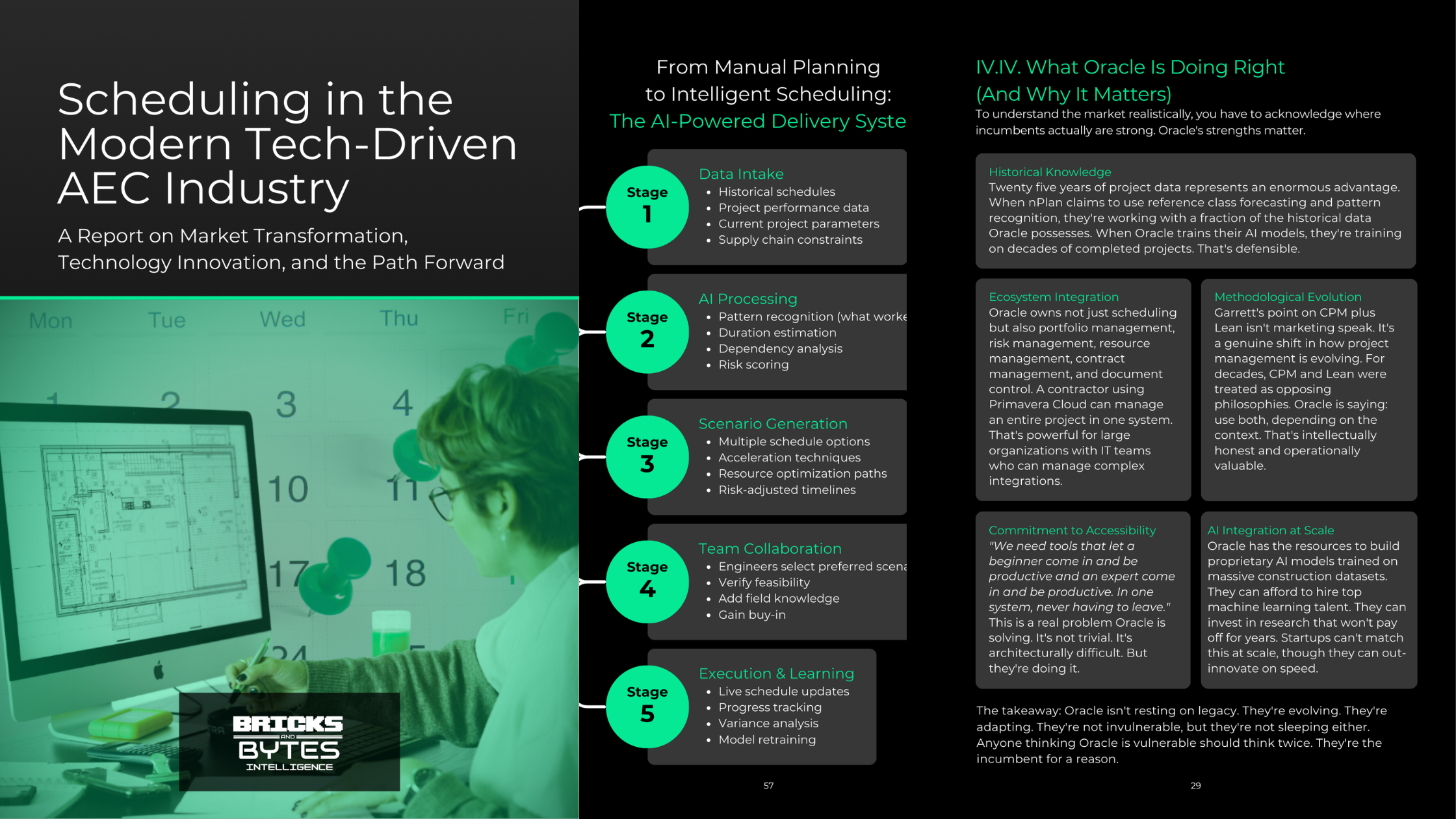
Get a FREE copy of our Scheduling in the Modern Tech-Driven AEC Industry: A Report on Market Transformation, Technology Innovation, and the Path Forward” (worth $150) and a FREE weekly email to stay up to date on construction tech. SIGN UP TODAY!

Scheduling in the Modern Tech-Driven AEC Industry

Sign up to the #1 Newsletter In AEC Tech. Join over 2,100 like-minded Founders, Investors and Techies disrupting the way we build. 

Scheduling in the Modern Tech-Driven AEC Industry