
Author name: Owen Drury

disrupting construction technology incumbents
Go To Market

Tackling Incumbent Challenges – Disruption in Contech

  Is it possible to disrupt established players in construction technology? With Autodesk’s dominant position in the industry, many startups dream of becoming the next big disruptor. But as former Autodesk co-CEO Amar Hanspal explains, the path to successful disruption is more nuanced than many realise. The State of Construction Technology “We’re still using 20th century tools for 21st century problems,” Hanspal observes about the current state of construction technology. This mismatch between modern needs and legacy tools creates opportunities for innovation, particularly as the industry grapples with demands for sustainability, resilience, and new construction methods.   In this episode of BitBuilders, Amar Hanspal, former co-CEO of Autodesk, talks about the challenges of building successful products, the importance of team dynamics, and crucial lessons for startups in the AEC space. The Challenge of Disruption The battle between incumbents and startups, Hanspal explains, comes down to “the speed between which a startup gets distribution and an incumbent gets innovation.” History shows that incumbents generally don’t innovate fast enough, creating opportunities for newcomers. However, there are exceptions – Microsoft’s successful pivot under Satya Nadella being a prime example. Why Disruption is Possible Now Several factors make this an exciting time for potential disruption: Technical Breakthroughs: The emergence of new technologies like advanced machine learning provides opportunities to reimagine product experiences Industry Evolution: The construction industry’s needs are changing rapidly, while tools haven’t kept pace Market Readiness: There’s increasing awareness of the need for better solutions Key Lessons for Challengers Start with the Problem, Not the Technology“Too many startups I’ve run across start from the technology and not the customer problem,” Hanspal notes. Success comes from deeply understanding customer pain points rather than starting with a technological solution looking for a problem. Focus on ExecutionIdeas aren’t unique – what matters is execution. As Hanspal puts it, “Your competitive advantage comes across in how you can translate that idea into reality.” This means building a team and process that can iteratively improve and deliver real value. Take the Long ViewDisrupting established players takes time, particularly in construction technology. “In the AEC industry, it’ll take two years for it to succeed,” Hanspal explains. This means planning for longer development and adoption cycles than in other industries.   The Customer Adoption Challenge One of the biggest hurdles in construction technology disruption isn’t technical – it’s behavioral. As Hanspal points out, “People will tell the incumbents, ‘You’re not innovating,’ and then spend the same amount of money with them the next year.” Successfully disrupting the market requires not just building better technology, but also changing deeply ingrained purchasing behaviors. Strategies for Success Speed of Innovation Matters More Than Being First Start Small and Focused Rather than trying to replace entire systems, focus on doing one thing exceptionally well. This was Autodesk’s own path to success – they started with drawings when the incumbents dismissed it as “nonsense.” Build for Scale Ensure your solution can scale beyond point solutions. As Hanspal warns, “Many young companies do not have software businesses because they’re doing custom things for everybody. That’s not scalable.” Find the Right Timing Timing matters enormously. Revit succeeded partly because it arrived when a generation trained on 3D gaming was entering the architecture workforce. Understanding and capitalizing on such timing factors can be crucial. The Path Forward The construction technology landscape is ripe for disruption, but success requires a thoughtful approach. As Hanspal notes, “If you’re an entrepreneur, I do think the winds are in your favor.” However, he emphasizes the importance of being prepared for the long haul: “Just know it’s going to take a while. So believe, be resilient, be thoughtful.” Key Takeaways for Startups ○ Focus on Real Problems: Ensure you’re solving genuine customer pain points rather than just building interesting technology ○ Build for the Long Term: Plan for multi-year development and adoption cycles ○ Create Sustainable Advantages: Develop capabilities that can’t be easily replicated by incumbents ○ Watch Market Timing: Pay attention to broader industry trends and adoption readiness The opportunity to disrupt construction technology incumbents exists, but success requires more than just better technology. It demands patient capital, deep industry understanding, and the ability to execute consistently over an extended period. As the industry continues to evolve and new technologies emerge, the opportunity for meaningful disruption grows – but only for those prepared to take a thoughtful, long-term approach to the challenge.      

construction technology market timing strategy
Go To Market

Importance of Market Timing & Competition in Contech

  Market timing in construction technology is a fascinating puzzle. Too early, and you’re solving problems the industry isn’t ready to pay for. Too late, and you’re playing catch-up in an increasingly crowded field. But occasionally, a company hits that sweet spot where market timing, technological capability, and customer needs align perfectly. Enscape’s journey from a VR startup to a successful rendering software company (ultimately acquired in a deal reportedly worth $200-250 million) offers valuable insights into market timing and competition in construction technology. The Power of Being Second One of the most counterintuitive lessons from Enscape’s story is that being first isn’t always best. As founder Moritz explains, “We thought that all the technologies converge to a point where there’s not a big differentiator between them because everyone can deliver a good or decent quality.” Yet Enscape managed to build a successful company in a space where established players like Lumion already existed. In fact, Moritz credits some of their success to learning from competitors: “Credit goes a lot to Lumion. We admired them a lot… We did copy some of the presence of what they did on their website.” This pragmatic approach allowed them to be more capital efficient by focusing on their core differentiators while adopting proven approaches for other aspects of the business. In this episode of BitBuilders, Moritz Luck, co-founder of Enscape, and we got to learn about his journey from a university project to a game-changing 3D rendering software When Competition Becomes Validation Sometimes, competition from industry giants can actually help validate and grow the market. Enscape experienced this firsthand when Autodesk launched a competing product after showing interest in their technology. While initially disappointing, this turned out to be beneficial: “Looking back, it was quite advantageous for us because they prepared the market… they did a lot of marketing that now you need VR.” Finding the Right Problem Market timing isn’t just about when you enter – it’s about finding the right problem to solve. As Moritz notes, “We had a lot of steps where people didn’t want to buy it, where then we thought it’s way better to have a product that people actually want to buy.” The team spent two years learning from mistakes before finding their true market fit. The key was moving from something technically interesting to something customers couldn’t live without: “Coming from that technical perspective of, this looks interesting to, this is something I really need now. And this is a no-brainer and I need to incorporate it into my business, into my workflow.” The ‘Banana Product’ Approach Moritz introduces an interesting concept from German business thinking – the “banana product.” Just as bananas are picked green and ripen during shipping, sometimes it’s better to launch a product that will mature through market exposure rather than waiting for perfection. “It wasn’t very sophisticated… but then we had quite some customers and then they helped us a lot in learning about the space and learning what’s really needed.” Customer-Centric Innovation Rather than optimising for acquisition or metrics, Enscape focused relentlessly on customer value. They priced their solution as a “no-brainer” where everyone could quickly adopt it, rather than maximizing short-term revenue. This approach led to strong customer acquisition and, ultimately, attractive metrics for investors. Key Lessons for ConTech Founders Speed of Innovation Matters More Than Being First○ Focus on innovating faster than competitors rather than being first to market○ Use existing solutions as learning opportunities○ Build on what works while focusing on key differentiators Listen to the Market○ Don’t mistake technical interest for market demand○ Be prepared to pivot based on customer feedback○ Accept that finding product-market fit can take years Pricing Strategy is Critical○ Consider “no-brainer” pricing to drive adoption○ Focus on customer acquisition over revenue optimization○ Build a sustainable model that can scale Embrace Competition○ Large competitors can help validate and grow the market○ Learn from established players rather than trying to reinvent everything○ Focus on your unique value proposition Perfect Timing Isn’t About Perfect Products○ Launch when you have something valuable, not perfect○ Use customer feedback to guide development○ Be prepared to iterate quickly based on market response Looking Forward The construction technology space continues to evolve, with AI and other emerging technologies creating new opportunities for innovation. However, the fundamental principles of market timing remain: success isn’t just about having great technology – it’s about introducing it at the right time, to the right customers, in the right way. As Moritz reflects, “You don’t start a business in order to get rich or to sell it, but you should start a business because there is a problem that you want solved or a need that you want to fulfill.” This focus on solving real problems, combined with smart timing and competitive strategy, remains the key to success in construction technology.      

Newsletter

The Story Behind $1.5bn Unicorn Built Technologies

Want to go deeper? Join our Patreon community for exclusive, not publicly available content and support the future of architecture, engineering, and construction. INDUSTRY INSIGHTSThe Story Behind $1.5bn Unicorn Built Technologies When Chase Gilbert and his co-founders started Built Technologies in 2014, they took an unconventional approach to construction technology. Instead of targeting contractors or project managers, they followed the money upstream to the source: banks and lenders. The strategy paid off. Built Technologies reached unicorn status in 2021 with a $1.5 billion valuation. Their platform now manages over $200 billion in annual construction spend across 300+ financial institutions. But what makes their story particularly interesting isn’t just the numbers – it’s the insights their journey offers for anyone working in construction technology. Chase Gilbert, CEO of Built Technologies Starting Upstream Changes Everything Construction relies on efficient capital flow, yet the industry’s financial processes have remained stubbornly antiquated. Built Technologies recognized that by starting with lenders, they could create a powerful ripple effect throughout the entire construction ecosystem. The math is compelling: one bank relationship can unlock hundreds of downstream connections with contractors and developers. When Built signs a new bank, they gain access to every construction project that bank finances. This creates a natural distribution channel that would be nearly impossible to build by approaching contractors individually. Measurable Impact Drives Adoption Before Built Technologies entered the market, construction loan processing was a mess.  Banks typically took five or more business days to process draw requests. Many institutions needed eleven back-office staff just to manage their construction loan portfolio. The process was manual, paper-based, and prone to errors. Built’s platform changed this dramatically.  Draw requests now process same-day. Banks have reduced their staff requirements by 80%. Real-time project tracking and risk monitoring have replaced manual spreadsheets. These aren’t just incremental improvements – they’re transformational changes that create measurable value. The Power of Value-Based Pricing Chase shared a revealing anecdote about their early pricing strategy. One of their first bank clients paid $50,000 annually for the platform. Built later discovered they were creating $2.5 million in value for that client. This massive value gap didn’t lead them to immediately raise prices. Instead, they used it to build trust and expand their footprint. The lesson here is clear: when you’re building something transformational, it’s better to capture a small slice of massive value than to optimize for short-term revenue. This approach has helped Built maintain a 99.999% client retention rate – nearly unheard of in enterprise software. Built is a leading provider of construction and real estate finance technology used by nearly half of the top 100 construction lenders in the U.S. Staying Resilient Through Market Changes Recent market turbulence has tested Built’s model. Rising interest rates and economic uncertainty have impacted construction lending. Their average client saw origination volume drop 57% from peak to trough. Yet Built has continued to grow by focusing on risk management and compliance – features that become even more valuable in uncertain times. This adaptability reveals an important truth about construction technology: the best solutions solve fundamental problems in both good times and bad. Built’s platform isn’t just about efficiency – it’s about giving stakeholders the visibility and control they need to make better decisions in any market condition. What This Means For founders in construction technology, Built’s story offers several key lessons. Start by solving problems at systemic chokepoints where improvement creates cascading benefits. Focus on measuring and proving value creation. Build for the long term while showing early wins. Contractors should prepare for continued digitization of financial processes. The days of paper checks and manual draw requests are numbered. Banks and lenders increasingly expect digital workflows and real-time project visibility. Getting ahead of these changes can create competitive advantages in securing project financing. For corporate leaders, Built’s success highlights the importance of looking beyond point solutions. The real value often lies in platforms that can improve core business processes while providing better risk management and visibility. Focus on solutions that can scale across your organization and improve key stakeholder relationships.  Looking Forward Built Technologies isn’t done innovating. They see their current success as “not even out of the first inning.” Their vision extends beyond loan administration to fundamentally transforming how money moves through the construction ecosystem. This ambitious outlook reflects a broader truth about construction technology: we’re still in the early stages of digital transformation. The companies that succeed will be those that solve fundamental problems, create measurable value, and build for the long term. Built Technologies has shown one path to success. The opportunity now is to build on these lessons and create the next generation of solutions that will transform our industry. Watch the full episode with Chase Gilbert here👇👇👇 Watch Episode WEEKLY MUSINGSHeuristics, Strategic Silence, India’s Tech Surge Challenging VC orthodoxy Brendan Wallace on LinkedIn | 76 comments Investors are drawing a false equivalency between the software revolution and the artificial intelligence revolution. In the software / IT revolution, value… Why you might not hear from the best startups When Should Construction Tech Startups Announce Their Moves? Ever caught yourself wondering why some construction tech startups seem to vanish after their splashy funding announcements? We’ve been thinking about the strategic silence in the AEC startup world. In 2024, construction tech companies raised serious capital – but the smartest ones might be the ones Global data center race heats up Last Week in ConTech on LinkedIn: The global energy landscape is transforming with record data centers, this is how: 👇 Billionaire Mukesh Ambani’s Reliance Group is developing what could be… OUR SPONSORS BuildVision — streamlining the construction supply chain with a unified platform for contractors, manufacturers, and stakeholders. Powered by beehiiv

Newsletter

ICYMI: Construction Giants, Arduino’s Story & Warehouse Robotics

Want to go deeper? Join our Patreon community for exclusive, not publicly available content and support the future of architecture, engineering, and construction. This Week’s Quickfire BytesFuel your curiosity with this week’s contentW/C 3rd February 2025 NEW EPISODES“Tech Adoption Will Come All At Once” – How Haskell’s $3B Construction Giant Approaches Innovation We had an insightful conversation with Cutler Knupp from Haskell’s DisruptTech about navigating construction tech investments and innovation. Learn how DisruptTech balances strategic value with investment returns in construction tech startups, why pilot programs often extend from 90 days to 12+ months before investment decisions and why construction tech adoption has been slower than expected, and what’s changing. open.spotify.com/episode/5slbJ41XWW0lkWaWBkok87 The Tool That Makes Carbon Transparency a Reality: Tangible’s Solution for Sustainability Anneli Tostar, co-founder and CEO of Tangible, shares how they’re helping real estate developers measure and reduce embodied carbon. Find out how Tangible measures embodied carbon using BIM files, making it easy for developers to see their impact, why legislation, corporate demand, and investor pressure are driving the need for carbon transparency and how data is used to drive better decisions in material selection and building design. open.spotify.com/episode/4LcQKIIYfhbHq2ShmwbOj6 $32M Series B: How Stratus is Revolutionizing MEP Workflows In this episode, we talked about Stratus raising $32M Series B to revolutionize MEP contractors’ digital workflows. We also explored how tech giants Microsoft, Amazon, and Google are planning to spend $300B on AI infrastructure construction, creating massive opportunities in the data center space. Through Patric Hellermann’s investor lens, we discovered why focusing on core infrastructure and authoring tools might be smarter than chasing AI-first solutions. open.spotify.com/episode/4TTODsBSAyadel9dXriXbV From Arduino to Innovation: How Massimo Democratized Hardware Prototyping Massimo Banzi, the co-creator of Arduino, discusses the evolution of open-source hardware, the challenges of building a global brand, and the future of edge computing in robotics. Banzi shares insights on making technology accessible to beginners while still serving professionals. He emphasizes the importance of hands-on learning in tech education and reflects on the changing landscape of open-source projects. open.spotify.com/episode/0li1xsItGhs6Y1tz7kMlrE Trayd’s Mission to Simplify Construction Payroll Anna Berger, founder of Trayd, shares her journey from failing at video dating apps to revolutionizing construction back offices. Learn how working in her dad’s construction office led to discovering a massive market opportunity, why Trayd focuses on specialty contractors instead of general contractors and the power of Trayd shows in B2B sales (and why cold calling doesn’t work). open.spotify.com/episode/3DJyCiB1XgbAhkGEjiNtBv InStock’s Blueprint for Affordable Warehouse Robotics Yegor Anchyshkin, CEO of InStock, talks about the fascinating world of automated storage and retrieval systems, the challenges of robotics startups, and the future of warehouse automation. Find out how InStock is revolutionizing warehouse automation with ceiling-driving robots, the importance of de-risking customers when selling new technology and why humanoid robots might not be the best solution for all automation needs. open.spotify.com/episode/0PBlXEnzWUwKnJ4L073NiA View All Podcasts BRICKS & BYTES BULLETINLessons From Levelset’s $500M Exit To Procore When Procore acquired Levelset for $500 million in 2021, it marked a significant milestone in construction technology. But the story behind this exit offers valuable insights for anyone building technology solutions for the construction industry. Scott Wolfe, Levelset’s founder, recently shared his journey from identifying a critical industry problem to creating a category-defining company. Read Full Article 2 FAVORITE QUOTES: “No one is doing this out of the goodness of their own heart. Construction and real estate development is not a philanthropic effort. And so neither is carbon reduction, at least not in the U.S.” – Anneli Tostar on what motivates companies to adopt carbon reduction measures “Obviously you get Chinese made products that are also made with lower quality components… But I guess there’s a category of customers who prefer to waste a lot of time and spend a little money.” – Massimo Banzi on clone products LATEST STORIES How to Cut Through the Noise and Find the Right Solutions Learn how to evaluate construction technology solutions effectively. Expert insights on finding the right partners and implementing valuable innovations. Construction Tech Founders: From Industry Veterans to Tech Innovators Explore how construction tech founders have evolved from industry veterans to repeat entrepreneurs and tech experts bringing AI and robotics expertise to the sector. Decoding Volvo’s Contech Investment Strategy Inside Volvo’s construction technology investment strategy: Learn how one of the world’s largest equipment manufacturers approaches CVC partnerships. View More Articles BONUS CONTENTWhat Are Investors Betting On? OUR SPONSORS BuildVision — streamlining the construction supply chain with a unified platform for contractors, manufacturers, and stakeholders. Powered by beehiiv

corporate venture capital construction technology
Venture

Decoding Volvo’s Contech Investment Strategy

  While many still associate Volvo primarily with safe family cars, the company’s construction technology investment strategy tells a fascinating story of innovation and strategic partnerships. Through insights shared by David Hanngren, Investment Director at Volvo Group Venture Capital, we get a unique glimpse into how one of the world’s largest equipment manufacturers approaches construction technology investments. Beyond the Traditional Manufacturer Role “Partnership is the new leadership” – this mantra, as Hanngren explains, drives Volvo’s approach to innovation. Despite having 100,000 employees and substantial R&D capabilities, Volvo recognises that some of the most innovative solutions come from smaller companies. “Sometimes the very best ideas or the very most innovative companies are not the biggest fish in the pond,” Hanngren notes.   In this episode of BitBuilders, David Hanngren, Investment Director at Volvo Group Venture Capital, shares Volvo’s approach to innovation, their investment strategy, and the future of construction equipment. The Investment Strategy Volvo’s investment approach centers around four key focus areas: • Electrification• Logistics• Site solutions (construction)• Sustainability What’s particularly interesting is how they balance strategic and financial considerations. “Most of the effort, let’s say 80%, is on the strategic side,” Hanngren explains. The primary question isn’t about financial returns but rather: “What can we do together? How can Volvo and this company benefit from each other?” The Partnership Approach Rather than pursuing full acquisitions, Volvo often opts for minority investments. As Hanngren colorfully puts it, sometimes an acquisition by a large company can be like “a wet blanket” on a startup’s momentum. This philosophy has led them to make typically 3-5 investments per year, ranging from $1-10 million each. Innovation Infrastructure Volvo has created specific structures to facilitate startup collaboration: CampX: A collaboration area where startups can work directly at Volvo sites in Sweden, the US, France, or India Innovation Lab: With locations in Silicon Valley and Sweden, focused on connecting with startups Fund Investments: Strategic investments in sector-specific funds, including construction technology focused funds The Construction Technology Focus When evaluating construction technology investments, Volvo looks for solutions that address three core customer needs: • Making operations safer• Improving productivity• Enhancing sustainability What’s particularly interesting is Hanngren’s observation about R&D resources: while Volvo spends enormous amounts on R&D, these resources are spread across multiple areas – from diesel engines to electric vehicles to automation. This means that a focused startup might actually have more resources dedicated to solving a specific problem than Volvo does internally. Investment Criteria For founders looking to partner with Volvo, Hanngren emphasises two key criteria: Problem Focus: “We’re very interested to see that they solve a real problem, that whatever they have developed is actually solving a very real pain point.” Monetisation Path: “If we would like to invest in a company, we want them to be successful… we want them to have a good idea of how can they actually make money.” Technology Trends Volvo is particularly interested in several emerging areas: • Safety technologies incorporating cameras and sensors• Autonomous operation solutions• Electrification across their product range• Software-defined vehicle systems• Fleet optimisation and management The Future Perspective Looking ahead, Volvo sees significant opportunities in autonomous operations. While they’ve already achieved 24/7 autonomous operation in mining environments, they believe construction equipment automation will follow the successful deployment of autonomous trucks on public roads. Key Takeaways for startups: • Stage Matters: While Volvo is open to early-stage companies, they prefer working with startups that have reached a certain scale (typically 40-50 people) to ensure effective collaboration. • Solution Focus: Having cool technology isn’t enough – there needs to be a clear connection to solving real customer problems. • Mutual Benefit: Volvo looks for partnerships where both parties can benefit, not just one-sided relationships. The evolution of Volvo’s construction technology investment strategy reflects a broader trend in the industry: large manufacturers increasingly recognize that innovation often comes from nimble startups. By creating structured ways to partner with these companies while allowing them to maintain their independence, Volvo is positioning itself to help shape the future of construction technology while ensuring its own continued relevance in a rapidly changing industry.      

evaluate construction technology
Technology

How to Cut Through the Noise and Find the Right Solutions

  With thousands of construction technology solutions flooding the market, how do large contractors separate signal from noise? Karel Van Eechoud, Head of Innovation at Implenia, offers valuable insights into evaluating and implementing construction technology effectively. The Challenge of Choice “We get a few [pitches] a week,” Van Eechoud notes. “If you include all the spam nowadays… I mean, I have the impression nowadays all this SaaS sales is automated. So you get like the most worthless emails with requests and semi-personalized email invitations.” This flood of potential solutions creates a significant challenge for innovation leaders: how to identify truly valuable technologies while avoiding wasted time on misaligned solutions.   In this episode of BitBuilders,  Karel Van Eechoud, Head of Innovation at Implenia, talks about the challenges of urban construction, the importance of material innovation, and the role of entrepreneurship in a large construction company. Key Evaluation Principles Layout errors don’t exist in isolation – they create a cascade of problems throughout the construction process: Start with the Problem. The most successful implementations often start with clearly defined problems rather than solutions seeking problems. As Van Eechoud explains, “We’re shifting that. So we’re really trying to work more challenge and problem focused. So what are the pain points? What needs to be improved?” Understand Company Context. Before approaching construction companies, solution providers must do their homework. “Read the website, check the kind of projects we do,” Van Eechoud advises. This basic research can save everyone time by ensuring basic fit. Don’t Overpromise. A common pitfall is promising too many features without a working product. “We have highly expert specialist people… Sometimes it can be very simple. And I think don’t over promise, but bring something solid fast,” Van Eechoud emphasizes. The Evaluation Process Implenia’s approach to evaluating solutions involves several key steps: Initial Filtering• Map solutions against identified business unit pain points• Consider strategic alignment with company direction• Evaluate team and technology credibility Validation• Gather feedback from internal experts• Consider implementation feasibility• Assess potential value creation Testing• Run focused proof-of-concepts• Validate assumptions• Measure actual value delivery Red Flags to Watch For Several warning signs can indicate potential misalignment: Lack of Research. Solutions providers who haven’t done basic homework about the company’s needs and operations often waste everyone’s time. Generic Approaches. Mass automated outreach rarely leads to meaningful partnerships. Personal, targeted approaches work better. Unrealistic Promises. Over-promising features without proven capabilities is a common red flag. Building Successful Partnerships For technology providers looking to work with large contractors, Van Eechoud offers several key pieces of advice: Do Your Research. “Look for what the company is really trying to do and where they’re moving towards to,” he advises. Understanding the company’s strategic direction helps align solutions appropriately. Be Patient. Enterprise partnerships take time. “You need to have a bit of patience… We are an enterprise. So things are slower and are sometimes a bit more cumbersome.” Start Simple. Focus on solving specific problems well rather than trying to address everything at once. “Sometimes it can be very simple… bring something solid fast.”   The ROI Question Return on investment remains crucial, but shouldn’t be viewed too narrowly. As Van Eechoud explains, “Innovation will never have a purely 100% return on innovation, meaning part of your activities will be indirectly contributing to this ROI.” Consider both direct and indirect benefits: • Direct cost savings• Productivity improvements• Cultural transformation• Capability building• Long-term strategic advantages Looking Forward The construction technology landscape continues to evolve rapidly. Success in this space requires: Clear Problem Focus. Start with well-defined problems rather than solutions seeking problems. Strategic Alignment. Ensure solutions align with company direction and capabilities. Realistic Expectations. Understand that enterprise partnerships take time and patience. Value Creation. Focus on delivering real value rather than just implementing technology. The Future of Layout Accuracy As construction technology evolves, new solutions are emerging to address these challenges. Automated layout systems, advanced measurement tools, and improved verification methods are helping reduce errors and their associated costs The industry is moving toward more integrated solutions that bridge the gap between digital models and physical construction. This evolution is essential as buildings become more complex and tolerances tighter. For construction companies, understanding and addressing layout accuracy isn’t just about cost savings – it’s about staying competitive in an evolving industry. As prefabrication and modular construction become more common, the ability to execute precise layouts will become increasingly critical to project success. Conclusion Finding the right construction technology solutions requires a structured approach focused on real problems and value creation. By following these principles and maintaining clear evaluation criteria, companies can better navigate the noise and identify truly valuable partnerships. For technology providers, understanding this perspective helps create more effective partnerships. Success comes from thorough research, patient relationship building, and focused problem-solving rather than overselling features or rushing implementation.      

construction tech founder evolution
Videos, Founders & Operators

Construction Tech Founders: From Industry Veterans to Tech Innovators

  Construction technology leadership has undergone a remarkable transformation over the past decade. In the early 2010s, the typical construction tech founder emerged from within the industry itself – professionals who intimately understood the challenges they faced and decided to build solutions when none existed. These “OG” founders, often with deep construction backgrounds, paved the way for a new wave of entrepreneurs now entering the space. Today, we’re witnessing an exciting shift as repeat founders, successful in other ventures, turn their attention to the construction industry’s vast potential for digitization. Perhaps most intriguingly, we’re seeing an influx of founders with specialized technical expertise in robotics and AI, many coming from prestigious tech companies. These innovators bring 10-15 years of cutting-edge technology experience, seeking to apply their knowledge to tangible, real-world problems in construction. This evolution signals two important trends: the growing recognition of construction as a massive, under-digitized industry ripe for innovation, and the increasing availability of venture capital in the space. The combination of domain experts, successful entrepreneurs, and technical innovators choosing construction tech demonstrates the sector’s maturation and promises an exciting future for construction innovation. Check out the full episode with Alice Leung from Brick & Mortar Ventures HERE.       

Newsletter

Lessons From Levelset’s $500M Exit To Procore

Want to go deeper? Join our Patreon community for exclusive, not publicly available content and support the future of architecture, engineering, and construction. INDUSTRY INSIGHTSLessons From Levelset’s $500M Exit To Procore When Procore acquired Levelset for $500 million in 2021, it marked a significant milestone in construction technology. But the story behind this exit offers valuable insights for anyone building technology solutions for the construction industry. Scott Wolfe, Levelset’s founder, recently shared his journey from identifying a critical industry problem to creating a category-defining company. Credit: Procore Finding the Right Problem It all started with a simple observation: getting paid in construction takes too long and creates too much stress. Scott noticed this while running a construction law practice in New Orleans after Hurricane Katrina. Instead of trying to revolutionise the industry with new technology, he focused on making existing processes better. “We weren’t going to these folks and saying, ‘Hey, you need to digitize,’” Scott explains. “We were really stepping in as a substitute for something they were already doing.” This approach proved crucial to Levelset’s success. Rather than forcing new processes, they enhanced familiar ones. The Power of Helping First Levelset’s growth strategy centered on a simple principle: help first, sell later.  They created comprehensive resources for every payment-related challenge in construction, similar to how WebMD covers medical symptoms. This wasn’t just content marketing – it was about becoming the industry authority on construction payments. The company built an extensive knowledge base covering payment-related laws and processes for every state. When contractors faced payment issues, they found Levelset’s resources through search engines. This organic approach generated thousands of leads monthly without aggressive sales tactics. Smart Money and Smarter Growth Despite being cashflow positive, Levelset chose to take venture capital.  But they did it differently.  Scott spent 16-36 months building relationships with potential investors before accepting funding. He chose investors based on alignment rather than valuation, often taking lower-valued term sheets from investors who better understood the vision. “If I were to start something else,” Scott notes, “one way you can really screw up is if you capitalize it wrong.” Each funding source – whether venture capital, private equity, or bootstrapping – shapes a company’s trajectory differently. Understanding this impact proved crucial for Levelset’s success. Natural Growth Over Forced Expansion From 2012 to 2015, Levelset grew naturally without external funding.  This period allowed them to develop their product, understand their market, and build a team that truly grasped the construction payment problem. When they finally took venture capital, they knew exactly how to use it. The company developed multiple growth engines. Beyond their content strategy, they created a marketplace of information about construction projects and implemented product-led growth through document signing and processing features. Each addition solved real problems while expanding their footprint. The Exit That Wasn’t Planned Scott never focused on selling the company. Instead, he concentrated on building value and solving industry problems. When Procore approached with an acquisition offer, he initially declined. It took multiple attempts and a compelling vision for the construction payments category to convince him. The deal’s success wasn’t just about the price tag. Scott considered the impact on all stakeholders – employees, customers, and investors. The final agreement included a $75 million stock package specifically for the team, recognizing their contribution to the company’s success.  Key Takeaways for Construction Technology Entrepreneurs The construction technology landscape continues to evolve, but several principles from Levelset’s success remain relevant: Solve existing problems better rather than forcing new processes Build authority through genuine help and education Choose investors based on alignment, not just valuation Allow time for organic growth and deep market understanding Focus on creating value rather than planning an exit The Future of Construction Technology Today, numerous companies are tackling construction payment challenges, each with their own approach. While they may differ from Scott’s original vision, they’re building on the foundation Levelset helped establish. The industry’s transformation continues, driven by entrepreneurs who understand that successful construction technology isn’t about digitisation for its own sake – it’s about solving real problems in ways that make sense for the industry. Remember Scott’s central advice: “Focus on building value because that’s going to serve all masters.” In construction technology, that means creating solutions that truly understand and address the industry’s needs, rather than just adding technology for technology’s sake. Watch the full episode with Scott Wolfe here👇👇👇 Watch Episode WEEKLY MUSINGSProud Moments, Stargate, Working Capital Congratulations to the entire Motif team Amar Hanspal on LinkedIn | 68 comments Final brag for the day. Now back to what matters the most – customers and creating/delivering value to them. AI race intensifies Last Week in ConTech on LinkedIn: Billions poured into AI and battery storage, reshaping energy and tech worldwide 👇 Copenhagen Infrastructure Partners (CIP) is investing £800 million to… The power of working capital yield The Secret Formula That Makes Working Capital Your Growth Engine Remember when your finance professor droned on about working capital? Well, turns out they were onto something big. We’ve spent seven years tracking a fascinating pattern: companies that master working capital yield aren’t just surviving – they’re turning every dollar into a money-printing machine. OUR SPONSORS BuildVision — streamlining the construction supply chain with a unified platform for contractors, manufacturers, and stakeholders. Powered by beehiiv

Newsletter

‘I’m Not Done Playing Yet’: From Uber to Leading UK’s Largest Trade Platform

Want to go deeper? Join our Patreon community for exclusive, not publicly available content and support the future of architecture, engineering, and construction. This Week’s Quickfire BytesFuel your curiosity with this week’s contentW/C 27th January 2025 NEW EPISODESSold for $500m – Scott Wolfe’s Epic Story With Levelset Scott Wolfe, founder of Levelset, shares the remarkable journey of building and selling his construction payment software company to Procore. Discover how helping contractors with payment problems evolved into a $500M exit, why Scott took the lowest valuation term sheet and spent 16-36 months building relationships with investors before taking their money and the power of “Help First” in content marketing – how Levelset generated thousands of leads by focusing on solving problems. open.spotify.com/episode/0GNnk8rT05EYhYixJ4Pi4h First Principles & Founder Success: Lessons from Scott Wolf’s Levelset Journey We explored how compound experience and non-linear career paths shape successful founders in construction tech. Learn how Scott Wolfe’s diverse background (software, retail, law) led to Levelset’s success, why non-linear experiences often lead to breakthrough innovations and why your customer should be your best source of capital. open.spotify.com/episode/2cJcHYVtjhsKEIiaM0SX1j 13% Profit at Risk? Kroo’s Solution for Construction’s Cash Flow Chaos Recently we were invited to the BOOST cohort from Suffolk Technologies, where we had a chance to interview Barry and Jonathan, Kroo’s co-founders. Find out how Kroo is unifying data from different platforms like project management, ERP, and scheduling software, why 80-90% of the industry is still struggling with basic data management and how Kroo is helping companies forecast cash flow and manage project costs. open.spotify.com/episode/5qPQ2mDhM3RqThoaaep1uM How Checkatrade Connects Millions of UK Homeowners with Vetted Professionals We sat down with Jambu, CEO of Checkatrade, who shared how he’s leading the UK’s largest trade platform through its next evolution. Find out why Checkatrade is moving from an advertising model to a full-service marketplace, how a tornado in West Sussex sparked the creation of a company that now serves millions and why the next wave of generational growth in trades is coming (and what’s driving it). open.spotify.com/episode/0LHFyT0YhxwtGixPpoKc31 The Problem with Project Write-Offs and How Novl is Solving It for Good We sat down with Novl’s founders, Sean and Hassan, at the Suffolk Technologies BOOST cohort to discuss how they’re helping companies boost margins and attract talent. Find out how Novl is helping companies use data to see where they’ve made and lost money, why predictive analytics is key for matching the right people to the right projects and how they are using a “baseball card on steroids” for resource management. open.spotify.com/episode/6R2AHGTFtRyLxCpB3NTj4p View All Podcasts BRICKS & BYTES BULLETINInside Ediphi: 10 Game-Changing Lessons for Construction Tech Today we release our deep dive Super Series with Ediphi. 4 hours of interviews with Ediphi’s founders, Dustin Devan & Mike Navarro, diving into: ‣ The Founders Story (incl Dustin’s previous large-scale exit)‣ The Landscape Of Estimating Tools‣ Ediphi’s Product‣ How To Build Great Construction Tech Companies In this newsletter, we share 10 things we learnt about pre-construction & estimating, and building preeminent construction tech companies. Read Full Article 2 FAVORITE QUOTES: “While AI may be growing dramatically, ultimately we still need people to put roofs over houses and fix boilers, right? And that’s always gonna be an imperative.” – Jambu on the enduring need for trades “Someone is repeating one year 20 times, not learning much. On the other hand, if you are venturing out and trying new things and are open, you can compound this knowledge over 20 years.” – Martin on the distinction between repetitive vs. compound experience LATEST STORIES The Hidden Costs of Inaccurate Layouts in Construction Discover how construction layout accuracy impacts project costs and timelines. Learn best practices for reducing expensive rework and improving building quality. The Evolution of Construction: Embracing Automation While Preserving Tradition Explore how automation and digital transformation are reshaping construction practices while maintaining traditional processes and addressing workforce challenges. Separating Signal from Noise in the Contech Investment Landscape Discover how to identify valuable construction tech investment trends and opportunities. Learn key market signals and investment principles from industry experts. View More Articles BONUS CONTENTWhat Are Investors Betting On? OUR SPONSORS BuildVision — streamlining the construction supply chain with a unified platform for contractors, manufacturers, and stakeholders. Powered by beehiiv

The Hidden Costs of Inaccurate Layouts in Construction
Robotics

The Hidden Costs of Inaccurate Layouts in Construction

  When we think about construction costs, materials and labor typically come to mind first. However, one of the most significant yet often overlooked cost drivers in construction is layout accuracy. Tessa Lau, CEO of Dusty Robotics, offers unique insights into how layout errors cascade through projects, creating substantial financial impacts. The Real Cost of Layout Errors “Rework due to mistakes made during construction, particularly layout, can cost up to 10% of the project,” Lau explains. This staggering figure becomes even more significant when considering large-scale projects like hospitals, data centers, or commercial buildings where budgets run into millions of dollars.   In this episode of BitBuilders, Tessa Lau, CEO of Dusty Robotics, talks about transforming construction with robots, the journey from prototype to product, why human-robot teams are the future of building… and many more. The Ripple Effect Layout errors don’t exist in isolation – they create a cascade of problems throughout the construction process: 1. Direct CostsLabor hours spent on reworkAdditional materials neededProject delaysCoordination disruptions 2. Indirect CostsTeam morale impactClient relationship strainReputation damageIncreased supervision requirements 3. Long-term ImplicationsHigher maintenance costsReduced building performancePotential structural issuesFuture renovation complications The Modular Construction Challenge The stakes become even higher with modern construction methods. As Lau notes, “If they’re off by like a quarter of an inch, one of them could be hanging off the side of the building when you’re done… You can’t refabricate a wall panel on site. You can’t just like shave off a quarter inch of it like you can with like a typical stud framing.” This precision requirement becomes particularly critical as the industry moves toward more prefabricated and modular construction methods. When components are manufactured off-site, there’s little room for adjustment during installation. The Communication Gap One of the fundamental issues leading to layout errors is the disconnect between digital design and physical construction. As Lau explains, “The perfect digital representation gets translated imperfectly into the field. And people make mistakes. It’s a really arduous task. It hurts their knees and backs.” This translation process from Building Information Modeling (BIM) to physical layout traditionally relies on manual measurements and chalk lines – a process prone to human error and physical limitations. Impact on Project Timelines Layout errors don’t just affect costs; they can significantly impact project timelines: 1. Direct DelaysTime spent identifying errorsRework executionMaterial reordering and delivery 2. Cascade EffectsSchedule disruption for other tradesResource reallocationExtended project supervisio 3. Documentation RequirementsChange order processingUpdated drawingsAdditional inspections The Human Factor Beyond the financial implications, inaccurate layouts create significant strain on the workforce: 1. Physical ImpactRepetitive stress from manual layoutAdditional physical labor for correctionsExtended time in uncomfortable positions 2. Mental StrainIncreased stress levelsFrustration with reworkTime pressure to maintain schedules 3. Team DynamicsPotential conflicts between tradesBlame allocationReduced job satisfaction Solutions and Best Practices To minimise layout-related costs, construction companies can: 1. Invest in TechnologyAutomated layout solutionsDigital verification toolsReality capture technology 2. Improve ProcessesEnhanced quality control proceduresBetter coordination between tradesClear communication protocols 3. Focus on TrainingUpdated skill developmentTechnology adoption trainingError prevention strategies The Future of Layout Accuracy As construction technology evolves, new solutions are emerging to address these challenges. Automated layout systems, advanced measurement tools, and improved verification methods are helping reduce errors and their associated costs The industry is moving toward more integrated solutions that bridge the gap between digital models and physical construction. This evolution is essential as buildings become more complex and tolerances tighter. For construction companies, understanding and addressing layout accuracy isn’t just about cost savings – it’s about staying competitive in an evolving industry. As prefabrication and modular construction become more common, the ability to execute precise layouts will become increasingly critical to project success. Conclusion The hidden costs of inaccurate layouts extend far beyond immediate rework expenses. By understanding these impacts and investing in solutions to address them, construction companies can improve their bottom line while delivering better projects more efficiently.      

The Evolution of Construction: Embracing Automation While Preserving Tradition
Videos, Startups

The Evolution of Construction: Embracing Automation While Preserving Tradition

  The construction industry stands at a fascinating crossroads between traditional practices and technological innovation. Rather than a complete replacement of conventional methods, we’re witnessing a natural evolution driven by necessity and efficiency. Whilst automation promises significant benefits, the reality is more nuanced than a straightforward technological takeover. Recent evaluations of robotic assembly have shown that despite its potential, the technology remains prohibitively expensive and complex to implement. Current estimates suggest we’re still three to four years away from practical, widespread adoption of such solutions. However, the most pressing challenge isn’t technological—it’s cultural. The industry faces a significant workforce crisis as traditional construction roles become less appealing to younger generations. This demographic shift necessitates a transformation in how we approach construction work. The solution lies in modernising construction sites through digital tools and innovative processes that make the industry more attractive to the next generation of workers. By creating an environment where construction work feels modern and technologically engaged, we can bridge the gap between traditional craftsmanship and contemporary workplace expectations. This evolution isn’t just about replacing manual labor with machines—it’s about creating a sustainable future for construction that combines the best of both worlds. Check out the full episode with Bruce and Oliver from Facit Homes HERE.       

construction tech investment trends
Venture

Separating Signal from Noise in the Contech Investment Landscape

  In the rapidly evolving world of construction technology investment, distinguishing genuine opportunities from market hype has become increasingly crucial. The story of Foundamental, one of the pioneering venture capital firms focused exclusively on construction technology, offers valuable insights into how investors can identify true potential in this emerging sector. The Investment Thesis: Beyond the Hype When Foundamental’s founding partners began exploring construction technology in late 2017, the sector wasn’t even recognised as a distinct investment category. As Patric Hellermann notes: “Construction tech, it wasn’t a category. It wasn’t even cool. There were a few early players in the industry. I wouldn’t even call them generation one because there was just not so much funding around at the time.” Yet beneath the surface, clear patterns were emerging that pointed to massive opportunity. The firm’s analysis revealed that construction technology was following similar investment patterns to other vertical-specific tech sectors: “When you look after PropTech or TravelTech or MobilityTech, FinTech, LogisticsTech, other sectors, the time it takes from when a sector reached 5 billion of accumulated VC funding to 10 billion, it’s always two to four years. From 10 billion to 50 billion, it’s always two to four years.”   Note: This is the 1st episode of our 8 part Super Series with Foundamental. You can go and check out the complete Super Series with Foundamental HERE,  Four Key Market Signals The investment thesis in construction technology rests on four fundamental market signals: Inflecting Demand: Global construction demand is experiencing exponential growth, with projections showing we’ll need to add “one New York City to this planet every month until 2060.” Declining Productivity: Labor productivity per full-time employee in construction has been shrinking, affecting revenue and margins on a per-head basis. Labor Shortage: Qualified construction workers are leaving the industry in droves, with Europe projected to be short 1.5 million workers by 2030. Knowledge-Based Business: Construction companies operate as project-based, service-oriented businesses where revenue is tied to billable hours and expertise. Identifying True Value Shubhankar Bhattacharya, a General Partner, explains: “Most VCs raise funds because there is fundraising opportunity, not because there is what we call DPI opportunity, distributions to paid-in capital opportunity. The difference is, well, some people raise funds because they can raise it, and some people raise funds because they can return it exceptionally well.” This distinction is crucial for investors looking to separate signal from noise in the construction technology landscape. True value creation comes not from following market trends or chasing the latest buzzwords, but from identifying companies that can deliver real solutions to the industry’s fundamental challenges. Investment Strategy Principles When evaluating construction technology investments, consider these key principles: 1. Focus on Controllable Factors Team quality and execution capability Technology effectiveness Market fit and timing 2. Avoid Uncontrollable Assumptions Regulatory changes Market timing speculation Broad industry adoption rates 3. Look for Global Patterns Different markets move at different speeds Solutions that work in one region may need adaptation for others Cross-border learning opportunities 4. Evaluate Market Conditions Industry readiness for adoption Existing infrastructure and support systems Competitive landscape The Path Forward The construction technology investment landscape continues to evolve, with new opportunities emerging as the industry faces increasing pressure to modernise and improve productivity. Success in this space requires: Deep understanding of industry dynamics Patient capital with long-term vision Focus on fundamental value creation Global perspective on market opportunities   For investors looking to participate in the construction technology revolution, the key is maintaining focus on fundamental value drivers while avoiding the temptation to chase short-term trends or unproven technologies. The Role of Automation While robotics and automation are part of Reframe’s solution, they’re not the starting point. As Enti emphasises, “We’re not an autonomous factory, we’re a modular micro factory that’s agile. Our whole goal is how do we improve labor productivity so we can deliver low carbon homes in a cost-effective manner.” Their approach to automation is pragmatic and focused: Automating tasks that workers don’t particularly value Focusing on behind-the-wall work first Maintaining flexibility to complete tasks manually when needed Gradually increasing automation as systems prove themselves   Conclusion The best opportunities will come from companies that can demonstrate clear paths to solving real industry problems, backed by strong teams and proven technology. As the sector continues to evolve, investors who maintain this focus while avoiding market noise will be best positioned to capture the tremendous value creation opportunity in construction technology.      

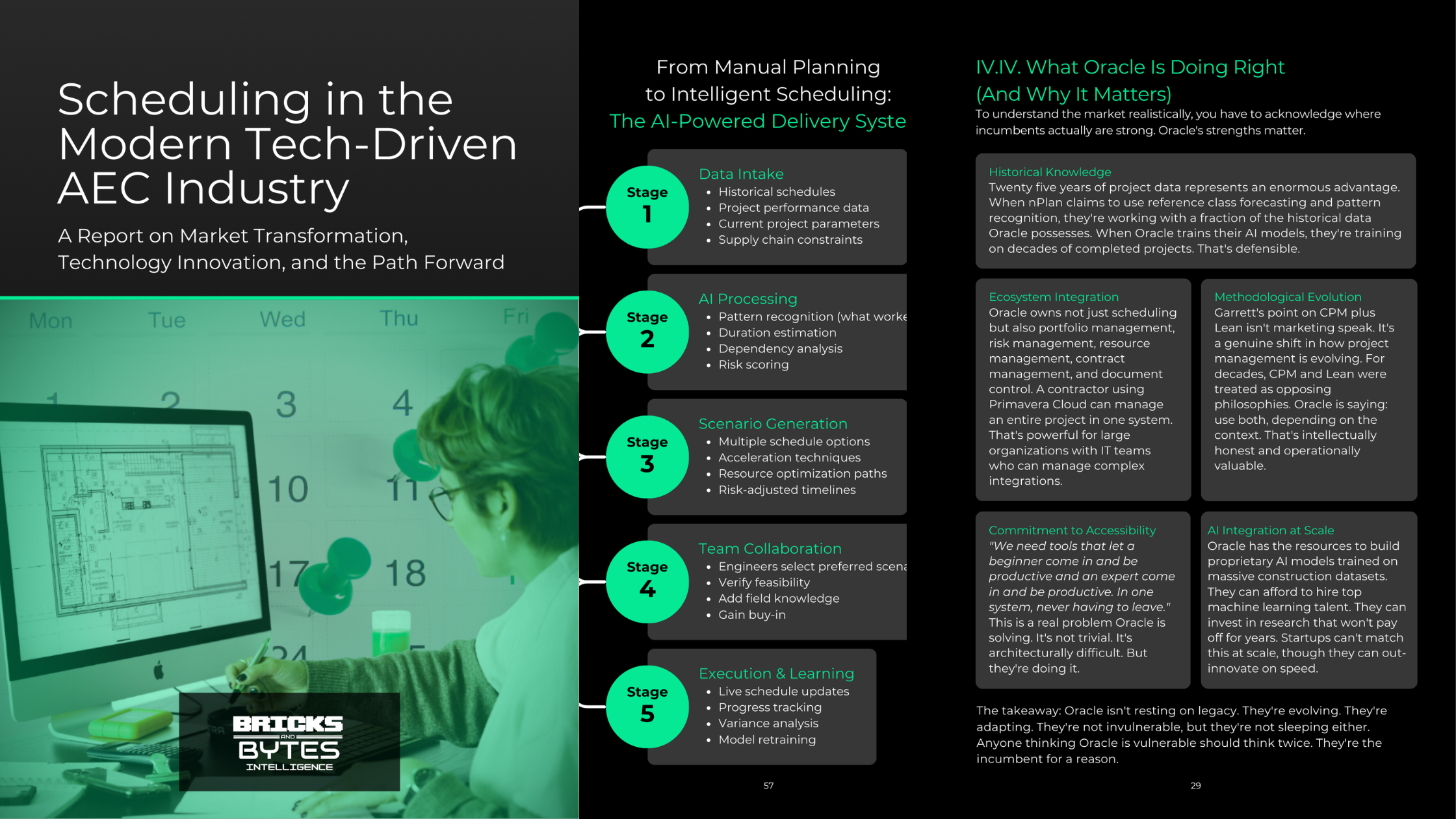
Get a FREE copy of our Scheduling in the Modern Tech-Driven AEC Industry: A Report on Market Transformation, Technology Innovation, and the Path Forward” (worth $150) and a FREE weekly email to stay up to date on construction tech. SIGN UP TODAY!

Scheduling in the Modern Tech-Driven AEC Industry

Sign up to the #1 Newsletter In AEC Tech. Join over 2,100 like-minded Founders, Investors and Techies disrupting the way we build. 

Scheduling in the Modern Tech-Driven AEC Industry