Author name: Owen Drury

Newsletter

ICYMI: $4.2Bn Innovation Process, 3D Scan to BIM & AEC Tech Marketing

Want to go deeper? Join our Patreon community for exclusive, not publicly available content and support the future of architecture, engineering, and construction. This Week’s Quickfire BytesFuel your curiosity with this week’s contentW/C 10th March 2025 NEW EPISODES3D Scan To BIM – Building Documentation Is Wrong 80% Of The Time Jose Cruz of Integrated Projects (IPX) shares his journey from bootstrapping to raising venture funding. Find out how growing up in his parents’ pizza shop gave Jose a “cheat code” for understanding business, the problem with building documentation (8 out of 10 landlords start projects with inaccurate as-built drawings) and how IPX is revolutionizing Scan-to-BIM technology by combining 3D scanning and modeling. open.spotify.com/episode/3vg2YGrL5Ld741EzrIVihz Germany’s Fiscal Bazooka Ignites Europe – Construction Tech Opportunities & Capital Shifts from Global VC Perspective We discuss Camber Creek’s unique investment approach with JP Bowgen. They raise funds from 300+ real estate companies to drive value for the founders they back. Also, we learned how building materials companies in Germany jumped 20% in share prices following this announcement, creating a flywheel effect for construction tech. open.spotify.com/episode/0PjlqqjUyRzRsat0eWkfn2 Most Tech Implementations Secretly Fail – $4.2Bn GC Innovation Implementation Process Aaron Anderson, Director of Innovation at Swinerton, shares incredible insights about technology adoption in the construction industry. Find out How they filter out “90% salespeople, 10% engineers” tech companies from their evaluation process, why contractors often “like to let other people fail first” when adopting new technologies and the critical factors that make a technology implementation successful on construction sites. open.spotify.com/episode/616DNUcaLsowkkwcWwKnK5 View All Podcasts BRICKS & BYTES BULLETINHow To Market Your Tech Solution: Insights from Industry Innovation Leaders Recently, we have been having tons of conversations with innovation heads and executives at large general contractors. We’ve learnt about what turns these people on (and off) and in today’s newsletter we give some guidance on how to effectively market your construction tech solution, so it speaks directly to your potential customers. Through conversations with innovation leaders at top general contractors, we’ve uncovered a consistent pattern of what makes construction technology succeed—and what causes it to fail. The truth is, technology adoption in construction isn’t primarily about the technology itself. It’s about understanding the industry’s unique challenges, speaking its language, and solving real problems that impact the bottom line. Read Full Article 2 FAVORITE QUOTES: “I often remind founders that it’s not so much of an achievement as it is an obligation, right? As in the same way that you would go to the bank and get a loan or line of credit, venture is just raising equity is a financing strategy. It’s not a particular milestone.” – Jose Cruz on bootstrapping vs venture capital “If an organization is like 90% salespeople and 10% engineers, you’re probably in trouble with their software. Because they’re gonna be slow to fix bugs. Their support is gonna make sure you keep buying and not to make sure it’s actually operating really well.” – Aaron Anderson on evaluating new technology CASE STUDIES AND REPORTS Windover Construction Discover how Windover Construction transformed from regional builder to global innovation leader with a practical, field-first technology approach. Download Case Study See Our Other ReportsIn-Depth Analysis & Industry Trends View All Reports OUR SPONSORS BuildVision — streamlining the construction supply chain with a unified platform for contractors, manufacturers, and stakeholders. Powered by beehiiv


Newsletter

How To Market Your Tech Solution: Insights from Industry Innovation Leaders

Want to go deeper? Join our Patreon community for exclusive, not publicly available content and support the future of architecture, engineering, and construction. INDUSTRY INSIGHTSHow To Market Your Tech Solution: Insights from Industry Innovation Leaders Recently, we have been having tons of conversations with innovation heads and executives at large general contractors. We’ve learnt about what turns these people on (and off) and in today’s newsletter we give some guidance on how to effectively market your construction tech solution, so it speaks directly to your potential customers. Through conversations with innovation leaders at top general contractors, we’ve uncovered a consistent pattern of what makes construction technology succeed—and what causes it to fail. The truth is, technology adoption in construction isn’t primarily about the technology itself. It’s about understanding the industry’s unique challenges, speaking its language, and solving real problems that impact the bottom line. Solving Real Problems, Not Pushing Solutions Innovation in construction only matters when it delivers tangible value: cost savings, quality improvements, time efficiency, or enhanced safety. Without these concrete benefits, even the most advanced technology becomes merely “cool” rather than useful. This sentiment resonates across the industry. The most successful construction technology companies don’t lead with their solution—they start by deeply understanding the problem. Across multiple interviews with innovation leaders, the consistent message is clear: focus on the problem first, then the solution. From a marketing perspective, this means your messaging should lead with the problem you solve, not the features you offer. Construction professionals want to know how you can reduce risk, save time, improve quality, or increase safety. Your technology is merely the vehicle to achieve these outcomes. Domain Expertise: Speak Their Language or Be Ignored If you can’t speak the language of construction and demonstrate genuine industry knowledge, you’ll struggle to gain traction. This extends beyond knowing terminology—it means understanding workflows, recognizing constraints, and appreciating the high-stakes, low-margin environment where most construction companies operate. Innovation leaders consistently cite alignment of values and understanding of the construction process as key factors when evaluating technology partners. If you’re not familiar with construction workflows, safety protocols, or project delivery methods, your solutions will likely miss the mark regardless of their technical merits. The ROI Question: Concrete Benefits, Not Theoretical Gains Construction technology must demonstrate clear, measurable ROI—but this goes beyond simple cost savings. At DPR Construction, for example, they recognize that companies don’t fully realize technology benefits until approximately two years after implementation due to adoption curves and necessary cultural shifts. This long-term view of ROI is critical for marketers to understand. Construction companies want partners who recognize the full complexity of implementation, including: The time required for adoption The process changes needed The cultural shifts that must occur The concrete benefits that will ultimately materialize Rather than promising immediate returns, successful vendors articulate a realistic timeline for value realization and support clients through the entire journey. Implementation Excellence: Where Most Technology Fails “Stop testing, start building” is Windover Construction’s approach to technology implementation. This philosophy highlights a critical truth: construction companies want technology that’s ready for real-world deployment, not endless pilots. Implementation excellence has emerged as perhaps the most significant differentiator for construction technology. Companies that invest in onboarding, training, and ongoing support consistently outperform those with superior technology but weaker implementation capabilities. The lesson? Marketing messages should highlight your implementation approach just as prominently as your technology’s capabilities. Integration Over Point Solutions The days of standalone point solutions are numbered. Construction companies are increasingly seeking integrated platforms that connect to their core project management systems. Innovation leaders consistently express a preference for fewer, more integrated tools rather than a multitude of specialized solutions. This preference is driven by practical considerations: construction teams face significant cognitive burden when required to learn and switch between multiple systems. For marketers, this means clearly articulating how your technology fits into the broader technology ecosystem, particularly with platforms like Procore, Autodesk, and Trimble products. The ability to integrate with existing systems is no longer optional—it’s a baseline requirement. Building Industry Relationships: The Collaborative Edge Contrary to what many assume, construction technology adoption is increasingly collaborative across companies. Innovation leaders regularly share insights about which technologies work—and which don’t. The industry is moving away from the “close to the chest” approach of years past. Today, when multiple general contractors adopt a technology, they can collectively influence product development and share implementation best practices. This industry-wide collaboration creates both opportunities and challenges for technology providers. Reference customers and case studies are more important than ever, as innovation leaders increasingly seek validation from their peers before making technology decisions. The Early Stage Advantage Interestingly, many construction innovation leaders express a preference for working with earlier-stage companies. There’s a growing recognition that working with startups provides an opportunity to shape products to specific needs rather than adapting to pre-established solutions. For construction tech marketers, this creates an opportunity to leverage flexibility as a competitive advantage against more established players. The ability to customize and co-develop solutions with clients can outweigh the stability advantages of larger, more established technology providers. The Path Forward for Construction Tech Marketers The insights from these innovation leaders point to a clear path for construction technology marketing: Lead with problems, not solutions – Demonstrate your understanding of construction challenges before discussing your technology Speak the language – Show genuine industry knowledge and avoid tech jargon Focus on implementation excellence – Highlight your approach to onboarding, training, and ongoing support Integrate, don’t isolate – Show how your solution fits into existing technology ecosystems Build relationships, not just customer lists – Invest in industry partnerships and reference customers Be transparent about ROI timelines – Set realistic expectations about value realization The needs and wants for each of your customers is pretty consistent across the board. So, for technology marketers who understand these dynamics, the opportunity has never been greater. The most successful construction technology providers are those who take the long view—partnering with their clients to build not just better technology,

construction field technology for craft workers
Technology

Empowering Craft Workers with Field-Focused Contech: The Next Frontier

  For years, construction technology has primarily focused on the back office – project managers, executives, and administrators. But what about the people who actually hammer the nails, lay the pipes, and pour the concrete? According to Hammad Chaudhry, VP of Innovation and Construction Technology at EllisDon, we’re finally seeing a shift toward empowering these essential craft workers with technology designed specifically for them. “The production comes from these individuals,” Chaudhry points out, “and they’ve been ignored for quite a long time.” It’s a striking observation that highlights a critical gap in how we’ve approached construction innovation. While we’ve developed sophisticated tools for planning and management, the actual builders – the ones doing the physical work – have often been left out of the technological revolution. In this episode of Corporate Innovations, Hammad Chaudhry, VP of Innovation and Construction Technology at EllisDon, shares insights on how they’re bringing cutting-edge startups and emerging tech like AI and robotics into the construction space.   The Challenge: Bridging the Gap The construction industry faces a perfect storm of challenges when it comes to craft workers. We’re seeing fewer people attracted to construction careers, experienced workers retiring faster than they can be replaced, and new workers entering the field with less practical knowledge than their predecessors. This creates a significant skills gap that threatens productivity across the sector. But here’s where things get interesting. Rather than viewing these challenges as insurmountable obstacles, innovative companies are seeing them as opportunities to reimagine how technology can support and empower craft workers. A New Approach: Gamification Meets Construction One fascinating example Chaudhry shares is EllisDon’s partnership with Crewscope, a platform that’s revolutionizing how craft workers engage with project goals. Instead of traditional top-down management, this technology creates alignment between upper management’s plans and the crews actually doing the work. Here’s how it works: Let’s say you’re part of a concrete crew. Your weekly goal might be to complete specific columns and formwork for an upcoming slab. Rather than this being just another task on a list, the platform turns it into a team challenge. Crews earn points for hitting milestones, but – and this is the clever part – it’s not about individual achievement. The entire crew needs to succeed together. “It sounds very simple,” Chaudhry notes, “but that gamification and unit methodology, creating that bond, aligning it back to the bigger picture of what maybe the organization and upper management is looking for for production – it’s a huge alignment, which you weren’t able to do before.” Beyond Games: Real Impact on Productivity This isn’t just about making work more fun (though that’s certainly a bonus). It’s about creating real, measurable improvements in productivity and engagement. When craft workers can see how their daily tasks connect to the bigger picture, when they have clear goals and instant feedback, and when they feel part of a team working toward shared objectives, the entire project benefits. The beauty of this approach is that it addresses multiple challenges simultaneously: ○ It makes construction work more engaging for younger workers who are used to digital interfaces○ It helps transfer knowledge and best practices across teams○ It provides real-time feedback on productivity○ It creates a sense of shared purpose and achievement The Future of Field Technology But this is just the beginning. As Chaudhry suggests, we’re seeing a broader trend toward field-focused technology that could transform how construction work gets done. From mobile apps that provide instant access to plans and specifications to tools that help workers visualize complex assemblies in 3D, technology is increasingly being designed with the craft worker in mind. What’s particularly exciting is how this shift could help address the industry’s ongoing labor challenges. By making construction work more technologically engaged and providing clear paths for skill development, we might just make the industry more attractive to the next generation of workers. The Bigger Picture: Changing the Paradigm Perhaps most importantly, this focus on craft workers represents a fundamental shift in how we think about construction technology. Instead of trying to manage around workers or replace them with automation, these new tools aim to enhance their capabilities and make their work more effective and enjoyable. “The current paradigm needs to flip,” Chaudhry emphasizes. While tools like Crewscope and others are valuable within the current system, he sees potential for even more fundamental changes in how we approach construction work altogether. This could mean new procurement methods, different approaches to project organization, and innovative ways of measuring and rewarding productivity. Looking Ahead As we look to the future of construction technology, it’s clear that empowering craft workers will be crucial. The industry faces significant challenges – from labor shortages to productivity pressures – but by focusing on the people who actually build our world, we might just find solutions that benefit everyone. The key will be continuing to develop tools that truly serve the needs of craft workers rather than just adding technology for technology’s sake. As Chaudhry’s insights show, when we get this right, we can create powerful alignment between management goals and field reality, potentially transforming how construction projects get delivered. After all, construction has always been and will always be about people. By finally bringing technology to the field in ways that empower rather than replace workers, we might be seeing the beginning of a new, more productive era in construction.      

Newsletter

ICYMI: 160+ Acquisitions: How One Company is Quietly Dominating Construction Technology

Want to go deeper? Join our Patreon community for exclusive, not publicly available content and support the future of architecture, engineering, and construction. This Week’s Quickfire BytesFuel your curiosity with this week’s contentW/C 3rd March 2025 NEW EPISODES160+ Acquitions – Hexagon’s Strategy Behind $32B Valuation Success Alex Brihac from Hexagon, a $6 billion company that most in construction tech haven’t heard of, shares their acquisition strategy, how they evaluate companies, and their vision for construction tech’s future. Find out how Hexagon decides between building vs buying technology (they spend $800-900M annually on R&D!), their four-pillar framework for evaluating acquisition targets and why they sometimes acquire service businesses, not just technology companies. open.spotify.com/episode/56cHyMfnZkIpjoq1TTFUTw Reneo’s €600M to Transform Real Estate, Nodes and Links $12m Scheduling Raise In this episode, we talk about Reneo’s massive €600M funding round (with €45M in equity) to transform energy-inefficient buildings into greener assets. We also explored Nodes and Links $12M Series B funding for their AI-powered scheduling management platform that enhances project delivery across construction and other industries. open.spotify.com/episode/0nxqcbTgj7ymLetaAtaG1A Hilti Ventures’ Strategic Bets in Construction Innovation – Antonia Soler Antonia Soler, Head of Hilti Ventures, shares invaluable insights from her 12 years of experience and her passion for transforming the construction industry. Find out how Hilti evaluates startups based on strategic fit and investability, why construction tech is thriving despite economic slowdowns and he story behind Women in Construction Tech initiative and its impact. open.spotify.com/episode/0ePSLGywYa9acXW5Heymbw View All Podcasts BRICKS & BYTES BULLETINInside Windover: The Technology Behind One Of The Industry’s Most Innovative Contractors If you haven’t already seen, we’ve started publishing the inside workings of the innovation departments within the General Contractors building our world. The first of these starts with Windover, a $150M Construction Management company based in Beverly, MA. Below is a snippet from the case study, if you want the full scoop, click here. Read Full Article 2 FAVORITE QUOTES: “The number of investments has not slowed down. Valuations may be lower and some of the investments happen earlier in stage, but there are the same or more number of investments in construction technology.” – Antonia Soler on the current investment climate “The biggest mistake of developing a strategy is based on products that you think are needed in the market without testing enough with customers.” – Alex Brihac on strategy development CASE STUDIES AND REPORTS Windover Construction Discover how Windover Construction transformed from regional builder to global innovation leader with a practical, field-first technology approach. Download Case Study See Our Other ReportsIn-Depth Analysis & Industry Trends View View View OUR SPONSORS BuildVision — streamlining the construction supply chain with a unified platform for contractors, manufacturers, and stakeholders. Powered by beehiiv

renovate robotics
Robotics

Building Robots That Construction Workers Will Actually Use: Lessons from Renovate Robotics

  The construction robotics landscape is littered with impressive technologies that workers never adopted. The challenge isn’t just building robots that work – it’s building robots that construction workers will actually use. The story of Renovate Robotics offers valuable insights into how to bridge this critical gap.   In this episode of BitBuilders, Dylan and Andy from Renovate Robotics share their journey in automating roofing installation, the challenges of hardware startups, and their unique approach to scaling a robotics business in construction.   Start with What Workers Already Know When Renovate set out to build their roofing robot, they made a crucial decision: rather than reinventing every aspect of the roofing process, they would build upon practices that workers already understand and trust. “We’ve tried to borrow as much from those intuitive areas that roofers already understand,” explains Andy Stulc, CEO of Renovate. Take their anchoring system, for instance. Instead of creating an entirely new way to secure their robot on the roof, they based it on the familiar safety anchor points that roofers already use to tie off their safety harnesses. This philosophy extends to how materials are handled too. Their robot doesn’t require special packaging or preparation of shingles – it works with the same bundles and methods roofers have been using for years. By building on existing practices rather than replacing them entirely, they lower the barrier to adoption. The Human Factor Can’t Be an Afterthought One of the biggest pitfalls in construction robotics is designing systems that only roboticists can operate. As Renovate discovered, it’s easy to fall into this trap early on. “Right now we’re definitely in the mode where there’s only about one person in the world that can run our robot and it’s our controls engineer,” Stulc admits. But they’re actively working to change this. Their solution? Hire a dedicated technician whose sole job will be operating the robot. This forces a crucial separation between developers and users, creating what Stulc calls a “developer-user relationship.” It’s a practical step toward making their technology more accessible to the average worker. Real-World Deployment Reveals Hidden Challenges The transition from lab testing to real-world deployment often reveals challenges that no amount of controlled testing can predict. When Renovate first took their robot to an actual job site, they discovered that seemingly simple tasks like unpacking and setting up equipment took far more time than expected. But rather than viewing these as setbacks, they saw them as opportunities for improvement. By their second deployment, they had already cut setup time to a third of what it initially took. This rapid iteration based on real-world feedback is crucial for developing technology that truly serves its users.   The Environment Matters More Than You Think Construction sites present unique challenges that can’t be fully replicated in a lab. For instance, Renovate discovered that their computer vision system, which worked perfectly in controlled conditions, struggled with the harsh shadows cast by trees on sunny days. These kinds of real-world complications can only be discovered and addressed through actual field deployment. Design for Integration, Not Replacement The most successful construction robots aren’t designed to replace workers entirely, but to integrate into existing workflows and make them more efficient. Renovate’s approach illustrates this well – their robot handles the repetitive task of shingle placement while workers handle setup, preparation, and other tasks that require human judgment and dexterity. This collaborative approach not only makes adoption more palatable but also more practical. It recognizes that construction work involves countless edge cases and unexpected situations that robots aren’t yet equipped to handle. The Business Model Affects Adoption How a robot is brought to market can significantly impact its adoption. Renovate’s careful consideration of whether to lease their robots or operate as a subcontractor shows how the business model needs to align with user needs and capabilities. Initially, they chose to operate as a subcontractor, allowing them to maintain direct control over their technology while it matures. This ensures that when problems arise – as they inevitably do with new technology – there are people on site who understand how to solve them. Keys to Success Based on Renovate’s experience, here are some key principles for building construction robots that workers will actually use: ○ Build on Existing Practices: Don’t reinvent processes that already work well – enhance them instead○ Prioritize Usability: If only engineers can operate your robot, it’s not ready for real-world deployment.○ Test in Real Conditions: Lab testing isn’t enough – get your technology onto actual job sites as early as possible.○ Design for Integration: Focus on augmenting human capabilities rather than replacing workers entirely.○ Start Simple: Begin with clearly defined, repetitive tasks where automation can provide immediate value. Looking Ahead The future of construction robotics won’t be determined solely by technological capabilities, but by how well these technologies can be integrated into existing workflows and adopted by actual workers. Success requires balancing innovation with practicality, and revolutionary technology with evolutionary adoption. As the construction industry faces continuing challenges with labor shortages and productivity, robots that workers can actually use – not just robots that work – will be crucial to moving the industry forward. The lessons from companies like Renovate show that achieving this requires more than just good engineering – it requires a deep understanding of the human side of construction work.      

Newsletter

Inside Windover: The Technology Behind One Of The Industry’s Most Innovative Contractors

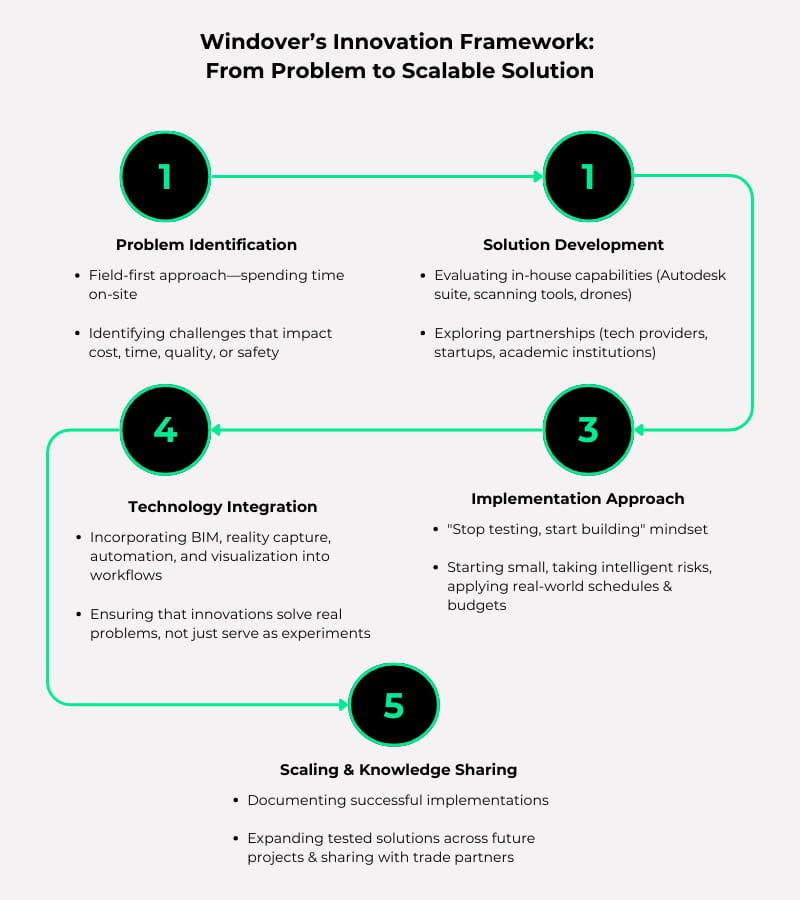
Want to go deeper? Join our Patreon community for exclusive, not publicly available content and support the future of architecture, engineering, and construction. INDUSTRY INSIGHTSInside Windover: The Technology Behind One Of The Industry’s Most Innovative Contractors Inside Windover: The Technology Behind One Of The Industry’s Most Innovative Contractors If you haven’t already seen, we’ve started publishing the inside workings of the innovation departments within the General Contractors building our world. The first of these starts with Windover, a $150M Construction Management company based in Beverly, MA. Below is a snippet from the case study, if you want the full scoop, click here. Windover Construction’s Innovation Approach Windover Construction has developed a unique approach to innovation in the architecture, engineering, and construction industry. Rather than simply adopting trending technologies, they focus on solving real construction challenges through practical applications of technology. Their innovation approach is characterized by: Problem-driven rather than technology-driven solutions Focus on real-world implementation instead of isolated pilots Integration of technology directly into live projects Embedding innovation into standard construction workflows Windover evaluates potential innovations based on whether they impact at least one of four key areas: Cost reduction (reducing rework, streamlining workflows) Time savings (reducing construction timelines) Quality improvements (ensuring precision and accuracy) Safety enhancements (reducing risks for workers) Windover’s Innovation Process & Framework Windover follows a structured 5-step process for implementing innovation: Problem Identification: Innovation begins in the field with the challenges experienced on construction sites. The VDC and innovation teams spend significant time on job sites, directly engaging with field teams to understand inefficiencies. Solution Development: Once a challenge is identified, Windover focuses on finding the right technological solution, not just adopting the latest trend. They first evaluate existing in-house capabilities before seeking external solutions through partnerships with technology providers, startups, and academic institutions. Implementation Approach: Following a “stop testing, start building” philosophy, Windover implements new technologies directly in active projects. They start small, take intelligent risks, and focus on practicality. Technology Integration: Successfully tested solutions are integrated into standard workflows and become part of the company’s construction process. Continuous Improvement and Scaling: Successful implementations are documented, refined, and scaled across the organization to become standard practice for future projects. Windover’s Technology Stack Windover has developed a comprehensive technology stack focused on three main areas: A. Reality Capture and Quality Analysis High-precision scanning systems (Faro laser scanners with 2-3mm accuracy) LiDAR-equipped drones for aerial surveys Quality control integration through overlay systems (NavSports) B. Digital Design and Visualization Advanced modeling tools (Autodesk Revit, Civil 3D, 3D Max) Custom-developed scripts for automated code checking Immersive technologies (VR, Mixed Reality with HoloLens, XR) Digital twin implementation using Autodesk Tandem with IoT sensors C. Automation and Manufacturing Innovation Robotic systems (automated diamond cutting, Howick machines for roof trusses) Digital fabrication tools (3D printers, automated prefabrication systems) Digital layout tools and automated quantity takeoff systems Lessons from Windover’s Journey For Construction Companies: Build Innovation from the Ground Up: Innovation should emerge from real-world challenges rather than top-down directives. Take Intelligent Risks: Start with smaller projects, document outcomes, scale successful innovations, and learn from failures. Invest in People First: Focus on training, create opportunities for experimentation, celebrate successes, and build a culture that embraces change. Partner Strategically: Build relationships with technology providers, academic institutions, and industry peers. For Technology Providers: Focus on Real Problems: Address specific construction challenges and demonstrate clear ROI. Build for Integration: Design tools that work with existing systems and support different levels of technological sophistication. Understand the Construction Environment: Consider the unique challenges of construction sites, including durability requirements and varying skill levels. The key takeaway from Windover’s approach is that successful innovation in construction isn’t about adopting technology for its own sake—it’s about applying the right technology in the right way to solve real problems and improve construction outcomes. To go deeper, check out the full case study here: https://bricks-bytes.work/innovation-case-studies/ OUR LATEST REPORTInnovating the Future: Robotics and the Revolution in Construction An exclusive deep dive into Monumental’s journey from a software startup to a pioneering force in construction robotics, featuring insider interviews with founders Salar Al Khafaji, Sebastiaan, and key investor Wouter Gourt. Get the full story now on our Patreon OR Get the report for FREE by sharing this newsletter with someone else. Click to Share WEEKLY MUSINGSJob Opportunities, Manpower Decimated, Theta Decay Provizual is hiring John Andres on LinkedIn: #layoffs #contech #autodesk | 13 comments Always tough to hear news about #layoffs in #contech. If you know of any software engineers impacted by the #autodesk layoffs, please have them connect with… | 13 comments on LinkedIn An opportunity for innovation Martyn Day on LinkedIn | 14 comments A lot of talk of what’s required, job wise, to get UK back to peak construction. The industry has seen manpower decimated | 14 comments on LinkedIn Construction tech’s “theta decay” Patric Hellermann on LinkedIn: Option Value in Construction-Tech, German Elections And AEC Tech Index What if your company’s secret sauce has a mathematical expiration date? Over my years of investing, I gained the conviction that there is a parallel between… OUR SPONSORS BuildVision — streamlining the construction supply chain with a unified platform for contractors, manufacturers, and stakeholders. Powered by beehiiv

Lucas Carne founder journey
Founders & Operators

From E-commerce Success to Construction Innovation: Lucas Carne’s Journey

Updates:• 011H has raised €20 million in a funding round led by Ship2B Ventures and CDTI to scale its low-carbon, tech-driven modular construction business across Europe. —– Sometimes the most interesting entrepreneurial stories aren’t about following a straight path, but about having the courage to venture into entirely new territories. Lucas Carne’s journey from e-commerce pioneer to construction innovator perfectly exemplifies this principle. Back in 1999, while working at Bain & Company’s Iberia office, Carne met José Manuel, who would become his longtime business partner. Both from Barcelona and coming from entrepreneurial families, they shared what Carne calls “the virus of entrepreneurship.” This partnership would prove transformative, leading to the creation of Privalia.com in 2006, a pioneering e-commerce company in Europe.   In this episode of BitBuilders, Lucas Carné, co-founder of 011H and former founder of Privalia (sold for $500M), shares insights on revolutionizing construction through digital innovation and sustainability.   The Privalia chapter of Carne’s story ended triumphantly in 2016 with a $500 million sale to a competitor. But beyond the impressive financial outcome, Privalia gave Carne something even more valuable: “It gave me professional growth and fulfillment. It gave me a wife – my wife is the former chief legal officer of the company. It gave me a lot of friends for life, and it gave me my freedom because now I can work just for passion and purpose.” This freedom to pursue purpose led Carne down an unexpected path. Rather than staying in the familiar territory of e-commerce or retiring to enjoy his success, he turned his attention to one of the world’s most traditional and challenging industries: construction. Why construction? As Carne explains, it wasn’t just about business opportunity. “I wanted to do something meaningful,” he says. The construction industry intersects with two of today’s most pressing challenges: housing affordability and climate change. The industry’s problems are well-documented – inefficiencies, delays, budget overruns, and a massive environmental footprint. For Carne, these challenges represented an opportunity to make a real impact. This led to the creation of 011H (pronounced “zero eleven h”), a company that’s reimagining construction through digital innovation. The name itself reflects their approach – the “0” and “1” representing digital transformation, while being the first three digits of the Fibonacci sequence, connecting mathematics with natural proportions found in architecture. But Carne didn’t just jump in blindly. He brought crucial lessons from his Privalia experience, particularly about how to integrate digital teams with operational ones. As he puts it, “At Privalia, we had the opportunity to learn how to put digital teams developing digital products to work together with operational teams in order to transform an industry like retail, which is very heavy on operations.” Perhaps most importantly, Carne approached this new venture with both ambition and humility. Unlike some construction tech startups that raised hundreds of millions only to fail, 011H took a more measured approach. They remained asset-light, focusing on building digital tools and processes rather than investing in manufacturing facilities. This strategy came from understanding that “construction is a very specific industry – it’s very difficult even if you standardize to the limit. Every location is different, every land is different, any urbanistic regulation is different.” Today, 011H is working to transform construction through four key differentiators: maximizing prefabrication, using sustainable materials, breaking down silos between design and construction, and leveraging digitalization. Their focus is on high-rise residential buildings in urban areas, where the need for affordable, sustainable housing is most acute. What’s particularly striking about Carne’s approach is his emphasis on trust and relationship-building. In an industry notorious for adversarial relationships, 011H refuses to participate in traditional bidding processes, instead focusing on collaborative projects where all parties are aligned from the start. As Carne notes, “We believe in design and build collaborative projects where the key trades, suppliers, contractor, designer stay from the very early stage of the design phase.” Looking ahead, Carne envisions 011H becoming a platform where developers, architects, and suppliers can connect and collaborate, all supported by digital tools that streamline the construction process. It’s an ambitious vision, but one that’s grounded in real experience and understanding of the industry’s challenges. Carne’s story is more than just a tale of entrepreneurial success – it’s about having the courage to tackle big problems, the wisdom to apply past lessons to new challenges, and the patience to build something truly transformative. As he puts it, “I consider myself a man on a mission and that’s my life motif right now.” For aspiring entrepreneurs, Carne’s journey offers valuable lessons about the power of purpose-driven entrepreneurship and the importance of bringing both ambition and humility to any new venture. It shows that sometimes the most meaningful opportunities lie not in disrupting the latest trending industry, but in applying fresh thinking to age-old challenges.      

Newsletter

ICYMI: Inside Gleeds: How a 100-Year-Old Consultancy Embraced AI

Want to go deeper? Join our Patreon community for exclusive, not publicly available content and support the future of architecture, engineering, and construction. This Week’s Quickfire BytesFuel your curiosity with this week’s contentW/C 24th February 2025 NEW EPISODESWhy Scandinavians Build Better – Secrets Of Modular Construction Excellence Helena Lidelow, a Swedish modular construction expert with 12+ years at Lindbacks and now with Volumetric Building Companies, breaks down why modular construction dominates Scandinavia and what the US industry can learn. Find out why labor costs and climate drive modular innovation in Scandinavia, the critical difference between volumetric and panelized construction approaches and how to measure factory efficiency (hint: man-hours per module is key). open.spotify.com/episode/0xxYdTPerQhAZLZ58OvAgy AI Agents Are Changing The Game – The Future Of Construction Workflows James Garner, Global Head of Data, Insights & Analytics at Gleeds, discusses how AI is transforming construction consultancy. Find out why construction is finally catching up with technology after decades of slow adoption, how the barriers to implementing AI have fallen dramatically, making it accessible to businesses of all sizes and why AI agents are perfect for construction’s workflow-based processes. open.spotify.com/episode/6ol0ao7Dfe6MSqRov3XGTf Building Materials Marketplace vs Cloud Manufacturing: What Works Where? We explore how Saudi BRKZ secured $17M Series A funding for their construction materials marketplace, bringing their total raise to $22.5M in just two years. Learn why Saudi Arabia’s construction tech scene is heating up, the difference between managed marketplaces and cloud manufacturers, how venture debt can be smartly used in profitable marketplace models and why expanding to 40 cities quickly might raise questions for investors. open.spotify.com/episode/2svtOcC3TIyoD6FvRbaVFy Built’s Path to becoming a $1.5B Construction Tech Unicorn Note: This episode is a re-release of an episode initially released at Groundbreakers. Chase Gilbert reveals Built’s journey from working with three community banks to becoming a construction tech unicorn that processes over $200 billion in annual construction spend. Discover why “following the money” upstream was the key to market penetration, how they turned an 11-person process into a 2-person operation and the strategy behind reducing loan processing from 5 days to same-day. open.spotify.com/episode/0rphItR122puMui125lHY1 View All Podcasts BRICKS & BYTES BULLETINAI Agents: The Definitive Guide Let’s face it. No matter how hard you try, you cannot avoid the conversation on AI. In recent weeks, we have been lucky enough to sit down with a number of experts including: ‣ Rajitha Charapala – VP of Product, Data & AI‣ Thiago Da Costa – CEO Founder at Datagrid‣ Alan Mosca – CTO at nPlan‣ James Garner – Global Head of Data at Gleeds The recurring theme in all of these conversations? Agents! As someone extremely curious, yet not quite understanding of the impact/use cases and potential of AI Agents, these conversations were extremely insightful and educational in understanding the biggest hype of 2025. So with that said, we felt it timely to share these experts insights on AI Agents. Read Full Article 2 FAVORITE QUOTES: “I come from an ecosystem where 90% of all my single family homes are made in a factory. So this is nothing special. I don’t have a site-built industry for single family homes. My norm is that they are made in a factory.” – Helena Lidelow on the Scandinavian approach to construction “We’ve said 2025 is going to be the year of the agents. I think by the end of this year, there’ll be some absolutely concrete case studies of what we’ve talked about happening in the market.” – James Garner predicting rapid adoption of AI agents LATEST REPORT An exclusive deep dive into Monumental’s journey from a software startup to a pioneering force in construction robotics, featuring insider interviews with founders Salar Al Khafaji, Sebastiaan, and key investor Wouter Gourt. Purchase “Innovating the Future: Robotics and the Revolution in Construction” now on our Patreon. OR Get the report for FREE by sharing this newsletter with someone else. Click to Share OUR SPONSORS BuildVision — streamlining the construction supply chain with a unified platform for contractors, manufacturers, and stakeholders. Powered by beehiiv
AI Agents: The Definitive Guide
Newsletter

AI Agents: The Definitive Guide

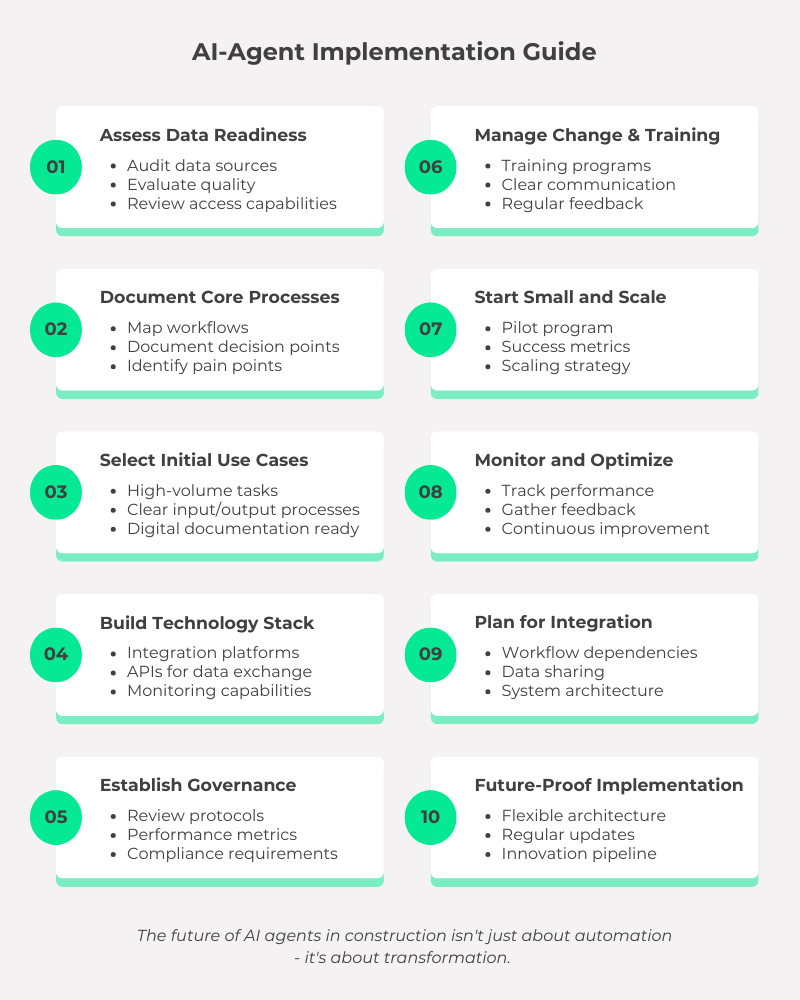
Want to go deeper? Join our Patreon community for exclusive, not publicly available content and support the future of architecture, engineering, and construction. INDUSTRY INSIGHTSAI Agents: The Definitive Guide Let’s face it. No matter how hard you try, you cannot avoid the conversation on AI. In recent weeks, we have been lucky enough to sit down with a number of experts including: Rajitha Charapala – VP of Product, Data & AI Thiago Da Costa – CEO Founder at Datagrid Alan Mosca – CTO at nPlan James Garner – Global Head of Data at Gleeds The recurring theme in all of these conversations?  Agents! As someone extremely curious, yet not quite understanding of the impact/use cases and potential of AI Agents, these conversations were extremely insightful and educational in understanding the biggest hype of 2025. So with that said, we felt it timely to share these experts insights on AI Agents. AI Agents in Construction: A Comprehensive Guide Understanding AI Agents AI agents represent a fundamental shift in how artificial intelligence operates within construction. Unlike traditional AI systems that simply respond to specific prompts or queries, AI agents possess autonomous capabilities that allow them to take action, learn from outcomes, and make decisions independently. These agents can observe their environment, process information, and execute complex sequences of tasks without constant human intervention. At their core, AI agents combine intelligence with agency – the ability to act on their own initiative. As Thiago Da Costa, founder of DataGrid, explains: “Agentic AI is really the ability of an AI to take control of its environment, affect the environment, observe what the effects were, take a step back, think about it, and then go step forward.” This capability transforms them from passive tools into active participants in construction processes. What truly sets agents apart is their ability to chain multiple tasks together and understand context. When presented with a challenge, an agent can break it down into steps, execute each one in sequence, and adjust its approach based on the results. This mirrors how human professionals work, but with the added advantages of tireless operation and consistent performance. Current Applications in Construction The construction industry is seeing AI agents deployed across numerous specific applications. Here’s a few ways on how they’re being used today, based on real implementations described by industry leaders: Document Management and Administration RFI Management: Agents can review incoming RFIs, cross-reference them with existing documentation, and even suggest responses based on historical data and project specifications Submittal Processing: Automated review of submittals against specifications, checking for compliance and flagging discrepancies Standard Operating Procedures: As described by Thiago Da Costa, “We built an SOP generator agent that actually generates the SOPs based on how companies have worked in the past… you can connect in your past projects, your past bids, and you can ask the agent to generate the SOPs” Contract Analysis: Agents can review contract documents to identify potential risks, inconsistencies, or missing information Documentation Updates: Automated tracking and updating of project documentation as new information becomes available Field Operations Installation Guidance: Field teams can photograph equipment or materials and receive immediate installation instructions and specifications Progress Tracking: Agents analyze site photos to quantify work completed and compare against schedule Quality Control: As described by Da Costa, “If you ask an AI to quantify something, it should actually check if you have any other drawings that have that same thing with more detail, or maybe there’s a schedule somewhere else” Asset Location: Teams can quickly locate equipment and materials by querying agents about inventory and placement Field Queries: Immediate responses to field questions by accessing and synthesizing project documentation Design and Engineering Drawing Review: Agents can compare different versions of drawings to identify changes and potential conflicts Model Comparison: Agents can look at entire models and compare them to other models and compare the things that are wrong with themodel without any instructions Specification Compliance: Automated checking of designs against project specifications and building codes Quantity Extraction: Automated take-offs and quantity calculations from drawings and models Schedule Generation: Agents can generate full works schedules and programmes, optimising for critical path, risk and workforce planning Risk Management and Safety Water Intrusion Prevention: Agents analyze site photos and weather data to identify potential water intrusion risks Safety Hazard Detection: Automated analysis of site photos to identify safety violations or potential hazards Schedule Risk Analysis: Agents analyze project data to identify potential delays and their knock-on effects Financial Risk Assessment: Monitoring of cost data and progress to flag potential budget overruns Environmental Monitoring: Integration of weather data with site conditions to predict and prevent environmental risks Project Controls Cost Tracking: Agents monitor actual costs against budgets, flagging variances and potential issues Schedule Monitoring: Automated analysis of progress and potential impacts on project timelines Resource Optimization: Agents can suggest optimal resource allocation based on project needs and constraints Change Order Management: Automated analysis of change orders for impact on schedule and cost Performance Analytics: Continuous monitoring and analysis of project performance metrics Communication and Collaboration Meeting Documentation: Agents can join meetings, take notes, and automatically categorize and distribute information Information Distribution: Automated routing of project information to relevant team members Query Resolution: Agents can answer project-related questions by synthesizing information from multiple sources Stakeholder Updates: Automated generation of progress reports and stakeholder communications Cross-team Coordination: Agents help ensure all team members have access to current and relevant information Each of these applications represents a real implementation of AI agents in construction today. What’s particularly powerful is how these agents can work together. As Rajitha Chaparala explains, “You can have multiple agents, like what’s getting triggered after one is done thinking about the next step.” This interconnected approach allows for comprehensive automation of complex workflows while maintaining human oversight at critical decision points. BEFORE WE DIVE BACK IN…Innovating the Future: Robotics and the Revolution in Construction The Inside Story of How a Tech Startup is Transforming the Construction Industry Through Robotics An exclusive deep dive

Newsletter

ICYMI: Inside Procore’s AI Strategy: A Conversation with their VP of Product Data & AI

Want to go deeper? Join our Patreon community for exclusive, not publicly available content and support the future of architecture, engineering, and construction. This Week’s Quickfire BytesFuel your curiosity with this week’s contentW/C 17th February 2025 NEW EPISODESWhy Top Construction Companies Are Abandoning Traditional Sales Methods – Building Radar Paul Indinger from Building Radar shares insights about transforming construction sales. From bootstrapping to raising 6.5M euros, Paul breaks down how they’re helping construction companies win better projects. Discover why most construction companies are missing the top half of their sales funnel, the stark difference between US and European construction sales culture and how they turned a student job researching construction projects into a tech company. open.spotify.com/episode/2fk1BNz131JUojF6XioWBu Procore’s AI Strategy & Implementation – AI’s Role in Modern Construction Rajitha Chaparala, VP of Product Data and AI at Procore, share fascinating insights about the future of construction technology and AI implementation. Discover how AI agents transform daily construction workflows – from submittal reviews to schedule updates, why the construction industry is finally embracing AI after years of hesitation and the three-pillar approach Procore is taking with AI: Co-pilot, Automation, and Insights. open.spotify.com/episode/0bBQwVmufDrZg1wHU76f48 Invoice reconciliation, AI automation, Material data infrastructure & CFO-driven adoption Henric Meinhardt from Comstruct walks us through how they’re digitizing the material delivery and invoice reconciliation process between suppliers and contractors. Find out how Comstruct automates invoice matching and material tracking, why large language models are making traditional EDI interfaces obsolete and how they convinced World Cup winner Mario Götze to invest. open.spotify.com/episode/5XnCi6QeQzhS85hQTkXSMW Formant’s Advanced Industrial Robot Management System – Jeff Linnell Jeff Linnell, CEO of Formant, shares his fascinating path from running an animation studio to leading a company that’s revolutionizing how humans interact with robot fleets. Discover how Jeff went from art school to controlling Hollywood cameras with industrial robots, why Google acquired his company and the lessons learned as an acquired founder and the untold challenges of making robot fleets work together (and why full autonomy isn’t the answer). open.spotify.com/episode/1xwlMQq25nyWRQjC8aTm6n Windover’s Industry-Leading Innovation Process Amr Raafat, Chief Innovation Officer at Windover Construction, shares how they’re revolutionizing construction through practical innovation. Discover why the best innovations start with field teams’ actual problems, how they achieved 50% cost reduction in historic facade restoration using 3D printing and their approach to implementing new tech: “Stop testing, start building”. open.spotify.com/episode/5ERJAfAyCXhdun4uuNn4fg View All Podcasts BRICKS & BYTES BULLETINConstruction Robotics Mastery: How This Startup is Bringing Robotics into Construction Imagine a construction site where robots and humans work side by side, each doing what they do best. It sounds like science fiction, but in 2024, it’s becoming reality – and it’s happening in the most unexpected way. As the number of skilled bricklayers in the Netherlands plummets from 10,000 to just 4,000 in a decade, few see a solution. The construction industry, contributing up to 30% of GDP in industrialized nations, is facing a crisis. Labor shortages are deepening, costs are spiraling, and traditional methods aren’t keeping up with urbanization demands. Enter Salar Al Khafaji and Sebastiaan, two software entrepreneurs who see something everyone else has missed. Read Full Article 2 FAVORITE QUOTES: “When the economy went down in 2008, 2009, not a lot of people wanted to build houses for fish anymore for aquariums. So I moved to construction” – Amr Raafat’s humorous reflection on his career transition from aquarium architect to construction innovation “On average, we did a survey a couple of years ago and we heard like 20% of time on a project is just spent looking for information.” – Rajitha Chaparala’s revealing statistic about inefficiencies LATEST REPORT An exclusive deep dive into Monumental’s journey from a software startup to a pioneering force in construction robotics, featuring insider interviews with founders Salar Al Khafaji, Sebastiaan, and key investor Wouter Gourt. Purchase “Innovating the Future: Robotics and the Revolution in Construction” now on our Patreon link. OR Get the report for FREE by sharing this newsletter with someone else. Click to Share OUR SPONSORS BuildVision — streamlining the construction supply chain with a unified platform for contractors, manufacturers, and stakeholders. Powered by beehiiv
Newsletter

Construction Robotics Mastery: How This Startup is Bringing Robotics into Construction

Want to go deeper? Join our Patreon community for exclusive, not publicly available content and support the future of architecture, engineering, and construction. INDUSTRY INSIGHTSConstruction Robotics Mastery: How This Startup is Bringing Robotics into Construction Imagine a construction site where robots and humans work side by side, each doing what they do best. It sounds like science fiction, but in 2024, it’s becoming reality – and it’s happening in the most unexpected way. As the number of skilled bricklayers in the Netherlands plummets from 10,000 to just 4,000 in a decade, few see a solution. The construction industry, contributing up to 30% of GDP in industrialized nations, is facing a crisis. Labor shortages are deepening, costs are spiraling, and traditional methods aren’t keeping up with urbanization demands. Enter Salar Al Khafaji and Sebastiaan, two software entrepreneurs who see something everyone else has missed. “Construction is the industry with the least innovation in terms of productivity growth,” Salar observes. But where others see obstacles, they see opportunity. Their solution? Robots that can lay bricks with millimeter precision, working alongside human crews to transform construction sites. But here’s where it gets interesting. Instead of positioning themselves as a typical robotics company, they make an unconventional choice. They become subcontractors, focusing on delivering completed brick walls rather than selling robots. This subtle shift changes everything. While other tech companies struggle to penetrate the conservative construction industry, their company, Monumental, starts gaining traction. The results are stunning. Traditional bricklaying costs of €1.20-1.50 per brick drop to €0.80-1.00. Project timelines shorten. Safety improves. But perhaps most surprisingly, instead of replacing workers, their robots become valuable team members, handling the most physically demanding tasks while human workers focus on higher-value activities. Their success catches the attention of major investors, including Wouter Gourt, who sees something revolutionary: a technology company that can smooth out construction’s notorious boom-and-bust cycles while delivering consistent results. But this is just the beginning of the story. Monumental’s inspiring workspace How do two software engineers convince a traditional industry to embrace robots? What strategies do they use to overcome deep-rooted skepticism? How are they planning to expand beyond bricklaying to transform entire construction sites? Today, we’re excited to announce the release of our comprehensive report: “Innovating the Future: Robotics and the Revolution in Construction.” This in-depth analysis reveals: The strategic frameworks Monumental uses to penetrate a conservative industry Detailed cost analyses and ROI calculations that convince skeptical contractors Real-world examples of successful human-robot collaboration Expert insights from key investors about the future of construction technology Practical lessons for entrepreneurs trying to transform traditional industries Inside, you’ll discover: Why starting with bricklaying is a strategic masterpiece How Monumental’s unique business model overcomes industry resistance The data-driven approach that’s revolutionizing project management Future opportunities in the $1.6 trillion construction automation market Practical frameworks for scaling hardware-based startups Whether you’re a construction industry veteran, a technology entrepreneur, or an investor seeking the next big opportunity, this report offers invaluable insights into one of the most significant industrial transformations of our time. Get the full story. Purchase “Innovating the Future: Robotics and the Revolution in Construction” now on our Patreon link. OR Get the report for FREE by sharing this newsletter with someone else. Click to Share WEEKLY MUSINGSAI Bell Curve, Agentic AI, Real Estate Action An accurate representation? Mike Powers on LinkedIn: Current state of construction tech companies: BuildVision #contech #construction #supplychain More than just a fancy term Thiago Da Costa on LinkedIn: Most AI products claiming to be “agentic”… aren’t. Agentic AI is not: 🟡 A workflow tool with AI steps (that’s AI workflows). 🟡 A RAG tool that retrieves… It’s a hyperlocal game Brad Hargreaves on LinkedIn | 12 comments Everyone thinks selling to real estate owners means going after Blackstone and Greystar. But after tracking 6,000+ developers, I discovered something… OUR SPONSORS BuildVision — streamlining the construction supply chain with a unified platform for contractors, manufacturers, and stakeholders. Powered by beehiiv

Newsletter

ICYMI: DeepSeek’s $6M AI Model: The Real Story Behind the Headlines

Want to go deeper? Join our Patreon community for exclusive, not publicly available content and support the future of architecture, engineering, and construction. This Week’s Quickfire BytesFuel your curiosity with this week’s contentW/C 10th February 2025 NEW EPISODESThe Truth Behind DeepSeek’s Impact on AEC | Alan Mosca on AI & Construction Tech Alan Mosca, CTO and co-founder of nPlan, shares fascinating insights about AI developments, construction tech, and the future of project planning. Find out how nPlan’s Barry agent helps construction teams make better decisions through meeting notes, WhatsApp integration, and email connectivity, the truth behind DeepSeek’s training costs and why media reporting missed the mark and why the future of software isn’t SaaS – it’s buying outcomes through agents that perform specific tasks. open.spotify.com/episode/1dD0pxhd9jykP71e4LcNEb Why European Construction Tech Could Outperform US Startups: A 5X Cost Advantage Revealed We talk about the story of an AEC start-up that raised $25M from a prestigious investor only to shut up shop shortly after announcing their round. We got insights into late-stage funding challenges in construction tech, with a seasoned investor highlighting why businesses struggle to raise Series B rounds when earlier rounds are overvalued. open.spotify.com/episode/6FsS0QQm2FnHeGtzyiLC3o Built’s Path to becoming a $1.5B Construction Tech Unicorn Chase Gilbert reveals Built’s journey from working with three community banks to becoming a construction tech unicorn that processes over $200 billion in annual construction spend. Discover why “following the money” upstream was the key to market penetration, how they turned an 11-person process into a 2-person operation and the strategy behind reducing loan processing from 5 days to same-day. open.spotify.com/episode/7uxdJqxDxwdePB7l6qKanH InStock’s Blueprint for Affordable Warehouse Robotics Yegor Anchyshkin, CEO of InStock, talks about the fascinating world of automated storage and retrieval systems, the challenges of robotics startups, and the future of warehouse automation. Find out how InStock is revolutionizing warehouse automation with ceiling-driving robots, the importance of de-risking customers when selling new technology and why humanoid robots might not be the best solution for all automation needs. open.spotify.com/episode/0PBlXEnzWUwKnJ4L073NiA View All Podcasts BRICKS & BYTES BULLETINThe Story Behind $1.5bn Unicorn Built Technologies When Chase Gilbert and his co-founders started Built Technologies in 2014, they took an unconventional approach to construction technology. Instead of targeting contractors or project managers, they followed the money upstream to the source: banks and lenders. The strategy paid off. Built Technologies reached unicorn status in 2021 with a $1.5 billion valuation. Their platform now manages over $200 billion in annual construction spend across 300+ financial institutions. But what makes their story particularly interesting isn’t just the numbers – it’s the insights their journey offers for anyone working in construction technology. Read Full Article 2 FAVORITE QUOTES: “DeepSeek did not spend six million dollars. This has been something that the media have done a beyond sloppy job of because it gets clicks… it’s like saying the finishes of MEP was six million dollars and then saying that the building cost six million dollars.” – Alan’s blunt correction of media misreporting about DeepSeek’s training costs “I’d be lying if I told you that I am particularly excited about being public. I see it creates a lot of perverse incentives… the short-term nature of quarterly thinking.” – Chase Gilbert’s view on going public LATEST STORIES Importance of Market Timing & Competition in Contech Learn vital lessons about market timing and competition in construction tech from Enscape’s success story and strategic approach to product development. Tackling Incumbent Challenges – Disruption in Contech Learn strategies for challenging incumbent construction technology providers from former Autodesk co-CEO Amar Hanspal’s insights on industry disruption. View More Articles BONUS CONTENTWhat Are Investors Betting On? OUR SPONSORS BuildVision — streamlining the construction supply chain with a unified platform for contractors, manufacturers, and stakeholders. Powered by beehiiv
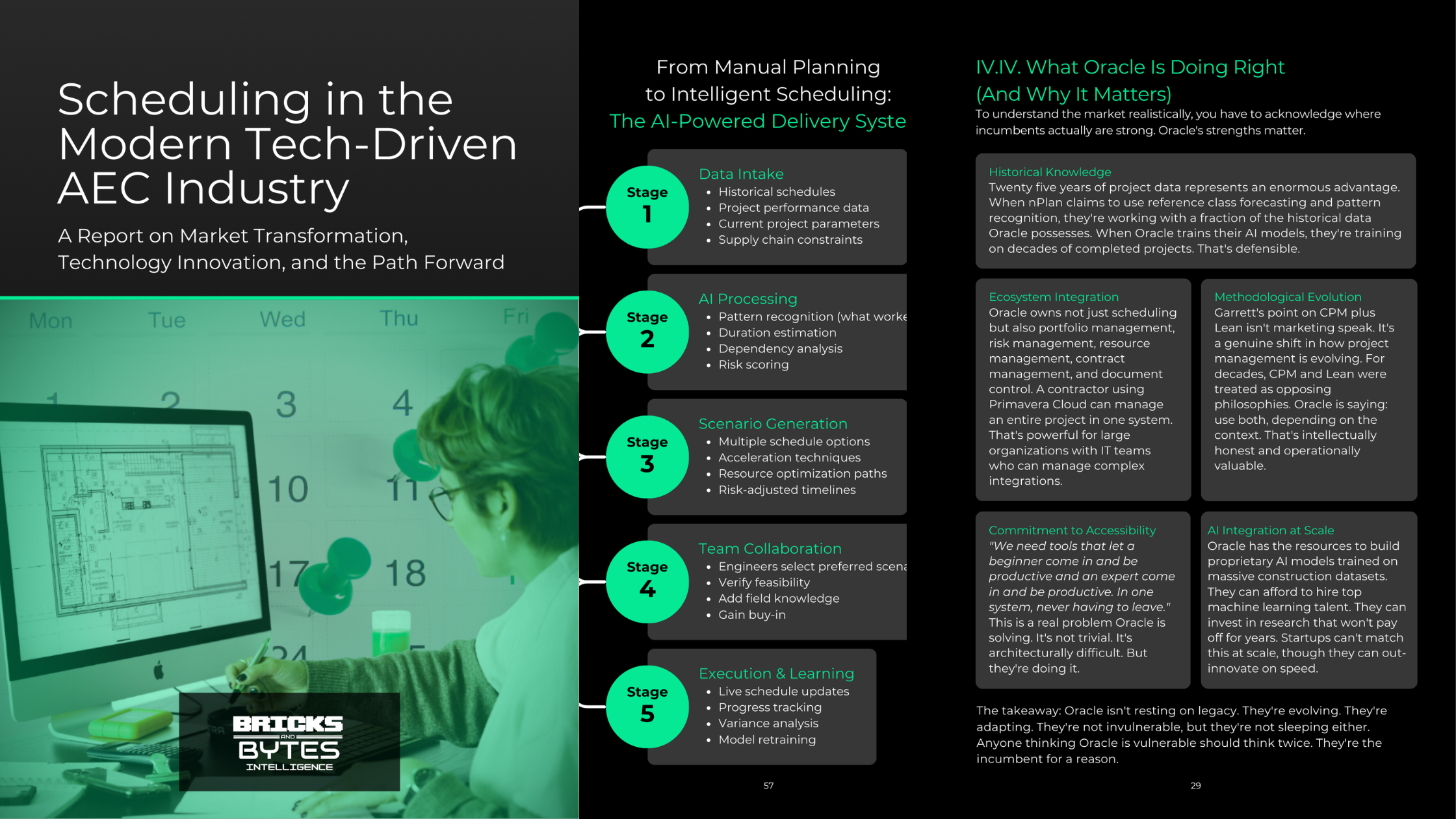
Get a FREE copy of our Scheduling in the Modern Tech-Driven AEC Industry: A Report on Market Transformation, Technology Innovation, and the Path Forward” (worth $150) and a FREE weekly email to stay up to date on construction tech. SIGN UP TODAY!

Scheduling in the Modern Tech-Driven AEC Industry

Sign up to the #1 Newsletter In AEC Tech. Join over 2,100 like-minded Founders, Investors and Techies disrupting the way we build. 

Scheduling in the Modern Tech-Driven AEC Industry