
Author name: Owen Drury

retrofitting europe
Technology

Can Europe Successfully Retrofit Its Way to Net Zero?

  Imagine a continent where three-quarters of all buildings are energy-inefficient. This isn’t a hypothetical scenario – it’s the reality in Europe today. A staggering 75% of buildings in the EU are energy inefficient, highlighting an urgent need for retrofitting. As energy costs skyrocket and climate change concerns intensify, retrofitting has become more than just a buzzword – it’s a necessity. Why Retrofitting Matters Now More Than Ever Europe’s building stock is ageing rapidly. Many structures date back decades, even centuries, long before modern energy efficiency standards were even conceived. With the EU’s ambitious goal of achieving carbon neutrality by 2050, upgrading these buildings isn’t just an option – it’s a critical step towards a sustainable future. Gregory Dewerpe, a leading voice in PropTech, emphasises this urgency: “There’s just no going around or getting around the fact that we need to retrofit stuff. It’s particularly true for Europe, where we have the oldest housing stock in the world.“ But retrofitting isn’t solely about meeting climate targets. Its benefits are far-reaching: Energy Bill Reduction: Homeowners can significantly cut their energy costs. Improved Living Conditions: Better insulation means more comfortable homes, winter and summer. Property Value Boost: Energy-efficient homes command higher market prices Job Creation: The retrofitting boom is opening up numerous opportunities in the construction sector.   An exclusive insider look at AO Venture Capital (now noa), Europe’s largest built-world VC firm with direct access to $40 Billion in real estate. Listen to the full episode HERE.  Key Drivers Fueling the Retrofitting Trend Several factors are converging to create the perfect storm for a retrofitting revolution: Government Regulations: The EU’s Energy Performance of Buildings Directive is setting stringent standards, pushing building owners towards efficiency. Soaring Energy Costs: As utility bills climb, homeowners are increasingly motivated to find long-term solutions. Climate Change Awareness: Public consciousness about carbon footprints is at an all-time high. Property Market Dynamics: Energy-efficient homes are becoming more attractive to buyers and renters alike.   Navigating the Challenges in the Retrofitting Landscape Despite the enormous potential, the path to widespread retrofitting isn’t without its obstacles: Skill Shortage: The demand for retrofitting far outstrips the supply of qualified professionals. As Dewerpe pointedly notes: “You could drop ship 5 million heat pumps tomorrow in Europe. It wouldn’t change a thing because there’s nobody to install it, or at least there’s not enough people to install it.“ Financial Hurdles: The upfront costs of retrofitting can be daunting for many homeowners. Technical Complexity: Retrofitting often involves intricate processes requiring specialised knowledge. Supply Chain Fragmentation: Coordinating multiple contractors and suppliers can be a logistical nightmare.   Opportunities Ripe for Innovation Where there are challenges, there are opportunities for innovative solutions: One-Stop-Shop Platforms: Companies like Enter are revolutionising the retrofitting process by offering comprehensive services under one roof. Cutting-Edge Materials: Startups are pushing the boundaries with new, more efficient insulation and sustainable building materials. Creative Financing: Novel funding models are emerging, making retrofits more accessible to a broader range of homeowners AI-Powered Assessments: Advanced technologies are enhancing the accuracy and efficiency of energy audits. Patric Hellerman during one of our BBBC episodes, highlights the importance of these platforms: “The energy audit is the right to play in this market because you acquire the physical substance and you gain the trust of the customer because you’re a credible arbitrator.“   Success Story: Enter’s Rapid Rise in Germany Enter, a German startup, serves as a shining example of the potential in the retrofitting market. Their innovative platform: Conducts detailed energy audits using cutting-edge technology Connects homeowners with a network of vetted, skilled contractors Facilitates access to financing options and navigates the complex world of government subsidies Enter’s meteoric growth and successful funding rounds underscore the massive potential in this market.   Credits: Enter / Enter’s Max Schroeren, Justus Menten, Alexander Müller The Future of Retrofitting: A Glimpse into Tomorrow AI and Machine Learning: These technologies will streamline the retrofitting process, from initial assessment to project completion. Prefabrication: Off-site manufacturing of retrofitting components will speed up installations and reduce costs. Green Financing: More banks and financial institutions will offer specialised loans for energy-efficient upgrades. Policy Evolution: Expect more government incentives and potentially even mandates for retrofitting. However, it’s not just about market size or funding amounts. The focus is on creating real value and being the best in the business. Success in this sector will come to those who prioritise excellence and innovation over mere financial metrics. Taking Action: What Can You Do? Homeowners: Start with an energy audit. It’s the first step to understanding your home’s efficiency potential. Investors: Look beyond traditional real estate. PropTech startups in the retrofitting space offer exciting opportunities. Policymakers: Consider innovative policies that can make retrofitting more accessible and affordable for all. Entrepreneurs: There’s still room for disruption in this growing market. Can you solve one of the industry’s pressing challenges? The retrofitting revolution in Europe isn’t just coming – it’s already here. As we collectively tackle the twin challenges of climate change and energy efficiency, the opportunities in this sector are set to grow exponentially. The question isn’t whether to get involved, but how and when.  

optima framework part 1
Go To Market, Technology

The OPTIMA Framework: Revolutionising Construction Innovation (Part 1)

  Are you struggling to implement innovation in your construction business? You’re not alone. The construction industry often grapples with adopting new technologies and processes. But what if there was a systematic approach to innovation? Enter the OPTIMA framework, developed by Todd Wynne, Chief Innovation Officer at Rogers O’Brien Construction. The Innovation Challenge in Construction Construction faces unique hurdles when it comes to innovation. Tight margins, safety concerns, and a traditional mindset often slow progress. Yet, the need for innovation has never been greater. From labour shortages to sustainability demands, the industry must evolve. Todd understands these challenges firsthand. With years of experience in construction technology, Wynne has been at the forefront of industry innovation. His journey from co-founder of Project Atlas to his current role at Rogers O’Brien has shaped his approach to innovation.   Introducing the OPTIMA Framework So, what is OPTIMA? It’s a systematic approach to innovation in construction. Each letter in OPTIMA represents a crucial element: O: Objective P: People T: Targeted outcomes I: Integrated processes M: Modern tools A: Accurate measurement This framework provides a roadmap for successful innovation implementation. It ensures that all aspects of a new initiative are considered and aligned.     Why a Systematic Approach Matters Have you ever tried to implement a new tool or process, only to see it fail? You’re not alone. Ad-hoc innovation often leads to disappointment. Why? Because it doesn’t consider all the factors needed for success. A systematic approach, like OPTIMA, changes this. It ensures that: You have a clear goal in mind The right people are involved Success is clearly defined New processes integrate with existing ones The right tools are selected Progress is measured accurately By addressing all these elements, OPTIMA increases the chances of successful innovation. Todd Wynne emphasises the importance of a structured approach: “Innovation is an outcome. It’s not an input. You can’t force innovation to occur. If you even think about it, we don’t know if something’s innovative until we’re looking in the rear view mirror. It’s always after the fact when and that’s why listen to how we even describe things are innovative. We go, that was innovative. And we’re saying it in the past tense. This insight underscores why a framework like OPTIMA is crucial. It helps create the conditions for innovation to occur naturally.   Setting the Stage: Objective and People Let’s dive deeper into the first two elements of OPTIMA: Objective and People. Objective: The Foundation of Innovation Every innovation effort must start with a clear objective. What problem are you trying to solve? What improvement are you aiming for? Without a clear objective, your efforts may lack direction. For example, your objective might be to reduce rework by 30% on your projects. This clear, specific goal provides a foundation for all other decisions.   People: The Drivers of Change Innovation doesn’t happen in a vacuum. It requires the right people with the right skills and mindset. When selecting team members for an innovation initiative, consider: Do they have the necessary skills? Do they have the capacity to take on this work? Are they open to new ideas and ways of working? Remember, the success of your innovation efforts often hinges on the people driving them. Todd stresses the importance of people in the innovation process: “We’re not looking to invest in technology just for investing in technology sake. We’re looking to solve the company’s problems and our company strategy.” This highlights why having the right people who understand the company’s objectives is crucial for successful innovation.   Conclusion The OPTIMA framework offers a structured approach to innovation in construction. By starting with clear objectives and involving the right people, you set the stage for success. In our next article, we’ll explore the ‘T’ and ‘I’ of OPTIMA: Targeted outcomes and Integrated processes. Stay tuned!    

Understanding Distribution Channels in Construction Tech
Startups

Cracking the Code: Understanding Distribution Channels in Construction Tech

  In the bustling world of construction technology, having a groundbreaking product isn’t enough to guarantee success. The real key to dominating the market? It’s all about distribution. Let’s roll up our sleeves and dig deep into the foundations of distribution channels in construction tech, exploring why they’re the cornerstone of industry triumph. What are Distribution Channels in Construction Tech? At its core, distribution channels are the pathways your product takes to reach your customers. In the complex world of construction tech, these channels can take several forms: Direct: Selling straight to the end-user Indirect: Using intermediaries like resellers or partners Hybrid: A mix of both direct and indirect methods   Why Efficient Distribution is the Bedrock of Success Imagine crafting the most innovative construction software or the most durable building material, but having no way to get it into the hands of architects, engineers, or contractors. That’s the problem inefficient distribution solves. Efficient distribution is like a well-designed blueprint – it provides a clear path forward. Here’s why it matters Rapid Growth: It helps you expand your customer base faster than your competitors. Customer Retention: Efficient distribution isn’t just about new sales – it’s about keeping existing customers satisfied with smooth, timely service. Scalability: As your business grows, your distribution channels should be able to handle increased demand without crumbling under pressure.     The Building Blocks of Successful Distribution Constructing successful distribution channels in construction tech is much like erecting a skyscraper – it requires careful planning and solid foundations. Key components include: A robust network of industry connections: In construction, relationships are everything. Your distribution strategy should leverage these connections. User-friendly platforms: Your technology should speak the language of the construction industry. Intuitive interfaces that align with workflow processes are crucial Exemplary customer support: Construction projects are complex and time-sensitive. Your support team should be equipped to handle intricate queries and provide rapid solutions Scalability and adaptability: The construction industry is ever-evolving. Your distribution channels should be flexible enough to adapt to new technologies and market demands.   Spotlight on Success: Speckle’s Distribution Strategy Let’s look at a real-world example. Speckle, a construction tech startup, has mastered the art of distribution. Their strategy? Creating a product so valuable that it spreads organically through the construction community. As Patric mentioned in our discussion, “When I show it to investor friends, they cannot believe, like literally, they cannot believe the numbers for CAC (Customer Acquisition Cost) for Speckle.” This word-of-mouth growth is the holy grail of distribution – it’s cost-effective and builds on the trust inherent in peer recommendations.   The construction industry, steeped in tradition, isn’t always quick to embrace change. Common challenges in distribution include: Market Fragmentation: The construction industry isn’t monolithic. It’s composed of numerous specialties, each with unique needs and buying processes. Technological Resistance: Many firms are hesitant to adopt new technologies, fearing disruption to established processes. Complex Decision-Making: Unlike B2C sales, B2B sales in construction often involve multiple stakeholders and longer sales cycles. However, these challenges aren’t insurmountable walls – they’re hurdles that innovative distribution strategies can overcome. Building Your Distribution Channel So, how can you construct an effective distribution channel? Here are some key strategies: Harness community-led growth: Encourage user communities where customers can share experiences and best practices. This not only aids in product adoption but also serves as a powerful marketing tool. Form strategic partnerships: Align with complementary services or products. If you’re selling project management software, partner with firms offering estimation tools or BIM solutions. Content marketing: Produce valuable, educational content that positions you as an industry thought leader. This could include webinars, whitepapers, or a regularly updated blog. Focus on ease of adoption: In construction, time is money. Ensure your product is easy to implement and integrate into existing workflows.   The Future of Distribution in Construction Tech As we look towards the horizon, several exciting trends are emerging: Virtual reality product demos: Allow customers to ‘experience’ complex products before purchase. Blockchain for supply chain transparency: Enhance trust and traceability in the distribution process. IoT for real-time support: Connected devices could alert support teams to issues before the customer is even aware.   The foundation for these innovations? Robust, well-planned distribution channels.   Wrapping Up: The Cornerstone of Construction Tech Success In the end, success in construction tech isn’t just about having the best product – it’s about ensuring that product reaches and resonates with your target market. By focusing on building strong, efficient distribution channels, you’re not just selling a product – you’re fostering relationships, solving real-world problems, and shaping the future of the construction industry. Remember, in the world of construction tech, your distribution channel isn’t just a path to market – it’s the foundation upon which you build your success.     

electric vehicle charging
Technology

Powering the Future: Challenges and Opportunities in Expanding EV Charging Infrastructure

  As electric vehicles (EVs) zoom into the mainstream, one question looms large: where will we charge them all? The EV revolution is here, but its success hinges on a robust charging network. Let’s plug into the challenges and opportunities of expanding EV charging infrastructure. The Current Charging Landscape Today, EV charging stations are popping up like flowers in spring. But we’re still far from a full bloom. While some countries lead the charge, others lag behind. The global distribution of charging points is as uneven as a potholed road. Biden’s Billion-Dollar Boost Enter the Biden-Harris administration with a game-changing move. They’ve earmarked a whopping $1.3 billion for EV charging infrastructure. It’s like a nitro boost for the EV industry, promising to accelerate the rollout of charging stations across the US. Patric Hellerman, however, offers a sobering perspective on the EV infrastructure challenge on Episode 001 of Bricks, Bucks & Bytes: “The implications of ‘electrify everything’ on the infrastructure to transport and balance energy grids physically are orders of magnitude beyond what we’ve done over the last 10 years. We’re talking 500 billion plus in both the US and Europe just to deal with EV changes.”     Roadblocks on the Charging Highway Several challenges are throwing speed bumps in the way of EV charging expansion: Grid Gridlock: Our current electrical grids are groaning under the strain. Upgrading them is like renovating a house while still living in it – complex and costly. Location, Location, Location: Finding perfect spots for charging stations is trickier than a game of Tetris. Urban planners are scratching their heads, trying to fit charging points into our cityscapes. Plug Puzzle: With different plug types and charging speeds, it’s a compatibility conundrum. We need standards more universal than the USB port. The Price Tag: Setting up and maintaining charging stations isn’t cheap. It’s an investment that makes wallets wince. Time is Money: Long charging times can test the patience of even the most zen EV owner. Balancing fast charging with battery health is a delicate dance.   Industry experts estimate that between $14 million and $30 million in public chargers need to be deployed globally to serve regular passenger vehicles, compared to the current 632,000 public EV charging points worldwide. This represents a significant commercial opportunity. – Source: Linklaters   Opportunities on the Horizon But where there are challenges, there are also opportunities. The EV charging sector is a gold mine of potential: Tech Magic: Imagine charging your car wirelessly, like your smartphone. It’s not science fiction; it’s the future knocking on our door. Cash Flow: From subscription services to advertising at charging stations, there’s money to be made. It’s a new frontier for business models. Job Bonanza: As the sector grows, so does the need for skilled workers. From installation to software development, new jobs are charging up the economy. Green Dreams: Integrating renewable energy with EV charging could give Mother Nature a big high-five. Public-private partnerships are the secret sauce in this EV charging recipe. Governments are laying down policies, while automakers and energy companies bring their expertise to the table. It’s a collaborative effort that’s electrifying the industry. The Road Ahead As we look to the future, the growth potential for EV charging infrastructure is as exciting as a fully charged battery on a long road trip. More charging stations mean more EVs on the road, creating a positive feedback loop that could jumpstart a transportation revolution. Conclusion: Charging Towards a Brighter Future Expanding EV charging infrastructure is like solving a complex puzzle. It’s challenging, but the picture it creates is worth the effort. As we tackle the hurdles and seize the opportunities, we’re not just building charging stations – we’re constructing the foundation for a cleaner, more sustainable future The road to a fully electrified transport system may be long, but with each new charging point, we’re getting closer to our destination. So, let’s keep our batteries charged and our vision clear as we drive towards an electrifying future!    

Newsletter

Weekly Roundup: Robots, Mistakes & Why Investors Fail Startups. Plus, a BONUS Episode

This Week’s Quickfire BytesFuel your curiosity with this week’s contentW/C 3rd July 2024 NEW EPISODES: New Podcasts, Robotic Innovations, and Modular Mistakes – June Monthly Roundup In this month’s Bricks & Bytes roundup, We discuss the latest trends and insights from the episodes we released in June. We discussed how Altaf’s persistence led SnapTrude to success after 8 rejections and why Shubhankar sees huge potential in India’s efficient startups and much more! We also shared about the future plans we have with Bricks and Bytes! open.spotify.com/episode/1hlXTrG8A4Dh2DVApaWVY7 Why 70% Of Investors Have A Negative Impact On Your Startup And The Future Of Energy Assessments Is remote sales killing your construction tech startup? One founder learned it the hard way. By listening to an investor who had no idea. In this episode of Bricks, Bucks and Bytes, we got to learn about Kelvin, a French startup using AI for home energy audits, which just raised 4.7 million euros. We explored Turner & Townsend’s latest construction cost survey, revealing cooling inflation across the sector. Also, we delved into Vinod Khosla’s controversial take that 90% of VCs add no value, with Patrick offering his candid perspective. open.spotify.com/episode/08PtOPF5qbkgi3KY7ktyfG BONUS – How India’s FIRST Unicorn in Construction was Created – InfraMarket – with Shubhankar Bhattacharya From delivering concrete in Mumbai to becoming India’s second-largest concrete supplier – how did InfraMarket do it? In this episode, we had Shubh from Foundamental, an early investor in InfraMarket, and we got to learn about the unique challenges of the Indian market, InfraMarket’s innovative acquisition strategy, and their journey to becoming a construction tech unicorn. open.spotify.com/episode/6D5dsSJTIVzQvZN8Hex36J Why SaaS Is Dying & How Procurement Is Changing, Reality-Check On AI in Construction – Mike Powers Are SaaS pricing models doomed in construction tech? Mike Powers thinks so. In this episode, we had Mike Powers, founder of BuildVision, and we got to learn about his contrarian take on SaaS pricing in construction, the challenges of selling to the industry, and his vision for revolutionizing procurement in mechanical and electrical equipment… and many more! View All Podcasts BRICKS & BYTES BULLETIN: 5 Principles for Building a Successful Retrofitting Company – From Two Leading Investors Retrofitting is reshaping the built environment. It’s not just about upgrading old buildings; it’s a crucial step towards a sustainable future. With its massive potential market size, retrofitting is attracting significant attention from investors and innovators alike. In the UK, around 30 million houses need upgrading. And in Germany, it’s a similar number with around 24 million houses. We were fortunate to sit down with two investors (Foundamental and A/O [now noa]) and see what retrofitting means for investors and startups alike. Read Full Article 2 FAVORITE QUOTES: “In developed economies like Europe or the US, about 90% of the buildings that will be here in 2050 are already built. So there’s a lot of work, there’s a lot of retrofitting to do.” – Gregory Dewerpe, Inside the Mind of Europe’s Largest VC Founder “What you want through these energy retrofit one-stop shops is to get to what we call self-identified demand, meaning the demand comes to you and because they have done the energy audit, because they have triggered the energy audit, they have self-identified to have a purchase readiness.” – Patric Hellerman, BBBC 13/04 – Europe’s Hottest Startup, Retrofitting, PR Best Practice & Nonsense LATEST STORIES: The Story Of Altaf Ganihar – Founder & CEO, Snaptrude – Bricks and Bytes In the conservative world of architecture and construction, where traditions run deep and change comes at a glacial pace, Altaf Ganihar emerges as an unlikely bricks-bytes.com/the-story-of-altaf-ganihar-founder-ceo-snaptrude From Construction Site to Cutting-Edge Startup: The Journey of David Mitchell and XYZ Reality – Bricks and Bytes Growing up on construction sites in the west of Ireland, David Mitchell learned to walk on building sites alongside his father. Even from a young age, he bricks-bytes.com/from-construction-site-to-cutting-edge-startup-the-journey-of-david-mitchell-and-xyz-reality Robots on Demand: The Game-Changing Impact of RaaS on Construction – Bricks and Bytes In recent years, the construction industry has been undergoing a significant transformation, with robotics playing an increasingly important role in improving efficiency, reducing costs, and enhancing safety on job sites. bricks-bytes.com/robots-on-demand-the-game-changing-impact-of-raas-on-construction View All Articles BONUS CONTENTWhat Are Investors Betting On? OUR SPONSORS Shft — helping contractors like you leverage BIM to secure a leading position in the race towards construction’s digital future.  BuildVision — streamlining the construction supply chain with a unified platform for contractors, manufacturers, and stakeholders. Powered by beehiiv

inframarket company overview
Startups

The Rise of Infra.Market: How India’s Construction Tech Unicorn is Reshaping the Industry

Updates:• Filed for IPO via the confidential route, marking a formal step toward going public after raising about US $82.4 million recently and valuation standing near US $2.8 billion. • The company secured an additional US $50 million in debt from MARS Growth Capital, bringing total debt support to US $150 million, as it gears up for its IPO later this year. • Infra.Market raised $83 million (₹732 crore) at a steady $2.7 billion valuation as it gears up for an IPO later this year. The funding, led by Nikhil Kamath’s family office and Tiger Global, cements its position as India’s dominant construction-materials marketplace. ——— In the dynamic world of Indian startups, one name is making waves in the construction technology sector: Infra.Market. This unicorn, valued at an impressive $2.5 billion, is not just another tech company – it’s revolutionising how India builds. From sourcing materials to streamlining supply chains, InfraMarket is leaving its mark on every aspect of the construction industry. Let’s dive into the fascinating story of InfraMarket and explore its far-reaching impact. From Humble Beginnings to Unicorn Status Founded in 2016, Infra.Market’s journey began like many startups – bootstrapped and fueled by vision. For nearly four years, the company grew organically, relying on its own resources and ingenuity. This changed in 2020 when they secured their first external investment round. Since then, Infra.Market has attracted attention and funding from top-tier investors like Tiger Global and Accel, catapulting them into the coveted unicorn club. A Two-Pronged Business Approach Infra.Market’s success stems from its dual-focused business model: B2B Operations: They’ve created a comprehensive platform for construction materials and machinery procurement. This one-stop shop approach simplifies the buying process for businesses of all sizes. B2C Business: Recognizing the potential in smaller markets, InfraMarket supplies retail stores in tier 2, 3, and 4 Indian cities. This strategy has allowed them to tap into a vast, often underserved market. By catering to both business and retail customers, Infra.Market has positioned itself as a dominant force in India’s construction sector. Impressive Financial Performance Their growth story is nothing short of remarkable. Recent reports paint a picture of robust financial health: Annual revenue of approximately $1.7 billion in the last year Net profit of $36 million from B2B operations What truly sets them apart is their consistent profitability. In a startup ecosystem where burning cash is often the norm, Infra.Market has been profitable for most of its existence. This financial discipline has not only attracted investors but also positioned the company for sustainable long-term growth.   Innovating the Construction Supply Chain At the heart of Infra.Market’s success lies its innovative approach to the construction supply chain. By leveraging technology, they’ve created a more efficient, transparent, and cost-effective process for procuring and distributing construction materials. Their platform uses data analytics to optimise inventory, predict demand, and streamline logistics. This tech-driven approach has several benefits: Reduced costs for construction projects Improved efficiency in material sourcing Greater transparency in pricing and availability Minimised waste and better inventory management Funding Success and Investor Confidence Their latest funding round with Mars Unicorn Fund is a testament to its strong market position. Despite global economic uncertainties and a cooling venture capital market, Infra.Market has maintained its $2.5 billion valuation. This speaks volumes about investor confidence in their business model and future prospects.     Future Plans: Going Global and Going Public Infra.Market isn’t content with dominating the Indian market. The company has set its sights on bigger goals: Expanding its export business: This move will allow Infra.Market to tap into global construction markets, diversifying its revenue streams. Planning for an IPO: Within the next 15-18 months, they aim to go public. This step will not only provide an exit for early investors but also give the company access to public markets for future growth capital. These ambitious plans signal Infra.Market’s intention to become a global leader in construction technology. “Our vision of creating India’s largest multi-product construction materials brand and transforming the construction materials supply chain is not limited to India. We are witnessing growth opportunities as we expand our product portfolio and market presence, and the launch of new verticals will help us establish a best-in-class construction materials company from India.” – Souvik Sengupta, Founder of Infra.Market Transforming India’s Construction Landscape Infra.Market’s impact extends far beyond its impressive financial figures. By digitising and streamlining the construction materials supply chain, they’re driving efficiency across the entire industry. This could lead to faster project completions, reduced costs, and improved quality control in construction projects nationwide. The Bigger Picture: India’s Thriving Startup Ecosystem Their success is part of a larger narrative – the rise of India’s startup ecosystem. It showcases how technology can disrupt traditional sectors, creating value and driving innovation. As India continues its rapid urbanisation and infrastructure development, companies like InfraMarket will play a crucial role in shaping the country’s future.   Conclusion: A Model for Construction Tech Success Infra.Market’s journey offers valuable lessons for startups in the construction tech sector and beyond: Focus on profitability from the start Leverage technology to solve real industry problems Build a robust business model before seeking significant funding Don’t be afraid to tackle traditional industries with innovative solutions As InfraMarket continues its growth trajectory, it’s clear that they’re not just building a company – they’re helping construct a more efficient, tech-driven future for the entire construction industry. Their story is a powerful reminder of the transformative potential of technology when applied to age-old challenges.  

Newsletter

5 Principles for Building a Successful Retrofitting Company – From Two Leading Investors

INDUSTRY INSIGHTS Smart Upgrades: Retrofitting for the 21st Century Retrofitting is reshaping the built environment. It’s not just about upgrading old buildings; it’s a crucial step towards a sustainable future. With its massive potential market size, retrofitting is attracting significant attention from investors and innovators alike. In the UK, around 30 million houses need upgrading. And in Germany, it’s a similar number with around 24 million houses. We were fortunate to sit down with two investors (Foundamental and A/O [now noa]) and see what retrofitting means for investors and startups alike.   Why Retrofitting Matters Climate goals and energy efficiency drive the push for retrofitting. But there’s more to it. Regulatory pressures from the EU and national governments are increasing. Economic factors play a role too. Energy price volatility and the risk of stranded assets make retrofitting a smart financial move. Customer demand is another key driver. Large corporations are making net-zero pledges, affecting their real estate choices. Tenants, too, are showing a preference for sustainable buildings. Gregory Dewerpe explains: “In developed economies like Europe or the US, about 90% of the buildings that will be here in 2050 are already built. So there’s a lot of work, there’s a lot of retrofitting to do.”   Tech Innovations in Retrofitting The huge demand for retrofitting across Europe has resulted in an influx of capital to tackle the space. But what are investors looking for when considering investing in retrofitting startups? Let’s explore:   Platformisation: This involves creating platforms that enable people to go through the retrofitting process smoothly, like Enter. These platforms provide a one-stop shop experience, connecting homeowners with installers, financing options, subsidies, etc. Platform solutions like Enter offer comprehensive retrofitting services. VARM focuses on specialised insulation solutions. These platforms streamline the complex retrofitting process.   New Technologies:  Investors also look at specific new technologies that will be part of the retrofitting toolbox, such as new types of heat pumps, materials and hardware. But the magic happens when you can intersect the new technologies using both software and hardware. Two companies tackling this are PassiveLogic and Span.   Labor upskilling Another consideration is using technology to enable labor upskilling and tap into a lower-skilled workforce to meet the demand for retrofitting services (solar, heat pumps, insulation, etc.). There is a huge labour shortage industry-wide. This shortage is a major bottleneck for scaling retrofitting efforts. Technology that helps to upskill, expand the pool of workers, and increase productivity is a key consideration when looking to tackle retrofits.   How To Build A Winning Retrofitting Company Below are a few of A/O’s and Foundamental’s hot-takes on what breeds a successful retrofitting startup: Operational excellence and focus Physical substance data Self-identified demand Expanding Services Long-term vision   Operational Excellence and Focus Operational excellence and focus are crucial for success in the retrofitting industry. Patric emphasizes the importance of “operational excellency, capital efficiency, focus, keeping your customer acquisition costs under great control,” while Greg stresses that companies should “compete because you are just the best at what you do operationally.” Both highlight the need to provide superior customer experiences and maintain strong margins. “I would say operational excellency, capital efficiency, focus, keeping your customer acquisition costs under great control, thinking about how to become a platform rather than a one-dimensional kind of tool that people could use.”   Physical Substance Data A key aspect of this excellence is leveraging physical substance data, which Patric describes as “what a good energy retrofit startup does.” This data provides detailed information about buildings’ physical properties, enabling companies to offer tailored, effective solutions. By utilizing this data, companies can position themselves as credible arbitrators, offering unbiased advice on the most effective retrofitting measures.   Self Identified Demand Self-identified demand is another critical factor, with Patric noting the importance of creating “self-identified demand, meaning the demand comes to you and because they have done the energy audit, because they have triggered the energy audit, they have self-identified to have a purchase readiness.” This approach allows companies to reduce customer acquisition costs and build trust with clients. “What you want through these energy retrofit one-stop shops is to get to what we call self-identified demand, meaning the demand comes to you and because they have done the energy audit, because they have triggered the energy audit, they have self-identified to have a purchase readiness.”   Expanding Services As trust grows, companies can expand their services. Patric suggests that “because you have the trust of the building owner, you can arbitrate all of those [additional services], which gives access to a vast market.” These expanded services can include financing, subsidies, insurance, and utility tariffs.   Long Term Vision Finally, both experts emphasise the importance of a long-term vision. Greg notes that retrofitting “is not going to get solved in a week or in a year or in five years. It’s a multi-decade process.” This long-term perspective allows companies to build category-defining businesses and adapt to the evolving needs of the market. “What we like is it’s not going to get solved in a week or in a year or in five years. It’s a multi-decade process. So you have the ability to really project yourself in building a category, defining business over the long term. This is not a fad.”   The Future Of Retrofitting The future looks bright for retrofitting. Market growth potential is enormous. We’re likely to see greater integration with smart building technologies. Retrofitting will play a crucial role in achieving global climate goals. There’s ample room for innovation in materials, processes, and business models. Interested in learning more? Check out the full episode with Gregory Dewerpe  Listen Now Check out the full episode with Patric Hellermann👇 Listen Now    WEEKLY MUSINGSAI, TikTok, and Contech ROI Let’s hear it from the real ones Nick H. on LinkedIn: #parking #restoration #aec | 85 comments How are AEC people actually using AI? Yes, every guru will tell you that you can transform your business using it…but many (not

Altaf Ganihar of Snaptrude
Founders & Operators, Startups

The Story Of Altaf Ganihar – Founder & CEO, Snaptrude

In the conservative world of architecture and construction, where traditions run deep and change comes at a glacial pace, Altaf Ganihar emerges as an unlikely disruptor. With a background in geometry research and computer vision, Altaf’s journey into the realm of architectural design tools was anything but conventional. His story is one of persistence, innovation, and the power of fresh perspectives in an industry resistant to change. “I’m not an architect. I don’t come from the construction or the engineering background,” Altaf admits with a hint of pride in his voice. It’s this outsider’s perspective that allowed him to see what industry insiders had overlooked for decades, setting him on a path that would challenge his career aspirations and push him to the brink of his capabilities. The Genesis of an Idea The spark that would eventually ignite Snaptrude came from an unexpected source. While working on a project to reconstruct a UNESCO World Heritage Site in 3D, Altaf found himself collaborating closely with architects. What he discovered shocked him and planted the seeds of what would become a revolutionary idea. “Most of their tools or the software stacks were built in late 90s, maybe early 2000s, and not a lot of innovation has happened,” Altaf recalls, his voice tinged with disbelief. “There’s a lot of silos and inefficiencies in the entire process of executing a design.” This realization was the catalyst for a journey that would transform not only Altaf’s life but potentially the entire architectural industry. As a hobby, he began developing a plugin for SketchUp, a popular 3D modeling software. To his surprise and delight, people started buying it. “That’s what compelled me to reconsider my academic aspirations,” Altaf says, reflecting on the moment he realized he might be onto something bigger than he initially thought. The decision to abandon his PhD dreams and dive into entrepreneurship wasn’t made lightly. For a year and a half, Altaf wrestled with the decision, working on plugins and observing the market response. The Turning Point The turning point in Altaf’s journey came from an unexpected source – rejection. When he didn’t get into Stanford for his PhD program, it forced him to reevaluate his path. “I thought this plug-in, to my surprise people are paying me money for it. Does it make sense to pursue it for a year and build it more deeply?” That one year changed everything. Snaptrude was born, with a vision to revolutionize the architectural design process by bringing it to the cloud and making it as collaborative as Google Docs. But the road ahead was far from smooth, and Altaf was about to learn just how challenging it could be to disrupt an established industry. Building in the Cloud: A Herculean Task The decision to build a cloud-based CAD software was ambitious, to say the least. Altaf and his team were venturing into largely uncharted territory, facing technical challenges that would have deterred many others. “Cloud is even harder, I would say, especially with the web browser as a client, because not a lot of fundamentals are available,” Altaf explains, his voice conveying both the excitement and the frustration of those early days. “At least in the desktop era, the geometry kernel, which is the heart of CAD software, you could license it out from some of the big companies. But when you’re doing it on a browser, you would have to actually just build it from scratch.” This meant not only reimagining how architectural design could work in the cloud but also building the fundamental tools and infrastructure to make it possible. It was a Herculean task, one that required not just technical skill but also a vision of what the future of architectural design could look like. Persistence in the Face of Rejection Despite the technical hurdles, Altaf’s persistence began to pay off. Snaptrude started gaining traction, attracting the attention of investors. But even here, Altaf’s journey was marked by rejection, teaching him valuable lessons about persistence and resilience. Shubh, an early investor in Snaptrude, recalls the journey with a mix of admiration and amusement. “I must have said no to you. How many times, dude?” he asks Altaf during an interview. “Three times,” Altaf responds with a smile, though Shubh thinks it might have been as many as eight times. This back-and-forth highlights not just the challenges of securing funding but also Altaf’s unwavering belief in his vision. Where others might have given up after multiple rejections, Altaf saw each “no” as an opportunity to refine his pitch, improve his product, and come back stronger. The Vision Takes Shape Through it all, Altaf remained focused on his vision. “The vision hasn’t actually changed,” he says, reflecting on the journey from those early days to now. “What has actually changed is our ability to articulate it and show the proof that we are making headway into that vision.” This ability to maintain a clear vision while adapting to feedback and market realities has been crucial to Snaptrude’s success. The platform has evolved from a simple plugin to a comprehensive solution that’s reimagining the entire design-to-construction workflow. “It’s a modern design tool, which is as collaborative as Google Docs, which everybody uses every day, and brings the complexity which is needed to get into the details of construction or detailed design with the ease and flexibility of freeform modeling,” Altaf explains, his enthusiasm palpable. The platform serves as a single source of truth for architectural data, eliminating the need for constant data recreation that plagues traditional workflows. This approach is not just about efficiency; it’s about fundamentally changing how architects work and collaborate. Challenges of Disrupting an Industry Bringing innovation to an industry as established as architecture and construction is no small feat. Altaf and his team have had to contend not just with technical challenges but also with the inherent conservatism of the industry. “The fear of messing up is very, very real,” Altaf acknowledges, understanding the hesitation of firms to adopt

XYZ Reality Construction Tech Podcast
Founders & Operators, Startups

From Construction Site to Cutting-Edge Startup: The Journey of David Mitchell and XYZ Reality

The Early Days Growing up on construction sites in the west of Ireland, David Mitchell learned to walk on building sites alongside his father. Even from a young age, he recognized the inefficiencies plaguing the industry. “I don’t know why I got so obsessed with paperless construction,” David reflects. “Maybe it was that time I got told to knock down a wall for putting it in the wrong position.” Driven by a vision for a better way forward, David founded XYZ Reality in 2017. The early concept used projectors to display 2D drawings directly onto the construction site floor. But the lightbulb moment came with the release of Microsoft’s HoloLens. “If we could get a 3D model loaded into a 3D environment and you can see the hologram positioned accurately on site, that would be a potential game changer.” David Mitchell, CEO of XYZ Reality Teaming up with his technical co-founder Murray, who he met via LinkedIn, they got to work. “When I met with him I just basically dumped a bag of wires on his desk and said, ‘Make this work.’” The duo toiled away on evenings and weekends building prototypes. A successful pilot project on a J. Coffey Construction site, which delivered a 5X productivity boost, gave them the validation they needed. Raising Funds As A Construction Tech Company But raising money for a construction tech hardware startup in 2017 was no easy feat. “I think I’ve met over a thousand VCs,” David says. “We used to go in, and they’d be like, ‘Okay, so what are you doing?’ We’d say ‘Augmented reality.’ They’d say, ‘In what market?’ We’d say, ‘Construction.’ They might as well have said get the fuck out of here.” Countless rejections later, XYZ Reality found a believer in Amadeus Capital. Partner Hermann Hauser had been following the company’s progress for two years. As David was seeing him out after another update meeting, frustrated and without an investment commitment, he turned around and said, “Herman, we’re going to fucking do this. We’re going to change the world.” Hermann replied, “Oh man, let’s do this.” That £5 million Series A was the catalyst for rapid growth. XYZ Reality expanded from 3 founders to 135 employees in a few short years. All the while, they tirelessly advanced the Atom headset and software platform. “Hardware is hard,” David emphasizes. “It takes armies. You want people who want to back visions, who want to change the world. Not small incremental changes.” Augmented Reality In Construction Today, XYZ Reality’s cutting-edge AR solution is deployed on some of the most complex construction projects. It’s enabling full-site capture, real-time progress tracking, and data-driven decision making in a traditionally low-tech industry. The Atom headset, now several generations advanced, is intuitive and user-friendly. “The vision remains the same,” says David. “We want builders building from holograms, everyone wearing these headsets on site.” Looking ahead, the potential is immense. David plans to open up the platform so other software providers can build applications for the Atom headset. He imagines a not-too-distant future where the jobsite superintendent puts on the headset in the morning, is guided to install a door, and with a click can access all the metadata on that door – its model number, fire rating, hardware, and more. The ultimate goal? “I always call it the construction operating system,” David says. “This merger of the digital and the physical world. That’s the future of the industry.” With strong recurring revenue and a path to profitability, XYZ Reality is poised to be the company enabling that future. Building A Generational Company For other founders looking to bring hardware innovation to antiquated industries, David offers some hard-earned wisdom. “You need an angel investor who believes in your vision, because hardware is hard to build. We had a prototype before going to VCs. If I went to them with just a pitch deck saying I wanted to create an engineering-grade AR headset and my background was in construction, it wouldn’t have been very compelling.” He also stresses the importance of patience and founder-investor alignment. “If you want to change the world and go after a massive opportunity, you need to find VCs who believe in that. It’s about building trust and a real partnership.” Now with offices in London and San Francisco, XYZ Reality has certainly come a long way from David’s early days knocking down walls. But in many ways, they’re just getting started. “It’s my life mission,” David says with a smile. “I’ll always be trying to innovate and move the needle in construction. We’ve got a big world to rebuild.” To learn more about XYZ Reality’s journey and how they’re transforming construction with augmented reality, visit xyzreality.com or reach out to David directly on LinkedIn.

Bricks Bucks and Bytes Cover
Newsletter

Inside the $2bn OPTIMA Framework for Transformative Success

Announcing – Bricks, Buck$ & Bytes On Friday 21st June, we released episode number 1 of our new format with Patric Hellermann. In these episodes, we dive into: Funding News Market News Investor’s Hot Takes Follow us on Spotify to keep up to date with the latest AECS tech news. Subscribe   INDUSTRY INSIGHTSHow Is Innovation Implemented? When 7 new software solutions land on your desk EACH DAY, you need a way to decide which tools are best. Cue the innovation framework of $2bn Rogers O’brien – OPTIMA. The OPTIMA framework is a step-by-step approach that guides organisations through the process of setting objectives, aligning people, defining targeted outcomes, integrating processes, selecting modern tools, and accurately measuring progress. “The OPTIMA framework prevents you from falling in love with the tools or the process. What you’re in love with is the objective. What are we trying to achieve?”   OPTIMA – A Step By Step Guide The first step in the OPTIMA framework is defining a clear objective. This means focusing on the specific problem you’re trying to solve and aligning it with your company’s overall strategy. “It’s so important to obsess around your problems as a company,” Wynne emphasises. “That’s why you can filter all that noise of all these startups and point solutions.” Once the objective is set, the next step is identifying the right people to lead the initiative. “You have to have that investment in time around the people that are gonna solve the objective,” Wynne advises. Empowering these individuals with the necessary resources and focus is crucial to their success. The third step is defining targeted outcomes – clear, measurable key results that indicate progress towards the objective. Wynne stresses the importance of having the team align around what “winning” looks like. “Lock yourself in a room with a whiteboard and paint the canvas of what done looks like,” he suggests. The next steps in the OPTIMA framework are integrating processes and selecting modern tools. It’s important to choose processes and tools that support the objective and align with the company’s existing tech stack and data strategy. However, Wynne cautions against relying solely on tools: “The tool isn’t the challenge. The process isn’t the challenge. Getting people to change their habits is the challenge.” The final step is accurate measurement – regularly gauging progress against the targeted outcomes and using those measurements as a feedback loop. If sufficient progress isn’t being made, organizations should be willing to revisit and adjust their approach. Throughout the process, Wynne advises companies to stay focused on the core problem they’re trying to solve. “Don’t fall in love with specific solutions,” he warns. “Obsess over your problems more than solutions.” Another key insight from Wynne is the importance of shaping people’s environment to encourage them to embrace change. “You can’t change people,” he explains. “But you can change something. You can change their environment.”   Selling To Innovation Departments With this knowledge, how should one approach selling into companies like RO? We dissected the OPTIMA and came up with the following points? Focus on solving specific problems: Instead of simply pitching your product, identify the key problems that Rogers O’Brien is looking to solve and demonstrate how your solution addresses those challenges effectively. Align with their data strategy: Ensure that your product can integrate seamlessly with Rogers O’Brien’s existing tech stack and data strategy. Wynne emphasizes the importance of easy data accessibility and manipulation. Provide a clear path to value: Show how your solution can help Rogers O’Brien achieve their objectives faster or more efficiently. Quantify the potential time and cost savings or other benefits they can expect. Offer change management support: Recognize that implementing new technology involves disrupting existing processes and habits. Be prepared to support Rogers O’Brien in driving adoption and helping their people adapt to the change. Build a strong understanding of their business: Demonstrate a deep knowledge of the construction industry and the specific challenges faced by companies like Rogers O’Brien. This will help build trust and credibility. Highlight your technology’s scalability: Ensure that your product is built on a solid, scalable foundation that can accommodate future growth and evolving needs. Be transparent about your technology roadmap and plans for managing technical debt. Foster a partnership mindset: Approach the relationship as a collaborative partnership rather than a one-time sale. Show a willingness to listen, learn, and adapt your solution to best fit Rogers O’Brien’s needs Interested in learning more? Check out the full episode with Todd Wynne 👇 Listen Now   WEEKLY MUSINGSThe VC Hype, Real-world Know-how, and Rising Stars 90% of VCs add no value… Navigating the VC Landscape⎟How to Choose the Right Investor for Your (Constru-Tech) Startup This week on Practical Nerds – tl;dr 90% of VCs add no value, and 70% actively harm your business Eliminate VCs that stand in your way, avoid harmful advice, and don’t over-prioritize value-add Getting the above sequence right is critical; starting with value-add in your prioritization process can l www.linkedin.com/pulse/navigating-vc-landscapehow-choose-right-investor-your-hellermann-vatge/?trackingId=kumXsvE5TEhrWO35ms8w%2Bg%3D%3D Experience, not just tech bros I think this is a big reason why construction tech is far behind other industries. Very tough for a Silicon Valley developer to tackle our problems. They just don’t have the experience in the field. — Todd Hesnor (@hez22273) Jun 23, 2024 ConTech’s rising stars Last Week in ConTech on LinkedIn: Who are the latest ConTech startups making waves in funding? 🚀 Field… Who are the latest ConTech startups making waves in funding? 🚀 Field Materials, a California startup, raised $3.5M. The company provides an AI platform for… www.linkedin.com/posts/last-week-in-contech_who-are-the-latest-contech-startups-making-activity-7206899466212188162-nh5a?utm_source=share&utm_medium=member_desktop   RESEARCH Construction Cost Data and Cost Estimating 1build – API For Live Construction Data 1build is a leading provider of construction cost data and estimation tools. They offer a comprehensive data platform that gives users access to real-time pricing information on over 68 million construction materials, labor, and equipment costs across the United States 1build’s proprietary API integrates with construction software platforms, enabling contractors and homeowners to access accurate, up-to-date cost data

mike powers buildvision construction procurement podcast
Q&A

Transforming Construction Procurement – Mike Powers – Q&A

This Q&A is taken from the full podcast episode we recorded with Mike. Q: What is BuildVision? A: BuildVision is a procurement network that connects all stakeholders in the construction industry to source, procure, finance, track, and ship critical components for construction projects, focusing primarily on large mechanical and electrical gear. Q: What problem does BuildVision solve? A: BuildVision addresses the inefficiencies in the current procurement process for mechanical and electrical equipment in construction. It aims to streamline communication, reduce lead times, improve pricing, and provide better supply chain visibility. Q: How does BuildVision’s pricing model work? A: Unlike traditional SaaS models, BuildVision’s pricing is based on the value it provides. The platform takes a percentage of the cost savings or markup generated through more efficient procurement, ensuring that BuildVision only makes money when its customers do. Q: Who are BuildVision’s target customers? A: The initial focus is on large general contractors, particularly those in the top 100. The platform is designed to work with contractors that have the capacity to handle multiple large-scale projects simultaneously. Q: How does BuildVision leverage technology? A: BuildVision uses data mining and machine learning to normalize construction data, automatically identify equipment in project drawings, and match base designs with comparable components from different manufacturers. It also provides tools for requesting and comparing quotes across multiple projects and manufacturers. Q: What’s your view on AI in construction? A: While AI has potential in back-office tasks, I don’t believe it will revolutionize on-site construction in the next 5-10 years. The unique nature of each construction project makes it challenging for current AI models to provide significant value in the field. Q: How did you fund BuildVision? A: We raised a pre-seed round of $780,000 from Euclid Ventures and recently closed a $3 million seed round led by Crosslink Capital. Q: What’s your expansion strategy? A: Currently, we’re focused on the US market, but our platform is built to scale globally. We’re starting to see interest from international entities, particularly in regions where manufacturers sell directly to contractors, such as EMEA, EU, and Australia. Q: What’s your advice for construction tech startups? A: Focus on solving real, tangible problems for your customers. In construction, it’s crucial to understand the day-to-day pain points of the people on job sites. Don’t just push technology for technology’s sake – show how your solution can make projects more profitable or efficient. Q: What’s the future vision for BuildVision? A: Our goal is to become the trusted platform for all construction procurement. We’re continually expanding our capabilities, from initial identification of equipment needs to facilitating competitive quotes across multiple projects and manufacturers. Ultimately, we aim to IPO and become a major player in revolutionizing construction procurement.  

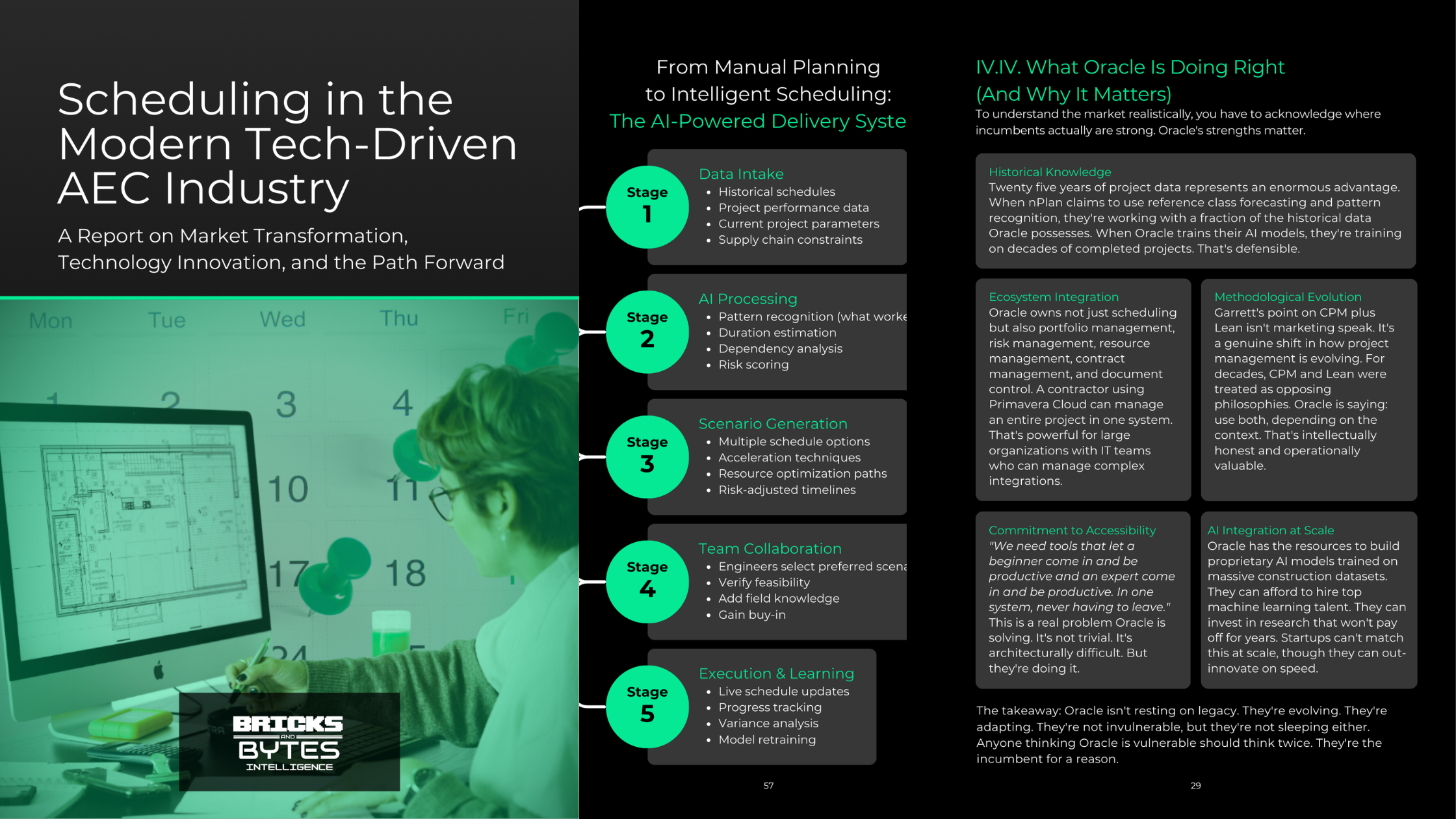
Get a FREE copy of our Scheduling in the Modern Tech-Driven AEC Industry: A Report on Market Transformation, Technology Innovation, and the Path Forward” (worth $150) and a FREE weekly email to stay up to date on construction tech. SIGN UP TODAY!

Scheduling in the Modern Tech-Driven AEC Industry

Sign up to the #1 Newsletter In AEC Tech. Join over 2,100 like-minded Founders, Investors and Techies disrupting the way we build. 

Scheduling in the Modern Tech-Driven AEC Industry