
Author name: Owen Drury

pricing models in construction
Go To Market

Innovative Pricing Models in Construction Tech: Finding the Right Fit for Your Product

  In the rapidly evolving world of construction technology, pricing strategy plays a crucial role in driving adoption and ensuring long-term success. As the industry embraces digital transformation, tech companies must rethink traditional pricing models to align with customer needs and value creation. Let’s explore innovative pricing approaches and how they can benefit both providers and users of construction tech. Traditional and Emerging Pricing Models Historically, construction tech has relied on familiar pricing structures like perpetual licensing, annual subscriptions, and per-user pricing. However, new strategies are gaining traction: Volume-based pricing: Charges based on construction project size or cost Pay-what-you-want (PWYW): Allows customers to determine the price Outcome-based pricing: Fees tied to measurable results Freemium models: Basic features free, premium features paid Token-based pricing: Customers purchase “tokens” to use various features Processing/Resource-based: Pricing determined by computing resources used   Each model has strengths and challenges in the context of construction technology. The choice depends on factors like the specific product, target market, and company goals.   Case Study: Buildots’ Volume-Based Approach Buildots, specialising in AI-powered progress tracking, has adopted a volume-based pricing model. Amir Berman, Director of Strategy and Go-To-Market, explains: “We price our product based on construction volume because we think it correlates the best to what’s the possible kind of reward that you will get as a construction organisation.” This approach aligns the cost of the software with the potential value it can deliver on larger projects, encouraging wider adoption within organisations and ensuring that costs scale with potential benefits. Pay-What-You-Want (PWYW) in Software The concept of PWYW pricing, while unconventional in B2B markets, has sparked interest in the software industry. A famous example from the music industry illustrates this approach. In 2007, the band Radiohead released their album “In Rainbows” with a revolutionary pricing model. They allowed fans to download the album and pay whatever amount they wanted, including nothing at all. In construction tech, a PWYW model could potentially: Lower barriers to entry for smaller firms Allow customers to pay based on perceived value Encourage wider adoption and feedback Aligning Pricing with Value Creation Regardless of the pricing model chosen, it’s crucial to demonstrate clear ROI to customers. Buildots faced a significant challenge in creating a transparent and rigorous ROI formula for their clients. They developed a formula that allows clients to input project details and see concrete outcomes focused on: Measurable increases in productivity Reduction in project delivery time Improved project predictability   This approach goes beyond simple time-saving calculations, offering tangible metrics that resonate with construction firms. Challenges and Considerations Adopting new pricing strategies in the construction industry can be challenging due to resistance to change, the need to educate customers on new structures, and internal financial planning complexities. Overcoming these hurdles requires clear communication, robust financial modeling, and a willingness to adapt based on market feedback. As Tooey Courtemanche, CEO of Procore, notes, even successful volume-based pricing models can be “wildly unpopular” with customers initially. However, he believes it provides the ultimate yardstick and flexibility for customers to scale usage. Expert Insights on Pricing Strategy Dev Amratia, CEO of nPlan, emphasises the importance of iteration: “Expect your initial pricing to be incorrect. Iterate rapidly with customer feedback and actively seek opinions on fair pricing.” Patric Hellermann of Foundamental highlights the growing popularity of hybrid models, combining a base subscription or freemium model with pay-as-you-go options for additional functionalities. Rohan Jawali, Founder of Joist AI, stresses the importance of understanding the market, providing value to customers, and keeping the pricing model simple. Parker Mundt, VP Platform at Suffolk Technologies, recommends a phased approach: “Start with project-by-project pricing to gain initial traction and demonstrate value. As companies grow, transition to enterprise agreements with tiered pricing based on usage.” Mike Powers, Founder of BuildVision, takes a contrarian view, arguing that the industry can’t support another $100 million/year revenue business based on SaaS fees outside of project management. His company focuses on facilitating more efficient transactions and offering additional services, with a dynamic pricing structure based on buying volume. Recommendations for Construction Tech Companies When developing pricing strategies, construction tech companies should consider a multi-faceted approach. Begin with project-based models to demonstrate value before transitioning to tiered enterprise agreements. Continuously refine your pricing based on customer feedback, focusing on value capture rather than flat fees.  Encourage broad adoption within client organisations by designing accessible pricing structures. Understand the decision-makers in your customer base and tailor your approach accordingly. Maintain simplicity in your pricing to facilitate sales, but don’t shy away from innovative models if they align with your product’s value proposition.  Leverage early adopters for social proof, and strive to balance recurring revenue goals with the project-centric nature of the construction industry. Regular re-evaluation is key to ensuring your pricing reflects your product’s evolving value. Future Trends in Construction Tech Pricing Looking ahead, we may see: AI-driven dynamic pricing adjusting to project specifics Blockchain and smart contracts automating payments based on milestones Ecosystem-based pricing leveraging partnerships across the construction tech stack In conclusion, there’s no one-size-fits-all approach to pricing in construction tech. The most important thing is to tailor a pricing model that you feel comfortable with and that your customers are willing to accept. By focusing on value creation, adaptability, and clear communication, construction tech companies can develop pricing strategies that drive adoption and foster long-term success in this rapidly evolving industry.      
Newsletter

How Enscape Was Created, Built & Sold

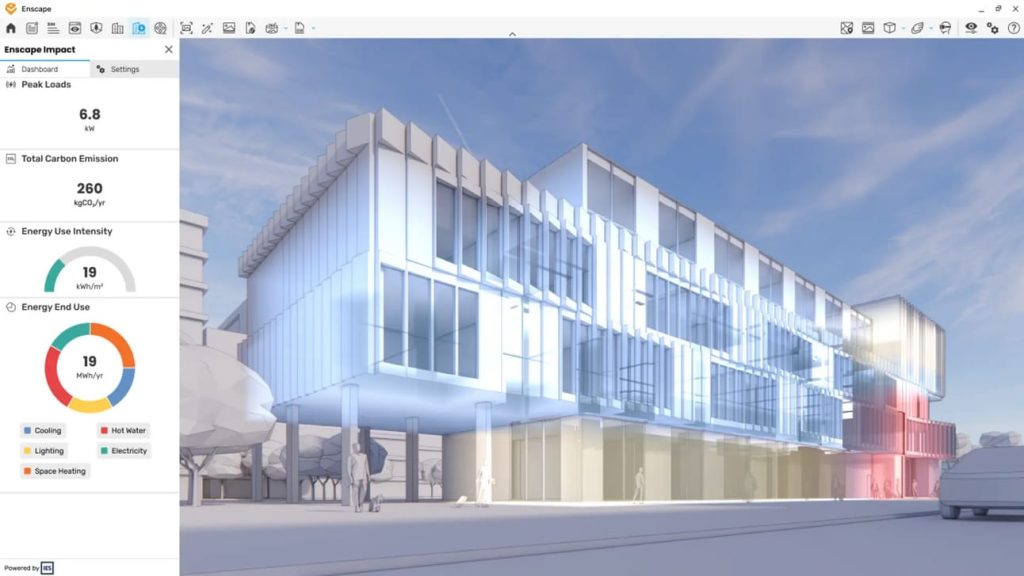
INDUSTRY INSIGHTSEnscape’s Journey: From VR to Industry-Changing Rendering Software Enscape is a staple in the world of architectural rendering. Rarely do you speak to an architect who hasn’t used it at least once. But how did it all start? How did we go from VR treadmill to rendering, to large acquisition? We were extremely lucky to sit down with Moritz Luck – co-founder of Enscape to hear his story. Read on to learn about: Mortiz’s masterclass in entrepreneurship, product development, market strategy and exits Mortiz’s advice for founders Perspective of exits and acquisitions The future of rendering  The future of the design stack (hint: consolidation) Advise for AEC-Tech startups Enjoy!  P.S. It’s a long one! The Unlikely Origins of a Rendering Revolution Moritz never set out to change the world of architectural visualization. In fact, when he and his co-founder Thomas started their company, they weren’t even thinking about architecture at all. Fresh out of university, with degrees in business engineering and mechanical engineering respectively, they had their sights set on the emerging world of virtual reality. Their first venture, InReel, aimed to create an omnidirectional treadmill for VR experiences. It was an ambitious project, conceived before Oculus had even entered the scene. But as they pitched their VR services to potential clients, including architects, they stumbled upon an unexpected insight. “We offered our services to architects,” Moritz recalls, “and they said, ‘No, this is too slow. If we give you our design, it takes two weeks until you get back to us. We have moved ahead quite a bit in this time.’” This feedback was a pivotal moment. It revealed a gap in the market that Moritz and Thomas hadn’t anticipated. Architects needed fast, real-time visualisation solutions, not slow, outsourced rendering services. With this new understanding, they pivoted. The treadmill idea was set aside, and a new vision began to take shape. They would create a tool that allowed architects to visualise their designs instantly, without the need for specialized rendering skills or powerful hardware. This pivot led to the birth of Enscape. The name, coincidentally similar to their previous use of Unreal Engine, was suggested by Thomas. It marked the beginning of a journey that would transform not just their company, but the entire field of architectural visualisation. The irony wasn’t lost on Moritz. He remembered his initial thoughts about the real estate and architecture industry: “I thought this is the most boring thing I’ve ever heard. Why would you do that?” Yet here he was, diving headfirst into this world he once dismissed.” As they developed Enscape, Moritz and Thomas faced a steep learning curve. Neither had a background in architecture or rendering. But this outsider perspective proved to be an advantage. They approached the problem with fresh eyes, unencumbered by industry conventions. Their lack of experience in the field also meant they had to listen closely to their potential users. Every conversation with an architect or designer became a learning opportunity, shaping their understanding of the industry’s needs and pain points. This journey from VR dreamers to rendering pioneers wasn’t smooth or straightforward. But it was this very process of pivoting, learning, and adapting that laid the foundation for Enscape’s eventual success. Without realizing it, Moritz and Thomas had stumbled upon a problem that would define their careers and reshape an entire industry. The Rise of Enscape Enscape’s journey from a pivoted startup to a industry-changing software wasn’t an overnight success story. It was built on a foundation of customer-focused strategies and relentless innovation. At the heart of Enscape’s approach was a commitment to real-time rendering. This wasn’t just a technical feature; it was a revolution in workflow. Architects could now see changes instantly, eliminating the hours-long wait times that had been the norm. Moritz explains, “We started with real-time rendering. So every change you see is directly there, or maybe with a delay of a couple of seconds. That was transformational for the architecture industry.” But having great technology wasn’t enough. Enscape needed to get it into the hands of users. Their pricing strategy was key to this. Rather than maximising revenue per user, they opted for a “no-brainer price” that would encourage wide adoption. “We wanted to price our solution not at the highest price we could possibly get, but at a no-brainer price where everyone could quickly adopt it,” Moritz recounts. This approach paid off. It allowed Enscape to rapidly build a large user base, which in turn provided valuable feedback for further improvements. Community building became another cornerstone of Enscape’s success. The team recognized the collaborative nature of the architecture and engineering world. They invested in fostering a strong community around their product, with a dedicated community manager leading these efforts. As the company grew, they faced the challenge of scaling while staying lean. Automation played a crucial role here. Moritz proudly notes, “By the time we merged with Chaos, I think we had similar numbers, but they had twice the people because we automated more than they did.” Perhaps most importantly, Enscape maintained a laser focus on customer happiness. They didn’t optimize for financial metrics or acquisition potential. Instead, they concentrated on solving real problems for their users. “We optimize how we can get the best value for the customer,” Moritz emphasizes. “And the rest will come. If you build a successful company, then people will be standing in line waiting to acquire you.” This customer-centric approach extended to their product development. Rather than trying to predict what features architects might want, they listened and responded to user feedback. This iterative process allowed them to continually refine and improve their software. The result was a tool that not only met the immediate needs of architects but also changed how they worked. As Moritz puts it, “Everyone came up to us and said, ‘Wow, this really transformed, changed the way we work.’” Enscape’s success story is a testament to the power of focusing on user needs, fostering community, and continuously innovating.

Newsletter

ICYMI: Volvo Transforms Construction, Amazon Robotics, September Highlights

This Week’s Quickfire BytesFuel your curiosity with this week’s contentW/C 30th September 2024 COMING SOONMonumental Super Series Explore the cutting-edge world of construction robotics in this exclusive five-part Super Series featuring Monumental, a pioneering startup revolutionising the building industry. COMING WEDNESDAY OCTOBER 16th WATCH EPISODE TEASERS NEW EPISODES Bringing Amazon Robotics to Homebuilding – Reframe Systems Ever wondered how Amazon’s robotic fulfillment centers revolutionized e-commerce? Now those same principles are transforming home construction. In today’s episode of BitBuilders, we had Vikas Enti from Reframe Systems, who shared insights on bringing speed and scale to low-carbon homebuilding. open.spotify.com/episode/16oXHE6EYLTAAZdLpgvI8V Volvo’s Secret Weapon in Construction – Startups and AI – David Hanngren Ever wonder how a 100,000-employee company like Volvo stays innovative in construction tech? 🤔 In this episode, we had David Hanngren, Investment Director at Volvo Group Venture Capital, and learnt about Volvo’s approach to innovation, their investment strategy, and the future of construction equipment. open.spotify.com/episode/6ECPK5CfJyAdOk40PtdWhD Space, Robots, and ‘Add the Egg’ Philosophy- September’s Bricks & Bytes Highlights September in review: From Paris to Boston, construction tech is booming! In this month’s roundup, Owen and Martin dive into the exciting developments in the world of construction tech. We’ve hit major milestones, with over 1,000 email subscribers and 900 YouTube followers! open.spotify.com/episode/71dYqVrfJVEFGF4bk53M4B Can Small Modular Nuclear Reactors Solve Big Energy Problem? – Last Energy’s $40M Bet on Energy Independence Euclear power’s comeback? Last Energy raises $40M for micro modular reactors. In this episode, we learnt about Last Energy’s $40 million Series B funding for developing 20 MWe micro modular nuclear power plants. We also explored how nuclear energy fits into the broader energy landscape, including its role in providing baseload power for data centers. open.spotify.com/episode/4b0UZyYq31JbbZhRO8OvQZ View All Podcasts BRICKS & BYTES BULLETINHow BuildingConnected Was Sold for $275m Dustin DeVan is one of the construction tech OG’s (or Mafia as we like to call them). Alongside the founders of companies like Levelset (Scott Wolfe), PlanGrid (Tracy Young & Ralph Gottee) and others, Dustin exited his first tech company for a substantial sum. BuildingConnected was founded in 2012 and six years later, sold for $275m. How did Dustin do it? And what is he doing now? It all started with gambling… Read Full Article 2 FAVORITE QUOTES: “Our homes actually emit more carbon than our cars. And what was I think pretty interesting too is the fact to decarbonize a home was actually all the existing technology.” – Vikas on the significant carbon emissions from homes and points out that the technology to decarbonise homes already exists, framing the problem as one of deployment rather than invention “Our aim is not to make them part of the Volvo family. We just want to make them strong so they can collaborate with us.” – On Volvo’s approach to investing in startups, focusing on strengthening them for collaboration rather than acquisition LATEST STORIES: The Strategic Acquisition: Why Autodesk Bought BuildingConnected Explore Autodesk’s strategic acquisition of Building Connected. Uncover the offensive and defensive reasons behind this game-changing move in construction tech. Data Analytics is Revolutionising Construction Management Discover how 95% of unused data can drive transformative improvements. Explore data-driven decision-making, from material quantities to project timelines, and revolutionise your construction management. The Venture Capital Reckoning: When Carry Dollars Evaporate In a recent statement that sent ripples through the venture capital world, Geoff Lewis delivered a sobering message: a generation of VCs is about to learn that “carry dollars” are worthless when a fund fails to reach carry. View All Articles BONUS CONTENTWhat Are Investors Betting On? OUR SPONSORS Shft — helping contractors like you leverage BIM to secure a leading position in the race towards construction’s digital future.  BuildVision — streamlining the construction supply chain with a unified platform for contractors, manufacturers, and stakeholders. Powered by beehiiv

Autodesk BuildingConnected acquisition
Videos, Founders & Operators

The Strategic Acquisition: Why Autodesk Bought Building Connected

  construction technology, Autodesk’s acquisition of Building Connected stands out as a prime example of strategic business maneuvering. This move was driven by both offensive and defensive considerations, showcasing the complex dynamics at play in the industry. Defensively, Autodesk prevented Building Connected from falling into competitors’ hands. This preemptive strike protected their market position and denied rivals access to valuable technology and customer base. Offensively, the acquisition filled a crucial gap in Autodesk’s portfolio. Building Connected’s unique network-based platform allows general contractors to search for subcontractors across the US, while subcontractors can respond to multiple GCs from a single location. This streamlined approach to invitation-to-bid and qualification services was unmatched in the industry. Building Connected’s innovative software would have taken Autodesk years to replicate independently, if ever. By acquiring the largest provider of these services, Autodesk instantly expanded its capabilities and market reach. This strategic move illustrates the importance of network effects in construction technology. It also highlights how established players like Autodesk are adapting to the changing landscape by acquiring innovative startups that bring unique value propositions to the table. As the construction industry continues to digitize, we can expect more such strategic acquisitions shaping the future of building technology. Checkout the full episode with Dustin DeVan HERE.       

Venture capital carry dollars
Videos, Venture

The Venture Capital Reckoning: When Carry Dollars Evaporate

  In a recent statement that sent ripples through the venture capital world, Geoff Lewis delivered a sobering message: a generation of VCs is about to learn that “carry dollars” are worthless when a fund fails to reach carry. This poignant observation blends sarcasm, schadenfreude, and a hint of melancholy for the industry’s current state. But what exactly are “carry dollars”? In the realm of private equity, including venture capital, fund managers typically invest alongside their backers. The carried interest, or “carry,” represents their share of the profits, often around 20% in traditional VC funds. It’s a powerful incentive, aligning the interests of managers and investors. However, Lewis’s comment suggests a harsh reality check looming on the horizon. Many funds may fall short of generating actual profits, rendering those anticipated carry dollars nothing more than a mirage. This scenario could be particularly jarring for a newer generation of VCs who’ve only experienced the industry’s recent bull run. As the VC landscape evolves, this wake-up call serves as a reminder: in the high-stakes world of startup investing, past performance doesn’t guarantee future results. It’s a timely prompt for both investors and fund managers to reassess their strategies and expectations in an increasingly challenging market. Listen to the full episode with HERE.

data analytics construction management
Technology

Data Analytics is Revolutionising Construction Management

  In an industry where precision is paramount, a startling statistic emerges: 95% of all data captured in construction goes unused, according to FMI. This revelation underscores a massive opportunity for improvement through data analytics. As we delve into the world of data-driven decision making in construction, let’s explore how this untapped resource is reshaping the industry. The Evolution of Data Collection in Construction Construction has always generated data, from material quantities to project timelines. However, the digital revolution has exponentially increased both the volume and variety of data available. Bernardo Gamboa, a venture capitalist focusing on Latin American construction tech, notes: “At the end, one of the things that we have seen the most is startups focusing on really supporting small to mid-sized companies. Because the larger companies might have solutions or they have solutions that come from the head office in France or in Madrid or whatever.” This observation highlights how data analytics is becoming accessible to companies of all sizes, not just industry giants. Key Areas Where Data Analytics is Making an Impact   Project Planning and Scheduling Resource Allocation Risk Management Safety Improvements Quality Control   Consider this: 13% of construction teams’ working hours are spent searching for project data. Data analytics can significantly reduce this inefficiency, streamlining processes and improving productivity. Tools and Technologies Driving Data-Driven Construction Management The Contech landscape is rich with solutions aimed at harnessing the power of data: Data Analytics Platforms Enterprise Resource Planning (ERP) Systems: ERP platforms like Microsoft Dynamics, Oracle, and SAP integrate data from across the organisation, providing a centralised source for real-time project data and analytics. Construction-Specific Analytics Tools: Solutions like OnIndus, Disperse.io, and RedSky offer construction-focused data analytics and visualization capabilities to support decision-making. Data Visualization Dashboards and Reporting: Construction firms use interactive dashboards and customised reports to present data in an easily digestible visual format for stakeholders. This enables faster, more informed decision-making. Data Collection Internet of Things (IoT) Sensors: Sensors embedded in equipment, materials, and job sites collect real-time data on performance, productivity, and safety. This data feeds into analytics platforms. Building Information Modeling (BIM): BIM models integrate data from design, engineering, and construction phases, providing a comprehensive digital representation to support decision-making. Data Integration Cloud-Based Software: Cloud platforms like Microsoft Azure and Google Cloud allow construction firms to integrate data from multiple sources into a unified system for analysis. API Integrations: Construction software solutions offer API integrations to connect data from various applications, breaking down data silos. Challenges in Adopting Data-Driven Approaches Despite the clear benefits of data analytics in construction management, several challenges persist in its widespread adoption. Many construction firms struggle with data silos and lack of integration across different systems, making it difficult to gain a holistic view of project data. There’s also significant resistance to change in an industry known for its traditional practices, with some professionals hesitant to embrace new technological solutions. Ensuring data quality and accuracy remains a crucial concern, as unreliable data can lead to flawed decision-making.  Additionally, privacy and security concerns surrounding sensitive project information pose significant hurdles, particularly as cyber threats become more sophisticated in the digital age. Future Trends in Construction Analytics As the construction industry continues to embrace data-driven approaches, several exciting trends are on the horizon. We can anticipate an increased use of AI for predictive maintenance and risk assessment, enabling proactive problem-solving and improved project outcomes.  The integration of augmented reality for on-site data visualisation promises to enhance decision-making by providing real-time, contextual information to workers. Blockchain technology is likely to play a larger role in secure and transparent data sharing, addressing concerns about data integrity and collaboration.  Advanced analytics will increasingly be applied to sustainability efforts, allowing for more accurate environmental impact assessments and supporting the industry’s push towards greener construction practices. Practical Takeaways for Construction Professionals Start small: Begin with one area of your operations to implement data analytics Invest in training: Ensure your team can effectively use and interpret data Choose integrated solutions: Look for platforms that can consolidate data from various sources Prioritise data quality: Implement processes to ensure accurate data collection Stay adaptable: Be prepared to adjust your strategies based on data insights The construction industry stands on the brink of a data revolution. By harnessing the power of analytics, companies can dramatically improve efficiency, reduce risks, and deliver projects with unprecedented precision.       

Newsletter

How BuildingConnected Was Sold for $275m + NEW Super Series

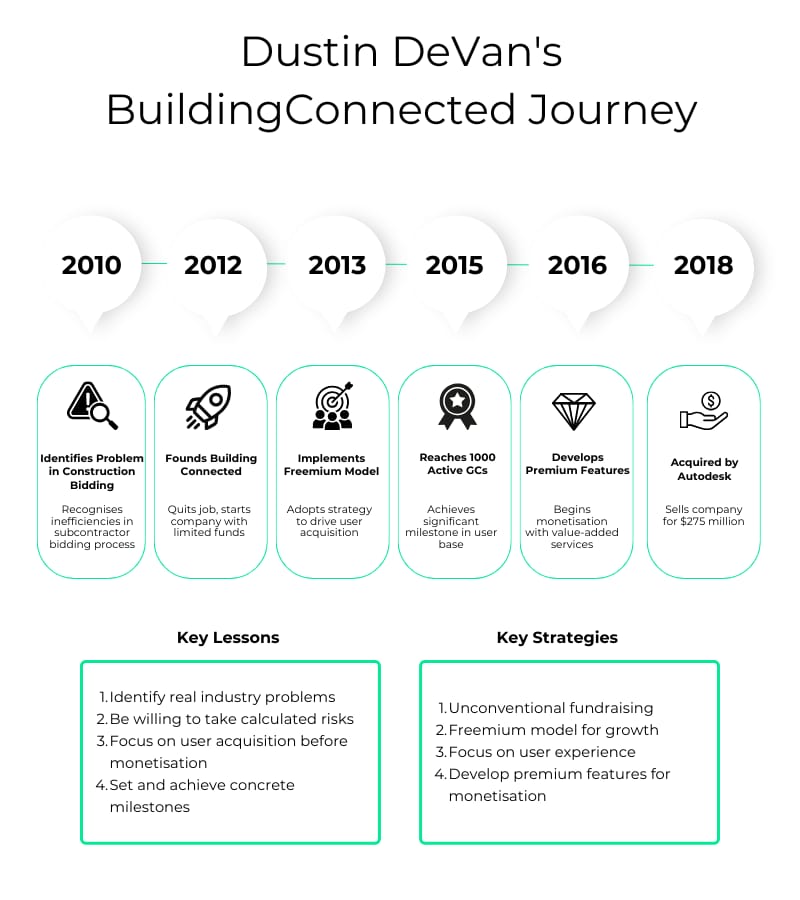
INDUSTRY INSIGHTSHow BuildingConnected Was Sold for $275m Dustin DeVan is one of the construction tech OG’s (or Mafia as we like to call them). Alongside the founders of companies like Levelset (Scott Wolfe), PlanGrid (Tracy Young & Ralph Gottee) and others, Dustin exited his first tech company for a substantial sum. BuildingConnected was founded in 2012 and six years later, sold for $275m. How did Dustin do it? And what is he doing now? It all started with gambling… Dustin DeVan’s journey to construction tech stardom began in an unlikely place: the world of online gambling. As a college student, he paid for his education by mastering the art of casino games. This unconventional start would later fuel his entrepreneurial spirit and risk-taking abilities. After college, Dustin found himself in the construction industry, working as a scheduling engineer for Bechtel. It was here that he first identified the problems that would later inspire BuildingConnected. The preconstruction process was a mess of disjointed systems and inefficient communication. The Spark of an Idea While working on a $150 million prison project, DeVan experienced firsthand the challenges of managing bids and subcontractor relationships. He realized there was a massive opportunity to streamline this process. But having an idea wasn’t enough. he spent years refining his concept before taking the leap. In 2012, DeVan made a bold move. With only $5,000 in his bank account, he quit his job to pursue BuildingConnected full-time. He convinced two friends to invest $75,000, giving him a short runway to prove his concept. The San Francisco Advantage Dustin credits much of his early success to being in San Francisco during the 2010-2019 tech boom. “San Francisco was the only place in the world that I could have made BuildingConnected successful,” he says. The city provided access to capital, talent, and a network of like-minded entrepreneurs. Fact: Dustin raised $250,000 by pitching random dudes in coffee shops in downtown SF. A Unique Go-to-Market Strategy BuildingConnected’s path to $50 million in annual recurring revenue (ARR) was unconventional. They started with a completely free model, focusing on getting 1,000 active general contractors to use the platform. This took two years of intense focus. Once they achieved this milestone, BuildingConnected had a powerful network effect. Hundreds of thousands of subcontractors were now using the platform to view bid invites. Only then did they start introducing premium features. The result? An astounding 93% cohort retention rate. Once a general contractor used BuildingConnected for three projects, they almost never stopped. The BuildingConnected Network Lessons for Construction Tech Founders Dustin’s journey offers valuable lessons for aspiring construction tech entrepreneurs. First and foremost, solving a real problem is crucial. Dustin’s industry experience allowed him to identify a genuine pain point, rather than creating a solution in search of a problem. Patience is also key. It took years for BuildingConnected to move from idea to execution, with him spending considerable time refining his concept before fully committing. Location can play a significant role in a startup’s success. Being in the right place at the right time provided Dustin with significant advantages, especially when it came to accessing capital and talent. The power of network effects cannot be overstated. BuildingConnected’s free model created a massive user base before monetization, making the platform incredibly sticky and difficult for competitors to replicate. Finally, focusing on retention proved to be a game-changer. The high retention rate was a key factor in BuildingConnected’s success and ultimate sale to Autodesk. By creating a product that users found indispensable, Dustin built a company that was not just valuable to its customers, but highly attractive to potential acquirers. The $275 Million Exit In 2018, Autodesk acquired BuildingConnected for $275 million. Dustin cites both offensive and defensive reasons for the acquisition. BuildingConnected had built a network-based platform that would have taken Autodesk years to replicate internally. Additionally, the acquisition prevented competitors from getting their hands on this valuable technology. Life After BuildingConnected Dustin didn’t rest on his laurels. After a brief stint as CEO of an indoor air quality monitoring company, he’s back in the construction tech world with his new venture, Ediphi. Ediphi aims to revolutionise the preconstruction process, building on his extensive experience in the field. He sees an opportunity to create a comprehensive platform that addresses the fragmented nature of current preconstruction solutions. Ediphi Estimates Views Lessons from a Second-Time Founder Dustin’s experience as a second-time founder offers fresh insights. He notes that the landscape has shifted significantly since 2012, with increased competition balanced by greater investor interest. This new environment requires a different approach to building a successful company. With Ediphi, Dustin is thinking on a grander scale. His ambition to build a publicly-traded company reflects his belief that there’s room for another major player in construction tech, particularly in the preconstruction space. This bold vision demonstrates the potential he sees in the industry. The post-pandemic world has reshaped how companies operate, and Ediphi embraces this new reality. Unlike BuildingConnected’s San Francisco-centric approach, Ediphi operates with a fully distributed team. This shift showcases the viability of remote work in the tech sector, even for complex, industry-specific solutions. Reflecting on his experience with BuildingConnected, Dustin acknowledges the importance of balancing rapid growth with operational efficiency. While BuildingConnected’s growth was impressive, he believes there might have been opportunities to optimize spending. This insight informs his approach to scaling Ediphi. Perhaps most importantly, Dustin emphasizes the crucial role of co-founders. He stresses the importance of finding partners who not only complement your skills but also elevate you as a person. This human element, often overlooked in discussions of tech startups, can be a key factor in a company’s success and the founder’s personal growth. The Road Ahead The construction industry is ripe for innovation, and there’s still plenty of room for new solutions. The next generation of construction tech leaders can follow in Dustin’s (and the so-called Construction Tech Mafia…) by adopting the tactics shared by the top founders on Groundbreakers. Check out the

Newsletter

ICYMI: A $275M Exit, Moon Water Mining and Building the Most Wanted Robot

This Week’s Quickfire BytesFuel your curiosity with this week’s contentW/C 23rd September 2024 NEW EPISODES Sold For $275M – Dustin DeVan’s Construction Tech Journey “I raised $250,000 pitching random people in coffee shops.” – Dustin DeVan’s unconventional approach to startup funding. In this episode, Dustin DeVan, founder of Building Connected and Ediphi, shares his journey from selling a company for $275 million to starting anew in the construction tech space. open.spotify.com/episode/5TTRupWHtKBVTCzauKvUtk Building The Most Wanted Robot in Construction – Dusty Robotics CEO Tessa Lau Did you know that a simple mistake in construction layout can cost millions? In this episode of BitBuilders, we had Tessa Lau, CEO of Dusty Robotics, and we got to learn about transforming construction with robots, the journey from prototype to product, and why human-robot teams are the future of building. open.spotify.com/episode/5pkuagleBi8YRWF0yfWyGN Build a Real Business – Why 1% of a Huge Market Isn’t Enough Note: This is a repost from an episode released last month on Bricks, Bucks & Bytes. “Building a f***ing business isn’t about chasing 1% of a huge market.” In this episode, Patric Hellermann shares insights on construction tech startups and investment strategies. We explored the evolving landscape of ERP solutions, 3D visualization software, and the pitfalls of lazy market assessments. open.spotify.com/episode/6tzoFqaSPenP08rfXg11H9 How Starpath Robotics Plans to Mine Space Water From Moon- Is It Even Possible? Construction robots: From hot dogs to highways? In this episode of Bricks, Bucks and Bytes, we explored how robotics is changing construction. We learned about Starpath Robotics’ plan to mine water on the Moon for rocket fuel. This could change how we explore space. We also covered how construction companies are now more open to using robots. open.spotify.com/episode/0qVra7lAkzRMfKnDRxoo1w View All Podcasts BRICKS & BYTES BULLETIN5 Corporates Share Their Innovation Strategies Understanding how and why the people who purchase (and use) the technology in AEC should be basic knowledge for anyone working in innovation across AEC. The truth is, this information is difficult to find.  That’s why we created Corporate Innovation (in AEC).  This podcast explores how cutting-edge technology transforms the Architecture, Engineering, and Construction (AEC) industry. We dive deep into innovation strategies, implementation challenges, real-world technology use cases, and emerging trends.  Each fortnight, we sit down with innovation leaders from companies who are integrating new software and hardware solutions.  And in this week’s newsletter, we’ve distilled some of the insights into a bite-sized read for those interested, starting with: Roger’s O’Brien, McKinsey, Barton Malow, Implenia and EllisDon. Read Full Article 2 FAVORITE QUOTES: “I’d rather have great people share the pie and build a big pie.” – Dustin DeVan stresses the importance of sharing equity with talented team members to build a successful company “The best supply chain is the one that you don’t need.” – Patric emphasises the importance of developing self-sustaining technologies for space exploration and colonization. LATEST STORIES: An Unexpected Call: Jim Cantrell’s Fateful Encounter with Elon Musk Space expert Jim Cantrell recounts his unexpected first encounter with Elon Musk, a pivotal moment that shaped the future of private space exploration. The Rise of Global Investments in Construction Technology Global investments in construction technology surged by 45% in 2023. Discover how international collaboration is shaping the future of the construction industry. Innovating with Purpose: A Three-Step Approach to Corporate Entrepreneurship Discover a proven corporate innovation playbook: the Kickbox method. Learn how this three-step approach transforms ideas into market-ready solutions for businesses. View All Articles BONUS CONTENTWhat Are Investors Betting On? OUR SPONSORS Shft — helping contractors like you leverage BIM to secure a leading position in the race towards construction’s digital future.  BuildVision — streamlining the construction supply chain with a unified platform for contractors, manufacturers, and stakeholders. Powered by beehiiv

Jim Cantrell's Fateful Encounter with Elon Musk
Videos, Founders & Operators

An Unexpected Call: Jim Cantrell’s Fateful Encounter with Elon Musk

  In July 2001, Jim Cantrell, a seasoned space technology expert, received a call that would alter the trajectory of his already impressive career. With over 30 years of experience in the space industry, Cantrell had built a reputation as a skilled engineer, strategist, and subject matter expert in satellite systems and space system markets. At the time, Cantrell was working at a university-owned space lab, building imaging and satellite technology for military applications. Little did he know that a seemingly random phone call would connect him to Elon Musk, who would become one of the most influential figures in modern technology and space exploration. The caller introduced himself as Ian Musk (later revealed to be Elon). At first, Jim dismissed Musk’s claims of being a billionaire and his talk about PayPal. However, as their conversation unfolded, it became clear this was no ordinary call. Musk passionately shared his life goals: making humanity multi-planetary, ending fossil fuel addiction, and protecting free speech. His audacious vision to inspire Mars missions caught Cantrell’s attention, especially when Musk sought his knowledge on Russian rockets. Initially cautious, Jim agreed to meet Musk in Salt Lake City. That meeting, joined by Musk’s friend and Bob Zubrin of the Mars Society, marked the beginning of an extraordinary journey. It would lead Cantrell to become a partner and VP at SpaceX, a CTO at Moon Express, and eventually the CEO and Co-Founder of Phantom Space. Today, Jim Cantrell leads Phantom Space, a company offering launch services, spacecraft design and construction, and constellation launch and deployment. His vast experience and the insights gained from that fateful encounter with Musk continue to shape his contributions to the space industry. Looking back, it’s remarkable how a single phone call can lead to pivotal moments in history. Musk’s determination and visionary thinking were evident from the start, foreshadowing the revolutionary impact both he and Cantrell would have on space exploration and technology. Listen to the full episode with Jim Cantrell HERE.

corporate innovation playbook
Videos, Founders & Operators

Innovating with Purpose: A Three-Step Approach to Corporate Entrepreneurship

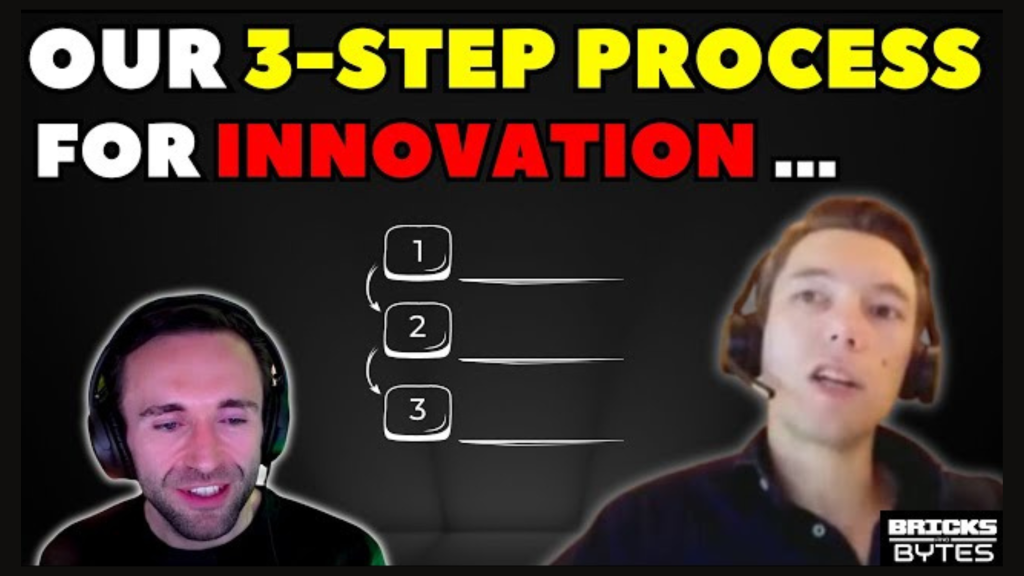
  In today’s fast-paced business world, innovation is key to staying competitive. But how do companies foster entrepreneurship within their ranks? One proven method is the “Kickbox” program, originally developed by Adobe and refined by Swisscom. At its core, Kickbox follows a three-step process: Red Box, Blue Box, and Gold Box. Each stage represents a crucial phase in bringing innovative ideas to life: Red Box: This initial stage focuses on problem validation. Employees explore and define the challenges they aim to solve, ensuring their ideas address real-world issues. Blue Box: Here, innovators develop a proof of concept (POC) with support from business sponsors. This stage demonstrates the technical feasibility and potential of the solution. Gold Box: The final phase involves seeking internal investors to implement the validated solution. This step bridges the gap between concept and market reality.   This structured approach, complete with dedicated coaching, provides a clear pathway for employees to transform their ideas into tangible solutions. By breaking down the innovation process into manageable steps, companies can cultivate a culture of entrepreneurship and drive meaningful change from within. Whether applied to internal projects or collaborations with external startups, this methodology offers a roadmap for turning potential into proven success in the marketplace. Listen to the full episode with Karel Van Eechoud HERE.

The Rise of Global Investments in Construction Technology
Venture

The Rise of Global Investments in Construction Technology

  The construction industry is going global, and so is its technology. In 2023, cross-border investments in construction technology (ConTech) surged by 45%, marking a new era of international collaboration and innovation. As the world becomes more connected, the future of construction is being built on a foundation of global partnerships and diverse perspectives. Current State of Cross-Border Investments in ConTech The ConTech landscape is no longer dominated by Silicon Valley alone. Emerging markets are becoming hotbeds of innovation, attracting attention from international investors. Bernardo Gamboa, a venture capitalist focusing on Latin American construction tech, notes: “We are starting to see a lot of solutions for the region in very early stages as an investor. Getting into those early stages and being able to help at that level is riskier, but at the end, the payback is much higher.” This sentiment reflects the growing interest in exploring untapped markets for ConTech innovations. Drivers of International Investment in Construction Technology Several factors are fueling the rise of cross-border investments in ConTech: Global challenges requiring global solutions Diverse market needs driving innovation The search for high-growth opportunities in emerging markets Technological advancements enabling remote collaboration Key Markets and Players in Global ConTech Investment While traditional tech hubs remain important, new players are emerging on the global stage: Latin America: Countries like Brazil and Mexico are seeing a surge in ConTech startups. Middle East: The region is becoming a hub for construction innovation, driven by massive infrastructure projects. Southeast Asia: Rapidly urbanising countries are fostering a vibrant ConTech ecosystem. Currently, Saudi Arabia stands out as a major hub for construction activity, attracting significant interest from companies worldwide. In this thriving market, Tenderd has established itself as a leading provider of construction solutions. Their services are in high demand not only for the high-profile Neom project but potentially for numerous other developments in Saudi Arabia’s rapidly expanding construction sector.In Latin America, Bernardo Gamboa highlighted several promising companies in the region. One such startup is Buildpeer, a Mexican company developing project management solutions tailored for the Latin American market. He also mentioned a Colombian-based company that utilises drones and cameras for image capturing, project management, and quality control in construction projects. This company stood out as the only Latin American participant in a prestigious European innovation program, receiving positive feedback from European firms. Additionally, Bernardo discussed a Chilean startup leveraging AI for asset management in industrial and infrastructure projects, particularly focusing on wind farms. These emerging startups demonstrate the diverse range of innovative solutions coming out of the Latin American ConTech ecosystem, addressing specific regional needs while also showing potential for global application. Challenges in Cross-Border ConTech Investments While cross-border investments in construction technology offer exciting opportunities, they also present unique challenges. Regulatory differences top the list, with each country having its own set of rules governing construction, technology, and foreign investments. For instance, data privacy laws like GDPR in Europe can significantly impact how contech companies handle project data. Cultural nuances in business practices also play a crucial role, affecting everything from negotiation styles to decision-making processes. As Bernardo Gamboa noted, “Latin America is a very complex market and is, I’ll say, is price, exclusively price driven.” This highlights how local business cultures can influence product adoption and pricing strategies. Moreover, market-specific construction needs vary greatly due to climate, available materials, and local traditions, making it challenging to create universally applicable solutions.Economic factors add another layer of complexity. Currency fluctuations and economic instability, particularly in emerging markets, can impact investment values and revenue streams. Language barriers, often overlooked, can significantly affect product development, marketing, and customer support. Intellectual property protection varies across countries, potentially putting innovative technologies at risk in some markets. Local competition with better market knowledge and established relationships poses another hurdle. Additionally, disparities in technological infrastructure can affect the adoption and functionality of contech solutions. Practical Takeaways for Investors and Startups For Investors: Look beyond your local market for high-potential ConTech startups Understand the unique challenges and opportunities in different regions Consider partnering with local investors for market insights   For Startups: Design solutions with global scalability in mind Build relationships with international investors and industry players Leverage your local market expertise as a competitive advantage Future Trends and Predictions Looking to the future of cross-border investments in contech, several key trends are emerging. We anticipate increased collaboration between startups from diverse regions, fostering innovation through shared knowledge and resources. Contech solutions are likely to be designed with global scalability in mind from the outset, enabling easier adaptation to various markets. Sustainability is set to become a central focus, with growing interest in eco-friendly construction technologies transcending national boundaries. Additionally, we expect to see the rise of new investment hubs beyond traditional centres, as emerging markets continue to develop their tech ecosystems and attract international attention.      

Newsletter

5 Corporates Share Their Innovation Strategies

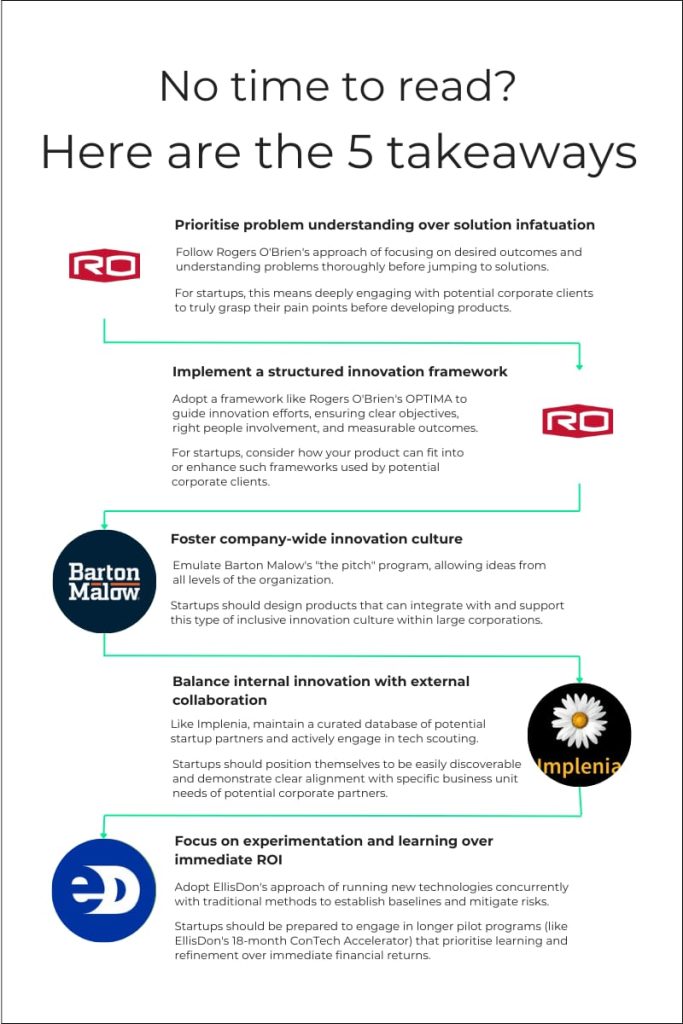
INDUSTRY INSIGHTS5 Corporates Share Their Innovation Strategies Understanding how and why the people who purchase (and use) the technology in AEC should be basic knowledge for anyone working in innovation across AEC. The truth is, this information is difficult to find.  That’s why we created Corporate Innovation (in AEC).  This podcast explores how cutting-edge technology transforms the Architecture, Engineering, and Construction (AEC) industry. We dive deep into innovation strategies, implementation challenges, real-world technology use cases, and emerging trends.  Each fortnight, we sit down with innovation leaders from companies who are integrating new software and hardware solutions.  And in this week’s newsletter, we’ve distilled some of the insights into a bite-sized read for those interested, starting with:  Roger’s O’Brien McKinsey Barton Mallow Implenia EllisDon Roger’s O’brien Rogers O’Brien innovates by focusing on discovering better ways to build. Their approach starts with defining innovation as finding a better way to achieve desired outcomes. They prioritize understanding problems over falling in love with solutions. Todd Wynne, as Chief Innovation Officer, oversees six departments including IT, VDC, quality, and R&D. The company fosters a culture of curiosity, courage, and learning, encouraging employees to challenge existing processes. They use the OPTIMA framework to guide innovation efforts, ensuring clear objectives, the right people, and measurable outcomes. RO also partners with startups and invests in technologies that align with their data strategy and can be seamlessly integrated into their existing processes, always keeping an eye on the impact on their workforce and project delivery. McKinsey Based on David Rockhill’s insights, corporations typically approach innovation through pilot projects, often led by dedicated innovation departments. These initiatives usually involve scouting for cutting-edge technologies at conferences and implementing them with mandatory training. However, this approach often leads to challenges in widespread adoption and scaling. Companies tend to focus more on acquiring new tools than on changing organizational culture. Innovation efforts are frequently disconnected from core business strategies, with limited employee empowerment. Rockhill suggests a more effective approach: integrating technology adoption into the core business strategy, empowering all employees to innovate, and focusing on adoption and scaling rather than just piloting new technologies. This holistic approach aims to create a culture of innovation throughout the organization. Barton Malow Barton Malow’s innovation strategy is multifaceted and provides valuable insights for other corporates. The company employs an Entrepreneur in Residence to explore commercializing internal innovations and IP, while a dedicated Business Transformation team evaluates new technologies and maps them to company problems. They encourage innovation from all levels through “the pitch” program, allowing any employee to propose ideas. Barton Malow is developing an e-commerce marketplace for contractors to sell hardware innovations, demonstrating a focus on monetising internal developments. The company actively pilots and implements various technologies, including AI, robotics, and AR/VR solutions, while continuously rethinking traditional construction processes. They allocate significant resources to innovation, recognizing its importance for long-term success. This comprehensive approach balances internal idea generation with external technology adoption, fostering a culture of innovation throughout the organisation. By implementing a structured evaluation process and aligning innovations with core business challenges, Barton Malow ensures that their innovation efforts drive tangible value and keep them competitive in the construction industry. Implenia Implenia’s innovation strategy is multifaceted and pragmatic, focusing on addressing both internal challenges and broader industry trends. Their approach includes an entrepreneurship program called Kickbox, which follows a three-step process from idea validation to implementation. The company actively engages in tech scouting and startup collaborations, maintaining a curated database of potential partners. Implenia emphasises aligning innovation efforts with specific business unit needs and pain points, rather than pursuing a broad, unfocused approach. They balance internal idea generation with external technology adoption, and prioritise innovations that can improve margins, increase profitability, and address sustainability challenges. The company is also developing integrated digital workflows, such as AI-based generative design for modular construction. Implenia takes a measured approach to investments, preferring strategic partnerships that demonstrate clear value before considering financial involvement. This strategy allows them to stay agile while driving meaningful innovation in their core business areas. EllisDon EllisDon’s approach to innovation focuses on experimentation rather than immediate ROI. Their process involves running new technologies concurrently with traditional methods to establish a baseline and mitigate risk. They emphasise “time to value” over ROI for truly novel innovations. For more established technologies, they do consider ROI when evaluating implementation. EllisDon has created the ConTech Accelerator program to foster innovation without a traditional corporate venture arm. The program offers startups access to EllisDon’s nationwide operations, brand credibility, and feedback from end-users across various projects. This 18-month pilot program helps startups refine their products and achieve product-market fit without requiring equity or cash investment from EllisDon. The company takes a portfolio approach to innovation, understanding that not all experiments will succeed but valuable learnings can still emerge. Enjoyed this? We’ll be adding more to this library as we release. Subscribe to Corporate Innovation (in AEC) to keep informed. WEEKLY MUSINGSLogo Changes, Data Entry, $875M Exit A costly game of GBs Jonathon Broughton on LinkedIn: UFF Such a lot of GBs to change the logo every year…. 😉 | 12 comments on LinkedIn Data captured in Excel is not good data Why construction companies need data governance | Federico Selmi posted on the topic | LinkedIn A WARNING TO THE CONSTRUCTION INDUSTRY Alas, you will have seen the saddening news by now, yet another top construction company has gone into… | 103 comments on LinkedIn From series A to $875M exit Plangrid was one of the most successful deals in contech. Let’s take a look: Plangrid founded in 2011. @sequoia led their series A ($18M) investment. 7 years later Plangrid sold to Autodesk for $875M. This gave Sequoia a ~9x multiple from series A. No homerun but not bad. — AEC Technology Guy (@AEC_Tech_Dash) 4:45 PM • Sep 23, 2024 OUR SPONSORS Shft — helping contractors like you leverage BIM to secure a leading position in the race towards construction’s digital future.  BuildVision — streamlining the construction supply

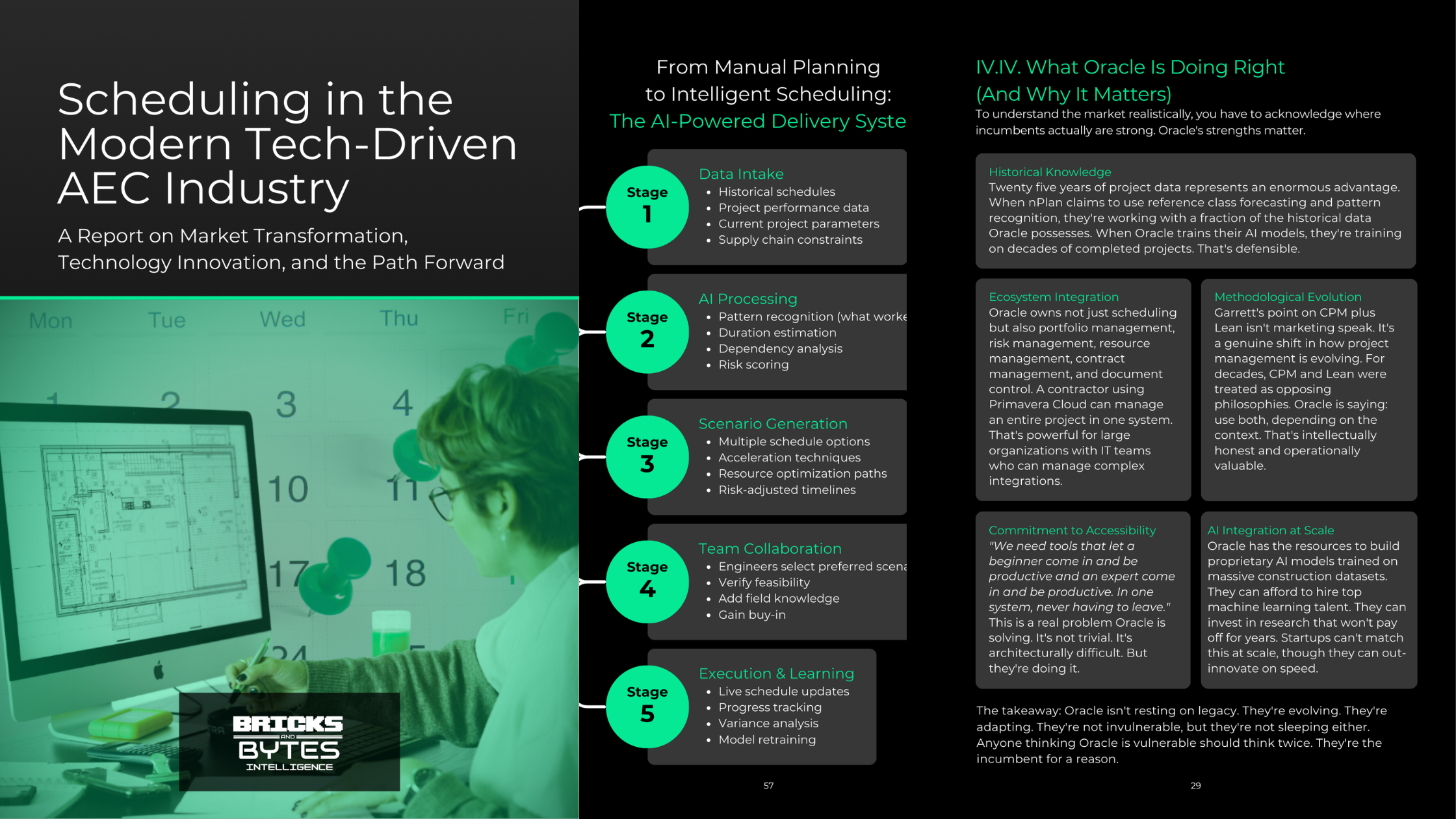
Get a FREE copy of our Scheduling in the Modern Tech-Driven AEC Industry: A Report on Market Transformation, Technology Innovation, and the Path Forward” (worth $150) and a FREE weekly email to stay up to date on construction tech. SIGN UP TODAY!

Scheduling in the Modern Tech-Driven AEC Industry

Sign up to the #1 Newsletter In AEC Tech. Join over 2,100 like-minded Founders, Investors and Techies disrupting the way we build. 

Scheduling in the Modern Tech-Driven AEC Industry