Author name: Owen Drury

Newsletter

ICYMI: Nuclear Race, AI Workflows & The $860B Construction Cash Problem

Want to get your message in front of {{active_subscriber_count}} highly engaged innovation leaders? Check out our sponsorship offers. This Week’s Quickfire BytesFuel your curiosity with this week’s contentW/C 12th May 2025 NEW EPISODESAI Will Transform Your Construction GTM Strategy – The Go-To-Market Playbook That Built a Billion-Dollar ConTech Tom Feliz shares his journey from construction sites to tech leadership at Data Grid. Tom unpacks the secrets behind effective Go-To-Market strategies in construction tech, drawing from his experiences at OpenSpace, Autodesk, and more. Find out why solving real industry pain points is the foundation of any successful ConTech product, how to identify your Ideal Customer Profile across the construction value chain and why the construction volume pricing model needs to change. open.spotify.com/episode/37RnvRTkVl8ukKzFWKiyv7 Procore’s 4 Steps to Save the Industry – Kris Lengieza – VP of Procore Kris Lengieza from Procore talks about their just-released Future State of Construction 2025 report, which reveals how technology will transform productivity, design, decision-making, and the workforce crisis. Find out why contractors, not architects, will own more of the design process in the future, how construction teams lose 18% of project time just searching for information and the shift from “gut feeling” decisions to data-driven insights using AI. open.spotify.com/episode/1MGo8DfMiPsKFcxRYlppke How China Builds Nuclear Plants Cheaper, Construction’s $860bn Problem, Robotics in Solar & Trump 2.0 Germany Effects In this episode of Bricks, Bucks & Bytes, we dive into why China can build nuclear reactors at a fraction of Western costs while the US and Europe struggle with massive delays and budget overruns. Key topics include: why China can build nuclear reactors for $2.7B while Western projects balloon to $40B+, the efficiency secrets behind China’s massive infrastructure projects and Small Modular Reactors (SMRs) as a potential solution to nuclear’s problems. open.spotify.com/episode/6hxMYMZ5KNiLz94MrHgIJk View All Podcasts BRICKS & BYTES PREMIUMEarly Release Episodes The Multi-Threading Sales Technique That Cut Planera’s Enterprise Sales Cycle in Half – Scotland Foss – EARLY RELEASE Scotland Foss reveals the strategic frameworks and approaches that drive success in the unique construction technology landscape. How PlanGrid Transformed an Industry and Sold for $875M – Ralph Gootee – EARLY RELEASE In this fascinating episode, Ralph Gootee, co-founder of PlanGrid (acquired by Autodesk for $875M) and current CEO of TigerEye, reveals the insider strategies that helped his company dominate the construction tech space. 2 FAVORITE QUOTES: “As an industry, we have just spent our entirety making decisions based on our gut… We haven’t made decisions with data and insights.” – Kris Lengieza on the need to evolve decision-making processes “I talk to another CEO that’s like, if I had the return on investment that every software promised me, I wouldn’t have to build buildings.” – Mike Powers on exaggerated ROI claims in construction software BRICKS & BYTES PREMIUM🚀 Ready to Break Through the $10M Ceiling? Here’s a quick recap of what you’ll receive as a premium subscriber: Premium in-depth articles delivered to your inbox Early access to podcast episodes before public release 33% discount on all future GTM guides we publish UPGRADE TO PREMIUM Want 33% off the guide?Sign Up for Our Monthly Subscription Monthly members ($10/mo) can purchase the guide for just $67 UPGRADE TO MONTHLY YOU MIGHT ALSO LIKE More Insights NSFW: Build a F*cking Business McKinsey’s Secrets to Scaling Construction Tech How Flux Burned Through $29M – Lessons for AEC Innovators Ex AutoDesk CEO’s 12 Lessons For Developing Products Could an Entrepreneur in Residence Save Your Construction Firm? Reports and Case Studies Innovating the Future: Robotics and the Revolution in Construction The Future of Design Software In AEC – Experts Insights Investing In AEC Tech The Future Of Construction Document Management The Construction Tech Revolution In India: Lessons From InfraMarket’s Success Innovation at Windover Construction Swinerton’s Innovation Strategy Most Popular Episodes How To Build A Unicorn In Construction Tech – Patric Hellermann Story Of A Modular Construction Startup That Burned Through £10M in 15 Months – Chris Spiceley McKinsey FINALLY updates their Productivity Curve, & The Future Of Construction – David Rockhill, Partner at McKinsey Procore’s AI Strategy & Implementation – AI’s Role in Modern Construction Disrupt Autodesk? This Ex-Autodesk CEO Has Some Advice – Amar Hanspal Super Series Super Series with Ediphi Super Series With Speckle Super Series With Monumental Super Series with Foundamental OUR SPONSORS BuildVision — streamlining the construction supply chain with a unified platform for contractors, manufacturers, and stakeholders. Powered by beehiiv

Newsletter

12 Lessons About Hiring From AEC’s Top Leaders

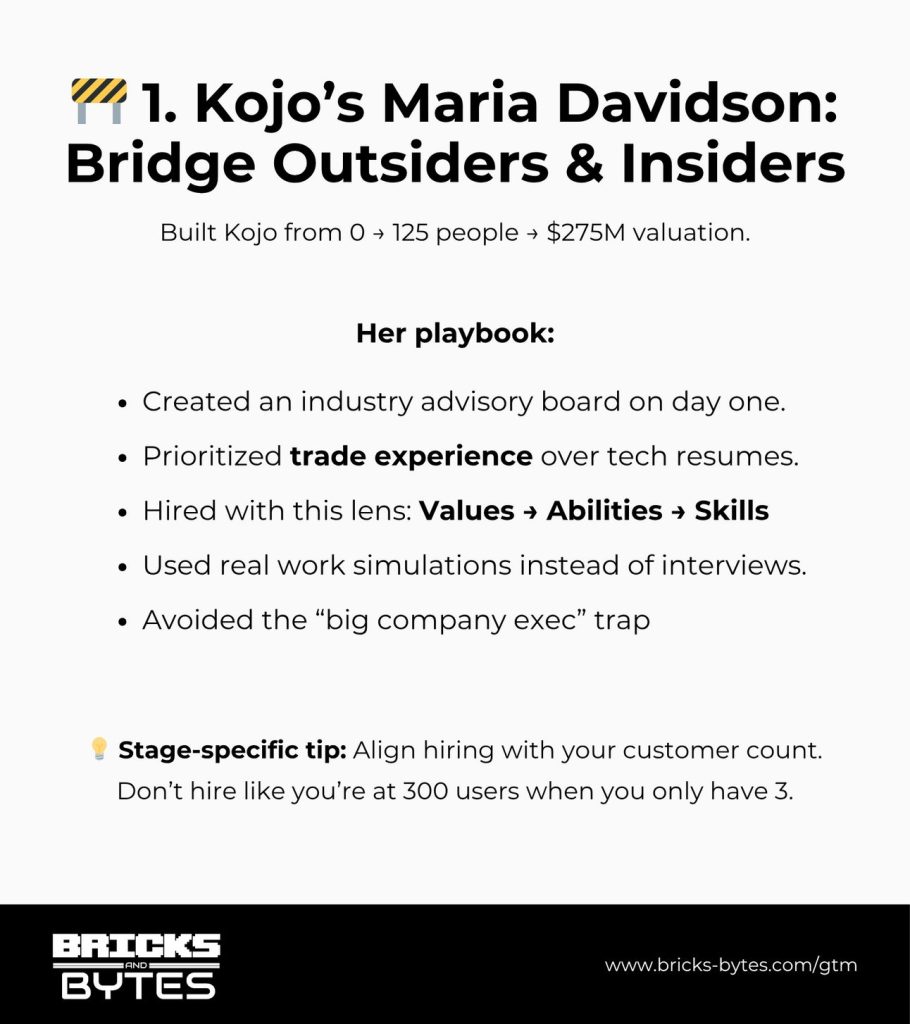
Want to get your message in front of {{active_subscriber_count}} highly engaged innovation leaders? Check out our sponsorship offers. INDUSTRY INSIGHTS12 Lessons About Hiring From AEC’s Top Leaders How Construction Tech Leaders Build Teams That Drive $100M+ Growth In this special edition of the Bricks & Bytes Bulletin, we’re diving into the hiring strategies of four AEC tech leaders who have built teams that propelled their companies to significant status and beyond.  Our deep dive reveals a critical pattern: while each leader has unique approaches, they share a systematic focus on mission alignment, industry understanding, and cultural fit that transcends traditional hiring playbooks. These aren’t just theories, they’re battle-tested strategies that have built teams generating hundreds of millions in revenue. 👇 Inside the full edition:  We break down how 4 top AEC tech leaders built $100M+ teams — including: The hiring framework that helped Kojo scale to 125+ employees in 4 years The one interview question that disqualifies 90% of candidates at OpenSpace Why Plangrid’s CRO avoids ex–Salesforce rep The 5 traits Levelset used to build a powerhouse sales team from bartenders and Uber drivers And how all four leaders avoided million-dollar hiring mistakes most startups make UPGRADE TO PREMIUM The Knowledge Bridge: Maria Davidson’s Team-Building Framework at Kojo Building a construction tech company zero to 125 employees and a $275m valuation in four years doesn’t happen by accident. For Kojo CEO Maria Davidson, the foundation was methodically creating what we call a “knowledge bridge” – systematically connecting outsider innovation with insider industry expertise. The Industry Knowledge Imperative While many founders try to disrupt construction with technology backgrounds alone, Maria recognized early that success required deep industry knowledge integration: “I don’t want to build what we think is right. I want to build what our customers think is right,” Maria emphasizes, highlighting the distinction between innovation for innovation’s sake versus customer-driven development. This philosophy translated into concrete action: creating an industry advisory board from day one and prioritizing hires with direct trade experience. This wasn’t just about credibility—it was about building intuitive understanding of customer needs that technology-only founders often miss. The Values-Abilities-Skills Framework Looking beyond Maria’s Kojo journey, we’ve observed that the most successful AEC tech companies employ a structured evaluation framework. Maria’s approach stands out for its clarity: “We look at everything through a framework of values, abilities, and skills, and making sure that there’s alignment across each one of those three.” While many companies prioritize skills first, this sequencing is purposeful. Values alignment ensures cultural fit, abilities reflect how candidates approach problems, and skills—while important—can often be developed. The Assignment-Based Hiring Test Perhaps Maria’s most replicable innovation is Kojo’s simulation-based hiring process. Rather than relying solely on interviews (which research shows are surprisingly poor predictors of performance), candidates complete written assignments that mirror actual work. This approach serves multiple functions: It reveals how candidates think and communicate It demonstrates their level of rigor and attention to detail It tests alignment with Kojo’s documentation-centric culture It provides a mutual preview of the working relationship Avoiding the “Big Company Transplant” Trap The most valuable lesson from Maria’s experience may be her candid assessment of hiring missteps. The pattern we see repeatedly is what she calls the “big company transplant” trap – assuming executives from larger organizations can simply replicate their success in a startup environment. “We underestimated how many resources people had at those larger companies and the entire infrastructure around them,” Maria explains. This insight calls for a fundamental shift in hiring for growth-stage companies: evaluate candidates not just on what they’ve built, but on how they built it and with what resources. Key Lesson: Stage-Appropriate Hiring The meta-pattern in Maria’s approach is understanding that different company stages require different hiring priorities. As Kojo moved through customer growth milestones (1-3 customers → 3-20 → 20-100 → 100-300 → 300+), their hiring focus evolved from finding early adopters to building repeatable processes to systematizing operations. The critical takeaway: analyze your current customer count and align your hiring strategy to your specific growth stage rather than applying generic hiring templates. Subscribe to our premium content to read the rest. This is a subscriber only post. Become a paying subscriber of our annual or monthly paid subscriptions to get inside takes on growth in construction tech. Upgrade Translation missing: en.app.shared.conjuction.or Sign In Powered by beehiiv

Newsletter

The Multi-Threading Sales Technique That Cut Planera’s Enterprise Sales Cycle in Half – Scotland Foss – EARLY RELEASE

This is an early release of our podcast, exclusive for premium subscribers. To get early access, upgrade here. To get the most out of this newsletter, please read it online. EARLY RELEASEThe Multi-Threading Sales Technique That Cut Planera’s Enterprise Sales Cycle in Half In this episode of Bricks & Bytes, we sit down with Scotland Foss, a construction tech sales veteran who shares his invaluable experience from PlanGrid’s landmark $875 million acquisition journey to his current role leading sales at Planera. Scotland reveals the strategic frameworks and tactical approaches that drive success in the unique construction technology landscape. In this episode, you’ll: Learn how successful construction tech companies align their solutions with industry-specific pain points and articulate value beyond technical features Discover how pricing models in construction tech have evolved from user-based to volume-based, and why unlimited user models can drive wider adoption Understand why engaging stakeholders across multiple organizational levels is critical for enterprise construction tech sales Gain insights on how defining and communicating company values attracts the right talent and creates a winning sales organization Chapters 00:00 – Scotland’s journey from healthcare tech to construction tech leadership 05:53 – The Planera pitch: Replacing legacy construction scheduling tools 10:17 – Defining success metrics in construction tech go-to-market 14:45 – Strategic pricing models: User-based vs. volume-based approach 20:26 – Compressing sales cycles with a strategic multi-threading technique 27:46 – Tech stack essentials for construction tech sales teams 35:32 – When to hire your first head of sales (and why product-market fit matters) 45:02 – The partnership ecosystem: Integration strategy with Procore and Autodesk 50:41 – Common go-to-market mistakes and the importance of company culture 55:30 – Why understanding construction is non-negotiable for customer-facing roles »»» Listen Now (Premium Subscribers Only) ««« Subscribe to our premium content to read the rest. This is a subscriber only post. Become a paying subscriber of our annual or monthly paid subscriptions to get inside takes on growth in construction tech. Upgrade Translation missing: en.app.shared.conjuction.or Sign In Powered by beehiiv

Newsletter

ICYMI:What Plangrid learned at $5M that took them to $100M

Want to get your message in front of {{active_subscriber_count}} highly engaged innovation leaders? Check out our sponsorship offers. To get the most out of this newsletter, please read it online. This Week’s Quickfire BytesFuel your curiosity with this week’s contentW/C 5th May 2025 NEW EPISODESMost Construction Tech Misses The Market – Modern Go-To-Market Strategies For Construction Tech Anton Marinovich from Joist AI shares his construction tech go-to-market journey from his father’s masonry business to leading sales at Contentful, HoloBuilder, and now Joist AI. Find out why matching your product to workflows is crucial in construction tech, how simplicity in sales compensation drives the right behaviors and the importance of transparency in building trust with construction clients. open.spotify.com/episode/3qr1tvjX8xM2veuBgbkmKc Construction Crash Coming – Our NEW Host, US Economy Contracts 0.3%, Trump Tariffs Hit Construction, Autodesk vs Procore Battle, AI, Biggest Construction Tech Failures This week on Bricks, Bucks & Bytes, things get spicy. We dig into the 0.3% drop in US GDP—and why it might just be the beginning for the construction sector. But tariffs and rate hikes are only half the story. The real drama? AI hype cycles, Autodesk vs. Procore, and why most “AI for construction” startups are just faucets with no bathtub. open.spotify.com/episode/4dxvYQgX3GmYkd0LDfUTOe Most Startups Die at $5M ARR – Breaking the $10M Barrier in Construction Tech In our Go To Market Series, Kevin Halter (CRO of OpenSpace) shares his journey from scaling PlanGrid from $5M to $100M+ ARR and building high-performing sales teams in construction tech. Find out why construction tech requires a unique go-to-market approach focused on project-level ROI, how to transition from project-level sales to enterprise agreements (the key to breaking the $10M ARR ceiling) and when founders should hire their first VP of Sales vs CRO. open.spotify.com/episode/5xHZzuJfNL8HOUv6xAfnDO View All Podcasts PREMIUM EARLY RELEASE How PlanGrid Transformed an Industry and Sold for $875M – Ralph Gootee – EARLY RELEASE In this fascinating episode, Ralph Gootee, co-founder of PlanGrid (acquired by Autodesk for $875M) and current CEO of TigerEye, reveals the insider strategies that helped his company dominate the construction tech space. Building a Construction Tech Sales Engine That Scales – Tom Feliz – EARLY RELEASE In this episode, we’re joined by Tom Feliz, Head of Growth at Datagrid, as he shares his fascinating journey from working in construction trailers to becoming a leading sales strategist in the construction tech space. 2 FAVORITE QUOTES: “That everything just happens easy or you know what my product is the best. Like you know my baby’s not ugly and you know sometimes it is or sometimes it’s just not fully there yet.” – Anton Marinovich on common go-to-market mistakes “Projects were already having trouble with the borrowing costs… So now you have higher input costs, which means projects are even more expensive to perform. I think that this is going to lead to a slowdown in construction.” – Dustin DeVan on tariffs affecting construction BRICKS & BYTES PREMIUM🚀 Ready to Break Through the $10M Ceiling? Here’s a quick recap of what you’ll receive as a premium subscriber: Premium in-depth articles delivered to your inbox Early access to podcast episodes before public release 33% discount on all future GTM guides we publish UPGRADE TO PREMIUM Want 33% off the guide?Sign Up for Our Monthly Subscription Monthly members ($10/mo) can purchase the guide for just $67 UPGRADE TO MONTHLY YOU MIGHT ALSO LIKE More Insights NSFW: Build a F*cking Business McKinsey’s Secrets to Scaling Construction Tech How Flux Burned Through $29M – Lessons for AEC Innovators Ex AutoDesk CEO’s 12 Lessons For Developing Products Could an Entrepreneur in Residence Save Your Construction Firm? Reports and Case Studies Innovating the Future: Robotics and the Revolution in Construction The Future of Design Software In AEC – Experts Insights Investing In AEC Tech The Future Of Construction Document Management The Construction Tech Revolution In India: Lessons From InfraMarket’s Success Innovation at Windover Construction Swinerton’s Innovation Strategy Most Popular Episodes How To Build A Unicorn In Construction Tech – Patric Hellermann Story Of A Modular Construction Startup That Burned Through £10M in 15 Months – Chris Spiceley McKinsey FINALLY updates their Productivity Curve, & The Future Of Construction – David Rockhill, Partner at McKinsey Procore’s AI Strategy & Implementation – AI’s Role in Modern Construction Disrupt Autodesk? This Ex-Autodesk CEO Has Some Advice – Amar Hanspal Super Series Super Series with Ediphi Super Series With Speckle Super Series With Monumental Super Series with Foundamental OUR SPONSORS BuildVision — streamlining the construction supply chain with a unified platform for contractors, manufacturers, and stakeholders. Powered by beehiiv
Newsletter

How PlanGrid Transformed an Industry and Sold for $875M – Ralph Gootee – EARLY RELEASE

This is an early release of our podcast, exclusive for premium subscribers. To get early access, upgrade here. EARLY RELEASEHow PlanGrid Transformed an Industry and Sold for $875M In this fascinating episode, Ralph Gootee, co-founder of PlanGrid (acquired by Autodesk for $875M) and current CEO of TigerEye, reveals the insider strategies that helped his company dominate the construction tech space. Drawing from his journey from Pixar engineer to construction tech pioneer, Ralph shares candid insights about product development, scaling challenges, and the unique opportunities within the construction industry that today’s founders can leverage. In this episode, you’ll: Discover why creating a truly mobile-first solution with superior performance was key to PlanGrid’s explosive growth and $875M acquisition Learn why “write code, talk to users” remains the essential founder mantra that Ralph credits for maintaining product-market fit Understand the pricing evolution challenges and why Ralph would never use per-seat licensing again, preferring project-based models Explore how construction’s inherent viral growth potential can be harnessed despite the industry’s natural project-based churn Gain insights on finding and nurturing the right founding team, with Ralph’s candid reflections on leading a successful 4-founder company See how AI is currently augmenting rather than replacing skilled professionals, making senior engineers dramatically more productive Chapters 00:00 – The $875M Question: Inside PlanGrid’s Acquisition Journey 02:07 – The Secret Weapon: How PDF Expertise from Pixar Created an Unbeatable Product 05:35 – Playing Hardball: How PlanGrid Leveraged Their Market Position with Autodesk 08:04 – Sam Altman’s Blunt Advice: “Don’t F*** It Up” and How to Live By It 13:23 – The Unlikely Love Story That Built PlanGrid 20:00 – AI in Construction: Where the Real Opportunities Lie Beyond the Hype 27:12 – Why Most Startups Fail with Multiple Co-Founders 35:38 – The Strategic Mistake That Nearly Crippled PlanGrid’s Growth 44:15 – Attracting Silicon Valley’s Best to an “Unsexy” Industry 51:12 – Why Domain Expertise Makes or Breaks Construction Tech 59:40 – TigerEye Vision: Reinventing Data Analytics for Today’s Tech Leaders 01:19:14 – The ROI Equation: How Construction Tech Companies Should Measure Success »»» Listen Now (Premium Subscribers Only) ««« Subscribe to our premium content to read the rest. This is a subscriber only post. Become a paying subscriber of our annual or monthly paid subscriptions to get inside takes on growth in construction tech. Upgrade Translation missing: en.app.shared.conjuction.or Sign In Powered by beehiiv

Newsletter

Building a Construction Tech Sales Engine That Scales – Tom Feliz – EARLY RELEASE

This is an early release of our podcast, exclusive for premium subscribers. To get early access, upgrade here. EARLY RELEASEBuilding a Construction Tech Sales Engine That Scales In this episode, we’re joined by Tom Feliz, Head of Growth at Datagrid, as he shares his fascinating journey from working in construction trailers to becoming a leading sales strategist in the construction tech space. With his boots-on-the-ground experience and tech savvy, Tom offers a refreshingly authentic perspective on what really works when selling technology to an industry that still values a firm handshake. In this episode, you’ll: Discover why solving real industry pain points with immediate “speed to value” is critical for construction tech adoption Learn how product-led growth strategies with freemium models can accelerate sales cycles in the traditionally conservative construction industry Understand why the industry is moving away from construction volume pricing toward more equitable consumption or seat-based models Explore how agentic AI is transforming traditional sales roles into “go-to-market engineers” with more intelligent prospecting capabilities Gain insights on why founders should remain deeply involved in the sales process to maintain customer connection before scaling the sales organization Chapters 00:00 – Introduction and Tom’s journey from construction to tech sales 04:30 – What makes an effective construction tech go-to-market strategy 10:15 – Understanding speed to value and solving real industry problems 15:45 – Identifying and segmenting ICPs across the construction ecosystem 24:30 – Creating value for different stakeholders with agentic AI 32:15 – Enterprise sales strategies for various company sizes 39:00 – Pricing models and the problems with construction volume pricing 47:00 – Key sales metrics and KPIs for construction tech companies 54:30 – Sales tools, AI in GTM, and traits of great salespeople 01:07:00 – When founders should hire sales leadership »»» Listen Now (Premium Subscribers Only) ««« Subscribe to our premium content to read the rest. This is a subscriber only post. Become a paying subscriber of our annual or monthly paid subscriptions to get inside takes on growth in construction tech. Upgrade Translation missing: en.app.shared.conjuction.or Sign In Powered by beehiiv

Newsletter

Why 80% of Solutions Die in MEP

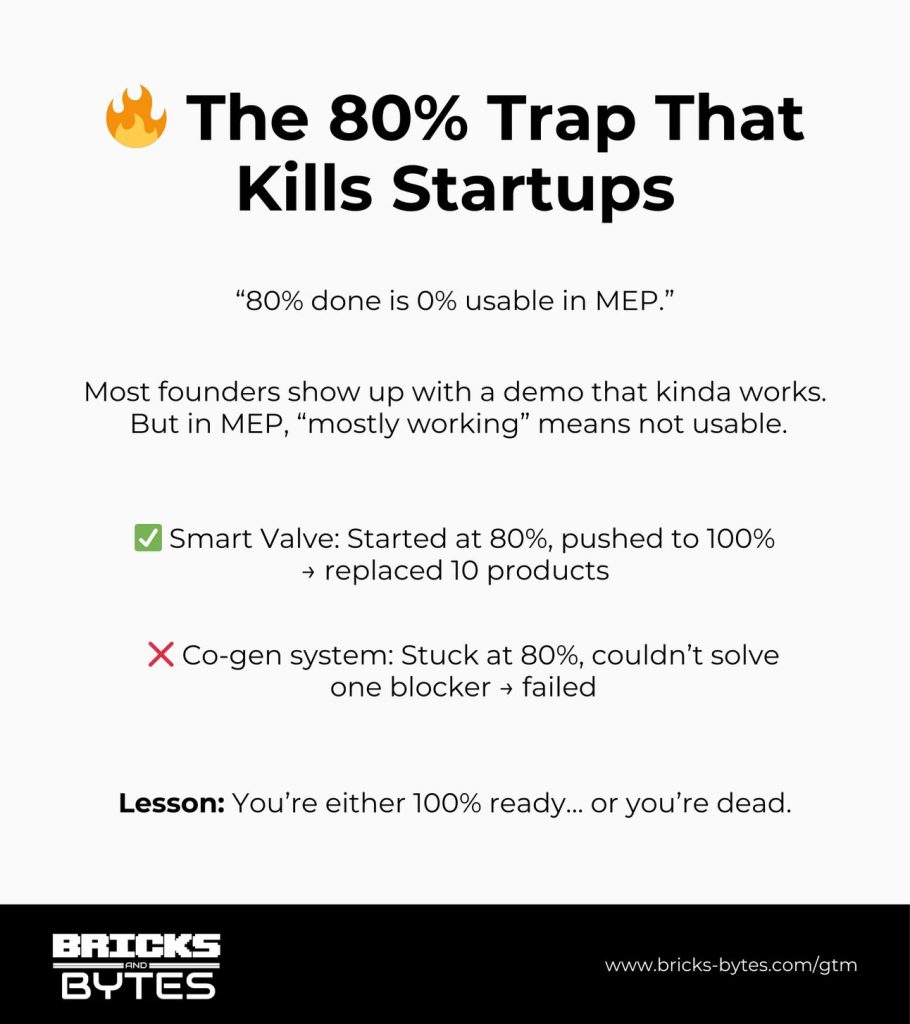
Want to get your message in front of {{active_subscriber_count}} highly engaged innovation leaders? Check out our sponsorship offers. INDUSTRY INSIGHTSWhy 80% of Solutions Die in MEP TL;DRHow Syska Hennessy—one of the top MEP design firms—successfully adopts new tech in an industry built to resist it: 🔧 MEP firms hate change – unbillable hours + liability = instant pushback ⚠️ 80% solutions fail – in MEP, “almost works” = not good enough 🔁 Innovation works backwards – start with shop drawings, not concepts ✅ 3-step filter for tech – must solve real pain, fully work, and come via trusted intros ⏳ Think long-term – in MEP takes a 10-year horizon The 3-Step Framework That Syska Hennessy Uses to Successfully Integrate New Technology About 15 years ago, Google tried to develop design software to compete with Autodesk, which dominates 90% of the construction industry. They started with Google SketchUp, adding pipes and MEP components. The industry watched nervously, expecting disruption. Then Google pulled the plug. Why? According to Robert Ioanna, Executive Principal of Syska Hennessy (a $200M MEP design firm), they didn’t understand a fundamental truth about MEP firms: “The investments in our industry, you have to come at it with at least a 10-year type of horizon.” After evaluating hundreds of construction tech startups through Syska’s innovation program, Rob has identified exactly why most fail to get adopted—and what the successful ones do differently. The Problem: MEP Firms Are Built to Resist Change MEP firms face a unique innovation paradox. As Rob explains, “We’re a consulting engineering business, kind of like a law firm. Our asset is people. We sell time.” This creates immediate resistance to innovation: Every hour spent on testing new technology is an unbillable hour Any efficiency gain potentially reduces revenue Engineers carry personal liability for designs, making them risk-averse When Syska introduced HVAC Manufacturing’s Smart Valve—a product that eliminated the need to specify 10 different box sizes—some partners were “pissed because that’s a lot of design revenue for us.” Yet Syska has successfully integrated numerous technologies. How? The 80% Solution Trap That Kills Most Startups Rob shares a critical pattern he’s observed: “We had a specific investment that was really doing an amazing thing… they claimed they had 80% of the way figured out.” The difference between success and failure? Getting from 80% to 100% functionality. Success Story: HVAC Manufacturing’s Smart Valve Started at 80% functionality Pushed through to 100% market readiness Result: Complete solution that replaces 10 different products Failure Story: A promising cogeneration product Stuck at 80% functionality Couldn’t solve a critical component issue Result: “They iterated and iterated… eventually it just ceased” The brutal truth? MEP systems can’t be “mostly working.” As Rob notes, “If AI can’t prove to me that it exactly meets codes… you’re going to be very hesitant to use it.” The “Backwards Innovation” Path That Actually Works Here’s where most startups go wrong: they try to innovate from concept to completion, like architects do. But MEP innovation works backwards. “On the MEP side, I think it’s going to come backwards,” Rob explains. “Companies like Augmenta, they’re going to take the engineer’s designs and automatically build the shop drawings from it.” The successful path: Start with construction documents: Automate shop drawings Move to clash detection: Solve the “17 different systems that can’t hit each other” Then tackle design principles: Implement rules for system layout Finally address early design: Work back to conceptual phases Why? Because individual engineers must sign and seal drawings, taking personal liability. They need absolute certainty before adoption. Syska’s 3-Filter System for Choosing Technology Partners After forming Syska Innovations in 2021, Rob developed a rigorous filtering system: Filter 1: Must fit one of seven specific buckets Smart buildings Digitization Eco innovation Industrialization of design AI/process automation Project design Project management “If something fits into those seven buckets, we’ll either invest in that company, take an idea internally, or help develop a product.” Filter 2: Must solve complete problems, not incremental improvements Rob is blunt: “We’re not interested in something that’s like a commodity play or something that does something slightly more efficient.” Good example: Smart Valve technology Replaces 10 different VAV box sizes with one Maintains accuracy within 5-6% Solves complete workflow problem Bad example: Products offering 5% efficiency improvements Don’t justify disruption to workflows Can’t overcome adoption friction Fail to deliver transformative value Filter 3: Must come through trusted networks Cold outreach rarely works. “In the beginning, I responded to every LinkedIn request… now I’ll barely even read, even if they do come up with some cool email.” What works: Ecosystem recommendations (Building Ventures, Shadow Ventures) Targeting specific named problems (“clash detection software”) Building visibility through quality content Demonstrating deep MEP understanding “The unfortunate answer is a lot of things we wind up looking at are usually because they were recommended or came through somebody that we knew.” The Bottom Line Success in MEP tech isn’t about having the most innovative solution—it’s about understanding that MEP firms need complete, liability-proof solutions that justify the disruption to their billable hours model. As Rob advises founders: “Spend a good amount of time really understanding what your total addressable market is. Everybody has the same slide… ‘the construction industry is worth $1 trillion’… And you’re just like, seriously?” The path forward? Start where the pain is most acute (construction documents), deliver 100% solutions, and be prepared for a 10-year journey. Because in MEP, there are no shortcuts to adoption WEEKLY MUSINGSStrategy Sprints, Sales Timing, Startup Implosions AI-powered ops, human-led boards Thiago Da Costa 2025 is off to a flying start—so we’re leveling up our operations with AI. Yet one ritual must stay inherently human: the Board meeting. Here’s our playbook: Context is everything in outbound sales Martin Roth In construction software sales, who you call matters. But when you call matters more. Most sales teams still treat construction like it’s a numbers game: 1. Build a big list 2. Hammer the phones 3. Hope you can generate enough opportunities

Newsletter

ICYMI: Demand a 4X ROI on Innovation: How AtkinsRéalis Prioritizes Technology

Want to get your message in front of {{active_subscriber_count}} highly engaged innovation leaders? Check out our sponsorship offers. This Week’s Quickfire BytesFuel your curiosity with this week’s contentW/C 28th April 2025 NEW EPISODESInnovation Is NOT About Technology! – Solving Resistance & Implementation from a Tech VP at Bulley & Andrews Dana Erdman, VP of Technology and Innovation at Bulley & Andrews, shares how a construction company approaches innovation, technology adoption challenges, and building relationships with startups. Find out why the best innovations often come from people doing the day-to-day work, the importance of onboarding support when implementing new technology and why per-project pricing models can be deal-breakers for construction companies. open.spotify.com/episode/2SPsa7uDflR0zRMkm93Pcn Inside AtkinsRealis’ Digital Transformation – How AtkinsRealis Drives Digital ROI Darren Martin, Chief Digital Officer at Atkins Realis, shares powerful insights about technology implementation in a global engineering firm with 40,000 employees. Find out how they evaluate technology investments (looking for at least 4X ROI within 12-18 months), the challenges of integrating startup technologies into enterprise environments and their approach to AI implementation across the organization. open.spotify.com/episode/3JTXe9irqDQSCwLZbrJ0VE Innovation Without ROI? – Practical Innovation Strategies from DPR’s Innovation Director Tim Gaylord, Corporate Director of Innovation at DPR Construction, shares fascinating insights into how one of the largest construction companies approaches innovation. Find out how DPR fosters a culture of innovation from the bottom up, why they’re building more solutions internally rather than solely relying on startups and the unexpected collaboration trend between competing general contractors. open.spotify.com/episode/7tYJEwG1gPTNBmAc2uddqW View All Podcasts BRICKS & BYTES BULLETINANNOUNCING – Bricks & Bytes Premium + The Ultimate Construction Tech GTM Guide Hola friends of Bricks & Bytes. Today, we are excited to announce the launch of two exciting products: Go To Market In Construction Tech – The Guide and Bricks & Bytes Premium. Since we launched Bricks & Bytes 3 years ago this month, we have found ourselves at the heart of the founder community, sharing and listening to the tales of those who are building, exiting from and purchasing technologies. The subject of Go-To-Market comes up time and time again. It is absolutely fundamental to success yet we found very little content on the subject aside from generic tech sales playbooks and mainstream platforms which recycle the same tactics which simply do not work in our industry. Through years of growing connections amongst the top founders, VCs, execs at construction companies and so on, we felt the timing perfect to launch our dedicated GTM content.  Within our premium subscription, we will be sharing in depth insights from battle-hardened CEO’s and execs and subject such as: Sales, Marketing, Product, Growth, and Corporate viewpoints. In addition, premium subscribers will get discounted access to our in depth guides (released every quarter), as well as early access to podcasts before they reach the public. If you want to be at the forefront of GTM within AEC technology, then sign up to show your support for our work and benefit from exclusive content at a very reasonable price. Read Full Article 2 FAVORITE QUOTES: “A commitment to supporting you through your onboarding shows that they care more than just selling the product. They care about its success in the organization.” – Dana Erdman on implementation and support “We moved away from the word pilot, and when I came here, some of the pilots were like indefinite pilots. They’ve been going for a number of years. They were so good that no one wanted to stop them, but we couldn’t necessarily put our finger on the value that they were bringing.” – Darren Martin on the need for disciplined evaluation YOU MIGHT ALSO LIKE More Insights NSFW: Build a F*cking Business McKinsey’s Secrets to Scaling Construction Tech How Flux Burned Through $29M – Lessons for AEC Innovators Ex AutoDesk CEO’s 12 Lessons For Developing Products Could an Entrepreneur in Residence Save Your Construction Firm? Reports and Case Studies Innovating the Future: Robotics and the Revolution in Construction The Future of Design Software In AEC – Experts Insights Investing In AEC Tech The Future Of Construction Document Management The Construction Tech Revolution In India: Lessons From InfraMarket’s Success Innovation at Windover Construction Swinerton’s Innovation Strategy Most Popular Episodes How To Build A Unicorn In Construction Tech – Patric Hellermann Story Of A Modular Construction Startup That Burned Through £10M in 15 Months – Chris Spiceley McKinsey FINALLY updates their Productivity Curve, & The Future Of Construction – David Rockhill, Partner at McKinsey Procore’s AI Strategy & Implementation – AI’s Role in Modern Construction Disrupt Autodesk? This Ex-Autodesk CEO Has Some Advice – Amar Hanspal Super Series Super Series with Ediphi Super Series With Speckle Super Series With Monumental Super Series with Foundamental OUR SPONSORS BuildVision — streamlining the construction supply chain with a unified platform for contractors, manufacturers, and stakeholders. Powered by beehiiv

Flux construction technology legacy
Startups

The Legacy of Flux: Lessons Learned and the Rise of a New Generation of Contech Startups

  In construction technology, some failures end up being more influential than successes. Such is the story of Flux, a Google X spinoff that, despite its eventual pivot and dissolution, helped shape the future of construction technology in ways that continue to reverberate through the industry today. With a whopping $29 million Series B funding round and a team packed with exceptional talent, Flux seemed poised to revolutionize the construction industry through better data interoperability. Their mission was ambitious yet straightforward: help architects, engineers, and cost planners share information more seamlessly to design better buildings. Think of it as trying to create the G Suite for construction – a unified ecosystem where different tools could work together harmoniously. But as former Flux CPO Anthony Buckley-Thorpe reveals, what seemed like a straightforward problem of technological innovation turned out to be a complex web of business and cultural challenges. “We had a great product, we had great feedback, we had some fantastic users,” he recalls. “It was really tough to let those people down.” The company’s eventual pivot wasn’t due to running out of money or lacking technical capability – it was about the fundamental challenge of monetizing their solution in an industry that wasn’t quite ready for it.   In this episode, Anthony Buckley Thorpe talks about the challenges of innovating in construction, lessons from Flux’s journey, and thoughts on building successful AEC tech products.   The Monetization Puzzle One of the most fascinating insights from Flux’s journey was the disconnect between users and decision-makers. The people who loved and used Flux’s products were often computational designers and forward-thinking architects – but they weren’t the ones controlling the purse strings. As Buckley-Thorpe notes, they’d often find themselves in meetings where the head architect would point to a new graduate and say, “He told me about you guys.” This highlighted a crucial lesson for construction technology startups: having great software for one type of user isn’t enough. You need to sell to the right person, and more importantly, you need to build a clear path to revenue from day one. The “we’ll figure out monetization later” approach that might work in consumer tech simply doesn’t fly in the construction industry. The Collaboration Conundrum Perhaps the most profound insight from Flux’s experience was what Buckley-Thorpe calls “the grease versus fat” dilemma. As their CEO once noted, “In construction, there is grease and there is fat, and you need to be careful which one you take out.” Flux’s dream of free-flowing information between parties ran headlong into a harsh reality: many industry players are actually incentivized not to share information. Why? Because in an industry where substantial revenue can come from claims against other parties, transparency isn’t always desirable. While individual users might dream of better collaboration, their organizations often have structural reasons to maintain information silos. It’s a sobering reminder that technical solutions alone can’t solve what are essentially business model and incentive problems. The Phoenix Effect But here’s where the story takes an interesting turn. While Flux itself may have pivoted away from its original vision, its impact continues through a new generation of construction technology startups founded by former team members. Companies like Join.build, focused on pre-construction, and Rayon, working on innovative construction solutions, emerged from the Flux diaspora. Even companies not directly connected to Flux, like Speckle, acknowledge learning from Flux’s experiences. What makes this particularly remarkable is that these talented engineers and entrepreneurs, despite experiencing setbacks, chose to stay in the construction industry. They could have easily moved to more traditional tech sectors, but instead, they remained committed to solving construction’s complex challenges.   Lessons for the Future For today’s construction technology startups, Flux’s legacy offers several crucial lessons: Revenue First: Don’t leave monetization as an afterthought. In an industry with long project lifecycles, you need a clear path to revenue from day one. Understand the Real Buyer: Great user adoption doesn’t automatically translate to sales. You need to align your solution with the priorities of those holding the purse strings. Respect Industry Dynamics: Just because something makes logical sense (like better collaboration) doesn’t mean the industry is structured to embrace it. Think About Scale: Consider how your solution will work not just for one project or team, but across the complex ecosystem of construction. Looking Ahead The construction technology landscape today is markedly different from when Flux emerged from Google X. There’s greater awareness of digital solutions, more willingness to adopt new technologies, and perhaps most importantly, a better understanding of the industry’s unique challenges. The new generation of startups emerging from Flux’s legacy seems to be taking these lessons to heart. They’re focusing more on specific, solvable problems rather than trying to revolutionize everything at once. They’re thinking about business models from day one. And crucially, they’re building solutions that work within the industry’s existing incentive structures rather than trying to completely reimagine them. As Buckley-Thorpe puts it, “There’s 20 years of technological innovation just sitting there ready to be applied… It’s not the technology. It’s the business model.” For the next generation of construction technology entrepreneurs, understanding this distinction might be the key to turning innovative ideas into sustainable businesses.      

Newsletter

Breaking The $10M ARR Barrier – Kevin Halter – EARLY RELEASE

This is an early release of our podcast, exclusive for premium subscribers. To get early access, upgrade here. EARLY RELEASEBreaking The $10M ARR Barrier In this episode, we sit down with Kevin Halter, the go-to-market mastermind behind some of construction tech’s biggest success stories. Kevin takes us through his remarkable journey – from founding his own construction tech startup to leading PlanGrid’s explosive growth from $5M to over $100M in annual recurring revenue. In this episode, you’ll: Learn Kevin’s proven approach for scaling construction tech companies past the point where most hit a growth plateau Discover how to transform $20K pilots into $500K+ enterprise deals by connecting job site ROI to executive priorities Get Kevin’s framework for identifying “hungry, humble, smart” people who consistently outperform traditional enterprise sellers Understand why boots on the ground in local markets beats digital-only selling in the construction industry Learn exactly when founders should hire sales leadership and how to structure your team at each revenue stage See how relationship-focused selling creates multi-year customer loyalty and significantly higher revenue per account Chapters 00:00-04:30 – From Biotech to Building the FutureKevin shares his journey from biotech strategic sales to founding his own construction tech marketplace, discovering the power of mobile technology on job sites. 04:31-15:00 – The PlanGrid Scaling Formula The inside story of how Kevin helped scale PlanGrid from $5M to $100M ARR in just 3 years—revealing the critical strategies most construction tech companies miss. 15:01-23:45 – Breaking the $10M ARR Ceiling Why most construction tech companies stall at $10M ARR and Kevin’s proven framework for pushing through this barrier to reach $100M+ territory. 23:46-29:30 – The Land & Expand Playbook How to transform small project pilots into multi-million dollar enterprise agreements by connecting project-level ROI to C-suite business priorities. 29:31-39:45 – Building Elite Sales Teams Kevin’s contrarian approach to hiring and structuring sales teams—focusing on fewer accounts and deeper relationships instead of traditional high-volume tactics. 39:46-54:20 – The “Hungry, Humble, Smart” Hiring Formula Inside Kevin’s talent identification system that’s produced dozens of future VPs and sales leaders across the construction tech ecosystem. 54:21-1:05:10 – Beyond Sales: Partnership Philosophy Why Kevin rejects traditional sales tactics for a long-term partnership approach—and how this builds relationships that span decades in the industry. 1:05:11-1:08:15 – The OpenSpace Decision Why Kevin chose OpenSpace after the Autodesk years and what their technology signals about the future of construction productivity. 1:08:16-1:19:00 – CEO to CRO: When to Make the Hire Critical advice for founders on exactly when to bring in sales leadership, how to structure the transition, and why founder-led sales is essential in the early years. »»» Listen Now (Premium Subscribers Only) ««« Subscribe to our premium content to read the rest. This is a subscriber only post. Become a paying subscriber of our annual or monthly paid subscriptions to get inside takes on growth in construction tech. Upgrade Translation missing: en.app.shared.conjuction.or Sign In Powered by beehiiv

Newsletter

ANNOUNCING – Bricks & Bytes Premium + The Ultimate Construction Tech GTM Guide

Want to get your message in front of {{active_subscriber_count}} highly engaged innovation leaders? Check out our sponsorship offers. INDUSTRY INSIGHTSANNOUNCING – Bricks & Bytes Premium + The Ultimate Construction Tech GTM Guide Hola friends of Bricks & Bytes. Today, we are excited to announce the launch of two exciting products: Go To Market In Construction Tech – The Guide Bricks & Bytes Premium Since we launched Bricks & Bytes 3 years ago this month, we have found ourselves at the heart of the founder community, sharing and listening to the tales of those who are building, exiting from and purchasing technologies. The subject of Go-To-Market comes up time and time again. It is absolutely fundamental to success yet we found very little content on the subject aside from generic tech sales playbooks and mainstream platforms which recycle the same tactics which simply do not work in our industry. Through years of growing connections amongst the top founders, VCs, execs at construction companies and so on, we felt the timing perfect to launch our dedicated GTM content.  Within our premium subscription, we will be sharing in depth insights from battle-hardened CEO’s and execs and subject such as: Sales Marketing Product Growth Corporate viewpoints In addition, premium subscribers will get discounted access to our in depth guides (released every quarter), as well as early access to podcasts before they reach the public. If you want to be at the forefront of GTM within AEC technology, then sign up to show your support for our work and benefit from exclusive content at a very reasonable price. More details below: With LoveOwen & MartinBricks & Bytes The Definitive Playbook for Scaling Your AEC Tech Company Past $10M ARR After months of deep conversations with the industry’s most successful leaders, we’re thrilled to announce the release of our comprehensive Construction & AEC Technology Go-To-Market Guide. This isn’t just another generic SaaS playbook with a construction label slapped on it. It’s the distilled wisdom from executives who’ve actually built and scaled construction technology companies from early product-market fit to $100M+ in revenue and successful exits. Why Most Construction Tech Companies Hit a Growth Ceiling at $10M If you’re building or selling technology in the AEC space, you’ve likely noticed something peculiar: many promising startups reach $5-10M in revenue… and then stall. Here’s what Kevin Halter (who helped scale PlanGrid from $5M to $100M before their $875M acquisition) shared with us: “The project is where you make money or lose money, right? There’s very little budget typically at the headquarters level… So you have to understand the value, the ROI at the project level, build those business cases, and then connect the project ROI to the enterprise business initiatives.” This insight reveals why conventional SaaS growth strategies often fail in construction tech. While horizontal SaaS companies can sell directly to headquarters with centralized budgets, construction operates differently. The path to scale requires mastering the “land and expand” motion from project-level adoption to enterprise deployment. Kevin Halter – responsible for scaling PlanGrid from $5 to over $100m. “It’s all about go-to-market” What’s Inside the Guide Our comprehensive guide tackles the unique challenges of construction tech go-to-market, including: The “Land and Expand” Blueprint: How to structure sales motions that start with project-level adoption and systematically grow to enterprise agreements Construction-Specific Pricing Models: Moving beyond construction volume pricing to value-based approaches that scale with customer success Building High-Performance Sales Teams: How to balance industry expertise with sales fundamentals when hiring, compensating, and enabling your team Field-Based Engagement Strategies: Practical approaches to leverage job site visits, industry events, and relationship building in a face-to-face industry Measuring Growth at Different Stages: Realistic benchmarks for early-stage, growth-stage, and scale-stage construction tech companies Why Getting GTM Right Is So Critical in Construction Tech  Chase Gilbert – CEO and Founder of $1.5bn unicorn Built Technologies “So few companies get to real scale.” Unlock Premium Access Today We’re offering two ways to access our Construction Tech GTM Guide: Option 1: Guide Only – $100 Get immediate access to the complete 100+ page guide with all case studies, frameworks, and actionable checklists. GET THE GUIDE NOW Option 2: Premium Subscription + Guide – $150/year (Best Value) Get the guide PLUS ongoing access to: Monthly deep-dive articles on specific AEC tech growth topics Early access to podcast interviews with industry leaders (at least 7 days before public release) 33% discount on all future guides (AEC Marketing Guide coming Q3, Corporate Lessons coming soon) Optional private Spotify feed for $1.99/month (launching May 2025) UPGRADE TO PREMIUM Want 33% off the guide? Sign Up for Our Monthly Subscription Monthly members ($10/mo) can purchase the guide for just $67. UPGRADE TO MONTHLY 🚀 Ready to Break Through the $10M Ceiling? GET THE GUIDE NOW UPGRADE TO PREMIUM Here’s to building the future of construction, Scott Ellison – prominent angel investor in construction tech “If you don’t get go to market right … you’re not going to have a business for very long” P.S. Have questions about the guide or premium membership? Just reply to this email and I’ll get back to you personally. WEEKLY MUSINGSTrustworthy Coordination, AI Progress, EU Tech When the map is accurate, everything changes Flying Blind: Construction’s Tech Outpaces Its Trust | Angel Say I’ve been thinking a lot about how much the construction industry invests in field tech like AI, AR, robotics without first building trust in the design itself. That’s like turning on autopilot before having a reliable map. Wrote some thoughts 📝 #ConTech #Construction #Trust #Coordination | 19 comments on LinkedIn Sandcastles of skepticism James Garner Alan Mosca – You’ve probably seen this one but it made me laugh The EU’s tech scene is heating up #tech #map #europe | Jeroen Westerbeek 🪐 | 1,231 comments Silicon Valley is out ❌ EUROPE is the future 🇪🇺 Finally urgency has come. Europe wants and dares to innovate again. **** great to see. Tech hubs all over Europe. Regulation changing. Talented builders staying, not heading to

Newsletter

ICYMI: From Zero to $500M: Levelset’s Sales Roadmap Revealed

Want to get your message in front of {{active_subscriber_count}} highly engaged innovation leaders? Check out our sponsorship offers. This Week’s Quickfire BytesFuel your curiosity with this week’s contentW/C 21st April 2025 NEW EPISODESInnovation Without ROI? – Practical Innovation Strategies from DPR’s Innovation Director Tim Gaylord, Corporate Director of Innovation at DPR Construction, shares fascinating insights into how one of the largest construction companies approaches innovation. Find out how DPR fosters a culture of innovation from the bottom up, why they’re building more solutions internally rather than solely relying on startups and the unexpected collaboration trend between competing general contractors. open.spotify.com/episode/7tYJEwG1gPTNBmAc2uddqW The Sales Mastery Behind Levelset’s $500M Exit – GTM Tactics & Growth From CRO Martin Roth Martin Roth shares his journey as Levelset’s go-to-market leader and the real-world tactics that helped scale the business to a successful exit. Find out why the first million in revenue requires founders to do the selling themselves, the five key traits Martin looks for when hiring salespeople (grit, resourcefulness, enthusiasm, curiosity, ambition) and how selling to construction differs from typical B2B SaaS. open.spotify.com/episode/1AjeJRcAkIMqT8NusEQQRP 90% of Construction Waste Avoidable? – Material Efficiency & Circular Design from Sustainability Experts We had Eduardo Gomez from CRH Ventures along with founders Eliot Brooks and William Knapp from Cocoon, Shahrukh Shamim from Envicore, Matt Kennedy-Good from NeoCrete, and Elizabeth Gilligan and David Hughes from Material Evolution. Find out how Cocoon is turning steel slag waste into sustainable cement while capturing CO2, Envicore’s SCMs reducing emission intensity by up to 26% in concrete mixes and NeoCrete’s technology making volcanic ash more reactive as a cement replacement. open.spotify.com/episode/0h5q9GCmcCv6kJbgfZBlBs AI Won’t Save Bad Construction Companies – Solving Tech Adoption Problems from VC Perspective Vivin Hegde from Zakua Ventures sharing insights on construction tech investments and market trends. Find out why robotics is becoming essential in construction (labor shortage is only getting worse), the three-tier approach to AI adoption in construction tech and why FlexNode’s modular data centers could grow faster than any construction tech startup in 15 years. open.spotify.com/episode/5Ir5b06LrKkbpchPG4O1ph View All Podcasts BRICKS & BYTES BULLETINConstruction Tech Sales Lessons From Exited Sales Leader When Anton Marinovich joined HoloBuilder as their first sales leader in 2017, he had a secret weapon that his Silicon Valley competitors didn’t: he’d grown up on construction sites. As the son of a Croatian immigrant mason who built a respected business in the Bay Area, Anton had spent weekends on job sites and summers working in the field. When his father heard about the construction documentation platform Anton was considering joining, his reaction was immediate: “That one. Remember when we would go to construction sites and had the disposable camera? If I saw something was wrong, I was taking a picture of it… that’s what this guy is doing.” This insider perspective has helped Anton build successful sales operations at HoloBuilder (acquired by FARO for $34m) and now at Joist.ai, where he’s developing AI-powered proposal solutions for AEC firms.  But you don’t need to have grown up in a construction family to apply these battle-tested strategies. Read Full Article 2 FAVORITE QUOTES: “We have a choice. If we’re going to build a team, we can choose to be a team that cares about success or a team that doesn’t care about success… Believe it or not, a whole bunch of people do not care about success.” – Martin Roth on success culture “The biggest pet peeve of mine is if we do connect with a startup, outline our process, tell them to please be patient. And then they go around us to the projects or to a different work group lead… that’s like the biggest way to get blacklisted here at DPR.” – Tim Gaylord on startups’ go-to-market mistakes YOU MIGHT ALSO LIKE More Insights NSFW: Build a F*cking Business McKinsey’s Secrets to Scaling Construction Tech How Flux Burned Through $29M – Lessons for AEC Innovators Ex AutoDesk CEO’s 12 Lessons For Developing Products Could an Entrepreneur in Residence Save Your Construction Firm? Reports and Case Studies Innovating the Future: Robotics and the Revolution in Construction The Future of Design Software In AEC – Experts Insights Investing In AEC Tech The Future Of Construction Document Management The Construction Tech Revolution In India: Lessons From InfraMarket’s Success Innovation at Windover Construction Swinerton’s Innovation Strategy Most Popular Episodes How To Build A Unicorn In Construction Tech – Patric Hellermann Story Of A Modular Construction Startup That Burned Through £10M in 15 Months – Chris Spiceley McKinsey FINALLY updates their Productivity Curve, & The Future Of Construction – David Rockhill, Partner at McKinsey Procore’s AI Strategy & Implementation – AI’s Role in Modern Construction Disrupt Autodesk? This Ex-Autodesk CEO Has Some Advice – Amar Hanspal Super Series Super Series with Ediphi Super Series With Speckle Super Series With Monumental Super Series with Foundamental OUR SPONSORS BuildVision — streamlining the construction supply chain with a unified platform for contractors, manufacturers, and stakeholders. Powered by beehiiv

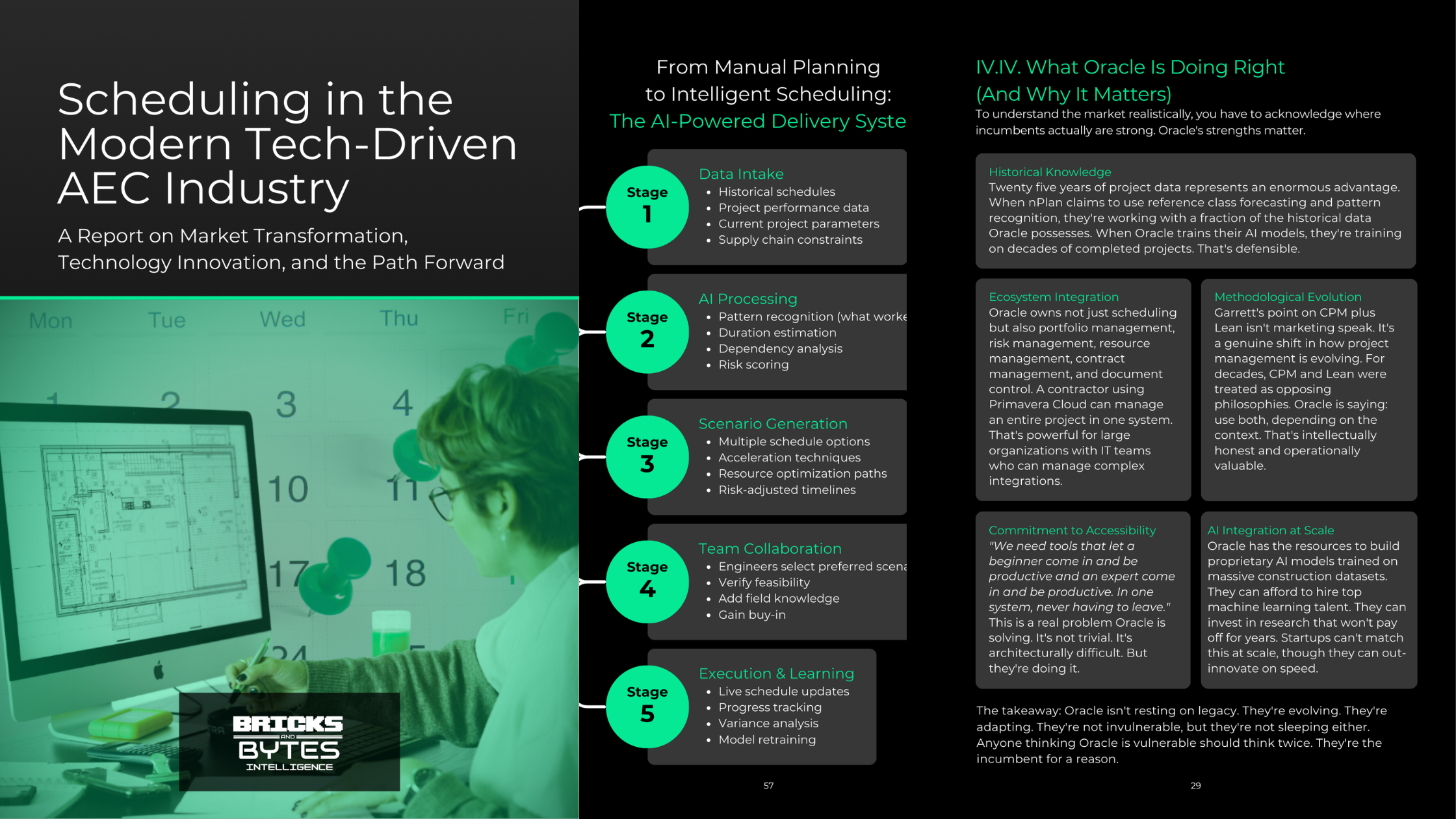
Get a FREE copy of our Scheduling in the Modern Tech-Driven AEC Industry: A Report on Market Transformation, Technology Innovation, and the Path Forward” (worth $150) and a FREE weekly email to stay up to date on construction tech. SIGN UP TODAY!

Scheduling in the Modern Tech-Driven AEC Industry

Sign up to the #1 Newsletter In AEC Tech. Join over 2,100 like-minded Founders, Investors and Techies disrupting the way we build. 

Scheduling in the Modern Tech-Driven AEC Industry