Author name: Owen Drury

Newsletter

Construction Tech Sales Lessons From Exited Sales Leader

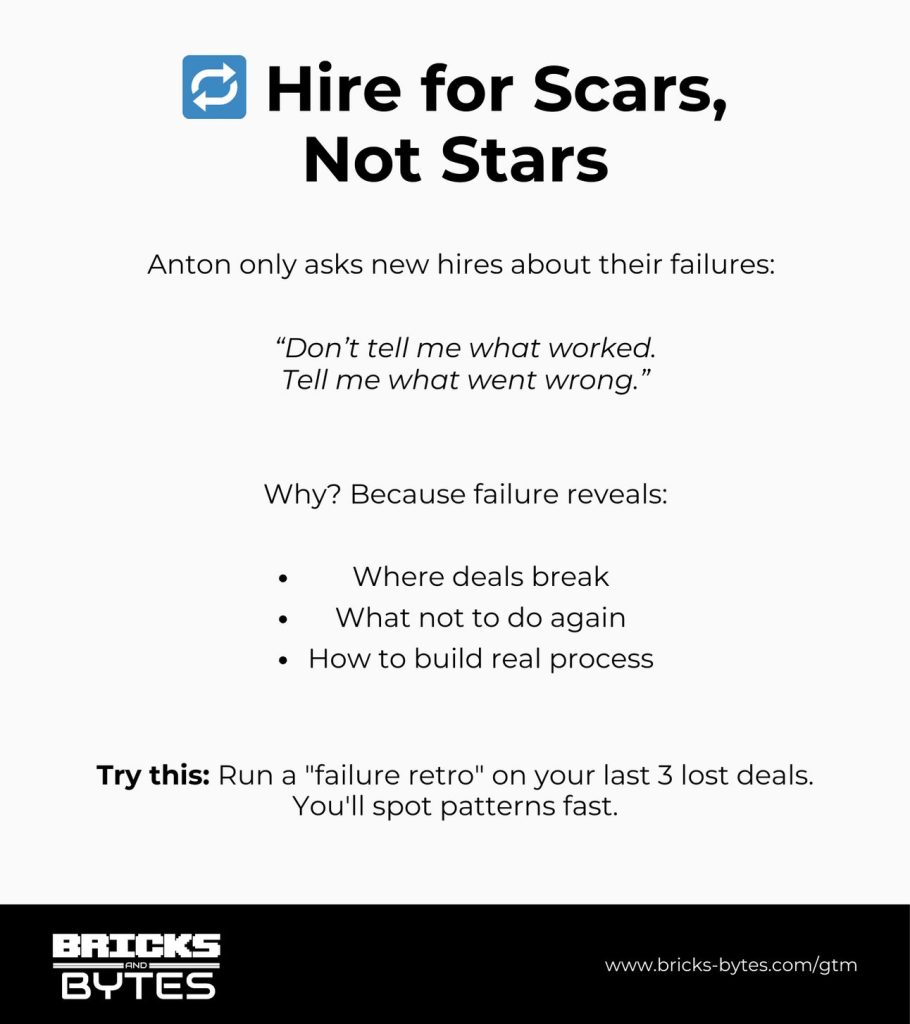
Want to get your message in front of {{active_subscriber_count}} highly engaged innovation leaders? Check out our sponsorship offers. INDUSTRY INSIGHTSConstruction Tech Sales Lessons From Exited Sales Leader When Anton Marinovic joined HoloBuilder as their first sales leader in 2017, he had a secret weapon that his Silicon Valley competitors didn’t: he’d grown up on construction sites. As the son of a Croatian immigrant mason who built a respected business in the Bay Area, Anton had spent weekends on job sites and summers working in the field. When his father heard about the construction documentation platform Anton was considering joining, his reaction was immediate: “That one. Remember when we would go to construction sites and had the disposable camera? If I saw something was wrong, I was taking a picture of it… that’s what this guy is doing.” This insider perspective has helped Anton build successful sales operations at HoloBuilder (acquired by FARO for $34m) and now at Joist.ai, where he’s developing AI-powered proposal solutions for AEC firms.  But you don’t need to have grown up in a construction family to apply these battle-tested strategies. 🛠️ TL;DR – The Construction Tech Sales Playbook (From a Field-Tested Pro): Anton Marinovic grew up on jobsites, exited HoloBuilder and now he’s building elite sales teams in AEC tech.Here’s what he’s learned (and what you can steal): 🔁 Only hire people who talk about their failures → That’s where the gold is. 📊 Build your sales process around how they buy → Study your last 20 deals. Patterns = power. 🧱 Be radically transparent → Early-stage? Say it. Trust is everything in this space. 🛠️ Hire Swiss Army Knives → Sales, onboarding, support — your team should do it all. 🏗️ Know the difference between project vs. enterprise sales → Each one’s a different game. Don’t confuse the two. 🤖 Use AI to win the top of the funnel → Research, cadences, call summaries, objection handling. Prompt like a pro. Learn From Failures, Not Successes When Anton brings on new sales talent, he has one unusual rule: “I don’t want to hear about anything successful that you did in a previous company. I only want to hear about everything that went wrong or what you should have done better.” This reverse-engineering approach can transform your team’s performance by: Identifying common pitfalls before encountering them Building processes that anticipate and prevent problems Creating a culture that values learning over posturing Action step: Schedule a “failure retrospective” with your team. Ask everyone to analyze their last three lost deals with these questions: What signals did we miss early in the process? Where did our understanding of the customer’s needs break down? What assumptions did we make that proved incorrect? How could we have qualified better or set clearer expectations? The insights from this exercise will likely reveal patterns that can immediately strengthen your sales approach. Match Your Process to Their Reality One of the biggest mistakes construction tech companies make is forcing buyers into a sales process that doesn’t match how they naturally make decisions. “I am always studying and looking for patterns,” Anton explains. “When I find the pattern, I could try to build a process around it.” Instead of imposing a generic sales methodology, study how your AEC buyers actually make decisions by: Documenting the steps in your last 15-20 deals (both won and lost) Identifying common stages and decision points Noting who gets involved at each stage Recognizing where deals typically stall or accelerate “You got to spend time and try to look at patterns,” Anton advises. “Take your last 15 demos, last 20 demos, and run a piece of paper saying, ‘Okay, this is call one, we had a call two, and then this and this and this,’ and you start writing it all out, and you’re like, ‘My God, there’s a pattern here.’” Once you identify these patterns, build your CRM stages and forecasting around them – not the other way around. Build Trust Through Transparency The construction industry runs on trust and reputation. As Anton notes, “everyone talks to everyone in this industry.” Contrary to what many founders believe, being transparent about your startup’s stage and limitations often strengthens rather than weakens your position: “Here at Joist, we’re very open. ‘Hey, we’re an early-stage startup. We’re building this. This is what we have and this is where it’s evolving. For the sake of transparency, this is where we’re at.’” This approach converts potential objections into collaborative opportunities. When buyers understand your current state, they can: Provide valuable feedback to shape your roadmap Feel like partners rather than just customers Set appropriate internal expectations Become invested in your mutual success “People are really appreciative of that transparency,” Anton confirms. “It hasn’t hurt us in our sales.” The Swiss Army Knife Approach In early-stage construction tech companies, specialized roles can be a luxury. Anton recommends building a team of versatile professionals who can handle multiple functions: “We’re taking this approach where we really see ourselves as Swiss Army Knives. Being Swiss Army Knives means that we’re doing multiple other things too, like helping out with onboarding, participating in customer success, helping out in support.” This approach creates a foundational team with: Deep product knowledge across all use cases First-hand understanding of customer challenges Ability to identify cross-functional improvements Perspective to spot expansion opportunities These versatile team members become invaluable as you grow and can eventually lead specialized teams with a holistic understanding of your business. From Project Sales to Enterprise Deals Construction tech sales typically falls into two distinct categories, each requiring different approaches: Project sales: Selling your solution on a project-by-project basis Shorter sales cycles Often requires reaching field personnel May involve multiple stakeholders from different companies Pricing often tied to project size or duration Enterprise sales: Company-wide implementation Longer, more complex sales cycles Multiple decision-makers within the same organization More formal procurement processes Usually requires executive sponsorship Understanding which model applies to your solution is critical. “Those are two different motions with two varying
Newsletter

ICYMI: 20-Year-Old Software vs. Cloud-Native: Qonic’s Industry Challenge

Want to get your message in front of {{active_subscriber_count}} highly engaged innovation leaders? Check out our sponsorship offers. This Week’s Quickfire BytesFuel your curiosity with this week’s contentW/C 14th April 2025 NEW EPISODESAI Won’t Save Bad Construction Companies – Solving Tech Adoption Problems from VC Perspective Vivin Hegde from Zacua Ventures shares insights on construction tech investments and market trends. Find out why robotics is becoming essential in construction (labor shortage is only getting worse), the three-tier approach to AI adoption in construction tech and why FlexNode’s modular data centers could grow faster than any construction tech startup in 15 years. open.spotify.com/episode/5Ir5b06LrKkbpchPG4O1ph “20-Year-Old Software is Killing Architecture” – Legacy Systems & Cloud Solutions from Qonic Founders We sat down with Mark and Aaron from Qonic to explore how they’re revolutionizing AEC software with cloud-native technology that overcomes the limitations of decades-old industry tools. Find out why existing AEC software built in the 90s is holding the industry back, how Qonic handles complex construction models that traditional tools can’t process and why contractors adopt new tech faster than architects (hint: it’s not about the colors). open.spotify.com/episode/5UALYVmn25TocRYtddaMy3 VCs Are NOT Always The Answer – Bootstrapping Benefits & Sustainable Growth from Funding Experts We talk about J.P. Bowgen’s journey from AlphaSites to Macy’s corporate innovation team to becoming a partner at Camber Creek. Find out how Camber Creek operates as an “outsourced R&D department” for real estate companies, why construction tech is 5-7 years behind PropTech but might soon leapfrog it and the shift in ConTech companies selling upstream to owners instead of just GCs. open.spotify.com/episode/5eRXyvJ3tX5LqxmaBz9ikI CRH’s Systematic Innovation Process – Lessons from VP of Industry Innovation Thomas Donoghue, VP for Industry Innovation at CRH, shares fascinating insights on how large companies can drive meaningful innovation in construction and why so many pilots never scale. Find out why construction innovation often gets trapped in “pilot purgatory”, CRH’s systematic innovation process – from problem identification to scale and how sustainability, decarbonization and circularity are reshaping material choices. open.spotify.com/episode/5aikAMrwjP6DASZSfQfStP View All Podcasts BRICKS & BYTES BULLETINThe GTM Tactics Behind A $500m Exit When we interviewed Martin Roth and Scott Wolfe, the key leaders behind Levelset’s growth from $20K in monthly revenue to a $500M+ acquisition by Procore, we were struck by how refreshingly honest they were about the messy reality of building a construction tech sales machine. “We didn’t even know what ARR was when I started,” Martin laughed. “We couldn’t even spell it.” Meanwhile, founder Scott Wolfe described the company’s origin: “At its core, what Levelset was is we looked at this problem, which is that it took too damn long to get paid in construction. Wherever you looked across the construction chain, suppliers, subcontractors, general contractors, owners, they all had stress around cash and cashflow.” It’s this kind of transparency that makes Levelset’s journey so valuable for founders and go-to-market leaders in construction tech today. Here’s how they built their sales playbook from scratch. bricks-bytes.beehiiv.com/p/the-gtm-tactics-behind-a-500m-exit Read Full Article 2 FAVORITE QUOTES: “We always had a joke internally, architects are the most difficult breed to sell to.” – Mark on customer differences “If I’m going to spend much more time in one market, India will probably be the market.” – Vivin Hegde on promising international markets YOU MIGHT ALSO LIKE More Insights NSFW: Build a F*cking Business McKinsey’s Secrets to Scaling Construction Tech How Flux Burned Through $29M – Lessons for AEC Innovators Ex AutoDesk CEO’s 12 Lessons For Developing Products Could an Entrepreneur in Residence Save Your Construction Firm? Reports and Case Studies Innovating the Future: Robotics and the Revolution in Construction The Future of Design Software In AEC – Experts Insights Investing In AEC Tech The Future Of Construction Document Management The Construction Tech Revolution In India: Lessons From InfraMarket’s Success Innovation at Windover Construction Swinerton’s Innovation Strategy Most Popular Episodes How To Build A Unicorn In Construction Tech – Patric Hellermann Story Of A Modular Construction Startup That Burned Through £10M in 15 Months – Chris Spiceley McKinsey FINALLY updates their Productivity Curve, & The Future Of Construction – David Rockhill, Partner at McKinsey Procore’s AI Strategy & Implementation – AI’s Role in Modern Construction Disrupt Autodesk? This Ex-Autodesk CEO Has Some Advice – Amar Hanspal Super Series Super Series with Ediphi Super Series With Speckle Super Series With Monumental Super Series with Foundamental OUR SPONSORS BuildVision — streamlining the construction supply chain with a unified platform for contractors, manufacturers, and stakeholders. Powered by beehiiv

Newsletter

The GTM Tactics Behind A $500m Exit

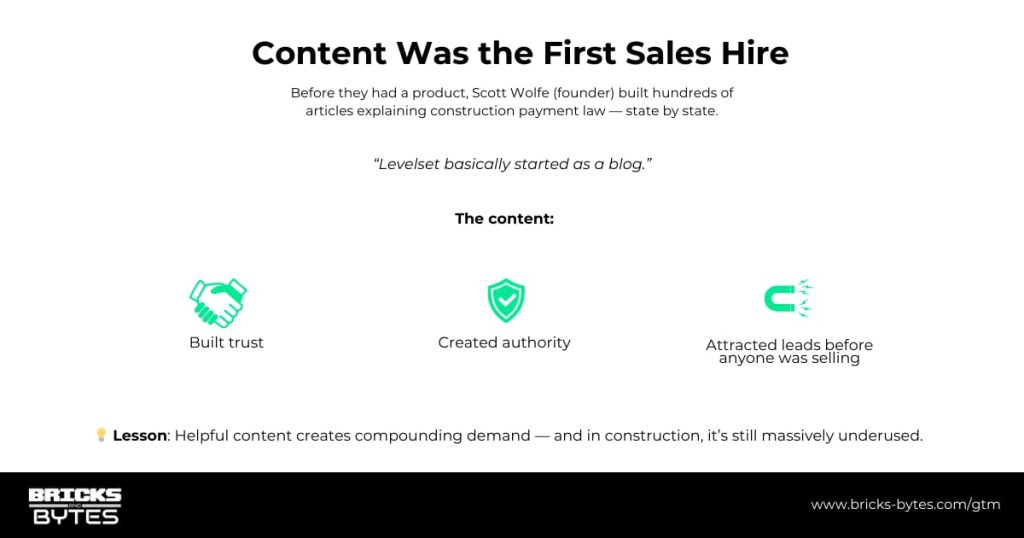
Want to get your message in front of {{active_subscriber_count}} highly engaged innovation leaders? Check out our sponsorship offers. BEFORE WE START…The GTM Tactics Behind A $500m Exit Before we dive into this week’s deep dive insight!! We’ve just finished a lengthy mini-series on Go To Market within AEC tech, interviewing the top GTM leaders who have built and scaled sales teams to the hundreds of millions. The episodes will be released from 22nd April 2025 and will be accompanied by a GTM guide to help you: Master the “land and expand” strategy that scaled PlanGrid from $5M to $100M in 4 years Implement the GTM approach specifically designed for construction’s unique buying cycle Access battle-tested frameworks for identifying champions and building winning business cases Avoid costly hiring mistakes that drain capital and waste critical market timing Learn directly from executives who’ve built billion-dollar construction tech companies Over the next few weeks on this newsletter, we will be releasing some eye opening stories, frameworks and lessons taken from the insights contained within the guide. To confirm your interest in receiving a copy of this guide once released, please click here. In the meantime, enjoy the content below: INDUSTRY INSIGHTSTLDR – The $10M Revenue Wall How did Levelset go from $20K/month to a $500M+ acquisition by Procore?By doing the opposite of what most startups are told. Here’s what worked: 🧠 Built demand before the product — with 100s of articles on lien law 📬 Landed $100K+ deals using handwritten notes + bubble mailers 💸 Closed deals by pricing pragmatically, not perfectly 🎯 Picked one GTM focus (SMB) and scaled like hell 🔥 Hired for grit, not resumes — then trained a sales army in-house 📈 Grew slow, then fast — with zero funding The playbook is old-school, unpolished, and ridiculously effective.And it still works today. From $0 to $500m Acquisition: Levelset’s Battle-Tested Sales Playbook When we interviewed Martin Roth and Scott Wolfe, the key leaders behind Levelset’s growth from $20K in monthly revenue to a $500M+ acquisition by Procore, we were struck by how refreshingly honest they were about the messy reality of building a construction tech sales machine. “We didn’t even know what ARR was when I started,” Martin laughed. “We couldn’t even spell it.” Meanwhile, founder Scott Wolfe described the company’s origin: “At its core, what Levelset was is we looked at this problem, which is that it took too damn long to get paid in construction. Wherever you looked across the construction chain, suppliers, subcontractors, general contractors, owners, they all had stress around cash and cashflow.” It’s this kind of transparency that makes Levelset’s journey so valuable for founders and go-to-market leaders in construction tech today. Here’s how they built their sales playbook from scratch. Chapter 1: The Founder’s Content Foundation Before Martin joined in 2013, Levelset (then called ZLean) had already laid crucial groundwork. Scott’s background uniquely prepared him for this venture – he had experience in software development, law, and entrepreneurship. “I was one of like five construction law bloggers in the country,” Scott recalled. “Content was just the way I saw the world. I read all the laws state by state related to construction payment and I published them.” This approach wasn’t a calculated marketing strategy but stemmed from Scott’s inherent understanding of the power of helpful content. “Levelset actually probably started as basically a blog or content and then became a product,” he explained. “Scott had already generated demand,” Martin added. “He’d written hundreds of articles and built a ton of resources around how to file liens, what is a lien waiver, and how to send a preliminary notice.” Chapter 2: The First Million in Revenue Martin’s arrival marked the beginning of a structured sales approach. With just a headset and a copy of Chet Holmes’ “The Ultimate Sales Machine,” Martin and Scott implemented the “Dream 100” strategy – identifying 100 target enterprise customers and persistently pursuing them with weekly touchpoints. Their approach was delightfully old-school: “We would send physical bubble mailers with handwritten cards and letter openers. You know what they do with mail? They open it,” Martin shared. The results? Within 14 months, they’d closed six or seven enterprise deals worth $100,000+ each, creating step-function jumps in revenue. As Martin put it: “We tripped ourselves into a bunch of revenue.” Chapter 3: The Pricing Puzzle As Levelset began scaling, they experimented constantly with pricing and packaging – “no joke, like 150 different pricing structures over 10 years,” according to Martin. Their early approach was pragmatic rather than scientific: “Sell to people the way they want to buy.” When selling to an equipment rental company, they’d ask what they were paying their current provider, then offer to do it for slightly less. “That’s not value-based pricing,” Martin admitted. “But you know what it did? It got us in the door and helped us learn more about the value.” This approach aligned perfectly with Scott’s philosophy on product adoption: “We weren’t coming in telling a bunch of people in the industry to do something brand new. They were already doing it with tablets and chisels and pen and paper, using service providers all over the place. We stepped in as a substitute for something they were already doing.” Chapter 4: The Focus Shift By $3-4 million in ARR, Levelset faced a critical challenge – they were running two different go-to-market strategies simultaneously: enterprise and SMB. This split focus was preventing them from scaling efficiently. “Around 2016 or 2017, we said we’re going to put our heads down to the exclusion of everything else and focus on SMB,” Martin explained. This laser focus finally unlocked significant growth. The decision allowed them to refine their messaging, sales process, and customer success approach for a specific market segment. Key lesson: Running multiple go-to-market strategies simultaneously can stunt your growth. Sometimes you need to make hard choices about where to focus. Chapter 5: The Scaling Engine After committing to the SMB segment, Levelset built a remarkable sales machine.

Newsletter

ICYMI: Floor Plans in Minutes: How Finch Achieved 13X Efficiency for Architects

Want to get your message in front of {{active_subscriber_count}} highly engaged innovation leaders? Check out our sponsorship offers. This Week’s Quickfire BytesFuel your curiosity with this week’s contentW/C 7th April 2025 NEW EPISODESInnovation Teams Can’t Scale – Adoption Automation Blueprint from Multi-Billion Project Leader Angelos Nicolaou from Sektor AI shares fascinating insights about construction tech adoption, the “anti-consultant” movement, and why technology must equal profitability. Find out how Sektor helps companies avoid wasting billions on unused technology, why large companies with tiny innovation teams need external firepower and why the consulting model is ripe for disruption through automation. open.spotify.com/episode/7slZIoLr5zgd126P47oQJb “Stop Solving Everything” – Innovation Overreach & Focused Approaches from Director of Innovation at ARCO Kathryn Dreitzler, Director of Innovation at ARCO, shares insights on how a $7 billion construction company approaches innovation. Find out how ARCO evaluates which innovations are worth pursuing vs just hype, why customer success is critical when implementing construction tech and the importance of solving specific problems rather than trying to do too much. open.spotify.com/episode/55YR4OAYWUX63SYamZymsd “Dolphin Founders” Outperform – Understanding Profitability Focus, Growth Timing, Capital Efficiency We discuss Green Fortune’s $4.5M funding from Foundamental, bringing cloud manufacturing to the windows and doors industry in India. Find out why windows are one of the most touched points in your home and critical to energy efficiency, how Green Fortune is filling the “missing middle” between luxury and substandard options and why building materials companies perform exceptionally well in Indian public markets. open.spotify.com/episode/0EiHCF2TWyfeLIM6uE4OPh Traditional Design Stack Is Dying! – Solving Compliance Challenges with AI-Powered Floor Plans In this episode of the Future of Design Series from the Bricks and Bytes, Jesper, co-founder and CPO of Finch, shares insights on construction tech and the evolution from architect to tech founder. Find out how a viral Grasshopper prototype led to a waiting list of 80,000 professionals, why interoperability between design tools is crucial for the AEC industry and the importance of creating “compliant” floor plans that meet regional regulations. open.spotify.com/episode/3xfRKcoPgti5USSXcSrc6O 90% of Warehouses Use 100-Year-Old Tech – Material Flow Revolution from Tesla’s Former Automation Leader In this episode of Bitbuilders, we had Chris Walti, founder and CEO of Mytra, who’s revolutionizing warehouse automation after spending 8 years at Tesla. Find out how Mytra turns warehousing into a software problem, using just 3 hardware components instead of thousands, open.spotify.com/episode/1U3OjLWbydnUNrtjDgAPwo View All Podcasts BRICKS & BYTES BULLETINBreaking The $10m ARR Wall – A Path To $100m+ Revenue Most construction tech startups hit a ceiling at $10 million in annual recurring revenue and never break through. We recently interviewed Kevin Halter (not yet released), who scaled PlanGrid from $5 million to over $100 million ARR in just three years, leading to the company’s acquisition by Autodesk. “There’s a graveyard in this industry of companies with great technology that didn’t prove out enough revenue to get the next round of funding. Then they no longer exist,” Kevin told us. Having guided multiple construction technology companies through explosive growth phases, Halter has a battle-tested playbook for breaking through the revenue wall that kills most construction tech startups. Read Full Article 2 FAVORITE QUOTES: “Every consulting company ought to become a tech company.” – Angelos Nicolaou’s advice for consultancies facing AI disruption “You haven’t been tested as a founder until you have actually run a business in India… It is bureaucratic to a maddening degree, I have to say.” – Shub Bhattacharya on the challenges of doing business in India YOU MIGHT ALSO LIKE More Insights NSFW: Build a F*cking Business McKinsey’s Secrets to Scaling Construction Tech How Flux Burned Through $29M – Lessons for AEC Innovators Ex AutoDesk CEO’s 12 Lessons For Developing Products Could an Entrepreneur in Residence Save Your Construction Firm? Reports and Case Studies Innovating the Future: Robotics and the Revolution in Construction The Future of Design Software In AEC – Experts Insights Investing In AEC Tech Innovating the Future: Robotics and the Revolution in Construction The Future Of Construction Document Management The Construction Tech Revolution In India: Lessons From InfraMarket’s Success Innovation at Windover Construction Swinerton’s Innovation Strategy Most Popular Episodes How To Build A Unicorn In Construction Tech – Patric Hellermann Story Of A Modular Construction Startup That Burned Through £10M in 15 Months – Chris Spiceley McKinsey FINALLY updates their Productivity Curve, & The Future Of Construction – David Rockhill, Partner at McKinsey Procore’s AI Strategy & Implementation – AI’s Role in Modern Construction Disrupt Autodesk? This Ex-Autodesk CEO Has Some Advice – Amar Hanspal Super Series Super Series with Ediphi Super Series With Speckle Super Series With Monumental Super Series with Foundamental OUR SPONSORS BuildVision — streamlining the construction supply chain with a unified platform for contractors, manufacturers, and stakeholders. Powered by beehiiv

Newsletter

Breaking The $10m ARR Wall – A Path To $100m+ Revenue

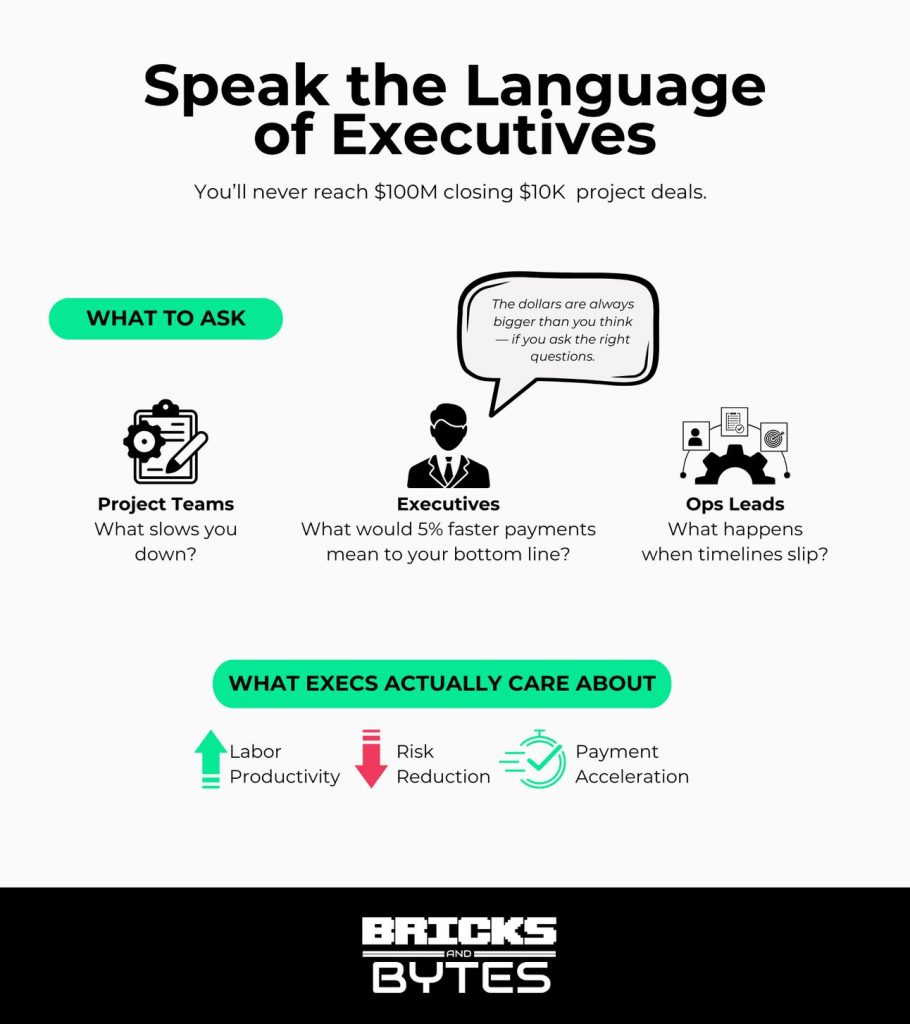
Want to get your message in front of {{active_subscriber_count}} highly engaged innovation leaders? Check out our sponsorship offers. BEFORE WE START…Breaking The $10m ARR Wall – A Path To $100m+ Revenue Before we dive into this week’s deep dive insight!! We’ve just finished a lengthy mini-series on Go To Market within AEC tech, interviewing the top GTM leaders who have built and scaled sales teams to the hundreds of millions. The episodes will be released from 22nd April 2025 and will be accompanied by a GTM guide to help you: Master the “land and expand” strategy that scaled PlanGrid from $5M to $100M in 4 years Implement the GTM approach specifically designed for construction’s unique buying cycle Access battle-tested frameworks for identifying champions and building winning business cases Avoid costly hiring mistakes that drain capital and waste critical market timing Learn directly from executives who’ve built billion-dollar construction tech companies Over the next few weeks on this newsletter, we will be releasing some eye opening stories, frameworks and lessons taken from the insights contained within the guide. »» If you’re interested in receiving a copy of this guide once released. Let us know below «« I’m Interested! 💸 INDUSTRY INSIGHTS TLDR – The $10M Revenue Wall Most construction tech startups flatline at ~$10M ARR. We spoke with Kevin Halter (ex-PlanGrid, now at OpenSpace) — the guy who helped scale it from $5M to $100M — to understand why. Here’s what we learned: 🚫 Project based deals won’t get you to $100M — enterprise sales will ⏳ Start expansion plans 9–18 months before renewal, not 90 days before 📊 The only metrics that matter: labor productivity, risk reduction, and payment acceleration 🔥 Don’t hire for pedigree — hire hungry reps who own the full customer journey If you want your startup to break through the $10M wall, here’s some handy advice: The $10M Revenue Wall: Why Construction Tech Companies Get Stuck (and How to Break Through) Most construction tech startups hit a ceiling at $10 million in annual recurring revenue and never break through. We recently interviewed Kevin Halter (not yet released), who scaled PlanGrid from $5 million to over $100 million ARR in just three years, leading to the company’s acquisition by Autodesk. “There’s a graveyard in this industry of companies with great technology that didn’t prove out enough revenue to get the next round of funding. Then they no longer exist,” Kevin told us. Having guided multiple construction technology companies through explosive growth phases, Halter has a battle-tested playbook for breaking through the revenue wall that kills most construction tech startups. 1. Master the Project-to-Executive Translation The fundamental challenge for construction tech companies is connecting project-level value to executive-level priorities. Most startups focus on landing many small project deals but fail to translate that success into language that resonates at the enterprise level. “You can’t get to $100 million fast by closing five or ten thousand dollar transactions,” Halter emphasizes. “Projects are great, but you’ve got to build the business case and turn them into enterprise agreements quickly.” The secret is in asking the right discovery questions to uncover what truly keeps executives up at night: Ask project teams: “What are your biggest challenges on site? What keeps you up at night? How often does this problem occur?” This builds your understanding of ground-level pain points. Ask operations leadership: “How do you measure success across projects? What’s the impact when projects fall behind? How do you track performance?” Ask executives: “What are your top three business objectives this year? What would it mean to improve [specific metric] by X%? How does this connect to your competitive position?” Halter shared a powerful example: “I was talking to some recent CFOs of top specialty contractors and general contractors. They said, ‘Kevin, I know your product already saves us a ton of money with labor and collaboration. But I got to tell you something that is much bigger dollars. Every project has a minimum of at least one change order, and we do 400 projects or more per year. An average change order for us can be upwards of $100,000.’” That simple discovery question uncovered a $40 million opportunity hidden in plain sight. “The dollars are much bigger than you think,” Halter notes. “When you ask those questions, the dollars that are at risk is always bigger than you believe.” The three areas that truly matter to construction executives: Labor productivity (combating the never-ending labor shortage) Risk reduction (minimizing insurance claims and litigation) Payment acceleration (getting paid faster for work completed) Most startups focus only on the first one, missing the bigger financial picture. 2. Fix Your Expansion Timeline The strategy that propelled PlanGrid’s growth was a disciplined “land and expand” selling motion, but with a crucial twist most companies miss: they started the expansion conversation 9-18 months before renewal. “We put in a model of landing multiple projects or paid pilots and quickly getting that into enterprise agreements because the project dollars are small,” Halter says. “If you can’t prove the value in a reasonable amount of time – two weeks, 30 days, 90 days – you may run out of money as a startup.” Most construction tech companies wait until 90 days before renewal to start expansion conversations. By then, it’s too late to build a compelling business case for a substantial increase. “The best renewal is no renewal,” Halter explains. “Close a three-year agreement, expand it realistically, and get into an enterprise agreement even if it’s just a portion of their business initially.” At PlanGrid, they focused on quantifying value in customers’ terms – not made-up ROI metrics. This approach secured multi-year enterprise agreements that grew substantially with each renewal. 3. Hire the Right Team (Hint: Not Who You Think) The team that gets you to $5 million likely won’t get you to $50 million without significant changes. But most founders make a critical mistake when hiring sales leaders. “Don’t hire enterprise reps that expect all these resources, which

Newsletter

ICYMI: NEW Unicorn – How BuildOps Reached $1B in Just 7 Years

Want to get your message in front of 1,500 highly engaged innovation leaders? Check out our sponsorship offers. This Week’s Quickfire BytesFuel your curiosity with this week’s contentW/C 31st March 2025 NEW EPISODES3-4X BETTER ROI THAN HEAT PUMPS – VARM’s Mission to Insulate 1 Million Homes by 2033 Christian Gruener from VARM shares his journey of building a VC-backed installation business aimed at becoming the European champion in the space. Find out how VARM is building a “cloud installer network” – a franchise model on steroids, why Chris pivoted from longevity e-commerce to climate tech after successfully exiting his first business and the surprising fundraising reality: “VCs and markets and investments are very often done based on FOMO”. open.spotify.com/episode/35h0MKIsblXC2I7DBOYlEf File-Based Design Is Dying – Solving Architecture’s Profitability Crisis with Cloud-First Solutions For our Future of Design Series, Altaf from Snaptrude shares fascinating insights about the evolution of design software in architecture and construction. Find out why cloud-based design tools are 10x faster than traditional file-based systems, how data connectivity is transforming early-stage design workflows and why architects are wasting billable hours on rework and value engineering. open.spotify.com/episode/7iNRnP3aCeclyMX3jpDGEX US VC Returns Underperform Globally – Market Saturation & Hidden Opportunities from Construction Unicorns We discuss BuildOps securing $127 million in Series C funding and achieving unicorn status with a $1B valuation. We also explore the structural differences between US and European contractor software markets, where European contractors are typically smaller and 5-10 years behind in software adoption compared to their US counterparts. open.spotify.com/episode/2lBz1hC31HFYxz1yhc95JY AI Is Mostly Marketing Hype! – Separating Real Solutions from Tech Buzzwords with a Construction CIO Adam Krob from Boh Bros talks about evaluating construction tech, successful implementation strategies, and his vision for AI in the field. Find out how Adam calculates ROI on tech investments, including his unique “two-year adoption curve” approach, why voice interfaces and LLMs could transform field data collection, letting workers tell stories instead of filling out forms and what makes tech vendors stand out (and what instant red flags to avoid). open.spotify.com/episode/7CgrkzSEV5262E2OrVThUp View All Podcasts BRICKS & BYTES BULLETIN30% Cheaper Build Costs – Inside This Tech Enabled GC’s Process When we spoke with Salman Ahmad, CEO of Mosaic, we expected another tale of a tech startup trying to revolutionize construction. What we discovered instead was something far more nuanced: a company balancing technological innovation with deep respect for construction traditions. “Construction companies aren’t innovators – we’re implementers,” explained Salman, whose unique background combines a PhD in computer science from MIT with growing up in a construction household.  This dual perspective has shaped Mosaic’s refreshingly practical approach to innovation. Read Full Article 2 FAVORITE QUOTES: “Don’t be afraid of investors telling you always that you need software. You just need good unit economics, good cash flow. Good cash flow is worth a lot” – Chris’ advice for physical-world startups “In the United States, you tend to have even the smallest specialized subcontractors tend to be larger than the equivalent in Europe… In Europe, that hardly exists.” – Paatric on market differences between US and Europe CASE STUDIES AND REPORTS Windover Construction Discover how Windover Construction transformed from regional builder to global innovation leader with a practical, field-first technology approach. Download Case Study See Our Other ReportsIn-Depth Analysis & Industry Trends View All Reports OUR SPONSORS BuildVision — streamlining the construction supply chain with a unified platform for contractors, manufacturers, and stakeholders. Powered by beehiiv

Newsletter

30% Cheaper Build Costs – Inside This Tech Enabled GC’s Process

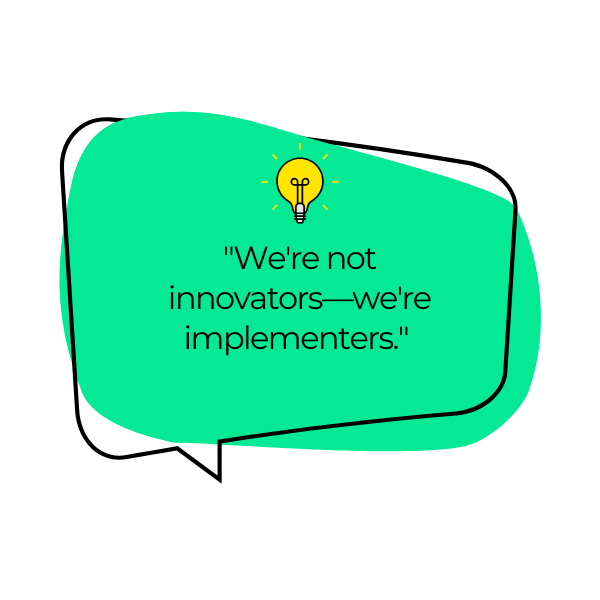
Want to get your message in front of 1,500 highly engaged innovation leaders? Check out our sponsorship offers. INDUSTRY INSIGHTS30% Cheaper Build Costs – Inside This Tech Enabled GC’s Process When we spoke with Salman Ahmad, CEO of Mosaic, we expected another tale of a tech startup trying to revolutionize construction. What we discovered instead was something far more nuanced: a company balancing technological innovation with deep respect for construction traditions. “Construction companies aren’t innovators – we’re implementers,” explained Salman, whose unique background combines a PhD in computer science from MIT with growing up in a construction household.  This dual perspective has shaped Mosaic’s refreshingly practical approach to innovation. Salman received his PhD from EECS at MIT, with research interests of Software Systems Programming Languages and Human Computer Interaction. The Mission: Better Places, Widely Available Mosaic was founded with a clear mission: creating places people love that are widely available. Growing up in Phoenix’s sprawling suburbs, Salman witnessed firsthand the challenge of balancing scale with quality. “We generally know how to create housing stock at scale. We know how to create beautiful individual places. It’s hard to do both at the same time,” he explained. Rather than trying to create the “iPhone of housing” and replicate it across America, Mosaic focuses on empowering local developers with better construction tools. Bringing Commercial Quality with Residential Pricing Mosaic has found its sweet spot in the emerging built-to-rent (BTR) space – purpose-built neighborhoods designed to be rented rather than sold. These projects fall awkwardly between commercial and residential construction, creating a unique challenge. “When you look at these BTR communities, they’re like weird mashups of different types of projects,” Salman noted. “On one hand, it’s a residential product. On the other, it’s a single commercial plat you’re constructing.” The company bridges this gap by combining commercial-grade construction methodology with residential-priced trades – resulting in impressive metrics for their clients: 30% reduction in construction costs compared to traditional commercial GCs 25% faster schedules than typical homebuilders Ability to overlap vertical and horizontal construction, shaving up to six months off timelines The Secret Sauce: Granular Data Representation At the core of Mosaic’s approach is what Salman calls their “cost model” – an extraordinarily detailed representation of the entire construction project. “We decompose the entire project into what we call cost lines,” he explained. “It’s literally: this plumber is going to go to this house on this date, doing this granular activity, and this is how much they’ll be paid.” While traditional construction contracts might have 30-50 line items, Mosaic breaks projects into around 30,000 granular items. This intense data granularity creates transparency, simplifies scheduling, and eliminates payment disputes. “If there’s ever any dispute about progress billing, we don’t even argue. We just say, ‘Tell us which items you don’t believe were completed, and we’ll move them to the next pay run.’” Making Technology Accessible Through Code Managing such granular data presents its own challenge. Mosaic’s solution? A software development kit (SDK) that allows code to manipulate their cost model. “Things that sound simple, like ‘our window installer can only do 10 installs per week, so adjust the schedule accordingly’ – try doing that manually in Microsoft Project for a 200-unit development,” Salman pointed out. Recently, they’ve integrated large language models to generate this code automatically. “You can literally say what you want, and it generates the code. This makes our advanced construction system more accessible to people without technical sophistication.” The Trade Partner Philosophy Perhaps most striking is Mosaic’s focus on their trade partners. In an industry that often treats subcontractors as replaceable commodities, Mosaic takes a different approach. “We don’t need to solve the fundamental macro labor shortage for us to be a wildly successful business,” Salman explained. “We just need to be a better GC than the folks down the street, and the trades will want to work with us.” Their formula is simple: respect trades and help them make more money on Mosaic projects than competitors’. This means: Making bidding easier with clear, granular scopes Providing predictable scheduling visibility Simplifying payment processes “They don’t have to invoice us,” Salman noted. “We check off completed work, show them what we’re paying for, they sign a lien waiver via DocuSign, and they’re done.” Growth Through Patience Mosaic recently hit two significant milestones: delivering their 1,000th unit and achieving profitability while maintaining aggressive growth. They’re managing 2,000 units under construction with just 60 employees. When we asked how they achieved profitability when so many startups struggle, Salman’s answer was refreshingly straightforward: “There is no free lunch and there are no shortcuts. Profitability is a grind.” He attributes their success to three cultural mindsets: patience, humility, and respect for trades – qualities he believes emerged from merging tech and construction cultures. The Future: Scaling Without Compromise Looking ahead, Mosaic sees opportunities to scale significantly while maintaining their disciplined approach. They’re exploring licensing their technology to other contractors and leveraging AI to make advanced construction management more accessible. “I hope in five to ten years we’re charging a fraction of our current fees,” Salman told me. “That creates benefits for our subcontractors, our clients, and ultimately means more housing being constructed.” In an industry full of bold claims about disruption, Mosaic’s “gentle disruption” approach stands out. By respecting construction traditions while thoughtfully applying technology, they’re creating something rare: innovation that actually works in the complex reality of today’s construction sites Key Lessons from Mosaic’s Approach The coordination problem is bigger than the complexity problem – Construction’s greatest inefficiencies occur between trades, not within them. Focus technology solutions on communication and coordination. Respect your trades – Make it easier for trade partners to bid, schedule, and get paid. Your success depends on their success. Gentle disruption works – Rather than trying to reinvent construction entirely, enhance existing processes and work with today’s trades and supply chains. Granular data enables better management – Breaking projects down to extremely detailed cost models creates transparency and predictability for all stakeholders.

Newsletter

ICYMI: BuildVision Raises $10M: “If You Lead with AI and You’re Not an AI Solution, Just Stop”

Want to get your message in front of 1,500 highly engaged innovation leaders? Check out our sponsorship offers. This Week’s Quickfire BytesFuel your curiosity with this week’s contentW/C 24th March 2025 NEW EPISODES“From Seed to $10M Series A” – BuildVision’s Procurement Platform & Growth Journey Mike Powers and Ben Lyddane from BuildVision share their journey of raising a $10M Series A led by Norwest Ventures. Find out how BuildVision grew from processing $700M to over $1B in equipment transactions, their three-tiered pricing model that aligns with customer success and how AI costs for processing documents dropped from thousands to just $1.40 monthly. open.spotify.com/episode/3hyJ1BeMPS8iISm3XBVvzm Profit Isn’t a Dirty Word! – Aligning Client-Contractor Goals from an Innovation Director James Pellatt, founder of Digital Trees consultancy, shares insights from his extensive career in real estate and construction technology. Find out why construction innovation is difficult and how bureaucracy, leadership gaps, and procurement approaches create barriers, the cultural differences between US and European construction tech adoption and James’ vision for how generative AI could reduce project delivery times by 12-18 months. open.spotify.com/episode/1aSDSvpNx1j9SED97sBiIV “Tariffs Will Bankrupt Contractors” – Contracts Hiding Risk & Free Solution from Document Crunch Josh Levy from Document Crunch shares how they’re helping construction companies navigate the recent tariff changes with China, Canada, and Mexico – completely free. Learn about Document Crunch’s growth to 100+ countries as a document compliance platform, the free Tariff Risk Assessment Tool that audits contracts for tariff-related risks and why cost isn’t the only risk – supply chain disruptions will follow. open.spotify.com/episode/3Bqhkj6v643tpKxMkzAiLj “AI Can’t Handle Full Design Workflows!” – Automation Promises & Real-World Limitations from AEC Experts We discuss Augmenta’s $10 million seed funding for their AI-powered design platform that aims to automate electrical designs for buildings. Find out why minimum feature sets in building design software are exceptionally high, the challenge of creating “fully constructible” designs through automation and the reality that vectorial AI systems will always need human refinement. open.spotify.com/episode/5LwLrryxPfguVi10QMNZ0g Why Most Construction Tech Tool Fails – The 80% Rule & Innovation Culture from a $2.7B Contractor Mitch Cornelius from Fortis Construction shares insights on innovation in construction for a $2.7B company. Find out why Fortis focuses on employee experience over ROI when evaluating new tech, how they reduced tech fragmentation by moving from dozens of point solutions to a platform approach and their “80% rule” for technology adoption across project teams. open.spotify.com/episode/2hJE0kOetFvoBeQhTcbj8f View All Podcasts BRICKS & BYTES BULLETINThe AI Parlor Trick – Why AI In Construction Tech Needs to Go Further When we sat down with Mitch Cornelius, CTO of Fortis Construction, we expected to hear enthusiasm about the latest AI hitting the construction market. Instead, he offered a perspective that should make every construction tech CEO pause and reconsider their AI strategy. “We’ve always kind of seen them as a little bit of a parlor trick,” Mitch told me, comparing today’s GPT implementations to a magician’s opening act – flashy and attention-grabbing, but not the real magic. This view from a technology leader at a $2.7 billion construction company should serve as both a warning and an opportunity for tech providers. While your AI-powered tool might demo well, contractors are already looking past the initial wow factor and asking a far more important question: “So what?” Read Full Article 2 FAVORITE QUOTES: “Now is not the time to bury your head in the sand.” – Josh Levy’s direct call to action for construction professionals facing tariff challenges “There’s two metrics that we use every time that have the greatest kind of indicator of success of any pilot. And they’re super simple. One is adoption, are people actually using the tool? And the second is user sentiment.” – Mitch Cornelius on what really matters when evaluating new technology CASE STUDIES AND REPORTS Windover Construction Discover how Windover Construction transformed from regional builder to global innovation leader with a practical, field-first technology approach. Download Case Study See Our Other ReportsIn-Depth Analysis & Industry Trends View All Reports OUR SPONSORS BuildVision — streamlining the construction supply chain with a unified platform for contractors, manufacturers, and stakeholders. Powered by beehiiv

Newsletter

The AI Parlor Trick – Why AI In Construction Tech Needs to Go Further

Want to get your message in front of 1,500 highly engaged innovation leaders? Check out our sponsorship offers. INDUSTRY INSIGHTSThe AI Parlor Trick – Why AI In Construction Tech Needs to Go Further “We see that the GPTs and AI for information gathering is where most of the focus is right now in construction tech. For us, it’s a little bit of a parlor trick… We know that there’s power there, but as soon as that connects to something bigger, our industry is going to look very, very different.” – Mitch Cornelius, CTO, Fortis Construction The Parlor Trick Problem When we sat down with Mitch Cornelius, CTO of Fortis Construction, we expected to hear enthusiasm about the latest AI hitting the construction market. Instead, he offered a perspective that should make every construction tech CEO pause and reconsider their AI strategy. “We’ve always kind of seen them as a little bit of a parlor trick,” Mitch told me, comparing today’s GPT implementations to a magician’s opening act – flashy and attention-grabbing, but not the real magic. This view from a technology leader at a $2.7 billion construction company should serve as both a warning and an opportunity for tech providers. While your AI-powered tool might demo well, contractors are already looking past the initial wow factor and asking a far more important question: “So what?” The Critical “So What?” Question “So now I know what submittals I have required, now what?” Mitch challenges. “You told me something that I could have found if I searched for a couple minutes, so what?” This is the fundamental disconnect between what many AI solutions currently offer and what construction companies actually need. Information retrieval – finding documents, surfacing data, answering questions – is just the starting point, not the destination. The problem is particularly acute because construction professionals are already overwhelmed. At Fortis, before consolidating their tech stack, superintendents were juggling over ten different applications daily. Adding another tool that simply retrieves information more efficiently doesn’t fundamentally change their work experience. Beyond Information Retrieval The next generation of construction AI needs to move beyond information retrieval to something far more valuable: enabling actions, decisions, and workflows. When we asked Mitch about the technologies he’s watching, he immediately focused on AI solutions that are thinking beyond the chatbot paradigm. While he couldn’t name specific companies due to NDAs, he described startups working on: Connecting information flows across systems rather than just retrieving from them Creating new user experiences that fundamentally change how people work Moving beyond chat interfaces to more intuitive, construction-specific interactions Automating not just information finding but decision-making workflows “It’s even a step beyond the agent side,” Mitch explained, “because the agents are great, but at some point, agents can only go so far in your workflows before you need to start intervening with more decisions.” The Established Players’ Dilemma For established construction tech companies, there’s a clear risk of focusing too narrowly on what Mitch calls “the race to create the next chatbot that asks your specifications questions.” “All of them are building that,” he observes, “And it’s like, this is great, but it’s not really news for us. This isn’t exciting. It’s not as useful as you think it is.” The major platform providers – Autodesk, Procore, Trimble – are making incremental improvements to their offerings. But according to Mitch, they’re moving from “80% of workflows to 85% or 88%,” rather than fundamentally reimagining how construction professionals might work. The Startup Opportunity This gap between information retrieval and transformative workflow change creates a massive opportunity for startups willing to think differently. Mitch specifically mentioned his interest in companies like Trunk Tools and Data Grid – startups that are approaching construction problems from new angles. What makes these companies different is that “they’re not trying to monetize specifically just the chatbot type tools. They accept that that’s not where their money’s gonna come from, and they’re looking at the next iteration.” The lesson for construction tech CEOs is clear: if you’re building an AI feature that merely retrieves information more efficiently, you’re solving yesterday’s problem. The real opportunity lies in leveraging AI to fundamentally transform how construction work happens. Looking Beyond the Horizon When we asked Mitch about his timeline for these more transformative AI solutions, his answer was telling: “If you ask them, it’s like next month every time. I don’t think it’s immediate. I don’t think it’s imminent. I think we have some runway in front of us.” This runway exists partly because of the complex relationship between industry expertise and computing power. As Mitch puts it: “Really, really big companies – Microsoft, OpenAI, Autodesk, Procore – they have compute power… They don’t have industry expertise, but we have the industry expertise.” For now, this expertise transfer is happening through early-stage startups. But Mitch believes the truly transformative changes will come when the innovations from the tech giants “trickle down” through industry-specific companies and into actual construction workflows. The Path Forward For construction tech operators, the message is clear: chatbots and information retrieval are just the beginning. To create lasting value, you need to be thinking about: Workflow transformation: How does your AI solution fundamentally change how work happens, not just how information is found? Integration depth: Does your solution connect systems and information flows in ways that eliminate work rather than just making existing work easier? Decision support: Are you moving beyond information retrieval to actually helping users make better decisions faster? User experience innovation: Are you stuck in a chat interface paradigm, or are you reimagining how construction professionals interact with technology? Value measurement: Can you demonstrate impact beyond the “wow factor” of retrieving information quickly? The companies that will prevail in construction AI aren’t the ones building the slickest chatbots. They’re the ones looking past the parlor trick to the real magic – transforming how construction works at a fundamental level. As Mitch puts it: “When that AI connects to something bigger, we know that

011H sustainable construction innovation
Startups

The 011H Story: How a Tech-Savvy Builder is Revolutionising Construction

  In the heart of Barcelona, a revolution in construction is taking shape. It began with a simple yet powerful observation: the construction industry, one of humanity’s oldest and most essential sectors, was struggling to meet the challenges of our time. Housing costs were soaring, construction delays were endemic, and the industry’s environmental impact was becoming increasingly unsustainable. This is where the story of 011H begins – not with blueprints or building materials, but with a vision of transformation. The company’s very name tells a story of bridging worlds: the “0” and “1” representing the digital realm, these numbers forming the first digits of the Fibonacci sequence found in nature’s most perfect proportions, and the “H” standing for the fundamentals of human habitat. Like Batman, as founder Lucas Carne often says, they don’t have superpowers – they have technology and determination.   In this episode of BitBuilders, Lucas Carné, co-founder of 011H and former founder of Privalia (sold for $500M), shares insights on revolutionizing construction through digital innovation and sustainability.   The construction industry faces a perfect storm of challenges when it comes to craft workers. We’re seeing fewer people attracted to construction careers, experienced workers retiring faster than they can be replaced, and new workers entering the field with less practical knowledge than their predecessors. This creates a significant skills gap that threatens productivity across the sector. But here’s where things get interesting. Rather than viewing these challenges as insurmountable obstacles, innovative companies are seeing them as opportunities to reimagine how technology can support and empower craft workers. The genesis of 011H came from an unexpected place. After successfully building and selling Privalia, an e-commerce company, for half a billion dollars, Carne could have easily retired to enjoy life in his 50s. Instead, he found himself drawn to construction’s fundamental challenges. The industry’s problems were visible everywhere – in the shortage of affordable housing, in the inefficiencies of traditional building methods, and in the growing urgency of climate change. What makes 011H different is their approach as a “Neo-Builder.” Imagine a construction company that thinks like a tech startup but builds like master craftsmen. They’ve rejected the traditional adversarial bidding process that often leads to cutting corners and broken trust. Instead, they’ve embraced a collaborative model where architects, suppliers, and builders work together from day one, sharing both risks and rewards. At the heart of their innovation is a commitment to timber construction for above-ground structures. This isn’t just about being green – though the environmental benefits are substantial. Timber components can be precision-manufactured off-site, transported easily, and assembled quickly, like a sophisticated architectural Lego set. The result? Buildings that rise from the ground up to 30% faster than traditional construction methods. The company’s digital DNA shows in everything they do. Half of their team consists of software developers and tech specialists working alongside architects and engineers. They’ve created a digital platform that connects every aspect of the construction process, from design to final assembly. It’s like having a master conductor coordinating a complex orchestra, ensuring every player knows exactly when and how to contribute. But perhaps most revolutionary is their vision for the future. 011H sees itself becoming the Amazon of construction – not just a builder, but a platform where developers can find architects, architects can source materials, and suppliers can connect with contractors. All of this happens under the umbrella of 011H’s quality assurance and technological infrastructure. The journey hasn’t been without challenges. Their commitment to sustainable materials and innovative methods means their initial costs run 4-5% higher than traditional construction. But they’re proving that this premium is an investment that pays for itself through faster completion times, better quality, and improved environmental performance. For rental developments, their approach can improve returns by four percentage points – a significant advantage in the real estate world. Starting in Spain’s residential market, 011H is already looking toward expansion into France and beyond. They’re targeting urban and pre-urban areas where the need for efficient, sustainable construction is most acute. Their projects aren’t just buildings; they’re proving grounds for a new way of thinking about construction. The company’s approach to growth is methodical and focused. Rather than trying to revolutionize everything at once, they’re proving their concept one successful project at a time. They started with a modest 650-square-meter building in 2021, gradually taking on larger projects as they refined their methods. Now, they’re handling multiple major developments simultaneously. What makes the 011H story particularly compelling is how it represents a bridge between two worlds – the traditional, physical craft of construction and the digital revolution that’s transforming every industry. They’re showing that you don’t have to choose between efficiency and quality, between sustainability and profitability, or between innovation and reliability. Looking ahead, 011H envisions a future where construction is not just about putting up buildings, but about creating a more sustainable, efficient, and collaborative industry. They’re working toward a world where digital tools democratize design, where sustainable materials are the norm rather than the exception, and where the barriers between different parts of the construction process dissolve into seamless collaboration. The story of 011H is still being written, but its mission is clear: to transform one of the world’s most essential industries for a more sustainable future. In doing so, they’re not just building buildings – they’re building a new way forward for construction itself.      

Newsletter

ICYMI: How One AI Tool Saves Developers 30% on Construction Costs

Want to get your message in front of 1,500 highly engaged innovation leaders? Check out our sponsorship offers. This Week’s Quickfire BytesFuel your curiosity with this week’s contentW/C 17th March 2025 NEW EPISODESHousing Crisis Solved? – Suburban Isolation & Affordability from Built-to-Rent Technology Salman Ahmad from Mosaic shares how they’re revolutionizing the built-to-rent housing sector by bringing together software and construction expertise. Find out how Mosaic achieves 30% cost reduction compared to traditional commercial GCs, their approach to “gentle disruption” that works with existing trades rather than replacing them and how they’re scaling to 2,000 units under construction with just 60 employees. open.spotify.com/episode/3cnJDCn0gAsQ8wL1Gw5c80 “$65 Billion Wasted!” – How Twin Knowledge’s AI Prevents Costly Construction Rework In this episode, we talk about Twin Knowledge, an AI-powered platform that raised $3.7M to help construction and real estate stakeholders QA/QC building drawings before they hit the field. Find out why developers feel the most pain from drawing errors, how Twin Knowledge can help teams do “4-5X the work with half the team” and why founder expertise matters more than ever in the AI boom. open.spotify.com/episode/1MUPQHmDaxcMK65E9pcjAr The End Of Software As We Know It: How DataGrid’s Agentic System Is Transforming Construction Thiago Da Costa, founder of Datagrid, shares his journey from visual effects to transforming construction with AI agents. Find out how agentic AI differs from standard AI and why it’s transforming construction workflows, why Data Grid focuses on connecting ALL data sources rather than just solving one isolated construction problem and how AI agents can read through 26GB of construction drawings and make them instantly searchable.dd open.spotify.com/episode/3163NgEPU46L9KNpgslyd8 View All Podcasts BRICKS & BYTES BULLETINHow Top Contractors *Actually* Implement Innovation in Construction In the construction technology world, everyone talks about innovation, but few truly understand what it takes to move from buzzwords to bottom-line impact. After speaking with Chief Technology Officers and innovation leaders at construction firms collectively worth billions, the disconnect between technology promises and jobsite reality has never been clearer. The truth?  Most construction firms don’t lack access to new technology—they lack the implementation frameworks that transform interesting tools into company-wide advantages. Read Full Article 2 FAVORITE QUOTES: “I guess one could argue that. Look, I think things are moving so quickly with AI that it’s possible that this solution is obsolete in 12 months.” – J.P. Bowgen on the rapid pace of AI development and potential technological disruption “Agentic AI is really the ability of an AI to take control of its environment, affect the environment, observe what the effects were, take a step back, think about it, and then go step forward.” – Thiago Da Costa on what makes AI truly intelligent and autonomous CASE STUDIES AND REPORTS Windover Construction Discover how Windover Construction transformed from regional builder to global innovation leader with a practical, field-first technology approach. Download Case Study See Our Other ReportsIn-Depth Analysis & Industry Trends View All Reports OUR SPONSORS BuildVision — streamlining the construction supply chain with a unified platform for contractors, manufacturers, and stakeholders. Powered by beehiiv

Newsletter

How Top Contractors *Actually* Implement Innovation in Construction

Want to get your message in front of 1,500 highly engaged innovation leaders? Check out our sponsorship offers. INDUSTRY INSIGHTSBeyond the Hype: How Top Contractors Actually Implement Innovation in Construction In the construction technology world, everyone talks about innovation, but few truly understand what it takes to move from buzzwords to bottom-line impact. After speaking with Chief Technology Officers and innovation leaders at construction firms collectively worth billions, the disconnect between technology promises and jobsite reality has never been clearer. The truth?  Most construction firms don’t lack access to new technology—they lack the implementation frameworks that transform interesting tools into company-wide advantages. The Implementation Mindset Shift The most successful construction innovators share a philosophy that contradicts conventional wisdom: they don’t focus on technologies; they focus on implementation. This requires a fundamental mindset shift that many firms struggle to make. As one Chief Technology Officer at a $2.5 billion general contractor told me recently, “We’re not innovators—we’re implementers.” This deceptively simple statement contains profound wisdom. Rather than chasing bleeding-edge technology, successful contractors excel at integrating proven solutions into their operations with minimal disruption. This distinction matters. Companies that obsess over having the newest technology often struggle with half-implemented systems and abandoned pilots. Companies that obsess over implementation excellence create sustainable competitive advantages. Stop Testing, Start Building The most revealing pattern among successful innovation leaders is their commitment to implementing technology in real projects with real stakes. They’ve abandoned the “innovation theater” of endless pilots in favor of carefully chosen implementations on active jobs. While this approach might seem riskier, it actually produces better results for three key reasons: Real projects create real urgency. When technology is implemented on an active project with actual deadlines and budgets, teams are motivated to make it work. Field feedback is immediate and honest. There’s no more accurate assessment of a technology’s value than feedback from superintendents and project engineers with schedules to meet. ROI becomes measurable against concrete outcomes. Rather than theoretical benefits, companies can track tangible improvements in cost, quality, safety, and schedule. The implementation-first mindset doesn’t mean reckless experimentation. It means calculated risk-taking focused on solving specific challenges that deliver meaningful value. The Four-Pillar Framework Through extensive conversations with industry leaders, we’ve identified a four-pillar framework that distinguishes successful implementation from failed technology initiatives: 1. Problem-Driven Selection Successful implementations begin with clearly defined problems, not technologies seeking problems to solve. The best CTOs insist on starting with jobsite challenges rather than vendor promises. This approach flips the traditional technology adoption model. Instead of starting with “What can AI do for us?” these companies ask, “What specific challenges are our field teams facing that technology might solve?” The difference is subtle but powerful. Problem-driven selection yields technologies that address genuine pain points rather than impressive demos that fail to deliver real-world value. 2. Field-First Development Unlike other industries where technology decisions flow from the C-suite downward, construction’s most successful innovations develop from the field upward. This pattern appears consistently across companies of various sizes. Field-first development means technology teams spending significant time on jobsites, observing workflows, and collaborating with superintendents and project managers to design solutions. It’s about recognizing that much of construction’s most valuable knowledge resides not in the boardroom but in the field office. The CTOs who reported the highest adoption rates all followed this pattern—they became regular fixtures on jobsites, building relationships with field teams and understanding their daily challenges firsthand. 3. Relentless User Focus Construction technology’s greatest implementation barrier isn’t technical capability—it’s user experience. The most successful implementation leaders obsess over two metrics above all others: adoption rates and user sentiment. Unlike other industries that might prioritize feature sets or theoretical ROI, construction technology leaders know that actual usage determines success. An impressive system that superintendents avoid using is worthless, while a simple tool they embrace can transform operations. This user focus extends beyond training to include the entire experience. Leading firms carefully manage the number of systems field teams must navigate, recognizing that tool proliferation leads to confusion and resistance. 4. Strategic Integration The final pillar addresses a challenge every construction firm faces: preventing technology silos. Successful implementers think beyond individual tools to consider their entire technology ecosystem. This strategic integration takes three forms: Process integration: Ensuring technology supports existing workflows rather than forcing workflows to adapt to technology Data integration: Creating connections between systems so information flows without manual intervention Team integration: Breaking down barriers between technology teams, operations teams, and project teams By focusing on these integration points, leading contractors avoid the “point solution problem” that plagues many firms—where each department implements its own tools without consideration for the broader ecosystem. Moving Beyond the 80% Rule One fascinating insight from these conversations is what we’ve come to call “the 80% rule.”  Multiple CTOs independently described a similar philosophy: they prefer one platform that handles 80% of their workflows effectively over multiple specialized tools that each handle 100% of a specific workflow. This counterintuitive approach prioritizes user experience and adoption over theoretical capabilities—and it works. Companies following this philosophy report higher technology utilization, less user frustration, and ultimately better outcomes. The 80% rule doesn’t mean settling for mediocrity. Rather, it recognizes that in construction’s complex environment, integration and adoption often matter more than perfect functionality in isolated areas. The lesson? Marketing messages should highlight your implementation approach just as prominently as your technology’s capabilities. From Pilots to Programs The days of standalone point solutions are numbered. Construction companies are increasingly seeking integrated platforms that connect to their core project management systems. Innovation leaders consistently express a preference for fewer, more integrated tools rather than a multitude of specialized solutions. This preference is driven by practical considerations: construction teams face a significant cognitive burden when required to learn and switch between multiple systems. For marketers, this means clearly articulating how your technology fits into the broader technology ecosystem, particularly with platforms like Procore, Autodesk, and Trimble products. The ability to integrate with existing systems is no longer optional—it’s

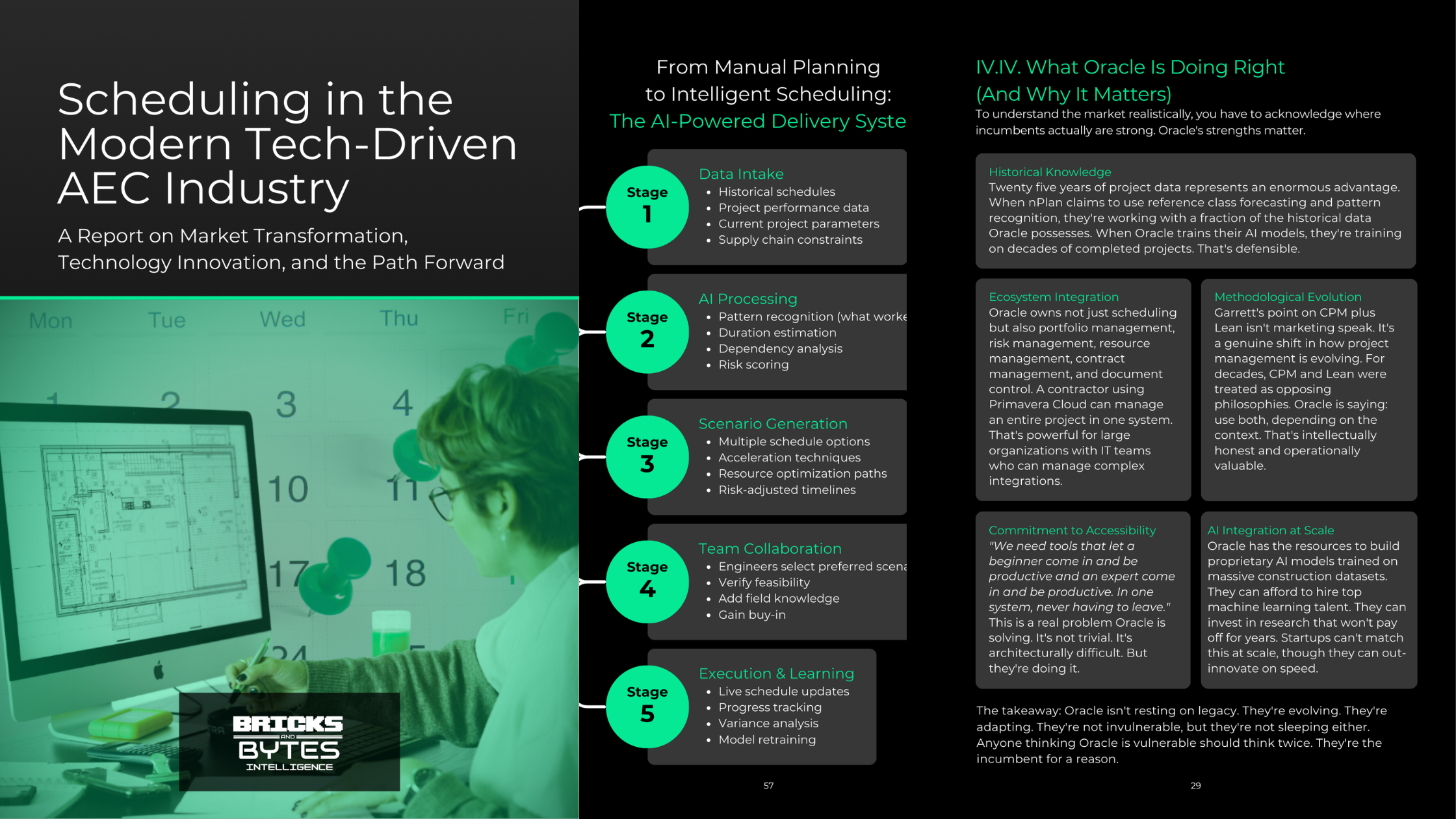
Get a FREE copy of our Scheduling in the Modern Tech-Driven AEC Industry: A Report on Market Transformation, Technology Innovation, and the Path Forward” (worth $150) and a FREE weekly email to stay up to date on construction tech. SIGN UP TODAY!

Scheduling in the Modern Tech-Driven AEC Industry

Sign up to the #1 Newsletter In AEC Tech. Join over 2,100 like-minded Founders, Investors and Techies disrupting the way we build. 

Scheduling in the Modern Tech-Driven AEC Industry