Author name: Owen Drury

Newsletter

Construction’s New Reality: Tariffs, Labor Woes, and Tech Overload

Construction’s New Reality: Tariffs, Labor Woes, and Tech Overload 🚨 US slaps 50% tariffs on aluminum and steel — construction braces for impact. 🏗️ Skanska’s 2025 Market Trends Report predicts project costs increasing 5–15%. 📈 Domestic suppliers feel the squeeze as demand strains US manufacturing capacity. 🏘️ Labor shortages deepen, and housing IRRs are headed south fast. But that’s not all: Patric Hellermann dives into how forward-deployed engineering (think Palantir for AEC) could reshape construction tech. Dustin DeVan explains why the real winners in this mess might just be… private equity firms. And the team breaks down how tighter immigration is quietly reshaping the labor market (and construction costs). 🎧 Listen now for: Why tariffs are a stealth tax on your next project. How a 20B contractor is partnering (not just buying) with startups. How AI + custom workflows could kill 100+ point solutions The quiet migration crisis impacting construction labor. Listen to the full episode 🗣 Bonus: Some personal highlights Dustin ran 6 miles before recording — all while plotting Ediphi’s next move. Patric’s chair upgrade is stealing the show. Martin’s engineering firm is booming — and no one knows why. Owen’s contemplating a podcast just for construction conspiracy theories You might also like: Builder AI $450M Bankruptcy – Beginning Of The End for AI Startups? Johnny Ive $6.5B Hire, TAM Check Why Data Centers Might Crash, Y Combinator Predatory Practices, with Softbank’s $100B Pledge How China Builds Nuclear Plants Cheaper, Construction’s $860bn Problem, & Trump 2.0 Germany Effects 90% Of AI Startups Are Worthless, US Economy CRASH, Is Autodesk Investable + $2bn Startup Meltdown Powered by beehiiv

Newsletter

ICYMI: 95% of AI startups will die (and other brutal truths from this week)

Want to get your message in front of {{active_subscriber_count}} highly engaged innovation leaders? Check out our sponsorship offers. This Week’s Quickfire BytesFuel your curiosity with this week’s contentW/C 2nd June 2025 NEW EPISODES$100K Lost Before Breaking Ground – Understanding Risk Management in Construction Victor Zhang from Trestle discusses the hidden profit leaks in construction, why phone calls still beat emails in B2B sales, and how AI is actually being used in construction tech. Find out why construction companies lose money before projects even start, the real reason email marketing fails with general contractors and how proprietary data creates stronger defensibility than AI algorithms. open.spotify.com/episode/1J5049tfW4vmTfSmHM4ZYq Construction Scheduling Is Dead – Broken Scheduling Systems & Modern AI Solutions from $600M Firm Patrick Hennessy from Harkins Builders shares why traditional project management tools are failing the construction industry, how AI could revolutionize daily site operations, and the brutal truth about construction tech pricing. Find out why Primavera P6 and traditional scheduling software create more problems than they solve, how AI daily briefs could replace morning huddles and transform job site management and the real reason construction software pricing is getting out of control and what contractors should demand. open.spotify.com/episode/3ArrWUx5av5DEVHWIlAxtX Builder AI $450M Bankruptcy – The Beginning Of The End for AI Startups? Johnny Ive’s $6.5B Hire by OpenAI, Hiring Missionaries vs Mercenaries, TAM Reality Check We dive deep into the shocking collapse of Builder AI and what it reveals about the entire AI industry. From fraudulent revenue claims to human workers disguised as AI, this cautionary tale exposes the dark side of Silicon Valley’s latest obsession. Key topics discussed: Builder AI’s spectacular $450M bankruptcy and 25% revenue overstatement, why 90-95% of AI companies are headed for failure according to VCs and OpenAI’s questionable $6.5 billion acquisition of Johnny Ive’s design firm. open.spotify.com/episode/3QkJJCnS8r2aAEfd0HzpUe View All Podcasts BRICKS & BYTES PREMIUMEarly Release Episodes The $13 Trillion Messaging Mistake Killing AEC Startups – Kevin Ferguson – EARLY RELEASE Product marketing expert Kevin Ferguson reveals why he can’t figure out what most AEC tech companies do—and why that’s costing them enterprise deals. 2 FAVORITE QUOTES: “There’s zero room for discrepancies on realized revenue. That either happened or didn’t. And that’s fraud.” – Dustin DeVan on Builder AI’s 20-25% revenue overstatement “I can’t tell you how often you meet marketplace founders who make GMV on a transaction basis, annualize that GMV and call it ARR.” – Patric Hellermann on startup metric manipulation BRICKS & BYTES PREMIUM🚀 Ready to Break Through the $10M Ceiling? Here’s a quick recap of what you’ll receive as a premium subscriber: Premium in-depth articles delivered to your inbox Early access to podcast episodes before public release 33% discount on all future GTM guides we publish UPGRADE TO PREMIUM Want 33% off the guide?Sign Up for Our Monthly Subscription Monthly members ($10/mo) can purchase the guide for just $67 UPGRADE TO MONTHLY YOU MIGHT ALSO LIKE Premium Insights 12 Lessons About Hiring From AEC’s Top Leaders More Insights NSFW: Build a F*cking Business McKinsey’s Secrets to Scaling Construction Tech How Flux Burned Through $29M – Lessons for AEC Innovators Ex AutoDesk CEO’s 12 Lessons For Developing Products Could an Entrepreneur in Residence Save Your Construction Firm? Reports and Case Studies Innovating the Future: Robotics and the Revolution in Construction The Future of Design Software In AEC – Experts Insights Investing In AEC Tech The Future Of Construction Document Management The Construction Tech Revolution In India: Lessons From InfraMarket’s Success Innovation at Windover Construction Swinerton’s Innovation Strategy Most Popular Episodes How To Build A Unicorn In Construction Tech – Patric Hellermann Story Of A Modular Construction Startup That Burned Through £10M in 15 Months – Chris Spiceley McKinsey FINALLY updates their Productivity Curve, & The Future Of Construction – David Rockhill, Partner at McKinsey Procore’s AI Strategy & Implementation – AI’s Role in Modern Construction Disrupt Autodesk? This Ex-Autodesk CEO Has Some Advice – Amar Hanspal Super Series Super Series with Ediphi Super Series With Speckle Super Series With Monumental Super Series with Foundamental OUR SPONSORS BuildVision — streamlining the construction supply chain with a unified platform for contractors, manufacturers, and stakeholders. Powered by beehiiv

Newsletter

The Death of P6: Why a $600M Contractor is Ditching Traditional Scheduling Software

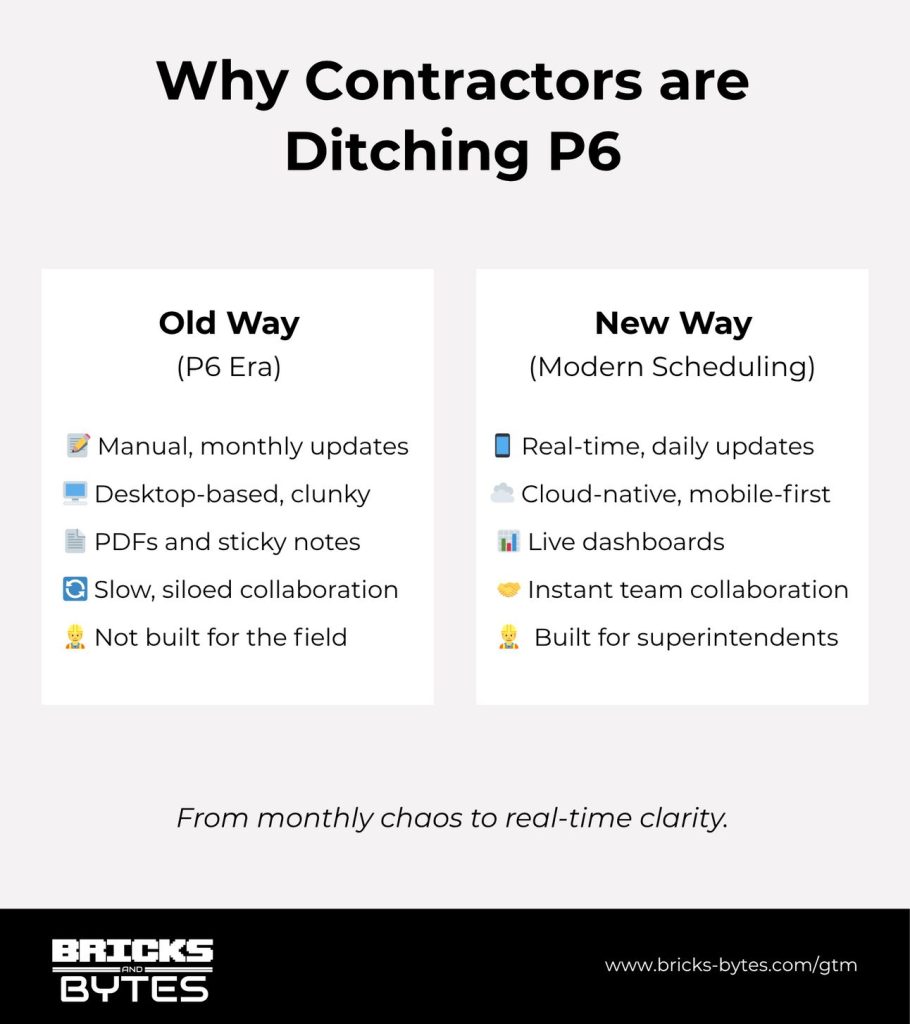
Want to get your message in front of {{active_subscriber_count}} highly engaged innovation leaders? Check out our sponsorship offers. INDUSTRY INSIGHTSThe Death of P6: Why a $600M Contractor is Ditching Traditional Scheduling Software I’ve been using Primavera P6 for years. And I’m done with it. That’s the blunt assessment from Patrick Hennessy, Planning and Analytics Executive at Harkins Builders, a $600 million general contractor. After spending over seven years implementing technology across every department at Harkins, Patrick has reached a breaking point with traditional scheduling software. “It has got to get to a place where it’s a cloud-based collaborative solution,” Patrick tells me during our recent conversation. “How disjointed is it when you have a lead superintendent and a group of superintendents trying to work their portions of the schedule, and this is all trying to be done through PDF or sticky notes?” Sticky notes. In 2025. At a half-billion-dollar construction company. TL;DR: The Death of P6 — Why Contractors Are Ditching Old Scheduling Tools We sat down with a $600M GC — here’s why the future of construction scheduling is changing fast: 👉 Swipe-right updates: Fast, gamified progress tracking📱 Mobile-first UX: Built for field teams, not back-office schedulers🛠️ Real-time collaboration: No more F5 refreshes or monthly scrambles🌐 Full integration: Daily logs, RFIs, weather, and trade data all in one place🧠 Seamless data capture: AI and reality capture update schedules automatically The Monthly Scheduling Charade Here’s what traditional scheduling looks like at most contractors, according to Patrick: “You go out there and spend hours collecting dates. You plug them into P6, hit schedule now, see what happened to the end date, make your logic changes. You produce reports, send them out, and wait until next month.” The problem? Those dates probably haven’t been thought about or written down in a month. “We encourage teams to write down dates daily,” Patrick admits. “But in reality, when the scheduler’s coming, that’s when people scramble to write their dates down.” Sound familiar? This once-a-month ritual creates a fundamental disconnect between the field and the schedule. While superintendents are making dozens of micro-decisions daily that affect the timeline, those insights disappear into the ether until the next formal update cycle. What Startups Are Building Instead Patrick is currently evaluating multiple cloud-based scheduling solutions. While he won’t name names (we don’t take commission), he’s seeing several promising approaches: Real-time collaboration: Instead of remote P6 servers where you “always have to press F5 to get other people’s changes,” these new platforms allow simultaneous editing with immediate updates. Field-friendly interfaces: Traditional scheduling software “is just not that easy to use if you’re a lifelong field person.” The new generation prioritizes user experience over feature complexity. Integrated data collection: Some companies are using reality capture with AI to automatically update schedules based on visual progress. Others are streamlining the data input process entirely. But Patrick sees an even bigger opportunity… The “Swipe Right” Solution – Ha! During our conversation, Patrick painted a picture of what scheduling could become: “Make it like a swipe left or swipe right. Did this happen on these dates? Yes? That’s a right swipe. No? Swipe left. Maybe 50 swipes while a superintendent is sitting in bed ready to go to sleep.” The next morning, they’d review the five “no’s,” make quick adjustments, and automatically generate a schedule update. “You could offer five cents every swipe,” I suggested, getting excited about the gamification potential. “Really incentivize participation.” “Once you create that brain sensation of gaming or competition,” Patrick agreed, “that’s where you really start to win over users.” The Integration Challenge But Patrick’s vision goes beyond just making scheduling software prettier. He wants “a living, breathing, everyone’s collaborating together at all times tool.” The key is data integration. Modern scheduling platforms need to connect with: Daily logs and field reports Submittal and RFI workflows Weather data and site conditions Trade partner performance history “If you can collect all that data and analyze it with AI,” Patrick explains, “you should be able to make informed decisions about what probably happened. Then it becomes a simple yes/no confirmation rather than starting from scratch each time.” Why This Matters for Contractors Patrick’s frustration represents a broader shift happening across the industry. The companies that figure out real-time scheduling collaboration will have a massive competitive advantage. Consider the ripple effects: Better trade coordination: Real-time updates mean subcontractors actually know when they’re needed Reduced delays: Issues get flagged immediately instead of discovered weeks later Improved cash flow: More accurate schedules lead to better billing and payment timing Enhanced safety: Proper sequencing reduces conflicts and hazardous conditions What This Means for Startups If you’re building scheduling software, Patrick’s comments reveal several critical requirements: Start with collaboration, not features: The platform needs to work for both scheduling professionals and field teams simultaneously. Simplify data collection: The biggest dysfunction in current workflows is gathering accurate information. Solve this, and you own the market. Build for mobile: Superintendents won’t carry laptops to check schedules. The primary interface needs to work on phones. Focus on adoption: The best scheduling software is worthless if only one person uses it. Design for viral internal adoption. The Bigger Picture Patrick’s criticism of P6 isn’t just about software frustration. It’s about an industry ready for fundamental change. “We’re seeing different trains of thought coming out of companies for how to solve this problem,” he observes. “Everyone’s got a different approach, and we’re happy to test all of them simultaneously.” Harkins is actively piloting multiple solutions, collecting feedback, and preparing to make a long-term decision. They’re not alone. Across the industry, contractors are questioning whether their current scheduling tools are fit for purpose. The companies that crack this code won’t just win software contracts. They’ll become the backbone of how construction gets planned, coordinated, and executed. And for contractors still pressing F5 to see schedule updates? The revolution can’t come soon enough. WEEKLY MUSINGSBig Win, Data Centers, AI VC Boom Huge news for Buildots! CTech by Calcalist Buildots raises

Newsletter

The $13 Trillion Messaging Mistake Killing AEC Startups – Kevin Ferguson – EARLY RELEASE

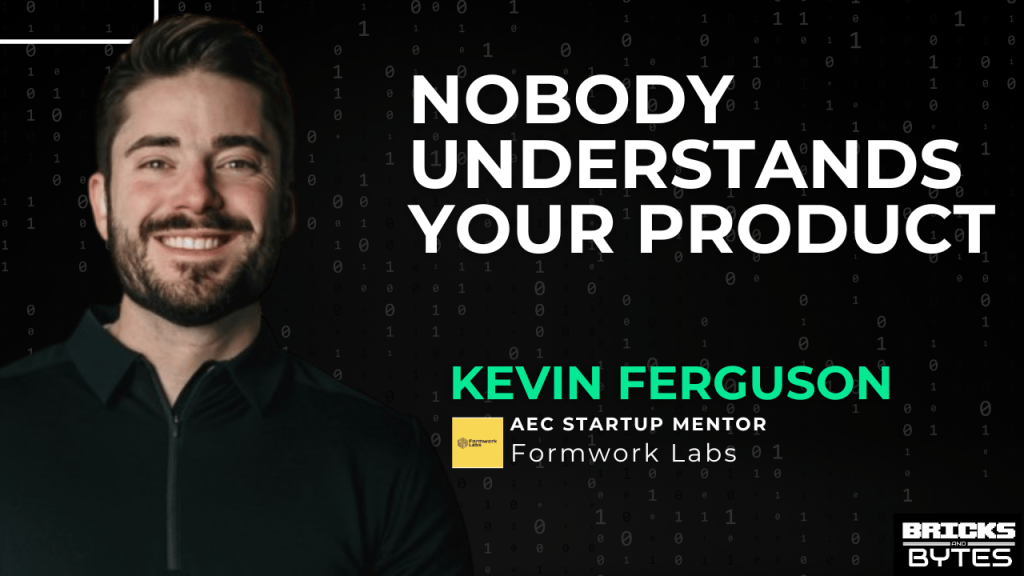
This is an early release of our podcast, exclusive for premium subscribers. To get early access, upgrade here. EARLY RELEASEThe $13 Trillion Messaging Mistake Killing AEC Startups In this revealing conversation with product marketing guru Kevin Ferguson, we dive deep into the messaging mistakes that are killing AEC tech startups and the frameworks that separate winners from the noise. Kevin brings a unique perspective, having worked with Microsoft’s massive marketing machine before niching down to serve exclusively AEC tech companies—and his insights on why most founders can’t clearly articulate what they do will make you rethink your entire go-to-market strategy. In this episode, you’ll: Discover the #1 messaging mistake that’s costing AEC tech startups millions in lost deals (and why even industry veterans can’t figure out what most companies actually do) Learn the “order of benefits” framework that transforms vague promises into compelling, trust-building narratives your prospects actually believe Master the art of product launches with Kevin’s tier-based system that maximizes ROI on every product investment Understand why your website is your biggest defense against the “will they be around in 5 years?” objection that kills enterprise deals Get the inside scoop on when to hire product marketing (hint: it’s probably sooner than you think, but not how you think) Chapters 00:00 – Why everyone knows Kevin Ferguson in AEC marketing 01:10 – The pervasive messaging problem plaguing 2,000+ AEC tech companies 02:53 – Why your website is your storefront (and most are broken) 05:59 – Kevin’s accidental journey from Microsoft to AEC tech consultancy 08:54 – The power of niching down: Why specialization wins 13:18 – Who are you actually marketing to in AEC? 17:19 – Research frameworks: Getting inside your customer’s head 25:44 – Product positioning strategies that actually work 30:05 – Red flags Kevin spots in first founder conversations 35:15 – Breaking down complexity without losing impact 45:14 – Product launch mastery: From release to market impact 52:44 – Post-launch metrics that matter (beyond vanity numbers) 56:49 – Attribution challenges and creative measurement solutions 01:00:37 – Microsoft lessons that don’t apply to startups 01:02:49 – Final thoughts on cutting through the noise »»» Listen Now (Premium Subscribers Only) ««« Subscribe to our premium content to read the rest. This is a subscriber only post. Become a paying subscriber of our annual or monthly paid subscriptions to get inside takes on growth in construction tech. Upgrade Translation missing: en.app.shared.conjuction.or Sign In Powered by beehiiv

Newsletter

Another $450M Down the Drain — RIP Builder.ai.

Builder.ai collapses, venture debt traps, and construction’s brewing tech skepticism. In this Bricks, Bucks & Bytes episode: 🚨 Builder.ai files for bankruptcy after raising $450M — AI-washing or just bad business? 🏗️ Zombie SaaS companies still haunt construction tech. 🧠 AI: Revolution or regression? Why it’s making people dumber and what it means for AEC. But that’s not all: Dustin DeVan explains why 90% of AI startups could be headed for zero. Patric Hellermann dives into how venture debt can quietly kill companies. Martin Piekarz shares why AI-powered emails are killing the art of engineering proposals. 🎧 Listen now for: Why “annual recurring revenue” is mostly a lie How AI could actually hurt your social skills (and your business) What happens when software startups fail — and the ripple effect on contractors The untold truth about venture debt and why it can destroy companies faster than VC Are AI startups today just 1999 dot-coms in disguise? Listen to the full episode 🗣 Bonus: Some personal highlights Patric reveals his secret to conference fashion — and it’s not what you’d expect. Martin survives Belarusian border control (barely). Dustin runs a marathon (nearly), negotiates venture debt, and dissects SaaS economics — all before lunch. Owen vs. AI hype — who wins? You might also like: AI Megaprojects. Autodesk as God. And a startup tackling the cost of… dirt How China Builds Nuclear Plants Cheaper, Construction’s $860bn Problem, & Trump 2.0 Germany Effects 90% Of AI Startups Are Worthless, US Economy CRASH, Is Autodesk Investable + $2bn Startup Meltdown Powered by beehiiv

Newsletter

ICYMI: The $875 Million Secret: What They DON’T Tell You About Selling a Startup

Want to get your message in front of {{active_subscriber_count}} highly engaged innovation leaders? Check out our sponsorship offers. This Week’s Quickfire BytesFuel your curiosity with this week’s contentW/C 26th May 2025 NEW EPISODESMost Construction Sales Reps Are Fake Consultants – Real Sales Strategy from Ediphi’s Director Trey Darnell, Director of Sales at Ediphi, shares why construction tech sales is completely broken, how most salespeople get it wrong, and why the industry desperately needs a new approach. Find out why 90% of construction salespeople fail at their job, why platforms are becoming “jack of all trades, master of none” and how to sell construction tech without being another annoying vendor. open.spotify.com/episode/1I5wtBlwfBrm3etufyMxHR How PlanGrid was Acquired for $875m – Ralph Gootee, CTO Ralph Gootee shares how PlanGrid became the first enterprise app on iPad, the brutal year-long acquisition process, and why pricing decisions can make or break your startup. Find out why iPad was crucial to PlanGrid’s success when even Facebook refused to build an iPad app, how having 5 co-founders worked despite conventional wisdom saying otherwise and why AI augments engineers but won’t replace them anytime soon. open.spotify.com/episode/0HdVexBb8IPJDkZoraWkBS 90% of Sales Demos Fail – Closing $1M Deals with Mutual Action Plans & Multi-Threading Secret to Accelerate Sales Cycles We had Scotland Foss, who helped build PlanGrid before its $1B acquisition by Autodesk. Scotland shared his proven playbook for construction tech go-to-market success from his journey across multiple ventures. Find out why product-market fit must come before hiring salespeople, how PlanGrid’s freemium strategy created viral adoption on job sites and why unlimited user pricing models work better than per-seat in construction. open.spotify.com/episode/7rtu92S2vQwSgizpZULYlo View All Podcasts 2 FAVORITE QUOTES: “You can’t build a company to be sold. It’s like impossible. Like it’s like not, not, it’s not even a good strategy building company to be sold. You have to, you need leverage. Leverage is all that matters in business to me, leverage.” – Ralph Gootee on building a company solely for acquisition “The reality is sales is not what sales used to be. It’s, it’s more of a consulting, right? Like it’s more about the people in the process and less about the tech.” – Trey Darnell on his modern philosophy of sales BRICKS & BYTES PREMIUM🚀 Ready to Break Through the $10M Ceiling? Here’s a quick recap of what you’ll receive as a premium subscriber: Premium in-depth articles delivered to your inbox Early access to podcast episodes before public release 33% discount on all future GTM guides we publish UPGRADE TO PREMIUM Want 33% off the guide?Sign Up for Our Monthly Subscription Monthly members ($10/mo) can purchase the guide for just $67 UPGRADE TO MONTHLY YOU MIGHT ALSO LIKE Premium Insights 12 Lessons About Hiring From AEC’s Top Leaders More Insights NSFW: Build a F*cking Business McKinsey’s Secrets to Scaling Construction Tech How Flux Burned Through $29M – Lessons for AEC Innovators Ex AutoDesk CEO’s 12 Lessons For Developing Products Could an Entrepreneur in Residence Save Your Construction Firm? Reports and Case Studies Innovating the Future: Robotics and the Revolution in Construction The Future of Design Software In AEC – Experts Insights Investing In AEC Tech The Future Of Construction Document Management The Construction Tech Revolution In India: Lessons From InfraMarket’s Success Innovation at Windover Construction Swinerton’s Innovation Strategy Most Popular Episodes How To Build A Unicorn In Construction Tech – Patric Hellermann Story Of A Modular Construction Startup That Burned Through £10M in 15 Months – Chris Spiceley McKinsey FINALLY updates their Productivity Curve, & The Future Of Construction – David Rockhill, Partner at McKinsey Procore’s AI Strategy & Implementation – AI’s Role in Modern Construction Disrupt Autodesk? This Ex-Autodesk CEO Has Some Advice – Amar Hanspal Super Series Super Series with Ediphi Super Series With Speckle Super Series With Monumental Super Series with Foundamental OUR SPONSORS BuildVision — streamlining the construction supply chain with a unified platform for contractors, manufacturers, and stakeholders. Powered by beehiiv

Newsletter

The 5 Traits That Make or Break Construction Tech Sales Leaders

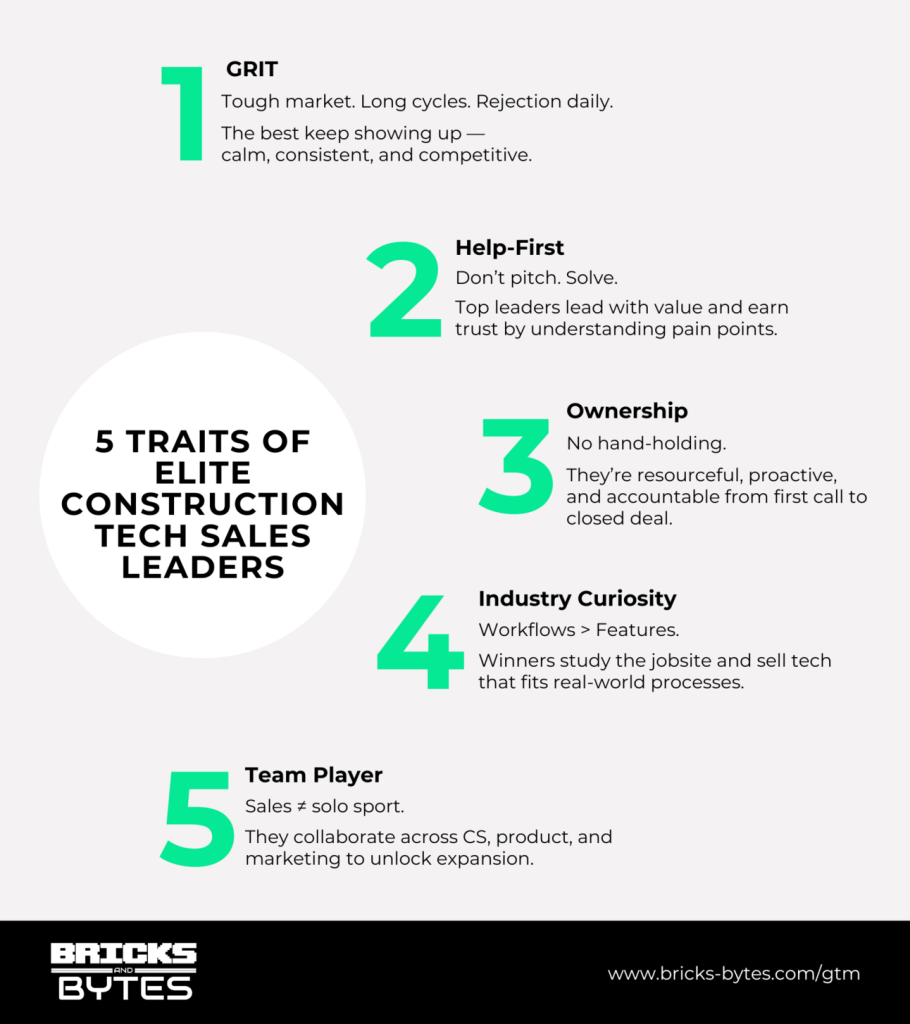
Want to get your message in front of {{active_subscriber_count}} highly engaged innovation leaders? Check out our sponsorship offers. INDUSTRY INSIGHTSThe 5 Traits That Make or Break Construction Tech Sales Leaders We’ve spent the last few months speaking with the greatest sales leaders in construction tech. Each leader has their own unique approach to building successful sales organizations. But common threads emerge when they describe what makes someone exceptional in this industry.  After distilling hours of conversations with these folks, we’ve identified five essential traits that separate the good from the truly great in construction tech sales leadership. TL;DR: Want to Crush Sales in Construction Tech? Start Here We interviewed top sales leaders in construction tech – here are the 5 traits they all share: 💪 Grit: Handle rejection like a pro🤝 Help-first mindset: Solve, don’t sell🧠 Ownership: Figure it out. No hand-holding🏗️ Industry curiosity: Learn workflows, speak the language🤝 Team-first: Expansion is a team sport 1. The Hunter’s Grit The construction tech sales landscape can be particularly challenging. Long sales cycles, traditional industries, and complex stakeholder relationships mean rejection is a daily reality. What sets the best leaders apart is their unwavering grit. This resilience shows up as consistency through the inevitable ups and downs of sales cycles. The most effective leaders maintain emotional stability regardless of whether they’re closing big deals or facing repeated rejection. They demonstrate perseverance by continuing to pursue opportunities even when progress seems slow. “I hire for hungry, humble, smart with a fire in the belly to get up in the morning and do something special. That competitive drive to find a way to win. No excuses.” Action tip: When interviewing potential sales leaders, ask about their most difficult rejection and how they responded. The best candidates will demonstrate resilience and learning rather than bitterness. 2. Help-First Mentality In an industry built on relationships and trust, successful sales leaders put solving customer problems ahead of pushing products. They understand that construction professionals value partners who genuinely understand their challenges. This approach builds credibility and establishes trust with clients who are often skeptical of salespeople. By focusing first on understanding workflows and pain points, exceptional sales leaders position themselves as trusted advisors rather than transactional vendors. “When you get on the phone, stop trying to angle them towards some pitch that you think you’re trying to land on. Just try to help.” Action tip: Start sales conversations by asking about your prospect’s biggest challenges rather than launching into your capabilities. Document these pain points before ever discussing your solution. 3. Resourcefulness & Ownership Great construction tech sales leaders take ownership of their results and find creative ways to overcome obstacles without waiting for direction. The most effective leaders demonstrate versatility, functioning as “Swiss Army Knives” who can support multiple aspects of the business when needed. They learn from past failures rather than resting on previous successes, continuously improving their approach based on what hasn’t worked before. “Do you have the figure it out genes? Can you go, or are you the person who every time you hit a roadblock, you turn around and say, ‘I’m stuck, I need help’? We need to see you being resourceful.” Action tip: Create an environment where your team feels comfortable sharing failures and learnings without judgment. Use these insights to build better systems and processes. 4. Industry Knowledge & Curiosity Construction is a complex industry with many stakeholders, workflows, and nuances. While technical sales skills are important, the best leaders demonstrate genuine curiosity about the industry and its challenges. Top performers continuously study patterns in how buyers make decisions, adapting their sales processes to match customer buying behavior rather than forcing an artificial structure. They invest time in understanding the specific workflows their solution enhances, recognizing that construction professionals prioritize tools that integrate seamlessly into their existing processes. “I’m a firm believer in whatever that you’re selling has to match the workflow of the individual. Workflows are so important in this space, whereas workflows aren’t as critical to other organizations and sectors.” Action tip: Spend time on construction sites observing workflows firsthand. Real-world exposure to the problems you’re solving builds credibility and deepens understanding. 5. Collaborative Spirit & Team Focus The best construction tech sales leaders recognize that success requires collaboration across departments, especially when expanding customer relationships. They build environments where knowledge sharing is rewarded, avoiding the “sharp elbows” mentality that can create toxic competition. This collaborative approach is particularly crucial for expansion revenue, which requires coordination between sales, customer success, product, and marketing. “Expansion is a total team play. 100% team play. You can’t expand by yourself…the new is very much a marketing-sales kind of motion, whereas expansion is very much a combination of customer success, sales, marketing, but also product.” Action tip: Create team-based incentives alongside individual goals. When the entire sales organization hits its target, everyone should benefit, encouraging collaboration and knowledge sharing.   Enjoyed these insights? We go even deeper in our GTM Guide. WEEKLY MUSINGSMarketing, New Acquisition, AI Disrupts   When users don’t appear Farzad Khosravi Founders needed a scapegoat. God gave them marketers. 📥 Then marketers made a worksheet so founders would finally talk to users.   Big congrats to the Novorender team 𝗘𝘅𝗰𝗶𝘁𝗶𝗻𝗴 𝗡𝗲𝘄𝘀: 𝗡𝗼𝘃𝗼𝗿𝗲𝗻𝗱𝗲𝗿 𝗝𝗼𝗶𝗻𝘀 Procore… | Novorender We’re proud to share that 𝗣𝗿𝗼𝗰𝗼𝗿𝗲 𝗧𝗲𝗰𝗵𝗻𝗼𝗹𝗼𝗴𝗶𝗲𝘀 𝗵𝗮𝘀 𝗼𝗳𝗳𝗶𝗰𝗶𝗮𝗹𝗹𝘆 𝗮𝗰𝗾𝘂𝗶𝗿𝗲𝗱 𝗡𝗼𝘃𝗼𝗿𝗲𝗻𝗱𝗲𝗿 to help contractors and owners build smarter on projects of all sizes.   AI’s threat to ConTech AI’s Double-Edged Sword: Construction And VC What keeps venture capitalists up at night? Turns out, it might be the same thing keeping the rest of us scrolling through news feeds at 2 AM. Patric and Shub dive into an existential question this week: what AI scenario presents the biggest threat to construction tech companies and VCs themselves?   BRICKS & BYTES PREMIUM🚀 Ready to Break Through the $10M Ceiling? Here’s a quick recap of what you’ll receive as a premium subscriber: Premium in-depth articles delivered to your inbox Early access to podcast episodes before public release 33% discount

testfit logo
Startups

Challenging Conventional Wisdom in Contech: Lessons from TestFit’s Journey

  Sometimes the most valuable insights come from those willing to question industry assumptions. Clifton Harness, co-founder of TestFit, isn’t afraid to challenge the status quo in construction technology – and his contrarian views might just help reshape how we think about innovation in the space.   In this episode, Clifton Harness, co-founder of TestFit, shares his journey from observing real estate development as a child to revolutionizing building design software   The 3D Modeling Myth Let’s start with a controversial take: maybe our industry’s obsession with 3D modeling is misguided. “Go pull out a stack of CDs and tell me what percentage of that is in 3D,” Harness challenges. “Why are we designing in 3D? I don’t get it.” It’s a provocative stance in an era where BIM and 3D modeling are often presented as the future of construction. But Harness points to a telling example: in reviewing $150 million worth of warehouse construction documents, he found just one 3D view on the front sheet of each phase – despite the entire set being produced in Revit. “The line weights were awful. It was completely unreadable. The door tags were abysmal,” he notes. This gets to the heart of his argument: we’re often adding complexity without adding value. While 3D tools might be great for creating Apple’s next UFO-shaped headquarters, they might be overkill for the bread-and-butter projects that make up most of construction. Rethinking Startup Growth Another piece of conventional wisdom Harness challenges is the typical Silicon Valley growth playbook. While many tech startups rush to raise massive funding rounds and scale quickly, TestFit took a different approach. They bootstrapped for 30 months before taking their first seed investment, focusing on building real value for customers rather than chasing rapid growth. “If you segment the market the way that we have, you’re allowed to make a little bit of failure,” Harness explains. This measured approach allowed them to test different market segments and product features without betting the farm on any single direction. The Empathy Edge Perhaps most importantly, Harness challenges the notion that outsiders can easily disrupt construction with technology alone. “Understanding where the problems are is very hard for technologists,” he notes. Having worked in architecture before founding TestFit, he brings a unique perspective to product development. This industry experience proved invaluable in the early days. “Knowing nothing about sales and knowing nothing about marketing, being from industry enabled me to MQL and SQL someone based off of their bio on a website and create a list of the first 30 people I was going to go talk to. And that yielded the first two customers.” The Truth About Product-Market Fit While many startups talk about finding product-market fit through data and metrics, Harness suggests a more nuanced approach. “It’s continuous improvisation,” he says. “And if you’re not learning on your feet, you’re going to fail.” This extends to how TestFit approaches product development. Rather than trying to build the perfect all-in-one solution, they focus on solving specific problems well. Their approach to configurators – tools that automate specific types of building designs – allows them to serve different market segments effectively while learning from each iteration. The Venture Capital Conundrum Harness also challenges how construction tech companies should think about venture capital. “Venture capital is an IRR-driven asset class, which means money in, money out faster is better,” he explains. “And this is buildings.” The mismatch between typical VC expectations and the realities of the construction industry means founders need to be thoughtful about who they take money from. TestFit’s solution? They sought investors with deep industry expertise. Their board includes people who understand both the technology and construction sides of the business – from a generative design expert who sold his startup to PTC to real estate developers who understand how companies like Chipotle and Starbucks want their buildings built. Building for the Long Haul Perhaps most radically, Harness challenges the typical startup exit mindset. Rather than focusing on a quick flip or exit, his goal is to “endure, assure that the value of the technology I’ve spent the last seven years on is at the hands of the architecture industry in perpetuity.” This long-term thinking influences everything from how they approach product development to how they structure their company. “You have to address the market with meaningful value,” Harness explains. “And for us, it’s like, okay, we’re going to try to get you in on some meaningful automation. And if you stick around for the manual tools, awesome. That’s a win-win.” The Path Forward What can other construction tech founders learn from TestFit’s contrarian approach? A few key takeaways: Question industry assumptions: Just because “everyone” is doing something doesn’t make it right Value industry experience: Deep understanding of the problems you’re solving is invaluable Take the long view: Building lasting value might mean growing more slowly than the typical tech startup Focus on real problems: Solve specific challenges well rather than trying to revolutionize everything at once As Harness puts it, success in construction tech isn’t primarily about intellect – it’s about endurance. “I don’t think what I’ve done has taken particularly a huge amount of intellect. I just think it’s taken endurance.” For an industry as complex and established as construction, maybe that’s exactly the perspective we need: less disruption for disruption’s sake, and more focused, sustainable innovation built on deep industry understanding.      

Newsletter

ICYMI: Elon Calls $500B AI Project ‘Smoke and Mirrors’ – Is He Right?

Want to get your message in front of {{active_subscriber_count}} highly engaged innovation leaders? Check out our sponsorship offers. This Week’s Quickfire BytesFuel your curiosity with this week’s contentW/C 19th May 2025 NEW EPISODES90% of Sales Demos Fail – Closing $1M Deals with Mutual Action Plans & Multi-Threading Secret to Accelerate Sales Cycles We had Scotland Foss, who helped build PlanGrid before its $1B acquisition by Autodesk. Scotland shared his proven playbook for construction tech go-to-market success from his journey across multiple ventures. Find out why product-market fit must come before hiring salespeople, how PlanGrid’s freemium strategy created viral adoption on job sites and why unlimited user pricing models work better than per-seat in construction. open.spotify.com/episode/7rtu92S2vQwSgizpZULYlo Why Data Centers Might Crash, Autodesk Alienates Christians, Y Combinator Predatory Practices, Paper Beats Digital, with Softbank’s $100B Pledge We talk about the $500B “Stargate” project between OpenAI, SoftBank, and Oracle that’s having trouble finding backers as data center costs rise. Find out why smart capital is hesitant to invest in data center construction right now, how Y Combinator takes 7% equity while giving little value to founders and why Safe Notes are becoming unpopular with serious investors. open.spotify.com/episode/3TKC4JOUYtyE8GfGws7v9R From Shop Drawings to Smart Buildings: The Radical Innovation Strategy of a $200M Engineering Firm Robert Ioanna, Executive Principal of Syska Hennessy Group, shares his innovative approach to construction tech investment and internal R&D. Find out why he believes MEP industry disruption will work backwards (from shop drawings to concept), how they gamify innovation with an internal point system that engages 20% of their firm and the challenge of AI adoption in a code-driven, legally-rigid industry with PE stamp requirements. open.spotify.com/episode/1xmPC7E9EcvNPnKzJmvVIb View All Podcasts BRICKS & BYTES PREMIUMEarly Release Episodes When Industry Experts Lead the Sales Process – Trey Darnell – EARLY RELEASE In this insightful episode, Trey Darnell, Director of Sales at Ediphi, shares his journey from construction BIM specialist to construction tech sales leader. How PlanGrid Transformed an Industry and Sold for $875M – Ralph Gootee – EARLY RELEASE In this fascinating episode, Ralph Gootee, co-founder of PlanGrid (acquired by Autodesk for $875M) and current CEO of TigerEye, reveals the insider strategies that helped his company dominate the construction tech space. 2 FAVORITE QUOTES: “Like you talk to some of these founders and it’s like, I’m the greatest thing since sliced bread because I got accepted into YC.” – Dustin DeVan on On Y Combinator “Every rep should take it upon themselves to bake their own cake like anything that’s going to come in inbound or be handed to them. That’s like icing.” – Scotland Foss on prospecting priority BRICKS & BYTES PREMIUM🚀 Ready to Break Through the $10M Ceiling? Here’s a quick recap of what you’ll receive as a premium subscriber: Premium in-depth articles delivered to your inbox Early access to podcast episodes before public release 33% discount on all future GTM guides we publish UPGRADE TO PREMIUM Want 33% off the guide?Sign Up for Our Monthly Subscription Monthly members ($10/mo) can purchase the guide for just $67 UPGRADE TO MONTHLY YOU MIGHT ALSO LIKE More Insights NSFW: Build a F*cking Business McKinsey’s Secrets to Scaling Construction Tech How Flux Burned Through $29M – Lessons for AEC Innovators Ex AutoDesk CEO’s 12 Lessons For Developing Products Could an Entrepreneur in Residence Save Your Construction Firm? Reports and Case Studies Innovating the Future: Robotics and the Revolution in Construction The Future of Design Software In AEC – Experts Insights Investing In AEC Tech The Future Of Construction Document Management The Construction Tech Revolution In India: Lessons From InfraMarket’s Success Innovation at Windover Construction Swinerton’s Innovation Strategy Most Popular Episodes How To Build A Unicorn In Construction Tech – Patric Hellermann Story Of A Modular Construction Startup That Burned Through £10M in 15 Months – Chris Spiceley McKinsey FINALLY updates their Productivity Curve, & The Future Of Construction – David Rockhill, Partner at McKinsey Procore’s AI Strategy & Implementation – AI’s Role in Modern Construction Disrupt Autodesk? This Ex-Autodesk CEO Has Some Advice – Amar Hanspal Super Series Super Series with Ediphi Super Series With Speckle Super Series With Monumental Super Series with Foundamental OUR SPONSORS BuildVision — streamlining the construction supply chain with a unified platform for contractors, manufacturers, and stakeholders. Powered by beehiiv

Newsletter

40,000 Brains. One Innovation Filter. How AtkinsRéalis Picks Winners

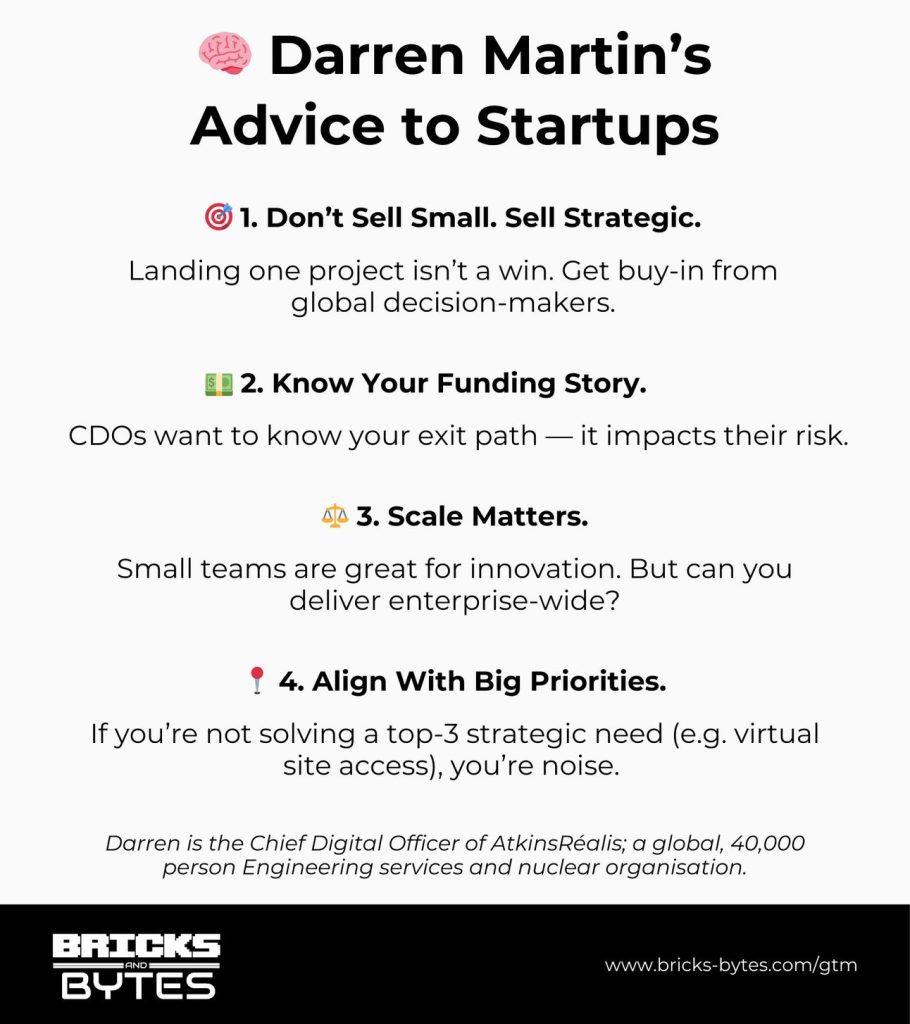
Want to get your message in front of {{active_subscriber_count}} highly engaged innovation leaders? Check out our sponsorship offers. INDUSTRY INSIGHTS40,000 Brains. One Innovation Filter. How AtkinsRéalis Picks Winners “It’s very easy to come up with ideas, but it takes a lot more time to execute those ideas. And in a world of finite resources, you’ve really got to be selective,” says Darren Martin, Chief Digital Officer at AtkinsRéalis. “Genius is 99% perspiration and only 1% innovation.” With 40,000 employees across the world, AtkinsRéalis could easily burn millions on promising technologies. Instead, they’ve built an innovation system that demands measurable returns and scales across a complex global organization. In a recent interview, Darren shared insights into how one of the world’s largest AEC firms evaluates, implements, and scales technology – offering valuable lessons for both industry leaders and the startups hoping to serve them. 🚨 TL;DR: What Big AEC Really Wants From Tech Startups AtkinsRéalis CDO Darren Martin breaks down how a 40,000-person firm actually adopts tech 💸 Every initiative must hit a 4X ROI in 12–18 months 🧠 Innovation is crowdsourced, but rigorously filtered ⚠️ Startups must align with global priorities and show scalability 🛑 “Pilots” are dead — it’s Proof of Value or nothing The AtkinsRéalis Innovation Approach: Structured for Success When Darren joined AtkinsRéalis, he discovered a familiar problem: enthusiastic but disconnected innovation happening throughout the organization. While this sparked creativity, it created challenges: “When I first joined, we were 38,000 brilliant minds all contributing to what we could do at a digital level. And it was quite hard to filter out some of the noise and focus on the priorities that were going to change the dial for the company,” Darren explains. His solution was developing a digital operating model that balances centralized strategy with regional execution. This includes: 1. Ideas Hub: A platform where any employee can submit innovation ideas, but focused on specific challenges rather than random concepts. “We’ve introduced an Ideas Hub where any one of our 40,000 people can create an idea and put that in. But what we’re really interested in is putting out particular challenges – industry challenges, market challenges, specific client challenges – and then crowdsourcing a response from our people.” 2. Voting and Regional Validation: Ideas gain momentum through employee votes, but must also align with business priorities represented by regional digital leads. 3. “Proof of Value and Accuracy”: Rather than running open-ended pilots, each innovation initiative must demonstrate both value and accuracy within defined timeframes. 4. The 4X Rule: Technologies must demonstrate potential for 4X return on investment within 12-18 months. This disciplined approach helps AtkinsRéalis concentrate resources on fewer, higher-impact innovations. But it also creates a high bar for new technologies to clear – something startups seeking to work with enterprise AEC firms should understand. Selling to Giants: Advice for AEC Tech Startups Darren offers candid advice for construction tech startups hoping to break into large AEC firms like AtkinsRéalis: 1. Target Strategic Leaders, Not Just Projects Startups should move beyond selling at the project level to achieve scale, aiming to align with global priorities and decision-makers: “I see a lot of people focused at some transactional level inside a region into a client… [but] trying to get the alignment right at a global strategic level is probably the best use of their time.” 2. Understand the Funding Reality Check Darren wants to know where startups are in their funding journey and their exit strategy. This isn’t just curiosity – it affects the risk calculation: “If I spend a lot of time with a startup that is eventually going to be acquired by a company, if they’re acquired by a company that we’re already heavily partnered with and is part of our ecosystem, then that’s great… But at the same time, if we invest a lot of time and money in a company that’s then acquired by a construction tech leader that we’re not heavily exposed with, that we don’t work with, then that technology goes.” 3. The Scale/Stability Tradeoff While startups offer innovation and focus, Darren weighs this against scalability and stability: “We’re definitely interested in disruption… But the transition from that particular small team of a few people to potentially a different technology that we think can be scalable may be part of that evolution… it doesn’t feel like the right balance between innovation and agility with the outcomes that we’re responsible for as a major employer of people all over the world.” 4. Align with Strategic Priorities AtkinsRéalis has defined focus areas like “virtual site access” that span multiple regions. Startups should understand how their technology fits these global priorities: “For example, I mentioned virtual site access, that’s really important for us globally. So technologies around that, there are probably 20 to 30 technologies that we could call off that are part of that suite… But getting close to the three top technologies that we want to work with and then we’ll mandate that as part of our tech stack and then roll that out in a consistent way, being in that cohort and investing shoe leather in that cohort, yes, you need to take a case study that says you deployed it here, but that might be in a region that we are less focused on or with a client base that’s not one of our top 60.” Enterprise Scalability: The Electric Bike Test One of Darren’s most insightful frameworks is his “electric bike” test for evaluating a technology’s potential to scale: “If you think about a paper round… typically by the time the morning’s done, someone can only do one paper round. Our job is to bring an electric bike into that paradigm and disrupt it. And the question is, how many more paper rounds can be done with this electric bike?” The challenge isn’t just finding technology that works – it’s finding technology that will work across diverse teams and geographies: “Some people are going to be looking at the

Newsletter

Forget KPIs. This Sales Director Reveals What Actually Closes Deals – Trey Darnell – EARLY RELEASE

This is an early release of our podcast, exclusive for premium subscribers. To get early access, upgrade here. EARLY RELEASEForget KPIs. This Sales Director Reveals What Actually Closes Deals In this insightful episode, Trey Darnell, Director of Sales at Ediphi, shares his journey from construction BIM specialist to construction tech sales leader. With experience spanning general contracting, PlanGrid, Autodesk, and now Ediphi, Trey offers valuable perspectives on effective go-to-market strategies in the AEC technology space and what truly drives successful sales leadership in our industry. In this episode, you’ll: Discover how Trey’s hands-on construction experience shaped his consultative approach to technology sales Learn why understanding client processes is more critical than product features in construction tech sales Gain insights into effective sales cycles, implementation strategies, and time-to-value approaches Understand the philosophy that “sales is more qualitative than quantitative” and how this impacts team building Hear practical advice on navigating enterprise vs. mid-market sales cycles in construction technology Chapters 00:00 – Trey’s journey from construction to tech sales 08:10 – The evolution of construction technology: point solutions vs platform 19:05 – The pre-construction challenge: why Ediphi exists 31:33 – Speed to value: the critical metric in AEC tech sales 37:45 – The art of selling to large construction enterprises 43:39 – Go-to-market tools and strategies in construction tech 48:00 – The pilot process: implementation and pricing approach 51:39 – What makes exceptional sales leaders in construction tech »»» Listen Now (Premium Subscribers Only) ««« Subscribe to our premium content to read the rest. This is a subscriber only post. Become a paying subscriber of our annual or monthly paid subscriptions to get inside takes on growth in construction tech. Upgrade Translation missing: en.app.shared.conjuction.or Sign In Powered by beehiiv

Newsletter

AI Megaprojects. Autodesk as God. And a startup tackling the cost of… dirt

AI Megaprojects. Autodesk as God. And a startup tackling the cost of… dirt. In this Bricks, Bucks & Bytes episode: 🚨 A $500B AI mega-project (Stargate) is stuck in limbo. 🏗️ Construction firms bet big on data centers—and now they’re spooked. 📉 Autodesk’s “God” ad sparks backlash. Is this the worst enterprise marketing move of the year? But that’s not all: Patric Hellermann drops a brutal truth: “I have no idea what the timeless part of this market is.” Dustin DeVan calls out the hype cycle and why construction might be overshooting demand—hard. A GC doing 80% of their work in data centers is quietly pulling back. Panic or prudence? 🎧 Listen now for: The inside scoop on Stargate — SoftBank’s $100B AI bet unraveling in real time Why tariffs + AI hardware costs = financing paralysis Clifton Harness on civil engineering, the future of grading dirt, and why paper > digital Listen to the full episode 🗣 Bonus: Some personal highlights Dustin’s utility bill is up 50% from AI strain Clifton rips into BIM like it stole his lunch Owen still listens to earnings calls while jogging And yes, the Procore cowboy hat debate continues… You might also like: How China Builds Nuclear Plants Cheaper, Construction’s $860bn Problem, & Trump 2.0 Germany Effects 90% Of AI Startups Are Worthless, US Economy CRASH, Is Autodesk Investable + $2bn Startup Meltdown Powered by beehiiv

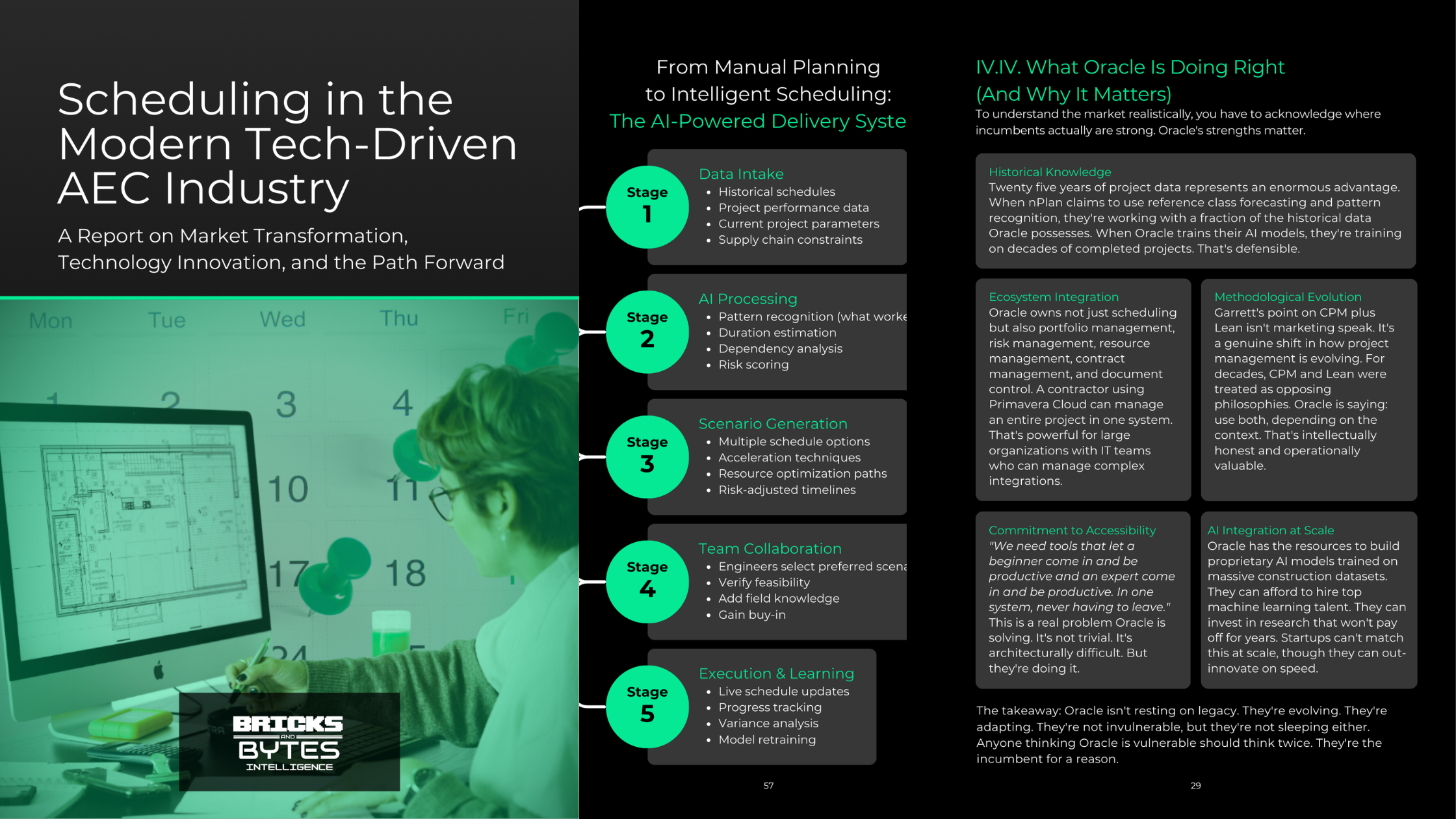
Get a FREE copy of our Scheduling in the Modern Tech-Driven AEC Industry: A Report on Market Transformation, Technology Innovation, and the Path Forward” (worth $150) and a FREE weekly email to stay up to date on construction tech. SIGN UP TODAY!

Scheduling in the Modern Tech-Driven AEC Industry

Sign up to the #1 Newsletter In AEC Tech. Join over 2,100 like-minded Founders, Investors and Techies disrupting the way we build. 

Scheduling in the Modern Tech-Driven AEC Industry