Author name: Owen Drury

Newsletter

The $275M Sale: BuildingConnected’s Sales Motion – Mike Pettinella – EARLY RELEASE

This is an early release of our podcast, exclusive for premium subscribers. To get early access, upgrade here. EARLY RELEASEThe $275M Sale: BuildingConnected’s Sales Motion Mike Pettinella, CRO at OnSightIQ and former VP of Sales at BuildingConnected, breaks down the strategies that drove a zero-revenue startup to a $275M acquisition by Autodesk. From navigating international expansion to cracking the notoriously difficult owner/developer market, Mike shares the hard-won insights that separate successful AEC tech companies from the rest. In this episode, you’ll: Discover the fundamental difference between a VP of Sales and a CRO and why it matters for your growth strategy Learn how BuildingConnected went from zero revenue to a $275M exit through strategic sales execution Understand why selling to owners/developers is harder but more scalable than targeting contractors Get practical frameworks for managing complex enterprise sales cycles with multiple stakeholders Master the art of international expansion without falling into common product-market fit traps Uncover the relationship-building tactics that close mid-six figure deals in construction tech Chapters 00:00 – Introduction: CRO vs VP of Sales – What’s the Real Difference? 01:09 – Building Connected’s Journey: Zero to $275M Exit Strategy 05:04 – The Art of Monetization: Flipping the Switch Without Losing Users 11:18 – From Consulting to SaaS: What Translates and What Doesn’t 16:40 – International Expansion: Why Most AEC Tech Companies Fail Globally 22:16 – Cultural Sales Challenges: Selling to Brits vs Germans vs Americans 26:17 – OnSiteIQ Strategy: Why Target Owners Instead of Contractors 30:48 – The Founder DNA: What Makes Great AEC Tech CEOs 36:28 – Reality Capture Market: Construction vs Owner Adoption 46:39 – Sales Execution: Managing Complex Enterprise Sales Cycles 56:16 – Closing Big Deals: The Anatomy of a $600K Sale 59:41 – Mentoring Sales Teams: Building Trust and Relationships 01:06:43 – Leadership Philosophy and Building Company Culture »»» Listen Now (Premium Subscribers Only) ««« Subscribe to our premium content to read the rest. This is a subscriber only post. Become a paying subscriber of our annual or monthly paid subscriptions to get inside takes on growth in construction tech. Upgrade Translation missing: en.app.shared.conjuction.or Sign In Powered by beehiiv

Newsletter

The Automation Paradox: Why ‘Imperfect’ AI Might Be the Only Honest Answer

Want to get your message in front of {{active_subscriber_count}} highly engaged innovation leaders? Check out our sponsorship offers. INDUSTRY INSIGHTSThe Automation Paradox: Why ‘Imperfect’ AI Might Be the Only Honest Answer How one founder’s 6-year journey from video games and high-performance computing to AI-powered electrical design reveals the hidden complexity of automation-first products “Error-free design is not what we generate today.” This candid admission from an AEC tech CEO was a surprising one. Here’s a company six years in the making, with a team building AI for electrical design, and their leader is telling us their system still requires human intervention. But, after diving deep into Francesco Iorio’s journey from video games development and computational research to automating electrical designs, we understand why this “imperfect” approach might be one of the most honest things anyone has said about design automation. TL;DR: The Automation Paradox AI in AEC doesn’t need to be perfect. It just needs to solve scarcity. Perfect automation isn’t the goal. Solving real scarcity is. 80% solutions work if they make experts 5x more productive Capacity expansion > efficiency gains = defensibility Integration beats disruption in conservative industries Deep domain expertise, not pure tech, drives adoption Vision: democratize expertise so every building gets world-class design The big idea? Imperfect AI that learns from human edits may be the only way to reach true automation — and transform entire industries. The Fork in the Road Every AEC tech company faces this moment: Do you build workflow acceleration tools or attempt end-to-end automation? Most choose acceleration. It’s the safer bet. Faster time-to-market, easier adoption, predictable revenue streams. But some choose the harder path. Design reviews in action. Source: Freepik While competitors build point solutions that speed up existing workflows, certain teams spend years building AI that can route tens of miles of electrical conduit across complex buildings in minutes. Their approach? Getting “full results in a single shot, with minimal commands.” This decision ripples through everything: product architecture, development timelines, competitive positioning, and funding requirements. Where others see workflow problems, they see automation opportunities Here’s the thing about that choice: Autodesk’s 2024 State of Design & Make report shows 44% of AECO professionals now cite improving productivity as their top AI use case. The industry is signaling readiness for more ambitious solutions. But automation isn’t just harder to build. It’s a fundamentally different category of software that requires different thinking about market timing, competitive strategy, and capital requirements. Selling Capacity Extension Vs Efficiency Gains Six months into the automation journey, Augmenta.ai discovered something that transformed their entire approach. The problem wasn’t making electrical design faster. It was making expertise available at scale. Think about it: Electrical contractors face a simple constraint. They need to complete projects on time with the people they have. But there simply aren’t enough skilled professionals who do this job well. You can’t solve a talent shortage by hiring more people if those people don’t exist. But you can solve it by making existing experts 5x more productive. When you’re selling capacity expansion rather than efficiency improvement, you’re not competing on cost. You’re solving constraints that literally cannot be solved any other way. And that makes you defensible. Automated routing and coordination of conduit systems. Source: Augmenta The Counterintuitive Truth About “Perfect” Here’s where it gets interesting. After six years of development, this system delivers designs that are roughly 80-85% complete. Users spend time finishing the remainder. Your first instinct might be: “That’s not automation, that’s just assistance.” But here’s the genius in the approach. Every human intervention teaches the system. Every edit becomes training data. Every “incomplete” design reveals exactly where the AI needs improvement. The team measures how much time people spend using their system relative to manual modeling, with the goal of driving that intervention time to zero. The learning strategy only works under one condition: You must be solving a real scarcity problem. If users desperately need the capability, they’ll tolerate imperfection while you perfect the system. If they don’t, they’ll abandon imperfect automation for familiar workflows. The generative design market validates this patient approach, growing from $298 million in 2024 to a projected $1.39 billion by 2034. Customers are willing to adopt imperfect automation that solves real problems. The path to 100% automation isn’t linear. It requires building learning systems, not just functional systems. Playing Nice with the Ecosystem Another paradoxical choice: integrate with existing platforms instead of building standalone solutions. This creates fascinating dynamics. Automation companies operate within established ecosystems while potentially competing with those same platform providers’ own automation initiatives. Why choose integration over independence? Because electrical contractors live in Revit. Fighting that reality adds years to adoption, regardless of technical superiority. The trade-off is real: Integration limits technical flexibility But respects established user patterns It’s distribution strategy disguised as technical architecture Acknowledges industry inertia while building for future possibilities In conservative industries, distribution often matters more than differentiation. You can have the most sophisticated technology in the world, but if it requires users to change fundamental workflows, adoption becomes an uphill battle that most startups can’t sustain. AI tools working inside familiar electrical design platforms. Source: Edraw.AI The Expertise Bottleneck What separates successful automation companies from the dozens of AI companies trying to crack construction? Understanding both the technology AND the problem domain. Technical backgrounds matter, but industry expertise creates the real differentiation. Teams with 20-30 years of electrical design experience understand pain points that pure technologists miss. Domain expertise shows up in unexpected places: Product decisions (starting with the most complex systems first) Technical architecture (building for component physicality) Go-to-market strategy (manufacturer-specific requirements from day one) Customer conversations (hardly ever mentioning AI) Successful automation companies make the technology secondary to solving real problems with deep industry knowledge. The implication is sobering: you need either founding team domain expertise or the patience to develop it through years of customer development. Pure technical talent isn’t sufficient for complex automation. The rules governing electrical systems are “very quirky” and

Newsletter

Procore Slows. Trimble Soars. Plus the $1.5M OpenAI Employee Bonus

Construction SaaS is slowing. Hardware is roaring back. And AI is playing Vegas odds. In this week’s Bricks, Bucks & Bytes episode: 📉 Procore delivers strong numbers but signals slowing growth (investors aren’t buying it). 🚜 Trimble raises forecasts, proving hardware + physical integration is the real moat. 🤖 Betting markets say Google beats OpenAI in the next AI race (but don’t count Anthropic out). But that’s not all: Patric Hellermann explains why hardware is the “ultimate bathtub moat” (and why OpenAI wants in). Dustin DeVan unloads on Procore’s upsell model (“their bidding tool is trash”). Derek Wong joins to drop a masterclass on winning LinkedIn in AEC: content is the new box of donuts. 🎧 Listen now for: Why SaaS multiples are depressed and what Procore must do to regain vision. How Trimble turned tractors and GPS into a 52-week high. Why betting on AI models looks a lot like poker. The one mistake Procore made back in 2021 that might haunt them today. Watch the Full Episode 🗣 Bonus: Some personal highlights Owen contemplates joining OpenAI for the $1.5m bonus. Patric still can’t resist bathtub metaphors. Dustin wonders if poker would’ve been easier money. Martin insists his engineering drawings are always 100% accurate (unlike Millennium Tower). You might also like: Turner’s 44% Growth, Figma IPO Rogue Calculations, Meta’s $150B Block & AI’s 85% Fail Rate $555K Salary for Construction Engineers, Trunk Tools $40M Round, Stone Carving Robots Vibe Coding Will Die, nPlan CTO Warning, Woodchuck $3.75M Raise, Parsepec $20M Series A $5B Heat Crisis, 89% Productivity Drop, Plastic Innovation, $10M Raise Success with Sean Petterson ChatGPT Makes Us Dumber, LIVE from House Factory, Vibe Designing Is Here Apple Kills Cold Calling, In Office Scares CEO’s, Insurance Proves Climate Change Fears New Steel Tariffs Hit, Is A 12hr Work-day Unreasonable? ChatGPT NoteTaker Kills Startups Builder AI $450M Bankruptcy – Beginning Of The End for AI Startups? Johnny Ive $6.5B Hire, TAM Check Why Data Centers Might Crash, Y Combinator Predatory Practices, with Softbank’s $100B Pledge How China Builds Nuclear Plants Cheaper, Construction’s $860bn Problem, & Trump 2.0 Germany Effects Powered by beehiiv

retrofit customer acquisition strategies
Go To Market, Startups

Cracking Customer Acquisition in Retrofit: Blending Digital Marketing with Hyperlocal Strategies and Partnerships

  If you’re building a retrofit business, you’ve probably heard the age-old marketing advice: “Just run some Facebook ads and scale from there.” While digital marketing certainly has its place, the reality of customer acquisition in the retrofit space is far more nuanced and requires a multi-channel approach that many founders overlook. Christian Gruener, co-founder and CEO of VARM (a German insulation company that’s completed over 500 projects), recently shared his hard-won insights about what actually works when it comes to acquiring retrofit customers. His approach offers a masterclass in blending digital efficiency with the relationship-driven nature of home improvement. TL;DR: The Three-Pillar Approach to Retrofit Customer Acquisition Successful retrofit companies need a balanced customer acquisition strategy that goes beyond traditional digital marketing. Digital paid marketing provides the foundation but becomes expensive at scale Hyperlocal strategies build community trust and generate powerful referrals Strategic partnerships with energy consultants create pre-qualified leads The combination of all three channels creates sustainable growth Referrals become increasingly important over time (60-70% for established craftsmen)   In this episode, Christian Gruener from VARM shares his journey of building a VC-backed installation business aimed at becoming the European champion in the space.   The Foundation: Digital Marketing That Actually Works Let’s start with the obvious channel: paid digital marketing. VARM, like most retrofit companies, began with Meta (Facebook) advertising and other digital channels. But here’s where Gruener’s approach differs from the spray-and-pray mentality of many startups. “We always said, hey, if we do something, it has to make sense taking the money and yes, we’re trying to create more revenue with that, but it has to have a positive return on investment. Otherwise we don’t do it,” Gruener explains. This disciplined approach to digital marketing is crucial because of a fundamental truth about paid advertising: it doesn’t scale linearly. “Paid marketing is always the easiest way to start, but it’s also the worst scaling factor of these dimensions,” Gruener notes. “Because if you spend more and more on marketing, leads becoming more expensive, at one point it’s not profitable anymore.” The key insight here is that digital marketing should be your starting point, not your ending point. It provides immediate feedback, allows for rapid testing, and gives you the cash flow to invest in other, more sustainable acquisition channels. The Secret Weapon: Hyperlocal Marketing Strategies Here’s where things get interesting. While most tech-enabled retrofit companies focus exclusively on digital channels, VARM discovered that hyperlocal, offline strategies can be surprisingly effective. “We try to be very, very locally on the ground doing some informative events,” Gruener shares. “For example, at a local municipality, they have an info session about retrofits. And then someone of us would go there and say, hey, you should insulate your house.” This might sound old-fashioned, but there’s method to this madness. Retrofit projects are high-consideration purchases that homeowners typically research extensively before committing. Being physically present in local community events builds trust in a way that digital ads simply cannot. The hyperlocal approach also taps into something powerful: the referral network effect. As Gruener points out, traditional craftsmen businesses get “60, 70% via referrals of their business.” This doesn’t happen overnight – “you need five years until referrals kick in” – but VARM is already seeing 10-20% of their business coming from referrals. The offline approach works particularly well in retrofit because homeowners want to see and touch the quality of work. “These five or five stars are important to us because in the long run, this will pay off. These will lead to more and more referrals,” Gruener explains about their focus on perfect execution. The Growth Multiplier: Strategic Partnerships The third pillar of VARM’s customer acquisition strategy might be the most ingenious: partnerships with energy consultants. This channel showcases how thinking systematically about your customer’s journey can unlock hidden acquisition opportunities. Here’s how it works: homeowners who are thinking about retrofit often start by hiring an energy consultant to assess their property and make recommendations. These consultants create detailed reports that typically include multiple recommendations: “insulate your facade, insulate your roof, insulate your cellar, then change your windows. And then at the end of the day, there’s a heat pump and a solar system.” For VARM, partnering with these consultants is a natural fit. “Collaborating with these energy consultants makes a lot of sense for us because when they already know the customer, they know the house, we can have a win-to-win partnership.” What’s particularly smart about this approach is that it targets customers who are already committed to retrofit improvements and have been pre-qualified by a trusted advisor. The energy consultant has done the hard work of education and need identification; VARM simply needs to execute. Interestingly, many of these partnerships aren’t even revenue-share arrangements. “Very, very often that’s the very cool part is that these energy consultants, they just want someone who does a proper job,” Gruener notes. “They often are lone wolves… and they just want for their customers, someone who does a really, really good job.”   The Compounding Effect of Multi-Channel Acquisition What makes VARM’s approach particularly effective is how these three channels reinforce each other. Digital marketing provides immediate lead flow and data. Hyperlocal strategies build brand recognition and trust in specific geographic areas. Partnerships create a steady stream of pre-qualified leads. Over time, the combination creates a compounding effect. As VARM completes more projects in a local area through digital marketing, their hyperlocal presence becomes more credible. Their reputation for quality work (evidenced by their perfect 5.0 star rating) makes energy consultants more likely to refer clients. And satisfied customers from all channels become referral sources themselves. This multi-channel approach also provides resilience. If Meta advertising costs spike or algorithm changes reduce reach, VARM isn’t left scrambling. They have established local presence and partnership relationships that continue generating leads. Lessons for Other Retrofit Companies The VARM case study offers several actionable insights for other retrofit companies: Start with digital, but don’t stop

construction tech digital marketing content
Go To Market

The Blue Ocean of ConTech Digital: How Memes and Meaningful Content Build Trust

  Here’s a secret that most construction technology companies haven’t figured out yet: while they’re all fighting over the same traditional marketing channels, there’s a massive blue ocean of opportunity sitting right under their noses. Digital marketing in construction tech is still largely untapped territory, and the companies that get this right are going to dominate. According to David Horesh, a marketing consultant who helped take 4M Analytics from startup to significant scale, the construction industry’s approach to digital marketing is fundamentally broken. And that creates an incredible opportunity for companies willing to do things differently. TL;DR: The Untapped Digital Marketing Goldmine in Construction Tech While everyone does traditional marketing, digital remains a blue ocean with massive opportunity Construction professionals are active on LinkedIn and Reddit, but companies aren’t reaching them effectively Corporate content doesn’t resonate—memes and authentic pain point content does Building trust comes before selling; show you understand their challenges first Digital marketing allows relationship-building at scale unlike traditional methods Success comes from being your audience’s “favorite,” not just the best product   In this episode,  David Horesh shares why construction marketing is still a blue ocean, how to avoid the handshake trap, and why memes might be your secret weapon.   The Great Digital Marketing Misconception “Something that I’ve heard from a lot of CEOs, a lot of founders in the construction tech industry is ‘this is a traditional industry, so we need to do traditional marketing,’” Horesh explains. “That’s print, billboards, conferences.” While these channels have their place, this thinking completely misses the massive digital opportunity. The misconception stems from a fundamental misunderstanding of how construction professionals actually behave. Yes, they work on job sites. Yes, they value handshakes and relationships. But they also carry smartphones, scroll LinkedIn during their morning coffee, and engage with content that resonates with their daily challenges. Horesh discovered this firsthand when exploring construction communities on Reddit. “I see threads on Reddit and I was really surprised because Reddit felt to me like a conspiracy theory platform,” he admits. “But I found forums with project managers and project engineers where people are active, posting their problems, and getting answers.” The data backs this up. When you look at LinkedIn’s published numbers for construction professionals across North America, there’s a clear alignment between the number of civil engineers and construction workers in the real world and those actively using the platform. The Content Problem: Corporate Noise vs. Authentic Connection So if construction professionals are online, why isn’t digital marketing working for most companies? The answer lies in the content they’re creating. “Even those who do use LinkedIn, Twitter, and these platforms—their content is just not good,” Horesh observes. “They’re sort of dark green, dark blue, grayish corporate materials. They put up these case studies, these one-pagers, and nobody’s reading that. Nobody’s downloading that.” This corporate approach completely misses the mark because it fails to understand a fundamental truth about the construction industry: these are no-BS people who can spot authentic communication from a mile away. “The greatest thing about the construction industry is that the people in the industry are no-BS type of people,” Horesh explains. “And the craziest thing is that industry marketers think they need to create BS content to market to no-BS people.” The Meme Revolution: Why Humor Works in Hard Hats This insight led Horesh to one of his most controversial but effective recommendations: using memes in construction tech marketing. And before you roll your eyes, consider this—some of the most successful construction tech marketers are already doing this. “You see the stuff that Matt is doing and Joey is doing, and these guys are killing it,” Horesh notes. “They’re standing out because they’re creating content that nobody else is creating. They’re making fun of pain points.” The genius of memes in construction marketing isn’t just that they’re different—it’s that they demonstrate understanding. When you create a meme about change orders, delayed permits, or the frustration of managing subcontractors, you’re showing your audience that you get their world. You understand their daily struggles. “When you see content from a company producing content that shows your ICP that you understand them, that you understand their challenges, they will believe in what you’re doing,” Horesh explains. “You need to first create content that shows you understand the pain points of your ICP. After that, they’ll engage with that content, and eventually they’ll ask themselves, ‘What’s this company that’s sharing this content? What do they do?’”   The Psychology of Digital Trust Building This approach works because it mirrors how people actually consume content and make purchasing decisions in 2025. Think about the last time you bought a pair of shoes—did you go to a store and ask a salesperson to explain the features, or did you research online first? “People want to buy with as little friction as possible,” Horesh argues. “This is buying behavior in 2025. We need to cater to it.” The construction industry hasn’t caught up to this reality yet. Most companies still believe they need face-to-face meetings for everything, missing the opportunity to build relationships at scale through digital channels. The key is understanding that digital marketing isn’t about replacing personal relationships—it’s about building them more efficiently. When someone has been consuming your content for months, seeing your memes, reading your insights about industry challenges, and nodding along with your understanding of their pain points, they’re already primed for a relationship when you do connect. The Strategic Framework: From Awareness to Advocacy Horesh breaks down the digital marketing journey into clear stages: Awareness: Getting in front of your target audience where they actually spend time—LinkedIn, Reddit, industry forums—not just where you think they should be. Trust: Creating content that demonstrates deep understanding of their challenges. This isn’t about your product; it’s about their problems. Demand: Converting that trust into actual interest. When people believe you understand their world, they’ll reach out to learn more. Relationship: Moving from digital connection to business conversation, armed with the

Newsletter

ICYMI: Turner’s $13.4B Revenue, TestFit’s Pod Strategy, and the $20B Figma Fiasco

Want to get your message in front of {{active_subscriber_count}} highly engaged innovation leaders? Check out our sponsorship offers. This Week’s Quickfire BytesFuel your curiosity with this week’s contentW/C 11th August 2025 NEW EPISODESTestFit Does 1000+ Iterations Per MILLISECOND – Construction AI That Actually Delivers Laura Paciano and Jack Joers from TestFit share how they’re collapsing two months of pursuit costs into a single day, why big tech giants keep failing in construction, and how one customer won $750,000 more business in their first year. Find out why innovation is never asked for and how to educate markets on solutions they don’t know they need, how TestFit collapses the traditional 2-month feasibility process into one day with live collaboration, and why architects are the hardest to convince but quickest to adopt new technology once they decide. Turner’s 44% Growth, Figma IPO Rogue Calculations, Meta’s $150B Block & AI’s 85% Fail Rate with Dex from Propel People We dive deep into the shocking stories reshaping the construction industry, plus a special guest appearance from construction tech veteran Dex who just raised $3 million to solve the industry’s biggest crisis. We cover Turner Construction’s mind-blowing 44% revenue growth (and why it’s “impossible”), the Figma IPO scandal that cost early investors millions, and why Meta can’t spend $150 billion even though they want to. Fieldwire’s $300m Exit Journey Yves Frinault shares how military training shaped his leadership style, why gaming experience was crucial for building construction software, and the near-death moment that almost killed Fieldwire. Find out how paratrooper training taught him fairness in leadership, why he went from half salary to a successful Series A in months, and how Fieldwire broke the $100M curse with their Hilti acquisition. View all Podcasts BRICKS & BYTES PREMIUMEarly Release Episodes Distribution Beats Product: Lessons From a Two-Time Founder- Maksim Markevich – EARLY RELEASE Maksim Markevich, CEO of Sunbeam and co-founder of PVFarm, shares brutal truths about building AEC tech companies. The Billion-Person Problem: How AI Will Replace Your Project Managers – Greg Lawton – EARLY RELEASE Greg Lawton, CEO of Nodes and Links, is solving construction’s billion-person workforce shortage with AI – and the results speak for themselves. How This CMO Built a 60% Word-of-Mouth Acquisition Engine – Matt Daly – EARLY RELEASE DroneDeploy CMO Matt Daly reveals the blueprint for scaling construction tech companies—from building a 60% word-of-mouth acquisition engine to navigating the reality capture market consolidation. Augmenta’s Bold Bet: Automating the ‘Hardest Problem’ in Construction – Francesco Iorio – EARLY RELEASE Francesco Iorio left his Director role at Autodesk to solve construction’s most complex automation challenge. Hear why electrical design became his $350M obsession. 2 FAVORITE QUOTES: “I joke with the team, I’m like on Wednesdays we change pricing. Just because we need to test, we need to push and see where that market fit really is.” – Laura Paciano on the iterative nature of finding the right pricing model “I would like to really meet these bankers in a dark alley after we had a few beers. Because this, honestly, is highway robbery for the existing investors.” – Patric Hellermann expressing frustration about Figma’s IPO underpricing BRICKS & BYTES PREMIUMReady to Break Through the $10M Ceiling? Here’s a quick recap of what you’ll receive as a premium subscriber: Premium in-depth articles delivered to your inbox Early access to podcast episodes before public release 33% discount on all future GTM guides we publish Want 33% off the guide? Sign up for our monthly subscription UPGRADE TO PREMIUM YOU MIGHT ALSO LIKE Premium Insights 10 Hard-Won Lessons from Founders Who Sold for Millions A Step-by-Step Guide to Clear Product Marketing for AEC Startups 12 Lessons About Hiring From AEC’s Top Leaders More Insights NSFW: Build a F*cking Business McKinsey’s Secrets to Scaling Construction Tech How Flux Burned Through $29M – Lessons for AEC Innovators Ex AutoDesk CEO’s 12 Lessons For Developing Products Could an Entrepreneur in Residence Save Your Construction Firm? Reports and Case Studies Innovating the Future: Robotics and the Revolution in Construction The Future of Design Software In AEC – Experts Insights Investing In AEC Tech The Future Of Construction Document Management The Construction Tech Revolution In India: Lessons From InfraMarket’s Success Innovation at Windover Construction Swinerton’s Innovation Strategy Most Popular Episodes How To Build A Unicorn In Construction Tech – Patric Hellermann Story Of A Modular Construction Startup That Burned Through £10M in 15 Months – Chris Spiceley McKinsey FINALLY updates their Productivity Curve, & The Future Of Construction – David Rockhill, Partner at McKinsey Procore’s AI Strategy & Implementation – AI’s Role in Modern Construction Disrupt Autodesk? This Ex-Autodesk CEO Has Some Advice – Amar Hanspal Super Series Super Series with Ediphi Super Series With Speckle Super Series With Monumental Super Series with Foundamental OUR SPONSORS BuildVision — streamlining the construction supply chain with a unified platform for contractors, manufacturers, and stakeholders. Powered by beehiiv

AI impact on critical thinking construction technology
Technology

The Impact of AI on Critical Thinking and Human Development in Contech

  A recent MIT study has sparked a fascinating debate about artificial intelligence’s impact on human cognitive development, and nowhere is this more relevant than in the construction technology sector. As AI tools become increasingly sophisticated and prevalent in architecture, engineering, and construction workflows, we’re facing a fundamental question: Are we creating a generation of professionals who can leverage AI’s power while maintaining their critical thinking abilities, or are we inadvertently creating cognitive dependency? TL;DR: AI and Critical Thinking AI’s growing influence in construction technology raises important questions about human cognitive development The research: MIT study shows ChatGPT users had lowest brain engagement and consistently underperformed The muscle atrophy effect: Like physical muscles, cognitive abilities may weaken without regular use The construction context: AI tools are becoming essential for design and workflow optimization The balance challenge: How to leverage AI benefits while maintaining human expertise and judgment Key insight: AI should augment human capabilities, not replace critical thinking skills   In this episode, we dive deep into the controversial world of AI and its impact on our brains, plus exclusive behind-the-scenes access to Cuby’s revolutionary construction process.   The MIT Study: A Wake-Up Call The study’s findings were stark. When researchers divided 54 subjects into three groups – using ChatGPT, Google search, and no assistance – those using AI consistently showed the lowest brain engagement across 32 neural regions. Perhaps most concerning, AI users became progressively lazier over time, often resorting to copy-and-paste by the study’s end. This shouldn’t shock anyone who’s been paying attention. As one industry observer noted, “All the fanboys online tell me that AI makes us more intelligent,” but the scientific evidence suggests otherwise. The human brain, like any muscle, appears to experience atrophy when not regularly exercised. The Muscle Atrophy Metaphor Think of it this way: imagine a drug that gave everyone supernatural physical abilities but caused muscle atrophy as a side effect. While you’d be incredibly capable while using it, your fundamental ability to function without it would deteriorate. That’s essentially what we’re seeing with AI tools. In construction technology, this presents a unique challenge. We’re seeing tools like SnapTrude revolutionize early-stage design, allowing architects to go from initial concept to complete design packages in record time. The question isn’t whether these tools are valuable – they clearly are. The question is how we use them responsibly. The Construction Technology Context The construction industry has always been about solving complex problems with limited resources and tight timelines. AI tools are becoming essential for: Design optimization: Tools that can rapidly iterate through design options while considering zoning codes, climate requirements, and structural constraints Workflow automation: Platforms that connect spreadsheets, design tools, and collaboration boards into seamless workflows Decision support: Systems that validate design decisions with real-time data and simulations But here’s where it gets interesting: unlike pure software development, construction deals with physical reality. You can’t just prototype a building and hope it works. As one construction tech entrepreneur put it, “You can’t collapse this time that quickly” when dealing with tangible engineering challenges. The Black Mirror Reality We’re already living in what one might call a “Black Mirror episode” when it comes to dependency on external systems. Consider how many professionals rely on GPS for navigation, smartphones for memory, and search engines for information. Each of these tools has made us more capable in some ways while potentially diminishing our natural abilities in others. The construction industry isn’t immune to this trend. Fast food has created dietary dependency, mortgages have created financial dependency, and now AI might be creating cognitive dependency. The pattern is clear: tools that make life easier often come with hidden costs. The Lovable Paradox A recent controversy involving DocuSign and an AI-powered app builder called Lovable illustrates this perfectly. While AI can rapidly create software prototypes, building production-grade enterprise software still requires extensive human expertise, testing, and refinement. As one developer noted, “Lovable can give you prototypes, but to write actually production-grade code… takes tens of thousands of work hours.” This distinction between prototype and production is crucial in construction technology. You can use AI to quickly mock up a design concept, but creating something that actually works in the real world – that passes inspections, meets building codes, and functions safely for decades – requires deep human expertise.   The Education Challenge For those raising the next generation of construction professionals, this creates a significant challenge. Today’s students have unprecedented access to AI tools that can solve homework problems instantly. The temptation to use these tools as shortcuts rather than learning aids is enormous. But here’s the paradox: the professionals who will be most valuable in the AI age are those who understand both the technology and the underlying principles. They can use AI as a powerful tool while maintaining the critical thinking skills to validate, refine, and improve AI-generated solutions. The Washing Machine Precedent History offers some perspective here. When washing machines became mainstream in the 1950s, there were concerns about job displacement. Instead, they freed up human potential for more productive work, particularly enabling women to join the workforce in unprecedented numbers. The key difference was that washing machines didn’t require human judgment – they simply automated repetitive tasks. AI, by contrast, can perform tasks that traditionally required human reasoning and creativity. This makes the potential impact more profound and the need for thoughtful implementation more critical. Finding the Balance The construction industry is uniquely positioned to navigate this challenge because it operates at the intersection of digital innovation and physical reality. Here’s how professionals can maintain the balance: Use AI as a Starting Point, Not an Endpoint: Let AI generate initial concepts, but apply human judgment to refine, validate, and improve them. As one architect noted, “AI systems will compound enough in the next few years to get to a point where they can write an enterprise-grade software. But those are like cute little tools which you can prototype your ideas very quickly.” Maintain Core

Newsletter

Lessons From the Corporate World: What We Learnt so Far in 2025

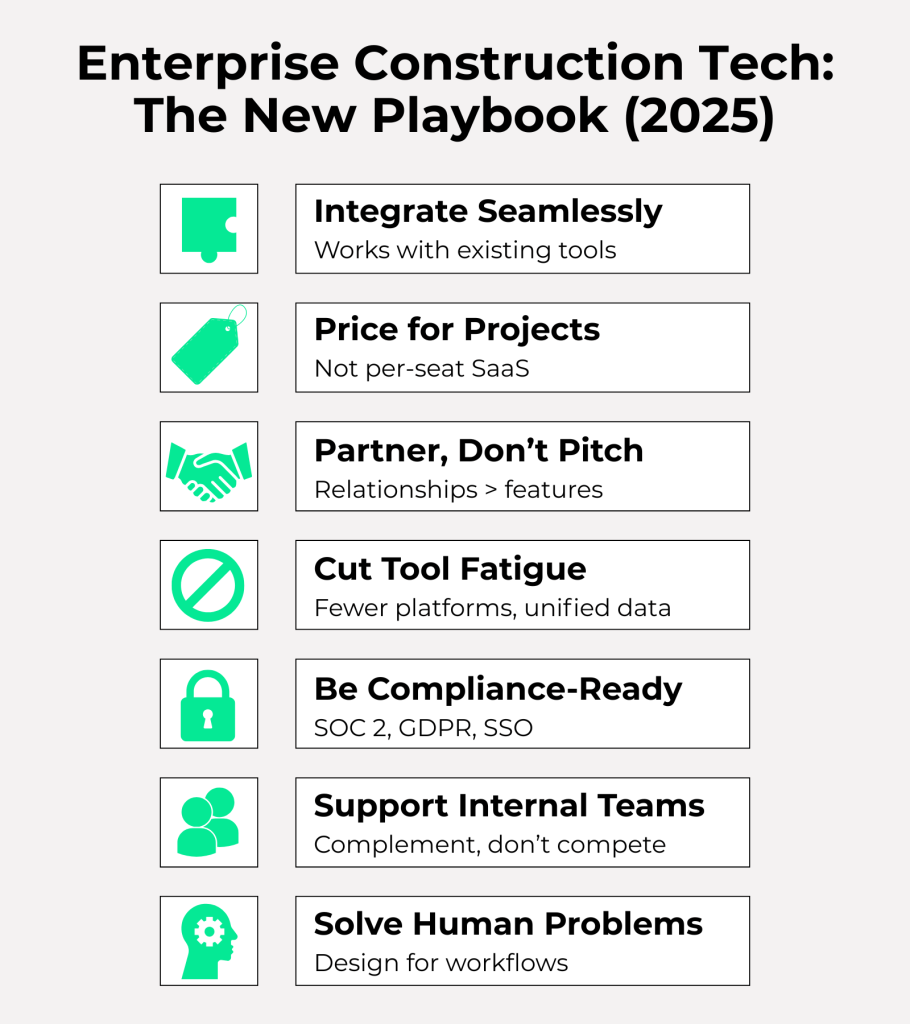
Want to get your message in front of {{active_subscriber_count}} highly engaged innovation leaders? Check out our sponsorship offers. INDUSTRY INSIGHTSLessons From the Corporate World: What We Learnt so Far in 2025 Here’s a sobering reality check: One Boston construction project requires workers to juggle 18 different software tools every single day. But that’s just the beginning. Across the industry, corporate giants are drowning in 200-300 applications, watching promising deals die in procurement hell, and discovering that everything they thought they knew about selling software to construction is wrong. We sat down with the people actually making technology decisions at Skanska, Burns & McDonnell, CRB, Syska Hennessy, and Bulley. What they told us will change how you think about enterprise construction sales forever. The message was unanimous: The enterprise construction market has evolved beyond recognition, and most startups are still fighting the last war. TL;DR: Selling to Enterprise Construction in 2025 The game has changed and most startups are still playing by old rules. Here’s what actually works now: Integration > Innovation – Enterprise buyers want tools that fit seamlessly into existing workflows, not shiny stand-alones. Interoperability is the #1 deal breaker. Project-Based Pricing – Per-seat SaaS models don’t match construction’s project-driven reality. Experiment with hybrid or volume-based pricing. Partnerships Win Deals – Long-term trust beats features, speed, or even ROI. Become the vendor they can’t afford to lose. Reduce Cognitive Load – Tool overload kills adoption. Buyers are consolidating tech into fewer platforms and unified data environments. Compliance is Table Stakes – SOC 2, GDPR, SSO integration — if you can’t meet enterprise security demands, you won’t get in the door. Compete with, Not Against, Internal Teams – Many corporates now build in-house tools. The winners complement internal capabilities, not replace them. Human-Centered Design – Solve people’s real workflow problems, not just “deploy tech.” Bottom line: Enterprise construction tech sales in 2025 are about partnering deeply, integrating intelligently, and pricing realistically. Disruption happens from inside the relationship. The Great Enterprise Deception Every construction tech founder believes the same myth: bigger companies with bigger budgets should be easier targets. The reality is brutally different. Take Skanska’s experience. With 27,000 employees across multiple continents, every single software decision becomes a compliance nightmare. GDPR requirements. SOC 2 certifications. Single sign-on integrations. What looks like a six-figure slam dunk becomes an 18-month procurement odyssey. Skanska workers in high‑visibility jackets on a connected construction site. Credit: Skanska But here’s where it gets interesting. The companies winning these deals aren’t the ones with the best technology. They’re the ones who understand that enterprise construction buyers operate under completely different rules. The decentralization trap: Large construction companies don’t operate like normal enterprises. They run 11+ global practices, each with distinct technology needs. Users constantly switch between projects. Teams form and dissolve. The stable, predictable user base that SaaS models depend on simply doesn’t exist. The compliance reality: The construction tech market, valued at $7 billion in 2025 and projected to reach $30 trillion by 2035, reflects this complexity. Progressive corporate buyers are creating internal “sandboxes” specifically for startups that can’t meet full enterprise requirements yet. They want to innovate, but security standards are non-negotiable. The partnership proof: The vendors succeeding in this environment aren’t selling software. They’re selling six-year relationships. When one major corporation described its primary vendor relationship, it wasn’t about features or pricing. It was about the vendor treating customer challenges as their own challenges, adapting roadmaps based on real feedback, and involving customers in development cycles. The lesson hit us like a freight train: Enterprise construction sales aren’t about having the best product. They’re about becoming the kind of partner that enterprises can’t afford to lose. The Hidden Tax Everyone Pays Every innovation leader we spoke with mentioned the same phrase: “tool proliferation.” But they weren’t talking about software licenses. They were talking about something much more expensive. Industry research reveals that construction businesses use a median of 11 different data environments. Companies report that training costs eat up 48% of their technology budgets, while operational complexity claims another 45%. Here’s the number that should terrify every startup: Construction leaders estimate they could save 10.5 hours per week by moving to unified data environments. Think about that. Ten and a half hours. Every week. For every manager, project lead, and field supervisor in the organization. Engineers and architects in discussion on a construction site The cognitive load crisis: Field teams aren’t rejecting new technology because they hate innovation. They’re rejecting it because they’re already drowning. Fifteen different logins. Eleven different interfaces. Dozens of different workflows that don’t talk to each other. One executive told us their biggest technology win wasn’t implementing a revolutionary new tool. It was eliminating three redundant systems and watching productivity skyrocket. The filtering revolution: The smartest corporate buyers have stopped evaluating individual tools. Instead, they’ve created systematic filtering frameworks. Everything from smart buildings to eco innovation to AI must fit into seven specific buckets. Everything else gets eliminated early, regardless of how innovative it might be. This isn’t technology evaluation. This is a survival strategy. The integration imperative: Leading corporations have learned to ask one question before any technology conversation: “How does this fit with what we already have?” Startups that can’t answer that question don’t get past the first meeting. As one project technology manager told us: “Interoperability is number one. We want to be able to have access to data.” The Pricing Revolution Here’s a controversial truth bomb from one of our participants that should shape every startup’s pricing strategy: “SaaS models don’t reflect how we’re structured as an industry.” The problem runs deeper than most founders realize. Construction operates on projects, not departments. Teams assemble for specific builds, then dissolve. The unit of transaction is the project, not the annual contract. Yet most construction tech companies still default to per-seat pricing designed for stable office environments. The transformation story: When robotic welding programs delivered 10x efficiency improvements, the path to ROI required project-based budgeting that aligned

Newsletter

Distribution Beats Product: Lessons From a Two-Time Founder- Maksim Markevich – EARLY RELEASE

This is an early release of our podcast, exclusive for premium subscribers. To get early access, upgrade here. EARLY RELEASEDistribution Beats Product: Lessons From a Two-Time Founder In this unfiltered conversation, Maksim Markevich, CEO of Sunbeam and co-founder of PVFarm, shares hard-won lessons from building his second AEC tech company. After experiencing the challenges of launching multiple products at Kreo, Maksim reveals the strategic pivot that led to the creation of specialized solar farm design software, featuring a unique industry partnership approach. In this episode, you’ll: Discover why distribution relationships often matter more than perfect products in AEC tech Learn the “go-kill framework” for vetting product ideas before burning through runway Understand how to leverage educational content and webinars to generate 600+ qualified leads Get insider insights on what works (and what fails) in AEC tech go-to-market Explore the future of AI in specialized construction software beyond the hype Hear honest perspectives on remote team management and founder decision-making Chapters 00:00 – From London to AEC tech: Maksim’s journey from Kreo to Sunbeam 03:00 – The hard lessons: Why building “shitty products for problems that don’t exist” fails 08:25 – Distribution vs. product: The two-path strategy for AEC tech success 15:30 – What PVFarm does: Vertical integration in solar farm design 28:00 – Go-to-market that works: Educational content and account-based marketing 32:00 – The webinar strategy: How to get 600 people to show up and engage 34:00 – What doesn’t work: LinkedIn outreach, email blasts, and third-party agencies 36:00 – AI in practice: Building meaningful AI beyond the buzzwords 44:00 – The go-kill framework: Vetting ideas before you build 46:00 – CEO insights: Managing people, understanding motivation, and orchestrating chaos 53:00 – What makes successful AEC products: Balancing innovation with getting the job done 55:00 – London vs. San Francisco: Does location matter for AEC tech? 58:00 – Remote team reality: Why Maksim would choose an office if he could »»» Listen Now (Premium Subscribers Only) ««« Subscribe to our premium content to read the rest. This is a subscriber only post. Become a paying subscriber of our annual or monthly paid subscriptions to get inside takes on growth in construction tech. Upgrade Translation missing: en.app.shared.conjuction.or Sign In Powered by beehiiv

Newsletter

Figma’s IPO a Robbery? + Schneider Electric SOLD OUT till 2030

Data centers, IPO drama, and why pilots keep killing innovation In this week’s Bricks, Bucks & Bytes episode: 🏗 Turner Construction posts a jaw-dropping 44% revenue jump to $13.4B in H1 2025, powered by $12.6B in data centers alone. 📈 The Figma IPO pops then drops, and Patric calls out the bankers for “highway robbery.” 🤖 Nearly half of enterprise AI projects are failing, and the reasons sound eerily familiar to construction tech. But that’s not all: Why Turner’s “SourceBlue” logistics arm could be its quiet billion-dollar profit machine. The pilot project trap. How 2-year zombie pilots waste innovation budgets. Recruiting in construction is broken. Meet Dex from Propel People, fresh off a $3M seed to fix it. 🎧 Listen now for: Why sports stadiums and healthcare are Turner’s other hidden goldmines The 300× forward-earnings madness of Figma’s first trading day How to fix tech adoption before your pilot drags on for years The looming energy bottleneck threatening AI infrastructure Watch the Full Episode 🗣 Bonus: Some personal highlights Why “OK” comes from a 19th-century President Patric’s thoughts on military-style procurement for software Dustin’s case for pilots with hard, fast ROI deadlines You might also like: $555K Salary for Construction Engineers, Trunk Tools $40M Round, Stone Carving Robots Vibe Coding Will Die, nPlan CTO Warning, Woodchuck $3.75M Raise, Parsepec $20M Series A $5B Heat Crisis, 89% Productivity Drop, Plastic Innovation, $10M Raise Success with Sean Petterson ChatGPT Makes Us Dumber, LIVE from House Factory, Vibe Designing Is Here Apple Kills Cold Calling, In Office Scares CEO’s, Insurance Proves Climate Change Fears New Steel Tariffs Hit, Is A 12hr Work-day Unreasonable? ChatGPT NoteTaker Kills Startups Builder AI $450M Bankruptcy – Beginning Of The End for AI Startups? Johnny Ive $6.5B Hire, TAM Check Why Data Centers Might Crash, Y Combinator Predatory Practices, with Softbank’s $100B Pledge How China Builds Nuclear Plants Cheaper, Construction’s $860bn Problem, & Trump 2.0 Germany Effects 90% Of AI Startups Are Worthless, US Economy CRASH, Is Autodesk Investable + $2bn Startup Meltdown Powered by beehiiv

AI construction technology marketing
Go To Market, Technology

How AI is Reshaping Contech Marketing (and What to Do About It)

  Remember when every construction technology company was slapping “AI-powered” on everything from scheduling software to safety apps? Those days are rapidly coming to an end, and if you’re still leading with AI in your marketing messages, you might be missing the mark. According to Phil Carpenter, a veteran tech marketing consultant specializing in the AEC industry, we’re living through a fascinating shift in how AI integrates into construction technology marketing. Carpenter, who teaches marketing at UC Santa Barbara and has spent three decades helping technology startups navigate complex markets, argues that the question isn’t whether AI matters—it absolutely does—but how we talk about it has fundamentally changed. TL;DR: The AI Marketing Evolution in Construction Tech Clear messaging is the make-or-break factor for contech startups in an increasingly crowded market AI marketing has shifted from flashy buzzword to expected ingredient in contech products Construction buyers are experiencing “AI fatigue” – the novelty has worn off Smart marketers are pivoting from AI-first messaging to value-first communication AI tools are revolutionizing marketing operations behind the scenes Success requires balancing AI capabilities with practical construction industry needs   In this episode, Phil Carpenter, a fractional CMO who specializes in AEC tech startups, shares why most AEC startups fail at marketing, the hidden costs of inexperienced hires, and how to actually reach construction professionals   The Great AI Marketing Pendulum Swing When ChatGPT burst onto the scene, construction tech companies went AI-crazy. Suddenly, every product demo led with machine learning capabilities, every website hero section screamed about artificial intelligence, and every sales deck was packed with neural network diagrams that made construction professionals’ eyes glaze over. But here’s what happened: the construction industry got tired of it. Fast. Carpenter observes that construction buyers are practical people who want to know one thing: “How will this help me build better, faster, or cheaper?” They don’t care about the underlying technology—they care about results. When you lead with AI, you’re answering a question they weren’t asking. The pendulum has swung from “AI is everything” to “AI is an ingredient.” Smart construction tech companies are adapting their marketing accordingly. From Spotlight to Background: The New AI Marketing Reality Today’s most successful construction technology companies treat AI like Intel treated their processors in the “Intel Inside” campaign. It’s there, it’s powerful, it matters—but it’s not the headline. Instead of saying “Our AI-powered scheduling platform revolutionizes project management,” winning companies are saying “Cut your project delays by 30% with intelligent scheduling that learns from your team’s workflow.” The AI is still there (it’s doing the learning), but the focus is on the business outcome. This shift reflects Carpenter’s deep understanding of construction buyers. They’re skeptical by nature—they want to see proof, they want references, and they want to understand exactly how something will work in their specific situation. Leading with AI often triggers their skepticism rather than their interest. How AI is Actually Transforming Marketing Operations While AI is becoming less prominent in marketing messages, it’s becoming more powerful in marketing operations. This is where Carpenter sees the real revolution happening. Content Research and Brainstorming. Carpenter recently used Google Gemini to brainstorm topics for byline articles, spending about 45 minutes in back-and-forth conversation with the AI to generate a list of ten compelling article ideas. Marketing teams are using AI tools for deep research and idea generation, rather than spending hours manually researching industry trends. Copy Creation and Optimization. AI is becoming an excellent writing partner—not replacing human creativity, but enhancing it. From crafting compelling ad copy to developing email sequences, AI helps marketers produce more content faster while maintaining quality and consistency. Customer Interaction Enhancement. AI-powered chatbots are handling initial customer inquiries on construction tech websites, qualifying leads, and even helping prospects book demos or consultations. Carpenter previously worked as interim VP of marketing for a Mexico City-based company that created AI-powered chatbots sophisticated enough to handle complete travel bookings for Aeromexico customers. Personalization at Scale. Construction companies serve diverse market segments—from residential contractors to commercial developers to specialty trade professionals. AI enables marketing teams to personalize content and messaging for these different audiences without multiplying their workload exponentially.   The Practical Marketer’s AI Playbook So how should construction tech marketers navigate this new landscape? Based on Carpenter’s experience working with numerous AEC technology startups, here’s what’s working: Lead with Value, Support with AI. Start every marketing message with the business outcome. If AI enables that outcome, mention it as supporting evidence, not as the main story. Construction professionals care about ROI, efficiency gains, and competitive advantages—not the technology stack that delivers them. Use AI to Enhance Your Research Game. Before launching any campaign, use AI tools to deeply understand your target audience’s pain points, industry challenges, and emerging trends. The construction industry evolves constantly, and AI can help marketers stay current with market dynamics. Experiment with AI-Powered Content Creation. Don’t replace human creativity, but augment it. Use AI to brainstorm headline variations, develop email subject lines, or create first drafts that teams can refine. The goal is efficiency and inspiration, not replacement. Implement Smart Customer Engagement Tools. Consider AI-powered chatbots and automated response systems, but implement them thoughtfully. Construction professionals still value human relationships, so use AI to enhance personal connections, not replace them. Focus on Proof, Not Promises. The construction industry remains relationship-driven and reference-dependent. Use AI tools to better identify and showcase customer success stories, but always lead with concrete results and testimonials from real projects. The Future of AI in Construction Tech Marketing Looking ahead, Carpenter predicts that AI will continue becoming more integrated into construction technology products, but its role in marketing messaging will become more nuanced. We’re moving toward a world where AI capabilities are assumed rather than advertised. The companies that will win are those that use AI to better understand their customers, create more relevant content, and deliver more personalized experiences—while keeping their marketing messages focused on practical business outcomes that construction professionals actually care about. Making the Transition

Newsletter

ICYMI: Sculpting Robots, $500K Paychecks, and a $300m Exit Strategy

Want to get your message in front of {{active_subscriber_count}} highly engaged innovation leaders? Check out our sponsorship offers. This Week’s Quickfire BytesFuel your curiosity with this week’s contentW/C 4th August 2025 NEW EPISODES Fieldwire’s $300m Exit Journey Yves Frinault shares how military training shaped his leadership style, why gaming experience was crucial for building construction software, and the near-death moment that almost killed Fieldwire. Find out how paratrooper training taught him fairness in leadership, why he went from half salary to a successful Series A in months, and how Fieldwire broke the $100M curse with their Hilti acquisition. $555K Salary for Construction Engineers, Trunk Tools $40M Round, Stone Carving Robots with Monumental Labs Owen, Martin, and Dustin expose the shocking reality behind AI salaries in construction, debunk viral industry charts, and reveal why your favorite building materials might be making a comeback. They cover why OpenAI is paying engineers 5x more than top architecture firms, he truth behind “construction AI growth” charts flooding social media, and how AI coding tools are changing the startup game (and why most companies are doing it wrong). The Physics of Farm Autonomy – How Autonomy Cuts Farm Capex by 75% Craig Rupp, founder of Sabanto, explains to us from first principles how autonomy is flipping CapEx economics on its head allowing farmers to invest in mode land and retain more of their labor pools. Find out why autonomy increases time and reduces the need for expensive horsepower, the economics behind retrofit kits vs buying new autonomous tractors, and why the next generation of farmers thinks completely different about technology. View all Podcasts BRICKS & BYTES PREMIUMEarly Release Episodes The Billion-Person Problem: How AI Will Replace Your Project Managers – Greg Lawton – EARLY RELEASE Greg Lawton, CEO of Nodes and Links, is solving construction’s billion-person workforce shortage with AI – and the results speak for themselves. How This CMO Built a 60% Word-of-Mouth Acquisition Engine – Matt Daly – EARLY RELEASE DroneDeploy CMO Matt Daly reveals the blueprint for scaling construction tech companies—from building a 60% word-of-mouth acquisition engine to navigating the reality capture market consolidation. Augmenta’s Bold Bet: Automating the ‘Hardest Problem’ in Construction – Francesco Iorio – EARLY RELEASE Francesco Iorio left his Director role at Autodesk to solve construction’s most complex automation challenge. Hear why electrical design became his $350M obsession. Inside TestFit’s Rapid Expansion Playbook – Laura Paciano & Jack Joers – EARLY RELEASE TestFit’s pod strategy revealed: How they launch new markets in months, not years. 2 FAVORITE QUOTES: “You know what’s more expensive? Not being successful.” – Dustin DeVan on large funding rounds and aggressive growth strategies “Forget about that first dollar. We’re going to count the second dollar.” – Yves Frinault, after realizing their first customer wasn’t actually in construction BRICKS & BYTES PREMIUM🚀 Ready to Break Through the $10M Ceiling? Here’s a quick recap of what you’ll receive as a premium subscriber: Premium in-depth articles delivered to your inbox Early access to podcast episodes before public release 33% discount on all future GTM guides we publish UPGRADE TO PREMIUM Want 33% off the guide?Sign Up for Our Monthly Subscription Monthly members ($10/mo) can purchase the guide for just $67 UPGRADE TO MONTHLY YOU MIGHT ALSO LIKE Premium Insights 10 Hard-Won Lessons from Founders Who Sold for Millions A Step-by-Step Guide to Clear Product Marketing for AEC Startups 12 Lessons About Hiring From AEC’s Top Leaders More Insights NSFW: Build a F*cking Business McKinsey’s Secrets to Scaling Construction Tech How Flux Burned Through $29M – Lessons for AEC Innovators Ex AutoDesk CEO’s 12 Lessons For Developing Products Could an Entrepreneur in Residence Save Your Construction Firm? Reports and Case Studies Innovating the Future: Robotics and the Revolution in Construction The Future of Design Software In AEC – Experts Insights Investing In AEC Tech The Future Of Construction Document Management The Construction Tech Revolution In India: Lessons From InfraMarket’s Success Innovation at Windover Construction Swinerton’s Innovation Strategy Most Popular Episodes How To Build A Unicorn In Construction Tech – Patric Hellermann Story Of A Modular Construction Startup That Burned Through £10M in 15 Months – Chris Spiceley McKinsey FINALLY updates their Productivity Curve, & The Future Of Construction – David Rockhill, Partner at McKinsey Procore’s AI Strategy & Implementation – AI’s Role in Modern Construction Disrupt Autodesk? This Ex-Autodesk CEO Has Some Advice – Amar Hanspal Super Series Super Series with Ediphi Super Series With Speckle Super Series With Monumental Super Series with Foundamental OUR SPONSORS BuildVision — streamlining the construction supply chain with a unified platform for contractors, manufacturers, and stakeholders. Powered by beehiiv

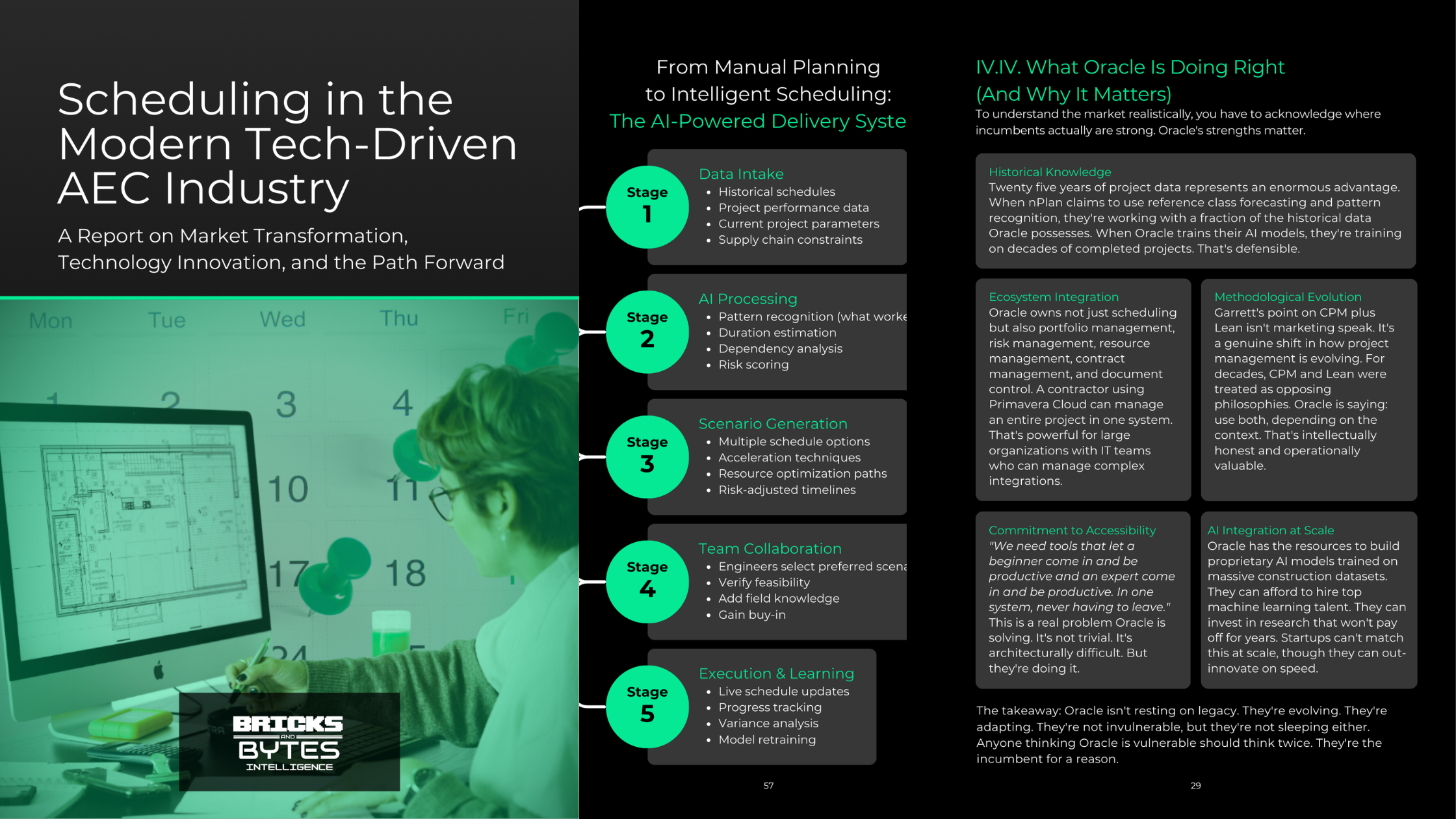
Get a FREE copy of our Scheduling in the Modern Tech-Driven AEC Industry: A Report on Market Transformation, Technology Innovation, and the Path Forward” (worth $150) and a FREE weekly email to stay up to date on construction tech. SIGN UP TODAY!

Scheduling in the Modern Tech-Driven AEC Industry

Sign up to the #1 Newsletter In AEC Tech. Join over 2,100 like-minded Founders, Investors and Techies disrupting the way we build. 

Scheduling in the Modern Tech-Driven AEC Industry