Author name: Owen Drury

Newsletter

Construction Tech’s Most Effective Communicators

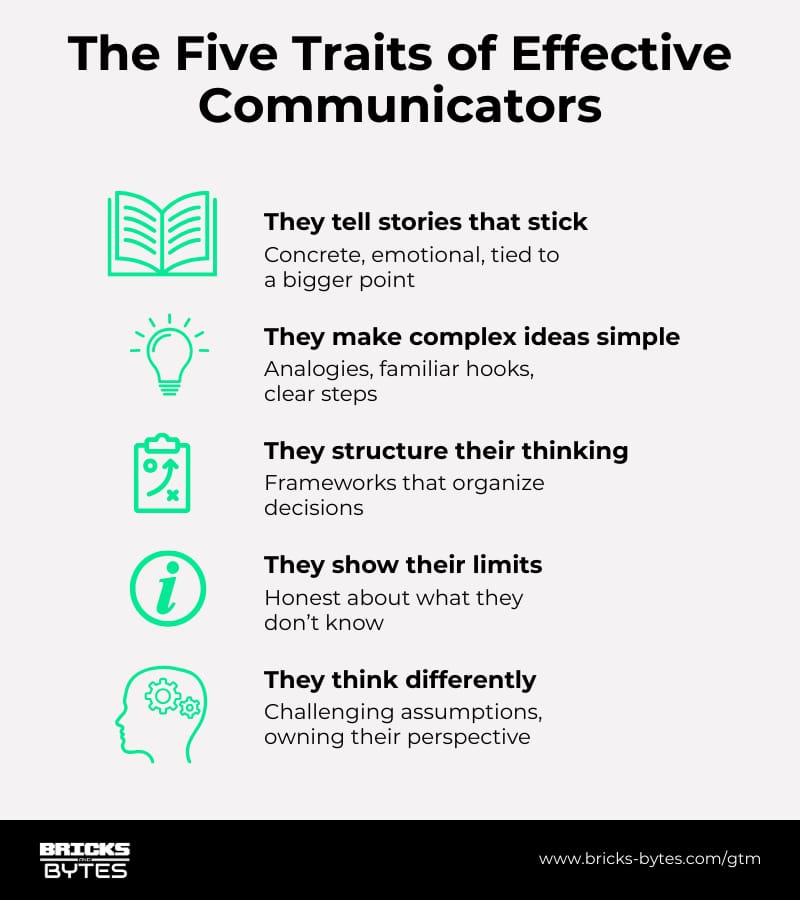
Want to get your message in front of {{active_subscriber_count}} highly engaged innovation leaders? Check out our sponsorship offers. INDUSTRY INSIGHTSConstruction Tech’s Most Effective Communicators Earlier this year, I was trying to figure out why, after hundreds if not thousands of hours of interviews on Bricks & Bytes, some conversations stick in my mind while others fade away. After stepping back and looking at the pattern, the interviews that live rent-free in my head are the ones with the best communicators.  But what exactly makes one person a better communicator than another? In this article, we’ve broken down the top communicators to ever appear on Bricks & Bytes to see what they do so well that their episodes stay with us long after we hit stop recording. It would be no surprise to anyone, that typically speaking, these people are the top performers in their category. Clear & effective communication plays a huge and understated role in building successful businesses.  Here are the five things that separate memorable communicators from everyone else. I’d also like to give a huge shout out to our own communication coach Frankie Kemp for helping us unpack these insights.  TL;DR The best communicators make ideas unforgettable. After thousands of hours of Bricks & Bytes interviews, five traits stand out: They tell stories that stick – concrete, emotional, and tied to a bigger point They make complex ideas simple – using analogies, familiar hooks, and clear steps. They structure their thinking – frameworks that organize decisions and stick in your head. They show their limits – honest about what they don’t know, confident about what they do. They think differently — challenging assumptions and owning their perspective. Subscribe to our premium content to read the rest. This is a subscriber only post. Become a paying subscriber of our annual or monthly paid subscriptions to get inside takes on growth in construction tech. Upgrade Translation missing: en.app.shared.conjuction.or Sign In Powered by beehiiv

Newsletter

What Pharmaceutical Construction Reveals About Tech ROI – James Mize – EARLY RELEASE

This is an early release of our podcast, exclusive for premium subscribers. To get early access, upgrade here. EARLY RELEASEWhat Pharmaceutical Construction Reveals About Tech ROI James Mize, Project Technology Manager at CRB, takes us inside the sophisticated world of pharmaceutical and biotech construction technology. In this candid conversation, James reveals how specialized AEC companies are leveraging digital twins, integrated tech stacks, and strategic vendor partnerships to build some of the most complex facilities on earth. From his unique vantage point managing emerging technology at a $2B+ design-build firm, James shares the unvarnished truth about what works, what doesn’t, and why most construction tech pilots fail. In this episode, you’ll: Discover why digital twins are finally moving beyond the buzzword phase into real ROI-generating applications Learn the exact vetting framework CRB uses to evaluate new technology vendors (including their people-process-technology metrics) Understand why Autodesk partnership delivers their highest ROI and what that means for your technology strategy Get insider perspective on the biggest pain points still plaguing construction projects (hint: it’s not what you think) Hear honest feedback on pricing models, pilot programs, and what actually makes tech leaders say “yes” Chapters 00:01 – Opening: The digital twin challenge 03:08 – CRB’s pharmaceutical construction specialization 08:45 – Technology innovation in design vs construction 12:09 – Autodesk partnership strategy and vendor relationships 17:35 – Advice for technology founders pitching design solutions 22:34 – CRB’s vendor vetting process and evaluation metrics 30:09 – Pricing models and pilot program preferences 36:48 – Biggest construction technology pain points right now 43:51 – Cold outreach strategies that actually work 49:44 – Technology failures and lessons learned 56:02 – Gathering field feedback on new solutions 01:00:13 – What’s next: CRB’s hiring priorities and future initiatives »»» Listen Now (Premium Subscribers Only) ««« Subscribe to our premium content to read the rest. This is a subscriber only post. Become a paying subscriber of our annual or monthly paid subscriptions to get inside takes on growth in construction tech. Upgrade Translation missing: en.app.shared.conjuction.or Sign In Powered by beehiiv

Newsletter

Balfour Beatty’s AI Gamble + Bluebeam’s Big Move

Microsoft’s $10M bet. Bluebeam’s big buy. Autodesk’s AI push. Figma’s stumble. In this week’s Bricks, Bucks & Bytes episode: 🚨 Balfour Beatty drops $10M on Microsoft AI – testing CoPilot on a $185M road project in Scotland. Big brand spend or future of project oversight? 🏗️ Bluebeam acquires Firmus AI – integrating design-risk detection into the industry’s go-to markup tool. A lifeline for Firmus, or a strategic AI leap? 💰 Autodesk earnings surge – $1.7B revenue, 30% free cash flow margins, activist investors pushing, and AEC leading the charge. 📉 Figma IPO hangover – shares slid from $115 highs to $57, even as they unveil agentic AI tools. Investors ask: is the margin squeeze coming? But that’s not all: Dustin DeVan reflects on Microsoft’s $500/seat AI contracts and whether the ROI adds up for GCs. Patric Hellermann shares why acquisitions like Firmus are meaningful milestones in construction tech. Mike Powers explores how Microsoft’s footprint could shape Procore & Autodesk’s enterprise landscape. Ari Bleemer (OneCrew) unpacks his $7.5M raise and why paving software is a promising vertical SaaS play. 🎧 Listen now for: Whether Microsoft is the new Palantir for construction Why Autodesk’s push into AEC is a bigger threat to Procore than ever How niche vertical SaaS plays like paving could be the next billion-dollar category What Figma’s AI bets tell us about software’s future margins Watch the Full Episode You might also like: Robotics Mega Show with Dusty Robotics and ex-Waymo exec & CTO of Bedrock Robotics Construction Productivity Myths, UAE Real Estate, TIMES VC Rankings, with Barton Malow $1.5M AI Employee Bonuses, Procore Growth Slowdown? & LinkedIn Growth Hacks with Derek Wong Turner’s 44% Growth, Figma IPO Rogue Calculations, Meta’s $150B Block & AI’s 85% Fail Rate $555K Salary for Construction Engineers, Trunk Tools $40M Round, Stone Carving Robots Vibe Coding Will Die, nPlan CTO Warning, Woodchuck $3.75M Raise, Parsepec $20M Series A $5B Heat Crisis, 89% Productivity Drop, Plastic Innovation, $10M Raise Success with Sean Petterson ChatGPT Makes Us Dumber, LIVE from House Factory, Vibe Designing Is Here Apple Kills Cold Calling, In Office Scares CEO’s, Insurance Proves Climate Change Fears New Steel Tariffs Hit, Is A 12hr Work-day Unreasonable? ChatGPT NoteTaker Kills Startups Powered by beehiiv

Newsletter

ICYMI: $485M in Robotics Rounds, 140% Retention Secrets, and Why Construction Has Ultimate FOMO

Want to get your message in front of {{active_subscriber_count}} highly engaged innovation leaders? Check out our sponsorship offers. This Week’s Quickfire BytesFuel your curiosity with this week’s contentW/C 1st September 2025 NEW EPISODESThis New Pre-Fab Marketplace Will Solve Construction’s Hidden Capacity Crisis Britton Langdon shares his journey from building M-Suite to launching BuildFactory, the hidden capacity problem in prefab shops, and why construction has more FOMO than any other industry. Find out how he achieved 140% net retention at M-Suite before selling to Stanley Black & Decker, why every prefab shop has hidden capacity but nobody talks about it, and the marketplace approach to solving construction’s supply and demand problem. Robotics Mega Show with Dusty Robotics and ex-Waymo exec & CTO of Bedrock Robotics We dive deep into the robotics revolution hitting construction with two industry-changing guests. Mo also joins as co-host, bringing his Silicon Valley robotics expertise to unpack the biggest funding rounds and breakthroughs happening right now. We discussed why Dusty Robotics chose layout printing over flashier robot applications, how ex-Waymo engineers are retrofitting excavators with self-driving tech, and why Field AI’s $405 million funding signals a tipping point for the industry. Construction Robots Drop From $100K to $15K: Why Every Contractor Will Buy One in 2025 Matt Daly, CMO of DroneDeploy, talks about the hidden robotics revolution happening in construction, why most startups are choosing the wrong funding path, and how AI agents with “a million eyeballs” are about to transform job sites. Find out how ground robots went from $100K to $15K and why this changes everything, why 60% of DroneDeploy’s new customers come from word of mouth, and the biggest mistake early-stage construction tech founders make with funding. View all Podcasts BRICKS & BYTES PREMIUMEarly Release Episodes How Procore Plans to Win BIM – Dave McCool & Tore Hovland – EARLY RELEASE Procore’s billion-dollar BIM bet: Why they acquired NovaRender and Flypaper, the real adoption numbers, and the streaming tech that could kill drawings forever. Managing 200+ Tools: Skanska’s Tech Reality Check – Mike Zeppieri & Danielle O’Connell – EARLY RELEASE Skanska’s innovation leaders reveal the brutal truth about enterprise tech adoption – from “zombie pilots” that never die to why AI transcription is breaking meeting culture. The $275M Sale: BuildingConnected’s Sales Motion – Mike Pettinella – EARLY RELEASE Mike Pettinella, CRO at OnSiteIQ and former VP of Sales at BuildingConnected, reveals the strategies that built one of construction tech’s biggest success stories. Distribution Beats Product: Lessons From a Two-Time Founder- Maksim Markevich – EARLY RELEASE Maksim Markevich, CEO of Sunbim and co-founder of PVFARM, shares brutal truths about building AEC tech companies. The Billion-Person Problem: How AI Will Replace Your Project Managers – Greg Lawton – EARLY RELEASE Greg Lawton, CEO of Nodes and Links, is solving construction’s billion-person workforce shortage with AI – and the results speak for themselves. NEW RELEASESpecial Bonus for Subscribers: The GTM Bundle 🎁 The GTM Bundle Individually, each guide is $100.Today, you can get both for $150. Together, they give you the full GTM playbook for construction tech from building trust-first marketing to structuring your sales motion, pricing models, and land-and-expand strategy. GET THE GTM BUNDLE NOW 2 FAVORITE QUOTES: “You can’t sell the future. You have to sell the now. You can sell the future, but you have to be honest about it.” – Britton Langdon on the core principle for construction tech sales and authenticity “We cannot bring a technology to market that requires experts to help it go.” -Tessa Lau on the need for autonomous, user-friendly robotics solutions YOU MIGHT ALSO LIKE Premium Insights 10 Hard-Won Lessons from Founders Who Sold for Millions A Step-by-Step Guide to Clear Product Marketing for AEC Startups 12 Lessons About Hiring From AEC’s Top Leaders More Insights NSFW: Build a F*cking Business McKinsey’s Secrets to Scaling Construction Tech How Flux Burned Through $29M – Lessons for AEC Innovators Ex AutoDesk CEO’s 12 Lessons For Developing Products Could an Entrepreneur in Residence Save Your Construction Firm? Reports and Case Studies Innovating the Future: Robotics and the Revolution in Construction The Future of Design Software In AEC – Experts Insights Investing In AEC Tech The Future Of Construction Document Management The Construction Tech Revolution In India: Lessons From InfraMarket’s Success Innovation at Windover Construction Swinerton’s Innovation Strategy Most Popular Episodes How To Build A Unicorn In Construction Tech – Patric Hellermann Story Of A Modular Construction Startup That Burned Through £10M in 15 Months – Chris Spiceley McKinsey FINALLY updates their Productivity Curve, & The Future Of Construction – David Rockhill, Partner at McKinsey Procore’s AI Strategy & Implementation – AI’s Role in Modern Construction Disrupt Autodesk? This Ex-Autodesk CEO Has Some Advice – Amar Hanspal Super Series Super Series with Ediphi Super Series With Speckle Super Series With Monumental Super Series with Foundamental OUR SPONSORS Archdesk – The #1 construction management software for growing companies. Manage your projects from Tender to Handover. BuildVision – Streamlining the construction supply chain with a unified platform for contractors, manufacturers, and stakeholders. Powered by beehiiv

Newsletter

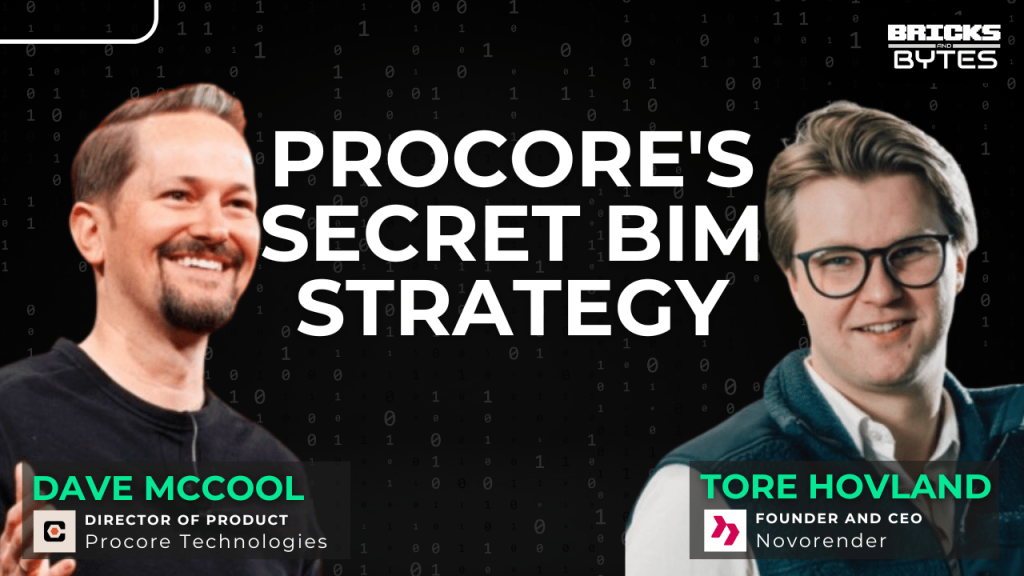
How Procore Plans to Win BIM – Dave McCool & Tore Hovland – EARLY RELEASE

This is an early release of our podcast, exclusive for premium subscribers. To get early access, upgrade here. EARLY RELEASEHow Procore Plans to Win BIM Procore just made two major acquisitions that signal where the construction industry is heading, and it’s not where most CEOs think. In this exclusive conversation, Dave McCool from Procore’s BIM team and Tore Hovland, founder of acquired startup NovaRender, reveal the real strategy behind winning BIM and why most companies are still playing the wrong game. In this episode, you’ll: Discover why Procore’s Chief Product Officer says “to be the leading construction platform, we have to win BIM” Learn how NovaRender solved the 2GB browser limit that’s killing most BIM workflows Understand the streaming technology that loads 100GB+ models in seconds (think YouTube for 3D data) See why 80% of acquisitions fail and what separates the winners Get the inside story on due diligence, cultural fit, and why timing trumps everything Hear predictions about a future where “there are no drawings” Chapters 00:00 – Opening: The billion-dollar BIM strategy 00:50 – What “winning BIM” really means for 17,000+ companies 02:02 – Why Procore acquired NovaRender instead of building internally 06:09 – The 2GB limit problem that’s crushing most BIM tools 08:13 – From oil rigs to construction: NovaRender’s origin story 12:00 – Why partnerships beat going it alone 15:19 – The simultaneous Flypaper acquisition strategy 18:08 – BIM adoption reality check: It’s not 70% 20:01 – Europe vs US: The mandate difference 27:49 – Moving left in the project lifecycle 30:25 – The competitive moat question 37:09 – Field experience shapes product strategy 41:29 – Streaming 3D like YouTube 46:07 – Success metrics beyond revenue 48:50 – Founder lessons: Obsess over customers, not hype 55:45 – What makes acquisitions succeed (hint: it’s not tech) 57:52 – The acquisition rollercoaster experience 01:04:23 – Future predictions: Where construction is heading »»» Listen Now (Premium Subscribers Only) ««« Subscribe to our premium content to read the rest. This is a subscriber only post. Become a paying subscriber of our annual or monthly paid subscriptions to get inside takes on growth in construction tech. Upgrade Translation missing: en.app.shared.conjuction.or Sign In Powered by beehiiv

Newsletter

The 80/20 Rule for Product Expansion: When to Build Your Second Product (& When NOT to)

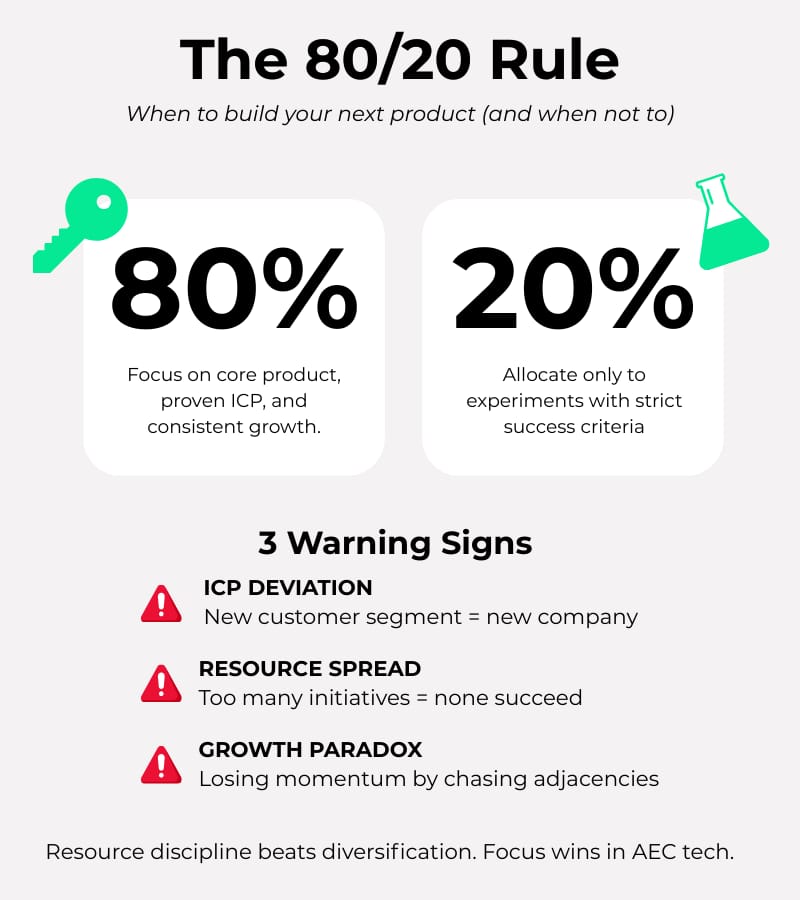
Want to get your message in front of {{active_subscriber_count}} highly engaged innovation leaders? Check out our sponsorship offers. INDUSTRY INSIGHTSThe 80/20 Rule for Product Expansion: When to Build Your Second Product (& When NOT to) How a leading reality capture company learned that resource discipline beats diversification in product expansion When is the right time to build your next product? It’s one of the hardest decisions AEC tech founders face, and the stakes couldn’t be higher. The temptation is strongest when customers start asking. When big-name contractors say, “Build this; we’ll pay lots of money.” When adjacent markets seem ripe for expansion. When the core product is gaining traction and confidence is high. That’s precisely when Matt Daly’s team at DroneDeploy built SmartTrack, a production tracking tool for drywall and framing contractors. It had eager customers, clear market demand, and a team that knew how to execute. Despite having many advantages, SmartTrack ultimately failed. The story reveals one of the most counterintuitive truths about product expansion: resource discipline, not resource abundance, drives sustainable growth. The framework that emerged from this failure should guide every founder’s expansion decisions. Matt Daly is the Chief Marketing Officer at DroneDeploy and ex Co-founder-CEO at StructionSite TL;DR: The 80/20 Rule for Product Expansion DroneDeploy’s failed SmartTrack product shows why timing and discipline matter more than customer demand when expanding beyond your core product. The biggest mistake? Diverting focus from your Ideal Customer Profile. The 80/20 rule is the antidote: Keep 80% of resources focused on your core product. Use 20% for tightly scoped experiments with strict success criteria (repeatable sales, customer re-buying). 🚩 Red flags for expansion: Moving away from your ICP. Spreading resources too thin. Slowing core growth just as momentum builds. In AEC tech, trust and focus beat diversification. Say no more often than yes because the companies that win are the ones that go deeper, not broader. The Fatal Flaw That Kills Product Expansions The problem wasn’t the technology or market demand. SmartTrack worked, customers used it, and the need was real. The fatal flaw was simpler: it took the company away from their core customer base. DroneDeploy had built their business serving large general contractors. These customers knew them, trusted them, and consistently bought from them. SmartTrack targeted trade contractors who operated in entirely different workflows, had different decision-makers, and had never heard of the company. “It’s like starting a new company when you decide to move into a different segment,” Daly reflects. “You pick up the phone to call these customers, and they have no idea who you are.” The result? A low-margin, expensive, slow product that required constant human intervention despite promises of automation. Every sale felt like a journey upstream. Growth didn’t accelerate; it stalled. This phenomenon is the classic expansion trap: mistaking customer requests for market validation and confusing product-market fit in one segment with the ability to succeed in another. The 80/20 Framework for Product Expansion From this failure emerged a resource allocation philosophy that should guide every expansion decision: Cap new experiments at 10-20% of your R&D resources. Period. This isn’t a suggestion. It’s a hard limit. The remaining 80% stays focused on the core business that’s driving growth. Why such rigid discipline? Because in early-stage companies, growth is everything. You’ve got to grow, or you fade away, and you don’t want that growth to slow down. Test smart: Use 20% of resources to validate new ideas with discipline and clarity. Credit: Dreamstime But the 20% isn’t just about limiting downside risk. It’s about creating space for systematic experimentation with clear success criteria: The Repeatability Test: Can a non-founder sales rep successfully sell this product? If founders have to sell every deal, it’s not scalable. The Customer Behavior Test: Do customers buy a small amount initially, then come back for more? This signals genuine product-market fit, not just polite pilot purchases. When experiments meet both criteria consistently, they can gradually migrate from the 20% bucket into core operations. Start with two reps this quarter; add two more next quarter. Let success drive resource allocation, not enthusiasm. When NOT to Build Your Second Product The construction industry has plenty of solid products that have stunted growth momentum. According to research from Business Talent Group, many market adjacency moves in established sectors tend to fail. This scenario often happens when companies underestimate local competition, overestimate customer demand, or jump into adjacent markets too soon. Three warning signs that expansion will backfire: The ICP Deviation Trap: Any product that takes you away from your proven Ideal Customer Profile requires treating it like a completely new business. You’re not leveraging existing relationships; you’re building them from scratch while your core business waits for attention. The Resource Reality Check: Most companies can only successfully bring one or two new products to market at a time. Spreading focus across multiple initiatives typically means none receive adequate resources to succeed. The Growth Paradox: Early-stage companies face immense pressure to show consistent growth. Diverting resources to unproven products just when momentum is building creates dangerous vulnerability. The temptation is strongest when customers from adjacent markets start asking for solutions. But customer requests aren’t always market validation; they’re often one-off needs that don’t scale. Timing Product Expansion Right So when is the right time to expand? The answer isn’t about market conditions or competitive pressure. It’s about internal metrics and organizational readiness. The underlying principles for expansion, followed by top-notch tech giants, could add a fresh perspective. Progressive Resource Migration: Successful experiments don’t suddenly become core products. They earn their way there by consistently hitting targets while consuming minimal resources. Two sales reps become four, four become eight, but only when each expansion proves sustainable. Natural Integration Signals: The best second products feel inevitable to customers and teams alike. They solve problems that naturally arise from using the core product, creating complementary value rather than competing for attention. Capacity Beyond Core: True expansion readiness means having proven systems for hiring, training, and scaling

Newsletter

Robotics is Eating Construction (and the Money’s Insane)

Robotics is eating construction, and the money is following. In this week’s Bricks, Bucks & Bytes episode: 🤖 Bedrock Robotics emerges from stealth with $80M to retrofit autonomy into heavy machinery. 🚀 Field AI soars to a $2B valuation, backed by ex-NASA and Boston Dynamics engineers. 🦾 Dusty Robotics shows why printing blueprints on the ground isn’t a gimmick. It’s the start of field intelligence. But that’s not all: Tessa Lau (Dusty Robotics) reveals how layout, a 5,000-year-old process, became the wedge for automating the connected job site. Kevin Peterson (Bedrock) explains why idle excavators are the biggest hidden cost in construction, and how AI-trained “drivers” can fix it. Patric Hellermann breaks down why accuracy itself is a moat in robotics, and why overspeccing sensors early pays off later. Mo dives into Japan’s labor crisis and why it makes them the global testbed for construction robotics. 🎧 Listen now for: Why collaboration, not just autonomy, will define the first wave of robots on site. The hidden financing gap in robotics (despite mega-rounds). Why building “cool robots” isn’t enough, and you need to solve a real pain. How hardware + SaaS creates sticky robotics businesses. Watch the Full Episode You might also like: Construction Productivity Myths, UAE Real Estate, TIMES VC Rankings, with Barton Malow $1.5M AI Employee Bonuses, Procore Growth Slowdown? & LinkedIn Growth Hacks with Derek Wong Turner’s 44% Growth, Figma IPO Rogue Calculations, Meta’s $150B Block & AI’s 85% Fail Rate $555K Salary for Construction Engineers, Trunk Tools $40M Round, Stone Carving Robots Vibe Coding Will Die, nPlan CTO Warning, Woodchuck $3.75M Raise, Parsepec $20M Series A $5B Heat Crisis, 89% Productivity Drop, Plastic Innovation, $10M Raise Success with Sean Petterson ChatGPT Makes Us Dumber, LIVE from House Factory, Vibe Designing Is Here Apple Kills Cold Calling, In Office Scares CEO’s, Insurance Proves Climate Change Fears New Steel Tariffs Hit, Is A 12hr Work-day Unreasonable? ChatGPT NoteTaker Kills Startups Builder AI $450M Bankruptcy – Beginning Of The End for AI Startups? Johnny Ive $6.5B Hire, TAM Check Powered by beehiiv

Newsletter

ICYMI: TIME’s Top VC’s, Hardware Psychology, and Why Robots Got 85% Cheaper

Want to get your message in front of {{active_subscriber_count}} highly engaged innovation leaders? Check out our sponsorship offers. This Week’s Quickfire BytesFuel your curiosity with this week’s contentW/C 25th August 2025 NEW RELEASESpecial Bonus for Subscribers: The GTM Bundle Construction is not just another vertical. It’s regional, relationship-driven, and project-based. That means what works in traditional B2B SaaS (spray-and-pray marketing, automated funnels, cookie-cutter pricing) falls flat when selling to contractors, owners, and GCs. That’s why we created two deep-dive playbooks, built with and from the people who have actually scaled in this industry. And now, we’re bundling them together. 🎁 The GTM Bundle Individually, each guide is $100.Today, you can get both for $150. Together, they give you the full GTM playbook for construction tech from building trust-first marketing to structuring your sales motion, pricing models, and land-and-expand strategy. GET THE GTM BUNDLE NOW NEW EPISODESConstruction Robots Drop From $100K to $15K: Why Every Contractor Will Buy One in 2025 Matt Daly, CMO of DroneDeploy, talks about the hidden robotics revolution happening in construction, why most startups are choosing the wrong funding path, and how AI agents with “a million eyeballs” are about to transform job sites. Find out how ground robots went from $100K to $15K and why this changes everything, why 60% of DroneDeploy’s new customers come from word of mouth, and the biggest mistake early-stage construction tech founders make with funding. Construction Productivity Myths, UAE Real Estate, TIMES VC Rankings, with Barton Malow We dive deep into the biggest misconceptions shaking up construction and venture capital. Plus, we’re joined by Victor Muchiri from Barton Malow (a $5 billion general contractor) who reveals what tech actually works in the field. We cover why Dubai developers are bringing $19 billion worth of construction in-house (and whether this trend will hit the West), the shocking truth about that McKinsey productivity chart everyone uses in pitch decks, and why 8 out of 10 construction companies can’t even define what a “project” is. Why Hardware Startups ACTUALLY Fail (It’s Not What You Think) Nathan Kirchner shares why the “hardware is hard” myth is killing innovation in construction, how to break through corporate inertia, and the real barriers startups face when selling to billion-dollar companies. Find out why 7 out of 10 biggest companies are actually hardware-dependent, how to escape “pilot purgatory” and get real corporate deals, and the psychology behind why big companies resist innovation. View all Podcasts BRICKS & BYTES PREMIUMEarly Release Episodes Managing 200+ Tools: Skanska’s Tech Reality Check – Mike Zeppieri & Danielle O’Connell – EARLY RELEASE Skanska’s innovation leaders reveal the brutal truth about enterprise tech adoption – from “zombie pilots” that never die to why AI transcription is breaking meeting culture. The $275M Sale: BuildingConnected’s Sales Motion – Mike Pettinella – EARLY RELEASE Mike Pettinella, CRO at OnSiteIQ and former VP of Sales at BuildingConnected, reveals the strategies that built one of construction tech’s biggest success stories. Distribution Beats Product: Lessons From a Two-Time Founder- Maksim Markevich – EARLY RELEASE Maksim Markevich, CEO of Sunbeam and co-founder of PVFarm, shares brutal truths about building AEC tech companies. The Billion-Person Problem: How AI Will Replace Your Project Managers – Greg Lawton – EARLY RELEASE Greg Lawton, CEO of Nodes and Links, is solving construction’s billion-person workforce shortage with AI – and the results speak for themselves. 2 FAVORITE QUOTES: “You’re making a list of the 500 or whatever best VC firms and Sequoia is not on your list.” – Patric Hellemann on the absurdity of excluding one of the most successful VC firms “I hate the P word… pilots are an artificial construct to make the innovation theater world spin around.” – Nathan Kirchner’s candid dismissal of the pilot process favored by corporate innovation teams YOU MIGHT ALSO LIKE Premium Insights 10 Hard-Won Lessons from Founders Who Sold for Millions A Step-by-Step Guide to Clear Product Marketing for AEC Startups 12 Lessons About Hiring From AEC’s Top Leaders More Insights NSFW: Build a F*cking Business McKinsey’s Secrets to Scaling Construction Tech How Flux Burned Through $29M – Lessons for AEC Innovators Ex AutoDesk CEO’s 12 Lessons For Developing Products Could an Entrepreneur in Residence Save Your Construction Firm? Reports and Case Studies Innovating the Future: Robotics and the Revolution in Construction The Future of Design Software In AEC – Experts Insights Investing In AEC Tech The Future Of Construction Document Management The Construction Tech Revolution In India: Lessons From InfraMarket’s Success Innovation at Windover Construction Swinerton’s Innovation Strategy Most Popular Episodes How To Build A Unicorn In Construction Tech – Patric Hellermann Story Of A Modular Construction Startup That Burned Through £10M in 15 Months – Chris Spiceley McKinsey FINALLY updates their Productivity Curve, & The Future Of Construction – David Rockhill, Partner at McKinsey Procore’s AI Strategy & Implementation – AI’s Role in Modern Construction Disrupt Autodesk? This Ex-Autodesk CEO Has Some Advice – Amar Hanspal Super Series Super Series with Ediphi Super Series With Speckle Super Series With Monumental Super Series with Foundamental OUR SPONSORS Archdesk – The #1 construction management software for growing companies. Manage your projects from Tender to Handover. BuildVision – Streamlining the construction supply chain with a unified platform for contractors, manufacturers, and stakeholders. Powered by beehiiv

Newsletter

From Fulfillment to Foundations: What Construction Can Learn from Amazon Robotics

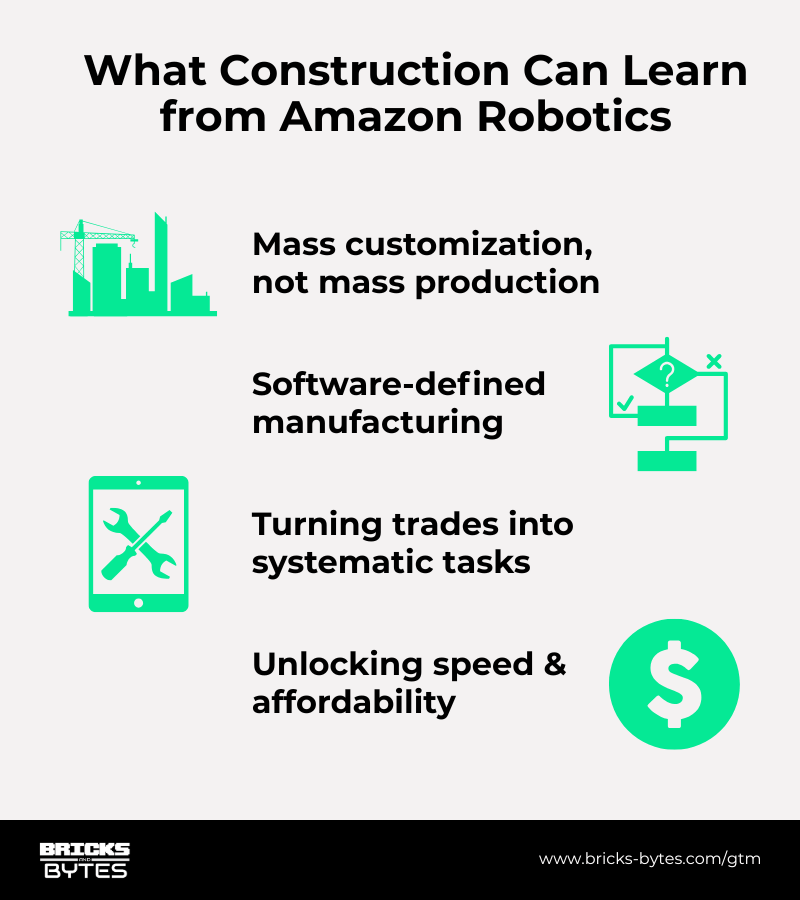
Want to get your message in front of {{active_subscriber_count}} highly engaged innovation leaders? Check out our sponsorship offers. NEW RELEASESpecial Bonus for Subscribers: The GTM Bundle Construction is not just another vertical. It’s regional, relationship-driven, and project-based. That means what works in traditional B2B SaaS (spray-and-pray marketing, automated funnels, cookie-cutter pricing) falls flat when selling to contractors, owners, and GCs. That’s why we created two deep-dive playbooks, built with and from the people who have actually scaled in this industry. And now, we’re bundling them together. 🎁 The GTM Bundle Individually, each guide is $100.Today, you can get both for $150. Together, they give you the full GTM playbook for construction tech from building trust-first marketing to structuring your sales motion, pricing models, and land-and-expand strategy. GET THE GTM BUNDLE NOW INDUSTRY INSIGHTSFrom Fulfillment to Foundations: What Construction Can Learn from Amazon Robotics Breaking the Assembly Line Myth in Construction Construction’s unique challenge: unlike manufacturing, no two sites are the same. Varying codes, soil conditions, and client demands make mass production tactics ineffective. It’s not a labor shortage issue. It’s a mass customization problem. One company applying Amazon’s fulfillment principles is building 30 times more square footage this year. Led by Amazon Robotics veteran Vikas Enti, they’re recognizing that construction tech has been solving the wrong problem entirely. Why does this matter beyond efficiency? The built environment generates 40% of carbon emissions. The recipes for climate-resilient homes exist, but traditional construction economics make them unaffordable. Solving mass customization could unlock both speed and sustainability. Vikas Enti. Credit: Reframe Systems TL;DR: From Fulfillment to Foundations Construction doesn’t have a labor shortage problem. It has a mass customization problem. Unlike manufacturing, every site is different, breaking the assembly-line model most contech startups chase. An Amazon Robotics veteran is applying fulfillment principles to construction, enabling “pixels to parts” in under nine minutes and employing 60% apprentices with software-driven instructions. The big unlock? Treating construction as an information architecture challenge, not just a supply chain one. Why it matters: Faster builds (30x more sq. ft. this year). Lower costs ($275/sq. ft. vs. $350–450). Climate potential: solving mass customization could make sustainable housing affordable. Takeaway: The future of construction won’t be won by bigger factories, but by smarter information systems. Why Every Assembly Line Assumption Is Wrong Walk into any construction tech boardroom. You’ll hear the same strategy: Solve the labor shortage through industrialization. Mass production. Assembly lines. Standard modules replicated across sites. The logic seems bulletproof. Manufacturing transformed every other industry by moving from craft production to standardized processes. Construction should follow the same playbook. Except construction has a fundamental difference that breaks every mass production assumption. Every site is unique. Building codes vary by municipality. Zoning requirements change home dimensions. The intersection of site conditions, local regulations, and zoning codes means you almost never replicate the exact same product across locations. “This is not a mass production problem,” explains the former Amazon executive. “This is a mass customization problem.” Mass customization breaks assembly lines. You can’t optimize for one standard output when every output must be different. Instead, you need what his team developed at Amazon: software-defined manufacturing that treats variety as a feature, not a bug. The insight transforms everything. Instead of fighting customization, you build systems that make customization manageable. Amazon’s mobile robots in action. A glimpse into software-defined manufacturing in motion. Credit: Amazon From Pixels to Parts in Under Nine Minutes The breakthrough concept is “pixels to parts“: seamless flow from design changes to manufacturing instructions. Here’s how it works in practice: Someone on the factory floor finds an assembly issue. They flag it on an iPad. The problem flows back to engineers who identify the mistake, update the CAD model, and push changes back to production. Fastest recorded time: under nine minutes. Compare that to traditional construction, where the same change takes weeks of coordination between architects, engineers, and contractors, plus change order fees. The speed comes from treating construction as an information problem, not just a supply chain challenge. Traditional construction relies on implicit knowledge. A plumber looks at a line drawing and knows from years of experience how to convert that line into fixtures, routing, and attachments. That expertise lives in their head. Software-defined manufacturing makes implicit knowledge explicit. Instead of showing trades a simple line marked “cold water pipe,” the system generates complete instructions: every clip needed to route the pipe, every hole to drill, bending radius requirements, and exact lengths. The information transformation enables something significant: Turning skilled trades into systematic tasks. Workers receive iPad instructions that resemble assembly manuals. Parts are pre-labeled and pre-cut. Components are designed to fit together in specific orientations. Holes are pre-drilled in exact locations. Their factory now employs 60% apprentices: workers new to trades who can perform framing, plumbing, and electrical work through better information architecture rather than years of experience. Reframe’s microfactories use software‑defined robotics to transform design into buildable components. Credit: Reframe Systems The Change Management Reality Even Amazon veterans underestimated how differently construction operates. The first surprise: Finding professionals who could work at software speed. Their original architect ended the relationship, citing too-frequent design changes and unrealistic timelines. The industry trains people to think in months and years, not hours and days. The solution required bringing architectural and engineering talent in-house: a costly decision that many construction tech companies avoid. The second surprise: Industry resistance to new business models. Initially, they planned to sell technology to existing manufacturers. Factory owners weren’t interested. One memorable response: “Chuck’s been doing this for 13 years. Chuck’s not broken. Why should I change it?” Next, they tried selling components to general contractors. GCs worried about losing control and didn’t want volumetric modules changing their workflows. The breakthrough came from targeting developers instead. Developers care about IRR and speed to market, not construction methodology. But here’s the strategic insight: instead of fighting industry structure, they abstracted their innovation behind familiar contracts. They operate as a design-build general contractor using standard

Newsletter

Managing 200+ Tools: Skanska’s Tech Reality Check – Mike Zeppieri & Danielle O’Connell – EARLY RELEASE

This is an early release of our podcast, exclusive for premium subscribers. To get early access, upgrade here. EARLY RELEASEManaging 200+ Tools: Skanska’s Tech Reality Check An exclusive behind-the-scenes conversation with Danielle O’Connell (Senior Director of Emerging Technologies) and Mike Zeppieri (Innovation Leader) from Skanska, one of the world’s largest construction companies. With 27,000 employees globally and 200-300 software tools in their tech stack, Skanska offers a unique perspective on navigating the complex world of construction technology at enterprise scale. In this episode, you’ll: Discover how a $17B+ construction company evaluates and implements emerging technologies across thousands of projects Learn the real challenges of managing tech stack consolidation when you have 18+ tools per project Understand why traditional SaaS pricing models fail in construction and what actually works Get insider insights on AI hype vs. reality from leaders who’ve piloted dozens of solutions Hear honest feedback on why certain “promising” technologies (like autonomous robots) haven’t delivered ROI Learn the exact compliance requirements (SOC 2, GDPR, SSO) that startups need to work with enterprise contractors Chapters 00:00 – Introduction and guest backgrounds 00:24 – Danielle’s role in emerging technologies at Skanska 01:45 – Mike’s journey from aerospace software to construction innovation 03:43 – Managing 200+ software tools: The burden and opportunity 06:08 – Project management pain points and duplicate systems 07:13 – Implementation strategies for enterprise solutions 10:17 – Current technology trends: Safety, quality, and AI integration 14:23 – Geographic innovation hubs and startup ecosystems 16:45 – Entry requirements for startups: Compliance and partnerships 18:19 – Adapting evaluation processes for AI’s rapid pace 20:43 – Success stories: From pilot to enterprise adoptio 25:02 – Defining “emerging technology” in a rapidly evolving landscape 28:58 – Sources for discovering new technologies 30:17 – Filtering and evaluation processes 31:47 – AI consolidation strategies and reality vs. hype 36:05 – In-house development capabilities 39:26 – Technologies that didn’t fit: Robotics and progress tracking 46:38 – Major frustrations: Contracting complexity and pricing models 52:17 – Advice for startups on partnerships and pricing 56:38 – Persistent industry challenges and unmet needs 01:01:16 – The future of construction technology in three years »»» Listen Now (Premium Subscribers Only) ««« Subscribe to our premium content to read the rest. This is a subscriber only post. Become a paying subscriber of our annual or monthly paid subscriptions to get inside takes on growth in construction tech. Upgrade Translation missing: en.app.shared.conjuction.or Sign In Powered by beehiiv

Newsletter

Developers are Firing Their Contractors 🚨

Developers turning into contractors, productivity charts getting roasted, and a GC dropping insider truths. In this week’s Bricks, Bucks & Bytes episode: 🏗️ Dubai developers are bringing construction in-house, chasing control, speed, and fatter margins. 📉 McKinsey’s famous productivity curve gets called out as misleading (and maybe cherry-picked). 🔋 Barton Malow’s strategy chief joins live to talk about industrial projects, fintech in construction, and how data really flows through a $5B GC. But that’s not all: Patric explains M&A with a metaphor about borrowing tools from your neighbor (and why “best owner logic” matters in construction). Martin drops Dubai stats that make your jaw hit the floor: sales up 20% YoY, prices doubling since 2021. Dustin reminds everyone that chasing higher GC margins also means chasing bigger risks. 🎧 Listen now for: Why standardization (not hype) is the hidden driver behind insourcing. How Barton Malow thinks about pre-con data, project definitions, and real ROI on innovation. Why branded residences might be construction’s version of luxury handbags. Watch the Full Episode 🗣 Bonus: Some personal highlights Owen almost became a British rock star (Nottingham was the world tour). Patric Googles cartel net worths mid-podcast. Dustin explains why management fees > LP returns in venture. Victor from Barton Malow shares the one startup product his GC actually loves. You might also like: $1.5M AI Employee Bonuses, Procore Growth Slowdown? & LinkedIn Growth Hacks with Derek Wong Turner’s 44% Growth, Figma IPO Rogue Calculations, Meta’s $150B Block & AI’s 85% Fail Rate $555K Salary for Construction Engineers, Trunk Tools $40M Round, Stone Carving Robots Vibe Coding Will Die, nPlan CTO Warning, Woodchuck $3.75M Raise, Parsepec $20M Series A $5B Heat Crisis, 89% Productivity Drop, Plastic Innovation, $10M Raise Success with Sean Petterson ChatGPT Makes Us Dumber, LIVE from House Factory, Vibe Designing Is Here Apple Kills Cold Calling, In Office Scares CEO’s, Insurance Proves Climate Change Fears New Steel Tariffs Hit, Is A 12hr Work-day Unreasonable? ChatGPT NoteTaker Kills Startups Builder AI $450M Bankruptcy – Beginning Of The End for AI Startups? Johnny Ive $6.5B Hire, TAM Check Why Data Centers Might Crash, Y Combinator Predatory Practices, with Softbank’s $100B Pledge Powered by beehiiv

Newsletter

ICYMI: Big Tech Bonuses, Failed SaaS Growth, and Why AI Won’t Replace Your Electrician

Want to get your message in front of {{active_subscriber_count}} highly engaged innovation leaders? Check out our sponsorship offers. This Week’s Quickfire BytesFuel your curiosity with this week’s contentW/C 18th August 2025 NEW EPISODESAI Won’t Replace Construction Workers – Here’s Why (Former Autodesk Director Explains) Francesco Iorio, CEO of Augmenta, shares why electrical design is so complicated, how AI misconceptions are holding back the industry, and why automation is the only path to sustainable building design. Find out why recreating software like Revit costs over 500 million dollars, how labor shortage is driving construction tech innovation, and hy error-free design is still years away but getting close. $1.5M AI Employee Bonuses, Procore Growth Slowdown? & LinkedIn Growth Hacks with Derek Wong What happens when AI hype, billion-dollar bets, and the cold reality of hardware vs. software collide? Plus, how to dominate LinkedIn without sounding like everyone else. In this episode, Owen, Martin, Patric, and Dustin are joined by LinkedIn strategist Derek Wong to unpack which AI giant will actually have the best model by the end of August and why public betting markets might be getting it wrong, The surprising slowdown at Procore vs. Trimble’s surge, and why hardware “moats” can be a game-changer for tech companies. TestFit Does 1000+ Iterations Per MILLISECOND – Construction AI That Actually Delivers Laura Paciano and Jack Joers from TestFit share how they’re collapsing two months of pursuit costs into a single day, why big tech giants keep failing in construction, and how one customer won $750,000 more business in their first year. Find out why innovation is never asked for and how to educate markets on solutions they don’t know they need, how TestFit collapses the traditional 2-month feasibility process into one day with live collaboration, and why architects are the hardest to convince but quickest to adopt new technology once they decide. View all Podcasts BRICKS & BYTES PREMIUMEarly Release Episodes The $275M Sale: BuildingConnected’s Sales Motion – Mike Pettinella – EARLY RELEASE Mike Pettinella, CRO at OnSiteIQ and former VP of Sales at BuildingConnected, reveals the strategies that built one of construction tech’s biggest success stories. Distribution Beats Product: Lessons From a Two-Time Founder- Maksim Markevich – EARLY RELEASE Maksim Markevich, CEO of Sunbeam and co-founder of PVFarm, shares brutal truths about building AEC tech companies. The Billion-Person Problem: How AI Will Replace Your Project Managers – Greg Lawton – EARLY RELEASE Greg Lawton, CEO of Nodes and Links, is solving construction’s billion-person workforce shortage with AI – and the results speak for themselves. How This CMO Built a 60% Word-of-Mouth Acquisition Engine – Matt Daly – EARLY RELEASE DroneDeploy CMO Matt Daly reveals the blueprint for scaling construction tech companies—from building a 60% word-of-mouth acquisition engine to navigating the reality capture market consolidation. 2 FAVORITE QUOTES: “If you are titling yourself [thought leader], I’m like, you’re probably an idiot.” -Dustin DeVan on LinkedIn self-proclaimed experts “I felt that at some point, my desire to innovate in the AEC space actually was larger than the brakes… that I had on the trajectory.” – Francesco Iorio’s honest reflection on corporate limitations vs. entrepreneurial drive BRICKS & BYTES PREMIUMReady to Break Through the $10M Ceiling? Here’s a quick recap of what you’ll receive as a premium subscriber: Premium in-depth articles delivered to your inbox Early access to podcast episodes before public release 33% discount on all future GTM guides we publish Want 33% off the guide? Sign up for our monthly subscription UPGRADE TO PREMIUM YOU MIGHT ALSO LIKE Premium Insights 10 Hard-Won Lessons from Founders Who Sold for Millions A Step-by-Step Guide to Clear Product Marketing for AEC Startups 12 Lessons About Hiring From AEC’s Top Leaders More Insights NSFW: Build a F*cking Business McKinsey’s Secrets to Scaling Construction Tech How Flux Burned Through $29M – Lessons for AEC Innovators Ex AutoDesk CEO’s 12 Lessons For Developing Products Could an Entrepreneur in Residence Save Your Construction Firm? Reports and Case Studies Innovating the Future: Robotics and the Revolution in Construction The Future of Design Software In AEC – Experts Insights Investing In AEC Tech The Future Of Construction Document Management The Construction Tech Revolution In India: Lessons From InfraMarket’s Success Innovation at Windover Construction Swinerton’s Innovation Strategy Most Popular Episodes How To Build A Unicorn In Construction Tech – Patric Hellermann Story Of A Modular Construction Startup That Burned Through £10M in 15 Months – Chris Spiceley McKinsey FINALLY updates their Productivity Curve, & The Future Of Construction – David Rockhill, Partner at McKinsey Procore’s AI Strategy & Implementation – AI’s Role in Modern Construction Disrupt Autodesk? This Ex-Autodesk CEO Has Some Advice – Amar Hanspal Super Series Super Series with Ediphi Super Series With Speckle Super Series With Monumental Super Series with Foundamental OUR SPONSORS BuildVision — streamlining the construction supply chain with a unified platform for contractors, manufacturers, and stakeholders. Powered by beehiiv

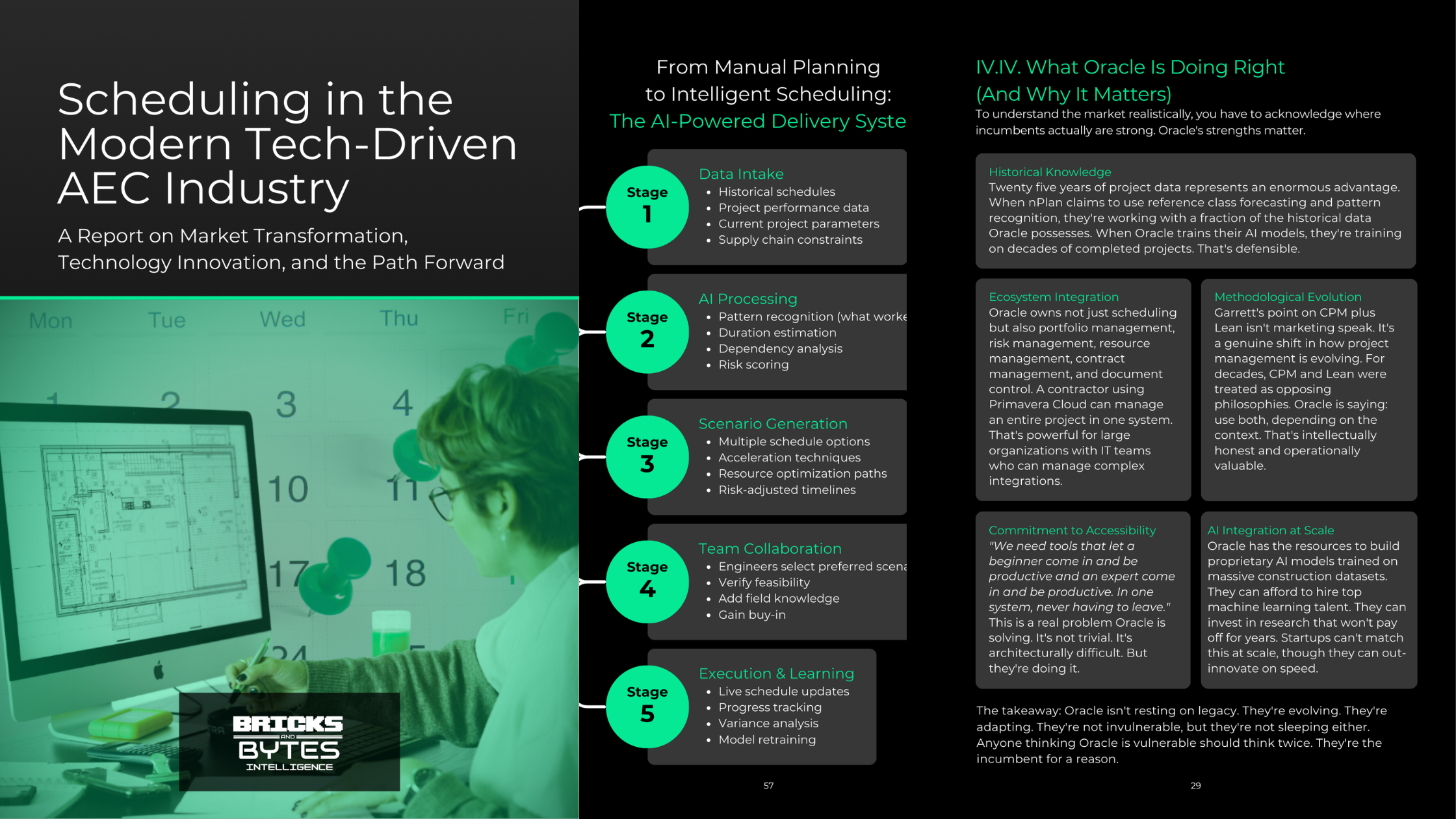
Get a FREE copy of our Scheduling in the Modern Tech-Driven AEC Industry: A Report on Market Transformation, Technology Innovation, and the Path Forward” (worth $150) and a FREE weekly email to stay up to date on construction tech. SIGN UP TODAY!

Scheduling in the Modern Tech-Driven AEC Industry

Sign up to the #1 Newsletter In AEC Tech. Join over 2,100 like-minded Founders, Investors and Techies disrupting the way we build. 

Scheduling in the Modern Tech-Driven AEC Industry