Author name: Owen Drury

Newsletter

ICYMI: Procore’s Acquisition Playbook, Goldbeck’s 570 Software Tools, and Oracle’s Construction Bet

Want to get your message in front of {{active_subscriber_count}} highly engaged innovation leaders? Check out our sponsorship offers. This Week’s Quickfire BytesFuel your curiosity with this week’s contentW/C 29th September 2025 NEW EPISODESWhy 70% BIM Adoption Is A Lie (And What Procore Just Did About It) – PROCORE’S BIM STRATEGY We sit down with Dave from Procore’s BIM team and Tore Hovland, founder of NovaRender (recently acquired by Procore), to unpack what’s really happening in the BIM space and why two major acquisitions just changed the game. We discussed why BIM adoption is actually 20-30%, not the 70% everyone claims, the hidden 2GB browser limit killing your ability to view large models, and how building from 2D vs 3D vs full BIM changes cost overruns from 20% to 5%. The €7bn CEO Breaking Every Rule In Construction We sit down with Hendrik Goldbeck, Co-CEO of Goldbeck Group, who reveals how 60 years of stubborn innovation and perfect timing transformed a small German metalworking shop into Europe’s construction powerhouse. Key topics discussed: the 1969 origin story: Why his father rejected “we’ve always done it this way” thinking, German reunification luck: How overnight demand boom accelerated their product approach, and the “war of all against all”: Why traditional construction’s sequential trade-by-trade model fails. $94M Fundraising Record, New Procore CEO, Oracle Push, Zoom Kills Careers In this episode of Bricks, Bucks & Bytes, Owen, Dustin, Maria, Kevin, and Stjepan dive deep into the biggest moves shaking up construction tech right now. Key topics discussed: Maria Davidson’s historic $94M fundraise – the most ever raised by a female founder in construction tech, why mixing venture capital with strategic partnerships is the secret sauce for growth, and Procore’s surprising new CEO choice and what it means for the industry. How 570 Software Tools Power Europe’s Most Innovative Construction Company We sit down with Fabian, Managing Director of Goldbeck Technologies, who reveals how this family-owned company complete rewrote the rules of construction by treating buildings like configurable products rather than one-off projects. Key topics discussed: why traditional construction is broken (fragmented design with no shared responsibility), the “LEGO approach”: How standardized building systems enable mass customization, and the 480-person R&D department developing everything from AI chatbots to augmented reality quality control. View all Podcasts BRICKS & BYTES PREMIUMEarly Release Episodes Bridgit’s Workforce Planning Story – Lauren Lake & Kevin Ferguson – EARLY RELEASE Listen Now: How do you replace Excel at enterprise scale? The Bridgit story shows exactly how to build category leadership in construction tech. What Pharmaceutical Construction Reveals About Tech ROI – James Mize – EARLY RELEASE Most construction technology fails to stick. James Mize from CRB reveals why in this unfiltered conversation about what really drives enterprise tech adoption decisions. 2 FAVORITE QUOTES: “You go to any job site in America and people just don’t know where their stuff is.” – Maria Davidson highlighting the absurdity of AI’s capabilities versus basic construction logistics problems “Most of the construction market simply is traditional construction. And that’s why so many startups out there, focus on making the horses better rather than developing the cars with us.” – Fabian Lenz on why most construction tech serves traditional workflows rather than transformative approaches SPECIAL OFFERSThe GTM Bundle Together, they give you the full GTM playbook for construction tech from building trust-first marketing to structuring your sales motion, pricing models, and land-and-expand strategy. Individually, each guide is $100. Today, you can get both for $150. GET THE GTM BUNDLE NOW YOU MIGHT ALSO LIKE Premium Insights 10 Hard-Won Lessons from Founders Who Sold for Millions A Step-by-Step Guide to Clear Product Marketing for AEC Startups 12 Lessons About Hiring From AEC’s Top Leaders More Insights NSFW: Build a F*cking Business McKinsey’s Secrets to Scaling Construction Tech How Flux Burned Through $29M – Lessons for AEC Innovators Ex AutoDesk CEO’s 12 Lessons For Developing Products Could an Entrepreneur in Residence Save Your Construction Firm? Most Popular Episodes How To Build A Unicorn In Construction Tech – Patric Hellermann Story Of A Modular Construction Startup That Burned Through £10M in 15 Months – Chris Spiceley McKinsey FINALLY updates their Productivity Curve, & The Future Of Construction – David Rockhill, Partner at McKinsey Procore’s AI Strategy & Implementation – AI’s Role in Modern Construction Disrupt Autodesk? This Ex-Autodesk CEO Has Some Advice – Amar Hanspal Super Series Super Series with Ediphi Super Series With Speckle Super Series With Monumental Super Series with Foundamental OUR SPONSORS Archdesk – The #1 construction management software for growing companies. Manage your projects from Tender to Handover. BuildVision – Streamlining the construction supply chain with a unified platform for contractors, manufacturers, and stakeholders. Powered by beehiiv

Newsletter

Lupa Technology: AI Document Analysis With An Unconventional Approach

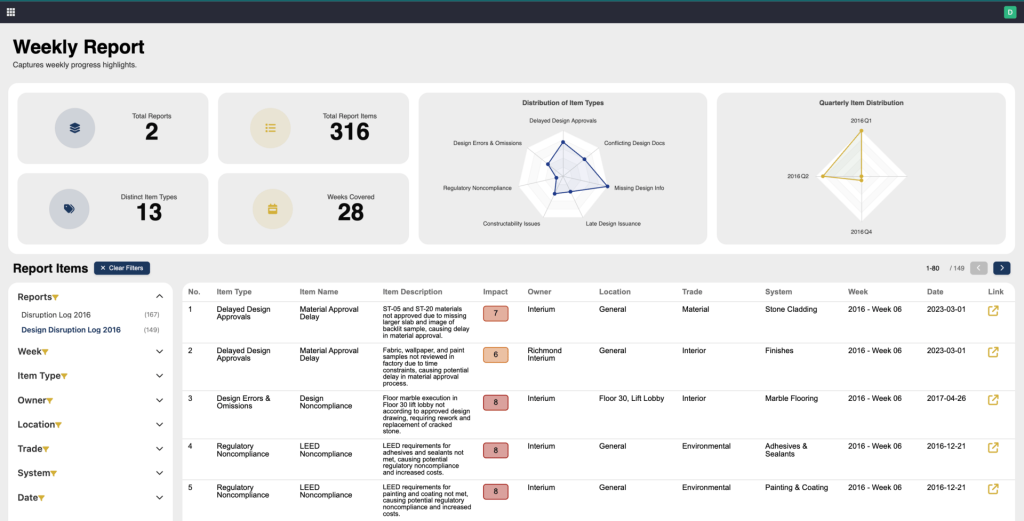
Want to get your message in front of {{active_subscriber_count}} highly engaged innovation leaders? Check out our sponsorship offers. INDUSTRY INSIGHTSLupa Technology: AI Document Analysis With An Unconventional Approach TL;DR Lupa Technology is a construction dispute resolution platform founded by a Turner Construction veteran. The company uses AI to analyze project documents including emails, drawings, schedules, and handwritten notes. The system performs document search, semantic tagging, multilingual analysis, and drawing comparisons to identify discrepancies in construction projects. The platform processes documentation for both active projects and dispute claims, reducing the time required for document review from weeks to hours. Note: This post is in partnership with Lupa Technology. Having worked as a Quantity Surveyor (no, US folks we don’t just count bricks!) for a number of years and doing my fair share dispute resolution – and the laborious process of trawling thousands and thousands of documents to find small nuggets of evidence – I found this company – Lupa technologies – tackling what might just be one of the biggest pain points for anyone working in the claims side of the construction industry. The problem – and this isn’t just related to claims – is that the construction industry generates unprecedented volumes of data yet most organizations struggle to extract meaningful insights from the millions of documents, communications, and technical files that accumulate across project lifecycles.  This problem is not novel and has resulted in a new category of AI-powered platforms emerging to address the challenge of extracting meaningful data from documentation. However, what is interesting is Lupa Technology’s focus on dispute resolution as a starting point.  Founded by Vladimir Milovanovic, a former Turner Construction “fixer” who spent two decades troubleshooting problematic projects globally, Lupa addresses a fundamental problem: the manual impossibility of analyzing the 2-3 million documents that accumulate on average construction projects. The platform transforms this data deluge into structured intelligence for both live project controls and post-construction dispute resolution. What Lupa Technology Does Lupa Technology is an AI-powered SaaS platform that consolidates fragmented construction project data into a single, searchable environment. At its core, the platform solves a practical problem: construction teams typically store project information across dozens of different systems, such as emails in Outlook, drawings in document control systems, schedules in specialized software, communications in messaging platforms, and reports scattered across various folders and drives. The initial extract report provides teams with their first comprehensive view of project data, identifying what information is available and what might be missing.   The platform ingests this disparate data, processes it using construction-trained AI models, and provides tools for searching, analyzing, and reporting across the entire dataset.  Rather than requiring teams to open multiple applications and manually piece together information, Lupa creates a unified intelligence layer that can answer questions, identify patterns, and generate insights from the complete project record. Lupa serves two primary markets: live project controls during construction and forensic analysis for dispute resolution.  During active construction, teams use the platform to monitor project health, identify emerging issues, and make data-driven decisions. For claims and disputes, legal teams and consultants use Lupa to rapidly analyze historical project data and build evidence-based cases. Core Platform Features Data Integration and Processing Connects to over 50 different data platforms including Microsoft ecosystems, project management systems (Procore, Aconex), and communication platforms Processes data at approximately 5 minutes per gigabyte Supports multilingual analysis across 115 languages Handles all document types including PDFs, emails, images, schedules, and handwritten notes through OCR AI-Powered Search and Analysis Semantic search that understands context and intent beyond keyword matching Bulk tagging that automatically categorizes content according to contractual provisions from FIDIC, AIA, and NEC contracts Sentiment analysis trained specifically on construction communications Deep research reports that analyze 100% of document collections Real-time chat interface for instant queries against project data AI power queries and prompts for complex Excel tables with the capability to obtain references from batches of unstructured documents Specialized Construction Analytics Drawing comparison tools that automatically overlay and analyze changes between revision sets Schedule analytics supporting Primavera P6, Asta PowerProject, and Microsoft Project Communication analysis across emails, meeting minutes, reports, and messaging platforms Photograph analytics using computer vision to identify objects and extract metadata, plotting photos with geolocation coordinates on a map Automated weekly reporting that tracks issues by category, location, and responsible parties AI powered Contract Reviews that generate CRS (Contract Review Sheets), Contract Risk Assessment Reports, etc. Reporting and Intelligence Pre-built workflows for common construction processes (delay analysis, change order tracking, risk assessment, RFI prioritization, Rebuilding As-built timelines, etc. Customizable dashboards showing project metrics and data composition Export capabilities to Excel, Word, PDF and other standard formats Timeline reconstruction for forensic analysis Evidence compilation tools for claims and dispute resolution Platform Architecture and Core Functionality Lupa operates as a cloud-based SaaS platform that ingests data from over 50 different construction and business systems. The architecture centers on two primary processing approaches, each optimized for different analytical requirements. The main dashboard displays data processing metrics and composition analysis across integrated project sources. Dashboards are tailored for two main use cases: 1.     Provide to users a clear understanding what data has been ingested by Lupa and what data may be missing – to inform the user if additional data should be provided for completeness2.     Allows users to drill down into project issues and understand them, by incrementally increasing the level of detail, providing bite-size chunks of critical information on topic   AI architecture allows different approaches: The first approach, Retrieval Augmented Generation (RAG), powers real-time chat interfaces by chunking documents and retrieving relevant sections for immediate AI interpretation. This method delivers responses within seconds but sacrifices comprehensiveness for speed; suitable for quick queries during active project management. The second approach, termed “Deep Research Reports,” processes entire document collections line-by-line to generate comprehensive analyses. While requiring 15-20 minutes for completion, these reports analyze 100% of available data rather than selected chunks. According to Vlad, “If you have 10,000 emails to process

Newsletter

Wesco Bets $10M on Kojo + Procore’s New CEO

$10M lands in construction tech, Procore shuffles leadership, and Oracle makes a bold move In this week’s Bricks, Bucks & Bytes episode: 💰 Maria Davidson (Kojo) lands $10M from Wesco, taking her raise total to $94M, the most ever by a female founder in contech. ⚡ Data centers dominate demand, but are contractors overexposed? 🏗️ Procore names Ajei Gopal as CEO (straight from Ansys, but is it bold enough? 🖥️ Oracle doubles down on construction with ERP + Primavera Cloud. But that’s not all: Dustin DeVan argues why the industry must shift from design-then-price to price-then-design. Kevin Halter makes the case that you can’t close big enterprise deals over Zoom. Stjepan Mikulic joins to share the global view of AI in AEC: excitement, skepticism, and what’s real. 🎧 Listen now for: The hidden risks of contractors betting everything on data centers Why “strategic” capital matters more than ever in contech How consolidation, JVs, and labor shortages are reshaping the supply chain Watch the Full Episode 🗣 Bonus: Some personal highlights Maria admits she still interviews every single final-round candidate at Kojo (140 people and counting) Dustin may or may not have bought Baker Hughes stock mid-show Owen records while his house has no heating thanks to renovations You might also like: Live from AU, Hosts World Travels, University Entrepreneurship Culture, NFL Insider Oracle $100B Hour, AI Government Fail, OpenSpace CEO, Barefoot Office Debate Microsoft’s $10M AEC Gamble, Autodesk $1.7B Earnings, Nemetscheck Acquires AI Startup Robotics Mega Show with Dusty Robotics and ex-Waymo exec & CTO of Bedrock Robotics Construction Productivity Myths, UAE Real Estate, TIMES VC Rankings, with Barton Malow $1.5M AI Employee Bonuses, Procore Growth Slowdown? & LinkedIn Growth Hacks with Derek Wong Turner’s 44% Growth, Figma IPO Rogue Calculations, Meta’s $150B Block & AI’s 85% Fail Rate $555K Salary for Construction Engineers, Trunk Tools $40M Round, Stone Carving Robots Vibe Coding Will Die, nPlan CTO Warning, Woodchuck $3.75M Raise, Parsepec $20M Series A $5B Heat Crisis, 89% Productivity Drop, Plastic Innovation, $10M Raise Success with Sean Petterson Powered by beehiiv

Newsletter

ICYMI: New Documentary, $275M Exit Secrets, and Tulip Bubble Lessons

Want to get your message in front of {{active_subscriber_count}} highly engaged innovation leaders? Check out our sponsorship offers. This Week’s Quickfire BytesFuel your curiosity with this week’s contentW/C 22nd September 2025 NEW RELEASEPREMIERE: GOLDBECK – The World’s Most Advanced Construction Powerhouse From a craftsman’s workshop to a construction revolution, discover how one man’s idea to industrialize building sparked a global movement. Watch Now NEW EPISODESSelling To Owners Is Harder – Why Construction Tech Companies Should Target Developers Over Contractors To Make Money Mike Pettinella talks about scaling construction tech from zero to a $275M exit, the brutal realities of international expansion, and why targeting owners instead of contractors is the harder but smarter play. Find out why sales is only two things: volume and efficiency (and you can’t train volume), the real difference between selling to American vs British buyers, and how BuildingConnected went from zero revenue to Autodesk acquisition. Live from AU, Hosts World Travels, University Entrepreneurship Culture, NFL Insider In this episode of Bricks, Bucks & Bytes, Owen reports live from Autodesk University in Nashville while Martin shares insights from ETH Zurich’s startup conference and Patric breaks down why popular AI bubble theories are dead wrong. Key topics discussed: why European universities systematically crush entrepreneurial thinking, the truth behind construction tech’s massive funding rounds (80-120M per quarter), and how to spot real market bubbles vs. media hype around AI stocks. Second-Time Founders Still Fail – Solar Market Lessons from Kreo Spinoff Maksim Markevich shares why distribution beats product in AEC, how he cracked the $150M solar design market, and why most startup marketing tactics fail in construction tech. Find out why relationship-based sales trump amazing products in AEC, the two pathways to selling enterprise software in construction, and why LinkedIn outreach and email marketing don’t work for AEC startups. View all Podcasts BRICKS & BYTES PREMIUMEarly Release Episodes Bridgit’s Workforce Planning Story – Lauren Lake & Kevin Ferguson – EARLY RELEASE Listen Now: How do you replace Excel at enterprise scale? The Bridgit story shows exactly how to build category leadership in construction tech. What Pharmaceutical Construction Reveals About Tech ROI – James Mize – EARLY RELEASE Most construction technology fails to stick. James Mize from CRB reveals why in this unfiltered conversation about what really drives enterprise tech adoption decisions. How Procore Plans to Win BIM – Dave McCool & Tore Hovland – EARLY RELEASE Procore’s billion-dollar BIM bet: Why they acquired NovaRender and Flypaper, the real adoption numbers, and the streaming tech that could kill drawings forever. 2 FAVORITE QUOTES: “If things don’t go well and you’re a VP of sales, then you either failed or you were given a bad plan. But if you’re a CRO, and things don’t go well, then you either failed or you probably shouldn’t have taken the job to begin with because you didn’t do your due diligence.” – Mike Pettinella on the clear distinction between execution roles vs strategic leadership responsibilities “It’s either stupid, idiotic, or dishonest because the signal on the right hand side cannot be used to establish whether you’re in a bubble or not.” – Patric Hellermann’s critique of bubble analysis methodology SPECIAL OFFERSThe GTM Bundle Together, they give you the full GTM playbook for construction tech from building trust-first marketing to structuring your sales motion, pricing models, and land-and-expand strategy. Individually, each guide is $100. Today, you can get both for $150. GET THE GTM BUNDLE NOW YOU MIGHT ALSO LIKE Premium Insights 10 Hard-Won Lessons from Founders Who Sold for Millions A Step-by-Step Guide to Clear Product Marketing for AEC Startups 12 Lessons About Hiring From AEC’s Top Leaders More Insights NSFW: Build a F*cking Business McKinsey’s Secrets to Scaling Construction Tech How Flux Burned Through $29M – Lessons for AEC Innovators Ex AutoDesk CEO’s 12 Lessons For Developing Products Could an Entrepreneur in Residence Save Your Construction Firm? Most Popular Episodes How To Build A Unicorn In Construction Tech – Patric Hellermann Story Of A Modular Construction Startup That Burned Through £10M in 15 Months – Chris Spiceley McKinsey FINALLY updates their Productivity Curve, & The Future Of Construction – David Rockhill, Partner at McKinsey Procore’s AI Strategy & Implementation – AI’s Role in Modern Construction Disrupt Autodesk? This Ex-Autodesk CEO Has Some Advice – Amar Hanspal Super Series Super Series with Ediphi Super Series With Speckle Super Series With Monumental Super Series with Foundamental OUR SPONSORS Archdesk – The #1 construction management software for growing companies. Manage your projects from Tender to Handover. BuildVision – Streamlining the construction supply chain with a unified platform for contractors, manufacturers, and stakeholders. Powered by beehiiv
Newsletter

Inside Procore’s Novorender Acquisition: How Customer Obsession and Technical Innovation Drive Strategic Deals

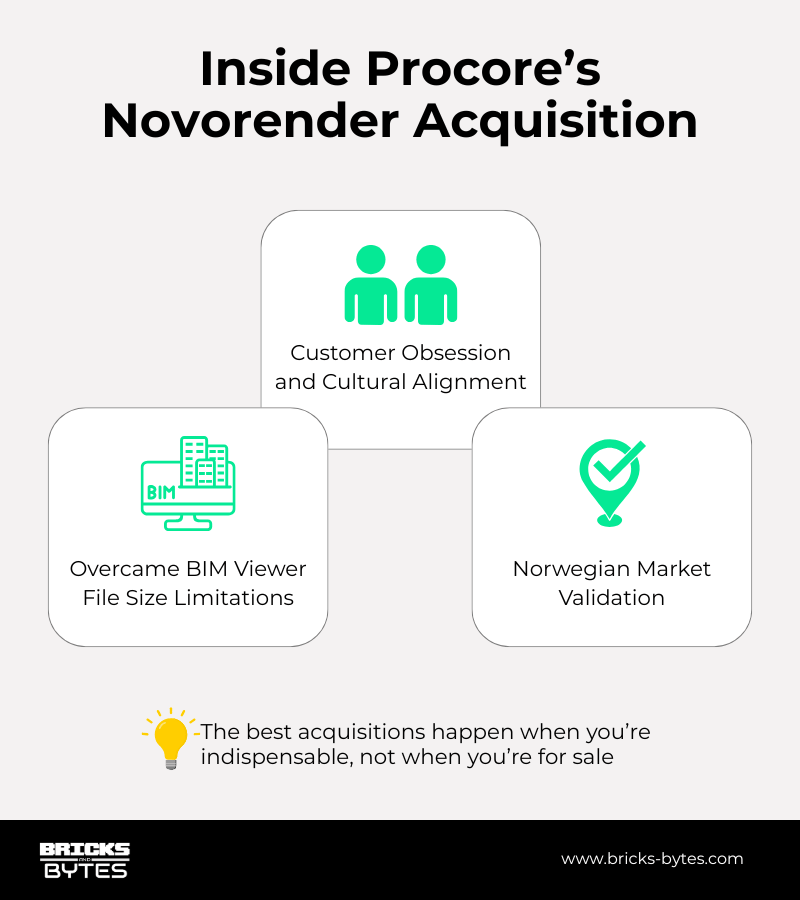
Want to get your message in front of {{active_subscriber_count}} highly engaged innovation leaders? Check out our sponsorship offers. NEW RELEASEGOLDBECK – The World’s Most Advanced Construction Powerhouse The documentary premieres this Friday, September 26th, at 12pm BST. Be the First to Watch INDUSTRY INSIGHTSInside Procore’s Novorender Acquisition: How Customer Obsession and Technical Innovation Drive Strategic Deals When Procore’s Dave McCool first spoke with Novorender founder Tore Hovland, it wasn’t about acquisition at all. It was about solving a problem that had stumped every major player in the BIM space. Years later, that conversation led to an acquisition that demonstrates how the best construction tech deals happen: through authentic relationships, genuine technical breakthroughs, and shared vision about serving customers. TL;DR: Inside Procore x Novorender Procore’s acquisition of Novorender shows how the best construction tech deals get done, not through chasing exits, but by: Customer obsession first – The relationship began around solving BIM challenges, not acquisition. Breakthrough tech – Novorender’s streaming solution made massive BIM files cloud-ready. Cultural alignment – Both teams shared a “serve the customer” DNA. Market validation – Norway’s BIM mandate proved real-world value in high-stakes projects. Strategic fit – Global standards, any-size project handling, and stronger “one source of truth” positioning. Lesson learned – The best acquisitions happen when you’re indispensable, not when you’re for sale. The result: Procore strengthened its global platform strategy, and Novorender became indispensable infrastructure. Tore Hovland with Jules Cantwell (Procore GM for Europe) and Steve Zahm (Procore co-founder) for the BIG annoucement at the Procore Construction Summit 2025 in London. Credit: Novorender The Technical Challenge That Started It All Procore faced a fundamental limitation that threatened their cloud-first strategy. Every BIM viewer hits the same wall: browsers can’t handle files larger than 2GB. The industry’s responses involved compromises: Fragment large models into smaller pieces Force users back to desktop applications Accept that complex projects couldn’t be viewed properly online For a platform supporting 17,000+ companies globally, none of these worked. “We cannot go back, like desktop, we cannot, we are a cloud-based platform,” Dave explains. Procore’s engineering team could have built a solution, but as Dave admits: “The answer was yes, we could. It would just be maybe longer than we wanted.” Meanwhile, in Norway, Tore had already solved it. The Breakthrough That Changed Everything Novorender didn’t try to force massive files through browsers. Instead, Tore rethought the entire approach, creating a streaming solution that loads only what users actually see. “Novorender is actually much more similar to YouTube than it is to Navisworks,” Tore explains. When Dave witnessed it in action, everything changed. A 50-mile infrastructure project loaded instantly in a browser. No installation, no fragmentation, no waiting. This wasn’t just a better BIM viewer. It was a fundamental reimagining of how 3D data could work in the cloud. First principles thinking had solved what seemed impossible, demonstrating the kind of technical breakthrough that creates real competitive advantage. Novorender’s project-browser view: designed for performance and scale. Credit: Novorender Why Relationships Matter More Than Technology The acquisition story really began with Dave’s approach to building industry relationships. Rather than waiting for acquisition opportunities, he proactively connected with innovative companies. “I started conversations with Tore pretty early and was like, hey, I heard about you. Let’s get on a call and talk.” What happened next reveals why most acquisitions fail while this one succeeded (so far). Their first conversation wasn’t about deals or valuations. It was about customers. Dave discovered something rare: complete alignment on values and vision. “When I get on a call with Tore, he’s like, it’s all about our customers. And I’m like, yes, it is.” Both teams obsessed over democratizing technology access rather than just building features. This cultural alignment proved more valuable than any technical specification. When teams share the same DNA around customer obsession, integration becomes natural rather than forced. This patient approach runs counter to typical startup wisdom. As PlanGrid co-founder Ralph Gootee learned through his own experience, sustainable companies focus on building customer relationships rather than seeking buyers: “You can’t build a company to be sold. Leverage is made through having a lot of customers that love you.” The Norwegian Market Validation Novorender’s credibility came from solving real problems in a demanding market. Norway’s BIM mandate for government projects over 100 million euros created the perfect testing ground. The results were significant: 2D-only projects averaged 20% cost overruns BIM implementations reduced overruns to 5% European BIM data growing 30% annually This wasn’t theoretical innovation. Construction companies actively sought out Novorender after seeing these results, even with free alternatives available. The company started in oil and gas, but construction companies began approaching them: “We saw this news article about Novorender, can we use that for our roads and tunnels?” Customer traction in regulated, high-stakes markets provides the strongest acquisition validation. When customers actively seek out your solution despite having alternatives, that signals genuine value creation. Procore’s Strategic Imperative For Procore, this acquisition addressed multiple strategic needs simultaneously. Technical capabilities: Novorender brought deep IFC expertise and European standards compliance exactly when Procore needed to expand globally. Market positioning: The ability to handle any project size anywhere supported Procore’s goal of serving “from the smallest projects to the biggest projects.” Platform strategy: Rather than just adding features, Novorender strengthened Procore’s position as “the aggregator of information” that creates “one source of truth” for project teams. Cultural fit: Most importantly, the teams shared the same customer-obsessed DNA that drives long-term innovation. This combination of technical capability, market positioning, and cultural alignment created the foundation for a successful integration. Platform companies don’t just buy features; they acquire capabilities that strengthen their entire ecosystem. Novorender won “Startup of the Year” at Proptech Norway’s Top of the Props in September 2024. The Acquisition Process Reality Most acquisitions fail, and the statistics are sobering. As Tore noted from industry discussions, seven out of 10 acquisitions don’t deliver expected outcomes. Only one in 10 companies successfully executes multiple acquisitions. The primary culprit isn’t

Newsletter

Live from Nashville: Autodesk, Procore, and more

AI booths everywhere, Autodesk underwhelms, and ETH says architects should be entrepreneurs. In this week’s Bricks, Bucks & Bytes episode: 🎤 Live from Autodesk University in Nashville – AI booths everywhere, but underwhelming announcements. 🤖 Hardware is back – robotics, vaulted slabs, and timber panels sparking debates on what’s truly venture-backable. 📈 Mega rounds in contech – $14M into Trunk Tools and $50M into GreenLight drawing eyes across the industry. But that’s not all: Patric calls out the “bubble logic” around Nvidia using tulips, CBRE, and Coinbase as his counterexamples. Martin moderates at ETH Zurich and argues: stop funding “innovation theatre,” start teaching entrepreneurship. Owen goes full field-reporter from Nashville, catching the Autodesk vs. Procore rivalry on the ground. 🎧 Listen now for: Why Autodesk’s future bets hinge on Construction Cloud The real challenges of scaling new building materials How universities (and VCs) can flip their approach to AEC startups Watch the Full Episode 🗣 Bonus: Some personal highlights Owen nearly bricks his iPhone trying to stream live from the expo hall Patrick gets an NFL locker room tour with the LA Rams president Martin is officially “Professor of Entrepreneurship” (ETH booked him again) You might also like: Oracle $100B Hour, AI Government Fail, OpenSpace CEO, Barefoot Office Debate Microsoft’s $10M AEC Gamble, Autodesk $1.7B Earnings, Nemetscheck Acquires AI Startup Robotics Mega Show with Dusty Robotics and ex-Waymo exec & CTO of Bedrock Robotics Construction Productivity Myths, UAE Real Estate, TIMES VC Rankings, with Barton Malow $1.5M AI Employee Bonuses, Procore Growth Slowdown? & LinkedIn Growth Hacks with Derek Wong Turner’s 44% Growth, Figma IPO Rogue Calculations, Meta’s $150B Block & AI’s 85% Fail Rate $555K Salary for Construction Engineers, Trunk Tools $40M Round, Stone Carving Robots Vibe Coding Will Die, nPlan CTO Warning, Woodchuck $3.75M Raise, Parsepec $20M Series A $5B Heat Crisis, 89% Productivity Drop, Plastic Innovation, $10M Raise Success with Sean Petterson ChatGPT Makes Us Dumber, LIVE from House Factory, Vibe Designing Is Here Powered by beehiiv

Newsletter

ICYMI: $100B Stock Surge, Skanska’s Tool Overload, and PVFARM’s Go-to-Market

Want to get your message in front of {{active_subscriber_count}} highly engaged innovation leaders? Check out our sponsorship offers. This Week’s Quickfire BytesFuel your curiosity with this week’s contentW/C 15th September 2025 NEW RELEASETRAILER – GOLDBECK – The World’s Most Advanced Construction Powerhouse The full documentary will be out next week, on Friday, 26 September.  Featured interviews: Fabian Lenz: How 570 Software Tools Power Europe’s Most Innovative Construction Company Jan-Hendrik Goldbeck: The CEO Breaking Every Construction Rule – Behind Germany’s €7bn Construction Giant NEW EPISODESSecond-Time Founders Still Fail – Solar Market Lessons from Kreo Spinoff Maksim Markevich shares why distribution beats product in AEC, how he cracked the $150M solar design market, and why most startup marketing tactics fail in construction tech. Find out why relationship-based sales trump amazing products in AEC, the two pathways to selling enterprise software in construction, and why LinkedIn outreach and email marketing don’t work for AEC startups. Oracle $100B Hour, AI Government Fail, OpenSpace CEO, Barefoot Office Debate We dive deep into the wild world of tech promises, government failures, and what’s really happening behind the scenes in construction technology. Key topics discussed: Oracle’s shocking $300 billion OpenAI deal and Larry Ellison’s instant $100 billion windfall, why the UK government’s Microsoft Copilot trial was a complete disaster, and the brutal truth about why companies keep buying expensive software that doesn’t work. Skanska Reveals – Why Construction Companies Have 300+ Software Tools But Still Can’t Get Work Done Michael and Danielle from Skanska discuss the brutal reality of construction tech adoption, why VCs keep backing the wrong startups, and how pricing models are completely broken for the industry. Find out why construction companies are drowning in software but starving for solutions, the real reason progress tracking tools cost a dollar per square foot, and how AI hype is following the exact same pattern as the cloud revolution. View all Podcasts BRICKS & BYTES PREMIUMEarly Release Episodes Bridgit’s Workforce Planning Story – Lauren Lake & Kevin Ferguson – EARLY RELEASE Listen Now: How do you replace Excel at enterprise scale? The Bridgit story shows exactly how to build category leadership in construction tech. What Pharmaceutical Construction Reveals About Tech ROI – James Mize – EARLY RELEASE Most construction technology fails to stick. James Mize from CRB reveals why in this unfiltered conversation about what really drives enterprise tech adoption decisions. How Procore Plans to Win BIM – Dave McCool & Tore Hovland – EARLY RELEASE Procore’s billion-dollar BIM bet: Why they acquired NovaRender and Flypaper, the real adoption numbers, and the streaming tech that could kill drawings forever. The $275M Sale: BuildingConnected’s Sales Motion – Mike Pettinella – EARLY RELEASE Mike Pettinella, CRO at OnSiteIQ and former VP of Sales at BuildingConnected, reveals the strategies that built one of construction tech’s biggest success stories. 2 FAVORITE QUOTES: “If you have no competitors, you probably aren’t in a real market. You’re probably off on Pluto and no one actually wants what you want… capitalism has a way of creating competition.” – Jeevan Kalanithi on competition as market validation rather than threat “Understanding of the market, of the problems, of the value chain is crucial. It is way more crucial than technology itself, in my opinion.” – Maksim Markevich on the fundamental shift in thinking after realizing technical prowess alone doesn’t guarantee success SPECIAL OFFERSThe GTM Bundle Together, they give you the full GTM playbook for construction tech from building trust-first marketing to structuring your sales motion, pricing models, and land-and-expand strategy. Individually, each guide is $100. Today, you can get both for $150. GET THE GTM BUNDLE NOW YOU MIGHT ALSO LIKE Premium Insights 10 Hard-Won Lessons from Founders Who Sold for Millions A Step-by-Step Guide to Clear Product Marketing for AEC Startups 12 Lessons About Hiring From AEC’s Top Leaders More Insights NSFW: Build a F*cking Business McKinsey’s Secrets to Scaling Construction Tech How Flux Burned Through $29M – Lessons for AEC Innovators Ex AutoDesk CEO’s 12 Lessons For Developing Products Could an Entrepreneur in Residence Save Your Construction Firm? Most Popular Episodes How To Build A Unicorn In Construction Tech – Patric Hellermann Story Of A Modular Construction Startup That Burned Through £10M in 15 Months – Chris Spiceley McKinsey FINALLY updates their Productivity Curve, & The Future Of Construction – David Rockhill, Partner at McKinsey Procore’s AI Strategy & Implementation – AI’s Role in Modern Construction Disrupt Autodesk? This Ex-Autodesk CEO Has Some Advice – Amar Hanspal Super Series Super Series with Ediphi Super Series With Speckle Super Series With Monumental Super Series with Foundamental OUR SPONSORS Archdesk – The #1 construction management software for growing companies. Manage your projects from Tender to Handover. BuildVision – Streamlining the construction supply chain with a unified platform for contractors, manufacturers, and stakeholders. Powered by beehiiv
Newsletter

What We Learnt From Robotics Experts – Dusty and Bedrock

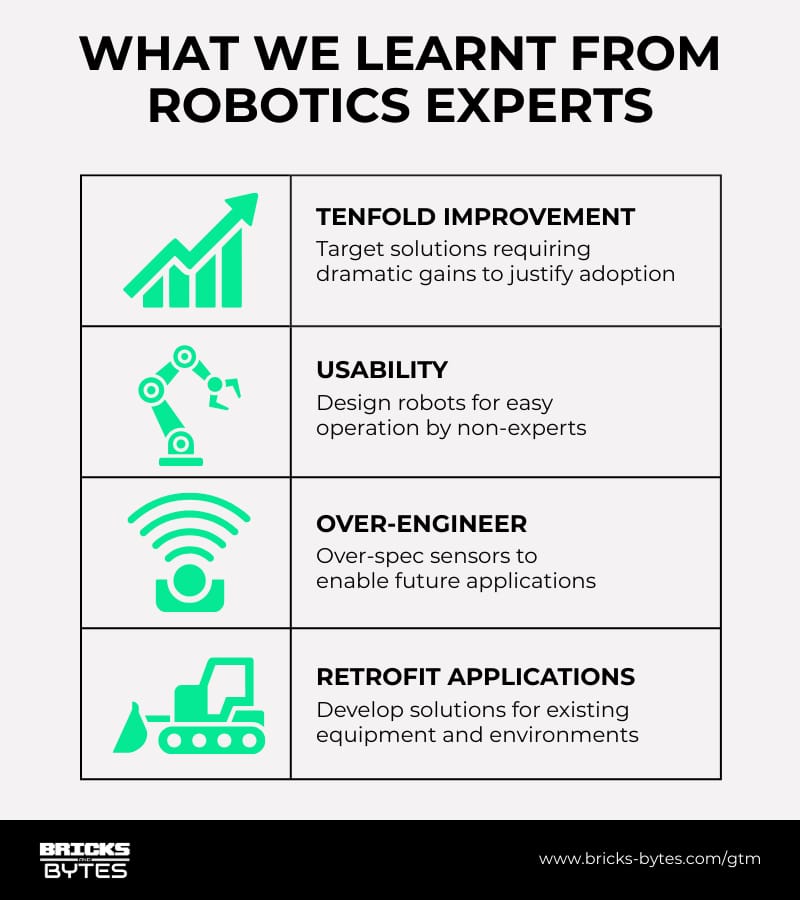
Want to get your message in front of {{active_subscriber_count}} highly engaged innovation leaders? Check out our sponsorship offers. NEW RELEASENew DocuSeries: Inside GOLDBECK We’re excited to kick off our latest docu-series with Fabian Lenz, Managing Director of GOLDBECK Technologies. 120 software engineers. 480+ in innovation. 570+ tech solutions. Mind-blowing Coming up: Friday, 19 September – Jan-Hendrik Goldbeck Interview Friday, 26 September – Full Documentary INDUSTRY INSIGHTSWhat We Learnt From Robotics Experts – Dusty and Bedrock Global robotics secured $6 billion in the first seven months of 2025, putting it on track to surpass last year’s total. Yet adoption rates are actually dropping. Recent conversations with Tessa Lau from Dusty Robotics and Kevin Peterson from Bedrock Robotics revealed why most companies fail to bridge the pilot-to-production gap. Both executives lead companies that have cracked the adoption code. Dusty, recognized as the most implemented and highest-rated construction robotics solution in recent BuiltWorlds research, has already been deployed across 25 million square feet of construction sites. Bedrock, which emerged from stealth with $80 million in funding, is developing self-driving retrofit kits for existing construction equipment with ex-Waymo leadership. The answer to adoption challenges isn’t about better technology; it’s about smarter business strategy. Dusty Robotics’ FieldPrinter at work TL;DR: Robotics funding is booming ($6B in 2025 YTD), but adoption lags. Conversations with Dusty and Bedrock reveal why winners succeed: Budget gap: Robots must deliver 10x better outcomes to justify new budgets, not fight for existing ones. Usability: Power-tool simplicity beats PhD-level complexity. Hidden strategy: Over-spec sensors today → recurring software revenue tomorrow. Retrofit focus: Faster adoption comes from working with existing equipment. Construction edge: Chaotic job sites are the perfect training grounds, accelerating tech maturity. Tech convergence: ML, LLMs, and sensor fusion now make superhuman accuracy viable. 📌 For AEC: focus on labor-heavy problems with no budget line, design for retrofit, and build orchestration platforms, not just task automation. The Budget Problem That Kills Robotics Companies Valuable construction problems don’t ALWAYS have line items. Layout automation saves thousands of hours per project but appears nowhere on budget spreadsheets. When contractors see a $50,000 solution for a “free” process, they pass. The companies winning contracts flip this dynamic completely. Instead of incremental improvements, they target 10x better solutions that force new budget creation. Layout hasn’t changed in 5,000 years. A robot delivering 10x speed, 10x accuracy, and unlimited information density doesn’t compete for existing dollars. It creates new ones. Credit: Bedrock Robotics The democratization factor matters equally. If your robot needs a PhD to operate, you’ve built a consulting business. The winners design robotics like power tools with iPhone-level usability. This directly addresses construction’s core challenge: only 11% of field workers have the information they need to do their jobs effectively. The Hidden Revenue Strategy: Over-Spec Your Sensors Most hardware companies obsess over cost optimization. The smartest robotics companies deliberately over-spec sensors, even when it seems wasteful. This is not a matter of engineering indulgence. It involves revenue planning. Embed unused sensors worth thousands per unit, and you create the foundation for future software applications without hardware recalls. Your installed base becomes a recurring revenue platform through software updates alone. The build versus buy timing matters too. Top companies often start by prototyping with readily available components and then move on to custom hardware when they hit around 60 units. This gives us the right manufacturing know-how to train our contract partners well, all while steering clear of jumping into optimization too soon. The retrofit versus new-build decision also shapes success. Companies targeting retrofit applications that work with existing drive-by-wire equipment can deploy faster than those requiring complete infrastructure replacement. With 439,000 construction workers needed in 2025 alone, creating urgent automation demand, companies mastering sensor fusion achieve superhuman performance that justifies premium pricing. Dusty Robotics printing something unusual at AU 2025 Why Construction Sites Are Perfect Training Grounds Every construction site changes every 48 hours. Materials move, workers shift, and priorities evolve. Most robotics companies see these modifications as a problem. The winners see it as their competitive advantage. Construction sites contain every real-world scenario robots encounter elsewhere, compressed into a more challenging environment. Companies succeeding here can adapt their technology anywhere. The key insight: embrace chaos as a feature. Design systems that learn from constantly changing conditions rather than fighting them. The most advanced platforms now use imitation learning to adapt behaviors based on human decision-making across thousands of similar scenarios. Companies succeeding here solve problems that exist across multiple industries. If you can navigate plastic sheets moving in the wind, water bottles scattered across sites, and buried utilities with millimeter precision, you’ve mastered challenges that appear everywhere. The companies bridging the pilot-to-production gap position themselves as intelligent orchestration platforms coordinating people, materials, and machines rather than just automating tasks. Industry research shows this growing sophistication: companies are moving from pilot programs to repeated implementation across multiple projects. The Technology Convergence Moment Three advances converged in the past 24 months to make construction robotics finally viable: Machine learning techniques allow robots to mimic human expertise without hand-coding every scenario. Large language models enable natural language interfaces for non-technical workers. Sensor fusion reached the price-performance threshold where superhuman accuracy becomes cost-effective. This timing matters because construction’s constraints haven’t changed. Projects still demand millimeter precision for prefabricated components. Sites still present unstructured environments with buried utilities and safety hazards. The companies capitalizing on this moment share three characteristics: they solve problems consuming significant labor hours, they design for retrofit applications with existing equipment, and they target industries with acute labor shortages. For robotics funding that reached record levels, this combination of workforce urgency and technological maturity creates unprecedented opportunity. What This Means for AEC Three patterns emerge from successful deployments: Target problems that consume significant labor hours but lack dedicated budgets. Design solutions requiring 10x improvement to justify adoption. Build platforms that orchestrate multiple stakeholders rather than just automate individual tasks. The bottom line: Companies mastering these principles position themselves as essential infrastructure for an

construction technology Africa market
Go To Market, Startups

The Rise of Contech in Africa: A Look at Jumba’s Impact on Construction Material Distribution

  While the global construction technology sector continues to mature, there’s a fascinating story unfolding in Africa that deserves attention. Meet Kagure Wamunyu, the civil engineer turned tech entrepreneur who’s revolutionizing how construction materials flow across Kenya and beyond through her company, Jumba. TL;DR:  Jumba is leading the construction technology revolution in Africa by transforming how materials reach builders The opportunity: Construction contributes 5%+ of Kenya’s GDP with massive infrastructure demand The challenge: Centralized manufacturing vs. distributed development creates supply chain gaps The solution: B2B marketplace + SaaS platform connecting manufacturers to 700+ hardware stores The innovation: Mobile money integration, AI-powered quotations, and end-to-end logistics Key insight: African markets require building multiple integrated solutions due to limited infrastructure The future: Expanding from basic materials to finishes, becoming Africa’s go-to construction platform   In this episode, Kagure Wamunyu shares how African tech companies must build entire ecosystems from scratch, why 60% of Kenya’s GDP runs on mobile money, and how construction distribution works in emerging markets.   From Uber’s Excel Sheets to Construction Innovation Kagure’s journey into construction technology began in an unexpected place: Uber’s Nairobi office in 2015. As the ride-hailing giant struggled to gain traction in Kenya with its credit card-based payment system, Kagure championed a radical idea – integrate mobile money payments through M-Pesa, Kenya’s ubiquitous mobile wallet system. “We ran Uber on Excel sheets,” Kagure recalls of those early days. “Drivers would take trips, we’d run a script and reconcile on Excel sheets, then have drivers line up to reconcile with their mobile money.” This manual process, while tedious, unlocked Nairobi as Uber’s first 100% cash market globally. The experience taught Kagure two crucial lessons that would shape her approach to construction technology: adapt your ideas to the market, and don’t be afraid to experiment with manual processes before perfecting the technology. The African Construction Challenge After her Uber experience, Kagure dove into real estate development as a side business – a common practice in Kenya’s “side hustle culture.” What she discovered was a construction ecosystem riddled with inefficiencies. Banks were terrified of construction loans due to long payment cycles. Finding qualified architects and engineers was challenging since they couldn’t legally advertise. And perhaps most frustrating, construction material prices could vary by 300% depending on whether you looked like you knew what you were doing. “If you walk in and look like you don’t know what the price is, it can be three times higher because we have the bargaining, haggling kind of culture,” Kagure explains. This experience, combined with her civil engineering background and her father’s contracting business, made her realize that construction was ripe for technological disruption. Building for the African Market What makes Jumba particularly interesting isn’t just what it does, but how it addresses the unique characteristics of the African construction market. Unlike Western markets where you might focus on a single point solution, African startups often need to build end-to-end systems. “When you’re building in Africa, you have to build for your own ecosystem,” Kagure notes. “You somehow have to also build for your logistics because you don’t really have that advanced company that has figured out warehousing and logistics. So you end up building multiple products that would be different businesses in other markets.” Jumba operates as both a B2B marketplace and a SaaS provider, connecting manufacturers of cement, steel, and wire products to over 700 hardware stores across Kenya. But it’s much more than a simple marketplace – it’s a complete ecosystem that includes: Distribution logistics: Jumba handles the physical movement of materials from manufacturers to retailers AI-powered quotations: Converting WhatsApp photos of handwritten quotes into digital orders Mobile money integration: Leveraging M-Pesa’s widespread adoption for seamless payments Fleet management: Real-time tracking of delivery trucks across the country   The Mobile Money Revolution One of the most fascinating aspects of Jumba’s operation is how it leverages Kenya’s mobile money ecosystem. M-Pesa, the mobile wallet tied to phone numbers, processes over 60% of Kenya’s GDP. This isn’t just convenient – it’s transformative for a construction industry where traditional banking relationships are often strained. “You buy things in the supermarket using mobile money. You pay for your Uber using mobile money. You pay for public transport. You buy vegetables by the roadside using mobile money,” Kagure explains. This infrastructure allows Jumba to serve customers who might not have traditional bank accounts but are fully integrated into the digital economy. Strategic Product Expansion Jumba’s approach to product expansion reflects a deep understanding of logistics economics. Starting with cement – a high-volume, low-margin commodity – allowed them to establish efficient distribution routes. Steel and wire products followed, creating bundled orders that maximize truck utilization. “The thinking here was the volumes. You have to be able to create efficient distribution – you’ve got to have the ability to move trucks into multiple areas of the country,” Kagure explains. “The bulky products allow you to move the truck because the transport component can pay for the load.” This foundation enables expansion into higher-margin finishes like tiles, where the technology value proposition becomes even stronger. Instead of just optimizing logistics, Jumba can provide comparison tools, visual catalogs, and sophisticated product selection capabilities. The SaaS Evolution Perhaps the most intriguing aspect of Jumba’s development is how their internal operational challenges led to a standalone SaaS product. Building technology to manage their own quotations, order tracking, and logistics created a platform that other manufacturers and distributors desperately needed. “They have an ERP system at best. After that, everything runs on WhatsApp,” Kagure notes about traditional construction material companies. “Orders are posted by the sales team on WhatsApp groups that have directors, then they forward it to the finance team.” Jumba’s SaaS platform transforms this chaos into structured, trackable processes. The Broader African Opportunity Kenya’s position as one of Africa’s four major tech hubs (alongside Nigeria, South Africa, and Egypt) gives Jumba a strategic advantage. But rather than jumping between major markets, Kagure advocates for a more nuanced expansion

Newsletter

Bridgit’s Workforce Planning Story – Lauren Lake & Kevin Ferguson – EARLY RELEASE

This is an early release of our podcast, exclusive for premium subscribers. To get early access, upgrade here. EARLY RELEASEBridgit’s Workforce Planning Story Lauren Lake, co-founder of Bridgit, and Kevin Ferguson, product marketing consultant, reveal how they transformed workforce planning from Excel spreadsheets into a category-defining software solution that now serves half of the top 20 general contractors. From cold-calling with Tim Hortons donuts to scaling internationally, this conversation unpacks the strategic moves that built market leadership in an industry resistant to change. In this episode, you’ll: Discover how to identify and validate real market problems before building solutions Learn the step-by-step process for displacing entrenched manual workflows Understand why 42% of general contractors can’t take on new projects due to workforce constraints Get insights on global expansion strategies that actually work in construction Learn the art of creating category-defining products in traditional industries See how product marketing expertise accelerates growth in conservative markets Chapters 00:01 – Opening introductions: Lauren Lake (Bridgit) and Kevin Ferguson (AECO Product Marketing) 00:59 – The secret behind Bridgit’s market dominance 02:37 – Core pain points in construction workforce planning 05:37 – The Harvard Business School case study phenomenon 09:31 – Validating market demand with letters of intent 11:33 – What the first version of Bridgit actually did 14:20 – Why Excel still dominates workforce planning in 2024 18:16 – How Bridgit transforms weekly planning meetings 22:00 – Creating a new software category from scratch 25:26 – Early revenue growth: $500K to $4M ARR trajectory 29:53 – Market penetration: 60 of top 150 general contractors 32:19 – The challenge of educating a conservative market 36:51 – Experience tracking: building the internal resume database 42:12 – Team chemistry and replicating project success 44:03 – Global expansion lessons from Australia and UK markets 50:34 – 2025 State of Workforce Planning report insights 55:00 – The surprising appetite for workforce planning investment 59:17 – Pricing strategy: per-employee model and market validation 01:02:54 – Building company culture during rapid growth 01:05:45 – Managing contractors vs. internal workforce »»» Listen Now (Premium Subscribers Only) ««« Subscribe to our premium content to read the rest. This is a subscriber only post. Become a paying subscriber of our annual or monthly paid subscriptions to get inside takes on growth in construction tech. Upgrade Translation missing: en.app.shared.conjuction.or Sign In Powered by beehiiv

Newsletter

$300B Oracle Deal & OpenSpace’s Next Act

AI megadeals, government tech flops, and a new era for construction’s reality capture. In this week’s Bricks, Bucks & Bytes episode: 💰 Oracle seals a $300B deal with OpenAI, propelling Larry Ellison past Elon Musk (for a moment). 📉 UK government’s Microsoft Copilot trial finds no clear productivity boost despite 10,000 licenses. 📸 OpenSpace’s CEO Jeevan Kalanithi joins to reveal how they’re moving beyond reality capture. But that’s not all: Oracle’s forecasted data center boom to $144B by 2030, but can they actually build fast enough? Dustin explains why rosy projections sound like “startup pitches on steroids.” Martin unleashes on taxpayer money wasted in the UK’s AI experiments. We debate the ultimate workplace controversy: barefoot in the office. 🎧 Listen now for: Why Oracle might be the Levi Strauss of the AI gold rush. What OpenSpace’s shift from reactive to “field system of work” means for contractors. The hidden risks of overbuilding data centers. Where value engineering and AI could actually change how projects get priced. Watch the Full Episode You might also like: Microsoft’s $10M AEC Gamble, Autodesk $1.7B Earnings, Nemetscheck Acquires AI Startup Robotics Mega Show with Dusty Robotics and ex-Waymo exec & CTO of Bedrock Robotics Construction Productivity Myths, UAE Real Estate, TIMES VC Rankings, with Barton Malow $1.5M AI Employee Bonuses, Procore Growth Slowdown? & LinkedIn Growth Hacks with Derek Wong Turner’s 44% Growth, Figma IPO Rogue Calculations, Meta’s $150B Block & AI’s 85% Fail Rate $555K Salary for Construction Engineers, Trunk Tools $40M Round, Stone Carving Robots Vibe Coding Will Die, nPlan CTO Warning, Woodchuck $3.75M Raise, Parsepec $20M Series A $5B Heat Crisis, 89% Productivity Drop, Plastic Innovation, $10M Raise Success with Sean Petterson ChatGPT Makes Us Dumber, LIVE from House Factory, Vibe Designing Is Here Apple Kills Cold Calling, In Office Scares CEO’s, Insurance Proves Climate Change Fears Powered by beehiiv

Newsletter

ICYMI: Figma’s 50% Crash, Prefab Marketplace Gaps, and Tens of Millions Missing PMs

Want to get your message in front of {{active_subscriber_count}} highly engaged innovation leaders? Check out our sponsorship offers. This Week’s Quickfire BytesFuel your curiosity with this week’s contentW/C 8th September 2025 NEW EPISODESWhy Construction Lacks Qualified Project Managers – Project Manager Shortage & AI Automation Solutions From Tech Leaders In Construction Greg Lawton from Nodes & Links shares how AI is solving construction’s biggest workforce crisis, why American customers bite your hand off for ROI while Europeans think about it for budget cycles, and the physics behind project acceleration. Find out why the construction industry needs a billion more project managers and how AI workers will fill the gap, how one customer saved $63,000 per scheduler per year using automation software, and the brutal reality of startup hiring – 0.3% acceptance rate from 15,000 CVs reviewed. Microsoft’s $10M AEC Gamble, Autodesk $1.7B Earnings, Nemetscheck Acquires AI Startup In this episode, we dive into the biggest tech moves shaking up construction while welcoming guests from two hot startups that just raised millions. Key topics discussed: Microsoft’s massive $10M AI bet with Balfour Beatty – and why some think it’s overpriced, Bluebeam acquires Firmus AI in a surprising exit story, Autodesk’s crushing $1.7B earnings that made investors very happy, why Figma’s stock crashed despite good earnings, OneCrew raises $7.5M to modernize paving contractors, and BuildFactory’s $3.3M raise for prefab marketplace (plus an epic stealth mode fail). This New Pre-Fab Marketplace Will Solve Construction’s Hidden Capacity Crisis Britton Langdon shares his journey from building M-Suite to launching BuildFactory, the hidden capacity problem in prefab shops, and why construction has more FOMO than any other industry. Find out how he achieved 140% net retention at M-Suite before selling to Stanley Black & Decker, why every prefab shop has hidden capacity but nobody talks about it, and the marketplace approach to solving construction’s supply and demand problem. View all Podcasts BRICKS & BYTES PREMIUMEarly Release Episodes What Pharmaceutical Construction Reveals About Tech ROI – James Mize – EARLY RELEASE Most construction technology fails to stick. James Mize from CRB reveals why in this unfiltered conversation about what really drives enterprise tech adoption decisions. How Procore Plans to Win BIM – Dave McCool & Tore Hovland – EARLY RELEASE Procore’s billion-dollar BIM bet: Why they acquired NovaRender and Flypaper, the real adoption numbers, and the streaming tech that could kill drawings forever. The $275M Sale: BuildingConnected’s Sales Motion – Mike Pettinella – EARLY RELEASE Mike Pettinella, CRO at OnSiteIQ and former VP of Sales at BuildingConnected, reveals the strategies that built one of construction tech’s biggest success stories. Distribution Beats Product: Lessons From a Two-Time Founder- Maksim Markevich – EARLY RELEASE Maksim Markevich, CEO of Sunbim and co-founder of PVFARM, shares brutal truths about building AEC tech companies. 2 FAVORITE QUOTES: “Most people are like, holy shit.” – Greg Lawton describing how clients respond when they see 20-hour reports generated in 7 minutes “If you don’t find much luck on the dating apps with not getting enough swipes, put Stealth Founder on LinkedIn and you will get at least 50 VCs reaching out to you.” -Patric Hellermann joke about how “stealth” status attracts investor attention NEW RELEASESpecial Bonus for Subscribers: The GTM Bundle 🎁 The GTM Bundle Individually, each guide is $100.Today, you can get both for $150. Together, they give you the full GTM playbook for construction tech from building trust-first marketing to structuring your sales motion, pricing models, and land-and-expand strategy. GET THE GTM BUNDLE NOW YOU MIGHT ALSO LIKE Premium Insights 10 Hard-Won Lessons from Founders Who Sold for Millions A Step-by-Step Guide to Clear Product Marketing for AEC Startups 12 Lessons About Hiring From AEC’s Top Leaders More Insights NSFW: Build a F*cking Business McKinsey’s Secrets to Scaling Construction Tech How Flux Burned Through $29M – Lessons for AEC Innovators Ex AutoDesk CEO’s 12 Lessons For Developing Products Could an Entrepreneur in Residence Save Your Construction Firm? Most Popular Episodes How To Build A Unicorn In Construction Tech – Patric Hellermann Story Of A Modular Construction Startup That Burned Through £10M in 15 Months – Chris Spiceley McKinsey FINALLY updates their Productivity Curve, & The Future Of Construction – David Rockhill, Partner at McKinsey Procore’s AI Strategy & Implementation – AI’s Role in Modern Construction Disrupt Autodesk? This Ex-Autodesk CEO Has Some Advice – Amar Hanspal Super Series Super Series with Ediphi Super Series With Speckle Super Series With Monumental Super Series with Foundamental OUR SPONSORS Archdesk – The #1 construction management software for growing companies. Manage your projects from Tender to Handover. BuildVision – Streamlining the construction supply chain with a unified platform for contractors, manufacturers, and stakeholders. Powered by beehiiv

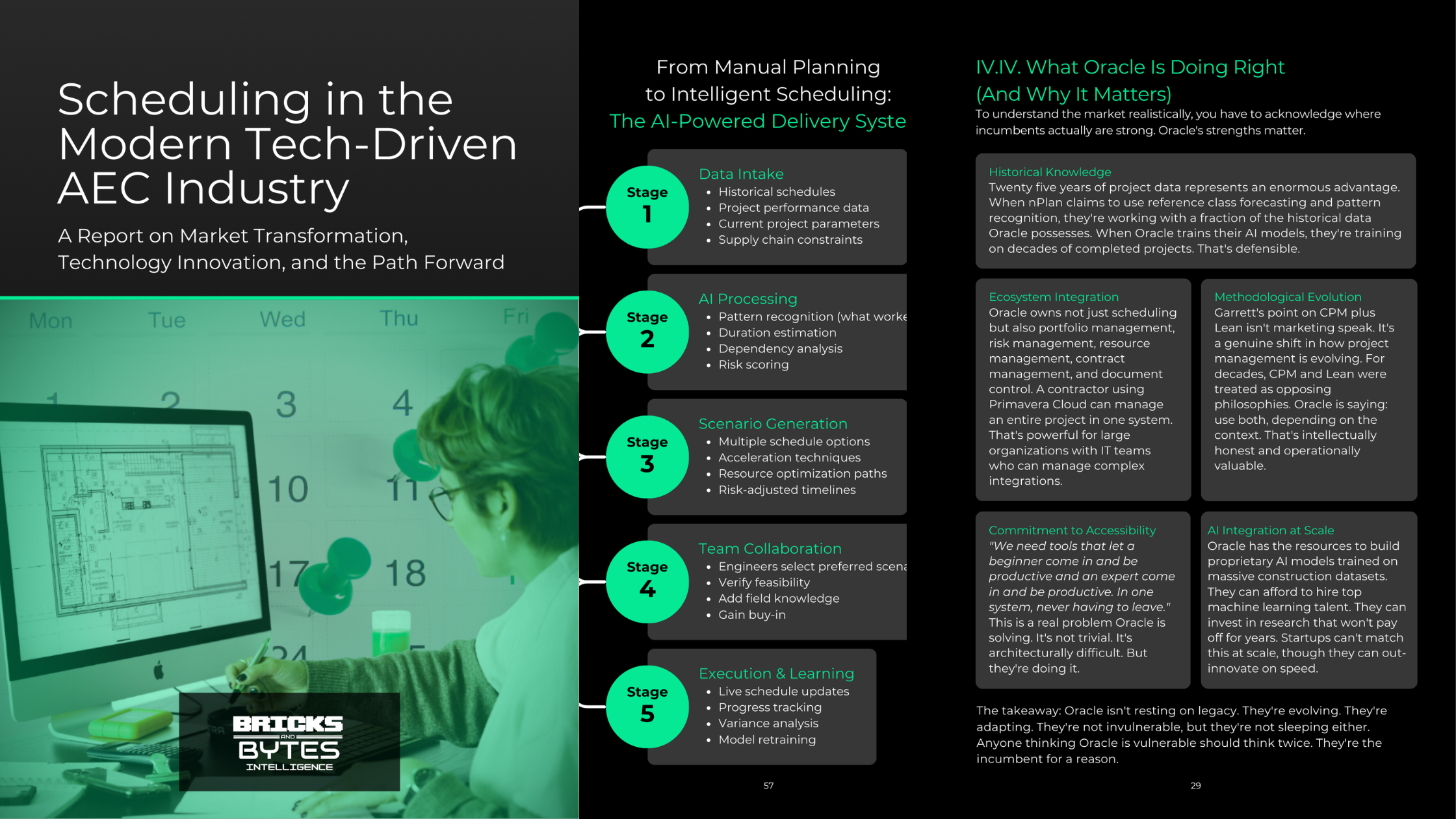
Get a FREE copy of our Scheduling in the Modern Tech-Driven AEC Industry: A Report on Market Transformation, Technology Innovation, and the Path Forward” (worth $150) and a FREE weekly email to stay up to date on construction tech. SIGN UP TODAY!

Scheduling in the Modern Tech-Driven AEC Industry

Sign up to the #1 Newsletter In AEC Tech. Join over 2,100 like-minded Founders, Investors and Techies disrupting the way we build. 

Scheduling in the Modern Tech-Driven AEC Industry