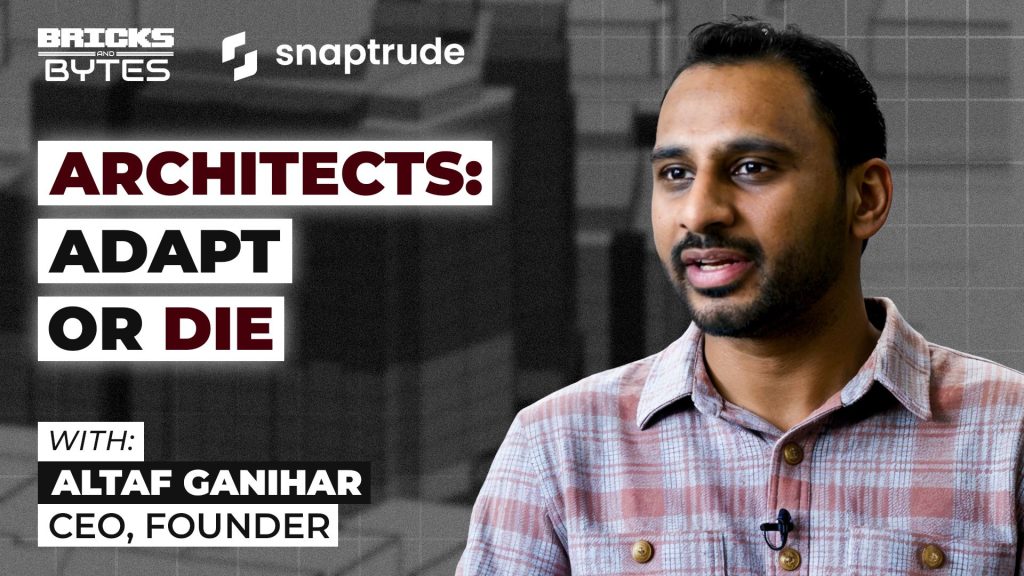
Want to get your message in front of {{active_subscriber_count}} highly engaged innovation leaders? Check out our sponsorship offers. INDUSTRY INSIGHTSArchitects: Adapt or Die The architecture industry has a time problem. Early-stage design work that should take hours stretches into weeks. Teams spend more time checking codes than creating. Billable hours disappear into manual iterations that add little value. Now there’s a data point that makes this concrete. A Department of Transportation project. One to two weeks using traditional methods. With Snaptrude’s new AI, the same work happened in 16 hours. Three complete design iterations. The firm saved tens of thousands in billable hours on that single project. The numbers are real. The implications are bigger. Snaptrude just launched AI that analyzes sites, interprets zoning codes, generates compliant programs, and produces presentable designs from a simple prompt. Whether this feels like a threat or an opportunity depends entirely on how you respond. The question isn’t whether AI is reshaping architecture. It’s already happening. The question is: what does this mean for your career? TL;DR A Department of Transportation project that took 1–2 weeks was completed in 16 hours using Snaptrude’s new AI, with three full design iterations. The AI reads zoning codes, analyzes sites, and generates compliant, presentable designs from a simple prompt. This frees architects from repetitive tasks that consume 30–50% of design time. Snaptrude built from scratch: structured data, tested workflows, then layered AI as a collaborator, not automation. The result: Senior architects design more. Juniors learn faster. The real shift isn’t “AI vs architects”. It’s architects who use AI vs those who don’t. What AI Can Actually Do Now (And What It Can’t) Picture two architects. The first has 30 years of experience and can sketch a brilliant concept on a napkin in minutes. But her team is underwater, and she has no time to learn new tools. The second is a junior designer working late on tasks that a mentor could resolve in an afternoon, full of potential but missing accumulated wisdom. What Snaptrude’s AI handles: A 300-bed hospital with an oncology center, understanding site constraints and occupancy restrictions. It knows nurse rooms should be near patient rooms. It ensures emergency departments have direct ambulance access paths. All compliant with local codes. What takes days happens in hours. What it doesn’t replace: Creative vision. Client relationships. The judgment calls that define great buildings. The outcome: Senior architects stop checking codes and focus on creative decisions. Junior designers get fewer obvious mistakes and more time learning by doing. The AI becomes the mentor that never sleeps and the compliance checker that never gets tired. The 30 to 50 percent problem: That’s how much design time disappears into manual iterations. Not designing. Not creating. Just iterating, checking, redrawing, reworking. Half your billable hours are going into work AI can now handle. The math: Senior architects bill at $200 per hour. The DoT project that took 16 hours would traditionally take one to two weeks for a single iteration. Snaptrude delivered three iterations in that time. Scale that across thousands of projects and firms, and you’re looking at millions of billable hours recovered. The critical question: When that time is freed up, what happens? Two paths forward. Firms could cut headcount and race to the bottom on pricing. Or architects could take on more projects, explore more design options, handle more complex work, and focus on creative decisions that define great buildings. The technology enables both futures. The choice belongs to the industry. Too many tools are wasting time and distracting from the core task of design. Credit: Salmaan Mohamed Why Snaptrude Could Do This When Others Can’t Most companies bolt AI onto 20-year-old software. Snaptrude rebuilt from scratch through three deliberate phases over several years. Phase one: Build data infrastructure. They created structured, editable, unified data on a cloud-native platform where design, data, and documentation live together. Invisible to users but essential. Phase two: Solve the use case manually first. They focused on early-stage design, where things are most broken and important decisions are made. They proved it worked without AI and built real adoption. Phase three: Layer AI on top. With structured data and proven workflows in place, they introduced AI as a collaborator. The AI could now understand context, work with real design data, and integrate into workflows architects already trusted. This is why their AI actually helps instead of frustrating users. The key insight: Without structured data, AI can’t help much. Without solving real use cases first, adoption can’t happen. Legacy software can’t just add AI because foundations don’t support it. But infrastructure is only half the story. How they positioned it matters just as much. Everything in Snaptrude AI is editable. You delegate what you want to be automated and intervene anytime. You keep authorship. They could have positioned their approach as automation (we’ll do it for you) but chose collaboration (we’ll do it with you). Four core principles: Your agency first. You decide what to delegate and when to take the wheel. Transparency over magic. See the assumptions, edit them, then rerun. Interoperability with no lock-in. Speed with standards. Faster only counts if it’s compliant and buildable. The litmus test for real collaboration: Can you turn off AI for any step? Override its decisions? See what it did? If no, it’s automation pretending to be collaboration. Snaptrude AI is designed for ‘yes’ to all three. This positioning matters because architects fear losing control. Every word choice reinforces that you remain in control, you’re enhanced, you’re irreplaceable. Start the AI workflow by defining the project and its programs. Credit: Snaptrude The Launch Strategy Worth Stealing Snaptrude made an unconventional move: they published their entire roadmap publicly. What’s coming next: Envelope Agent for zoning-compliant building envelopes Program Packing for departmental layouts with circulation Massing to BIM for automatic LOD 300/350 model conversion Enterprise Knowledge to bring firm-specific standards into the AI Why show your cards? Most companies hide roadmaps, fearing competitors will copy or customers