
Author name: Owen Drury

olivier lepinoy construction business model
Q&A

Reinventing Construction Business Models – Olivier LEPINOY – Q&A

This Q&A is taken from the full podcast episode we recorded with Olivier. Q: Why did you decide to focus on business models in the construction industry, rather than just technology? A: I decided to focus on business models because I believe people in the construction industry tend to focus too much on technology as the only way to solve problems. My experience working in various roles at companies like Vinci and Autodesk has shown me that business models play a crucial role in how companies create and deliver value. Q: What are some common areas for improvement in construction business models? A: Construction companies tend to focus on playing defense – optimising productivity and cutting costs. While this is important, they often neglect playing offense, which involves developing new offerings, differentiating from competitors, and reinventing themselves. Digital platforms have opened up new opportunities for companies to capture value in different parts of the value chain. Q: How important is company culture in business model innovation? A: Culture and mindset are crucial for companies looking to adapt and innovate. As technology becomes more accessible, culture will be a key differentiator. Many of the case studies in my “arc of transformation” collection focus on initiatives to transform company culture, such as learning programs and open innovation. Q: What does the future of construction business models look like? A: I believe the construction industry will shift from a traditional value chain to a more data-centric model. In this new arrangement, there will be originators (who gather land and financial resources), providers (who offer design, materials, and workforce), aggregators (who orchestrate the work and manage data flow), and consumers (who maintain and operate the assets). Construction companies are building their own technology platforms to enable this transition. Q: What advice would you give to construction tech startups looking to grow? A: My advice would be to look outside of your familiar geographies and regions. Business models and project dynamics can vary significantly between countries, so exploring new markets can uncover untapped opportunities for growth. Q: Can you share a favorite case study of a company that has successfully transformed its business model? A: I’m impressed by what Ferrovial has done in Spain. They’ve built the necessary IT infrastructure to create platforms, formed alliances with technology companies, and continuously think in terms of business models. One example is their joint venture with Renault to create Zity, an electric car-sharing service – showcasing how a traditional construction company can enter entirely new business areas.


shawn van dyke construction business coach
Q&A

Profit First for Contractors – Shawn Van Dyke – Q&A

This Q&A is taken from the full podcast episode we recorded with Shawn. Q: Can you tell us about your career journey and how you ended up as a construction business coach? A: My career path has been a series of evolutions and learning experiences. I initially wanted to be an architect but discovered that engineering was a better fit for my problem-solving skills. After working as an engineer, I transitioned into real estate development and construction management. I started my first business in 2005, and when the 2008 financial crisis hit, I pivoted to residential remodeling. Later, I became the CEO of a trim and millwork company, where I honed my skills in systemizing construction businesses. These experiences led me to coaching, where I help contractors improve their operations and profitability. Q: What is the Profit First method, and how can it benefit construction businesses? A: The Profit First method, developed by Mike Michalowicz, is a financial management approach that encourages businesses to set aside a percentage of revenue as profit before expenses. This helps contractors prioritize profitability and better manage their cash flow. By setting aside money for profit, taxes, and owner’s compensation first, construction businesses can ensure they are not operating at a loss and have the resources to grow and invest in their future. Q: Why do construction businesses often struggle with technology adoption? A: Construction businesses often struggle with technology adoption because they lack standardized processes and workflows. Many contractors try to implement technology solutions without first establishing clear systems and understanding how the technology fits into their operations. This leads to underutilization of the software and a failure to see the full benefits. To effectively leverage technology, construction businesses need to define their systems, answering key questions like “Where am I at?”, “How does this work?”, and “What’s next?” for each process. Q: How has the COVID-19 pandemic impacted the construction industry, particularly in terms of technology adoption? A: The COVID-19 pandemic accelerated the adoption of virtual interactions and digital transformation in the construction industry. Prior to 2020, many contractors were resistant to virtual meetings and remote work. However, the pandemic forced the industry to quickly adapt and embrace these technologies. This shift has led to increased efficiency and new ways of collaborating with clients and team members. Q: You’ve written a book on Profit First for contractors. What advice would you give to someone looking to write a book in their area of expertise? A: Writing a book requires commitment and discipline. When I wrote my book, I committed to writing 1,000 words per day for 30 days. The key is to focus on writing without editing or revising during this phase. After the initial draft, I spent another 30 days revising and 30 days editing with the help of a professional editor. My advice is to set a daily word count goal, write without self-editing, and hire professionals to help refine your work. Additionally, consider productizing your knowledge and experience through coaching programs, courses, and other resources to create additional revenue streams alongside your book.

Sherif Tarabishy computational design foster + partners
Q&A

Navigating AI Adoption in Architecture – Sherif Tarabishy – Q&A

This Q&A is taken from the full podcast episode we recorded with Sherif. Q: Can you tell us about your background and journey from studying architecture in Egypt to working in computational design and applied research at Foster + Partners in London? A: I started my architecture education in Cairo, Egypt, where I initially studied electronics engineering before switching to architecture. After completing my bachelor’s degree, I worked in an architecture studio and then opened a digital consultancy with one of my university tutors. In 2012-2013, we were one of the first consultancies in Egypt to focus on integrating technology into the design and production workflow. However, the market in Egypt wasn’t quite ready for this kind of intervention at the time. I then moved to London to pursue my master’s in architecture computation and started working on the Applied R&D team at Foster + Partners. Q: What is the role of the Applied R&D team at Foster + Partners, and what are the main areas of research you focus on? A: The Applied R&D team at Foster + Partners acts as an in-house consultant for the six design studios within the company. We offer design support, tool development, and research across six core capabilities: machine learning and data science, geometry optimization for fabrication, high-performance computing, XR, VR, and collaborative tools for designers. Our team consists of around 24 people from diverse backgrounds, including architects, structural engineers, and artists, all united by our interest in programming and problem-solving. Q: Why does Foster + Partners develop tools for internal use rather than making them available to the wider market? A: Developing tools in-house is part of what gives Foster + Partners a competitive edge in the market. There are ongoing discussions about potentially opening up some tools to the market, but it’s important to consider the responsibility that comes with supporting and maintaining software for external users. Additionally, many of the tools we create are tailored to the specific types of projects we work on, so they may not have a broad application in the wider market. Q: What areas within the design stack do you think should be explored more broadly? A: I believe there are opportunities to explore inefficiencies in running a design business, as the design aspect itself is already well-explored. Many architecture schools don’t teach the business side of running a creative industry, so there is potential for improvement in the processes that support the design work. Q: Can you tell us about Hermes, an in-house tool developed by your team, and how it addresses interoperability issues? A: Hermes is a message-passing software that lives in the cloud and facilitates communication between different software used by project stakeholders. It allows users to control specific elements of a project, such as grid lines, from their preferred software (e.g., Revit) and publish updates to other team members working in different programs (e.g., Rhino or Grasshopper). This enables automated workflows and ensures everyone is working with the latest version of the project data. Q: What excites you most about the potential of machine learning in architecture, and what concerns do you have about its impact on designers’ intent? A: The widespread adoption of machine learning and the ability to be part of this technological shift is exciting. However, I’m interested in how it affects designers’ intent. With generative AI, users can create polished outputs regardless of their skill level, but there is a risk of accepting these outputs without much thought or iteration. The cognitive dissonance that usually occurs when a designer’s vision doesn’t match the output can lead to frustration or motivation to explore new approaches. I’m curious to see how this will impact the data and artifacts we generate moving forward. Q: What skills do you think future architects should focus on developing, and how do you envision the role of the architect evolving? A: I believe future architects should be more technology-oriented, but not necessarily in an all-or-nothing way. Developing a curious mindset and consistently questioning current processes and investigating new tools is crucial. While we can’t predict exactly how the architect’s role will change, being adaptable and open to new technologies will be essential.

robotics getty images
Robotics

The Rise Of Construction Robots

A humanoid robot meticulously lies bricks near the Docklands .. the hum of 3D printing arms fills the air while they steadily lay layer after layer of concrete, and seven drones buzz above monitoring every inch. Just a few years ago, this would sound like a scene from a sci-fi thriller. But it’s not fiction anymore.

roman baran canary wharf group digital construction
Q&A

ConTech: Finding the Market Gap – Roman Baran – Q&A

This Q&A is taken from the full podcast episode we recorded with Roman. Q: Can you give us an overview of the Canary Wharf Group and the scale of development at Canary Wharf? A: Canary Wharf is a 128-acre estate in London that has been developed by the Canary Wharf Group over the past 36 years. It includes over 2,200 residential units, with plans to double this number in the near future. The estate features five shopping malls, over 300 retail units, and more than 70 cafes, restaurants, and bars. Currently, Canary Wharf Group has over £2 billion in ongoing development, with 75% of that being residential. Q: What is your role as Senior Manager of Digital Construction at Canary Wharf Contractors? A: My role is to drive digital transformation and improve productivity, quality, safety, sustainability, and efficiency in our design and build processes. I work with internal and external stakeholders to identify gaps and implement software solutions that address business needs and provide value to the team. Q: Can you describe Canary Wharf Group’s technology selection process? A: We have a rigorous selection process that involves creating a working group with representatives from different departments, assessing the functionality of potential solutions, and testing them on live projects. We gather feedback from the team and make a decision based on the results and the value the solution provides. Q: What advice would you give to construction technology entrepreneurs looking to sell to large contractors like Canary Wharf Group? A: My advice would be to focus on finding a gap in the market and ensuring your solution addresses a real business need. Demonstrate the value your technology can provide and make sure it is user-friendly and scalable. Don’t just try to sell a shiny new feature; deeply understand the industry and the challenges contractors face. Q: How do you see AI and data analytics impacting the future of construction? A: I believe AI and data analytics will enable more informed, data-driven decision-making in construction. It will help optimise manual and repetitive tasks, improve overall productivity, and provide insights into areas such as workforce location and productivity. However, there are challenges to overcome, such as changing attitudes towards data collection and managing the vast amounts of data generated. Q: Can you tell us about your experience pursuing a part-time PhD while working in the industry? A: Pursuing a part-time PhD while working has allowed me to think critically about AI and productivity in construction, challenge my assumptions, and explore new perspectives. It has been a challenging but rewarding experience, requiring me to set priorities, minimize distractions, and learn how to learn efficiently. I believe the combination of academic research and practical industry experience can lead to valuable insights and innovations. Q: What is your vision for the future of digital construction at Canary Wharf Group? A: My vision is to continue driving digital transformation and adoption of new technologies that improve our processes and deliver value to our clients and stakeholders. I see a future where data-driven decision-making, AI-assisted planning and scheduling, and real-time monitoring of workforce productivity are the norm. By staying at the forefront of digital construction, we can build more efficiently, sustainably, and safely, while maintaining our position as a leader in the industry.

anthony hauck hypar generative design
Q&A

Streamlining AEC with AI – Anthony Hauck – Q&A

This Q&A is taken from the full podcast episode we recorded with Anthony. Q: Can you tell us about your journey from an IT director in an architectural engineering firm to creating the world’s first cloud-based design automation platform? A: My journey started with trying out AutoCAD 2.6, the first version with snapping. As I worked with CAD, I realized there was a programming language underneath that could make things go faster. This led me to focus more on the technology side. Eventually, I joined Autodesk on the Revit team and went into product management. In my last two years at Autodesk, I proposed ideas for how computation could intersect with building design and construction. When Autodesk didn’t pursue these ideas, my partner Ian Keough and I left to start Hypar. Q: What limitations do you see in current BIM software? A: BIM software is primarily designed for creating coordinated construction documents rather than modeling buildings or supporting specific tasks. While you can use BIM software for various purposes, it’s not optimised for them. For example, you might use Revit, Rhino, or even Excel for space planning, but none of these tools were designed specifically for that task. Q: How does Hypar address these limitations? A: Hypar focuses on creating targeted applications that address specific building problems and tasks. We want to make it easy for anyone to create a tool that is super suited to their needs, whether it’s space planning, designing sprinkler systems, or optimising wallboard. By providing a platform where people can contribute their expertise, we aim to support a wide range of targeted applications. Q: Can you explain how Hypar uses AI and procedural approaches to generate building models? A: In Hypar, users can input natural language descriptions of a building, like “a five-story U-shaped building.” We then use a large language model to map this description to various inputs and parameters in our system. These inputs feed into procedural models that generate the actual building geometry. So, it’s a combination of AI for natural language processing and procedural approaches for model generation. Q: How do you view the role of AI in the design process? A: We see AI as one computational technique among many. It’s particularly useful when you suspect there might be patterns in data that you can’t easily find. However, we don’t think it makes other types of computation or human judgment obsolete. In many cases, if you know how a process works, it’s better to write it down procedurally than to try to infer it from data using AI. Q: What advice would you give to someone seeking investment for their startup? A: Talk to your target customers and ask them lots of questions. Don’t invest heavily in something you’re unsure of. Instead, focus on creating the simplest thing you can, even if it’s just an interactive PowerPoint presentation, and see if potential customers like it. Minimise investment until you’ve validated your idea. And remember, software development should be a last resort for solving problems because it’s expensive and error-prone.

Startups, Technology, Venture

Tech Comes To Rescue Amid Construction-Climate Crisis

The development industry has left the planet with more toxic waste than anyone else. A staggering 40% of global greenhouse gas is credited to the building sector. A study by the World Green Building Council, reveals that construction is currently the single biggest culprit for global greenhouse gas emissions. Our current construction model is failing – depleting Earth’s natural resources and consuming unsustainable amounts of energy.

tom deane project mark construction crm
Q&A

Generic vs. Construction-Specific CRMs – Tom Deane – Q&A

This Q&A is taken from the full podcast episode we recorded with Tom. Q: Can you tell us about your journey from college roommates to co-founders of ProjectMark? A: My co-founder Noel and I have known each other for over 17 years, starting as college roommates. After gaining extensive experience in the construction industry, we recognized a significant problem in business development and marketing workflows. Inspired by the emergence of construction technology, we decided to start ProjectMark, a CRM built specifically for the construction industry. Q: What makes Project Mark different from generic CRMs?  A: Generic CRMs often require extensive customisation and can be challenging for technical teams to adopt due to their feature-rich nature. ProjectMark is tailored specifically for the construction industry, focusing on projects rather than deals. Our platform combines sales enablement, content management, and a data hub alongside RFP and proposal generation, addressing pain points that would otherwise require multiple software solutions.  Q: How did you fund the early stages of ProjectMark? A: We initially put our own money together to build an MVP and validate the concept. Our early clients, who were construction executives, reacted positively to the idea, and some even invested in the company. This allowed us to raise $500,000 from construction executives and early clients, giving us the confidence and drive to continue building the product.  Q: You recently raised a $3 million seed round. Can you share some tips for founders looking to raise money? A: Building momentum is crucial when raising funds. Establish a strong network of VCs and founders, attend industry events, and leverage podcasts to learn about potential investors. When you’re ready to raise, communicate with all the VCs in your network and ask your founder friends for introductions. The more momentum you build around your fundraising efforts, the quicker VCs will move. Q: How do you collaborate with your investors post-fundraising?  A: We maintain regular communication with our investors, updating them on the company’s progress every 6-8 weeks. Our investors provide valuable support in areas such as networking, go-to-market expertise, product expertise, and technical expertise. The more transparent you are with your investors, the better value you can get from your investment team. Q: What are your plans for the future of ProjectMark A: We’re constantly enhancing our core product based on client feedback and market trends. We see great opportunities in AI and the data we collect to make it easier for companies to enter, absorb, and understand their data. While we’re currently focused on the US and Canadian markets, we recognize the potential for expansion, as construction professionals worldwide face similar challenges in tracking opportunities and managing data.

michelle du plessis shft co founder bim construction technology
Q&A

BIM: Beyond 3D Modeling Misconceptions – Michelle du Plessis – Q&A

This Q&A is taken from the full podcast episode we recorded with Michelle. Q: How and why did you get into BIM consulting? A: My husband and I are both architects by profession. When we moved to the UK from South Africa in 2016, our qualifications didn’t fully transfer. Rather than redo our studies, we looked for ways to apply our architecture skills in a new way. In 2018, a friend connected us to a client looking for BIM services, which was a lightbulb moment. We saw BIM as an exciting opportunity to help digitize the construction industry and improve processes we weren’t satisfied with from our experience. This led us to start formulating our own BIM consulting company. Q: What is the biggest misconception about BIM? A: The biggest misconception is that people believe BIM is just a 3D model that has to be produced. But BIM is really about building information management – it’s a strategy to improve information flow throughout a building’s entire lifecycle, from design through construction to operations. The 3D model is just one of the outputs. BIM requires overhauling work processes and how teams interact. Q: Why do you think there is negativity around BIM? Is it justified? A: I think there are two main reasons for negativity around BIM. First, there are misconceptions about what BIM actually is and entails. For example, subcontractors often see it as just a tender requirement pushed on them that someone else will handle. Second, unclear processes and deliverables lead to frustration, like when BIM is done only for compliance at the end of a project with no real collaboration or benefit. The negativity shows there is room for improvement and growth. Clearer understanding of BIM’s purpose and timely engagement is needed. Q: What portion of projects are using BIM currently? What do you see in the future? A: It’s hard to quantify overall adoption, as it varies a lot by project scale, type, sector and goals. BIM is becoming the norm on large projects with sufficient budgets and timelines to invest in it and realize the benefits, like with infrastructure and data centers. Smaller projects adopt it much less due to cost-benefit considerations. But I hope and expect to see residential projects increasingly provide structured digital information to owners in the future, even if not full BIM models, so people can better understand and maintain the homes they’re investing in. Simpler technologies and processes may emerge for those scales. Q: Where do you see the construction industry and MMC in 10 years?  A: In the coming years, I think we’ll see more hybrid solutions, composites, and panelized systems being used in homebuilding. Homes will be simplified in their construction but still allow for individualization and aesthetics. More spray and pump finishes for plaster and render will be utilized. If these advancements can be applied in the affordable housing market to make stunning homes, that will be a major accomplishment.

Paul Richards - Gurbuild - modern methods of construction (MMC)
Q&A

Industrialising Innovation: MMC’s New Era – Paul Richards – Q&A

This Q&A is taken from the full podcast episode we recorded with Paul. Q: Can you briefly describe your background in construction and why you founded GURBuild? A: I have a 40+ year background in construction, starting from when I was a kid. Around 2010, I got involved in the Retrofit for Future program and could see that solutions for retrofitting houses should first be tried in new builds. In 2017, I got involved in a program in Cornwall looking at ways to affordably produce houses to passive house standards. I founded GURBuild because I saw the UK starting to look at alternatives to traditional construction and wanted to bring my manufacturing and commercial construction experience to the housing sector.  Q: How has modern methods of construction (MMC) technology changed over the last decade? A: The last 10 years has seen people trying different approaches, often trying to industrialize an old technology, which I don’t think works. Now some successes are emerging that have a common theme of using sub-assemblies manufactured offsite and assembled at the final destination, similar to how alternators are made for cars. The changes on the professional side are done – the focus now is on bringing the workers onsite up to speed with these modern methods. Q: Can you explain what the passive house standard is and what an n-ZEP is? A: A passive house uses building physics and technologies to create a structure that requires very minimal energy to run, so utility bills are very low. An n-ZEP, or net-zero energy house, is one that in its operation does not contribute to any carbon emissions, though embodied carbon in materials is still a challenge. The goal is to use technology to get homes to passive house standards in a cost-effective way.  Q: What type of construction system does GURBuild use? A: The GURBuild system is a hybrid approach using a light gauge steel frame and engineered timber that allows for liquid insulation to be injected to reach high thermal standards. It’s a “kit of parts” that enables a starter home to be expanded over time, going from a 2-bed to 3-bed to 4/5-bed by bolting on extensions. The parts are manufactured offsite using a “chassis” approach similar to car manufacturing. Q: Where do you see the construction industry and MMC in 10 years?  A: In the coming years, I think we’ll see more hybrid solutions, composites, and panelized systems being used in homebuilding. Homes will be simplified in their construction but still allow for individualization and aesthetics. More spray and pump finishes for plaster and render will be utilized. If these advancements can be applied in the affordable housing market to make stunning homes, that will be a major accomplishment. Q: Where should the construction industry focus more attention?  A: The industry is overlooking the workers onsite. We need to focus on making the onsite working environment safer, warmer and better in order to attract more young people into construction. Changing onsite work to be more like a production format could enable people to be paid better and improve quality of life. Using build rigs and bringing factory-like processes to the site can help maintain accuracy and eliminate mistakes while empowering a more diverse workforce. Women in particular could make phenomenal house builders if treated with respect and paid decent wages.

jeevan kalanithi open space reality capture
Q&A

OpenSpace Co-Founder Shares Startup Insights – Jeevan Kalanithi – Q&A

This Q&A is taken from the full podcast episode we recorded with Jeevan. Q Can you tell us about your background and what led you to co-found OpenSpace? A: My passion for artificial intelligence and building products that make people’s lives better has been a driving force throughout my career. I studied AI at Stanford and MIT, and co-founded my first startup, which I later sold. I then became the president of 3D Robotics, North America’s largest drone company. Through my experiences, I identified the need for a simple, comprehensive, and affordable reality capture solution in the construction industry, which inspired me to join forces with my co-founders, Mike and Philip, to create OpenSpace. Q: How does OpenSpace’s technology help construction teams? A: OpenSpace’s core product allows construction teams to easily capture and document job sites using 360 cameras, creating a visual record accessible from anywhere at any time. This enables builders to have a complete, up-to-date view of their projects, making it easier to resolve issues, collaborate with stakeholders, and make informed decisions. Our technology streamlines processes like OAC meetings, RFIs, change orders, and punch lists, saving time and improving communication. Q: What do you envision for the future of reality capture in the construction industry? A: I believe that in five to ten years, using a technology like OpenSpace will be standard practice on every job site. Just as it would be unusual to conduct research without using Google today, it will be rare for a construction project not to employ reality capture technology. As AI and computer vision advance, we’ll see more breakthroughs in analyzing and extracting insights from the vast amounts of visual data captured on job sites. OpenSpace is uniquely positioned to lead this revolution with our extensive dataset and cutting-edge AI capabilities. Q: What advice would you give to aspiring entrepreneurs? A: One of the most important pieces of advice I would give to my younger self is to run towards the punch in the face – identify and address the critical risks to your idea as early as possible. It’s crucial to validate or invalidate these risks quickly, even if it means confronting uncomfortable truths about your business. As your company grows, it’s equally important to dedicate time for creative work and seek feedback from your team and customers to ensure you’re steering the ship in the right direction.

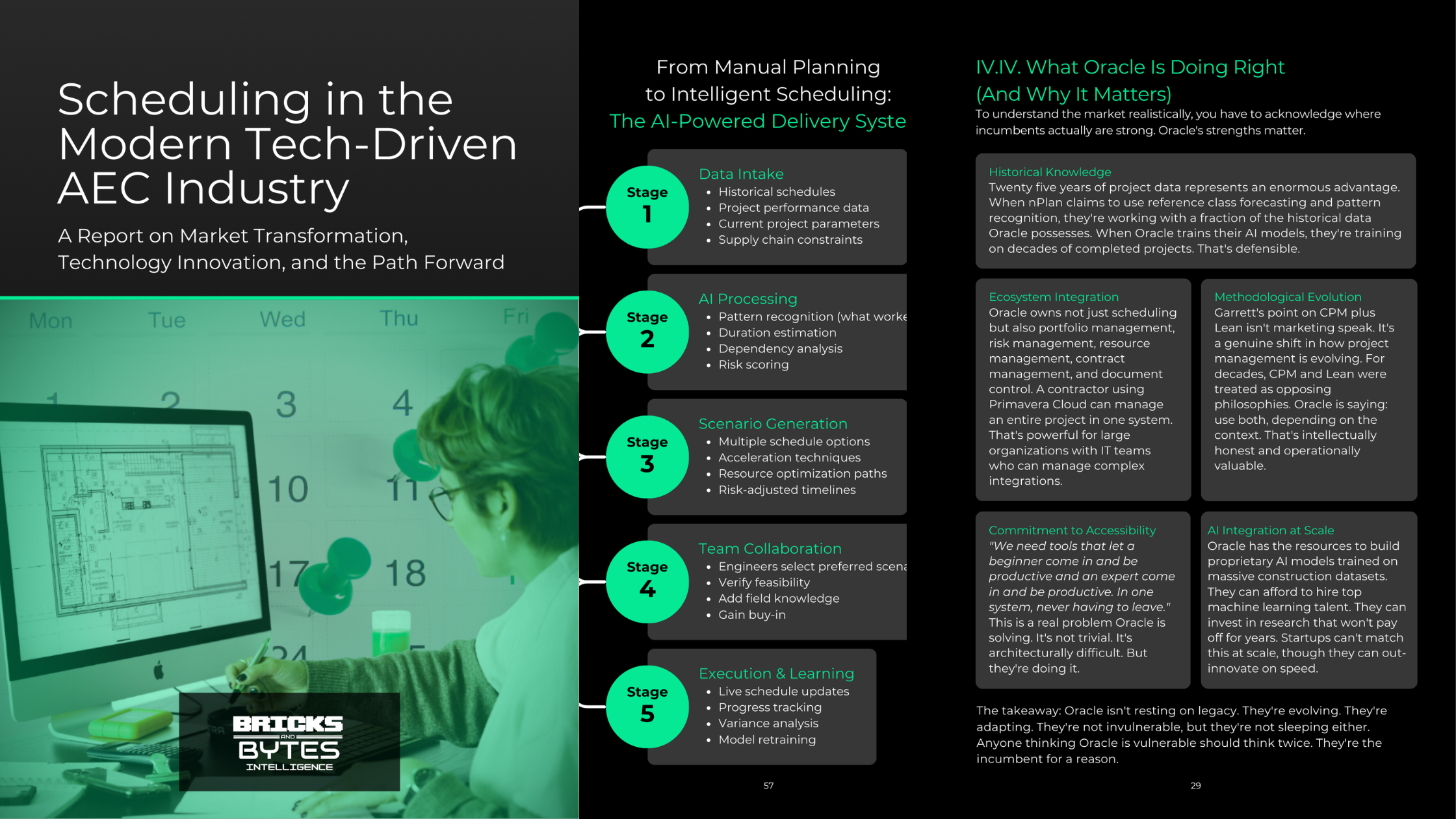
Get a FREE copy of our Scheduling in the Modern Tech-Driven AEC Industry: A Report on Market Transformation, Technology Innovation, and the Path Forward” (worth $150) and a FREE weekly email to stay up to date on construction tech. SIGN UP TODAY!

Scheduling in the Modern Tech-Driven AEC Industry

Sign up to the #1 Newsletter In AEC Tech. Join over 2,100 like-minded Founders, Investors and Techies disrupting the way we build. 

Scheduling in the Modern Tech-Driven AEC Industry