Author name: Owen Drury

Newsletter

Carbon Accounting Collapse + Apple Finally Chooses AI Partner

Carbon accounting collapsed. Apple outplayed everyone. And construction’s next IPO might be a warning sign. In this week’s Bricks, Bucks & Bytes episode: 🌳 Carbon offsets are mostly fiction; up to 90% of rainforest credits may be worthless 📉 $2.3B poured into carbon accounting software… for a market that barely exists 🧮 Construction carbon math is broken: high effort, near-zero confidence 💸 Plan A’s “€55M exit” looks very different once you open the public filings 🎙️ Special guest: Tom Yeshurun (Civ Robotics) explains how robots are now doing in hours what surveyors used to do in days, laying out thousands of points on solar farms, roads, and megaprojects with millimeter accuracy. But that’s not all: Apple’s quiet AI masterstroke: why waiting beats racing Why Gemini (not OpenAI) ended up inside Siri Google paying Apple ~$20B a year to not build search EquipmentShare’s $6B IPO ambition: impressive business or financial gymnastics? 🎧 Listen now for: Why carbon accounting became a consultant economy How AI hype and regulation are pulling in opposite directions What real construction tech scale actually looks like Why some “exits” aren’t really exits Watch the Full Episode You might also like: 2026 Construction Industry, $3 Billion Construction Tech Exits & LinkedIn Content Crisis $100K Christmas Party, AEC UFC Arrives, EquipmentShare Files Public, Three?? AEC Tech IPOs Coming Bobyard’s $35M AI Claims, Oracle’s $523B Backlog, Larry Ellison’s Debt Mastery AEC’s Craziest Acquisition Ever? Landing Page 101, UK Construction Doomed, Robotics to win 2026 $875m Founders Return to Construction, $9.2M Nextlight Raise, AI Go-To-Market Race OpenAI Turner Mega Deal, OpenSpace Buys Disperse, Government Shutdown Impact on Construction nPlan Raises £11.9M Series B, AI Agents Lack Evals Crisis, WhatsApp Dominates 90% Site Communication Procore’s AI Bomb, Should VCs Pick Ideas, Revolutionary Site Layout Tool Buildots Acquisition, Procore Groundbreak’s Awkward Week, Pre-Con Is On Fire NEOM Cancelled, SoftBank’s $5.4B Bet, Track3D Raises $10M $500k Salaries for Mechanics, VC’s Getting Defrauded, DOT Causes Chaos Powered by beehiiv

Newsletter

ICYMI: $10M Pre-Con Raise, Founder War Stories, & Office Construction Rebounds

This Week’s Quickfire BytesFuel your curiosity with this week’s contentW/C 12th January 2026 NEW EPISODES 2026 Construction Industry, $3 Billion Construction Tech Exits, Canvas Robotics Acquired, Pre-Con Debates & LinkedIn Content Crisis We kick off 2026 with hot takes, bold predictions, and a no-holds-barred discussion on what’s really happening in construction tech. “I Liquidated My Entire Savings to Make Payroll” – Startup Survival Stories – Thiago & Clifton Thiago Da Costa from DataGrid and Clifton Harness from TestFit talk about the raw truth of building construction tech startups – from pivoting at $1M ARR to nearly missing payroll. Why 72% of Leaders Are In Trouble | Global eTraining We sat down with Susan Brattberg, co-founder and Chief Customer Officer at Global eTraining, and what started as a conversation about an epic rooftop party at Autodesk University (300 people, live band, line dancing – yeah, these guys know how to do marketing) turned into a deep dive on something way more important. View all Podcasts 2 FAVORITE QUOTES: “I think you do need to be more worried about startups who in the last two years raised capital to fund their SaaS businesses because they will not be able to scale down quick enough.” – Patric’s warning about construction tech startups facing challenges in the current climate “If you don’t have the guys that are inside the atoms, understanding how they turn into bits in the long run, you’re going to absolutely crash and burn.” – Clifton on why technical founders are essential YOU MIGHT ALSO LIKE Premium Insights 10 Hard-Won Lessons from Founders Who Sold for Millions A Step-by-Step Guide to Clear Product Marketing for AEC Startups 12 Lessons About Hiring From AEC’s Top Leaders More Insights NSFW: Build a F*cking Business McKinsey’s Secrets to Scaling Construction Tech How Flux Burned Through $29M – Lessons for AEC Innovators Ex AutoDesk CEO’s 12 Lessons For Developing Products Could an Entrepreneur in Residence Save Your Construction Firm? Most Popular Episodes How To Build A Unicorn In Construction Tech – Patric Hellermann Story Of A Modular Construction Startup That Burned Through £10M in 15 Months – Chris Spiceley McKinsey FINALLY updates their Productivity Curve, & The Future Of Construction – David Rockhill, Partner at McKinsey Procore’s AI Strategy & Implementation – AI’s Role in Modern Construction Disrupt Autodesk? This Ex-Autodesk CEO Has Some Advice – Amar Hanspal Super Series Super Series with Ediphi Super Series With Speckle Super Series With Monumental Super Series with Foundamental OUR SPONSORS Aphex – The multiplayer planning platform where construction teams plan together, stay aligned, and deliver projects faster. Archdesk – The #1 construction management software for growing companies. Manage your projects from Tender to Handover. BuildVision – Streamlining the construction supply chain with a unified platform for contractors, manufacturers, and stakeholders. Powered by beehiiv

Newsletter

How Spacemaker Sold to Autodesk: 5 Hard-Won Lessons From Building & Exiting in AEC Tech

INDUSTRY INSIGHTSHow Spacemaker Sold to Autodesk: 5 Hard-Won Lessons From Building & Exiting in AEC Tech Carl Christensen on outcome-based design, finding product-market fit in a resistant industry, and why culture trumped valuation in the M&A process When Carl Christensen first started talking to architects in 2016, his immediate reaction was confusion. Coming from a software engineering background scaling products for Nordic companies, the workflows he observed didn’t make sense. “It sounded like Howard was doing something wrong or kind of his company was doing something wrong because it sounded so inefficient and so unlike what other industries were going through in terms of digital transformation,” Carl recalls. Howard was an architect who questioned established practices. “I wasn’t really seeing any digital transformation.” That confusion became the seed of Spacemaker, which Autodesk eventually acquired. Carl now leads product development for Autodesk Forma, but the lessons from building and exiting Spacemaker offer a masterclass in navigating one of the industry’s toughest challenges. Here are five lessons that apply whether you’re raising your seed round or preparing for an exit. TL;DR: How Spacemaker Built, Survived, and Sold to Autodesk Solve the system, not the symptom – Point solutions die in AEC. Spacemaker won by tackling systemic decision-making (outcome-based design) instead of fixing isolated workflow inefficiencies. Go where leverage lives, not where budgets scream – Early-stage decisions (site, massing, constraints) create exponential downstream impact. Small changes early beat massive optimizations late. Product-market fit in AEC takes ~3–5 years – Long project cycles, conservative buyers, regulatory risk, and committee procurement slow everything down. Pilots ≠ PMF. Dependency is the signal. M&A is about culture more than price – The Autodesk deal worked because visions aligned and relationships were built early. Cultural fit determines whether teams and products actually survive post-acquisition. AI advantage requires years of real-world validation – Spacemaker used generative AI years before the hype—but trust took seven years of production use. In regulated industries, proof beats novelty every time. Bottom line: Winning in AEC tech demands patience, systems thinking, and trust-building, not SaaS shortcuts. If you’re building for quick wins, you’ll stall. If you’re building leverage into the system, you create something worth acquiring. Spacemaker: Make intelligent site acquisitions. Credit: Autodesk Lesson 1: Solve a Systemic Problem, Not Point Solutions Carl’s first instinct was to fix individual problems one by one. There were inefficiencies everywhere. Surely there had to be easy wins. That approach didn’t work. The team spent more time digging into root causes and developed what Carl calls a systemic hypothesis. “The industry is fundamentally incapable of change because there are so many interconnected problems.” This led to what they called outcome-based design: focusing on the actual purpose of a construction project rather than deliverables like models or drawings. The challenge isn’t that people don’t understand a hospital should improve health. The challenge is competing outcomes pulling in different directions: Profitability that needs to justify investment while maintaining acceptable risk levels throughout development and operations Living quality that determines whether spaces serve their intended purpose and create environments people actually want to inhabit Sustainability that drives increasingly stringent regulatory requirements and shapes market expectations from investors and end users Maintainability that affects long-term operational costs and determines the asset’s viability over decades Community impact that determines approval timelines, project viability, and the building’s relationship with its surroundings Regulatory compliance that creates hard constraints on design decisions and can derail projects late in development When you’re selling transformation rather than features, you need to help buyers understand why their current approach creates these tensions. Spacemaker wasn’t another tool. It was a framework for thinking differently about decisions. If you’re solving point problems, you’ll face objections about workflow disruption. If you’re solving the system, you’re creating a category. That takes longer but builds defensibility that point solutions never achieve. Lesson 2: Attack the Leverage Point, Not the Cost Center Most AEC software targets late-stage projects where teams spend significant hours. The logic makes sense: go where the budgets live. Spacemaker went elsewhere. Carl notes that few software companies focused on the early stage because it’s not the obvious cost driver. The team observed that teams constantly realize they could have done something differently. Either they get information too late, or they make early decisions without critical data. Early in projects, teams make high-level defining decisions about where to build, how big, and the basic massing. As they progress and detail the building, they learn more but become constrained by previous decisions. Teams can’t incorporate information gained later because fundamental choices are already locked in Supporting early-stage decisions that were typically done without software became Spacemaker’s focus. The insight was leverage. Small changes early create exponential downstream impact. Better starting points lead to better outcomes. But nobody was asking for this software because the pain point wasn’t obvious in budget line items. Lesson 3: Product-Market Fit Takes Three Years in AEC (Even When You’re Right) “The first three years, we didn’t have product-market fit. We had a product that was beautiful, and it worked, but we couldn’t sell it.” Spacemaker had working AI. Simulation capabilities predicting sunlight, noise, and wind. Beta users who loved it. But they couldn’t monetize at scale. “We were kind of constantly pivoting and adjusting,” Carl admits. The turning point came when conversations shifted from “This is interesting” to “When can we use this on our next project?” That subtle change signaled customers moving from curiosity to dependency. Why This Timeline Matters Product-market fit takes three to five years in AEC because: Projects span years, so proving value requires seeing results through entire development cycles. A pilot on a two-year project means waiting that long to demonstrate actual impact, not just theoretical benefits. Procurement involves extensive evaluation with committee decisions rather than individual authority. Software purchases require sign-off from IT, finance, operations, and project leadership, each with different success criteria. Teams need proof on real projects because theoretical benefits don’t convince buyers who’ve seen countless overpromised tools. Case studies

Newsletter

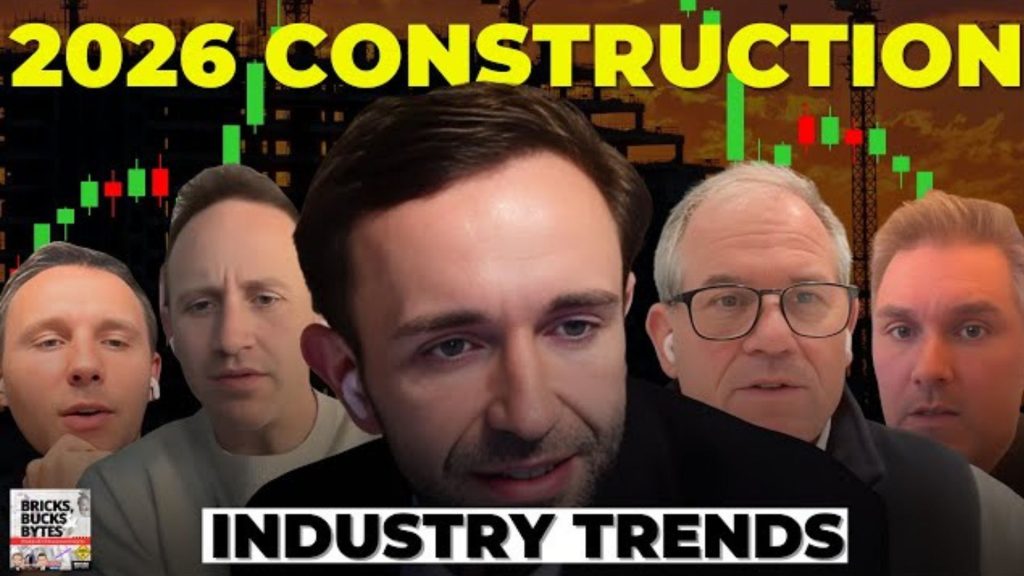
Our Take on 2026 Construction Trends

2026 is already breaking construction’s mental models. And we’re only a few days into the year. In this week’s Bricks, Bucks & Bytes episode: 🏗️ Data centers keep ripping, but manufacturing has hit a weird plateau. 📉 Condos are collapsing while purpose-built rentals quietly take over. 🤖 Robotics exits are here, JLG acquires Canvas, and physical AI finds its first real buyers. 💸 Tariffs + uncertainty are still poisoning bids and breaking price certainty. 🌱 Green mandates slow down as grids, geopolitics, and data centers take priority. 🎙️ Special guest: Steve Dell’Orto, Founder of Concentric, joins us fresh off a $10M Series A to talk real pre-construction workflows, not slideware. But that’s not all: Patric drops a hot take: “We’ll see $3B construction tech exits in 2026.” Dustin calls out “AI-native” theatre and why most startup messaging is built for VCs, not customers. Off-site manufacturing gets a reality check (less hype, more grind). Pre-construction myths get dismantled, no, you can’t compress it to “minutes”. 🎧 Listen now for: Why robotics buyers won’t look like SaaS buyers How LinkedIn content incentives are breaking industry discourse The real reason big incumbents will start acquiring niche tools Why it’s never been easier to start a company and never harder to build a great one Watch the Full Episode You might also like: $100K Christmas Party, AEC UFC Arrives, EquipmentShare Files Public, Three?? AEC Tech IPOs Coming Bobyard’s $35M AI Claims, Oracle’s $523B Backlog, Larry Ellison’s Debt Mastery AEC’s Craziest Acquisition Ever? Landing Page 101, UK Construction Doomed, Robotics to win 2026 $875m Founders Return to Construction, $9.2M Nextlight Raise, AI Go-To-Market Race OpenAI Turner Mega Deal, OpenSpace Buys Disperse, Government Shutdown Impact on Construction nPlan Raises £11.9M Series B, AI Agents Lack Evals Crisis, WhatsApp Dominates 90% Site Communication Procore’s AI Bomb, Should VCs Pick Ideas, Revolutionary Site Layout Tool Buildots Acquisition, Procore Groundbreak’s Awkward Week, Pre-Con Is On Fire NEOM Cancelled, SoftBank’s $5.4B Bet, Track3D Raises $10M $500k Salaries for Mechanics, VC’s Getting Defrauded, DOT Causes Chaos $94M Fundraising Record, New Procore CEO, Oracle Push, Zoom Kills Careers Powered by beehiiv

Newsletter

ICYMI: Trimble Acquires in 30 Days, 400% Training ROI, & Digital Skills Crisis

This Week’s Quickfire BytesFuel your curiosity with this week’s contentW/C 5th January 2026 NEW EPISODES Why 72% of Leaders Are In Trouble | Global eTraining We sat down with Susan Brattberg, co-founder and Chief Customer Officer at Global eTraining, and what started as a conversation about an epic rooftop party at Autodesk University (300 people, live band, line dancing – yeah, these guys know how to do marketing) turned into a deep dive on something way more important. From Signed Papers to Product Launch in 30 Days – How 21 Employees Startup Closed an M&A Deal With Zero Advisors Or Lakritz, founder of StructShare (now Trimble Materials), shares how a 21-person startup navigated acquisition conversations with multiple players, the critical importance of transparency during M&A, and why integrating with Procore in 2021 was one of their best decisions. View all Podcasts 2 FAVORITE QUOTES: “A lot of companies that started coming down this path have actually dropped out of the game. It’s too niche for them… So we’re kind of a low last man standing.” – Susan Brattberg on how their focused specialization in AEC training became a competitive advantage as others abandoned the space “We chose the home where we saw that it’s a real priority. It’s something that once we’ll get in, we’ll be able to continue to build what we are building and to fulfill our vision in the industry.” – Or Lakritz on selecting Trimble over other potential acquirers based on strategic alignment. YOU MIGHT ALSO LIKE Premium Insights 10 Hard-Won Lessons from Founders Who Sold for Millions A Step-by-Step Guide to Clear Product Marketing for AEC Startups 12 Lessons About Hiring From AEC’s Top Leaders More Insights NSFW: Build a F*cking Business McKinsey’s Secrets to Scaling Construction Tech How Flux Burned Through $29M – Lessons for AEC Innovators Ex AutoDesk CEO’s 12 Lessons For Developing Products Could an Entrepreneur in Residence Save Your Construction Firm? Most Popular Episodes How To Build A Unicorn In Construction Tech – Patric Hellermann Story Of A Modular Construction Startup That Burned Through £10M in 15 Months – Chris Spiceley McKinsey FINALLY updates their Productivity Curve, & The Future Of Construction – David Rockhill, Partner at McKinsey Procore’s AI Strategy & Implementation – AI’s Role in Modern Construction Disrupt Autodesk? This Ex-Autodesk CEO Has Some Advice – Amar Hanspal Super Series Super Series with Ediphi Super Series With Speckle Super Series With Monumental Super Series with Foundamental OUR SPONSORS Aphex – The multiplayer planning platform where construction teams plan together, stay aligned, and deliver projects faster. Archdesk – The #1 construction management software for growing companies. Manage your projects from Tender to Handover. BuildVision – Streamlining the construction supply chain with a unified platform for contractors, manufacturers, and stakeholders. Powered by beehiiv

Newsletter

From Zero to Trimble Materials: How StructShare Built an 8-Year Procurement Platform Worth Acquiring

INDUSTRY INSIGHTSFrom Zero to Trimble Materials: How StructShare Built an 8-Year Procurement Platform Worth Acquiring How Or Lakritz turned early missteps into strategic advantages, partnered with Procore, and closed a 10-month deal that made his 21-person team the cornerstone of Trimble’s materials strategy Building a construction tech company that gets acquired isn’t about luck. It’s about making strategic decisions at critical moments, even when those moments don’t feel strategic at the time. Or Lakritz and his team at StructShare spent eight years building a procurement platform for specialty contractors, navigating everything from product-market fit questions to investor relationships to integration strategies with major platforms. The result: Trimble acquired the company and relaunched it as Trimble Materials in under a month. This is the story of the five pivotal decisions that transformed a 21-person startup into a strategic asset, and what founders can learn from each one. TL;DR: Find the real gap. Or Lakritz built StructShare for specialty contractors stuck on spreadsheets (slow market, real pain, little competition). Measure what matters. Despite strong sales, weak daily usage triggered a hard reset toward adoption, retention, and workflow stickiness. Partner for leverage. Early integration with Procore delivered credibility and distribution no sales team could match. Trust saves companies. When a 2024 round fell apart, strong investor relationships kept the business alive. Prepare the team. Transparent communication made acquisition a continuation, not a shock. Right buyer, right time. Trimble needed procurement now, not later, making StructShare a clear buy. Result: After 8 years and a 10-month deal, StructShare became Trimble Materials; proof that patient category-building + real usage beats hype every time. Before platforms like StructShare, specialty contractors ran procurement on spreadsheets, emails, and texts. Credit: Plot Identifying the Opportunity When StructShare launched eight years ago, Or Lakritz saw something others had missed: specialty contractors were running procurement on spreadsheets, emails, and text messages while general contractors had sophisticated tools. The gap was obvious, but the opportunity required patience. Without existing digital solutions to reference, every customer conversation meant explaining not just why StructShare was better, but why digitization itself mattered. This market education phase proved challenging, but it also meant building in a space with real demand and minimal competition. The company was creating a category, not just competing in one. This is consistent with broader industry patterns. A McKinsey study suggests that even today, large contractors spend less than 1 percent of revenues on IT, and technology uptake remains slow and heavily skewed towards basic control rather than workflow transformation. That foundation would prove valuable years later when strategic acquirers started looking for proven solutions in the procurement space. There were legacy players and a few attempts that had already shut down, but no one was truly serving specialty contractors with modern digital tools. The Pivot That Changed Everything Learning to Measure What Matters In 2023, StructShare’s sales team was closing 40 to 50 percent of their demos. For most founders, this signals strong product-market fit and justifies scaling sales operations. Or and his co-founder Eric made that investment, confident in their momentum. What they discovered changed how they thought about success. While sales numbers looked strong, usage patterns told a different story. Customers were buying StructShare but not embedding it deeply into their daily workflows. The insight led to what Or calls a “hard reset,” but it was really a strategic refocus. Rather than continuing to pour resources into top-of-funnel growth, they shifted their entire organization toward understanding customer behavior. The new priority became learning why some customers adopted the product fully while others didn’t, then using those insights to refine the product. Sales looked strong. Usage told a different story and forced a hard reset. Credit: Geckoboard This decision required conviction. Pausing growth initiatives when sales are strong goes against startup instincts. But the refocus paid off. By prioritizing usage and retention over new customer acquisition, StructShare built a product that customers actually depended on. That stickiness became a key asset when acquisition conversations began. The reset worked. They refocused both on costs and team priorities, shifting from measuring success by sales volume to measuring it by customer learning. Or reflects on the strategic shift: “In the early days, you need to measure your success in the amount of learnings you are doing in order to build the right product.” Early-stage success metrics should emphasize customer behavior and product integration, not just revenue growth. The companies that get acquired at attractive multiples are the ones solving real problems that customers can’t easily replace. Strategic Integration as Growth Lever The Procore Partnership Strategy In May 2021, StructShare became the first procurement application in the Procore Marketplace. The decision reflected a clear-eyed view of their market position and growth challenges. Or’s logic was straightforward: StructShare needed distribution, and Procore had the largest customer base in their target market. More importantly, Procore was investing in serving specialty contractors but lacked a materials management solution. The partnership created mutual value. Some founders worry that integrating with larger platforms reveals too much about their approach or creates risk of being copied. Or saw it differently. The real risk was remaining invisible in a market where customers already trusted and used Procore daily. “If I won’t be integrated or won’t work with them, what’s the risk? They will know what I’m doing if they will care about my space, any case.” Integration gave StructShare immediate credibility and access to thousands of potential customers who were already comfortable with digital tools. The relationship went beyond a simple API connection. StructShare built strong working relationships with Procore’s specialty contractor team, positioning themselves as the solution for a specific, critical function. When acquisition discussions began years later, StructShare had already established itself as a proven player in the ecosystem. Or notes that their initial go-to-market strategy was significantly leveraged by their close partnership with Procore. Looking ahead, Or sees the platform partnership dynamic evolving with AI and LLMs. The larger platforms have the customer base and distribution assets

Newsletter

What 3,500 Autodesk Proposals Tell You About Storytelling

INDUSTRY INSIGHTSWhat 3,500 Autodesk Proposals Tell You About Storytelling Why clarity, tension, and vision decide which stories get heard Most construction tech case studies follow the same tired formula: The client had a problem. Bought our software. Everything was perfect. Clean. Linear. Completely unconvincing. The reality? Construction is chaos. Lawyers, rain, design changes after shows are already booked, tunnels that need digging under F1 tracks with 11-month hard deadlines. When you present a sanitized story to an audience living in that chaos, they disconnect. Because it feels fake. Lee Mullin spent 18 years at Autodesk, from technical support through sales to managing the content program for Autodesk University. He’s reviewed over 3,500 speaker proposals and produced documentaries about billion-dollar construction projects. And he’s learned something critical: the story without struggle isn’t a story. It’s a brochure. Now, through his consultancy BuildArk, Lee helps construction tech companies tell stories that actually land. Not by polishing the rough edges, but by leaning into them. Construction doesn’t happen in straight lines. Neither should the stories we tell about it. TL;DR: Perfect construction tech stories feel fake. Real projects are messy, and audiences know it. After reviewing 3,500+ Autodesk proposals, Lee Mullin learned this: no struggle, no story. Your product isn’t the hero. The customer is. You’re the guide that helps them through the chaos. Stories that land follow Context → Contrast → Call to Action: show the pain, show believable progress, point to a clear outcome Don’t hide the “dip.” That’s where credibility lives. Bottom line: Stop selling perfection. Show the struggle and how people actually get through it. The Missing Ingredient: Why Perfect Stories Fall Flat After years of working with AEC companies, Lee noticed a consistent pattern: they’re terrified of showing the dip. The pitches all sound the same. AI-driven tools that deliver insights. Platforms that optimize workflows. Technology that transforms operations. The words change, but the structure stays identical. And it feels inhuman because it skips the most important part: the actual pain customers were experiencing. Take the Western Sydney Theater project, one of the documentaries Lee produced. Mid-construction, the owner wanted to increase the orchestra pit size. After it had already been built. And they’d already started booking shows. The deadline wasn’t moving. Lee knew this tension was critical to the story. Without showing that moment of crisis, the documentary would collapse into just another case study. The software didn’t erase the problem. It helped them navigate through it. That’s the story worth telling. This connects to a principle Lee borrows from Hollywood screenwriting. The framework is called “Save the Cat,” and it’s built on a simple truth: every hero hits a low point. You need to show that dip to make the recovery meaningful. “The story shouldn’t be ‘our software failed,’” Lee clarifies. “It should be ‘the project was impossibly hard, and the software was the guide that got us through.’” The Luke Skywalker Problem: You’re Not The Hero Credit: Giphy The fundamental mistake that many AEC companies commit is that they make their product the hero. Lee’s correction is simple but profound. The customer is Luke Skywalker. You are Yoda. The audience needs to see themselves in the story. They need to feel like they can make the journey from struggling project manager to confident decision-maker. Your job isn’t to be the protagonist. Your job is to be the experienced guide who provides the tools and wisdom they need. Look at how Nike has done this for decades. Their advertising isn’t about shoes. It’s about the athlete. They’re the hero. They just happen to wear Nike gear. Red Bull takes it further. Scroll their Instagram, and you’ll rarely see a can. Instead, you see people doing extraordinary things. The product recedes; the story takes center stage. For AEC companies, this means shifting the narrative. Instead of talking about AI-powered platforms that deliver data-driven insights, tell a human story. Project Manager Dave spent two days running energy analysis through spreadsheets. Now he finishes in a few hours and actually sleeps at night instead of thinking about emails he should have sent. The human element. That’s what connects. The Framework: Context, Contrast, Call to Action After years of experimentation, Lee landed on a three-step framework that works consistently: Context, Contrast, and Call to Action. Think of it as an evolution of the basic “beginning, middle, end” we learned as kids, but optimized for corporate storytelling. Step 1: Context (Setting the Scene) Before pitching the future, acknowledge the present. When Lee was selling BIM 360 (now Autodesk Construction Cloud) in the early days, he’d walk onto construction sites with iPads and get “crazy eyes” from crews. His context wasn’t about the technology. It was about meeting people where they were. He’d start by acknowledging how quickly the world had moved forward. Mobile devices had already changed personal lives. The question was whether construction was ready to bring that change onto the site. That context prepared people for what came next. For one of Autodesk’s Master Class videos, they featured Esteban, a former construction project manager. Instead of jumping into software features, they started with the human pain: lying in bed at night thinking about tomorrow’s tasks, worrying about forgotten emails, and never being fully present. That’s context. That’s the scene your audience already lives in. Step 2: Contrast (The Sawtooth Method) From rolled-up drawings to real-time decisions. Credit: All Things Construction PM Lee describes this as the moment where transformation happens, but it’s not a single leap from pain to relief. It’s a series of escalating contrasts. He calls it a “sawtooth diagram”: this is where you are. This is where you could be. Back to where you are. Where you could be. Using his iPad pitch as an example: Contrast 1 (Plans): You’re carrying big A2 rolls of paper around the site. What if you could view everything on a tablet instead? Pull out the iPad. Contrast 2 (Snagging): Right now, you’re taking notes all day, then typing

Newsletter

Why AI Prefers McDonald’s Over Skyscrapers

INDUSTRY INSIGHTSWhy AI Prefers McDonald’s Over Skyscrapers Why cookie-cutter consistency beats custom complexity for early AI adoption. When most people think about AI in construction, they picture algorithms generating sweeping architectural curves or optimizing the structural engineering of supertall towers. The assumption is that artificial intelligence belongs in the realm of the complex and the creative, helping architects push boundaries and engineers solve unprecedented challenges. Alim Uderbekov, CEO and founder of Surfaice, sees it differently. With a background that spans from optimizing satellite trajectories for the International Space Station to building construction material marketplaces, Alim has developed a contrarian thesis about where AI delivers the most value in construction. The answer isn’t in the Burj Khalifas or the Zaha Hadid masterpieces. It’s in the McDonald’s. “The race car of construction isn’t a prototype hypercar,” Alim explains. “It’s a mass-produced sedan.” His company, Surfaice, is betting that the future of AI in construction lies not in automating the unique but in perfecting the repetitive. His co-founder, Genevieve Davis, brings a different lens to this vision. After 20 years leading store development at companies like 7-Eleven and Kate Spade, she arrived at business school convinced AI would eliminate jobs. “I’d never used AI before. Everyone was talking about it, and I thought, why am I even here? AI is just going to take all our jobs,” she recalls. But her perspective shifted quickly: “AI is not going to take our job. It’s the people who use AI.” That connection between Alim’s automation-first engineering mindset and Genevieve’s pro-human industry experience shapes everything Surfaice builds. For an industry drowning in administrative work and fragmented data, this balance represents a fundamental shift in how technology should be deployed. Why AI prefers McDonald’s over skyscrapers: repetition beats uniqueness. Credit: Shutterstock TL;DR: AI works best on repeatable projects, not one-offs. McDonald’s-style rollouts beat skyscrapers because standardisation creates usable data. Structured data = AI leverage. Thousands of near-identical builds let AI learn, generalise, and execute reliably. Iconic projects don’t. Surfaice automates the boring 80%. Admin, workflows, documents, onboarding—freeing humans to focus on judgment, deals, and design. Real results, not hype:~15 hours saved per person per week, 15× productivity from AI agents, onboarding cut from months to hours The win isn’t replacing people. It’s letting AI handle repetition so humans do the work that actually differentiates projects. Bottom line: AI wins where speed, scale, and predictability matter most—not where uniqueness does. Why McDonald’s Beats the Burj Khalifa Alim’s “race car” theory starts with a simple question: who in construction requires efficiency the most? The answer revealed itself when he began analyzing the structure of different project types. McDonald’s has built roughly 40,000 restaurants worldwide, nearly all following standardized playbooks with cookie-cutter specifications. Every location follows similar timelines, uses comparable materials, and encounters predictable challenges. This standardization creates something rare in construction: structured data at scale. While most construction projects generate mountains of unstructured information buried in emails, spreadsheets, and PDF markups, franchise rollouts represent the most organized data ecosystem the industry produces. For AI systems that rely on patterns to function effectively, this structure is essential fuel. The Burj Khalifa, by contrast, is a dataset of one. It’s a spectacular achievement of human engineering and creativity, but its uniqueness makes it nearly impossible for AI to learn transferable lessons. You can’t train an algorithm on a sample size of one and expect it to generalize useful insights. Genevieve understands this intuitively from her years in the field. “I joined a company in 2016 and introduced Excel and got employee of the year,” she says. This anecdote reveals how low-tech store development remains. If spreadsheets qualify as innovation, the industry is ripe for transformation. But Genevieve is also cautious about where that transformation should focus. Not every process should be automated, and not every problem needs an AI solution. Spectacular for humans. Nearly useless for machine learning. Credit: Arch Daily The Numbers Tell the Story Surfaice’s focus on repeatable projects has produced measurable results: 15 hours saved per week per person through automated workflows. That’s nearly two full workdays returned to each team member, previously spent on document routing, status updates, and milestone tracking. 15x productivity gain for one early customer’s AI agent versus their entire team. A real estate broker specializing in site searches for Tesla, Amazon, and UPS saw their AI agent outperform the combined output within just six months. Time collapsed from months to hours for customer onboarding as the system learns. Surfaice’s first customer took three months to onboard. Their most recent implementation was completed in two hours. These aren’t hypothetical efficiency gains. They represent the tangible outcome of applying AI where it works best: on the standardized, the repetitive, and the predictable. From Search Engines to Reasoning Agents Understanding Surfaice’s approach requires distinguishing between two fundamentally different applications of AI in construction. Most software in the industry today is what Alim calls “horizontal.” Tools like Procore or Autodesk’s Building Connected serve multiple project types across various sectors. A general contractor building luxury condos might use the same project management platform as a team rolling out retail stores. Genevieve adds an important qualifier about Procore specifically: “The number of retailers who actually have Procore are… I have never worked at a company that had Procore because it’s expensive.” She explains that businesses selling clothing or groceries aren’t developers building stores as their core competency, so they don’t invest in that level of IT infrastructure. This insight reveals a crucial gap in the market that Surfaice targets. Surfaice is building what Alim describes as “vertically integrated AI” that functions more like a trained employee than a software tool. The distinction becomes clear when you examine what the company calls “skills.” What Makes a “Skill” Different? Traditional software helps you retrieve information. Surfaice’s AI executes complete workflows. Consider the task of ordering a site survey for a new project location: Traditional Approach: Search for vendor contact information Draft email requesting survey Manually attach property details Copy relevant

Newsletter

Hot Takes Before the Holidays

AI is accelerating, marketing’s finally waking up, and construction might actually surprise us in 2026. In this end-of-year Christmas special: 🎯 The AEC prediction market beta gets real: points, prizes, and competitive leaderboards 📈 Ediphi triples revenue as pre-con momentum accelerates 🏗️ Despite recession headlines, work is still flowing (if you’re adaptable) But that’s not all: AI hype meets reality; why quantity takeoff isn’t the real bottleneck Why fear-driven media narratives are warping how the industry sees itself Dustin predicts a major M&A wave in 2026 (small, medium, and a few eye-watering multiples) 🎧 Listen now for: Why AI tools are racing ahead, but users are falling behind The uncomfortable truth about “vibe-coded” construction software Where innovation will really come from: startups vs in-house teams Why some pre-con roles may quietly disappear by 2026 Watch the Full Episode 🗣 Bonus moments: Dustin recorded sick… but still booked calls with top-20 ENR builders Martin says the UK downturn is overblown (and backs it up) Owen admits AI + media fear-mongering has made him deeply skeptical A six-figure Silicon Valley Christmas party story (yes, really) 🎄 Plus:A surprise deep dive into construction marketing done right with Esther Dawson, why humour, characters, and human stories are finally breaking through industry blandness. This is the last episode of the year.We’ll be back in January with sharper debates, bigger guests, louder opinions. Until then:Build well. Think critically. And don’t believe every headline. —Owen, Martin, Patric & DustinBricks, Bucks & Bytes You might also like: Bobyard’s $35M AI Claims, Oracle’s $523B Backlog, Larry Ellison’s Debt Mastery AEC’s Craziest Acquisition Ever? Landing Page 101, UK Construction Doomed, Robotics to win 2026 $875m Founders Return to Construction, $9.2M Nextlight Raise, AI Go-To-Market Race OpenAI Turner Mega Deal, OpenSpace Buys Disperse, Government Shutdown Impact on Construction nPlan Raises £11.9M Series B, AI Agents Lack Evals Crisis, WhatsApp Dominates 90% Site Communication Procore’s AI Bomb, Should VCs Pick Ideas, Revolutionary Site Layout Tool Buildots Acquisition, Procore Groundbreak’s Awkward Week, Pre-Con Is On Fire NEOM Cancelled, SoftBank’s $5.4B Bet, Track3D Raises $10M $500k Salaries for Mechanics, VC’s Getting Defrauded, DOT Causes Chaos $94M Fundraising Record, New Procore CEO, Oracle Push, Zoom Kills Careers Powered by beehiiv

Newsletter

ICYMI: 18 years of Autodesk Lessons, Retail Tech’s $300B Opportunity, & Has AI Solved Estimating?

This Week’s Quickfire BytesFuel your curiosity with this week’s contentW/C 15th December 2025 A BRICKS & BYTES FIRSTREPLAY: The Great LLM Debate: Powers VS La Corte NEW EPISODES This Fortune 500 Company’s AEC Department Had Never Used Excel Until 2016 – The $300 Tech Gap on Store Development We sat down with Genevieve Davis and Alim Uderbekov from Surfaice. These two met on a beach in California (yes, really) and decided to tackle one of the most analog industries out there with AI agents. Bobyard’s $35M AI Claims, Oracle’s $523B Backlog, Larry Ellison’s Debt Mastery, Parallax Worlds $4.9M Robot Testing, ChatGPT vs Construction Reality We tear into the latest construction tech funding news, Oracle’s jaw-dropping earnings, and set up what might be the most heated debate in AEC tech this year. Storytelling in AEC – Why And How to Influence and Sell More + Autodesk’s Storytelling Tactics We sat down with Lee from BuildArc. He spent 18 years at Autodesk, and honestly, the conversation completely changed how we think about talking about products. View all Podcasts 2 FAVORITE QUOTES: “They have done a much better job of stitching together a lot of disparate pieces than say like an Autodesk has… Oracle has the best ecosystem in construction, but the worst go-to-market approach because they’re not selling it as a single unit. They’re still selling it as all the individual pieces.” – Dustin on Oracle’s acquisition strategy and execution challenges “I joined a company in 2016 and introduced Excel and got employee of the year. So that tells you a little bit about the state of technology in this industry.” – Genevieve Davis describing the retail store development industry’s lack of technology adoption YOU MIGHT ALSO LIKE Premium Insights 10 Hard-Won Lessons from Founders Who Sold for Millions A Step-by-Step Guide to Clear Product Marketing for AEC Startups 12 Lessons About Hiring From AEC’s Top Leaders More Insights NSFW: Build a F*cking Business McKinsey’s Secrets to Scaling Construction Tech How Flux Burned Through $29M – Lessons for AEC Innovators Ex AutoDesk CEO’s 12 Lessons For Developing Products Could an Entrepreneur in Residence Save Your Construction Firm? Most Popular Episodes How To Build A Unicorn In Construction Tech – Patric Hellermann Story Of A Modular Construction Startup That Burned Through £10M in 15 Months – Chris Spiceley McKinsey FINALLY updates their Productivity Curve, & The Future Of Construction – David Rockhill, Partner at McKinsey Procore’s AI Strategy & Implementation – AI’s Role in Modern Construction Disrupt Autodesk? This Ex-Autodesk CEO Has Some Advice – Amar Hanspal Super Series Super Series with Ediphi Super Series With Speckle Super Series With Monumental Super Series with Foundamental OUR SPONSORS Aphex – The multiplayer planning platform where construction teams plan together, stay aligned, and deliver projects faster. Archdesk – The #1 construction management software for growing companies. Manage your projects from Tender to Handover. BuildVision – Streamlining the construction supply chain with a unified platform for contractors, manufacturers, and stakeholders. Powered by beehiiv

Newsletter

The One Thing PE Looks For When Buying AEC Companies

INDUSTRY INSIGHTSThe One Thing PE Looks For When Buying AEC Companies A software vendor proves their innovation works on a project. Results are clear. ROI is measurable. But when they try to scale across the organization, momentum dies. This isn’t a product problem. It’s structural. Darren Martin spent years as Chief Digital Officer at Atkins Realis, where he led enterprise digital transformation across a 40,000-person global organization. More recently, he transitioned to advising private equity firms on AEC acquisitions and now serves as Chief Investment & Technology Officer at AInvested, a firm focused on purposeful innovation investment and transformational strategy. He sees a pattern repeatedly: the vendors with the best technology aren’t necessarily the ones that scale. The ones that scale are those that understand why organizational bottlenecks exist in the first place. The pilot works. The organization doesn’t. Credit: Getty Images TL;DR: Your pilot works. Enterprise adoption stalls because AEC is structurally fragmented, not because your product is weak. Project managers own project P&L, not transformation. They lack mandate and incentive to scale innovation. Features don’t scale. Outcomes do. Boards care about margin, schedule, safety, and labor efficiency. PE buys transformation potential, not current revenue. Valuation = the gap between today and a digitally transformed future. Mid-tier AEC exits are accelerating due to consolidation and baby-boomer sell-offs. PE doesn’t replace teams. It backs them to execute. Perform, and you stay. Fail, and leadership changes. Bottom line: Scaling in AEC is an organizational and GTM problem. Tie your tech to board-level outcomes, or it won’t scale. Your Innovation Works. So Why Doesn’t It Scale? Projects succeed. Pilots prove value. And then enterprise adoption stalls. The reason isn’t technical. It’s organizational, and it runs deeper than most founders realize. Project managers are fighting daily fires: labor shortages, supply chain disruptions, weather impacts, and pricing constraints from original bids. These managers are accountable for their project’s P&L, not enterprise transformation. They have neither the mandate from above nor the discretion in their contracts to allocate resources to scale innovation across the organization. “Projects can be at pilot subscale forever because they’re passionate projects, and people know that they should have worked, and they don’t quite know why they haven’t worked,” Darren observes. It’s a pattern he’s seen across multiple organizations, and it reveals something important about how AEC is structured differently from other industries. In manufacturing or retail, centralized decision-making authority can force scaling. Here, it can’t. Project managers operate in silos, each protecting their own economics. Even when a technology demonstrably works, the person incentivized to scale it doesn’t have the authority or resources to do so. This bottleneck is unique to AEC, and understanding it is critical for founders trying to scale software and AEC leaders trying to implement innovation. The real question becomes: if the problem is organizational, how do you get past it? The answer lies in who you’re actually selling to. Project leaders are incentivised to protect project P&L, not enterprise change. Credit: BigRentz You’re Selling Features. Decision-Makers Want Outcomes. Tech teams love your product. They see the value immediately. The problem is that tech teams don’t control budget decisions. Decision-makers at the board, C-suite, and CFO level think differently. They care about safety, schedule reduction, margin improvement, and labor efficiency. Not features. Not ease of use. When a vendor presents a workflow demo, decision-makers are asking themselves something entirely different: how much faster can we build, what’s the margin impact, and can we serve more clients with the same headcount? “If someone implements a technology that will reduce rework and improve the schedule by 10%, that’s not the same conversation as ‘what’s my functionality and what’s my price point.’ The second conversation doesn’t drive enterprise adoption,” Darren explains. Most vendors spend months perfecting the first conversation. They talk about workflows, dashboards, and integration. Decision-makers want outcomes. Your GTM strategy is broken until you tie product value to board-level outcomes, not user workflows. Understanding how PE thinks about valuation makes this clear. PE Doesn’t Buy Your Current Revenue. It Buys Your Transformation Potential. When private equity evaluates an AEC acquisition, they ask one fundamental question: What would this company be worth if we digitally transformed it? The acquisition price isn’t based on current revenue. It’s based on the gap between the current state and the transformed state. Consider the math. Current state: $100 million revenue with a traditional labor-intensive model. Transformed state: the same revenue plus 30 percent margin improvement through technology, plus the ability to scale without proportional headcount growth. That gap equals the valuation multiple PE is willing to pay. “We recently bought a company at $1 billion and got involved in valuing that company from a digital transformation perspective,” Darren reflects. “What would it mean to transform the organization? What would be the value if it were transformed?” This matters because if you’re considering an exit, your valuation depends on PE’s belief in a digital transformation story. If you’re acquired, you’re measured on whether you deliver that transformation. But Darren also sees a deeper issue: many companies have sunk investments in digital initiatives that didn’t work. PE will want to understand what failed and why, and whether the next bet will succeed. That’s where the diligence gets rigorous. Capital doesn’t run the business. People do. Credit: Autodesk Why Mid-Tier Exits Are Happening Now Baby boomer ownership is exiting. Proprietary firms, not publicly traded ones, are being acquired at accelerating rates. Consolidation is happening at the mid-tier level through geographic roll-ups, service-line carve-outs, and portfolio builds. What’s driving it: Infrastructure investment is forecast to grow to $13.9 trillion by 2035. PE sees predictable cash flows. Market leaders see geographic expansion opportunity. Timing matters. Who’s acquiring: Market leaders including AECOM, Jacobs, ARUP, and Atkins Realis have been consolidating through acquisitions. Private equity is also active in this space, building portfolios of mid-tier firms rather than pursuing the largest global players, as demonstrated by the trend of baby boomer exits creating acquisition opportunities. If you’re a

Newsletter

Oracle’s $523B Construction Signal

AI takeoffs are booming, data centers are bending construction, and robots still break in the real world. In this week’s Bricks, Bucks & Bytes episode: 🚀 Bobyard raises $35M to automate construction takeoffs, claiming 70% automation and bids in minutes, not hours. 🏗️ Estimators push back: quantity takeoff isn’t the bottleneck, price volatility is. ⚡ Oracle shocks the market with $523B in contracted demand, reigniting fears of an AI bubble… and quietly supercharging data center construction. But that’s not all: Patric Hellermann breaks down why founder obsession still beats market obsession in early-stage investing. Dustin DeVan calls out the illusion of “perfect estimating” and why 4% errors don’t matter nearly as much as people think. Tanmay Agarwal (Parallax) reveals why robots fail after deployment and how hyper-realistic digital twins can save factories millions before robots ever hit the floor. 🎧 Listen now for: Why automating takeoffs won’t fix pre-construction How AI data centers are becoming construction’s biggest safety net The uncomfortable truth about price databases no one wants to talk about Why most “AI-powered” robots are still flying blind Watch the Full Episode 🗣 Bonus moments: Dustin drops the line of the episode: “It’s the f**ing price, man.”* Patric casually compares Oracle’s backlog to the GDP of entire countries A robot gets stuck… and somehow that’s the most realistic moment A teaser for this week’s showdown: Have LLMs actually solved construction estimating, or is 100% accuracy a dangerous myth? 🎄 Heads up: This week is the final Bricks, Bucks & Bytes of the year. Christmas vibes. Costumes may happen. Chaos is likely guaranteed. You might also like: AEC’s Craziest Acquisition Ever? Landing Page 101, UK Construction Doomed, Robotics to win 2026 $875m Founders Return to Construction, $9.2M Nextlight Raise, AI Go-To-Market Race OpenAI Turner Mega Deal, OpenSpace Buys Disperse, Government Shutdown Impact on Construction nPlan Raises £11.9M Series B, AI Agents Lack Evals Crisis, WhatsApp Dominates 90% Site Communication Procore’s AI Bomb, Should VCs Pick Ideas, Revolutionary Site Layout Tool Buildots Acquisition, Procore Groundbreak’s Awkward Week, Pre-Con Is On Fire NEOM Cancelled, SoftBank’s $5.4B Bet, Track3D Raises $10M $500k Salaries for Mechanics, VC’s Getting Defrauded, DOT Causes Chaos $94M Fundraising Record, New Procore CEO, Oracle Push, Zoom Kills Careers Live from AU, Hosts World Travels, University Entrepreneurship Culture, NFL Insider Powered by beehiiv

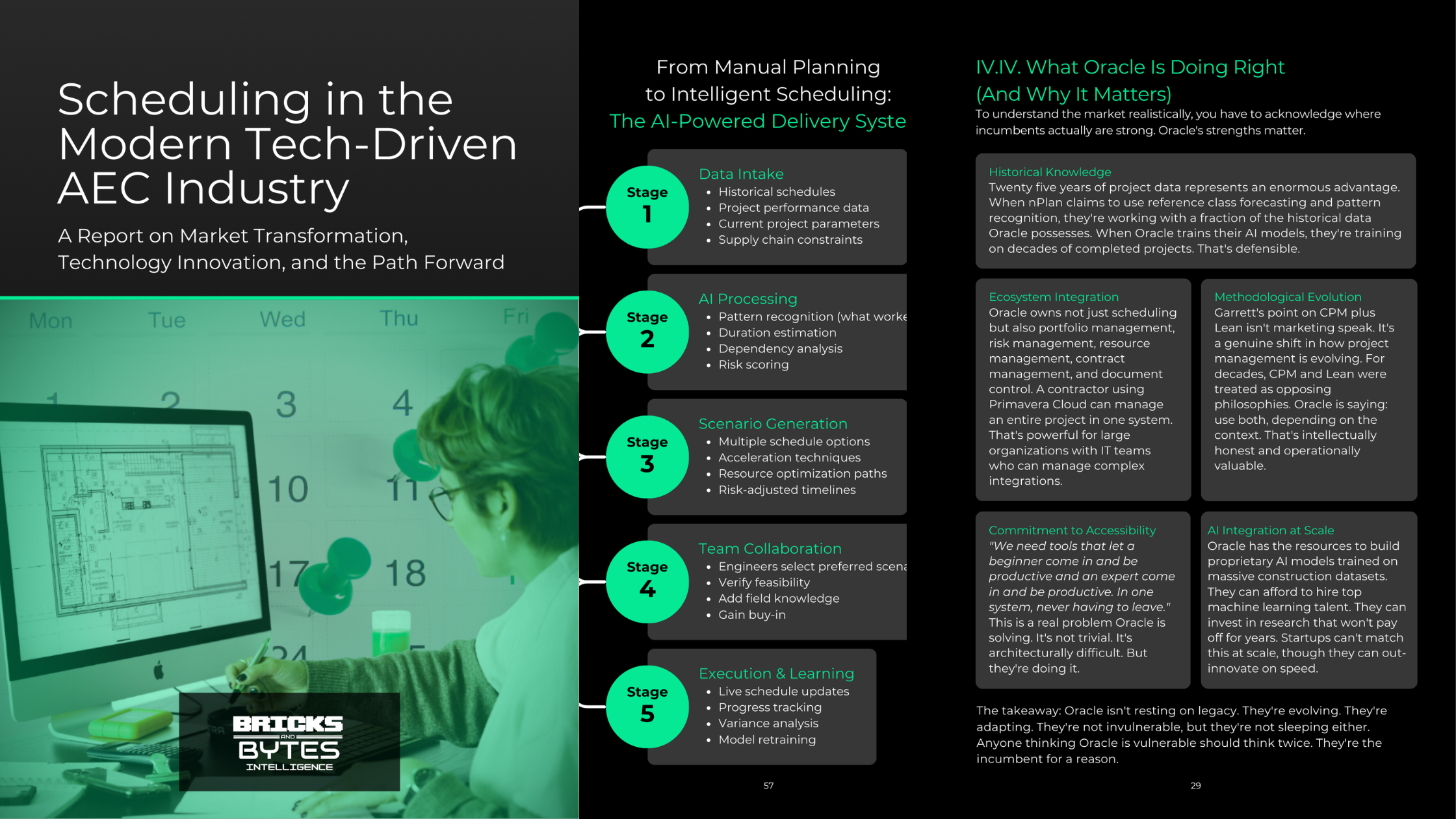
Get a FREE copy of our Scheduling in the Modern Tech-Driven AEC Industry: A Report on Market Transformation, Technology Innovation, and the Path Forward” (worth $150) and a FREE weekly email to stay up to date on construction tech. SIGN UP TODAY!

Scheduling in the Modern Tech-Driven AEC Industry

Sign up to the #1 Newsletter In AEC Tech. Join over 2,100 like-minded Founders, Investors and Techies disrupting the way we build. 

Scheduling in the Modern Tech-Driven AEC Industry