Episode

From SpaceX to Rail: How One Veteran is Fixing America’s Supply Chain Crisis

“The future of logistics isn’t about more trains or trucks – it’s about erasing the line between them.” In today’s episode of BitBuilders, we had Kevin Damoa, founder of Glid, who’s revolutionizing freight transport by tackling the industry’s biggest pain point: the costly and time-consuming transload process between rail and road. From fighting fires in California to designing rocket transport systems at SpaceX, Kevin brings unique insights into why our current logistics infrastructure is holding back American manufacturing and how automation could transform port communities. Tune in to learn about: ✅ Why transloading a single container can cost up to $2,500 and add weeks to shipping times ✅ How ports like Rotterdam handle 3x the capacity of U.S. ports through automation ✅ Why trains won’t move until they’re 2 miles long (and what that means for your shipping costs) ✅ The untold story of how poor infrastructure affects port-adjacent communities —– Chapters 00:00 Intro 03:30 Introduction to Kevin Damoa 05:53 Military Logistics Experience 09:05 Transitioning to SpaceX 15:39 Life After SpaceX 22:24 The Birth of Glide 27:01 Challenges in American Rail Infrastructure 29:54 The Glide Vehicle Design 35:16 Future Applications and Industries for Glide 35:18 Partnerships and Initial Use Cases 37:34 Business Model and Pricing Strategy 40:45 Challenges in Execution and Regulation 42:55 Building a Mission-Driven Team 46:18 Social Issues in Logistics and Labor 50:54 Future of Automation in Ports 54:20 Innovations in Freight and Passenger Rail 1:02:10 Vision for Glide in the Next Decade 1:05:31 Advice for Founders in Hard Industries


Bricks & Bytes Podcast

The £6.5 Million Factory Secret: How Artic Increased Production Without Spending More

Ever wondered how offsite manufacturing is changing the construction game? Recently, we were invited to the BOOST cohort from Suffolk Technologies where we had a chance to interview Tom and Ross, co-founders of Artic, and we gained insights into their innovative factory-to-site logistics approach and how they are addressing the challenges of modular construction. Tune in to find out about: How Artic is bridging the gap between manufacturing and construction, creating more efficient workflows. Why predictability and control are crucial when more construction happens offsite. How they’re addressing quality control all the way from the factory to the final installation on site. How they’re shifting company culture by making costs visible.

Bricks & Bytes Podcast

Why Brick & Mortar is Going Global – Construction Tech Investing In India, Europe & Beyond

“We invested in companies doing direct factory procurement in India, access control for equipment theft prevention, and project management tools for emerging markets – and that’s just from our latest cohort.” In today’s episode of Bricks & Bytes, we had Alice from Brick & Mortar Ventures share fascinating insights about construction tech investing, global expansion, and what’s happening in different markets. Tune in to find out about: ✅ Why construction tech startups are increasingly launching outside Silicon Valley, especially in Europe and India ✅ How construction tech in India feels like the US market did 6 years ago – and why that’s exciting ✅ The shift in founder profiles: from industry veterans to repeat entrepreneurs and deep tech experts ✅ Why mega-funds might not be the best thing for construction tech right now

The Truth About 3D Printed Homes: A Deep Dive Into ICON’s $450M Technology

Is 3D printing concrete homes worth the $450M investment? In today’s episode of Bricks, Bucks and Bytes, we got to learn that despite being a $2B company, ICON’s 3D printed homes only show a tiny 0.5% carbon advantage over regular timber construction. We also explored why Q4 2024 was special for construction tech – it grabbed nearly 1% of all VC funding, the second-highest share ever. Even more impressive given that 2024 saw the lowest overall VC funding since 2014. The most striking insight came from questioning the basics – why use concrete, a material best for large-scale projects, to print single-family homes? Tune in to find out about: ✅ What’s driving Asia-Pacific’s growing lead in construction tech funding ✅ Why 3D printed concrete homes struggle in wet climates ✅ Which parts of construction tech are actually getting funded ✅ How early-stage funding stayed strong while growth rounds dropped —– Chapters 00:00 Introduction and Technical Glitches 01:03 Recent News: ICON’s Layoffs and Valuation 02:49 Exploring 3D Concrete Printing Technology 05:49 Sustainability Concerns in Concrete Printing 08:59 Comparative Analysis: Concrete vs. Timber Homes 12:04 Challenges in 3D Concrete Printing 14:56 Automation and Efficiency in Home Construction 18:09 Future of 3D Concrete Printing Technology 21:54 Challenges in 3D Concrete Printing 22:56 Market Fit for 3D Concrete Homes 24:04 Impact of Staff Reductions on Valuation 25:47 Understanding Company Valuations and Experiments 27:07 Applications of 3D Printing in Housing 29:02 First Principles of Cost in Construction 30:58 Trends in AEC Tech Funding 39:10 Market Dynamics and Future Predictions

The $12M Factory That Could Fix America’s Housing Crisis: How Cuby Plans to Build 55,000 Homes Annually

“In tech, being cheaper is everything. But no one in construction tech has managed to build homes cheaper than traditional methods… until now.” In today’s episode of Bricks & Bytes, we had Aleksandr Gampel, co-founder of Cuby, share how he and his team are transforming new home construction with their Mobile Micro-Factories (MMFs)™ – a plug-and-play $10M solution that can manufacture and assemble 200 homes annually at $100 per square foot.  Arguably, this is the first and only system of its kind that touches all aspects of a new home (from foundation to finishes).  Tune in to find out about: ✅ Why decentralized manufacturing is the key to solving housing shortage ✅ How they achieved 400,000 engineering hours at 1/10th the cost by leveraging Eastern European talent ✅ Why venture capital might be the wrong funding source for construction tech ✅ Their innovative approach to deskilling construction labor through software-enabled processes Listen to the full episode to learn how Cuby plans to deploy 275 Mobile Micro-Factories (MMFs)™ across the US, CAD, EU, CAD, etc. in the next decade, potentially transforming 5% of the US housing market — more homes with less skilled hands. —– Chapters 00:00 Intro 02:50 About Aleks and Cuby 05:50 Decentralized Manufacturing: A New Approach to Construction 08:51 Thesis Two: Traditional Construction Meets Innovation 12:33 Thesis Three: Cost Efficiency in Home Building 18:09 Labor Dynamics: Unskilled Workers in Construction 25:15 Scaling Up: The Future of Mobile Micro Factories 35:56 Market Reception: Overcoming Industry Conservatism 38:27 The Challenge of Traditional Construction 40:00 Industrializing Construction: A Historical Perspective 42:29 Understanding Cost of Capital in Construction 44:21 Scaling Production: The Vision for MMFs 46:05 Time Efficiency in Home Building 48:12 Navigating Regulations and Warranties 50:35 The Master Plan: Future Growth and Development 52:53 Avoiding Pitfalls: Lessons from the Industry 56:37 Leveraging Global Talent for Competitive Advantage 1:00:55 Go-To-Market Strategy for Scaling 1:06:01 Flexibility and Adaptability in Startups 1:07:39 Building a Strong Thesis for Success 1:10:10 Misconceptions in Venture Capital about Construction

Bricks & Bytes Podcast

Building Mercator: From 90 Investor Pitches in 3 Weeks to Changing How Contractors Find Projects

“Pre-construction is actually just free construction because it’s a lot of work up front that you don’t often get paid for.” – Chloe Smith, CEO of Mercator In today’s episode of Bricks and Bytes, we sat down with Chloe Smith, who shared her journey of building Mercator, a construction tech startup that’s changing how contractors find early-stage project opportunities. Tune in to discover: ✅ Why Mercator focuses only on Texas (for now) and how they plan to expand ✅ The power of hiring for talent over skill in a fast-growing startup ✅ How they built their own “accelerator” by carefully selecting operator-investors ✅ Their unique approach to product development through an intensive beta program with general contractors Listen to the full episode on Spotify to learn how Mercator is helping contractors get involved in projects before the bidding phase even begins – as Chloe puts it, “It’s almost like using a marriage registry as a dating app.”

Building a €450M Construction Tech Giant: How Philip Schröder’s Marketing Built Germany’s Latest Energy Tech Giant

“Your margin is my opportunity… unless you’re selling outcomes in construction tech!” In today’s episode of Bricks, Bucks and Bytes, we explored 1KOMMA5°’s impressive €150M pre-IPO round and their unique approach of acquiring 30+ companies since 2021 to scale their energy tech business. We also learned about an intriguing debate around whether companies can call themselves “market leaders” in Germany, sparked by a court case between 1KOMMA5° and their competitor. The most fascinating insight came from Patric’s take on fixed vs. variable costs in construction tech: Companies that produce with fixed costs but sell outcomes (variable costs) have a unique opportunity to build generational businesses in construction – but this window might only last 10 years. Tune in to learn about: ✅ Why 1KOMMA5°’s founder Philip Schröder’s marketing genius is their secret sauce ✅ How selling outcomes beats traditional SaaS pricing in construction ✅ Why converting variable costs to fixed costs through automation is game-changing ✅ An innovative structural engineering firm reducing design time by 90% Sign up to the #1 Newsletter In Construction Tech. Join over 1,000 like-minded Founders, Investors and Techies disrupting the way we build. Forever : https://bricks-bytes.beehiiv.com/subscribe —– Chapters 00:00 Intro 01:56 Diving into One Comma Five 06:01 Understanding the Solar PV Market 11:59 Investment Insights and Market Valuation 18:03 The Role of Technology in Energy Solutions 24:02 Marketing Strategies and Competitive Landscape 30:12 Future Challenges and Business Models 31:07 The Evolution of Energy Training 32:29 Understanding Fixed vs. Variable Costs 37:38 The Impact of SaaS on Construction 43:34 Exploring IPOs and Market Trends 49:45 Emerging Trends in Construction Technology Sales

From $500M E-commerce Exit to Transforming Construction: How 011H is Building High-Rise Residential Buildings 30% Faster

“Batman doesn’t have superpowers – he has cash and technology. That’s exactly what we are – the Batman of construction.” – Lucas Carné’s candid take on how 011H is transforming construction through technology. In today’s episode of Bricks and Bytes, we had Lucas Carné, co-founder of 011H and former founder of Privalia (sold for $500M), share insights on revolutionizing construction through digital innovation and sustainability. Tune in to discover: ✅ Why 011H chose to be asset-light when most construction tech companies fail by investing heavily in manufacturing facilities ✅ How they’re achieving 30% faster project delivery while maintaining quality through their design-build approach ✅ The strategy behind tackling high-rise buildings first, contrary to conventional wisdom ✅ Why they reject traditional bidding processes and focus on collaborative risk-sharing with developers Listen to the full episode to learn how 011H is bridging the gap between digital innovation and traditional construction, while tackling major challenges in housing affordability and sustainability. —- Chapters 00:00 Intro 03:04 Introduction to Lucas and Zero11H 06:14 From E-commerce to Construction Tech 09:08 Lessons from Previous Ventures 12:11 Identifying Pain Points in Construction 15:03 The NeoBuilder Concept 18:03 Focus on High-Rise Buildings 21:05 Innovative Approaches to Sustainability 24:05 Scalability and Digital Integration 27:06 Client Engagement and Collaboration 30:16 Transforming the Construction Industry 33:08 Challenges and Future Directions 42:58 Navigating the Risks of Supply Chain Ownership 48:06 The Importance of Humility in Construction Tech 51:06 The Future of O11H: Platform vs. Developer 55:01 Expanding Horizons: O11H’s European Ambitions 59:06 Building Trust in a Complex Industry 01:05:10 Leadership Lessons from a Second-Time Founder

Bricks & Bytes Podcast

Factories in Shipping Containers to Build Houses – Facit Homes

“A £650,000 micro-factory can build 100 homes per year, while a traditional modular factory costing £100M+ struggles to deliver 200 homes annually. The math speaks for itself.” In today’s episode of Bricks and Bytes, we had Bruce and Oliver from Facit Homes and Facit Technologies sharing their journey of revolutionizing home construction through digital fabrication and micro-factories. Their approach challenges traditional modular construction, showing how bringing manufacturing to the site can be more efficient and cost-effective. Tune in to learn about: ✅ Why micro-factories are winning over traditional modular factories ✅ How Facit grew without external investment for 15+ years ✅ The real cost comparison: £2,400 vs £120,000 per house in factory overhead ✅ Why software alone can’t solve construction’s biggest challenges Listen to the full episode to understand why the future of construction might be closer to the building site than you think. —– Chapters 00:00 Intro 03:50 Introduction to Facet Homes 06:39 Innovative Manufacturing in Home Construction 09:51 The Microfactory Approach 12:45 Design Philosophy and Flexibility 15:39 Scalability and Customization of Homes 18:52 Target Customers and Engagement Process 21:46 B2B and B2C Dynamics 24:40 Cost Efficiency and Time Savings 27:50 Building Trust in a Skeptical Industry 30:46 Labor and Automation in Construction 33:42 Cultural Changes in Construction 36:40 Future Vision for Facet Homes 44:24 Building the Future: Microfactories and Scalability 47:57 Challenges in Construction: Building a Company 53:51 Investor Perspectives: Overcoming Prejudice in Construction 58:13 Expanding Horizons: Going Beyond the UK 1:06:45 The Evolution of Construction: Modern Methods and Digital Fabrication 1:08:21 Improving Processes: The Future of Construction Technology

Bricks & Bytes Podcast

10x Faster Structural Drawings: Genia’s AI Co-Pilot for a New Era of Design

Imagine generating structural engineering drawings 10 times faster. That’s what Genia is doing, and it’s changing the game for structural engineers. Recently we were invited to the BOOST cohort from Suffolk Technologies where we had a chance to interview Zhihao, co-founder and CEO of Genia, and we got to learn about how their generative design co-pilot is transforming the industry. Tune in to find out about: How Genia uses AI to generate structural drawings while ensuring accuracy and code compliance. Why Genia is reducing human errors and material use by 5-20% in designs. How they are building trust with engineers through transparent calculations and detailed analysis reports. How their technology is automating end-to-end processes that were once manual and time-consuming.

Bricks & Bytes Podcast

A Product Manager’s Guide to Building Hardware for Construction Sites – Emidio Piermarini

“I can’t make that journey all the way to that facility and write up for you in a Notion board what it’s like. You have to go to a construction site to really understand how busy people are.” In today’s episode of Bricks and Bytes, we had Emidio Piermarini, and we got to learn about the challenges of product management in construction tech, the importance of physical solutions for physical problems, and the value of embracing negative feedback… and many more! Tune in to find out about: ✅ The journey from structural engineering to product management ✅ How Converge is revolutionizing precast concrete tracking ✅ The limitations of software-only solutions in construction ✅ The potential for performance-based contracts in construction tech Listen to the full episode on Spotify to gain insights into the future of construction technology and the importance of bridging the gap between digital solutions and physical realities. —– Sign up to the #1 Newsletter In Construction Tech. Join over 1,000 like-minded Founders, Investors and Techies disrupting the way we build. Forever : https://bricks-bytes.beehiiv.com/subscribe —- BuildVision is a procurement network for the $5T commercial construction market. We are transforming the commercial construction supply chain by bringing contractors, manufacturers, and project stakeholders onto a single software platform—revolutionizing how every component is sourced, purchased, and financed.

Building a $1.6B Construction Tech Company in Australia – Lessons on Distribution vs Product

“The construction tech founders obsess over product, but distribution might matter more.” In today’s episode, we discussed about VisiBuild securing a $6.6M round from Skip Capital to improve construction quality checks – going beyond just turning paper into apps. We also discovered why Australian construction tech punches above its weight, with just two companies (Aconex and Safety Culture) putting the country third globally in unicorns. Most valuable was Shubhankar’s take on why typical SaaS metrics might not tell the whole story in construction tech’s early stages. Tune in to learn: ✅ Why the “build it and they will come” approach fails in construction ✅ How Australian founders turn their small market size into a global advantage ✅ What makes construction tech distribution different from regular SaaS ✅ Why community building matters as much as features Listen to the full episode on Spotify to hear practical insights for anyone building or investing in construction tech. —– Chapters 00:00 The Importance of Distribution in AEC Tech 03:05 Execution Moat: The Key to Success 05:59 Navigating Distribution Challenges in Construction Tech 09:08 Market Dynamics: Distribution Strategies for Different ARR Levels 12:04 Global Perspectives: Indian Founders Targeting the US Market 14:49 Comparative Approaches: US vs. Indian Founders in Distribution 18:08 Community Building: A Strategy for Distribution Success 21:00 The State of SaaS in Indian Construction Tech 24:12 VisiBuild: A Case Study in Construction Tech Investment 33:14 Exploring Visibild’s Impact in Construction Tech 36:09 The Evolution of Quality Checks in Construction 40:05 Unicorns in Construction Tech: Australia’s Rising Stars 42:58 The Unique Landscape of Australian Startups 47:59 Challenges and Opportunities for Australian Founders 52:57 Assessing Product-Market Fit in Construction Tech

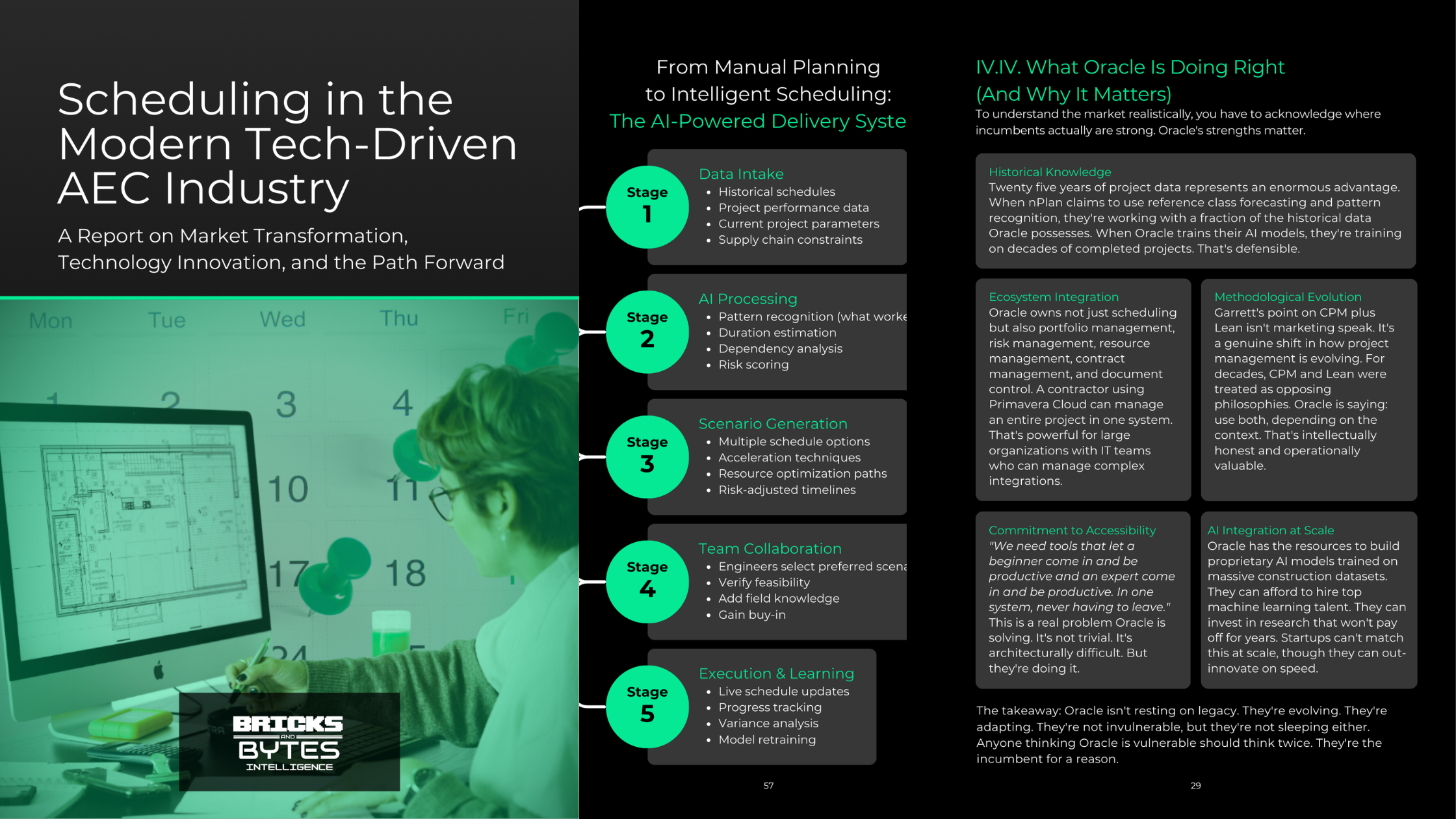
Get a FREE copy of our Scheduling in the Modern Tech-Driven AEC Industry: A Report on Market Transformation, Technology Innovation, and the Path Forward” (worth $150) and a FREE weekly email to stay up to date on construction tech. SIGN UP TODAY!

Scheduling in the Modern Tech-Driven AEC Industry

Sign up to the #1 Newsletter In AEC Tech. Join over 2,100 like-minded Founders, Investors and Techies disrupting the way we build. 

Scheduling in the Modern Tech-Driven AEC Industry