Bricks & Bytes Bulletin
INTELLIGENCE FOR CONSTRUCTION LEADERS
THIS WEEK’S INSIGHTS
The Buildings That Will Never Get Built
Funded, designed, approved, and still not moving. What the pipeline data shows about which sectors are stalling and why.
There’s a version of the construction market that looks, on paper, reasonably healthy. Backlogs are up. In the US, nearly 40% of contractors report a larger order book than a year ago. In the UK, Gardiner & Theobald revised its 2026 tender price inflation forecast upward to 3%, pointing to a pipeline beginning to stir. Planning activity in London had its busiest start to a year since 2018.
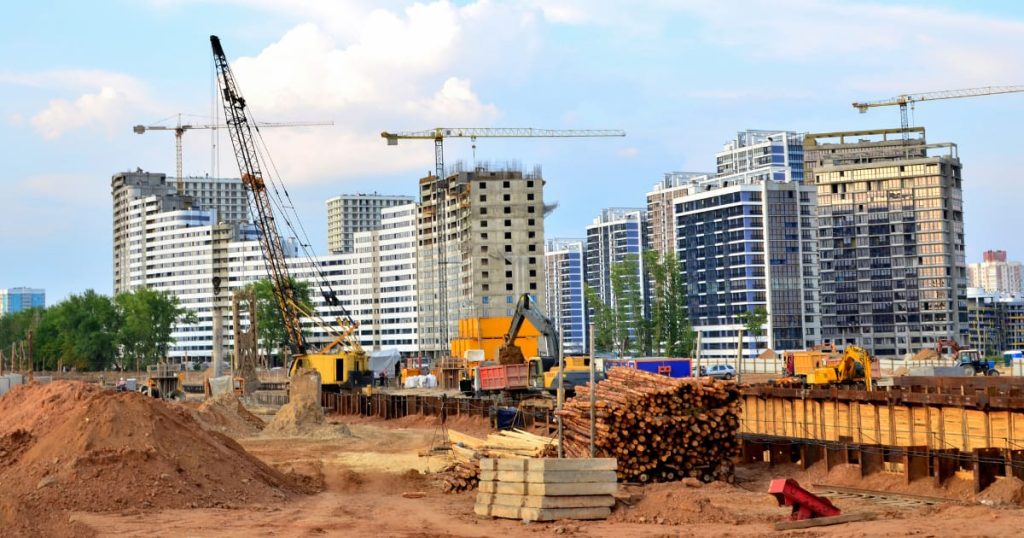
Alongside that backlog sits a growing category of projects that have cleared almost every hurdle. They are funded, designed, approved, and contractor-engaged, and yet, they are still stuck. The gap between work that exists on paper and work that actually breaks ground has widened significantly, and the mechanisms driving it are worth understanding clearly.
The big question is whether these projects are delayed or dead. Increasingly, the answer depends on which sector you’re looking at.

The Deferral Economy
The clearest frame here is the distinction between deferral and abandonment. In the UK, a February 2026 report from Gardiner & Theobald found schemes parked at the end of 2025 re-emerging, particularly in residential and mixed-use sectors where Building Safety Act Gateway 2 delays had become a critical bottleneck. Many are being pushed into late 2026. The RIBA Workload Index turned tentatively positive in January after four consecutive negative months.
“Tentatively positive” and “things are healthy” are very different readings. Writing in Construction News in March 2026, Robbie Blackhurst, founder of Black Capital Group, described principal contractors across the UK sitting on public sector schemes with planning approval, completed design development, and preconstruction work signed off, all stuck in limbo waiting for construction funding to be released. His framing was blunt: “Contractors aren’t asking for shortcuts or lowered standards. They’re asking for momentum, for decisions to be made.”
In the US, the picture is more acute. According to research published by K38 Consulting, project abandonment surged 88.2% year-on-year in August 2025. A Sage/AGC survey found that over 63% of US firms had a project postponed, scaled back, or cancelled in the previous six months, overwhelmingly due to financing difficulty.
California’s affordable housing pipeline is the sharpest illustration. A March 2026 analysis identified 39,880 homes across 461 developments that had already cleared local approvals, community engagement, and partial financing, but cannot begin construction without final public subsidy commitments.
Four Constraints, Working Together
What makes the current stall structurally different from a cyclical slowdown is the number of independent constraints operating simultaneously. Each compounds the others.
Financing remains the bluntest instrument. Interest rates, though easing at the margins with the Bank of England signalling further cuts through 2026, are still elevated enough to make viability calculations genuinely difficult across private residential and commercial sectors. Berkeley Group’s decision to pause land acquisition in early 2026 was one of the more commercially candid signals to emerge from the market. When a firm of that scale steps back, it communicates something real about where development economics currently sit.

Read: Construction Is the Only Industry That Signs Contracts It Knows Will Lose Money
Labour is a structural problem, increasingly disconnected from cyclical project flows. The US industry needs approximately 499,000 net new workers in 2026 alone, according to the Associated General Contractors of America. Across EU member states, the European Construction Industry Federation estimates a deficit of 2.1 million workers, a figure that has grown every year since 2020. The shortage is most acute in licensed trades: electricians, pipefitters, HVAC technicians, the people you need on every complex project before anyone else.
Material costs remain unpredictable in ways that create more damage than the costs themselves. US construction goods are carrying an effective tariff rate of 25-30%, the highest in 40 years according to NAHB. When tariff positions shift without notice, pricing an 18-month project becomes close to guesswork. As we explored in our piece on why construction firms sign contracts they know will lose money, fixed-price contracts with no escalation clause turn that guesswork into guaranteed losses.
Power infrastructure is the least-discussed constraint and, in certain sectors, now the dominant one. Lead times for high-capacity transformers have stretched from the pre-2020 norm of 24 to 30 months to as long as five years, according to Sightline Climate data cited by Bloomberg. A site can have planning permission, a signed tenant, and committed funding, and still be unable to energise on schedule if transformer procurement was left too late.
The Data Centre Paradox
The funded-but-unbuildable problem is playing out most visibly in the sector with more committed capital than anywhere else in construction.
Alphabet, Amazon, Meta, and Microsoft have collectively committed over $650 billion in AI infrastructure spending in 2026. Of the roughly 12 to 16 gigawatts of US data centre capacity planned to come online this year, only about one-third is currently under active construction. The rest is waiting, primarily for electrical equipment that can take three to five years to deliver.

Read: Major Data Center CEO on Labour Demand, Power Scarcity, and the Real Work Behind AI Buildouts
As we covered in our deep-dive on data centres building their own power plants, grid interconnection queues in Virginia, Texas, and across the PJM region have stretched to seven to ten years for new large-load connections. That gap with an 18 to 24-month deployment cycle is simply not closeable through faster construction. And as one data centre CEO put it earlier this year, solving the GPU constraint exposes the power constraint; solving power exposes the labour constraint. The bottlenecks queue up.
For contractors and developers, the operational conclusion is clear: electrical infrastructure procurement now has to sit at the very front of a programme schedule. A transformer order needs to be placed years before a building gets a key in the door.
Two Pipelines Forming
An obvious split is surfacing. Some work is progressing reliably; other work is quietly deteriorating without formal cancellation.
The sectors stalling hardest are affordable and social housing (subsidy-frozen), private residential in high-cost urban markets (viability ceiling), speculative commercial (office, retail, hotel), and, ironically, the AI data centre boom where capital is abundant but physical delivery is infrastructure-constrained.
The sectors still progressing are regulated infrastructure with committed funding cycles (water, energy, utilities), public sector schemes where government releases funding, and specialist MEP markets sustained by data centre demand and infrastructure programmes. Our analysis of the UK construction insolvency wave found that the firms navigating this best had one thing in common: real-time financial visibility across live projects, so they could see exactly where they stood before problems compounded.
Firms treating this as a volume problem are likely misreading where the pressure is actually coming from. The timing gap between awarded and active work is the constraint, and it requires a different kind of management than an empty order book.

Read: 4,000 Firms Gone in a Year – What the UK Construction Insolvency Crisis Actually Means
Key Takeaways
-
The stalled pipeline is a conversion problem. Work exists; what’s broken is the pathway from awarded to active, where financing, regulatory, and infrastructure constraints are all operating simultaneously.
-
The four compounding constraints (financing, labour, material cost unpredictability, and power infrastructure) amplify each other. Projects that might have survived any one in isolation are stalling under all four at once.
-
Data centres illustrate a new category of project risk: funded, approved, and technically ready, but physically blocked by transformer lead times that outrun deployment cycles by years.
-
For public sector construction, the economics of intervention are clear. Enterprise Community Partners’ California analysis found that every dollar of state subsidy unlocks approximately $3.60 in additional private and federal investment.
The industry has spent years arguing that planning was the bottleneck. Planning reform has helped. The projects stalling now have planning. The problem has shifted upstream, into the supply chains, the power connections, the funding mechanisms, and the workforce pipelines that make delivery physically possible. A healthy backlog number is only meaningful if you understand how much of it will actually convert.
POWERED BY:


The multiplayer planning platform where construction teams plan together, stay aligned, and deliver projects faster.
|

The construction intelligence platform delivering data and insights to act faster and outperform, from site to boardroom. |

The #1 construction management software for growing companies. Manage your projects from Tender to Handover.
|