Bricks & Bytes Bulletin
INTELLIGENCE FOR CONSTRUCTION LEADERS
THIS WEEK’S INSIGHTS
Construction Safety Tech Is Finally Growing Up. Here’s What We Found.
We spent months talking to the people building, buying, and deploying construction safety technology. This is a category being rewritten in real time.
Construction is still the most dangerous industry in the developed world. One in five worker fatalities in the United States in 2023 occurred on a construction site: roughly 1,075 deaths across a workforce of eight million, according to the Bureau of Labor Statistics. The leading causes (falls, struck-by incidents, electrocutions, caught-in accidents) have barely shifted in decades.
And yet the software layered on top of that problem has changed many times over: paper forms, digital versions of paper forms, dashboards nobody opens, and now a new generation of AI-powered platforms that range from genuinely impressive to rebranded inspection templates.
Over the past several months, we sat down with founders, product leaders, and enterprise safety executives who are actively building, buying, and deploying construction safety technology: people like Prakash Senghani at Navatech, Ben Leach and Andrew Matthews at HammerTech, Simon Elliott at Breadcrumb, Benjamin Legg at Digital Realty, Juliana Richard Butler at Procore Technologies, and Cam Stevens at Pocketknife Group, among others. We asked them what works, what doesn’t, and where the category is heading between now and 2030.
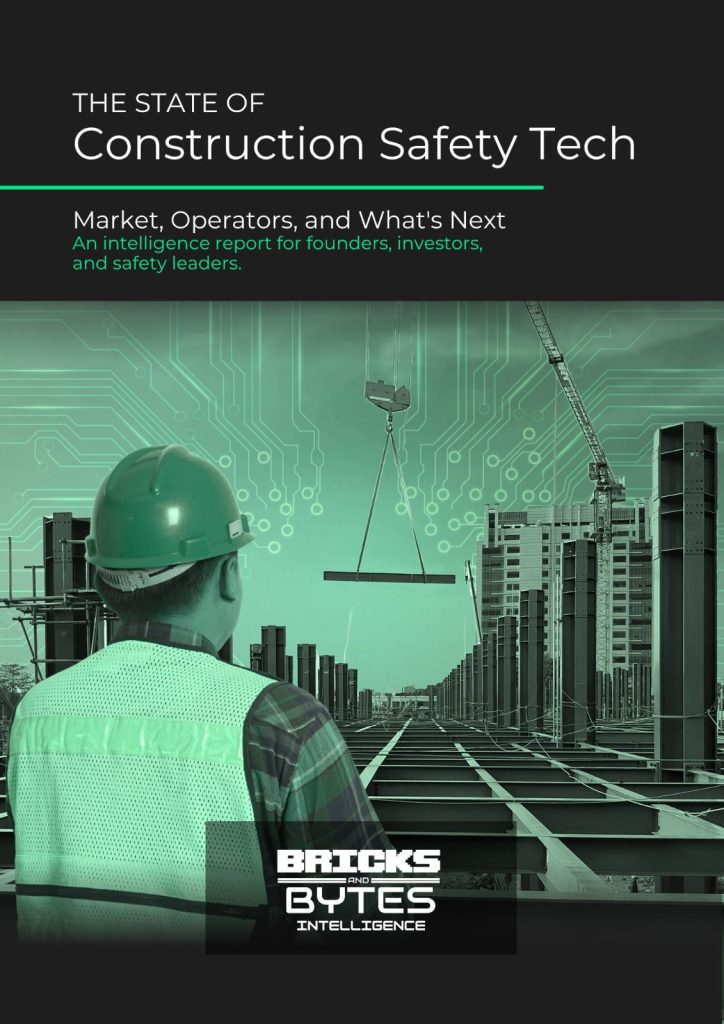
The result is the Bricks & Bytes State of Construction Safety Tech report, publishing this week. Here’s a preview of what we found.

The Category Is Being Rewritten From Multiple Directions at Once
The problems safety tech is asked to solve, the technologies available to solve them, the regulatory environment, and the buyer expectations are all shifting simultaneously in 2026. For the first time, they’re shifting each other.
One of the clearest things we heard across our conversations was how much the definition of “safety technology” itself has evolved. Cam Stevens, founder of Pocketknife Group and advisor on over 200 safety tech deployments globally, put it simply:
Most platforms sold under that label today would struggle to demonstrate impact on any of the three. They speed up documentation, and the companies closing that gap are the ones building what comes next.
For a long time, the product category reflected that gap. Safety tech was bought by a safety director with a modest budget, evaluated on compliance features, and deployed as a parallel system nobody else touched. Much of what passed for digital transformation was taking paper forms and putting them on a screen, and in several cases, that made things worse. Digital forms often take longer to complete than paper ones and generate volumes of low-quality data that bury the useful signals.
That model is now breaking down. Safety tech is evaluated by a coalition of safety, operations, IT, risk, and sometimes finance, with a mandate that extends well beyond OSHA recordables. The addressable budget has expanded because the product draws from multiple pools. Every general contractor is one poorly managed incident away from wiping out the entire profit on a project, and framing safety spend as margin protection lands with a CFO in ways that a traditional safety ROI calculation never has.

Adoption Is the Category’s Dominant Constraint
Ask anyone who has actually deployed safety tech at scale and they’ll tell you the same thing: the hardest problem has never been the technology. It’s getting people to use it.
The failure mode is consistent. A platform wins the RFP, signs the master agreement, and is then quietly starved of data on the projects where it matters most. Superintendents and workers find it clunky, can’t access it in their language, or default to the channel they were already using, usually WhatsApp, Teams, or paper. When data does eventually flow, it’s often because someone sanitized it at the end of the day and pasted it in to tick a box. That creates false confidence in the safety function and an audit trail that can be actively misleading.
Simon Elliott, founder and CEO of Breadcrumb, has a useful way of framing what good adoption actually looks like:
This 6am test is one the category’s legacy platforms are failing routinely.
The vendors getting adoption right share a common instinct: meet the worker where they already are. That means multilingual interfaces, offline-first architecture, and voice and photo capture as primary input modes. WhatsApp, for all the IT department’s objections, is probably the most widely used construction technology tool in the world.
The platforms that accept this and build on it are capturing data their competitors aren’t. Per-seat pricing also carries a structural problem: the people most likely to spot a hazard are often the ones least likely to be provisioned a license. Pricing per project removes that exclusion entirely.

The Interface and the Data Are the Actual Moats
Feature comparisons miss the point in this category. Here’s what the defensibility of the leading platforms actually comes down to:
Longitudinal data
A decade of accumulated jobsite data, structured properly, is an asset a better-funded entrant cannot easily replicate. It records what conditions were present when injuries happened, who was licensed, how frequently they’d been on-site, and how many hours they’d worked. Layer AI on top of that, and a platform can start to anticipate where risk is concentrating before anyone gets hurt. That shift from reactive to predictive is where the category’s next five years are playing out.
Data quality over data volume
A platform built around structured, high-fidelity inputs is a materially different asset from one that captures high volumes of low-quality form data. The point matters more now that AI outputs are only as reliable as the inputs they run on. The platforms that have invested in intent-based data capture, where every field has a purpose and the worker understands why they’re filling it in, are building something a form-digitization tool cannot replicate regardless of how many AI features get bolted on.
Community
Safety leaders deploying at scale don’t just want software. They want a vendor who understands their operation, shares what’s working across their peer group, and stays engaged after the contract is signed. The platforms running peer learning programs across their customer base are winning renewals that feature-level competition can’t touch.

Regulation Is About to Pull Harder Than Buyer Enthusiasm
The regulatory environment is the most underappreciated driver of the next five years.
-
Australia enacted psychosocial safety legislation in December 2025, making psychological health risks legally enforceable alongside physical ones. Unions now have the right to inspect digital scheduling and planning tools for their psychosocial impact, dramatically widening the scope of what a safety tech product may need to address. Mental health conditions already account for roughly 12 percent of serious workers’ compensation claims, per Safe Work Australia.
-
Singapore mandated video surveillance systems for all construction projects above S$5 million in contract value, effective June 2024. That single regulation shifted computer vision from a voluntary sales motion to a procurement-level requirement overnight.
-
Hong Kong has implemented comparable surveillance mandates for public-sector construction contracts.
Australia, Singapore, and Hong Kong represent the leading edge of a broader global reframing of what “safety” means in regulatory terms, and other jurisdictions will follow. A market where safety tech is optional grows at the industry GDP. A market where it’s mandated grows at a compliance pace, which historically runs three to five times faster. The psychosocial expansion in Australia and the surveillance mandate in Singapore are leading indicators, and the vendors building for them now are positioning ahead of the demand curve everywhere else.

What’s in the Report
The Bricks & Bytes State of Construction Safety Tech covers the full market landscape: seven functional categories of safety tech, three distinct venture waves since 2018, how pricing and packaging are evolving, and what the competitive structure looks like by 2030. It includes a technology frontier assessment on computer vision, AI agents, wearables, and robotics, along with seven detailed expert case studies and our predictions for where the category is heading.
It’s written for founders building in this space, investors picking winners in a compounding category, and safety and operations leaders trying to figure out what to actually deploy.
Read the State of Construction Safety Tech report.
Built from conversations with safety technology founders, product leaders, and enterprise safety executives across the US, UK, Australia, and the Middle East.
POWERED BY:


The multiplayer planning platform where construction teams plan together, stay aligned, and deliver projects faster.
|

The construction intelligence platform delivering data and insights to act faster and outperform, from site to boardroom. |

The #1 construction management software for growing companies. Manage your projects from Tender to Handover.
|