Bricks & Bytes Bulletin
INTELLIGENCE FOR CONSTRUCTION LEADERS
AI Reads the Blueprint Now. The Fight Is Over What It Reads Next.
Takeoff is the slowest task in preconstruction and the one that sets the price of everything after it. An estimator reads a drawing set, counts every material the building requires, and hands the quantities to whoever prices the job. A single miscount shifts a residential bid by tens of thousands of dollars.
The work consumes a large share of every preconstruction team’s hours, and for decades the only way through it was a printed plan set, a scale ruler, and several days of manual counting.
By industry accounts, adoption of AI estimating among the top 100 general contractors crossed 60% during 2025. Vendors now report accuracy above 95% on standard plans, a level at which many firms trust an output without rechecking every detail line by line. Manual takeoff is now rare at the larger end of the market.
The question moved beyond whether a machine can read a blueprint. It is how much of the estimator’s remaining work the machine produces and which vendor is most competent to carry out the required tasks

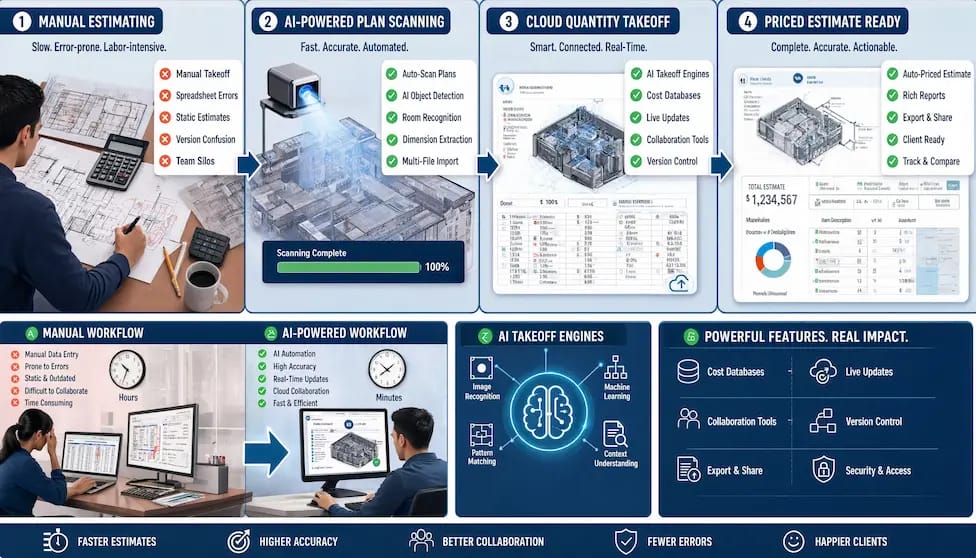
Manual to AI workflow. Credit: Nedes
The category has split three ways
The tools typically fall into three groups, separated by how much of the job each one completes.
-
Pure computer-vision takeoff. Togal.AI, Kreo, and STACK Assist scan a drawing set, detect and classify walls, doors, windows, and rooms, and return measured quantities. Entry pricing runs from roughly $35 to $299 per seat per month. These tools produce the count and stop there.
-
Hybrid AI plus human review. Beam AI runs an automated first pass and then routes every output through expert reviewers, delivering a finished estimate within two to three days. The team receives a reviewed estimate to work from. The company operates the software on its behalf.
-
End-to-end agents. The newest group aims to run takeoff, pricing, scope review, and proposal assembly as a single sequence, with the estimator stepping in at fewer points. There’s no such tool yet that does this without supervision, and this is where the market is expected to expand.
All three categories have one thing in common. Nearly every tool on the market still needs an estimator to check the output, confirm the quantities, and put the final scope together by manual supervision.
The segment is more critical than the leaderboard
The most common mistake in evaluating these tools is taking an accuracy figure from one segment and assuming it holds in another. A tool trained on commercial drawings will post a lower number on residential work, and the reverse holds too. Each tool is built for a different part of the industry.

Comparison table. Credit: Dan Cumberland Labs
Togal.AI leans toward commercial work and high-volume commoditized scopes such as sitework, concrete, and masonry, and it has reported accuracy gaps on electrical drawings. Kreo targets the quantity surveyor and developer market, reading both 2D plans and 3D BIM models. Mechanical and plumbing work is harder still, because MEP-dense drawings demand trade-specific element recognition that general takeoff tools handle poorly.
Handoff builds for the residential market alone. Its benchmark, its training data, and its live deployments all concentrate on single-family and small-scale work, and the company has scoped the product that way on purpose. So Handoff’s accuracy figures describe residential drawings and tell you nothing about commercial estimating.
A vendor’s 98% claim on clean commercial floor plans says nothing about performance on a messy residential renovation set, and the same limit applies in the opposite direction. Match the tool to the segment before trusting the demo.
Why the counting is the hard part
A general-purpose model fails at this work for a specific reason, and that’s what the market is trying to address. A frontier language model will describe a plan sheet fluently and then miscount the windows on it because describing a drawing and measuring it are separate operations.
A takeoff requires precise measurement across sheets drawn at different scales, and a detail on one page frequently changes the correct answer on another. A single sheet read in isolation is effectively meaningless. An experienced estimator holds the whole set in view at once, and general models still cannot do that.
Vendors report 95 to 99% on clean, vector-based plans, with the figure falling into the 80s and low 90s on scanned images, dense annotations, or overlapping trades. Almost all of these figures are self-reported and have not been checked by any neutral party on a shared plan set, so an estimator still reviews the output on every job.

Read: Best AI Tools for Construction Takeoffs in 2026: What Actually Works
Framing, roofing, and drywall are the trades where the error concentrates, because their quantities have to be derived from wall areas, roof pitch, and sheet conventions, a calculation the plans never state directly, and professional estimators themselves legitimately disagree on the right number for them.
One company took a different route here. The company published an open benchmark and ran its own residential system against frontier models, reporting that off-the-shelf models scored well below its result even when handed Handoff’s own computer-vision output. No outside party has run that test yet. Most of the category has never published a test like this, one any competitor can download and run. In its founders’ own account, most rivals took the safe route and built “a faster horse,” and Handoff took the harder path.
We recorded a walkthrough with the Handoff team showing how the residential takeoff runs from raw plan set to itemized quantities. Watch here.
What this means for an estimating team
The industry has settled on a human-in-the-loop model, and it expects to continue in this mode. Most firms see it as the permanent shape of the job. AI handles the repetitive counting and the judgment work, complex assemblies, regional labor pricing, and the final sanity check stays with the estimator who signs the bid. The firms most skeptical of AI are the ones being offered a locked final number with no visible assumptions, and their skepticism is well founded.
Most of these tools already deliver strong accuracy on clean plans. Their primary efficiency is evident in the increased bid volume. When bid preparation drops by 40 to 60%, a team responds to two or three times as many requests without adding headcount, and in a bidding market this can be the most significant contributor to winning more work.

Watch: The AI That Can Estimate an Entire House in 2 Hours
The strategic risk runs in two directions. The firm that ignores the tools falls behind on bid volume. An organization that accepts the black box without review will encounter errors once the project is underway.
The market is moving toward closing what vendors now call the ‘takeoff-to-transaction gap’. Right now, a measured count often just appears in a spreadsheet, and someone still has to carry it into pricing and ordering by hand. Vendors are working to close that gap, so the count flows straight into pricing and the purchase order without a person copying it over. The next edge in this market will come from this transition from manual effort to automation. A tool that carries the count all the way to the order will beat a tool that only produces the count.
Key Takeaways
-
The manual takeoff is finished as a competitive method. Industry accounts put top-100 GC adoption above 60% in 2025, and vendors report accuracy above 95% on standard plans.
-
The market divides by how much of the job each tool completes: raw counting, hybrid human-reviewed estimates, and the emerging end-to-end agents.
-
Accuracy claims are segment-specific and almost entirely self-reported. Togal and Kreo serve commercial and QS markets; Handoff is residential only; MEP work remains the hardest case for every tool, and no neutral party has verified the headline numbers.
-
General language models fail at takeoff because measuring a full drawing set is a separate operation from describing one sheet, and the continuous-measurement trades defeat even human consensus.
-
The near-term payoff is bid volume. Most tools already handle accuracy on clean plans, and the human-in-the-loop model is the deliberate industry standard.
Closing reflection
Most tools now read a clean blueprint accurately, so accuracy has stopped being the differentiator. The competition over the next two years moves up the estimating stack, from the raw count into pricing, scope, and buyout. Two things are important in this context: the vendors that reach furthest along that chain and the firms that put their estimators on judgment work, complex assemblies, regional pricing, and the final call on a bid while the software carries the counting underneath.
POWERED BY:


The multiplayer planning platform where construction teams plan together, stay aligned, and deliver projects faster.
|

The construction intelligence platform delivering data and insights to act faster and outperform, from site to boardroom. |

The #1 construction management software for growing companies. Manage your projects from Tender to Handover.
|