
Most construction tech founders struggle with the same fundamental question: how do I get from zero to my first million ARR without burning through cash or making expensive hiring mistakes? Martin Roth has the answer, having lived through this exact journey at Levelset.
When Martin joined Levelset (then Zlien) in January 2013, the company had just $15-20,000 in monthly transactional revenue helping contractors file liens online. Eight years later, they’d built a business that scaled to over $30 million in total revenue before being acquired by Procore. The journey from zero to that first crucial million offers a masterclass in construction tech early sales tactics that actually work.
TL;DR: The First Million ARR Playbook
The Challenge: Getting from zero to first million ARR without venture backing or sophisticated sales infrastructure
Proven Early Sales Tactics:
- The Dream 100 approach – Target 100 companies and persistently pursue them until they say yes or no
- Founder-led selling is non-negotiable – Don’t hire sales leadership until you understand your own sales process
- Start with enterprise then focus down – Counter-intuitive but enterprise deals can accelerate early traction
- “Chunky mail” and persistence – Physical touchpoints still work in a digital world
- Help first, sell second – Lead with education and problem-solving, not product features
- Ask for the sale directly – Don’t dance around the buying conversation—ask them to pay
- Hire for character over experience – Look for grit, resourcefulness, enthusiasm, curiosity, and ambition
In this episode, Martin Roth shares his journey as Levelset’s go-to-market leader and the real-world tactics that helped scale the business to a successful exit.
The Foundation: Content Creates Opportunity
Before diving into specific tactics, it’s crucial to understand that early sales success in construction tech rarely happens in a vacuum. Scott Wolfe, Levelset’s founder, had spent years building what Martin calls “a nice garden to grow plants in” through prolific content creation.
“Scott had already generated demand,” Martin explains. “He’d written hundreds of articles and built a ton of resources around how to file liens and how to what is a lien waiver and how to send a preliminary notice.”
This content foundation is critical because construction is fundamentally an educational sale. Most prospects don’t wake up thinking they need your specific solution—they wake up with problems they may not even realize have tech-enabled solutions.
The Dream 100: Your First Sales Strategy
Martin’s early sales training came from a single book: “The Ultimate Sales Machine” by Chet Holmes. The core concept that drove Levelset’s first million? The Dream 100.
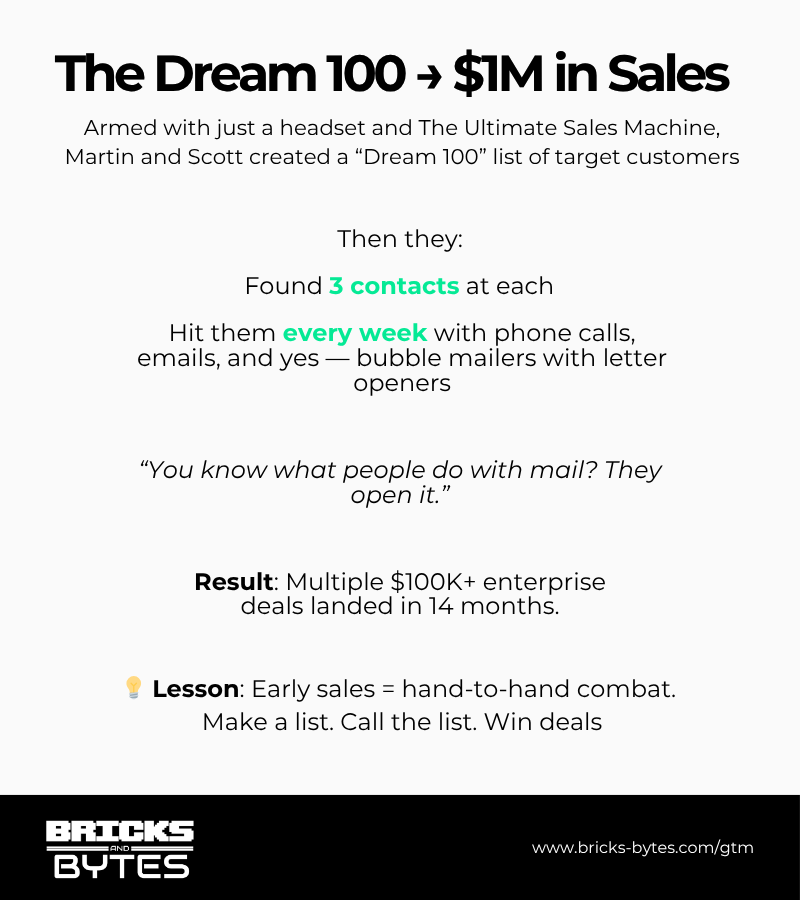
“Go pick 100 companies, the biggest companies you could ever sell to and go persistently go after them,” Martin recalls. “Touch them once a week forever until they tell you to go pound sand or until they give you an opportunity to buy.”
Within 14 months, this approach had closed six or seven enterprise deals worth $100,000+ each. But here’s the counterintuitive part: Martin doesn’t necessarily recommend targeting the biggest companies you can sell to.
“I don’t recommend you go after the biggest companies you can sell to, but I do recommend that founders do the selling. And I also recommend that you just need to pick 100 companies that you want to be customers and you need to go sell to them.”
The Persistence Playbook: Beyond Cold Calls
While the Dream 100 approach sounds simple, execution requires creativity and persistence. Martin and Scott used what he calls “chunky mail”—physical packages that recipients couldn’t ignore.
“We would send physical bubble mailers, like we would put letter openers in a bubble mailer with a handwritten card,” Martin explains. “You send people mail, you know what they do with mail? They open it. They may not call you back, but they will [remember you].”
The key insight here: in an increasingly digital world, physical touchpoints create memorable moments. Everyone gets emails; few people get thoughtful packages.

The Founder-Led Sales Imperative
One of Martin’s strongest recommendations flies in the face of many startup playbooks: founders must do the selling themselves, and they should do it longer than they think.
“The wrong thing to do is to try to strategize and analyze this,” Martin emphasizes. “Sales is really simple. At least the first version of sales: put a hundred companies in a list, pick three contacts at each company that are your people that would be buyers, get their contact information and then call them. Pick up the phone and call them.”
This founder-led approach serves multiple purposes:
- It forces product-market fit conversations
- It builds essential sales skills in leadership
- It creates the foundation for training future hires
- It ensures you understand your sales process before scaling it
Martin and Scott would travel together extensively, often selling “vaporware”—promising features that didn’t exist yet but rushing back to build them based on customer commitments. While not recommended as a long-term strategy, this approach helped them understand market needs in real-time.
The Art of Getting to “Yes” or “No”
One of the biggest mistakes early-stage founders make is having “nice chats” instead of sales conversations. Martin’s approach cuts through this:
“You have to have the conversation. Here’s your current set of challenges. I understand those challenges well. Here’s the desired outcome. Do you agree with this desired outcome? Okay, great. Here are the commercial terms and here’s why my product is the best solution to solve those problems you just said. Do you want to buy this?”
This direct approach serves two purposes: it respects everyone’s time and it provides immediate market feedback about whether you have something people will actually pay for.
Early Pricing: Start Competitive, Evolve to Value
Levelset’s pricing evolution offers practical lessons for early-stage companies. Martin estimates they had “150 different pricing and packaging structures over the course of 10 years”—a number that might seem excessive but reflects the iterative nature of finding product-market fit.
Their initial approach was competitive anchoring: “We just said, what are you paying them? Are you willing to share that? Okay, great. We’ll do that, but just a dollar less.”
While not sophisticated, this approach got them in the door and provided data to optimize pricing over time. The lesson: don’t let perfect pricing strategy prevent early revenue generation.
The Hiring Foundation: Character Over Experience
When Levelset eventually started hiring sales people, they faced a unique challenge: there was no established construction tech talent pool in New Orleans. This forced them to develop a systematic approach to identifying sales potential.
Martin’s five-characteristic framework for sales hiring:
- Grit – “You’re gonna have to pick up the phone 40 to 70 times every single day with a bunch of strangers who don’t want to talk to you”
- Resourcefulness – “Do you have the figure-it-out genes?”
- Enthusiasm – “You gotta manufacture a relationship over the screen”
- Curiosity – “If you’re not curious, you’re not gonna really learn the problems that we solve”
- Ambition – “I can’t want you to be more successful than you want you to be successful”
This framework enabled them to successfully train “Uber drivers and bartenders” into effective software salespeople.
The Timeline Reality Check
Martin’s honest assessment of timeline provides realistic expectations. It took Levelset:
- 18 months to reach ~$1.5 million ARR
- 6 additional years to reach $10 million ARR
- 18 months to go from $10 million to $20 million ARR
This hockey stick growth pattern is common in construction tech, where initial traction can be slow but accelerates once you nail the formula.
Key Lessons for Your First Million
Start with the problem, not the product. Martin’s advice: “Start with the problem that you solve, not by the market that you want to serve. If you have discipline and conviction around the problem that you solve and you know it well, then the sale becomes really easy.”
Don’t overthink the early sales process. The sophistication comes later. Early on, it’s about persistence, direct conversations, and rapid iteration based on market feedback.
Embrace the educational sale. Construction tech often requires educating the market about problems they didn’t know they had. Lead with education and expertise, not features.
Physical touchpoints still matter. In a digital world, thoughtful physical outreach creates memorable moments that digital communications can’t replicate.
The Path Forward
Getting to your first million ARR in construction tech isn’t about having the perfect sales strategy from day one. It’s about founder-led persistence, direct customer conversations, and rapid iteration based on market feedback.
As Martin puts it: “You learn the most whenever you ask somebody to pay for something, because that is the moment of truth about whether or not there’s a fair trade of value for dollars.”
The construction industry may be slow to adopt new technology, but when you solve real problems with genuine value, the sales will follow. The key is being willing to do the unglamorous work of picking up the phone, sending the mail, and having the difficult conversations that separate successful construction tech companies from the graveyard of good ideas that never found their market.