
Construction progress tracking has come a long way from clipboards and pencils to artificial intelligence and machine learning. This evolution has revolutionised how projects are managed, improving efficiency, accuracy, and decision-making. Let’s explore this journey and see how modern solutions are reshaping the industry.
Traditional Manual Progress Tracking
Progress tracking is the backbone of successful construction project management. It ensures projects stay on schedule, within budget, and meet quality standards. Over the years, the methods for tracking progress have undergone significant changes, driven by technological advancements and the need for more accurate, real-time data.
In the not-so-distant past, construction managers relied heavily on manual methods to track progress:
- Paper-based systems: Daily reports, checklists, and hand-drawn updates on blueprints.
- Visual inspections: Regular site walks to assess progress and identify issues.
- Face-to-face meetings: Weekly or daily gatherings to discuss progress and challenges.
Whilst these methods served their purpose, they were time-consuming, prone to human error, and often resulted in delayed decision-making.
In this episode, Amir Berman of Builddots challenges the status quo in construction technology. We explore how AI and data are silently revolutionizing the industry, despite widespread skepticism.
The Shift to Digital Tools
The digital revolution brought the first wave of modernisation to progress tracking:
- Digital cameras: Allowed for visual documentation of site progress.
- Mobile devices: Enabled on-site data entry and real-time communication.
- Basic project management software: Introduced digital scheduling and task management.
These tools improved communication and data accessibility but still relied heavily on manual input and interpretation.
Advanced Digital Solutions
As technology advanced, more sophisticated tools emerged:
Building Information Modeling (BIM): Integrated 3D modeling with project timelines. Companies offering BIM solutions:
- Autodesk Revit: A comprehensive BIM software for architects, engineers, and contractors.
- Bentley Systems MicroStation: Provides advanced BIM capabilities for infrastructure projects.
Cloud-based platforms: Enabled real-time collaboration and data sharing. Leading cloud-based construction management platforms:
- Procore: Offers a suite of project management tools, including scheduling and document control.
- PlanGrid (now part of Autodesk): Specialises in construction productivity software with a focus on field collaboration.
Specialised mobile apps: Streamlined on-site data collection and reporting. Examples of mobile apps for construction:
- BIM 360 (Autodesk): Connects project teams and data in real-time, from design through construction.
- Fieldwire: Provides task management, plan viewing, and reporting tools for field teams.
These solutions significantly improved project visibility and collaboration but still had limitations in terms of data accuracy and analysis capabilities.
The Rise of AI and Machine Learning in Progress Tracking
The latest revolution in progress tracking comes with the introduction of AI and machine learning. As Amir Berman shared during an episode in the Bricks and Bytes podcast, Buildots’ AI-driven technology automatically analyses video footage to measure construction progress. It then compares this real-world data against the project’s planned schedule, which serves as a baseline for our assessment.
AI-powered solutions offer:
- Computer vision: Automatically analyses site photos and videos to track progress.
- 360-degree cameras: Capture comprehensive site data with minimal human intervention.
- Automated analysis: Compares actual progress to planned schedules and 3D models.
Case Study: BuildDots
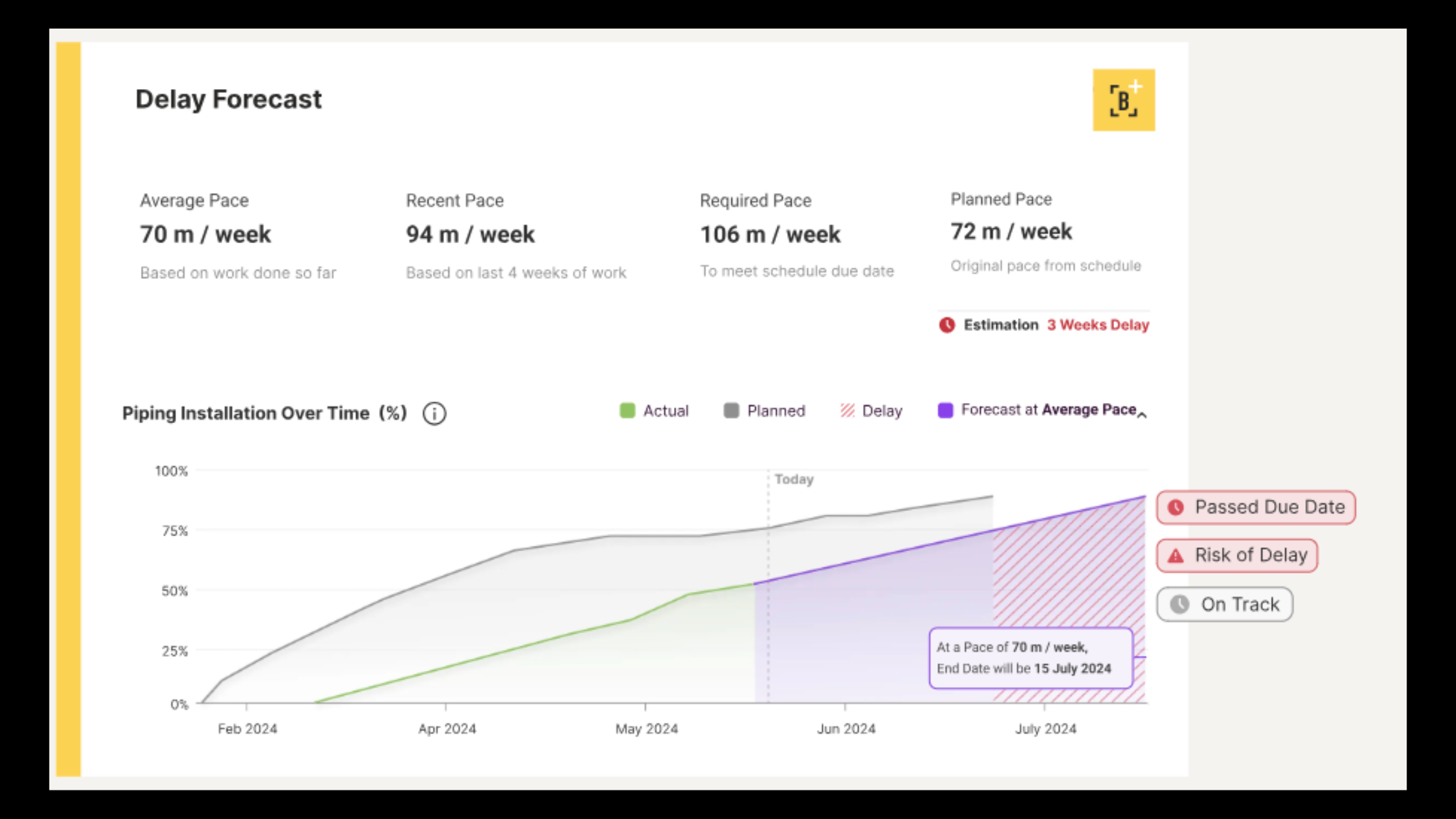
Buildots exemplifies the power of AI in progress tracking. Amir notes, “The basic foundation of Buildots was that we’re going to introduce a reliable and scalable kind of progress tracking on site by combining your plans, which are the 3D models and the schedules on site.”
Their solution integrates AI-powered analysis of 360-degree camera footage with 3D models and project schedules. This combination allows for automated progress tracking, comparing real-time site conditions against planned timelines.
The result is a comprehensive system that provides accurate, up-to-date progress reports and actionable insights, enabling project managers to make informed decisions quickly and efficiently.
The Impact of AI-Powered Progress Tracking
AI-powered progress tracking solutions are revolutionising project management in the construction industry. By leveraging advanced technologies, these systems dramatically increase data accuracy, eliminating human errors in collection and analysis. They provide real-time insights, allowing managers to access up-to-the-minute progress data and make informed decisions faster than ever before.
Furthermore, the predictive analytics capabilities of AI can forecast potential delays or issues before they occur, enabling proactive problem-solving. This combination of accuracy, speed, and foresight leads to improved decision-making across all levels of project management, ultimately resulting in more efficient operations, reduced risks, and better project outcomes.
Challenges and Considerations
While AI-powered progress tracking solutions offer significant benefits, their implementation comes with several challenges. Construction firms may face resistance to change when adopting new technologies, requiring careful change management strategies. Data privacy and security concerns are paramount, as these systems often handle sensitive project information. Integration with existing processes and software can be complex, potentially requiring updates to current workflows or additional training for staff.
Moreover, the initial investment in AI technologies and the need for specialised skills to manage these systems can be significant. Overcoming these hurdles requires a strategic approach, clear communication, and a commitment to long-term digital transformation.
Future Trends in Progress Tracking
The evolution of progress tracking in construction is far from over, with several exciting trends on the horizon. Internet of Things (IoT) integration is set to play a major role, with sensors providing real-time data on equipment usage, material consumption, and environmental conditions.
Augmented Reality (AR) is poised to revolutionise on-site visualisation, allowing workers to see BIM models overlaid on actual progress, enhancing accuracy and decision-making. Advanced predictive modelling, powered by increasingly sophisticated AI algorithms, will enable more accurate risk assessment and scenario planning.
These emerging technologies promise to further streamline project management, improve safety, and increase overall project efficiency, pushing the boundaries of what’s possible in construction progress tracking. As Amir notes: “We now figured out collectively how to optimise our operation based on results and performance data. So it opens up a whole new branch of innovation and capabilities.”