
In construction, keeping track of materials can be a logistical nightmare. Enter Matrak, an Australian startup that’s changing the game. Let’s dive into how this innovative company is reshaping the construction supply chain.
Founding Story
Matrak was founded in 2013 by brothers Shane and Brett Hodgkins in Melbourne, Australia. Brett, who was studying for a Masters in computer science, was working for his father’s window installation company. Frustrated with the challenges of tracking window deliveries and installations, Brett developed a prototype mobile app on his phone.
This simple solution caught the attention of both the window manufacturer and the main contractor on the project. Sensing an opportunity, Brett’s older brother Shane, who was working in software development, saw the potential to turn this prototype into a real business.
The Hodgkins brothers registered the company and spent the next five years developing the product in their bedrooms. It was a challenging period, with constant pitching to investors but little traction due to the lack of large clients.
The breakthrough came around 2018 when Matrak landed a project with Buildcorp. This success led to their first seed round, raising $760,000. A subsequent convertible note round in 2019 brought in an additional $3.6 million, allowing the brothers to work on Matrak full-time and sign up clients like Hickory and Super See.

What Matrak Offers
From its humble beginnings as a simple tracking app, Matrak has evolved into a comprehensive platform that provides transparency and connects all stakeholders in the construction supply chain.
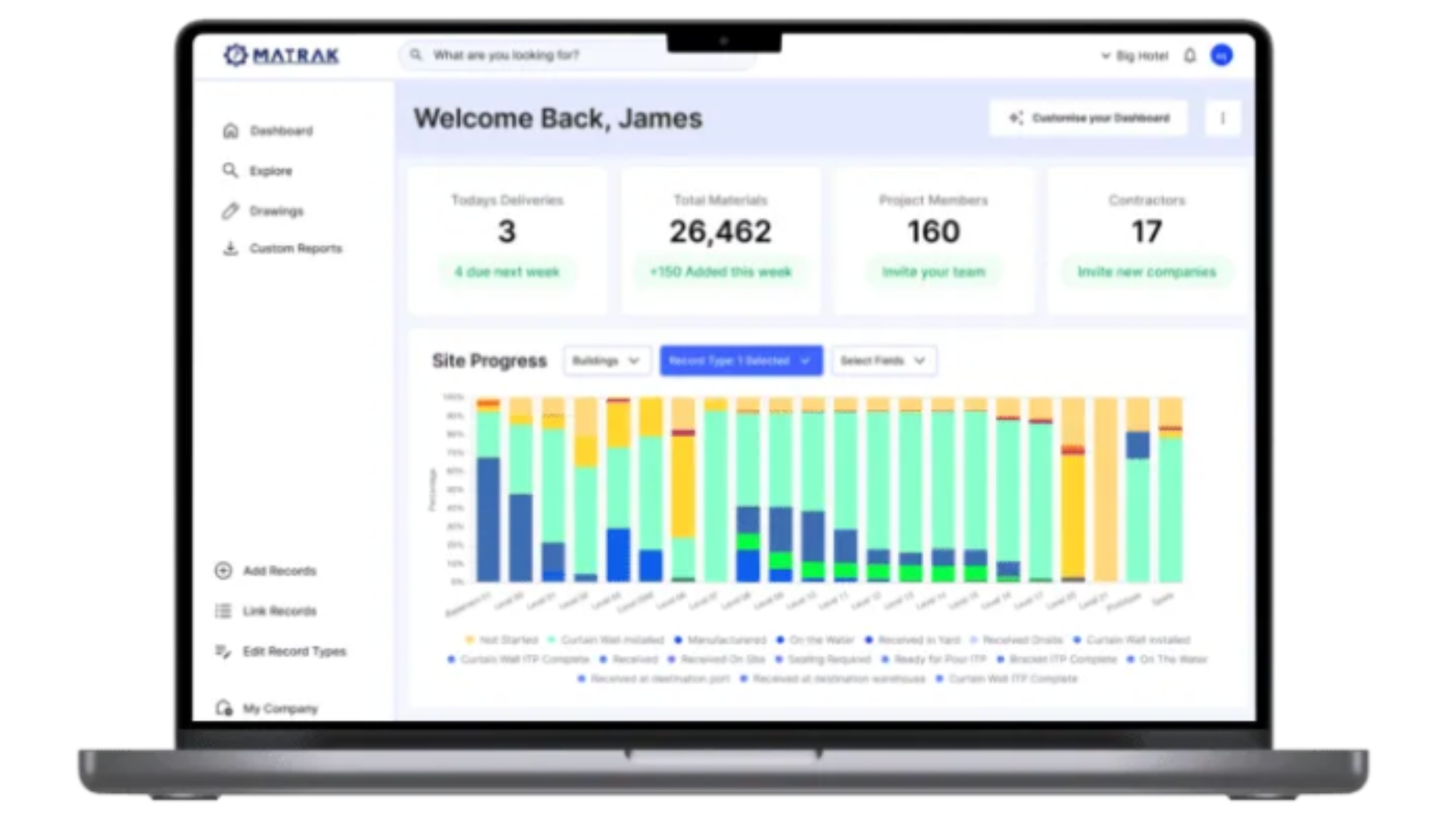
The system provides comprehensive, real-time visibility across the entire project lifecycle. It connects initial design plans and project schedules with every phase of construction, tracking materials from production to on-site installation. This integration offers a complete overview of the project’s progress and supply chain dynamics.
Imagine zooming in on a 3D model of your building and seeing exactly where each component is in real-time. That’s Matrak’s core offering today, a far cry from its initial prototype but still true to its original mission of helping suppliers and site teams track the manufacture, transport, delivery, and installation of building components.
Shubhankar Bhattacharya, a General Partner at Foundamental, adds insight into Matrak’s business model: “From what I recall, at least back in the day, the pricing was very much like a typical subscription plan, pay a certain price per user.” This subscription-based approach allows for scalability and recurring revenue, a significant evolution from the company’s early days.
Tech Magic: How It Works
What makes Matrak special? Its seamless integration with design processes. While many solutions track deliveries, Matrak links this data directly to project plans and 3D models. They use:
- QR codes for tracking
- IoT devices for real-time updates
- Integration with 3D design models
This creates a digital twin of the construction supply chain, offering unprecedented visibility. However, as Shub points out, “It’s a very profound value statement and value proposition. It’s a very complex set of things to build and put together as part of the same platform.” This complexity underscores the technical challenges Matrak has overcome.
Who’s Using Matrak?
Matrak targets:
- Head contractors (known as general contractors outside Australia)
- Home builders
- Component installers (think windows and doors)
A significant majority of finished building components used in Australian homes, including doors and windows, are sourced from China. The estimated range of these imports is between 50% to 70%, highlighting China’s crucial role in Australia’s construction supply chain.
This makes Matrak’s solution particularly valuable for managing international supply chains. Shub emphasises this point: “If you have to make a dent in that slice of the Australian housing and construction market, you’re not going to do that without making a decent show of it in China.”
Overcoming Hurdles
One of Matrak’s biggest challenges? The complex nature of construction supply chains and geopolitical tensions. They’ve addressed this by creating a flexible system that can adapt to different project types and scales.
Shub provides context on the challenges: “I think eventually what made on my mind, and I encourage you to think back to what the narrative was like in 2020, especially if you think back to what say mid 2020 was, the Australia China rhetoric was very, very intense.” This highlights the geopolitical risks Matrak must navigate in its expansion plans.
In this episode, we discussed the role of working capital in scaling a construction materials business.
Looking Ahead
Matrak’s ambitions don’t stop at Australia’s shores. The company has recently raised AUD 2.9 million (USD 1.9 million) in a Series A funding round, with a clear focus on international expansion, particularly in China.
This latest funding round, led by China-based G&M Capital and supported by Our Innovation Fund and former Aconex chairman Simon Yencken, underscores the company’s global ambitions. As reported by Business News Australia, the funds will be used to strengthen Matrak’s balance sheet as they prepare to launch Matrak China, a strategic collaboration with G&M Capital.
The decision to establish a presence close to the industry’s manufacturing base in China is a game-changer. It allows Matrak to be at the heart of the global construction supply chain, potentially offering even greater visibility and control to its clients.
Wrapping Up
Matrak’s success offers valuable lessons:
- Solve a real, pressing problem
- Integrate with existing workflows
- Think globally from day one
- Be prepared to navigate complex geopolitical landscapes
As construction continues to evolve, companies like Matrak will play a crucial role in shaping its digital future. The question isn’t if digital supply chain solutions will become standard, but when. And Matrak is leading the charge, despite the complex technical and geopolitical challenges it faces.