
“We kept delivering outside of the Bay Area. The second unit was delivered in San Diego. Another one was in Oakland…” recounts Alexey Dubov, co-founder of Mighty Buildings, describing their early days. But fast forward a few years, and their production line sits in Monterrey, Mexico, their material science team operates from Istanbul, and their systems engineering remains in California.
To understand why this matters, consider the construction industry’s persistent challenges: chronic labor shortages, rising costs, and increasing pressure for sustainability and innovation. Traditional approaches of either keeping everything domestic or shipping all production overseas simply don’t cut it anymore. The new playbook, as exemplified by companies like Mighty Buildings, is far more nuanced and strategic.
The Global R&D Chess Game
One of the most striking aspects of Mighty Buildings’ journey is their sophisticated approach to global R&D. As Alexey shared, “Material science was done in Russia. Engineering was done here [in the US].” This wasn’t just about cost savings – it was about leveraging global talent pools strategically. The company later moved their material science operations to Istanbul, Turkey, while maintaining engineering in Oakland, California, and setting up production in Monterrey, Mexico.
This distributed approach might seem complex, but it reflects a deeper truth about modern contech companies: innovation doesn’t need to be geographically centralised to be effective. In fact, the ability to tap into different talent pools and expertise around the world can be a significant competitive advantage.
In this episode of BitBuilders, Alexey shares his journey from robotics to construction tech, the challenges of building a hardware startup in the construction industry, and how Mighty Buildings is transforming home building with 3D printing technology..
The Mexico Opportunity
A particularly interesting insight emerged when Alexey discussed their decision to open a factory in Monterrey, Mexico. The location wasn’t chosen simply for lower operating costs – it was selected for its strategic position in serving both U.S. coasts. As Alexey noted, “Monterrey, Mexico is exactly like two hours below Austin, Texas. And it’s very well connected. So from logistic perspective, we can deliver from East coast to West coast.”
This strategic positioning highlights a broader trend in contech: the emergence of Mexico as a crucial manufacturing hub that combines proximity to U.S. markets with more competitive operating costs. It’s not just about labor costs anymore – it’s about creating resilient supply chains that can efficiently serve major markets while maintaining quality control.
The Factory Deployment Strategy
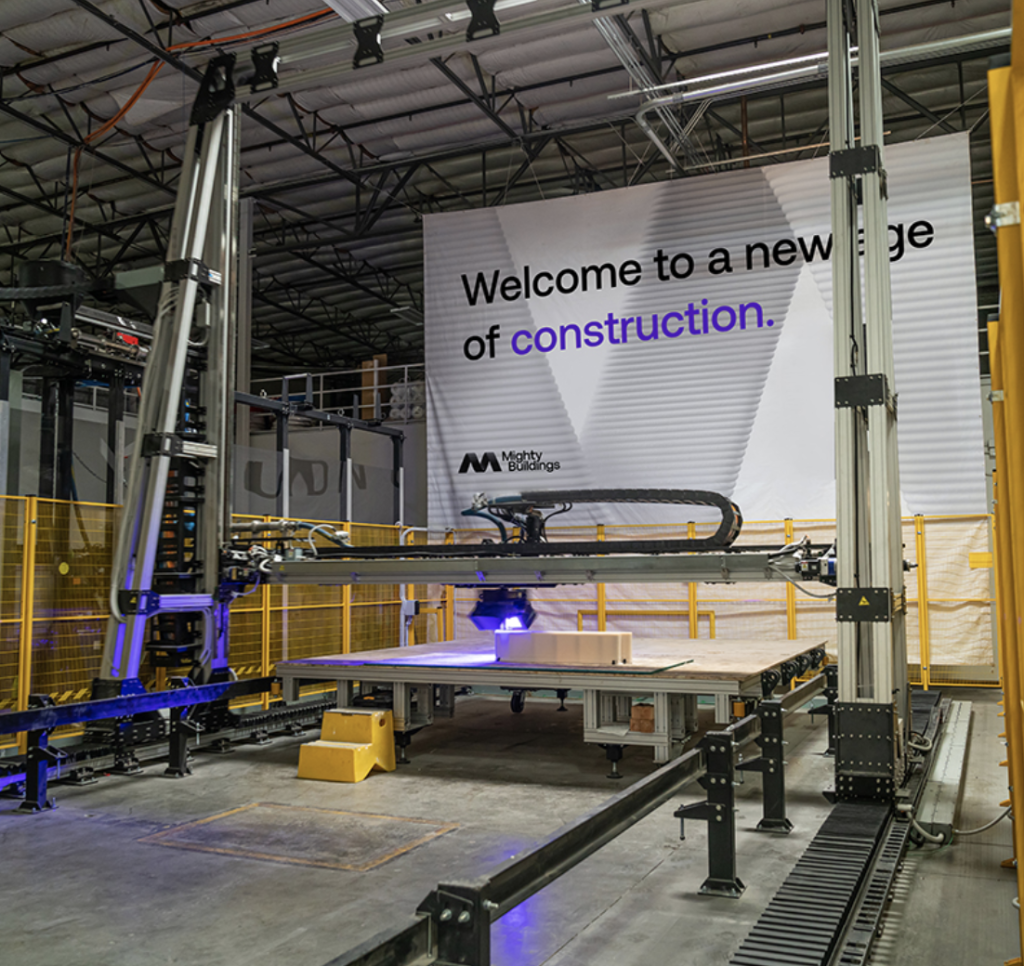
Perhaps the most innovative aspect of Mighty Buildings’ approach is their view on factory deployment. Rather than centralising all production in one location, they’ve developed a flexible model where new factories can be deployed based on demand density. As Alexey explained, “Our business model is not dependent on only one factory… In the moment we need hundreds of units, 500-plus units for two years and a half somewhere closer to New York or Illinois, it would make sense to deploy a factory closer.”
This hybrid approach to manufacturing allows them to maintain the benefits of offshore production while being ready to reshore when market conditions warrant it. The key metrics they consider include:
- Projected volume of buildings/panels
- Capital investment requirements
- Operating costs (including labor and utilities)
- Expected margins in the target market
The Future Balance
Looking ahead, the construction technology sector appears to be moving toward a more nuanced approach to global operations. The binary choice between offshoring and reshoring is giving way to a more sophisticated strategy that Mighty Buildings exemplifies.
This distributed approach allows companies to optimise for different factors in different locations:
- Innovation and R&D where talent is strongest
- Manufacturing where logistics and costs align
- Assembly and deployment close to end markets
The Human Factor
One often-overlooked aspect of this global strategy is its impact on talent attraction and retention. As Alexey observed, “Since the industry will adapt more robotics and automation, people will prefer to go into this industry. I mean, no one wants to go after education to go ‘hey, there’s a hammer, let’s go,’ right? But once you are in a field where you have robotics, automation… people will be interested to go into construction.”
This perspective suggests that the future of construction technology might not be about choosing between domestic and international operations, but rather about creating a global ecosystem that attracts talent and innovation from everywhere.
Practical Implications
For contech founders and executives, the key takeaway is that geography shouldn’t be viewed as a constraint but as a strategic variable. The goal isn’t to simply find the lowest-cost location for operations, but to create a distributed network that optimises for multiple factors: talent, costs, logistics, and market access.
The success of this approach requires careful attention to:
- Building strong communication systems across global teams
- Maintaining consistent quality standards across locations
- Creating clear processes for knowledge transfer
- Developing local partnerships in each region
As the industry continues to evolve, this flexible approach to global operations may become not just an advantage, but a necessity for success in the construction technology space.