The construction technology industry is no stranger to major acquisitions, but every so often, a deal comes along that feels like a foundational shift.
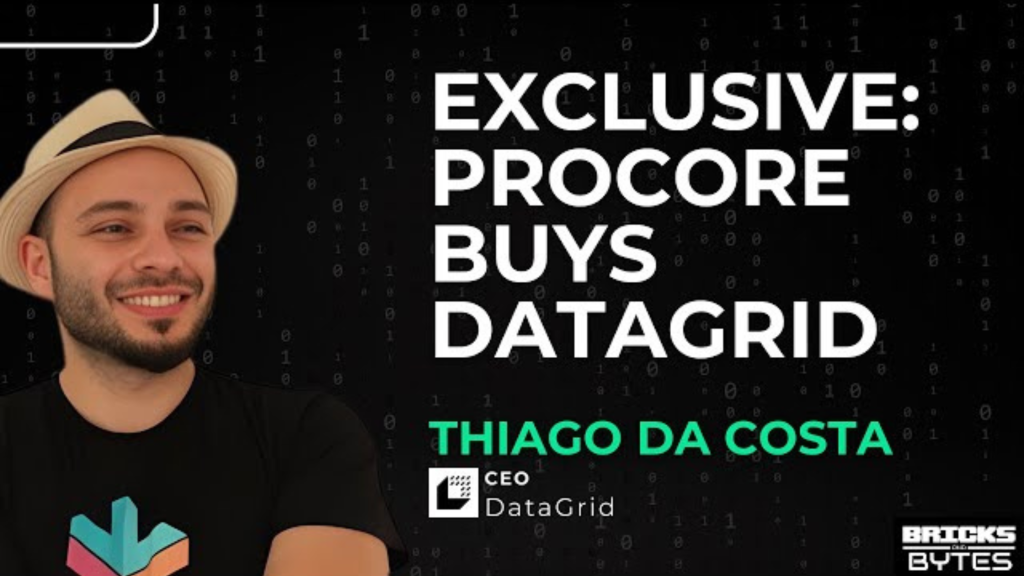
On October 15, 2025, Procore announced significant enhancements to Procore Assist and the launch of the Procore Agent Builder. Shortly after, the industry was hit with an announcement: Procore had officially acquired DataGrid.
In the first interview since the acquisition, DataGrid founder Thiago Da Costa sat down with Owen Drury to pull back the curtain on the deal. The conversation was a masterclass in growth, the reality of “agentic” AI, and a blunt warning for anyone building in the space today.
The “Why” Behind the Deal
For many, the acquisition felt like a sudden pivot. Only a year prior, Procore was discussing its internal plans to build out an AI stack and agent platform.
So, why buy now?
Thiago suggests the answer lies in the relentless velocity of AI. In the current landscape, companies no longer have the luxury of a three-to-four-year development cycle. “You have to be building and you have to be building really fast,” Thiago noted. For Procore, DataGrid represented an immediate acceleration of their vision.
In the year leading up to the acquisition, the company saw a staggering $600% growth rate. This explosive demand from the Procore customer base made the partnership a “win-win-win” for the customers, the company, and the acquirer.
The Reality of AI “Wrappers”
Thiago’s advice to other founders building in the AEC space. He was clear: the era of simply “wrapping” existing data or models with a simple interface is over.
“There is too much of that. Let’s figure out how do you really use AI to do something really important”.
He urged founders to move beyond basic ChatGPT wrappers and focus on true value creation -solving specific, difficult workflows that provide unique technology shifts. He pointed to examples like Novorender, which succeeded not just by being a “product,” but by building the fastest, most scalable BIM loader technology in the market.
A New Model for Intelligence
For the operators and construction professionals wondering how this affects their day-to-day, the change is as much about economics as it is about technology. Unlike traditional SaaS, which is often sold by “seats,” AI consumes resources through GPU usage and tokens.
DataGrid has successfully implemented a credit-based model that prioritizes transparency. This allows customers to pay for the “work” the AI completes rather than just access to the software. As DataGrid’s agentic capabilities are integrated into the core Procore platform, this usage-based approach will likely become the standard for how the industry consumes intelligence.
Is the Ecosystem Closing?
One of the biggest fears in any major acquisition is the “shadow” risk, the idea that a nimble, innovative startup will disappear into a corporate giant and stop playing well with others. Thiago was quick to dismiss these concerns.
DataGrid intends to remain a multi-platform system. The goal is to continue building an open ecosystem that connects deeply with other industry giants like Trimble, Autodesk, and Bentley. “We don’t do any good for the customers for closing ecosystems,” Thiago stated, emphasizing that customer mobility and data privacy remain top priorities.
The Road Ahead
The decision to sell wasn’t an easy one. Thiago admitted that they initially “rejected the idea entirely” before seeing the potential for scale that Procore provided. Ultimately, the move was about people and intent – finding a group that wanted to move fast and invest heavily in the future of agentic AI.
For the construction industry, this acquisition signals that AI has moved past the “hype” phase and into the “execution” phase. As Thiago puts it, “It takes an army to build this type of solution”. With this deal, that army just got a lot bigger.