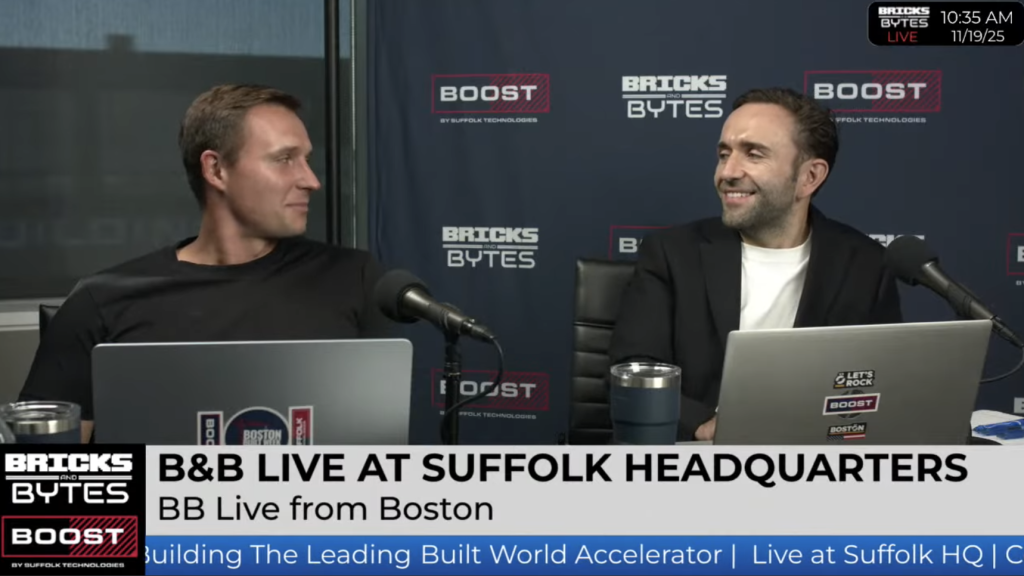
Boston in November isn’t exactly tropical, but that didn’t stop the Bricks & Bytes team from broadcasting live from Suffolk Construction’s headquarters for one of the industry’s most anticipated events. We set up shop at BOOST Demo Day 2025, bringing viewers an unfiltered look at the eighth cohort of startups transforming construction—from AI-powered design tools to robots working 60 feet in the air.
The vibe? Equal parts scrappy startup energy and big industry muscle. Suffolk Technologies has been running BOOST for six years now, and the program has evolved from a nice-to-have accelerator into something resembling construction tech’s farm system. With 38 graduates who’ve collectively raised $720 million, Parker Mundt, Partner at Suffolk Technologies and head of BOOST, wasn’t shy about the program’s ambitions: go international, keep growing, and prove that construction innovation doesn’t have to be a slow burn.
The Hardware Renaissance
One theme dominated the conversations: robotics is having a moment. Parker dropped a stat that turned heads: robotics applications tripled this year compared to previous cohorts. The reason? Founders are getting scared of software. With horizontal AI players eating everyone’s lunch and $200,000 suddenly being enough to get working robots in the field (impossible just five years ago), hardware suddenly looks a lot more defensible.
Gabe Rodriguez from Puppet Robotics embodied this shift perfectly. The ex-Cruise engineer left self-driving cars behind after a metal stud framing tour in Indiana, where he watched workers 60 feet up breathing diesel fumes. His solution? Modular robots with swappable tools that let tradespeople work from ground level. “Robotics doesn’t have to be fully autonomous,” he explained. “It can augment workers, letting them be in multiple places at once.” No humanoids required.
The Materials Innovation Struggle
Teresa Liu and Sharon Tracy from Ouros Materials brought a different kind of heat—literally. Their ceramic polymer composite materials are three times stronger than concrete, fire-resistant, and carbon-storing. The catch? Getting anyone to be the guinea pig for new building materials when people’s lives are at stake.
Sharon, who has a ceramic engineering background, put it bluntly: “People don’t want to be the guinea pig, and there’s so much at stake in a building.” Their strategy? Start small with exterior panels and siding, prove it works, then license the technology to major manufacturers rather than trying to compete directly. Smart move for a space where 50-100 years of understanding isn’t just preferred. It’s mandatory.
The Software Platform Play
Not everyone was ditching software, though. Yashar Moradi from MOD made a compelling case for why prefabrication needs a platform, not more point solutions. The civil engineer turned software developer built an AI that scans designs and matches them to the world’s largest prefab supplier library—and made the whole thing open source. Why? “We want everybody to speak the same language. We don’t want to create another silo.”
Since launching go-to-market in January, MOD has already secured $2 billion in project volume across Germany, Switzerland, and now the U.S. Yashar’s hot take? We should’ve stopped laying bricks one at a time decades ago.
The Big Picture
Behind all the startup pitches, Jit Kee, Suffolk’s CTO and co-founder of Suffolk Technologies, painted the real vision. The future isn’t just about better software or smarter robots. It’s about organizations that are half humans, half AI agents, working together in ways we’re only beginning to understand. “We have to define those interfaces and workflows that maximize the potential of both,” he said. Timeline? Maybe three years.
David Hindley from Autodesk, who’s been doing M&A deals since 2003, had advice for founders: “Be successful on your own, control your destiny, be cashflow breakeven.” Translation? Don’t wait around hoping to get acquired. Growth hides a lot of problems, but independence is the ultimate negotiating position.
The Dunkin’ Donuts Debate
The unofficial controversy of the day? Whether Dunkin’ Donuts coffee is actually good or just legally addictive. The European contingent remained unconvinced, despite multiple attempts at conversion.
As demo day wrapped up, one thing was clear: construction tech isn’t waiting for permission anymore. The startups are scrappier, the capital is flowing, and the industry (surprisingly) is more receptive than anyone expected. Not bad for a sector that still runs 80-story builds on Excel spreadsheets.